As of today the “Sears” Tower is officially the “Willis” Tower. Much grumbling about the name change, but the truth is that Sears hasn’t had anything to do with the building since they sold it in the early 90s. Plenty of downtown buildings have kept their old name after being sold, or after the company in them has long since departed (Inland Steel, for instance, doesn’t even exist as a company anymore). Aon Center didn’t seem to bother anyone–not a lot of love lost for Amoco (or Standard Oil, for that matter). But for some the name sticks, no matter what. Asking for the “Railway Exchange” will still get you to the Santa Fe Building, and the same goes for “Marshall Fields” which is now “Macy’s.” After thirty-five years, “Sears” will probably stick. I just hope the new name gets rendered in serious 70s Helvetica on the sign like the old name.
Day: July 16, 2009
What might have been–the Tribune Tower and height limits
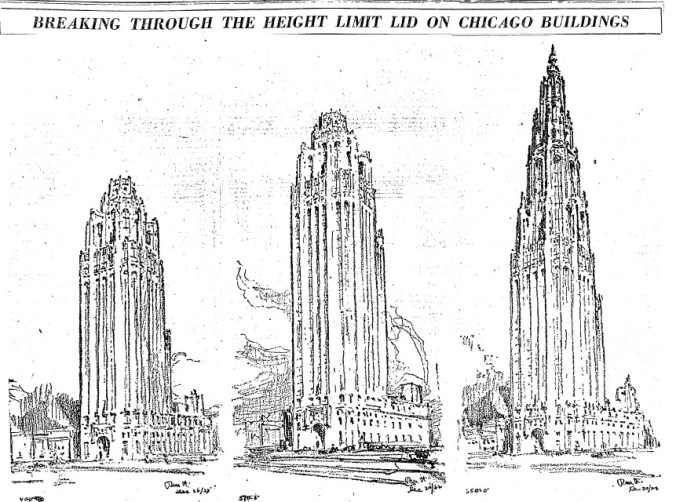
Three versions of the Tribune Tower
The Tribune Tower was designed and built between 1922 and 1924, during a period that saw intense debate about height limits. The old limit of 260 feet had been gradually eroded by a loophole allowing spires and towers to rise higher, to 400 feet, and the successful appeal of a downtown Methodist church to build what is now called the Chicago Temple, rising to 555 feet, led many to suggest that the limit be abolished entirely. While buildings of the 1920s ended up being subject to a complex formula of setbacks and volumetric calculations, for a brief few months it seemed possible that the Tribune, among others, would be free to build as high as they liked.
The Tribune, which publicized its new headquarters regularly, asked New York architects Hood + Howells, winners of their international competition, to suggest ways in which their neo-gothic design could be enlarged, and they responded with the sketches shown above (from James O’Donnell Bennett, “M-E Building Opens New Era of Skyscrapers,” Chicago Daily Tribune, Dec. 22, 1922). The original scheme is on the right, with its spire matching the 400 foot limit; in the center is a scheme that rose to 570 feet, and on the right is a 650′ version. In the end, economics as well as code limited the tower to 462 feet, but Michigan Avenue would look somewhat different today if thing had worked out otherwise.
 architecturefarm