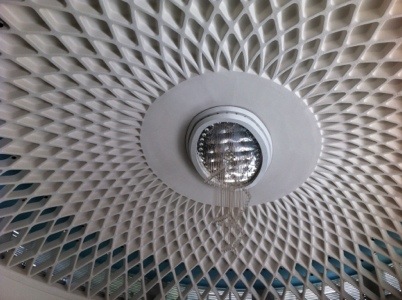
Sala Nervi, Terme di Chianciano

20120615-172434.jpg

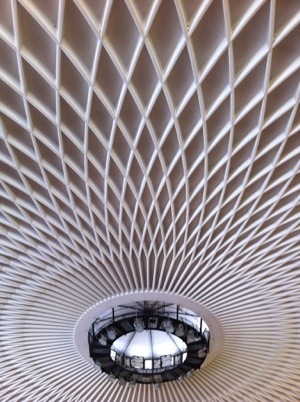
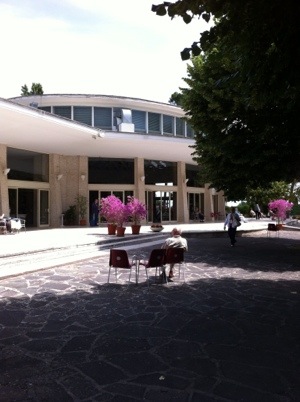
Nervi was commissioned to design the ceiling of a ballroom at the Acqua Santa mineral spa in 1952. It was the third of his ceilings to feature a construction technique of diamond ferrocemento pans, each with the same shape, but in concentric rings of different sizes. The result, apparently unintentional, was a series of interlocking logarithmic spirals, a visual effect that gained a great deal of attention. (I’ve written about the geometry of these roofs here). The two previous iterations of this technique came at the Turin Exposition Hall B (1947) and the Kurssal at Ostia (1950). At Chianciano, my guess is that Nervi had a client who knew what he wanted, but didn’t want much else. Nervi had nothing to do with the rest of the building:
20120615-174318.jpg

Which is certainly not bad as a piece of postwar international style modernism, but also isn’t exactly structurally expressive–or legible.

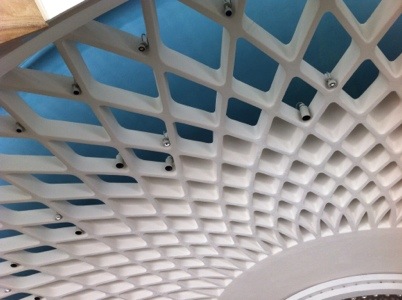
The ceiling is stunning, though, and from what I can tell it has a far higher level of finish and detail than the earlier two instances, an example of Nervi learning from doing a similar thing over and over again. The Palazetto dello Sport came a few years later, and obviously learned a great deal from this project, too. One thing that is unique about this instance, and that shows up a little bit in the eyebrows of the Palazetto, is that the roof itself peels up from the concrete net toward the edges, letting in light around the perimeter of the ceiling and making the structure seem particularly lacy:
20120615-174845.jpg

It’s in remarkably good shape, and still used as a ballroom–a number of elderly couples were ballroom dancing to lounge music in it when I snuck in. The vibe at the spa–which was also the setting for Fellini’s great film 8-1/2, was decidedly in the ballroom dance mode. The managing director gave me a tour, and pointed out that the room’s acoustics are lamentable–a predictable shortcoming in an elliptical room with travertine wall paneling. I’m going to guess that Nervi had little to do with either the shape or the finishes–the former looks like it came out of a larger response to a master plan for the park, and the latter, well, let’s just say there was probably a reason Nervi’s office always published carefully cropped photos of the ceiling alone. Sort of “from the waist up.”

It was a good day trip, too. The ‘Sala Nervi’ itself probably isn’t enough to draw architectural tourists from Rome or Florence–it’s about halfway between the two–but as requested by my gracious host, I will point out that the Spa’s waters have a reputation for curing all sorts of digestive ailments. And the taxi ride from Chiusi, the nearest train station, is 20 minutes of dramatic scenery and death-defying curves that are, in the local style, taken in both lanes at once.
Lanificio Gatti, episode I

20120613-212745.jpg

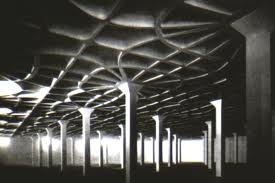
One of the most iconic images of Nervi’s work is the underside of the floor slab at the Gatti Wool Factory. Nervi laid out it’s concrete ribs along isostatic lines, which put the greatest bending resistance at the point of maximum moment while visually expressing the flow of forces through the slab and toward the column.

It’s a great moment in his work, and the picture graces all kinds of history textbooks. But it’s the only image I had ever seen of the factory. And none of my Nervi contacts in the U.S. or Italy knew where it was, or even whether it was still extant.

So this one involved a bit of detective work. There were references online to a commercial redevelopment in the 1990s, and one news article that described it being on the Via Prenestina. That was some help, but that’s a long, long street, one that follows an old Roman road way out into the world. The Nervi Archives had interior images of an upper floor–the space above the slab—which was covered by what were obviously north-facing skylights in a pretty standard (though of course elegantly detailed) configuration. Still, no exterior shots, or plans.

I was able to find just a handful of structures on Google Earth that fit what the interior pictures showed, and I guessed that it was a building that was listed as now being a shopping center. That fit the news item I’d seen, so I hitched a ride (with someone who, for reasons that will soon be apparent, probably doesn’t want to be associated with this whole escapade) and we drove out to see it. It wasn’t promising, and it looked a little late for the Gatti’s 1953 date. And, it was chinos. Big fence, and a gate that wasn’t just locked. It was welded shut.

I am firmly of the opinion that seeing a building that the owner wants you to see is tourism. For it to count as research, you probably need to jump at least a fence or two. Which I did, and I got just to the front door before two security guards–one of them wielding a knife–caught up with me. They had keys, which looked promising, until even my rusty Italian figured out that their very generous offer was not to let me in the building, but rather to let me out the front gate so I wouldn’t have to vault the fence back again. My colleague used some far better Italian to explain what I was up to, and after apologizing for the knife (they were eating lunch, it was a cheese knife, but it still would have hurt) they let me take a peek. And once inside it was obvious that I had the wrong building anyway.

I didn’t jump any more fences, but I did spend an hour or so walking around a pretty gritty industrial part of the town. And just as I was giving up and waiting for the bus back to the centre, I saw one last alley. And I hoofed down it about a quarter mile, and:

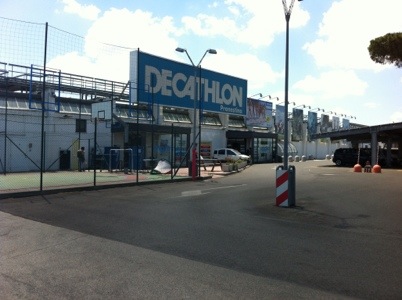
20120613-214430.jpg

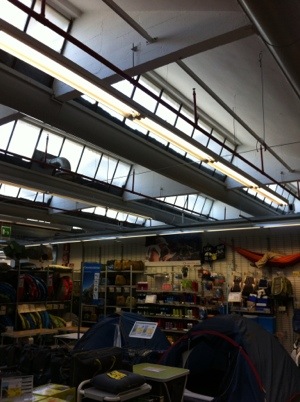
North-facing skylights, 1950s concrete, exposed end girders. And, best of all, it’s a sporting goods store, so no fence to jump.

20120613-214614.jpg

So this is the top level, and it’s a pretty bog-standard concrete factory roof with light monitors–not terribly impressive even if you mentally take out the tents and the running shoes. But it is immaculately detailed, and there was clearly some attention paid to making the ceiling read as a continuous, hovering plane of light. Simple, but thoughtful.

One of the staff confirmed that it was the old Gatti factory after I showed him the classic picture. And where are the stairs down to the storage room? The one with the great ceiling? Ah. The store only rents the upper floor. Downstairs? The auto dealership next door uses it to store their luxury cars.

Big fence on the ramp. Padlocked doors. And the dealership had closed for the afternoon. So I have a call into them with a rather unusual request, and we’ll see if there’s an episode II of this one next week. I’ve jumped enough fences for one day, and I suspect that the dude guarding the Lancias has more than a cheese knife in his arsenal.

Palazzine in via Cortina d’Ampezzo

20120611-174730.jpg

Here’s a Nervi project that didn’t make any of the books…

A few years ago I came into a copy of the Nervi office brochure from about 1973. It was pretty clearly designed to woo potential clients, and it had a variety of projects that were industrial, commercial, or institutional. Just one sports stadium, and it was a late one in Novara–none of the Rome Olympic work. Water towers, factories, a bank in Venice, and two that seemed particularly interesting for completely opposite reasons.

One was a highway-straddling rest stop outside of Padua that probably won’t get documented this year— giant double cantilevered concrete tube over the traffic lanes with the restaurant inside. Bombastic, auto-scale, super-tour de force kind of stuff,

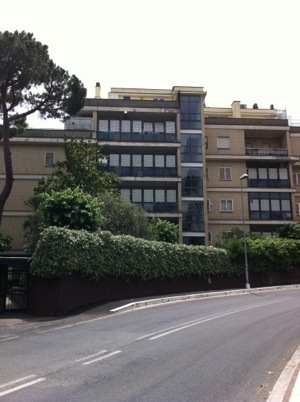
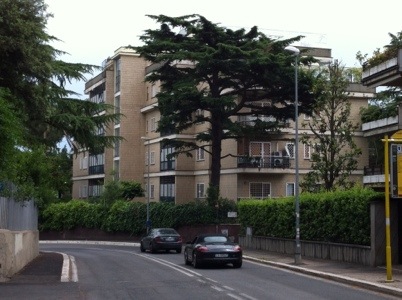
And then there was this eons–a small apartment block in a Roman suburb. The two Gage’s n the brochure had almost no text–just a short description saying it had been built for a speculative developer and built with an unnamed residential design specialist. No fancy structural gymnastics’ just a fairly ordinary (if pretty refined) take on the standard suburban Italian four-story free-standing flat building.

I’m not sure there’s a good story here, though certainly the flat slab construction is as efficient as can be. It’s certainly well detailed, but it’s almost shockingly modest. Nervi designed it in conjunction with his architect brother, Antonio, and it was built in 1963-64. I don’t know of any other housing that the office did, though given the lack of attention Nervi gave this project, it’s possible that this was a (probably lucrative) sideline.

Totally unknown Nervi project? I had to find it. Cortina d’Ampezzo is a long road in the hills north of the city, lined with apartment blocks that are almost all the same scale and mass. There is, fortunately, a bus from Piazza Mancini, but the road itself goes on…and on. It took me two tries, and some divination from Google Earth, but I found it, at the corner of a small side street called Via Valdieri. It’s in good shape, though it’s occupants have understandably personalized it a bit. Worth the trip? Maybe. It has some nice moments–super shallow slab balconies and a well-detailed ceramic tile exterior. Definitely not threatening anything else in the canon, but an interesting bit of very normal residential design that shows the Nervi office was capable of fairly simple things as well. I suspect that’s the main reason it ended up in the office catalogue: you can imagine a client being reassured by something they recognized, and that looked in-budget…

20120611-180326.jpg

Corso Francia

20120610-161043.jpg

Running behind the 1960 Olympic sites is a fairly modest highway overpass that connects the Via Flaminia to arterial roads north and east. It was part of the planning for the Games, and also part of Nervi’s commission. While it’s hardly as eye-catching as the Palazetto, it’s worth a look on its own.

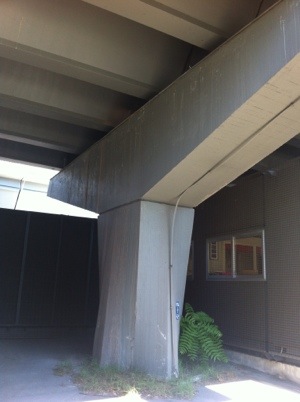
The supports are made of in situ concrete. They’re wide at the base, and narrow at the top, as you’d expect in a viaduct that required some ductility. But it’s how they’re that shape that’s impressive. A constant theme in Nervi’s later work involves concrete supports that change section gradually along their length, in this case a very subtle transition from a broad diamond shape at their base to a square at the top. The resulting form is easy to define with a series of straight ruling lines–connect the corners of the top shape with the midpoints of the base, midpoints of the top to corners of the base, then divide the resulting line segments into equal parts, connect those with straight lines, and you have a series of curves surfaces defined by straight lines.

These shapes were useful to Nervi because they allowed rotational freedom in one direction at the top, and in the opposite direction at the bottom. Here, I suspect they were designed to allow the overpass deck to rotate slightly under differential loading while maintaining a robust, fixed connection to the foundations (happy to be corrected by the commentariat, here…)

Building for work to make these shapes, of course, was something of a trick. But looking closely at the concrete itself provides a clue:

20120610-161925.jpg

What you’re seeing there are the impressions left by nail heads sticking out of board-formed concrete–a leftover that would have been eliminated by higher standards in more architectural concrete. Here, in a highway overpass, they were apparently acceptable. Each support has three or four of these lines of nail heads, and I think these show that the form work consisted of narrow, thin boards, each of which was slightly twisted between nailing strips to achieve the gently curving surface. The edges of the boards, being straight, followed the ruling lines of the geometric shape, and the nailers were designed to force each board into a very slight twist, one that made up the difference between one ruling line and the next.

To me, this is a perfect example of Nervi’s clever form work detailing–he was consistently able to achieve stunningly complex forms with relatively crude methods. This was in part due to his insistence on maintaining a full concrete laboratory and yard on the outskirts of Rome, where he and his office could experiment with techniques and materials before they went on site. In this case, it would have been important to get the thicknesses of the boards exactly right, for instance–too thin and the hydrostatic pressure of the concrete would have warped the boards between nailers, too thick and the boards would have been too difficult to twist,

There are other, more impressive examples of these sectionally-transforming supports–the Palazzo dello Sport in Rome, also done for the Olympics, and the Palazzo del Lavoro in Turin, done about the same time, have quite different takes on the idea. I have tentative appointments to see both in the next couple of weeks, and. I’m curious to see whether the tell-the-tale nailer details are evident or not…

Stadio Flaminio

20120608-174353.jpg

The low-hanging fruit on the Nervi reconnaissance are the Olympic sites from 1960. The small arena (the Palazetto Della Sport), the Corsa Francia overpass, and the Stadio Flaminio are all within a stone’s throw of one another along the Via Flaminia, north of the city center.

All of them are more or less accessible–you can drive on the Corso, of course, but as an American tourist you’re more likely to walk under it to get to Renzo Piano’s concert halls. The Palazetto is home to Rome’s professional basketball team (yep, you read that correctly) but it’s also more or less wide open during the daytime, and I wasn’t the only architectural sightseer there yesterday.

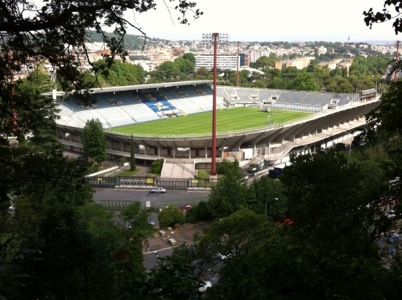
Stadio Flaminio is less accessible, and a somewhat sadder tale. Designed as a setting for the field sports in 1960, it was intentionally intimate, with only 32,000 seats spread out along the entire perimeter. Nervi designed a main grandstand with a cantilevered roof that echoed his first major work, the football grounds in Florence, but with a more refined sense of materials and structural form–at the Flaminio, the roof’s long span is formed of folded precast plates, and supported by steel pipes instead of concrete arms. The remainder of the stadium is brilliantly engineered with a repeating structural frame whose shape changes at every interval to accommodate the constantly shifting section. This let Nervi tune the end zones and secondary grandstand to provide more seats in better viewing areas, and the result is a subtly curving, sensuous form that.

Unfortunately, it’s intimate scale has done it no favors recently. For a decade it served as the home for Italy’s national Rugby team, but plans to hold international championships there more recently fell apart as funding for renovation and expansion never materialized. Italy’s team now plays in the larger–though far less graceful–Stadio Olimpico across the Tiber, and even Rome’s local team has abandoned Nervi’s structure.

20120608-175910.jpg

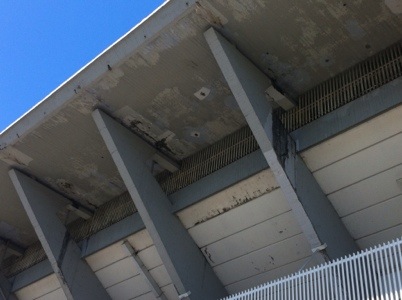
And the structure has suffered from this desertion. There’s a lot of visible spalling, and plants have begun to take root in the concrete–early signs of gravely compromised material. There was a grounds crew working on the immaculately trimmed field, but there is a lot of work that needs to be done to rescue this one. Part of the goal with this research is to call attention to the disintegrating works of Nervi that are perhaps a bit more obscure–water towers, warehouses and the like that belie their humble functions with poetic expressions of static and constructive logic. Stadio Flaminio, however, is arguably one of his most visible works, and it’s more than slightly shocking to see it in obvious distress.

Rome for more than a day

20120607-174414.jpg

With the Chicago book now mostly in the publisher’s hands (and semi-officially due out in May, 2013–watch this space for further details), I’m shifting my focus a bit, at least for a little while. Skyscrapers are and endless source of questions and possible investigations, but given that I’ve been working on their history for nine years, now, I’ve decided I’m entitled to spend some research travel funds somewhere other than Chicago. Or Kokomo.

Rome will do, thanks. I taught here in Iowa State’s study abroad program in 2008, and among other things I sort of re-discovered Nervi. The Palazetto Della Sport (above), which he designed for the 1960 Olympics, formed the lynch pin of one of my first academic papers, and I’m constantly surprised by how often I end up using his buildings in class to illustrate one structural principle or another.

I’ve been meaning to get back to his work ever since, and this month I’m doing some basic reconnaissance to see what structures of his are still in use, what sort of shape they’re in, etc., and to get into the Nervi archives at MAXXI. I know some of the news won’t be good–the Olympic buildings themselves are in dubious shape, and I gather that some of his more interesting industrial work has disappeared. All the more reason to document them and, maybe, to put together some essays and analytical work to draw attention to a body of work that’s remarkably consistent yet also probing and full of surprises.

And there are skyscrapers too. The Pirelli Tower in Milan is his, in addition to Sydney’s Australia Square and Montreal’s Place Victoria. Milan will be as far as I get this trip, though.

So expect a bit more concrete and a lot less steel over the next few weeks…

elevATE omaha

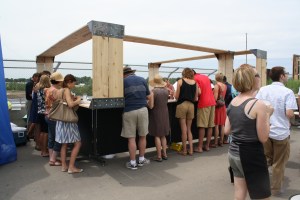
The last few weeks have been busy–with this.  Emerging Terrain, a non-profit in Omaha dedicated to increasing awareness of land and food issues, sponsored a huge food festival this weekend featuring local chefs and designers collaborating on 30-minute meals in bespoke “elevation stations.”  The festival was held on a freeway bridge that looks out on a set of disused grain elevators, which have been a canvas for Emerging Terrain-commissioned banners designed to attract attention from passing motorists and to raise questions about the region’s relationship to its land and its main industry.

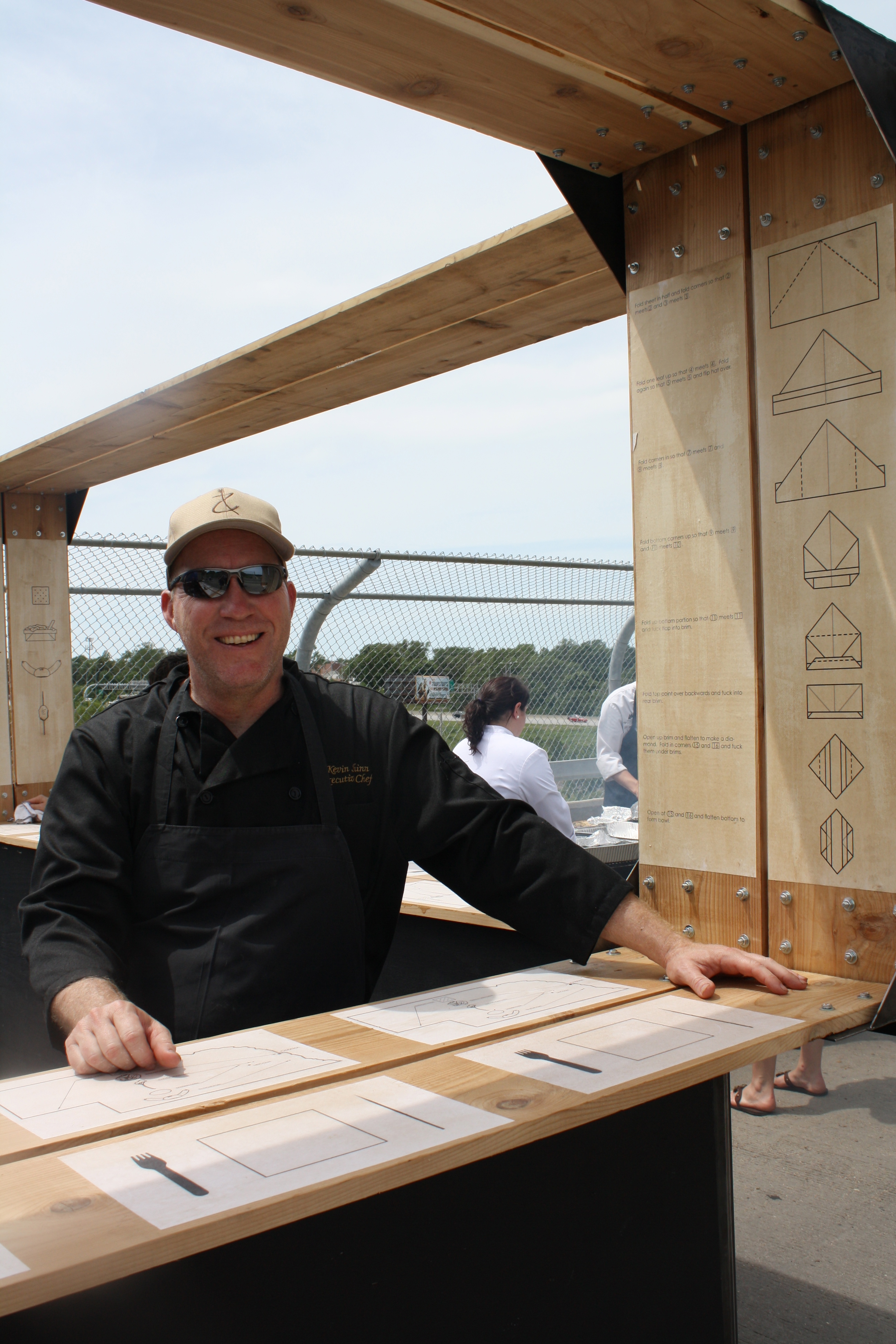
Rudolphi|Leslie were paired up with Kevin and Karen Shinn, who co-own a brilliant bakery and restaurant called bread&cup in Lincoln.  We’ve been working with them since January to design and fabricate a portable stand that can host 25 diners while giving their team opportunities to carry on a conversation about their menu, their sources, and their philosophy.  This, for us, was a perfect match.  bread&cup’s menu is deceptively straightforward–their motto is “simple food and drink,”–but the ingredients and preparation are thoughtful, finely crafted, and–of course–locally based.  bread&cup is an unpretentious, comfortable, and practically detailed environment that gets the job done in an elegant way.  We wanted their station to do the same.

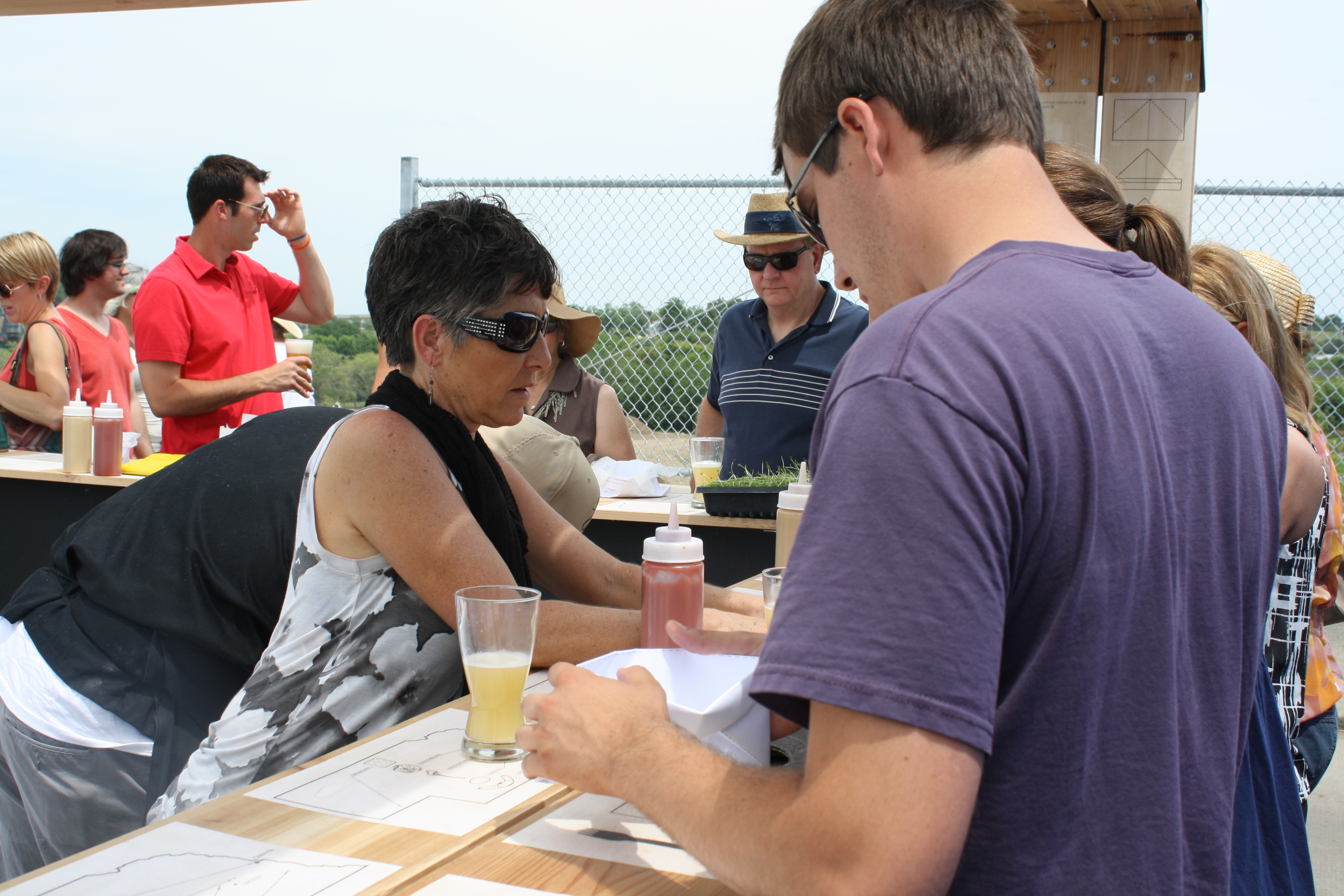
The main idea was to create a set of boxes that would literally frame the conversations that Kevin and Karen had with local foodies.  Our budget was, to say the least, unpretentious, and we found we were able to do it with rejected cedar boards from a local hardware store and some simply fabricated steel done by a local welder here in Ames.  These all broke down to fit on a small truck, and we were able to put the thing together in an afternoon.  The inside surfaces of the boards have information about the menu and instructions for folding an origami salad bowl that served as the setting for the first course.  This gave Kevin and Karen a way to start the discussion, by handing diners an unfolded sheet and showing them how to get started.

The bowls were a hit, and the entire festival was a blast–lots of good food and a nice crop of mostly young designers who we bonded with over two days of assembly and demolition.  Many thanks to the Shinns for letting us in on their operation and their philosophy, and special thanks to Kris and James at thinktankstudio for helping with the teardown and for dinner at Omaha’s lot2, another gem of a local dining spot.  This was a fantastic weekend all around…