aarome

Image

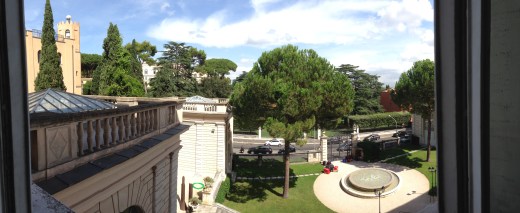
Just a bit hard to wrap my head around this, but that’s the view out of my studio for the next six months–the forecourt of McKim, Mead, and White’s American Academy building up on top of the Janiculum Hill.  Most of my class of fellows arrived today, so it is a building full of jet-lagged, barely unpacked folks who are, nevertheless, ecstatic at the prospect of working here.  So far my major achievement has been walking down to the Ghetto, where ISU’s studio is located, for an espresso at Bar Toto, a first-day ritual that has the added benefit of serious caffeine.

We have a couple of days to get settled in, then a pretty intensive first couple of weeks–Italian lessons (always welcome), presentations by all of us so that we know who’s doing what, and Friday morning walks that will get us down the hill and out into the world.  Super happy to be here, and looking forward to getting Nervi stuff underway soon…

partenza per roma

Airside, waiting for Aer Lingus to get me to Rome via Dublin after a good weekend in Chicago.  A big day, for sure.  None of this would be happening without a small army of friends, family, colleagues, etc., who are chipping in back at Iowa State, in Ames, and in Chicago to take care of various things for the next few months, and I couldn’t be more grateful.  All of you have a Campari and soda waiting for you if you make it over, or once I return, and I will do my best to get back stateside next summer with a decent stab at a Nervi manuscript.  

I’ll keep architecturefarm rolling, though it will–obviously–change focus a bit, to Nervi details and our Friday walks through various, usually off-limits, pieces of Rome.

Thanks again to all, and arrivaderci…

5icch planning

20130906-173931.jpg
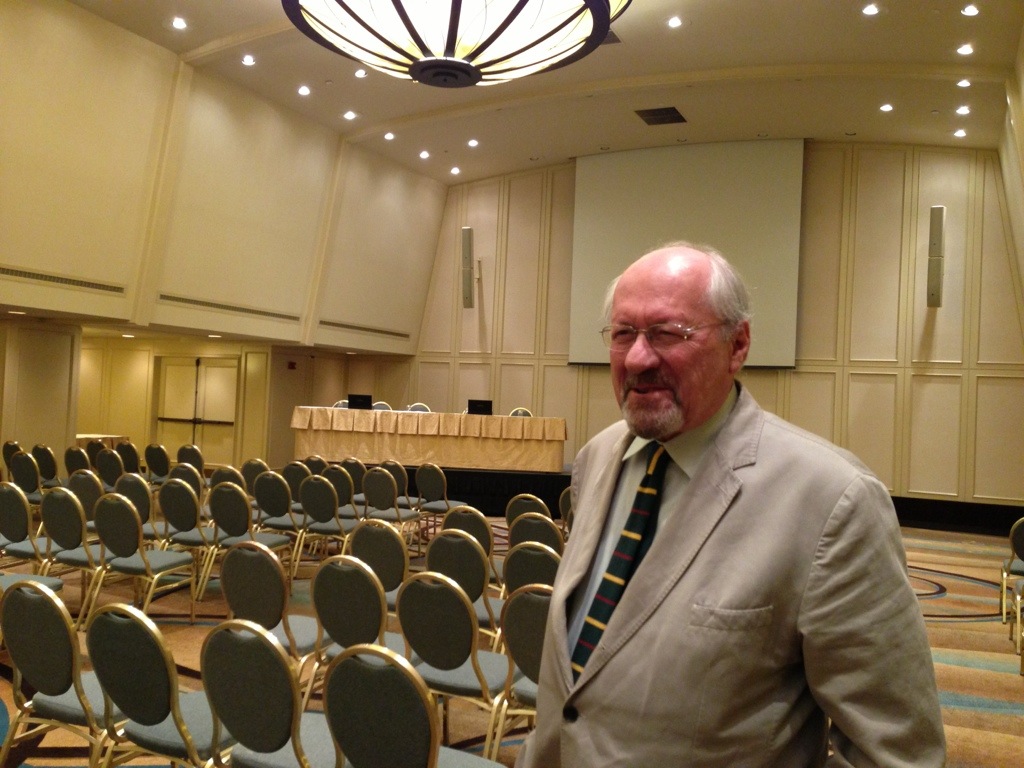
That’s the Construction History Society’s fearless leader, Brian Bowen, checking out the Adams Room at the Palmer House, where the 2015 Congress will be held. We’re both in town for the semi-regular meeting of the local organizing committee, and spent the morning going over the Palmer House with a fine toothcomb. Suffice it to say that, in addition to being the oldest continually operated hotel in America. our host venue may be the only hotel on the planet with its own in-house historian. A suitable venue, to say the least…

new naab conditions…

…and something’s missing!  ACSA sent out a draft of the proposed new accreditation criteria today, and Comprehensive Design has been replaced by a whole new realm called “Integrated Architectural Solutions,” which stipulates that students must show…

Ability to produce an architectural solution that demonstrates the ability to make design decisions about a single project while demonstrating broad integration and consideration of environmental stewardship, technical documentation, accessibility, site conditions, life safety, environmental systems, structural systems, and building envelope systems and assemblies.

This replaces the old criteria of “Comprehensive Design,” which called for:

Ability to produce a comprehensive architectural project that demonstrates each student’s capacity to make design decisions across scales while integrating the following SPC:

A.2. Design Thinking Skills

A.4. Technical Documentation

A.5. Investigative Skills

A.8. Ordering Systems

A.9. Historical Traditions and Global Culture

B.2. Accessibility
B.3. Sustainability
B.4. Site Design
B.5. Life Safety
B.8. Environmental Systems

B.9. Structural Systems

That’s quite a change, and for those of us who have struggled to get Comprehensive through accreditation visits in the last twelve years, I think it’s a call for celebration, because it means the focus of the capstone studio can now be on design and not on ticking off boxes like a code official.  Not that we did, anyway, but explaining how we went about what we’ve always called “Integrated” design at ISU never quite fit what accreditors were looking for in “Comprehensive” design.  Our argument has always been that no school project is ever “Comprehensive,” since students don’t have consultants, and also don’t have to build the damned thing.  The new criteria seem much more humane, more pedagogically useful, and a step away from the vocational emphasis that the NAAB criteria had been sliding toward.  Hope this continues through the next round of drafts and comments.

george schipporeit

Image

Sad news this week that George Schipporeit, key figure in postwar Chicago architecture, co-designer of Lake Point Tower, and long-time IIT professor, died this week at the age of 80.

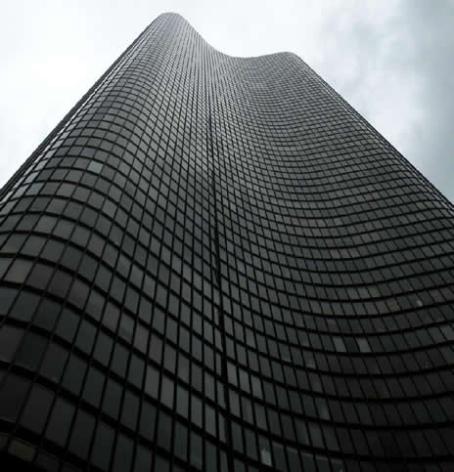
If it were only Lake Point Tower that he was known for, that would be enough; the residential tower at the foot of Navy Pier has become one of the best-known images of the city’s lakefront, and it’s one of the era’s most elegant towers, translating the Miesian ideal of the Glass Skyscraper into a curving, graceful curtain wall that also proved to be a wildly successful piece of real estate, too.

Schipporeit came to Chicago in 1955 after a childhood in Nebraska, an undergraduate degree from Purdue, and military service in Manhattan, Kansas.  He told me once that he had spent his time in Kansas scouring the nearby architecture library, and that he decided to enroll in IIT because “that was where it was all happening.”  With a young family, he eventually left IIT and worked in Mies’ office, particularly on residential projects.  While based in in New York working on the Newark high rises, he met and impressed attorney Bill Hartnett, who was working with Alcoa to develop residential projects.  When the Lake Point site came up, Hartnett offered Schipporeit and another Mies/IIT alum, John Heinrich, the job after rejecting a disappointing proposal by Perkins and Will.   Schipporeit remembered that the site was “the best site in the country,” and he and Heinrich poured the next seven years into its design and construction, beginning around Schipporeit’s family dining table.  Heinrich thought that the project was the “biggest gamble in the world,” but that the two of them had a chance to do something spectacular.  Schipporeit was 29 years old.  He took the licensing exam while doing the 70-story tower’s working drawings.

The resulting tower was a state-of-the-art flat plate structure, taller and more efficient than any apartment tower in the city and absolutely iconic on the lakefront.  The shape bore a resemblance to one of Mies’ 1922 projects for a glass skyscraper, but it’s Y-shaped form came from a programmatic decision to reduce an original cross-shaped plan by 25%, and its curving glass walls were designed to avoid entirely difficult corner details; in the process they provided panoramic views from every major interior space.  IIT landscape architecture professor Alfred Caldwell designed a rooftop garden atop the building’s large parking podium.  The construction took four years and was documented in this film.

The result has always been one of the most popular residential addresses in the city–Chicago’s A-list residents, from Ryne Sandberg to David Axelrod, have owned units in it. And it remains Schipporeit’s best-known work, though his subtly minimalist IBM Self Park just north of the River has inspired paeans from many.  Schipporeit’s greatest legacy, though, will undoubtedly be the years’ of students he taught at IIT, a program that he also led in the 1980s.

I was very lucky to run across George on a number of occasions.  The first, which he later had to remind me about, came during my brief stint as a substitute studio critic at IIT in the early 1990s.  George spotted me after class and offered a ride–and a long introductory conversation about practice and teaching and how the two could inform one another.  More recently, I was re-introduced to him through the Chicago Council on High Rise Buildings, and he very generously agreed to a long, multi-part interview about Mies’ office, IIT during the 1950s and 1960s, Lake Point Tower, and Chicago architecture today.  He was still teaching studio, though his interests had grown into city planning and development in emerging economies.  His students adored him, and rightly so.  He was a constant voice for doing things well, for being thoughtful, and for taking whatever the latest trend was with a heavy grain of salt.  I’ve been listening to that interview this weekend, grateful for his generosity, his sharp recall of the Chicago scene in the 1950s and 1960s, and the genuine love of teaching and architecture that radiated from him.  I’m glad he got to see the first skyscraper project in print; his work and thoughts will be a big part of the next one.