rogelio salmona

One of the great joys of traveling and lecturing about building is discovering new heroes. Bogota has been a great crash course in local and regional traditions, and a whole city of case studies in how a global city has balanced those with international ideas.

IMG_1883

The students and faculty who showed us around painted a pretty clear picture of postwar architecture in Colombia. Keen to show itself as a global city, Bogota’s architects adopted International Style modernism in several forms—glass curtain walls, a standard-issue 1950s SOM tower for the Banco de Bogota, and a whole slew of Corbusian concrete buildings with purely decorative brise-soleil (the city is equatorial, and the “sun breaker” for any building is really the roof—not much more is needed). Corbusier came here in 1947, beginning a decade-long relationship that resulted in a master plan that was never executed. But that relationship led to four Colombian architects working in Corbusier’s office, including the Paris-born Rogelio Salmona, whose family moved here while he was young. Educated at the National University, Salmona followed Corbusier back to Paris, where he worked for about ten years.
IMG_1775

Salmona absorbed much from Corbusier, but he also looked around at other influences—historic Islamic architecture in Spain, but also very obviously to the north, and to Alvar Aalto. When he returned to finish his degree at the Universidad de los Andes in the early 1960s, he carried home with him a rich synthesis of ideas and attitudes that were condensed into his first major project, the Torres del Parque, a set of Aalto-inspired towers that wrap around Bogota’s historic bull ring and its early 20th century Planetarium while offering public staircases and plazas that extend a city park up one of the downtown area’s hills. We got to see it inside and out thanks to an accommodating faculty member and resident, and the scale of the towers and outdoor spaces together was brilliant. Salmona was obsessive about the long tradition of Colombian brickwork and about the newer utility of reinforced concrete, and he managed to draw out the textures and colors (the country’s brickwork is characteristically a distinct pale orange) in ways that make the entire complex feel like a series of intimate residential spaces.
IMG_1904

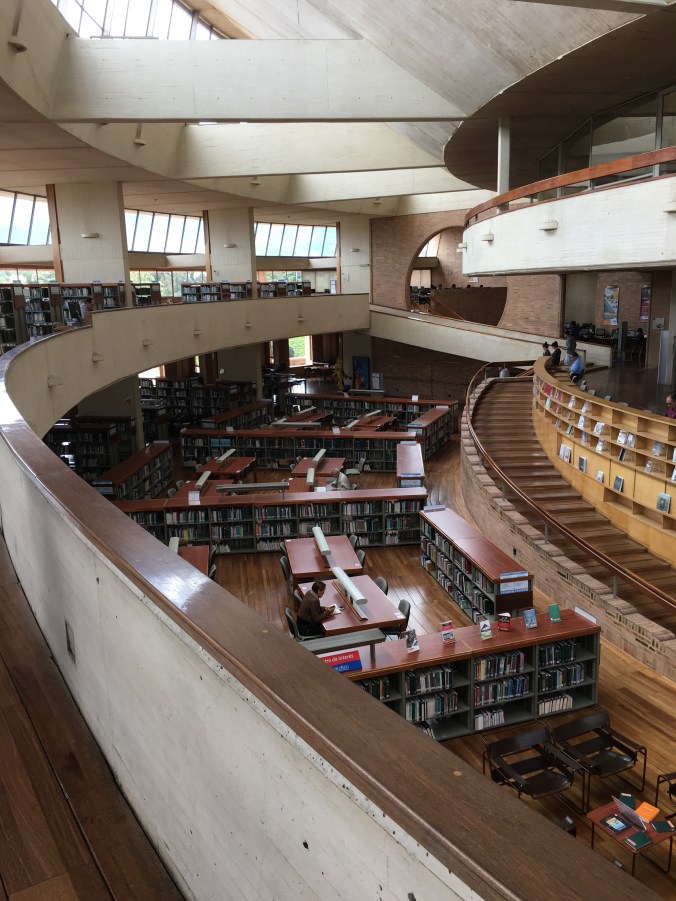
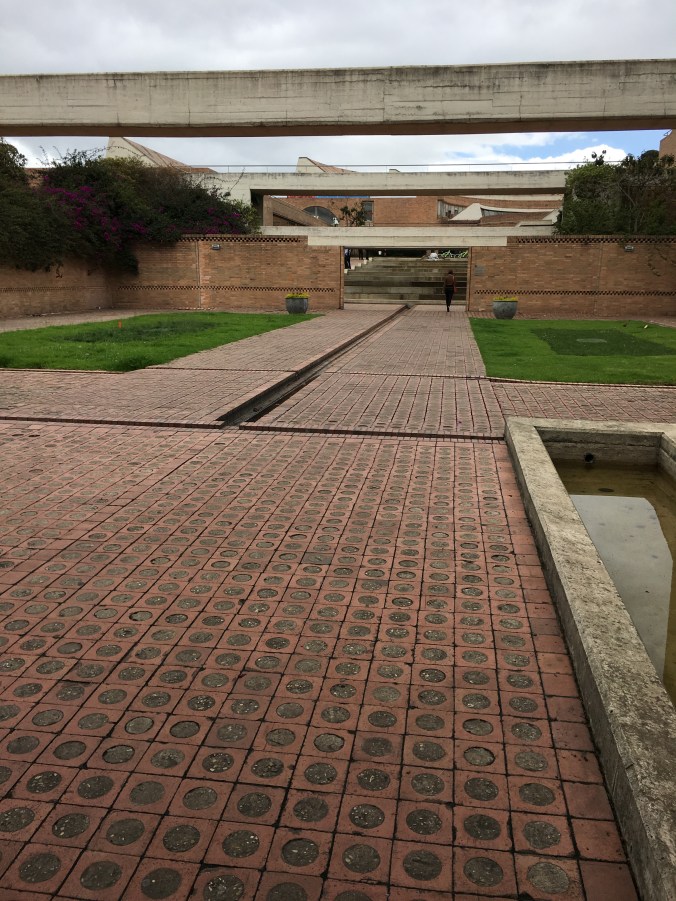
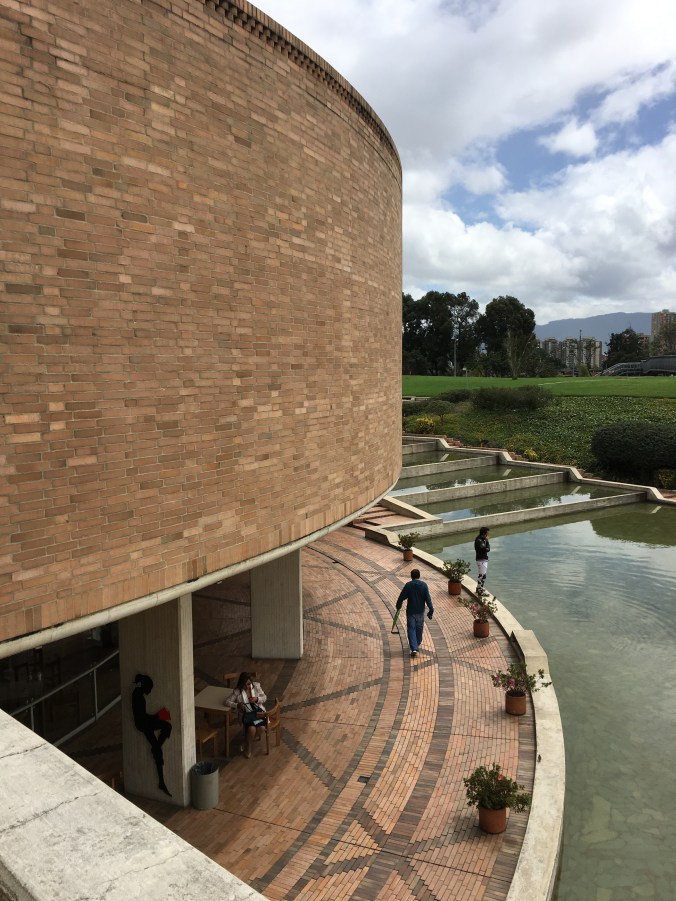
Yesterday we spent the morning at the country’s national library, one of his last works completed in 2001. Its range of influences includes Aalto, Kahn, and Corbusier, but it also integrates a sensitive understanding of the city’s climate—spaces wander inside and out, the sun is always diffused through concrete roofs and vaults, and dark, cool spaces alternate with bright views outward toward the mountains. Around it, water makes for a consistent theme. Fountains bring you in the entrance alongside a lengthy channel (shaped with Salmona’s trademark gutter-profile bricks).
IMG_1823

IMG_1861

It’s a monument, but a graceful, subtle one that manages to be impressive and dignified (there was a graduation ceremony there for a University across town—quite a commitment given the city’s traffic) and yet utterly humane and often surprising. One student pointed out that the clerestories were cleverly proportioned so that patrons in the main reading room looking out would see one strip of nothing but grass, and another of nothing but sky, leaving the mountains for views from the indoor and outdoor circulation areas at the library’s perimeter. Amazing to see that level of experience designed into a complex building type.
IMG_1929

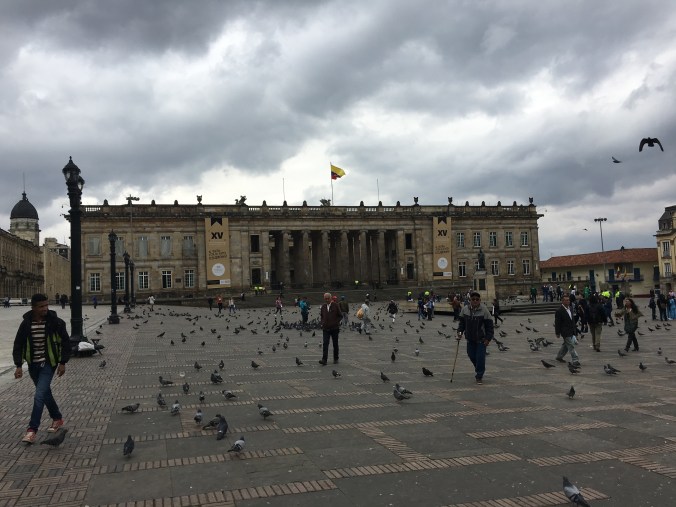
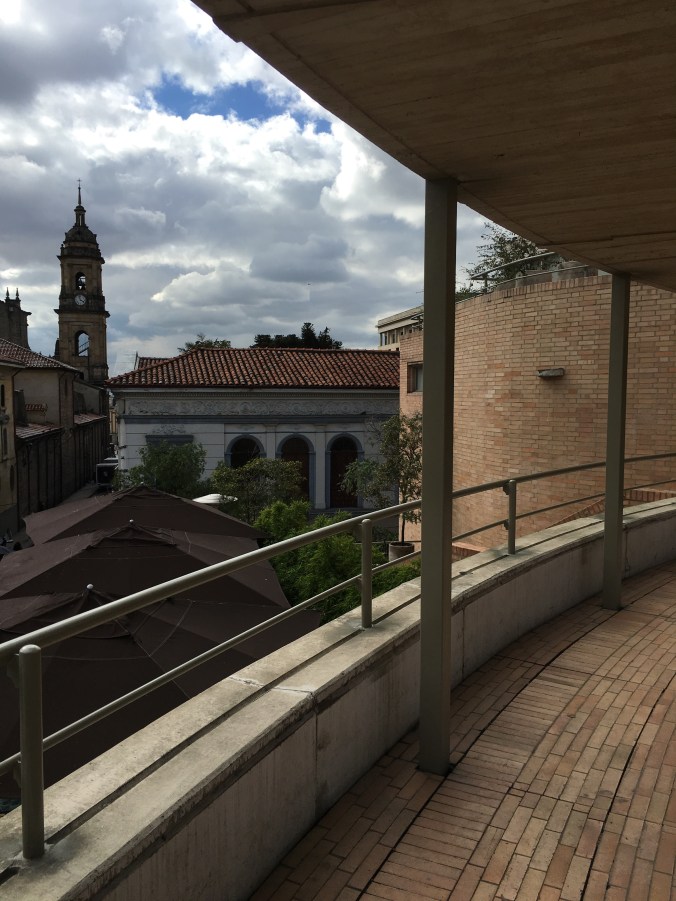
Lunch yesterday on the terrace of the Gabriel Garcia Marquez Cultural Center a few blocks from our hotel and from the Plaza Simon Bolivar, the country’s ceremonial center. Again, an uncanny sense for place—you see the towers of the Plaza’s Cathedral sticking up beyond a circular colonnade as you arrive at its level—and for construction, with brilliantly executed concrete detailed to diffuse light, to shade patrons from the overhead sun, and to define a ceremonial moment in a gloriously chaotic neighborhood.


Much more to read up on and to find out. But Salmona deserves more attention in the canon of both architectural history and of construction history—a gifted designer who achieved real fluency in local materials and built up a body of work that wears its influences frankly and gracefully.
IMG_1782North, that is, not centigrade…

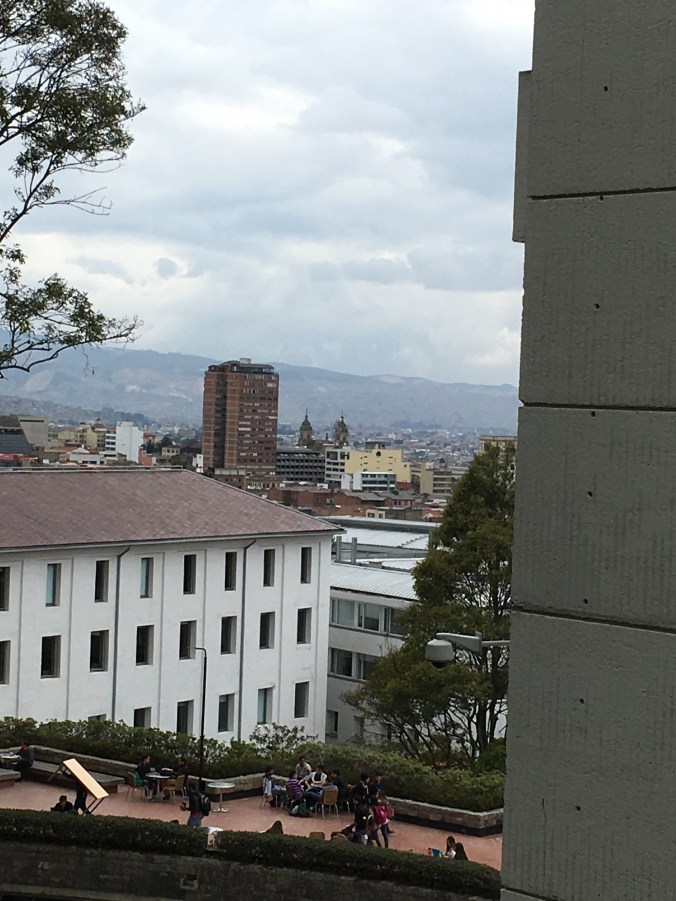
I’ve been in Bogota, Colombia, this week as a guest of the Architecture faculty at the Universidad de los Andes, a gorgeous campus nestled into the foothills surrounding Bogota. Tom Peters and I were invited to lead a week’s worth of lectures and discussions with faculty and students about our work in Construction History, and the chance to talk about Chicago and Kahn, to see one of the world’s more fascinating cities, and to help make connections between north and south within the discipline made for a priceless week.

IMG_1678

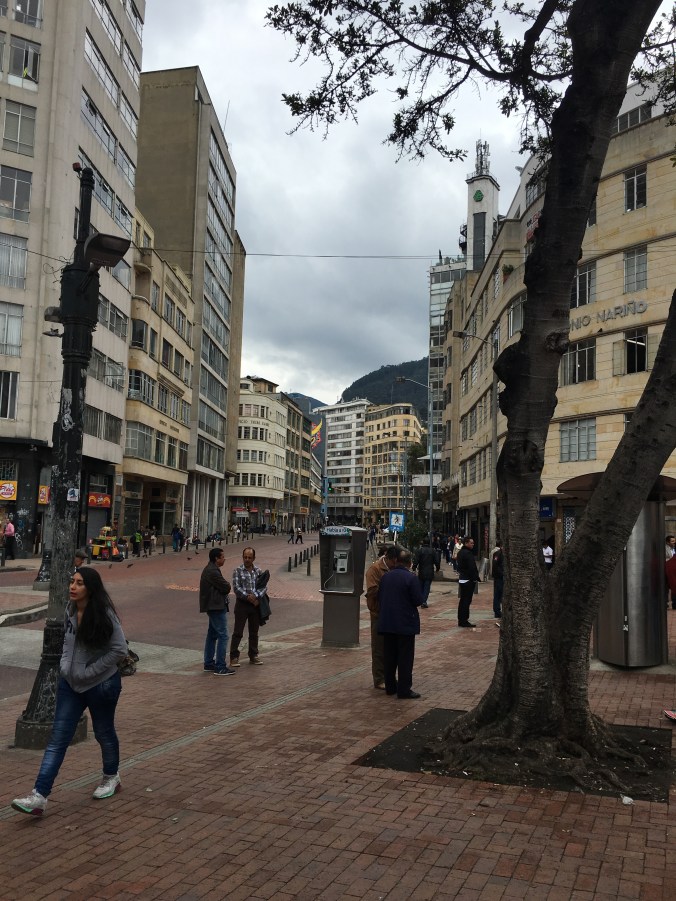
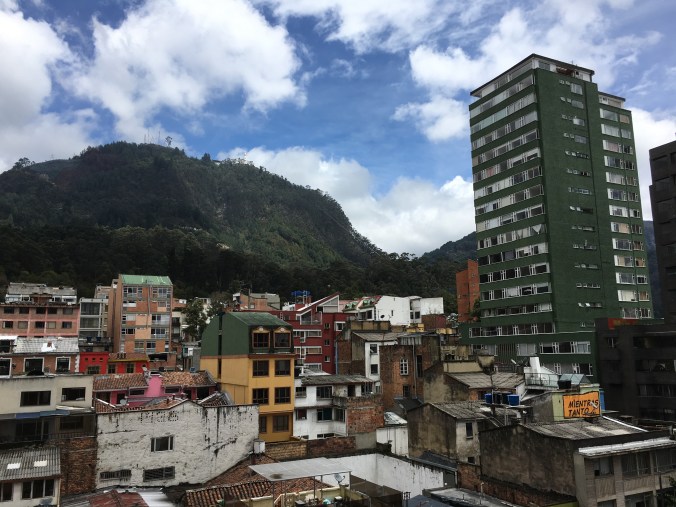
Bogota is amazing, and we were lucky to have a group of really thoughtful, engaging students show us some of the city’s monuments and neighborhoods this week. In particular, I’m now a huge fan of Rogelio Salmona, a heroic figure in postwar Colombian architecture—more on him later—but also fascinated by how a design culture very attuned to international movements has also inflected those ideas with local traditions and (especially) materials. Colombia, like Italy, has little in the way of steelmaking resources, so it’s been a center for concrete and brick production and both materials have strong traditions of design and craft. But it also has about as mild a climate as you can get—equatorial but some 2600m above sea level, which keeps things cool—so it’s an easy place to build with site and nature. And the setting of the city is inspiring, with 300-400m hills that butt up against the downtown and a range of mountains to the west and south that give the city a natural edge (and a foolproof wayfinding strategy…). The city has its problems, and no one showing us around glossed over the traffic or economic issues that you get when a city goes from 300,000 to 9 million over the course of a generation. But the students showing us around also talked about masterplans to reverse the city’s current sprawl (and the political reversals that’s faced), to densify its walkable central business district, and to build new infrastructure that’s long overdue at what everyone hopes will be the end of a debilitating, fifty-year long civil war.

IMG_1622

So, it’s been a really enlightening, mind-expanding week. The talks themselves focused on how the program teaches architectural history—they combine essays and writing with hands-on drawing and modeling projects that show how technology, culture, and society have all influenced how buildings are constructed and why they’re constructed in the ways they are. This, as any ArchFarm reader will know, is heartwarming to me, since it gives students the opportunity to engage with just how complicated and rich building really is—and how it connects to a huge range of other fields, not just art history. I’ve let them know that I’m stealing plenty of their ideas in the coming semesters.

IMG_1699 (1)

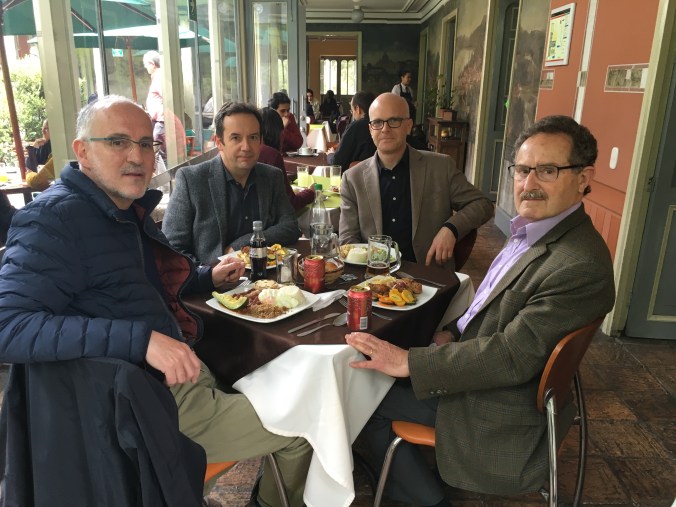
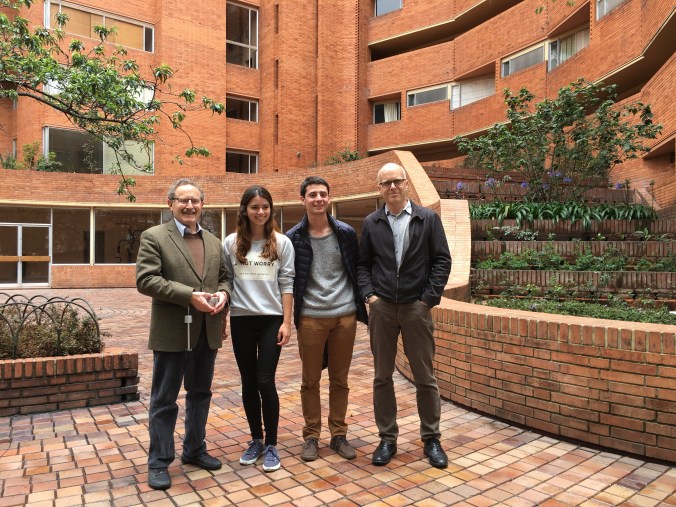
Marc Jané i Mas, Camilo Villate Matiz, random Chicago scholar, and Construction History guru Tom Peters…

And it was an honor to share the stage with Tom Peters, whose Building the Nineteenth Century is to my mind still the best model for what Construction History is and what its potential impact can be. Tom’s lectures covered the prehistory of the Crystal Palace, a nice bit of exposition that showed how almost nothing in it was new, necessarily, except for its scale and the quantity of its production. This “algebra,” to use Ruskin’s perjorative term, was the outgrowth of several developments in iron, glass, and structural design, and his lecture concluded nicely just on the eve of 1851—a lecture about the building that explained it without even showing it. He also presented on current research on Chinese stone bridges, a good look at what he’s up to and theories about cultural preferences for ductility over rigidity. The other patrons in the hotel bar last night must have wondered what the hell was going on as we hashed out some of his conclusions…

IMG_1701

I talked about Kahn and early Chicago, and also test-drove some new material about postwar Chicago—glad to have a friendly audience for this as it’s about 40% baked. It will go back into the oven for a while, but there was an unintentional resonance with local politics here and a series of mayors who have wielded infrastructural projects in the name of the city’s development…and just possibly political gain.

Hoping to come back soon. The University has a great program and is surrounded by art and engineering programs that are also doing amazing things—shared labs and maker spaces, all sorts of cross-disciplinary initiatives, and collaboration with some of the groups working to make Bogota work better.