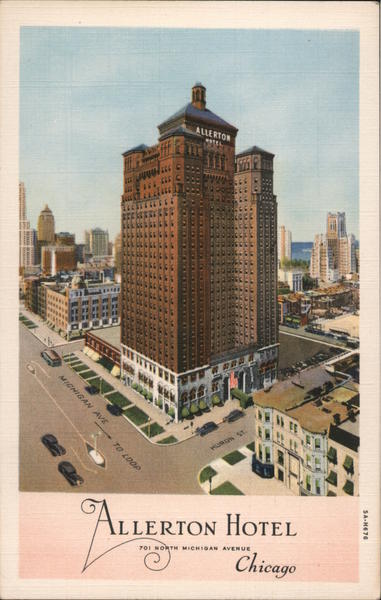
The Allerton is a fairly typical 1920s hotel. Designed and built in 1923-24 by Murgatroyd and Ogden, it’s an ersatz combination of pyramidal massing, scooped out ventilation courts, and a vaguely Moorish theme, a landmark on Michigan Avenue mostly for its signage, which announces not only the hotel but also the fetchingly named Tip-Top-Tap, its rooftop bar.
Eminently forgettable as a piece of architecture, except…
PACE Architects’ principal, Charlie Genther, recalled that on the early Herbert Greenwald/Metropolitan Structures projects, Mies was constantly pushing to have floor-to-ceiling windows, newly enabled by the 1950 building code (about which, much more here…) Legal though that may have been, Greenwald had trouble convincing lenders that tenants wouldn’t find the vertiginous lack of solid walls at the edges of their floor plates terrifying.
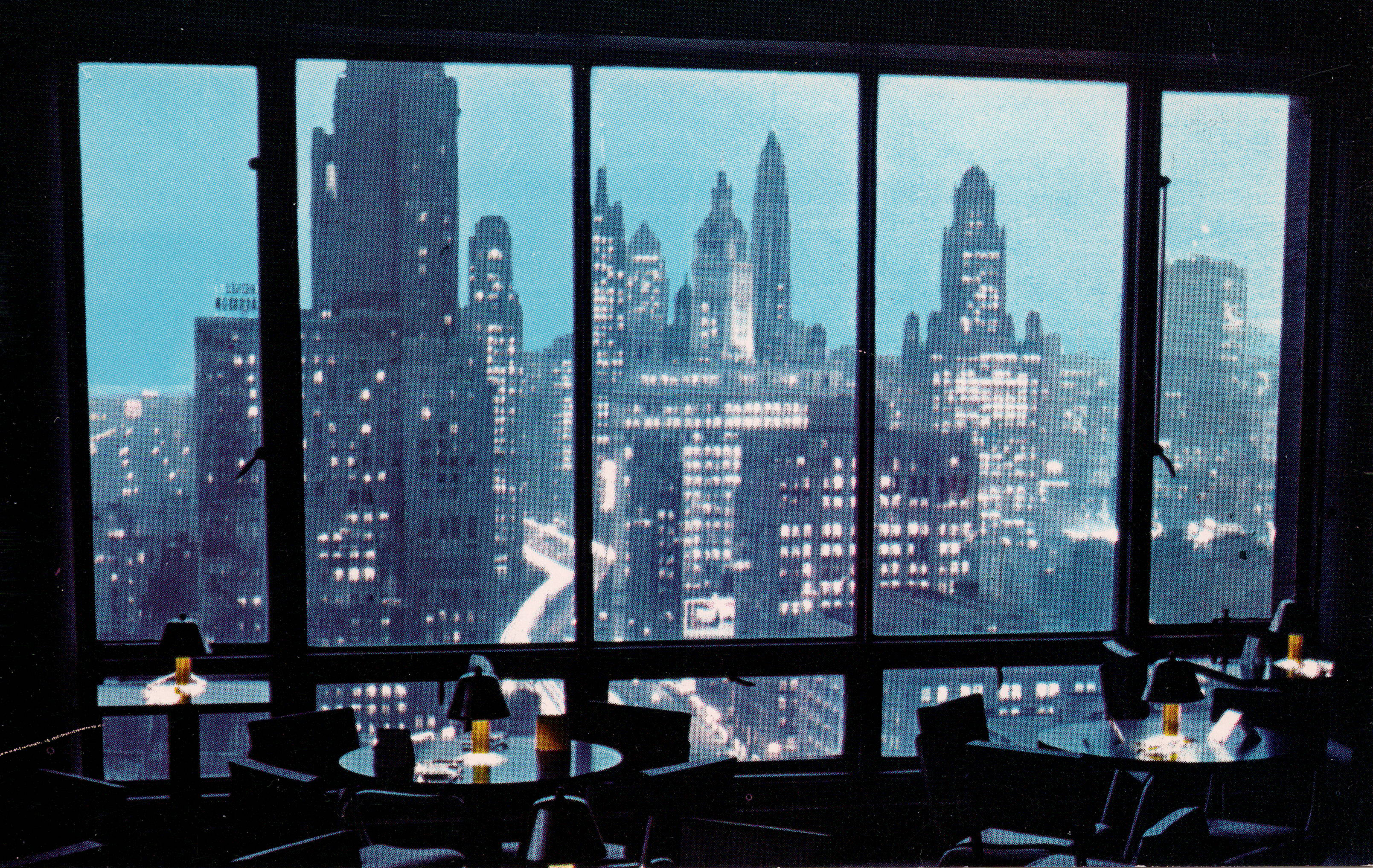
There was one convenient prototype, just blocks from 860-880 Lake Shore Drive, though. The Tip-Top-Tap, which relied on its panoramic views to draw customers for “after-theater rendezvous” and “midnight chats.” The romance of the city, seen from above, was enhanced by the largest possible windows, which–sure enough–are floor-to-ceiling:
Greenwald apparently used the bar first as a test case, and then–at least according to oft-repeated anecdotes–as proof that the lack of a spandrel wall wouldn’t disturb potential tenants. Judging from the Eames chairs, that view is probably contemporary with Greenwald’s excursions there–the DCW came out in 1946. The planters and radiator cabinets suggest that this wasn’t quite as easy a sell as the story makes it seem, but here’s a slightly later view, not too much later since the Prudential isn’t peeking out over the Trib’s shoulder:
It’s another story that’s impossible to confirm but too perfect to not be true, and it does suggest a research trip to the Tip-Top-Tap once it’s possible again…
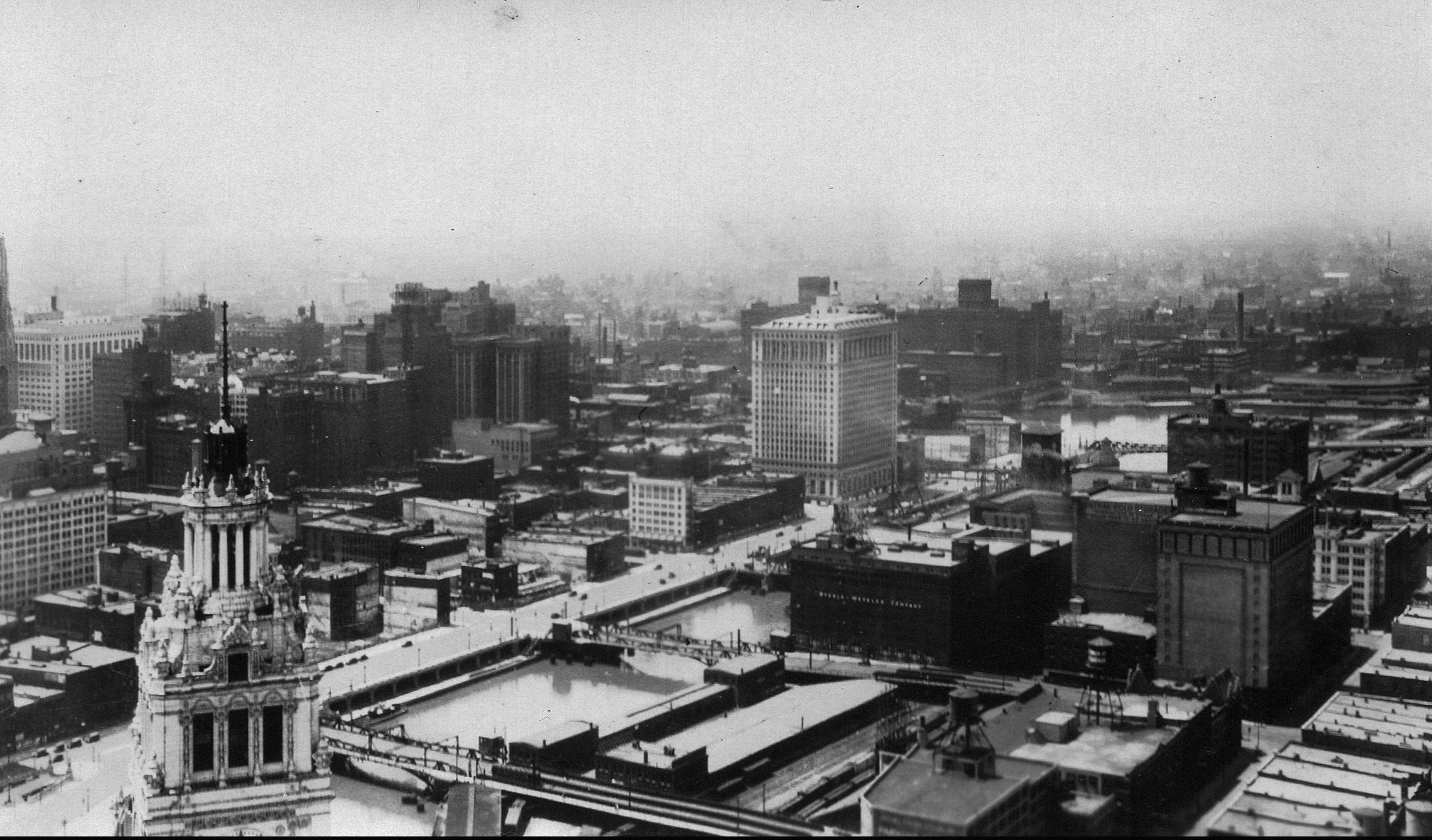
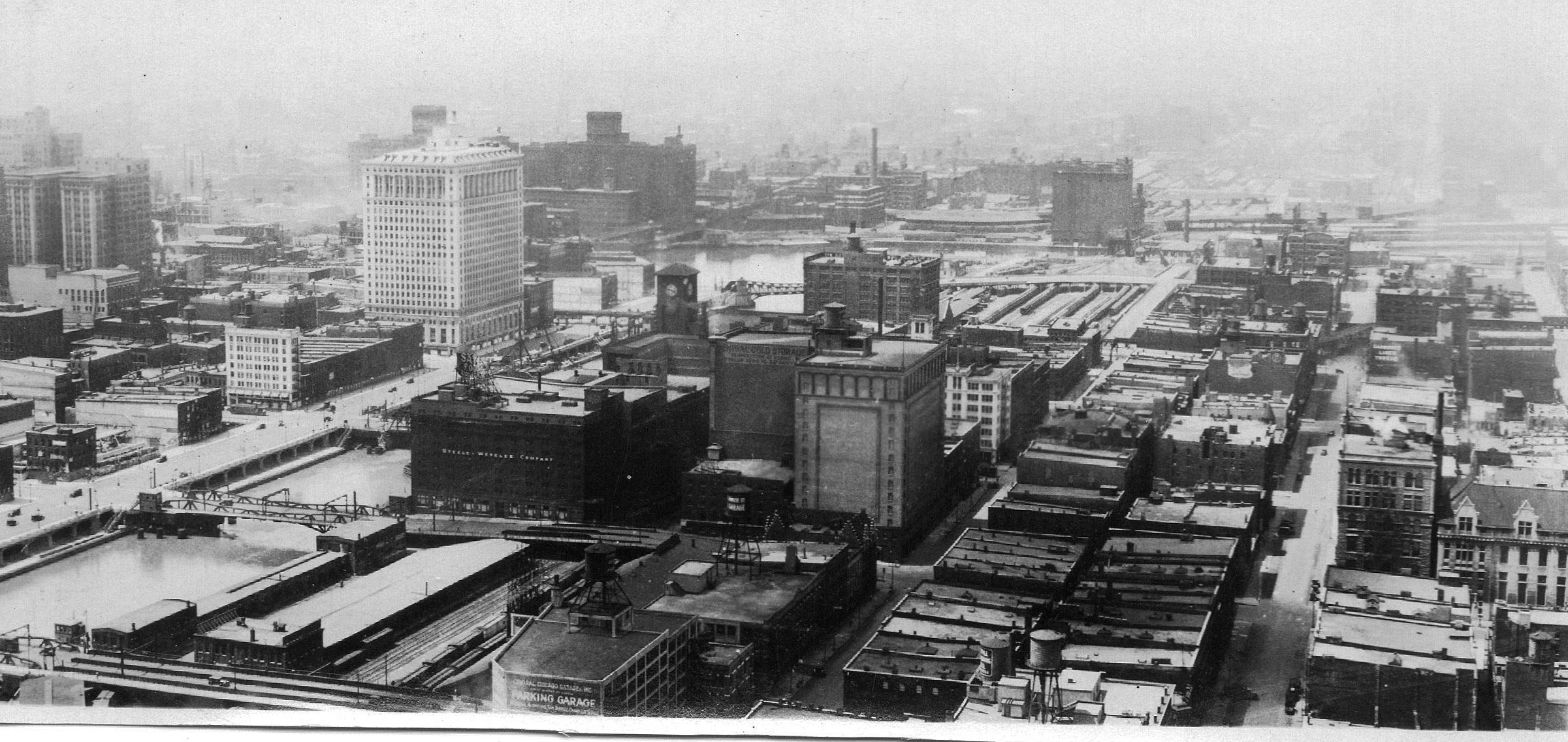
Scrounging around for unconventional illustrations allows me to call eBay shopping “research” instead of just “procrastination,” but every so often it pays off. This week’s haul includes a set of Brownie photographs that were taken from the roof of the Tribune Tower (judging from the position of the Wrigley Building, lower left). You’re looking at the Marina City site in the foreground and the still-new Wacker Drive across the River–the only tall building on it is Graham, Anderson, Probst, and White’s Builders Building, which was just finished in 1927. The warehouses and factories that lined the riverfront are still mostly intact…not exactly the high-rent district it would become.
Photographer unknown
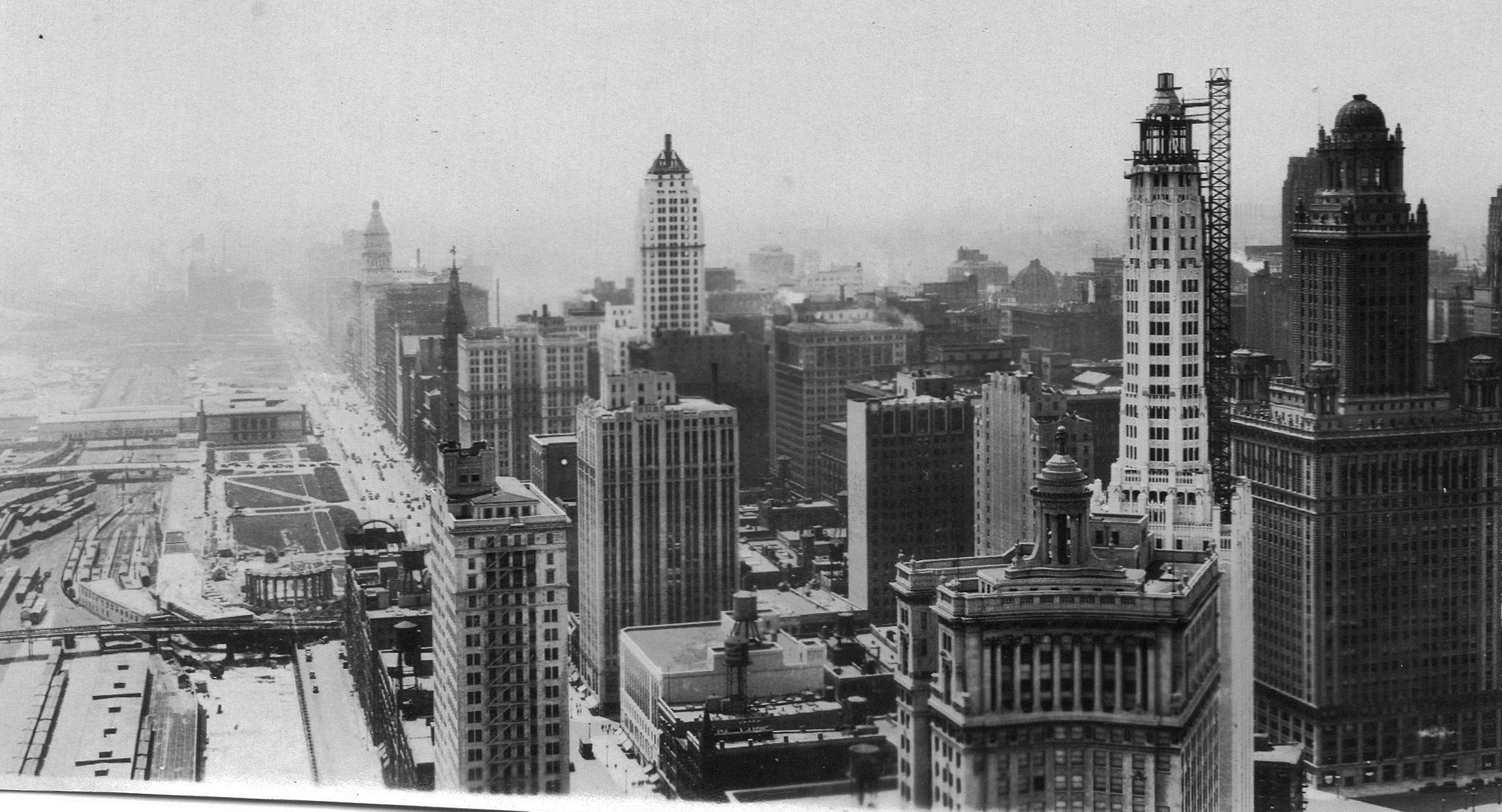
Our photographer has just turned to the left…Herbert Hugh Riddle’s Mather Tower–a building so slender it needed tension foundations to hold it down in a windstorm–is being finished on the right and if you look closely you can see that GAPW’s Pittsfield Building is up and nearly all clad, but missing interior walls. That was Al Shaw’s first major project and you can see that he brought a distinct style to the firm that had just done the solidly classical Builders the year before. Those two being under construction puts a pretty firm date on these–the Pittsfield opened in February, 1928, so these must have been taken sometime in Fall, 1927. Note the Peristyle at the head of Grant Park.
Photographer unknown.
And finally, swinging around to look almost due west. The Merchandise Mart hasn’t been started and you can see the “twin tower” Butler Warehouses and the Cold Storage building on the opposite side of the North and South Branches of the River–now all converted into residential uses. Over to the right is the 1892 Criminal Courts Building by Otto Matz, and the tower of George Nimmons Reid Murdoch Building (1913) is just peaking up on the main branch’s north bank. Other than those, there’s not a whole lot along Hubbard and Kinzie that’s still there.
Useful? Well, as a baseline for the development along the Main Branch, for sure, but mostly just a rare find of some comprehensive views of the city at the peak of its 1920s boom. Thirty years later in 1957 the view wouldn’t have changed much–but another thirty years from that and our anonymous photographer wouldn’t have recognized much…
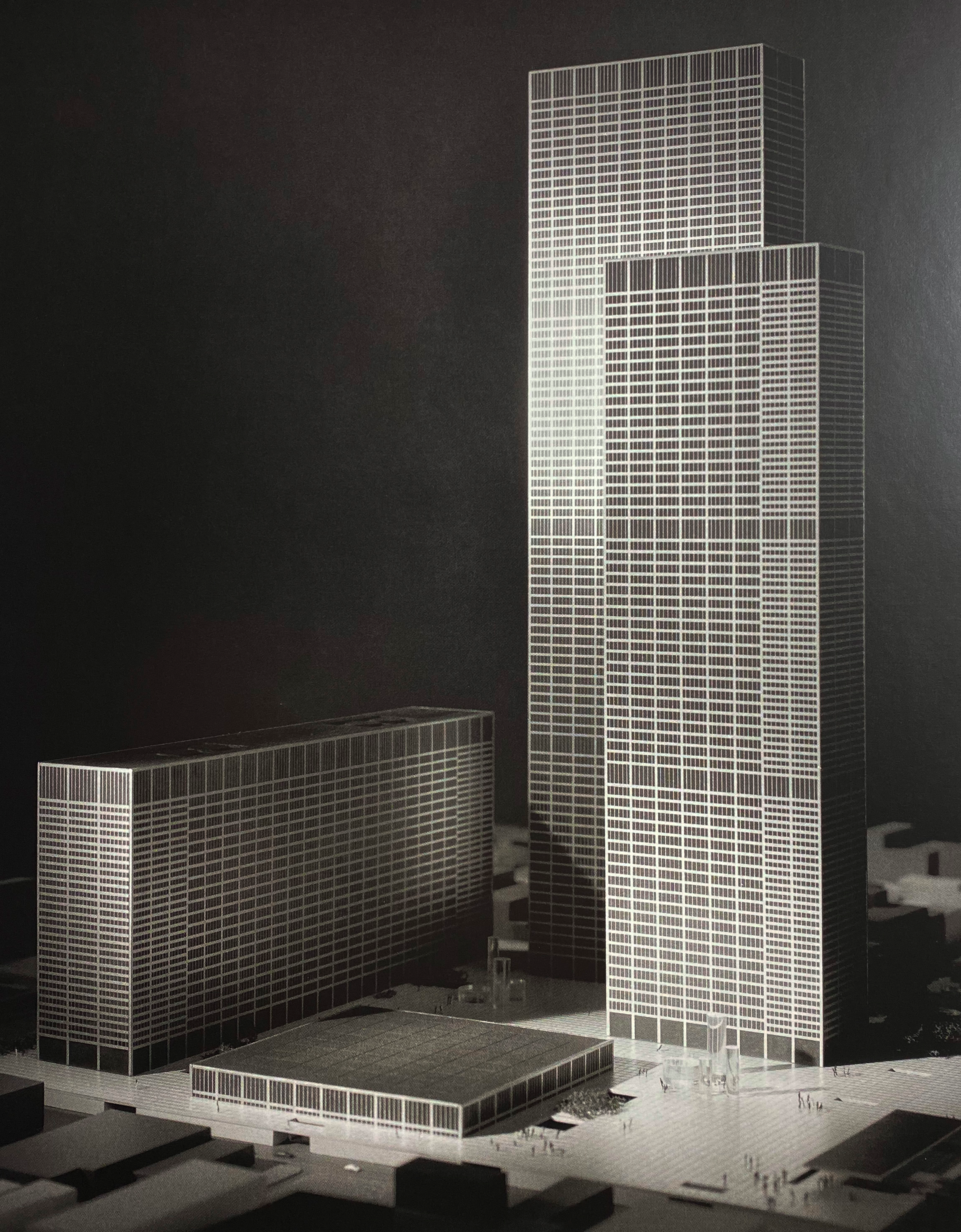
Place du Sable, Chicago (C.F. Murphy, 1967-74, unbuilt). From Werner Blaser, Gene Summers: Art/Architecture
Whoa, right? That massive post-Miesian complex was to have taken up six city blocks of the West Loop, including the blocks that now contain Presidential Towers, the Social Security Administration, and 540 W. Madison–plus two blocks of parking next to the Kennedy. Madison Street, which would have run under the acres of open plaza space connecting the three buildings, was Chicago’s notorious Skid Row, a dozen or so blocks of flophouses, bars, and general decay that the Daley administration regarded as one of the city’s most visible embarrassments.
West Madison Street had plummeted into dereliction beginning in the late 19th century, when its proximity to the smoke and noise of the railroad terminals and yards west of the River made it a center for transient men who subsisted on the day labor that the constant flow of trains and freight required. The mile or so extending west from the River became populated by boarding houses that brought those seeking “a rough life style with low expectations” and, with them, “taverns, liquor stores, second-hand shops, [and] day labor agencies.” After World War II, mechanization and automation in the rail industry eliminated many of the subsistence jobs that had drawn “The Street’s” 75,000 or so denizens, but the flophouses and dive bars remained, serving an ever-smaller but harder-core population.[i] The city began clearing several blocks of Madison Street west of Northwestern Station in the mid-1960s, and in 1968 an open competition was announced for the six city blocks bounded by Clinton and Monroe Streets, Washington Boulevard, and the new Kennedy Expressway, hoping to replace the flop houses and taverns with a new gateway to the burgeoning Loop.[ii] The winning bidder would be offered the land at cost, with the understanding that they would develop all six blocks over ten years.
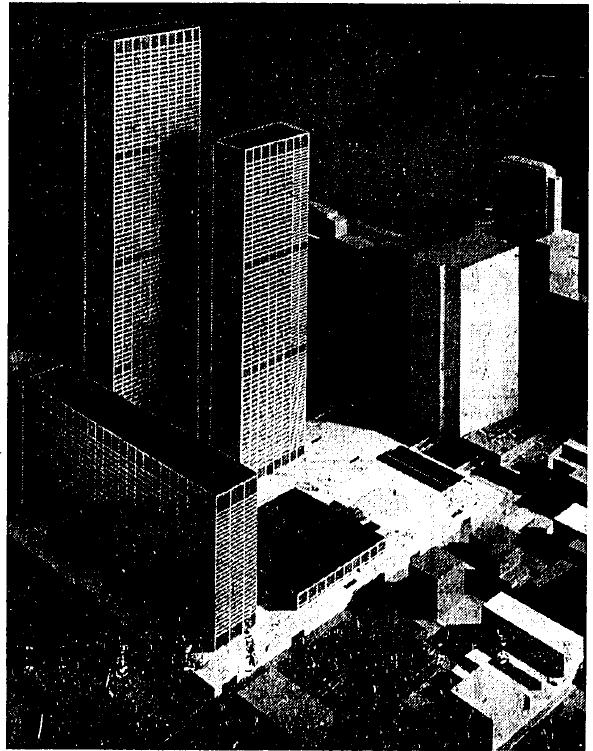
That December, the newly-assembled Madison-Canal Development Company was announced as the winning bidder. The Company was organized by two Memphis-based executives with Holiday Inn, and they had, wisely, hired C.F. Murphy to draw up a proposal for a 5-million square foot, $350 million complex that would take up the entire six-block footprint. Murphy’s scheme borrowed from the office’s own portfolio, proposing two steel-framed towers with an expressed structural frame that recalled their Continental Insurance building, but blown up to colossal scale—one tower would rise 90 stories, the other 68. These were to be joined by a low, slab-like apartment building and a square pavilion taking up almost an entire city block, all sitting atop a raised podium extending across the whole site that would contain retail space while offering a raised pedestrian concourse above the existing street grid, and it proposed connecting via an underground concourse to Northwestern Station. The scheme clearly looked to contemporary urban structures such as Ville Place Marie in Montreal, where the city’s even harsher climate had led Pei and his developer to a raised podium and basement retail that connected to that city’s growing underground network of concourses, but it also showed a debt to Mies’ arrangement of towers and slabs at the Federal Center and elsewhere.[iii] While the 90-story tower was to be a straightforward—if strikingly tall—office building, the Murphy scheme, developed by Mies protégé Gene Summers, proposed combining office and residential functions in the shorter tower. Instead of stacking the narrower apartments atop the wider offices, as SOM had done at the Hancock, the Place du Sable tower grafted an apartment high-rise onto the side of an office tower, staggering the floors so that three residential floors would take up the height of two office floors.
Chicago Tribune, June 9, 1974.
The double-use tower was the first phase of the project and the city began demolishing the far-northeastern block in preparation for foundation work.[iv] Meanwhile, it emerged that Madison-Canal was, in fact, the brainchild of Charles Swibel, who had been Chairman of the Chicago Housing Authority for more than five years. This was a disqualifying and potentially illegal conflict of interest. Place du Sable was taking shape in the midst of an election campaign that, while never in doubt, took place in the aftermath of the 1968 unrest. Richard Friedman, a liberal reformer running against Daley as a Republican, publicly released the project’s prospectus, which disclosed Swibel’s stake in the project and showed that the partnership was paying him an annual $100,000 fee for “consultation.”[v] No keen observer of the city’s politics could fail to recognize such a huge annual payment to one of the city’s most notorious back-room dealers for what it was, but more was to come; a Department of Urban Renewal whistleblower came forward just weeks before the election to reveal that Madison-Canal hadn’t provided proof of their financial reserves—the two Holiday Inn executives had resigned while contracts were being signed—and that additional payments had been made from an empty shell company to the Real Estate Research Corporation which, it turned out, not only studied the possible rehabilitation of West Madison for the Department of Urban Renewal in 1966-69, but had then turned around and contracted with Madison Canal to assist on their bid.[vi]
The accusations barely registered among the growing list of financial scandals that plagued the late Daley administration, but lawsuits delayed the project and threatened its funding. The company’s proposed sale of common stock was put on hold by the Securities and Exchange Commission in 1969 and Place du Sable began its long, tortuous death throes. By the end of 1970, Swibel publicly doubted the viability of the retail mall and underground concourse abandoning the raised podium in favor of a street-level plaza.[vii] Madison-Canal only bought the site’s first blocks in January and June, 1971 as the project’s vaporous finances became apparent.[viii]
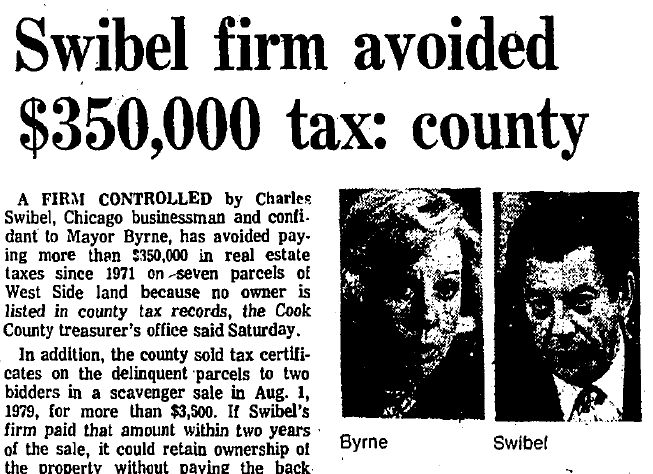
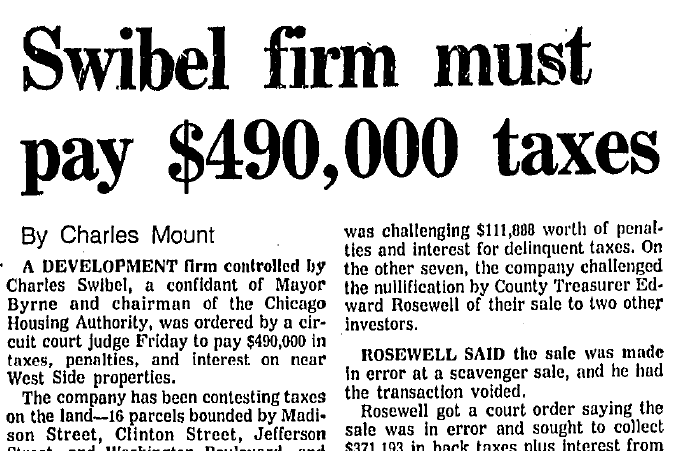
Later that year, the General Services Administration announced that they would locate a new, consolidated regional headquarters for the Social Security Administration on one of the blocks that Madison-Canal owned. The SSA had preferred a site on the River but Chicago’s Department of Urban Renewal convinced them to build on the Madison-Canal site instead. Swibel and his company earned a quick 20% profit on their $5.8 million purchase of the land.[ix] In June, 1974, the city formally abandoned Place du Sable, citing the failure of Madison-Canal to make any progress and starting a wave of lawsuits between the developers, the city, and the federal government.[x] Swibel, however, held on to his one remaining block. While he served as a confidant to Mayor Jane Byrne in the late 1970s, part of his block disappeared from the property tax rolls. This came to light only when a termination agreement was drawn up that allowed Swibel to sell the entire block outside of the Place du Sable agreement and it was found that he had avoided paying nearly half a million dollars in property taxes on the land.
Chicago Tribune, Feb. 1, 1981.
Place du Sable’s visual power—which existed in little more than a presentation model—was enough to earn Swibel millions of dollars through the mere promise of a project so gigantic that it would have realigned the Loop’s orbit, offering not only a new gateway development to arriving workers on the Kennedy, but a new center of commerce, residence, and entertainment that would have transformed the West Loop. Did Swibel and his shell company have the capabilities—or even the intent—to pull such a vast, impactful scheme off? Or was Place du Sable a cynical land banking venture, designed simply to earn one of the best connected operatives in Chicago an easy profit without any real commitment to the difficulties of building an actual project? Swibel narrowly avoided criminal charges over his role in the affair, eventually agreeing to pay back nearly half a million dollars in back taxes, but this was a fraction of what he earned for essentially sitting on an empty piece of land for nearly a decade.
Skyscrapers played a role in shaping the city’s skyline, but even the ones that weren’t built reveal much about the political and fiscal mechanisms that shaped the city as a whole. The contrast between such active engagement and the lassez-faire approach of 19th and early 20th century politicians is one of the themes that’s shaping the new book. Often this was for good—Swibel’s role in realizing Marina City, for instance, aligned labor, government, and financial interests toward one of the city’s most successful, iconic, and equitably conceived mixed-use projects. But Place du Sable shows that these interests weren’t always as balanced.
Chicago Tribune, July 25, 1981
[i] Richard Greb, “Chicago’s Skid Row Fades as New High-Rise Slated.” The Austin Statesman, Feb. 23, 1969. A18.
[ii] Paul Gapp, “Architecture: Presidential Towers No Beauty, But it Works Like a Charm.” Chicago Tribune, Dec. 22, 1985. H6.
[iii] “Developers Alter West Side Plans [Place du Sable].” Chicago Tribune, Dec. 6, 1970. E1.
[iv] “Crews Tear Down Skid Row for New Development.” Chicago Tribune, June 28, 1970. W9.
[v] “Friedman Hits Swibel Again, Says He Would Halt Project.” Chicago Tribune, Feb. 20, 1971. D5.
[vi] Cornelia Honchar, “Suit Challenges ‘Skid Row’ Plan.” Chicago Tribune, Mar. 18, 1971. 12.
[vii] Developers Alter West Side Plans [Place du Sable].” Chicago Tribune, Dec. 6, 1970. E1.
[viii] “Caisson Work Set for First Building in Place DuSable.” Chicago Tribune, Sept. 16, 1971. W12.
[ix] “$46 Million U.S. Building Set for Swibel Land on West Side.” Chicago Tribune, Sept. 16, 1972. N5; Alvin Nagelberg, “100% Land Profit Expected in Sale by Swibel to GSA.” Chicago Tribune, Sept. 23, 1972. 1.
[x] Stanley Ziemba, “City Urged to Scrap West Side Development.” Chicago Tribune, June 5, 1974. B2 and “Place Du Sable Dream Dying Amid Controversy.” Chicago Tribune, June 9, 1974. 45.

 architecturefarm