There aren’t many figures who span both of Chicago’s great historic skyscraper eras. The twenty-year commercial hiatus between 1934 and 1955 meant that lots of careers ended, or got their start, between the Field Building and the Prudential–few figures had the longevity or the timing to design in both.
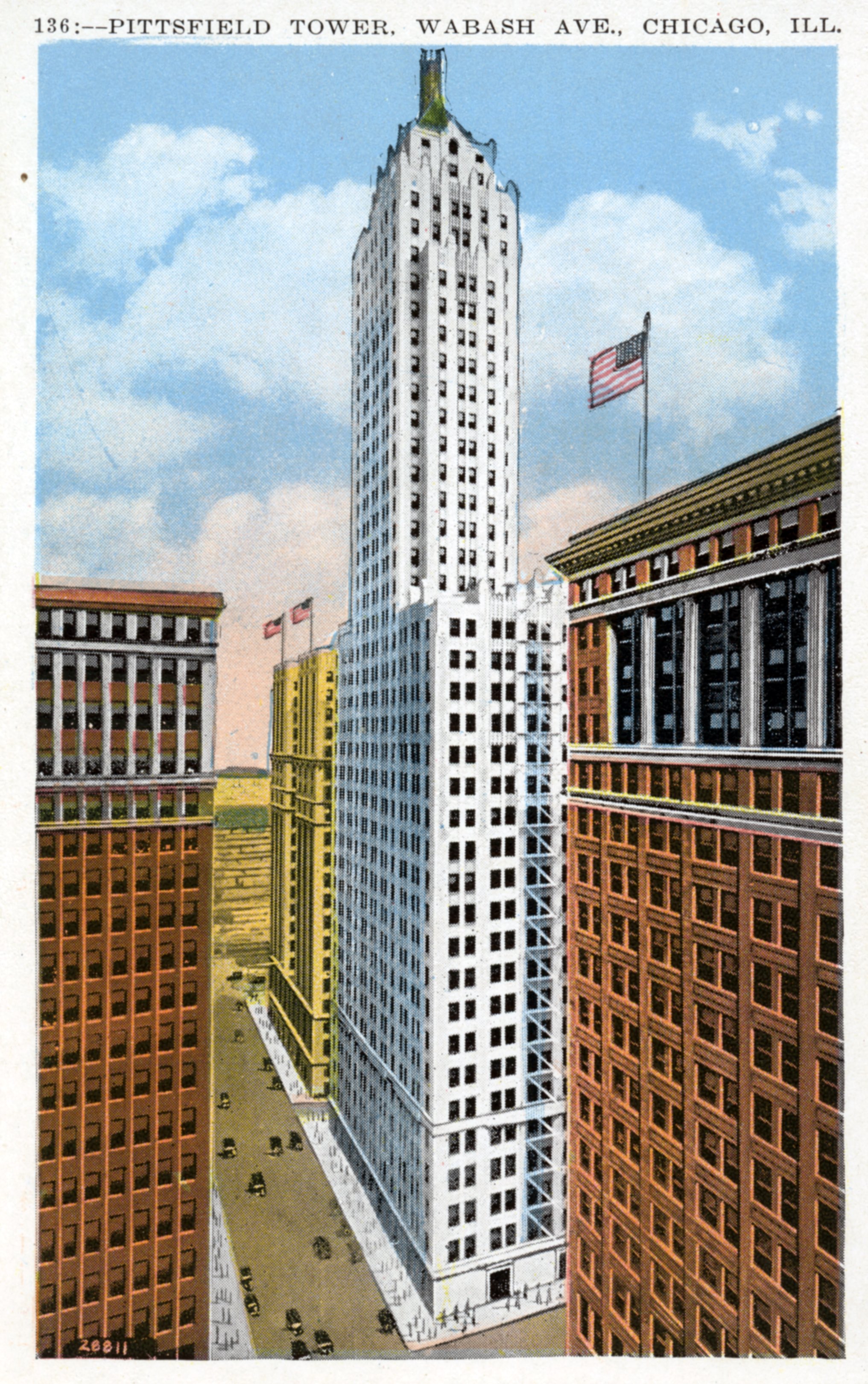
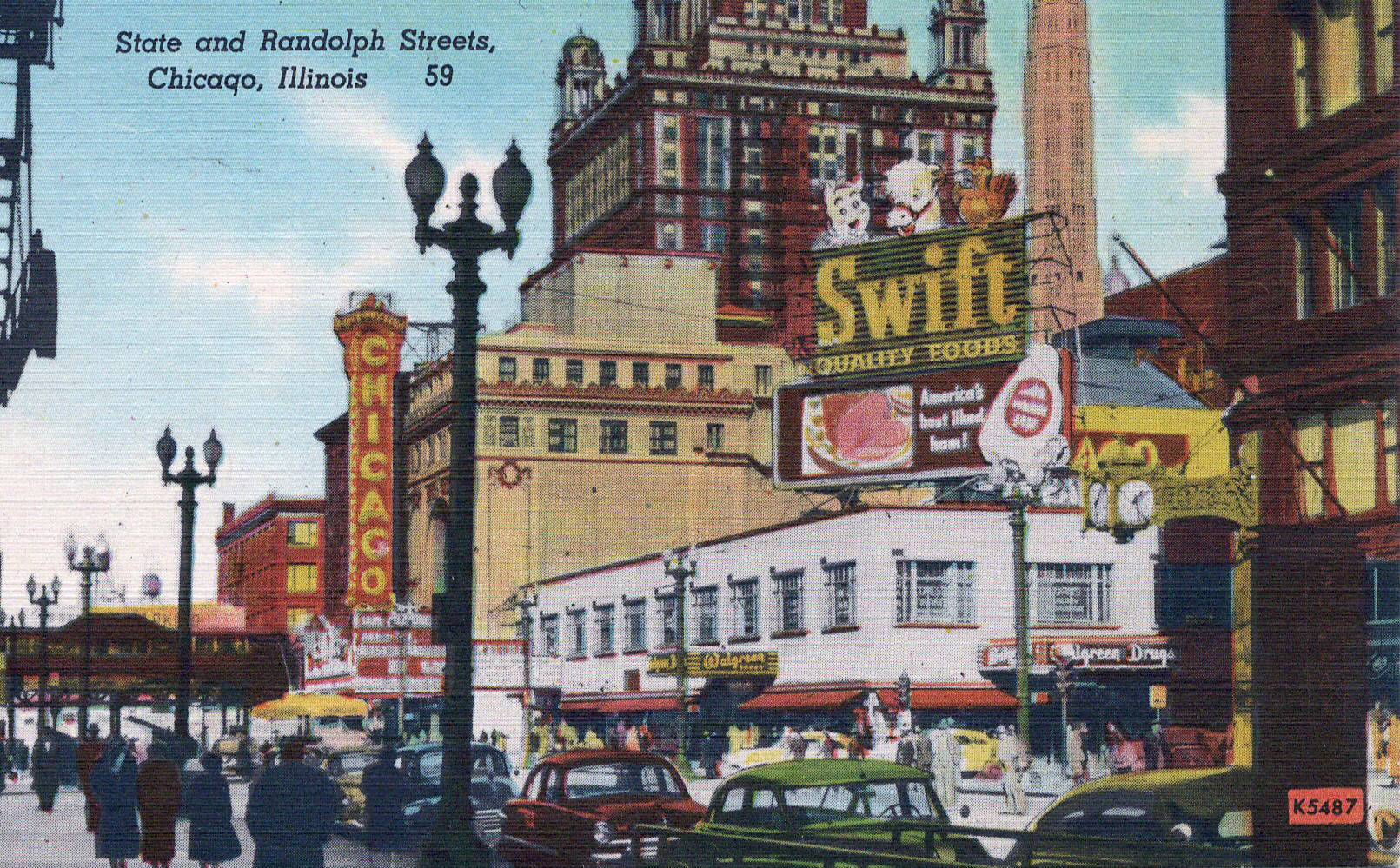
Except for Al Shaw (1895-1970). Shaw was a Boston native, educated at the Boston Architectural Club. After serving in the Army Signal Corps during WWI he worked in Boston before coming to Chicago, where he joined Graham, Anderson, Probst, and White in the mid-1920s. Shaw was a formidable draftsman and designer, and he immediately took on some of the firm’s largest works in the wake of longtime chief designer Peirce Anderson’s death; he was chief designer for the Pittsfield Building, the Civic Opera, the Merchandise Mart, and the Field Building, as well as Philadelphia’s 30th Street Station, all of which featured sharply delineated vertical patterns ornamented in styles ranging from Beaux-Arts classical to moderne. He relied in part on the expertise of the more senior Sigurd Naess (1886-1970) to develop these. After Ernest Graham and Howard White died within weeks of each other in 1936, Naess and Shaw teamed up with the firm’s managing partner, Charles Murphy, to start Shaw, Naess, and Murphy, which rode out the last years of the Depression with industrial and institutional work, including DePaul’s O’Connell Hall and a three-story “taxpayer” building on the site of Burnham and Root’s demolished Masonic Temple, at Randolph and State–an early project of developer Arthur Rubloff.
The trio lasted for ten years, finally splitting up in 1947–in large part due to Shaw’s tempestuous personality, according to Murphy’s later recollection. Shaw was well-connected to Chicago’s art and social circles, though, having married Rue Winterbotham, heir to a barrel-making fortune and a major figure in the city’s cultural scene, in 1932. Shaw joined forces with structural engineer Carl Metz and mechanical engineer John Dolio, debuting with the moderne Florsheim Shoe Factory, on the block just north of Union Station.
The new firm designed industrial and retail buildings in its early years, including the Woolworth store on State Street downtown, which borrowed the vertical limestone striations of the Field Building, albeit at a far more modest scale. Like many fledgling Chicago firms in the late 1940s, though, Shaw, Metz, and Dolio concentrated on the surging residential market, designing seven walkup apartment blocks at Cottage Grove and 84th sts. that took advantage of a new FHA mortgage insurance program and designing a demonstration house in Lincolnwood that highlighted the battle between building trades in the Chicago Building Code debacle that occupied much of the late 1940s.
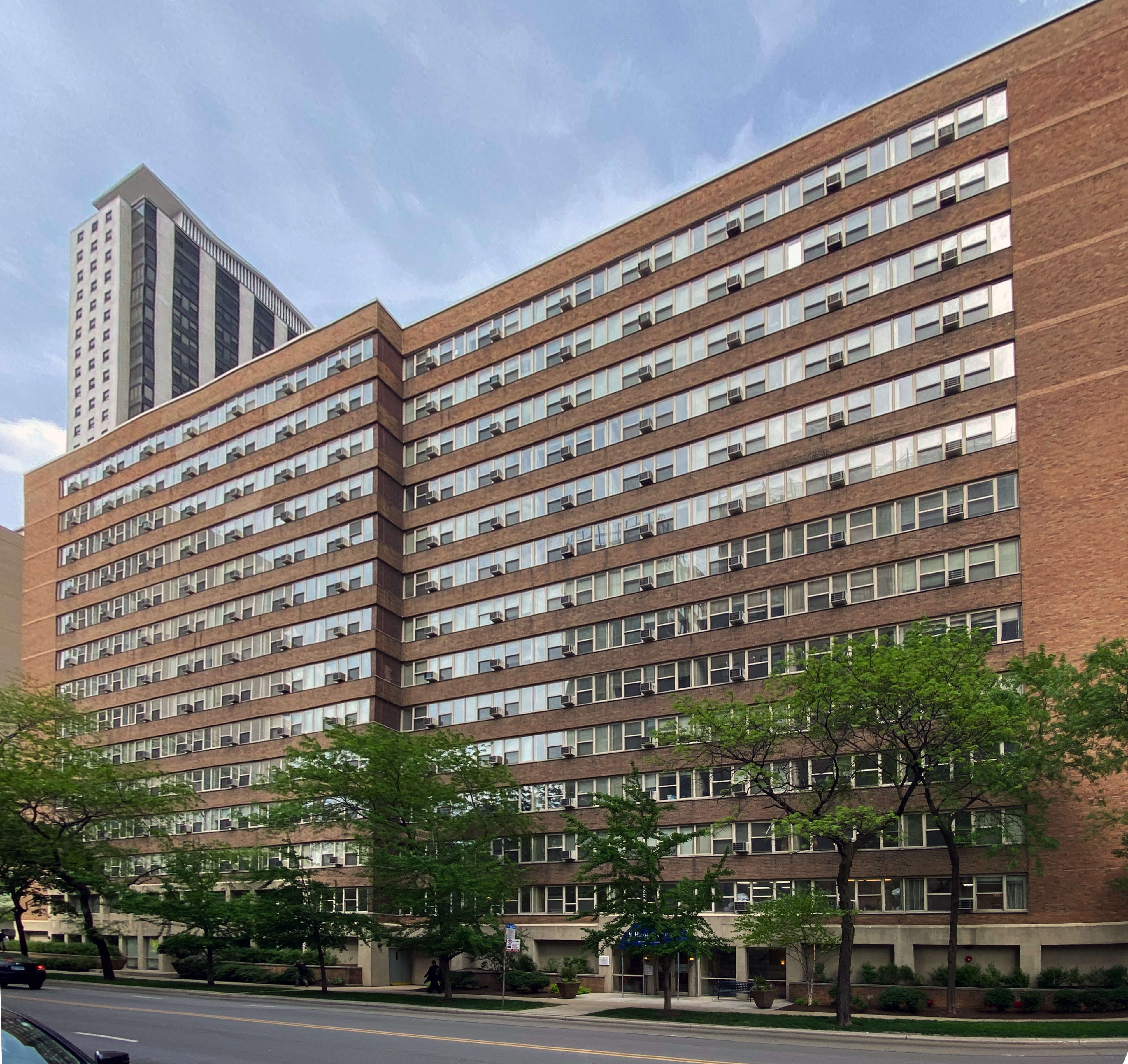
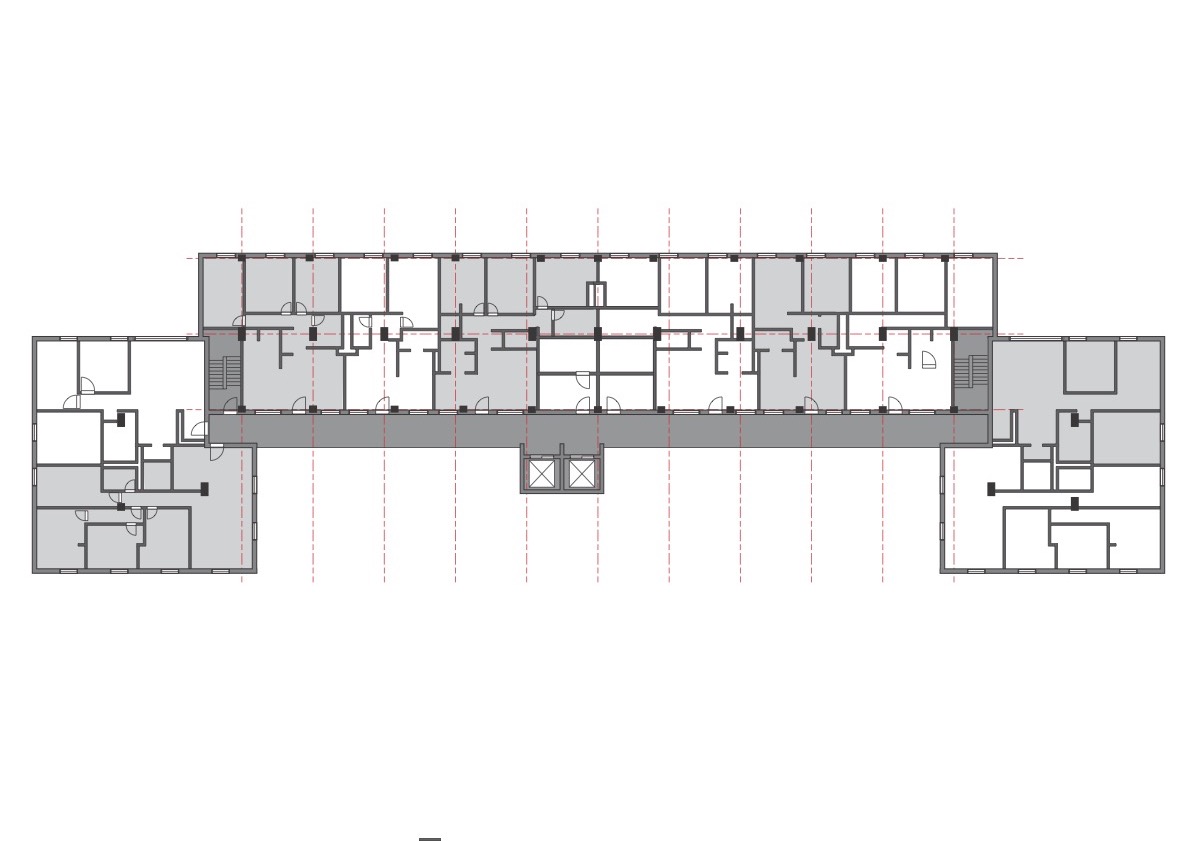
The firm’s growing residential expertise led to three commissions for apartment buildings along Sheridan Road in Lakeview East, all developed by John Mack and Raymond Sher with financing from Prudential, which like many insurance firms was pouring the proceeds from the postwar demographic boom into real estate and commercial properties through American cities. The first of these, at 3100 N. Sheridan, set the model for the firm’s early high-rise residential design, featuring long, horizontal strip windows set between simple brick spandrel walls, while the last–just two blocks north, between Sheridan and Lake Shore Drive at Belmont, arranged units around short, stub corridors and multiple elevator cores that allowed every unit to occupy the slab’s full width and, thus, to have both lake and city views.
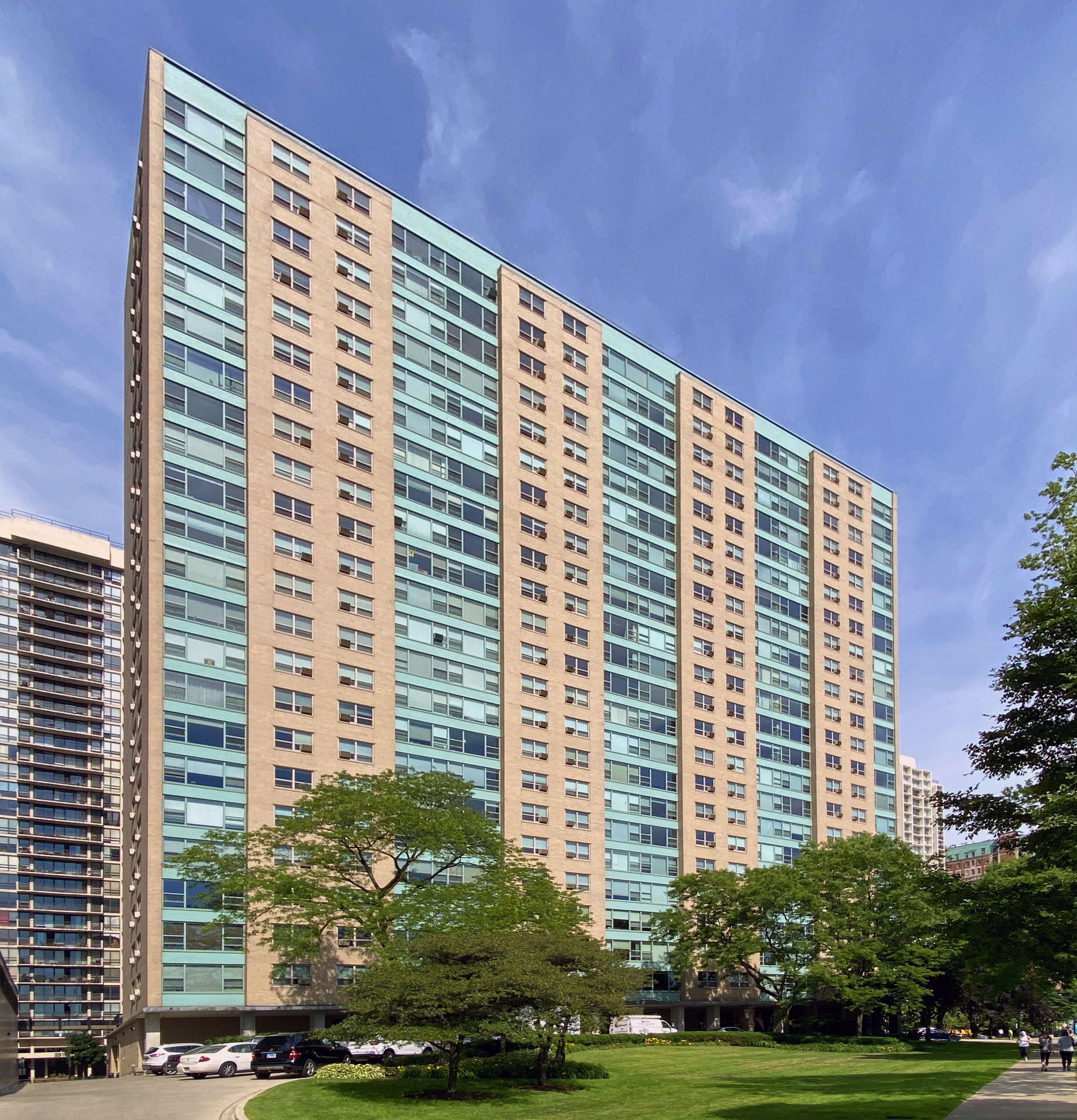
Mack and Sher built on the success of this residential cluster, ultimately hiring Shaw, Metz, and Dolio for four large complexes that punctuate Lake Shore Drive today. The first of these, at Irving Park (3950 N. Lake Shore), adopted the horizontal strip windows of the earlier slabs, but for the subsequent projects Shaw adopted his earlier preference for stark verticality, rendering these in contrasting stripes of white face brick and windows with dark spandrel panels. 3600 N. Lake Shore, at Addison, was the paradigm of this approach, employing newly available low-profile air conditioning units to allow for larger window units in two parallel slabs set–counter-intuitively to some–perpendicular to the lakefront. This arrangement allowed Mack and Sher to claim lake views for all of the complex’ units, even if only the end apartments actually faced the lake itself.
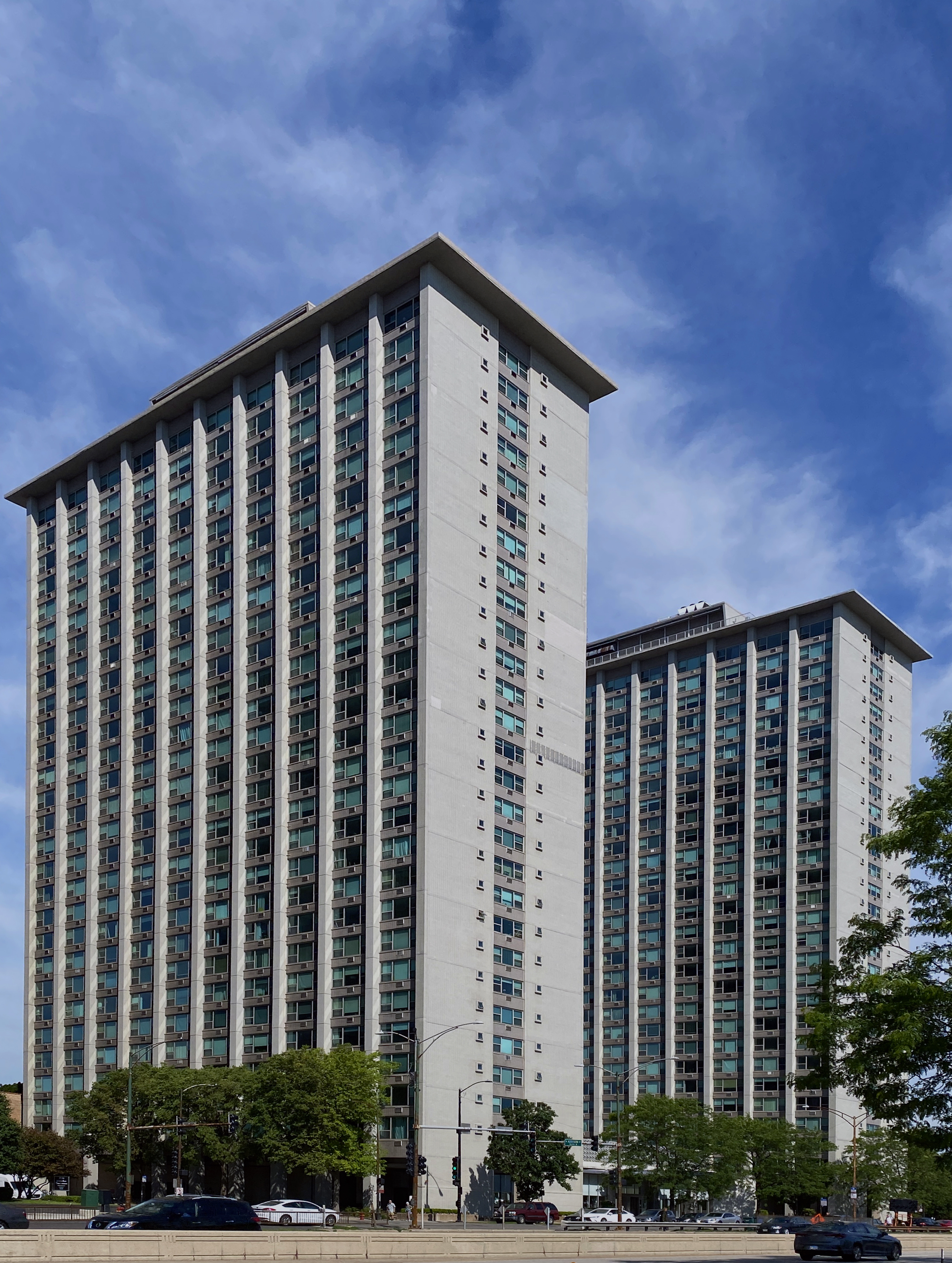
More immediately recognizable were the two single slabs the firm designed for Mack and Sher along the Drive in 1962, at Belmont (3950 N. Lake Shore Dr.) and North (1550 N. Lake Shore Dr.). These were, again, set perpendicular to the Lake, and each one featured a signature metal enclosure around its rooftop mechanical plant, along with emphatic vertical striping.
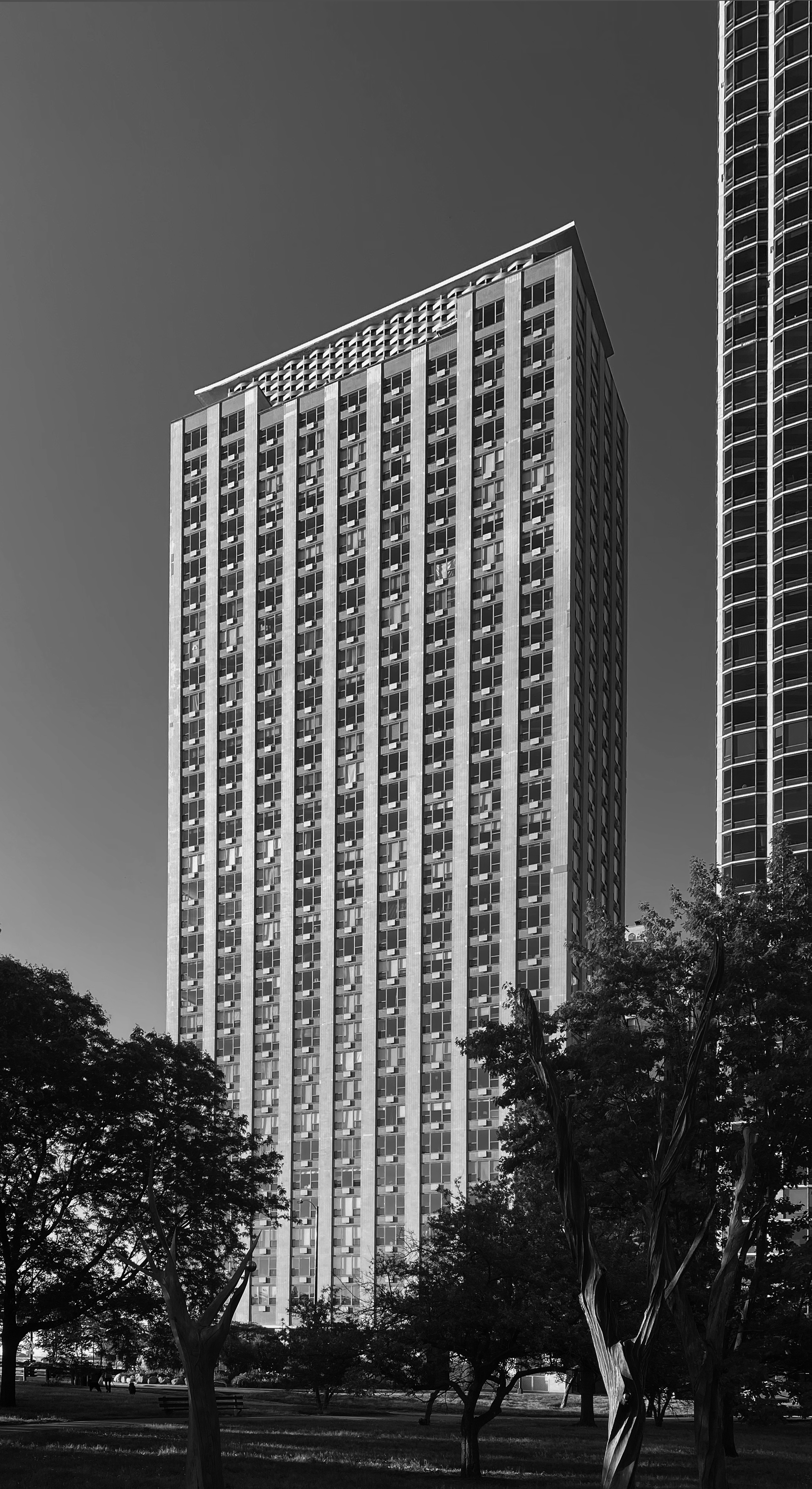
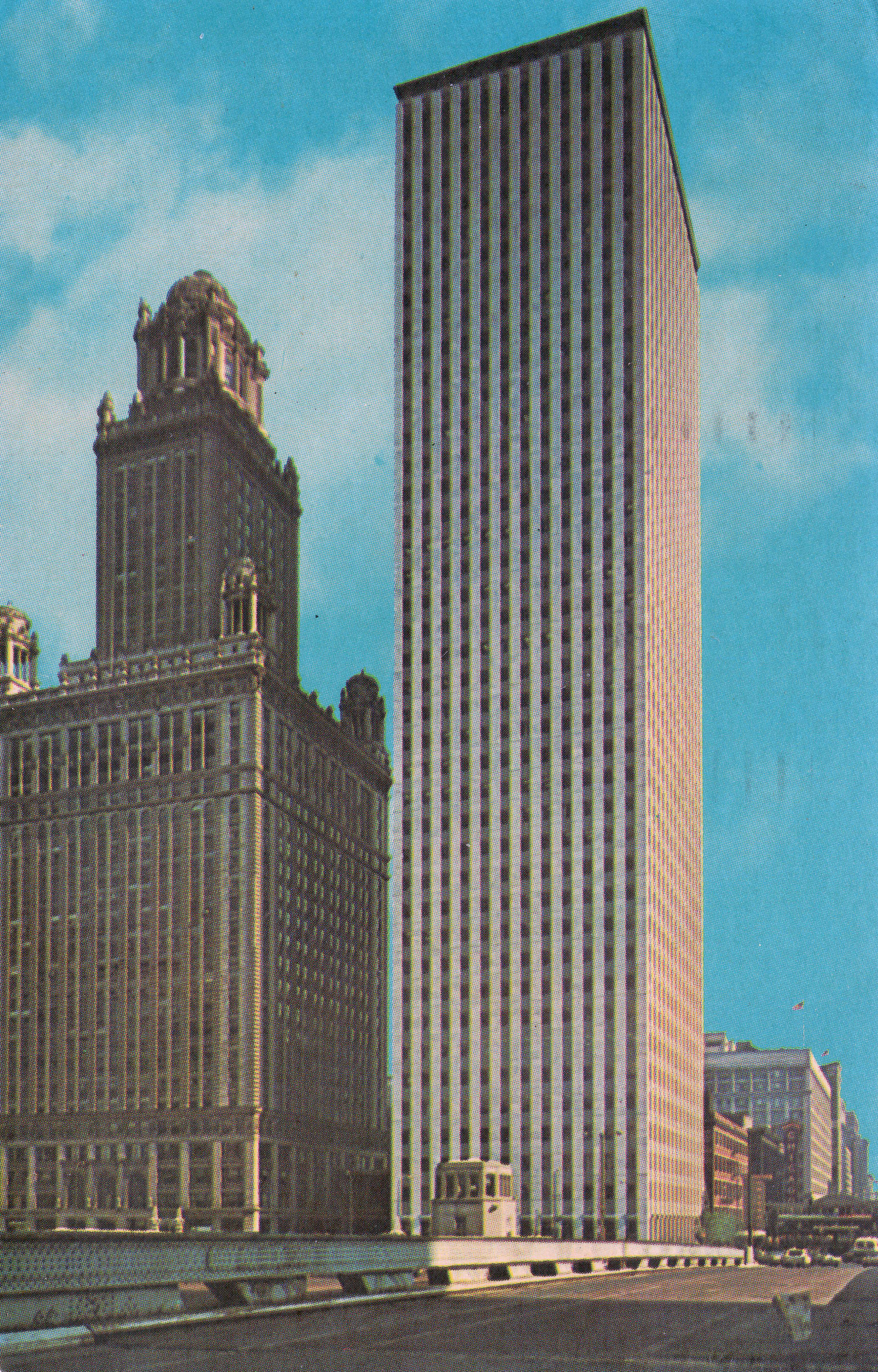
These projects appealed to singles and families alike—3950 N. Lake Shore housed “mostly” families when it opened, drawing tenants for its “ranch house” like units and its location, just “10 to 15 minutes” from the Loop by car. But the firm also began drawing larger commercial clients, in particular United Insurance, a family-owned Chicago company that had found a niche by offering weekly premium plans to working-class clients. Shaw designed a 40-story tower for United’s highly visible site, at State and Wacker, that featured continuous stripes Georgia marble and recessed, black Vitrolite spandrels–repeating, more or less, the aesthetic formula of the later apartment buildings and making the building the “tallest marble structure in the world” when it opened in 1962.
The firm’s now trademark, gleaming white version of Shaw’s earlier moderne styling found its way to apartment buildings and commercial structures throughout downtown and along the Drive: the Continental Hotel and 777 N. Michigan, at the north end of the Magnificent Mile, were just two of the most visible examples of this formula (and they were–nearly–joined by a third Shaw building between them in an unrealized scheme for the site that became the John Hancock Center).
But the firm’s success was tempered by failure and calamity. The firm’s design for the first McCormick Place, finished in 1960, was widely seen as a grotesque intrusion on the lakefront; its lack of sprinklers contributed to its destruction by fire in 1967. Worse, Shaw took on public housing projects for the CHA that proved disastrous, including the Robert Taylor Homes. Their track record with CHA projects had already been mixed; their designs for the Grace Abbott Homes, at 14th and Loomis, were compromised by shoddy workmanship. The Taylor Homes were beset by budget cuts that made for grossly inadequate elevator service and a program that called for an unrealistically large percentage of large family units. As a result, the towers’ plans were too deep to provide the ‘eyes on the street’ that had made an earlier generation of gallery apartment projects workable. Long wait times and a lack of visibility made the elevators magnets for petty crime and, eventually, assaults.
Dolio left the firm in 1959 and Metz in 1966. Shaw’s son, Patrick, joined the renamed Alfred Shaw & Associates, and carried on work that continued to translate the father’s trademark vertical striation in new materials–55 E. Monroe, for instance, which employed a block-long facade of aluminum mullions that produce that building’s corduroy-like effect along Wacker. Alfred Shaw died in 1970, ending a career that had spanned styles, building types, and eras, a spread that was equaled only by his former partner, Charles Murphy.
References
AIA Directory of Architects, 1962.
“Architect Alfred P. Shaw Dies.” Chicago Tribune (1963-1996), Dec 02, 1970, pp. 5.
Chappell, Sally A. Kitt, Architecture and Planning of Graham, Anderson, Probst and White, 1912-1936: Transforming Tradition (Chicago: University of Chicago Press, 1992), 259-281.
“Florsheim Shoe Will Construct 7 Story Plant: Output Facilities, Offices to be Included.” Chicago Daily Tribune, Oct 12, 1947, pp. 1-nwB.
Ernest Fuller, “Turn Ground This Week For 640 Flat Unit: Building To Cost 12 1/2 Millions.” Chicago Daily Tribune, Apr 19, 1959, pp. 1-a9.
Gavin, James M. “Shaw Metz Ledger Compiled in 18 Years: Shaw Metz Achievement Ledger Big.” Chicago Tribune, Jan 26, 1964, pp. 2-f1.
Charles Gotthart, “Unions, Realty Men Test New Home Methods: Model House to Aid Community Fund.” Chicago Daily Tribune, Oct 23, 1949, pp. 1-b9.
“Redesign, Loop’s Newest “Taxpayer”.” Chicago Daily Tribune, May 21, 1939, pp. 1-b8.
“Reveal Shoddy Work On New Housing Units: Two Contracting Firms, Architects Blamed.” Chicago Daily Tribune, Sep 15, 1953, pp. 7.
“Three Form a New Firm of Architects.” Chicago Daily Tribune, Dec 13, 1936, pp. 1.
 architecturefarm