[Chicago Skyscrapers, 1934-1986, published by University of Illinois Press, is out now–available on Bookshop.org and Amazon.com, among other outlets.
Gateway Center I-III (SOM, 1963-72)
Weeks after the Hartford’s opening in April 1961, Bruce Graham’s concerns about predatory New York developers and architects proved relevant. Erwin Wolfson, chairman of Morse Diesel and the leading figure behind Manhattan’s Grand Central City, disclosed plans to invest $200,000,000 in air rights developments over Union Station’s riverfront railroad tracks, stretching four blocks between Madison and Van Buren. Mayor Daley had arranged the deal, bypassing the city’s Planning Commission and surprising the Commission’s chair, Ira Bach, who nevertheless expressed support, pointing out that it would represent a “major step” in realizing the Central Area Plan.[i] Air rights projects like the Prudential, the Merchandise Mart, and the Daily News Building had made Chicago a pioneer in developing infrastructural space. Grand Central City (later Pan Am) followed Chicago’s lead by developing the space over that station’s tracks in New York and was being built to designs by Emery Roth, Walter Gropius, and Pietro Belluschi even as Wolfson worked out the deal in Chicago. At fifty-nine floors and nearly 3 million square feet of space, that project’s bulk and its “clumsy” connections to the surrounding streets were drawing withering criticism, though.[ii] Concerned about initial reactions to the Grand Central project, Daley pressured Wolfson to employ Chicago architects and demanded that the development include “abundant” urban amenities along the River.[iii]
Wolfson hired Skidmore, Owings, and Merrill’s Chicago office, and they presented a scheme for the northernmost parcel in November 1961—an 18-story rectangular block running parallel to the river, occupying just half of the site, and set atop an elevated pedestrian plaza. In deference to Bach’s association with the Central Area Plan, Wolfson suggested that, if the city moved ahead with the Transportation Center, the building could be built on the block to the south. Wolfson was confident enough in the market and the site’s proximity to the Station that he announced the project would start without a confirmed major tenant.[iv] “My reputation is at stake,” Wolfson told the Tribune in January 1962, committing to the project and predicting demand in the neighborhood for at least a million square feet.[v]
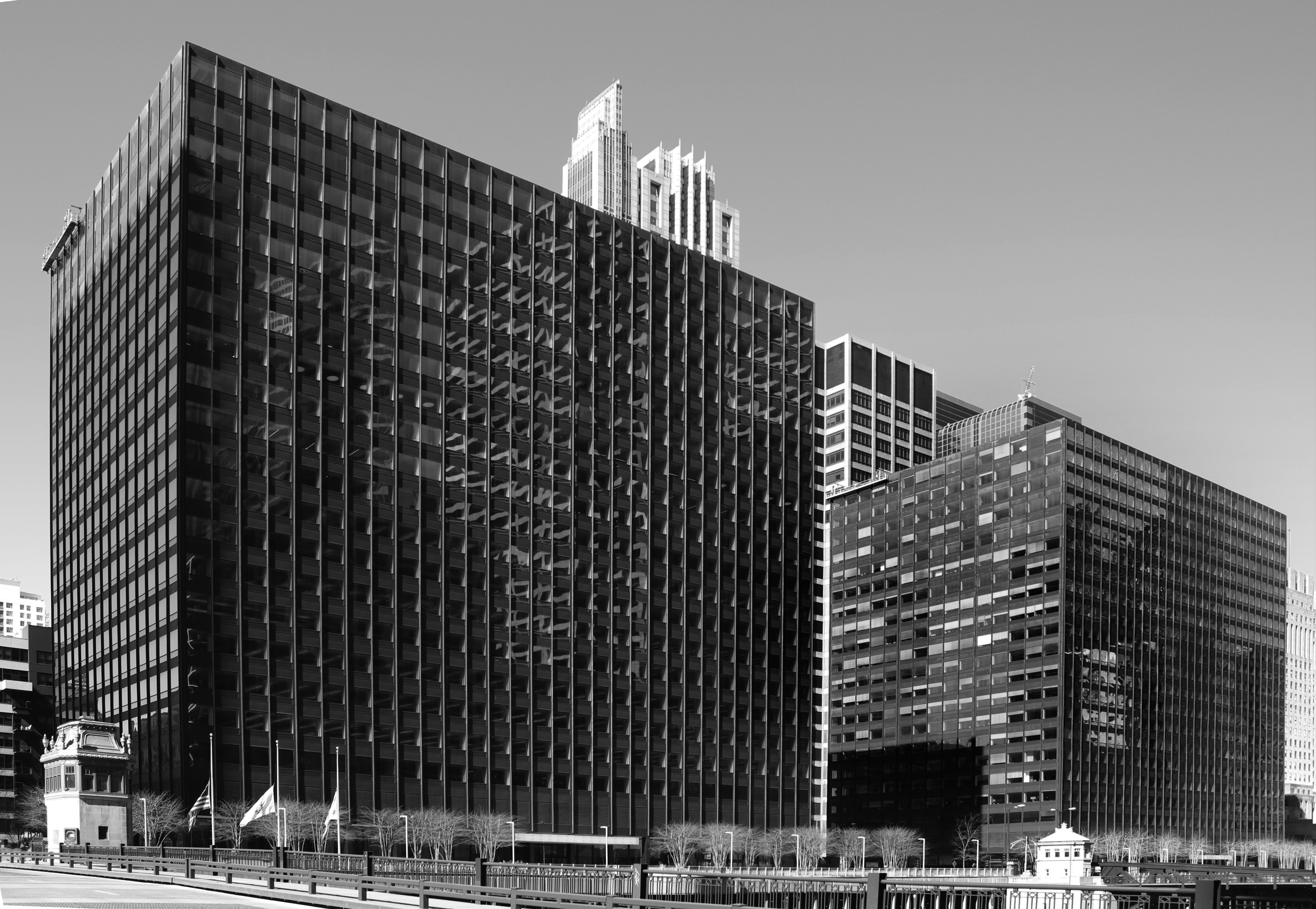
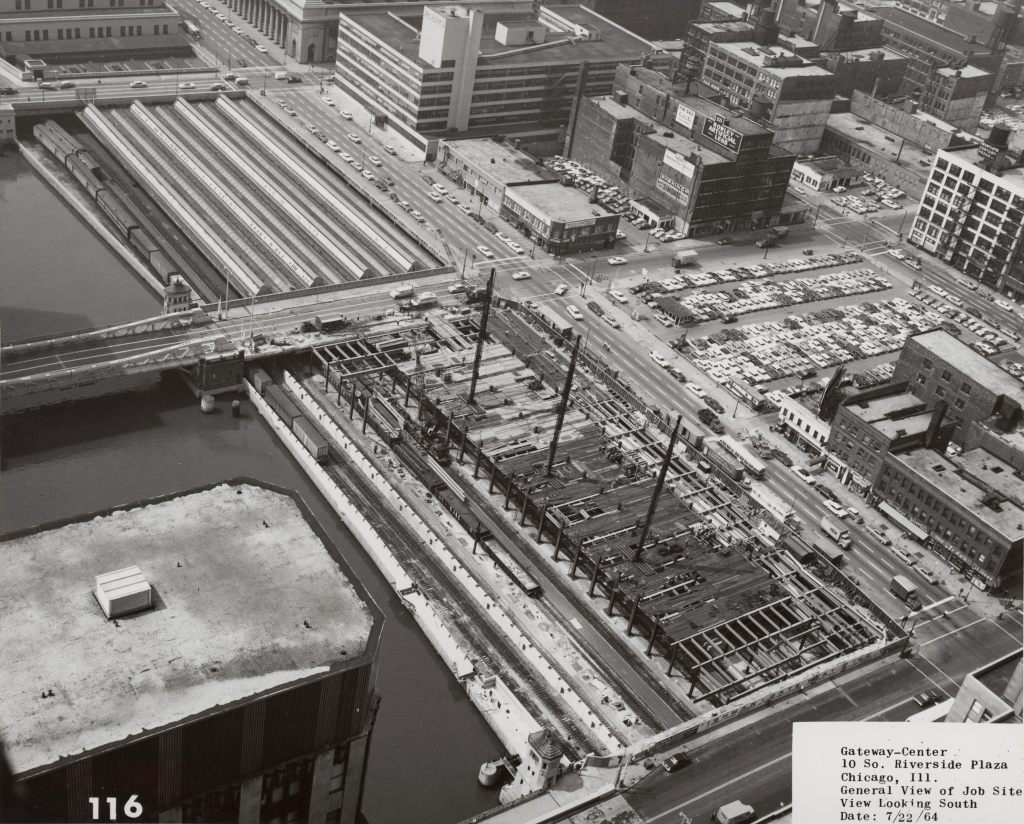
Wolfson died of cancer in June 1962, however, throwing the project into doubt. His air rights options ran out, though the railroads and the city expressed interest in renewing them.[vi] New York-based Tishman Realty and Construction took over his leases, keeping SOM on board and hiring Arthur Rubloff as their local agent. Tishman was more ambitious than Wolfson had been. SOM released a revised design for them in January 1963, showing a 20-story steel frame clad in glass and black metal set on a riverfront promenade with plazas at the Madison and Monroe ends of the block. An inset glazed lobby and projecting I-beam mullions made this design SOM’s strictest Mies’ interpretation yet, though with blue-green heat-absorbing glass that contrasted with the otherwise dark palette. Office floors within extended north and south from a central core and the structure was tuned to the position of tracks below, with three track-spanning 45’ bays in the east-west direction and fifteen smaller, 18’ bays running north-south to reduce spans and, thus, vibration from trains underneath.[vii] All told, Gateway I would contain 750,000 square feet and cost $20 million.[viii]
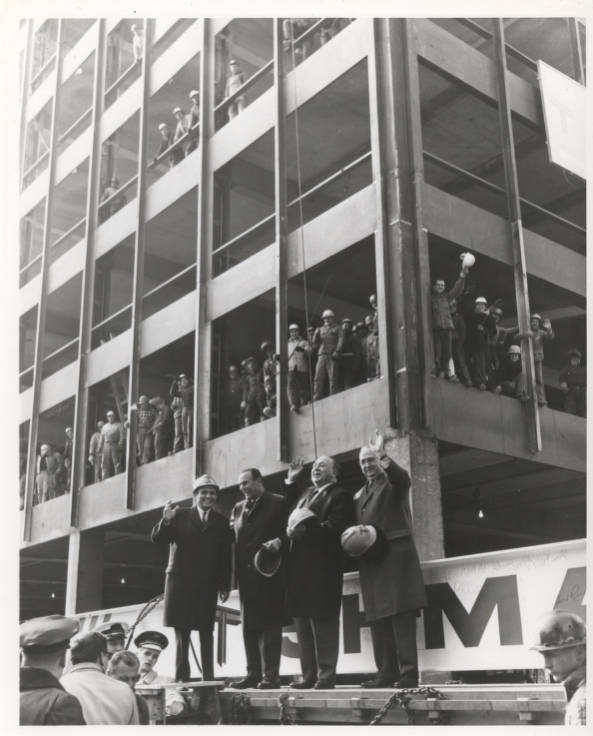
Reassured by Daley’s personal role and the promise of new investments in the West Loop, First National and Continental Illinois led Gateway’s financing. This first tower broke ground in September 1963, as Tishman reported that 14 stories had been leased and that a second building, south of Monroe, would follow suit. Originally planned as a four-story transportation center to meet the Central Area Plan’s goals, Tishman was so convinced of the market that it re-conceived this second phase as a twin to the first.[ix] This first building opened in February 1965 and the second, a strict copy, broke ground that December.[x] Steelwork for Gateway II began rising in the spring, of 1966, and Gateway I filled that August, with IBM, Weyerhaeuser, and Monsanto taking space in its upper floors.[xi] Tishman began looking for the next logical expansion, taking an unfortunate cue from New York’s Penn Station, where they had been consultants for Madison Square Garden and Penn Plaza, projects that involved the demolition of the McKim, Mead, and White Penn Station. In March 1967, Tishman vice president Perry Herst announced that the third phase of Gateway would rise above Union Station’s boarding platforms, replacing the stone, steel and glass head house from Graham, Anderson, Probst, and White’s 1922 structure. This, Herst explained, would keep the development contiguous, rejecting a proposal from the city to build farther west in the West Madison urban renewal district.[xii] Objections from Chicago’s burgeoning preservation movement failed to convince the City to stop the demolition.
Tishman presented SOM’s preliminary plans for the third Gateway Tower in February 1969—initially a steel frame with aluminum and glass curtain walls, much like the first two buildings, but with different proportions—a square plan of 35,000 square foot floor plates extended to 35 stories. Much of SOM’s work went into weaving Union Station’s pedestrian access and baggage services through the structure, but as the design progressed, Graham brought Fazlur Khan in to consult on the structure as well. Khan had, by this point, engineered so-called tube structures for the Hancock and Chestnut-DeWitt apartments (see Chapters 6 and 8), and he proposed the ‘composite tube’ to address the unique problems of Tishman’s site. Perimeter walls of steel columns encased in structural concrete would form a stiff exterior shell. In contrast, a lightweight, more flexible structure of steel alone would support its interior—a more literal interpretation of the Monadnock’s hybrid. The exterior shell alone would provide lateral resistance, eliminating heavy shear walls that would have interfered with the tracks below. Light steelwork supporting the center of the building could be supported on smaller, shallower foundations, limiting the amount of deep caisson work required between tracks.[xiii] Tishman’s executives approved the idea, and Khan’s revised design began to take shape in early 1970.[xiv]
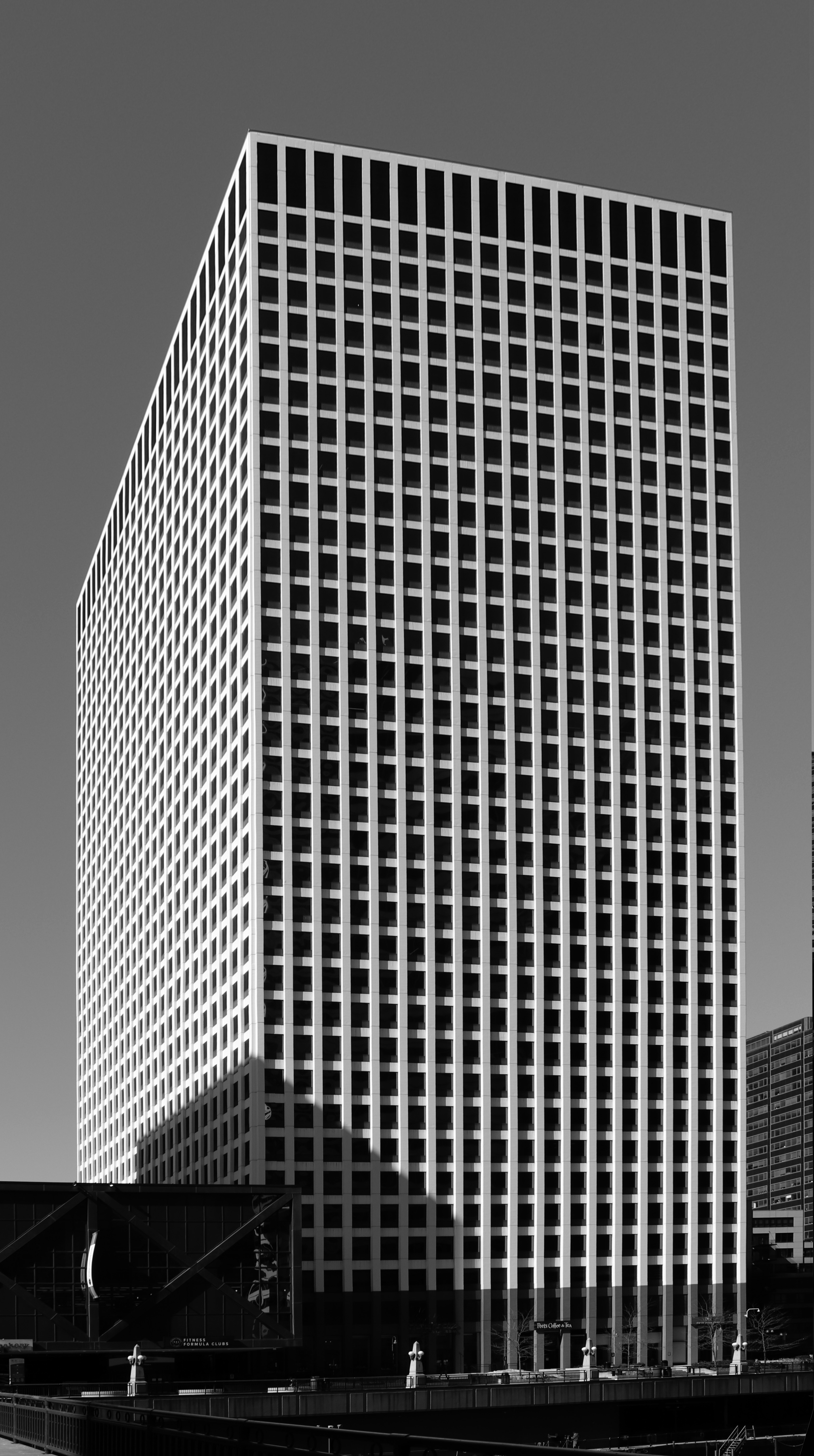
Tishman’s optimism was borne out as the third Gateway building topped out in 1971 when insurance brokerage Marsh & McLennan leased the top eight floors for 20 years—at $36 million, the largest commercial office lease in the city’s history.[xv] That paralleled the Chicago Mercantile Exchange’s announcement that they would occupy a dedicated trading floor in an extension to the new tower, a cross-braced, cantilevered structure on Jackson Street.[xvi] A new concourse for Union Station, meanwhile, swapped the spatial drama of the old, glass-roofed head house for 30,000 square feet of underground concessions and corridors on two 12’-0” stories between track and street level.
As the complex opened in January 1972, Tishman announced the fourth and fifth Gateway buildings for the riverside site south of Gateway III, including a long-anticipated heliport and the half block just west of the second building. But these were delayed by economic uncertainty and the politics of the 1970s—Tishman would not complete the final two Gateway blocks, designed by a new generation of SOM architects, until the 1980s. The three original buildings continued to attract tenants, but they also came to stand for SOM’s formulaic approach. The three buildings’ relentless grids and the simple replication of the second structure left critics unimpressed. Paul Gapp, while acknowledging the “cool and proper” Miesian design of the first two, thought the “uncomely” third phase was unforgivable given the demolition of Union Station’s concourse and its replacement with “ugly…lower-level spaces.”[xvii] The three buildings served as effective backdrops, however, to the riverfront promenade, christened “Riverfront Plaza” as the first two buildings opened.
[i] Thomas Buck, “Skyscrapers Planned on Air Rights Site.” Chicago Tribune, July 20, 1961. 3.
[ii] Edgar Kaufmann, Jr., “The Biggest Office Building Yet…Worse Luck.” Harper’s Magazine, May 1, 1960. 220.
[iii] Thomas Buck, “Skyscrapers Planned on Air Rights Site.” Chicago Tribune, July 20, 1961. 3.
[iv] “Wolfson Group Plans Transit Hub.” The Wall Street Journal, Nov. 17, 1961. 24 and James M. Gavin, “$20,000,000 Skyscraper First Air Rights Project.” Chicago Daily Tribune, Nov. 17, 1961. C7.
[v] James M. Gavin, “City Skyscraper Plan Definite—Wolfson.” Chicago Daily Tribune, Jan. 14, 1962. A9.
[vi] “Attempt in Chicago to Build on Air Rights is Being Re-Evaluated.” Wall Street Journal, July 2, 1962. 24.
[vii] “Train Yard Towers.” The Architectural Forum, Vol. 128, no. 2. March, 1968. 73.
[viii] “Start Construction of First Gateway Center Building.” Chicago Tribune, Sept. 18, 1963. C5.
[ix] “Start Construction of First Gateway Center Building.” Chicago Tribune, Sept. 18, 1963. C5.
[x] Alvin Nagelberg, “2d Gateway Building to Rise.” Chicago Tribune, July 30, 1965. C7 and “Begin No. 2 building in Gateway Center.” Chicago Tribune, Dec. 2, 1965. G7.
[xi] “Start Plaza Twin’s Steel Construction.” Chicago Tribune, May 29, 1966. E5 and “Occupancy is Completed in 1st Gateway Building.” Chicago Tribune, Aug. 28, 1966. E1.
[xii] Alvin Nagelberg, “Tishman May Build Over Union Station.” Chicago Tribune, Mar. 1, 1967. E6.
[xiii] “Massive Core [sic] Supports Thin Steel Frame.” Chicago Tribune, Nov. 22, 1970. E1 and “Innovation at Gateway Center.” Chicago Tribune, May 23, 1971. D1.
[xiv] Richard Ellis and David Billington, “Construction History of the Composite Framed Tube Structural System.” Proceedings of the First International Congress on Construction History. (Madrid, January, 2003). 799-810.
[xv] Alvin Nagelberg, “Gateway Lease a Record.” Chicago Tribune, Mar. 25, 1970. D9.
[xvi]“Future Mercantile Home.” Chicago Tribune, May 19, 1970. C7.
[xvii] Paul Gapp, “River’s Newest: One Works, One Doesn’t.” Chicago Tribune, Apr. 15, 1984. K28.
 architecturefarm