[Chicago Skyscrapers, 1934-1986, published by University of Illinois Press, is out now–available on Bookshop.org and Amazon.com, among other outlets.
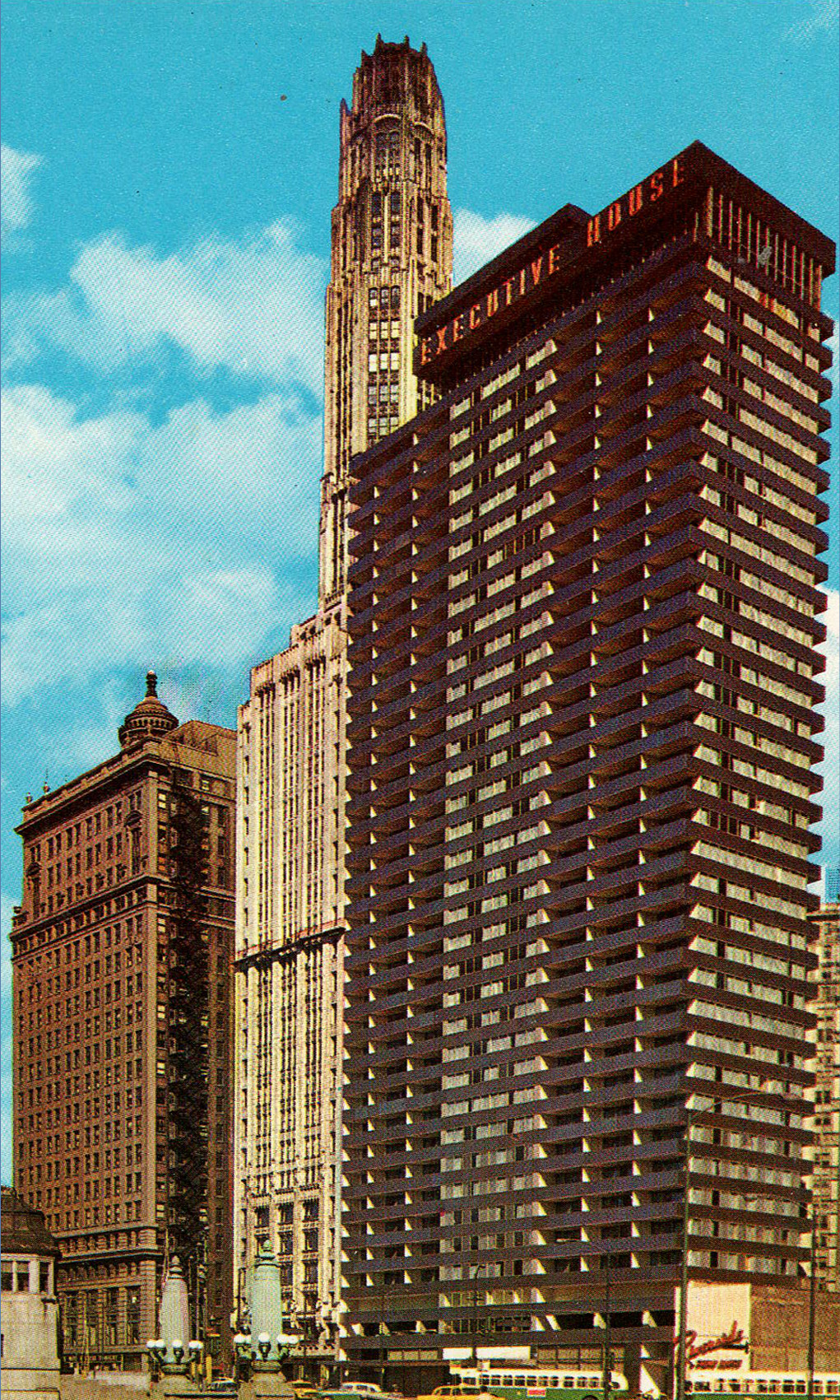
Executive House. (Milton M. Schwartz ,1959).
Hotels were one of the last sectors to resume construction in the Loop after the twenty year building hiatus; by the end of the 1950s, no new dedicated hotel building had been built in downtown Chicago since Holabird and Root’s 23-story Chicagoan was built as an extension to the Morrison Hotel, on West Madison, in 1932. Seeing an overdue opportunity developer George S. Lurie, along with his partner, Jerrold Wexler and two local lawyers, spent much of the decade assembling parcels on Wacker Drive at the northward bend in the River.[i] In 1956, working with Draper and Kramer, they arranged a $3,500,000 loan from Aetna Life Insurance to cover 50% of their costs. In June of that year, they announced plans by Milton M. Schwartz, then enjoying the acclaim from the attention given to his 320 Oakdale and Constellation apartment towers, for a 37-story skyscraper containing a unique mix of units that blurred the distinction between apartment and hotel.[ii] Apartment hotels had a long and mixed history in Chicago—they formed a critical supply of short- and medium-term housing for middle class workers who were able to afford daily or monthly leases but preferred not to commit to longer contracts. Most were built to provide studio—or, in the term of the day, ‘efficiency’—units, with small kitchenettes that were typically supplemented by cafes or restaurants. Their appeal to young singles was apparent in constant controversy over their construction. Often opposed by neighborhood organizations who feared the moral implications of night clubs and large groups of unmarried residents, they saw a gradual change from single-sex to co-ed in the 1950s along with more of an appeal to the lifestyle benefits of the arrangement. Lurie and Wexler, though, claimed a different motive. In talking to investors, they found reluctance to fund pure residential development in the Loop itself. More certain of the market for business travelers, and recognizing the aging stock of hotel rooms downtown, Aetna had been willing to fund a ‘hotel’ but not an ‘apartment’ project, and the investors carefully announced the project as a ‘luxury hotel’ while instructing Schwartz to design the building with kitchenettes in every room. The investors signed a management contract with Condado, a Chicago hotel company, and gradually recognized that the central area was “vastly underbuilt in the apartment hotel field,” where efficiencies and kitchenettes were associated with flop houses on skid row more than with luxury living.[iii]
The hotel’s program reflected Lurie and Aetna’s hedged bets on the future of downtown living; more than 85% of the building’s 448 units were studios—essentially hotel rooms with kitchenettes—providing for both hotel guests and for longer term renters. A restaurant and café on the ground floor replicated the usual apartment hotel amenity, while a cocktail lounge on the roof offered views of the city and, because of the project’s siting, of the River’s main branch. All interiors were provided with air conditioning, and a 200-car garage in the basement could be rented daily or long term—as at the Constellation, Schwartz specified an automobile elevator to save space. Wexler and Lurie proposed rents that reflected the additional services that the hotel arrangement provided—at $150 per month for a studio, rents were about a fifth higher than rates for high-end rentals within walking distance of the Loop and daily rates of $16 were similarly aggressive for local hotels.[iv] But tenants and guests would receive more than access to parking, bars, and a restaurant; finished in ‘gleaming metal and glass’ and with balconies providing fresh air and views, the freshly-named Executive House would also, its backers argued, appeal to the growing taste for urban living among young residents. Initial inquiries were promising; Loop corporations were particularly avid, signing long-term deals for units on what Wexler called the “New York basis,” where company personnel and guests could be put up in their dedicated units while visiting on business.[v] But responses from prospective hotel guests were also strong, and Condado recognized another potential market in tourist and executive families, who would find the suites and kitchenettes particularly attractive.[vi] Ultimately, just eight of the building’s 37 floors were reserved for permanent residents.
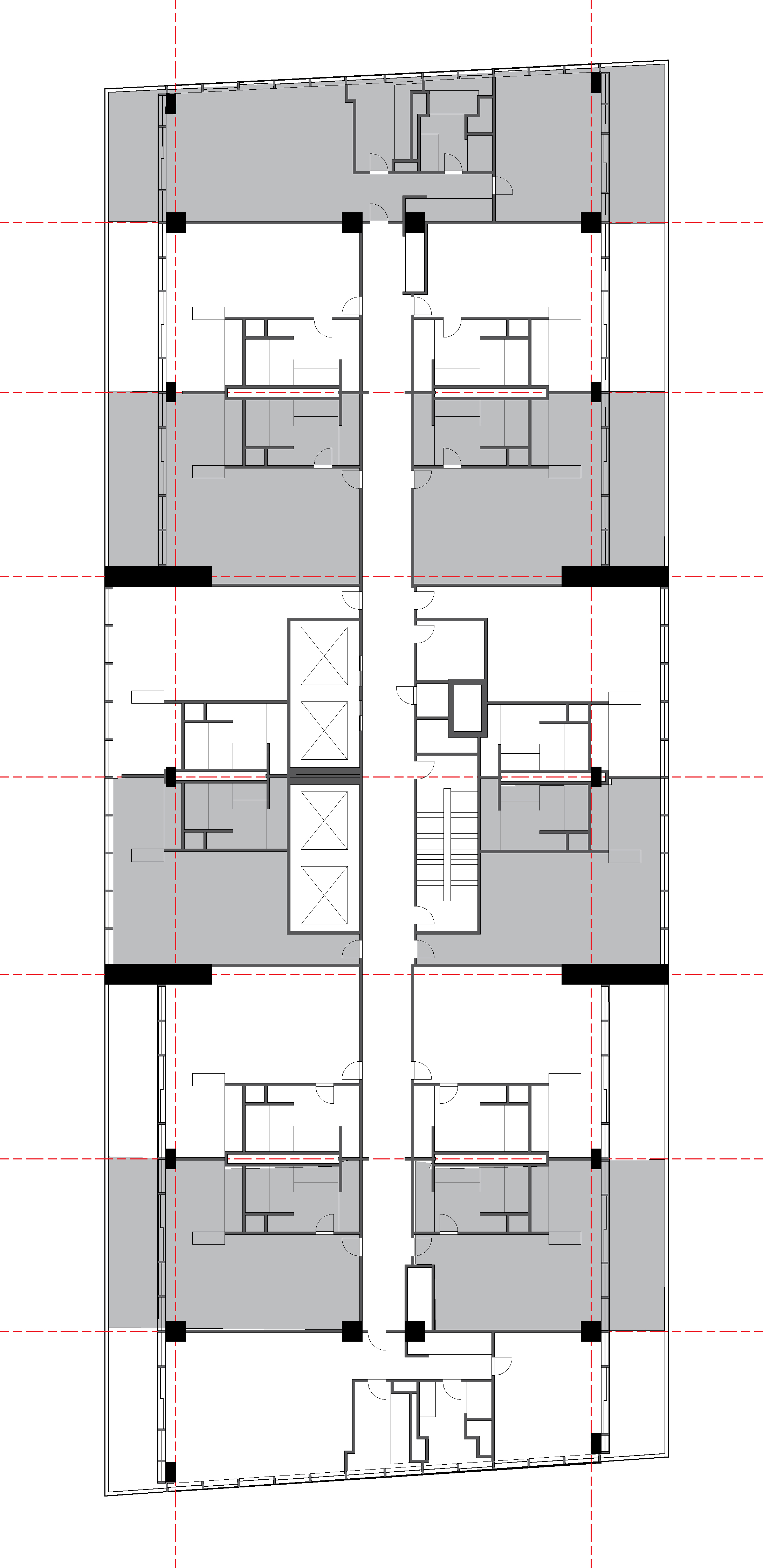
Schwartz initially proposed a cylindrical design for the site but, as at 320 Oakdale, he faced stiff resistance from financial backers for such a radical scheme and instead focused, again with structural engineer Henry Miller, on maximizing views and efficiency. The site was a particularly narrow one, restricted at the rear by Holabird & Root’s 1932 Automobile Club building. Schwartz and Miller’s plan responded with a tightly integrated reinforced concrete structure that relied on shear walls placed ever 40 feet to stiffen a 20 x 20 column grid.[vii] Four centrally located elevators were tied directly to the concrete structure (a mistake that would plague the development with excessive mechanical noise until renovations in the 1980s), across a double-loaded corridor from two interwoven staircases that occupied a single fire shaft. At the ends, one-bedroom suites took up the leftover site dimensions with subtle angles that wedged as much lettable area into the parallelogram of a site; the result was a supremely efficient floor plan of fourteen units per floor—six studios and two one-bedrooms, ten of which had balconies, six of which overlooked the River.[viii] Miller’s design was, briefly, the tallest reinforced concrete structure in the United States, and, at 37 stories, the slab was, also briefly, Chicago’s tallest residential tower.[ix] Interiors of the furnished units, along with the hotel lobby and restaurant, were designed by Morris Lapidus, then riding the popular success of the Miami Beach Fontainebleu, specified gold-upholstered settees to complement blue-green and gold finishes throughout the ground-level restaurant and bar.[x] The “Executive Dining Room and Lounge” was pitched not only to guests and residents, but to the downtown business community as “an atmosphere of muted magnificence” in the “ultra-modern new 40-story skyscraper hotel.”[xi]
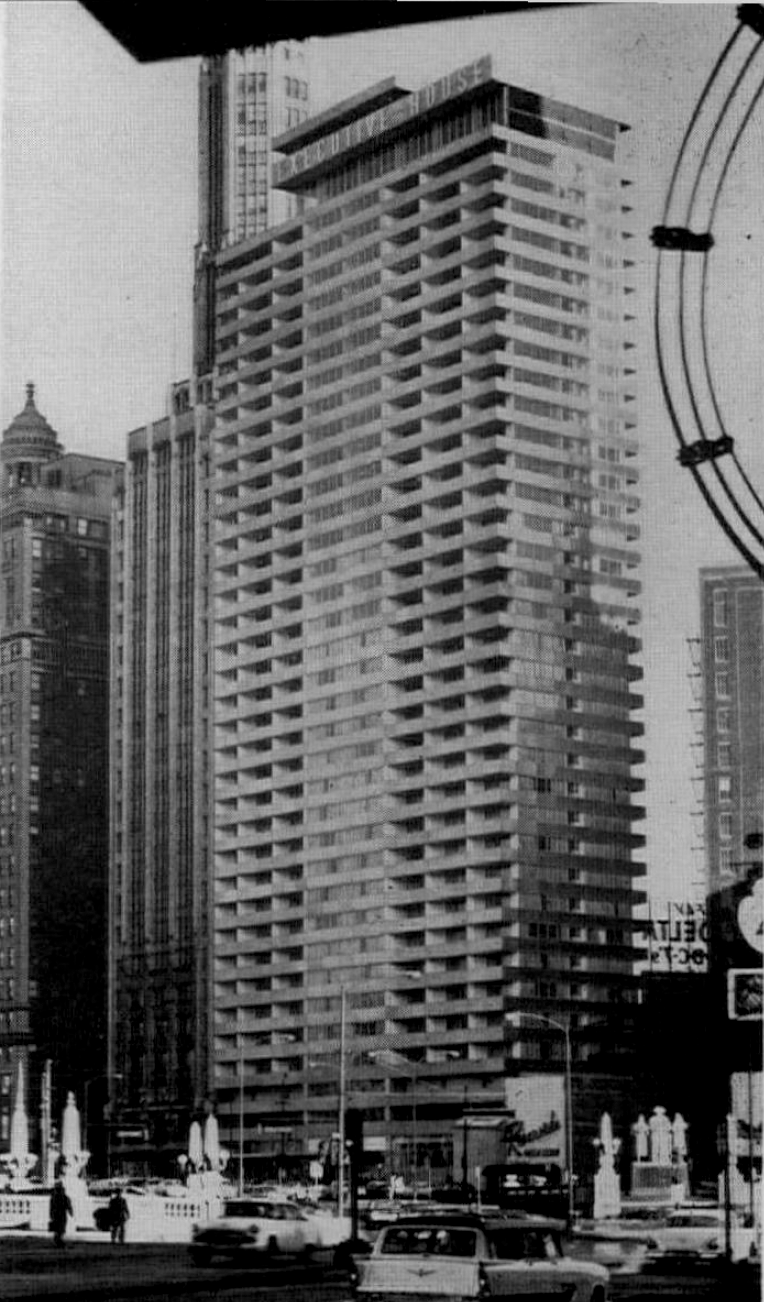
Lapidus’ trademark excess occurred within a project that featured notable technical advances in its foundations and cladding, as well as its record-breaking structural design. The building broke ground, with Mayor Daley in attendance, at the end of January, 1957, and right away the job site attracted attention for its caisson drilling technique. Schwartz, shocked by the poor safety record of foundation excavation in the city, demanded that the contractor, C.A. Tharnstrom & Co., use a French Benoto drilling machine that relied on its own dead weight to screw 3-1/2 foot diameter steel tubes into the ground, after which soil could be safely extracted by bucket from within. The method eliminated the need to send workers into the fragile excavations—though Schwartz insisted on being lowered, himself, to take samples once the machine hit bedrock, but it also handled ground water more readily than traditional methods and it lessened noise and vibration, both critical on the tightly confined site.[xii] The Benoto machine was a success, drilling on average one caisson a day over a two month period over 110 feet deep.
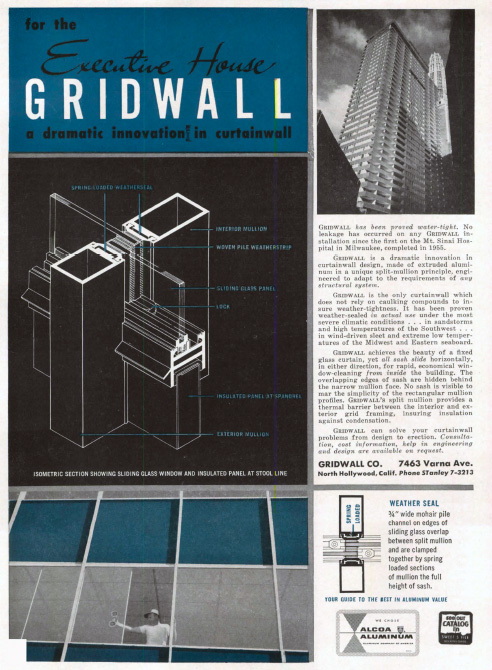
Surrounding Miller’s reinforced concrete structure, Schwartz designed a glistening stainless steel skin that functioned as both enclosure and, on the building’s balconies, as a parapet. Grand Rapids-based Haskelite manufactured the metal panels, laminating 26-gage stainless sheets to 4’ x 8’ foam cores 1” thick.[xiii] These were held in place by aluminum z-bars and steel angles connected to embedded plates in the adjacent concrete slabs, all of which provided a precise, even surface that had none of the oil-can effect that marked Inland Steel’s cladding, a few blocks away.[xiv] The resulting elevation was, like Schwartz’ 320 Oakdale, expressive of its slab construction, presenting a powerful horizontal grain to the river that was capped by the asymmetrical cocktail lounge with bright neon signage—a sleek, stylish contrast to the art-deco rocket of Lincoln Tower next door. Fully enclosed units in the center of each floor formed a light vertical counterpoint, but Executive House’s overwhelming sense was that of cool, trim horizontality, emphasizing its views out and over the River and City instead of the grasping skyward reach of the earlier generation. Executive House proved enormously popular; Schwartz’ careful planning and Lapidus’ interiors did, in fact, appeal to the broad range of business travelers, families, downtown professional singles, and corporate guests that Wexler and Lurie had imagined, and the building filled with eager residents and guests even as construction finished in February, 1959.[xv] While the building itself enjoyed continued success due to its location and its amenities, its namesake parent company—renamed to reflect Executive House as its flagship property—floundered in the late 1960s after disastrous expansions including an airport hotel in San Francisco and resorts in Puerto Rico and the Caribbean. The company filed for bankruptcy in 1971, but Wexler and his company maintained an interest in the building. Under management by Ramada in 1986 the building underwent a renovation that enclosed the original balconies and replaced Schwartz’ original clear glass with deeply-tinted, blue-green panes that have obscured the original, more elegant proportions.[xvi] The project’s success was proof that there was a strong market for both hotel and residential construction downtown; it also extended the height to which reinforced concrete seemed viable in skyscraper construction.
[i] Ernest Fuller, “Work Begins on Downtown Apartments.” Chicago Daily Tribune, Jan. 31, 1957. D7.
[ii] Ernest Fuller, “Plan Skyscraper on Wacker Dr.: Tallest Apartment House in City.” Chicago Daily Tribune, June 21, 1956. 3.
[iii] Ernest Fuller, “Many Inquire of Leases in Wacker Bldg.” Chicago Daily Tribune, Mar. 25, 1957. C5.
[iv] Ernest Fuller, “Many Inquire of Leases in Wacker Bldg.” Chicago Daily Tribune, Mar. 25, 1957. C5.
[v] Ernest Fuller, “Many Inquire of Leases in Wacker Bldg.” Chicago Daily Tribune, Mar. 25, 1957. C5.
[vi] “Loop to Have 1st New Hotel in 2 1/2 Decades.” Chicago Daily Tribune, Sep 27, 1957. 1-c9.
[vii] “New Hotel in Midwest Offers Unusual Facilities: Executive House, Chicago, IL.” Architectural Record, Vol. 125, no. 5. May, 1959. 215-218.
[viii] “New Hotel for Chicago’s Loop [Executive House].” Architectural Forum, Vol. 3, no. 2. August, 1959. 124.
[ix] “New Hotel in Midwest Offers Unusual Facilities: Executive House, Chicago, IL.” Architectural Record, Vol. 125, no. 5. May, 1959. 215-218.
[x] Richard J.H. Johnston, “Chicago’s New Hotel Ready to Open.” The New York Times, Jan 25, 1959. X31.
[xi] “New Hotel for Chicago’s Loop [Executive House].” Architectural Forum, Vol. 3, no. 2. August, 1959. 124; and “Executive House Announces the Opening…” Display ad, Chicago Daily Tribune, Feb. 28, 1959. 18.
[xii] Ernest Fuller, “Many Inquire of Leases in Wacker Bldg.” Chicago Daily Tribune, Mar. 25, 1957. C5; see, too, Schwartz Oral History, ARTIC [????]
[xiii] “Executive House Steel Face Shines in Dark.” The Chicago Defender, Jan. 31, 1959. 4.
[xiv] “New Hotel in Midwest Offers Unusual Facilities: Executive House, Chicago, IL.” Architectural Record, Vol. 125, no. 5. May, 1959. 215-218.
[xv] “Guests Filling New Hotel as Work Goes On.” Chicago Daily Tribune, Jan. 10, 1959. B5.
[xvi] Karl Plath, “Executive House Puttin’ on the Glitz to Edge Rivals.” Chicago Tribune, Sept. 13, 1987. [????]
 architecturefarm
Hi Tom, Thanks for sharing. One of my colleagues, Jeff Renterghem lead the conversion of the building to Hotel 71 for Wydham in 2011. It’s been rebranded to the Royal Sonata now I think. The tavern at the ground level was named Hoyts after the merchant whose ware house stood at the corner of Michigan and Water St pre-Wacker Drive.
>
LikeLiked by 1 person