[Chicago Skyscrapers, 1934-1986, published by University of Illinois Press, is out now–available on Bookshop.org and Amazon.com, among other outlets.
Lake Point Tower (Schipporeit and Heinrich with Graham, Anderson, Probst and White, 1965-1969)
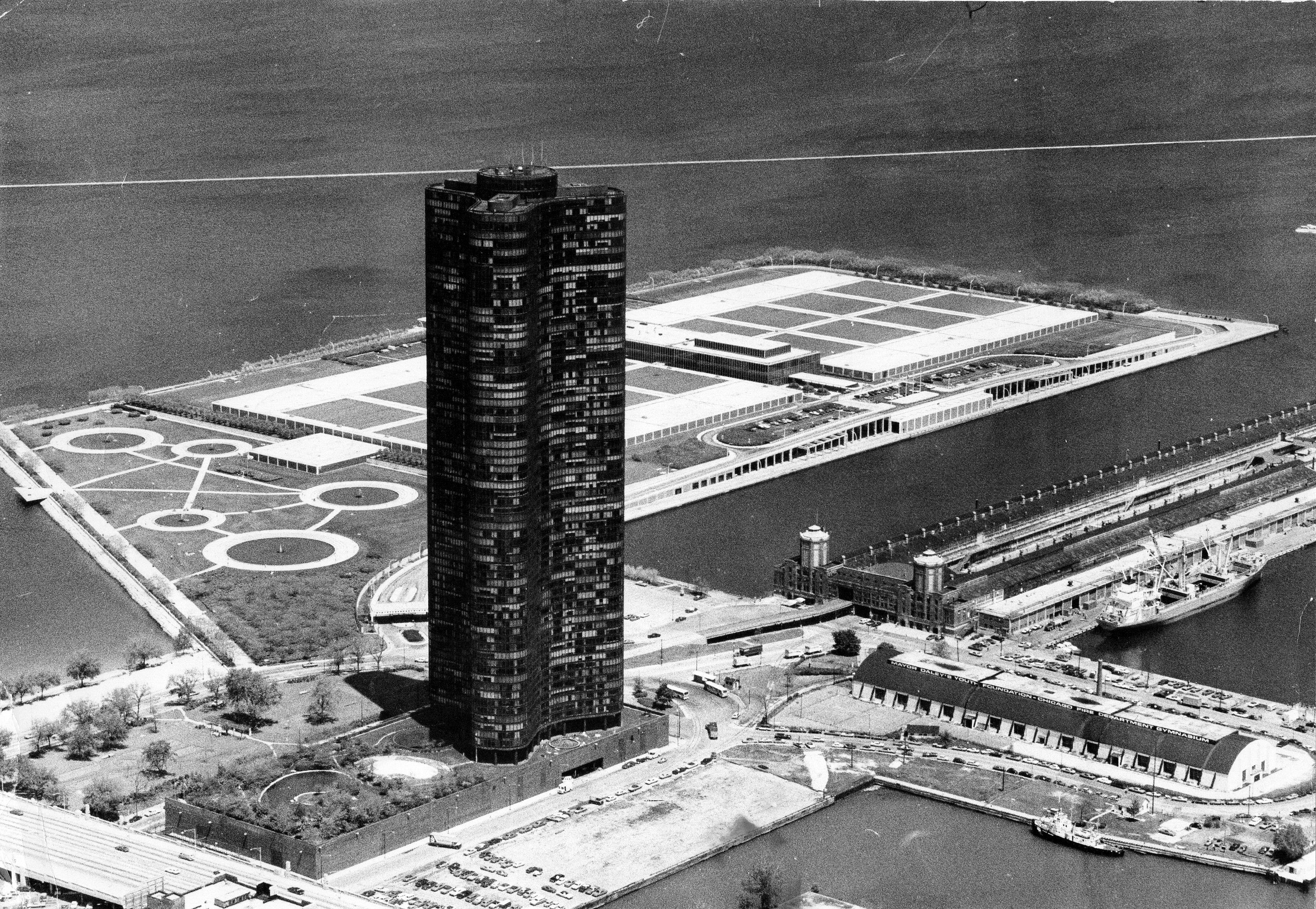
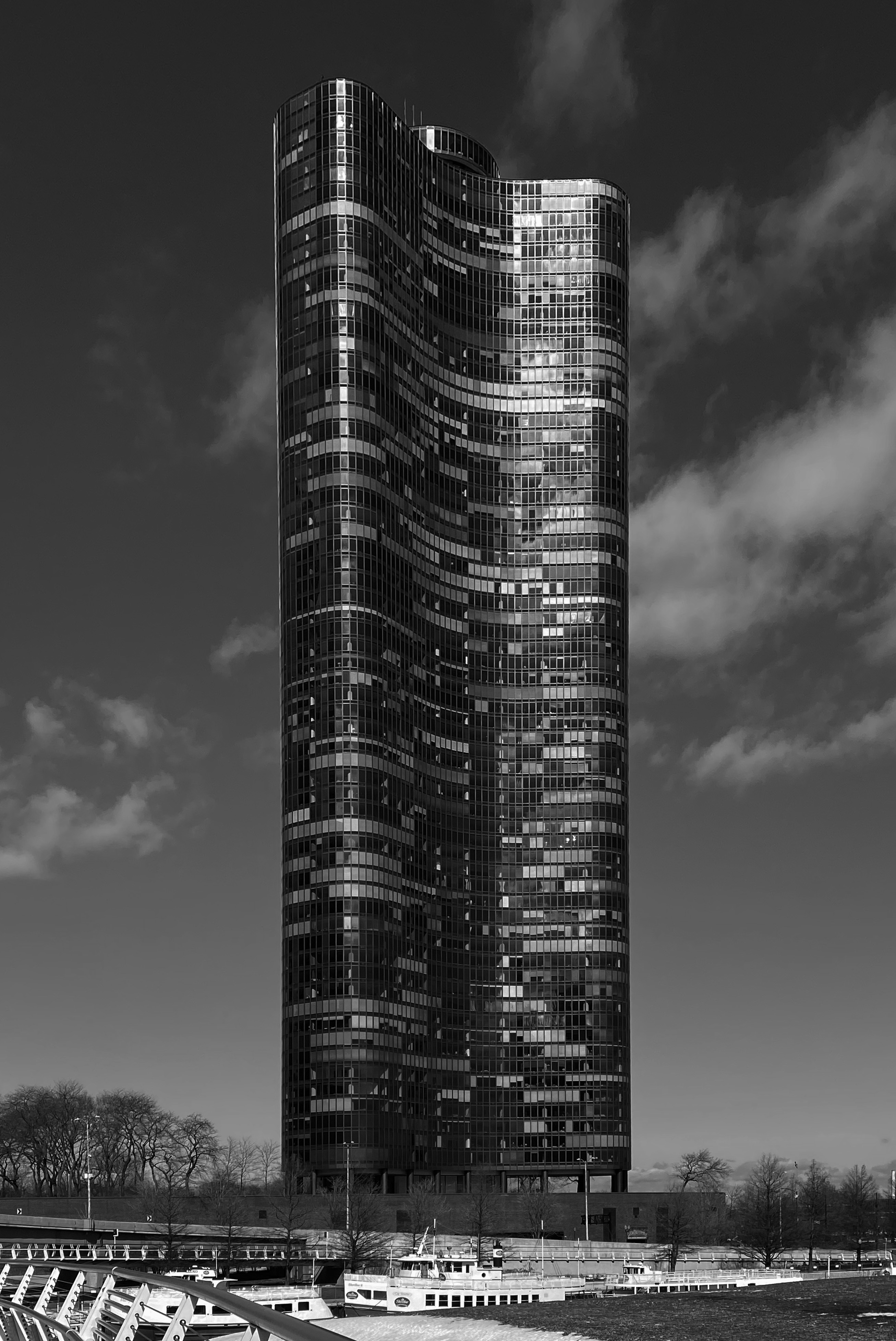
Chicago’s most visible residential tower, rising 645 feet from the base of Navy Pier, sprung from a cladding detail and a helicopter flight, matching a dramatic, undulating curtain wall and technical developments in air conditioning to a singular lakefront location. Owned by Chicago Dock & Canal, the site was occupied by declining warehouses and factories adjacent to the obsolete Navy Pier. Chicago’s port facilities’ move to Calumet drew industry with them, though, and the area’s loft structures gave way to parking lots. By the early 1960s, Chicago Dock & Canal was more real estate company than active port, selling its land to developers who hoped to transform the grimy, polluted acres of fill and asphalt into a desirable residential neighborhood.
Lake Point Tower’s developers and architects were part of a growing network of skyscraper experts centered on Chicago.[i] William Hartnett, a New York lawyer assisting Herbert Greenwald on Metropolitan Structures’ Mies-designed Newark apartment project, worked with Charles Shaw, an Alcoa employee who was develop prototype aluminum housing and high-rise components in St. Louis. Alcoa was considering a demonstration project on the Dock & Canal property and Hartnett and Shaw invited architect George Schipporeit to join them on a helicopter tour of the site in 1962. Schipporeit, a Nebraska native, came to Chicago in 1955 studying at IIT before going to work for Alfred Caldwell and then Mies. He had worked on curtain walls with integral fan coil units for Mies’ Newark and Detroit projects before moving to St. Louis in 1960 to work with Shaw at Alcoa’s Cupples subsidiary.[ii] After joining Shaw for the aerial tour, Schipporeit recalled thinking that the property was “the best site in the country.”[iii] Alcoa passed on the opportunity but Hartnett and Shaw formed their own development company for the site and, after finding initial schemes by Perkins & Will unimpressive, Hartnett turned to Schipporeit, who in turn brought his IIT classmate John Heinrich on board. Heinrich (1928-1993) had been a field architect for Mies on Lafayette Park; he took Schipporeit up on his offer of “the biggest gamble in the world.” Hartnett and Shaw brought Los Angeles-based Fluor into the project as financiers, while Schipporeit and Heinrich associated with Graham, Anderson, Probst, and White for technical assistance and with William Schmidt for structural engineering.[iv]
The site, east of Lake Shore Drive between Illinois and Grand, was massive but “marooned,” in Schipporeit’s words, a half-mile from Michigan Avenue. Zoning would allow over 1230 apartments, they estimated. Wanting to leave as much open space as possible, Schipporeit and Heinrich accommodated these within a point tower rather than a slab. Given the site’s extraordinary views they developed a cruciform plan with rounded corners to provide lake and skyline panoramas. Set diagonally at the far eastern end of the site, atop a podium containing parking and a landscaped deck, the four wings of the tower were to radiate from a central core. As the design progressed, Fluor grew concerned about renting so many units at such a remote site. Marina City, they pointed out, had only 900 units and Outer Drive East just 945. One of Fluor’s executives suggested slicing one arm of the cruciform off, leaving a three-lobed form that reduced the number of apartments, offered more open views and greater privacy, and—with some fine-tuning—eliminated inefficient fire stairs at the corridor ends of the four-armed scheme.[v] Schipporeit and Heinrich took to this idea, first laying out a three-lobed plan around the site’s east-west axis, accessed by long automobile ramps from the west end of the site. They found the resulting form “too static.” By rotating the tower 120°, however, so that one arm pointed due north, the tower fit more comfortably on its base, allowing more generous space for automobile access from Grand Avenue, an enclosed drop-off they developed with an open skylight in the roof, offering a dramatic, upward view of the tower.
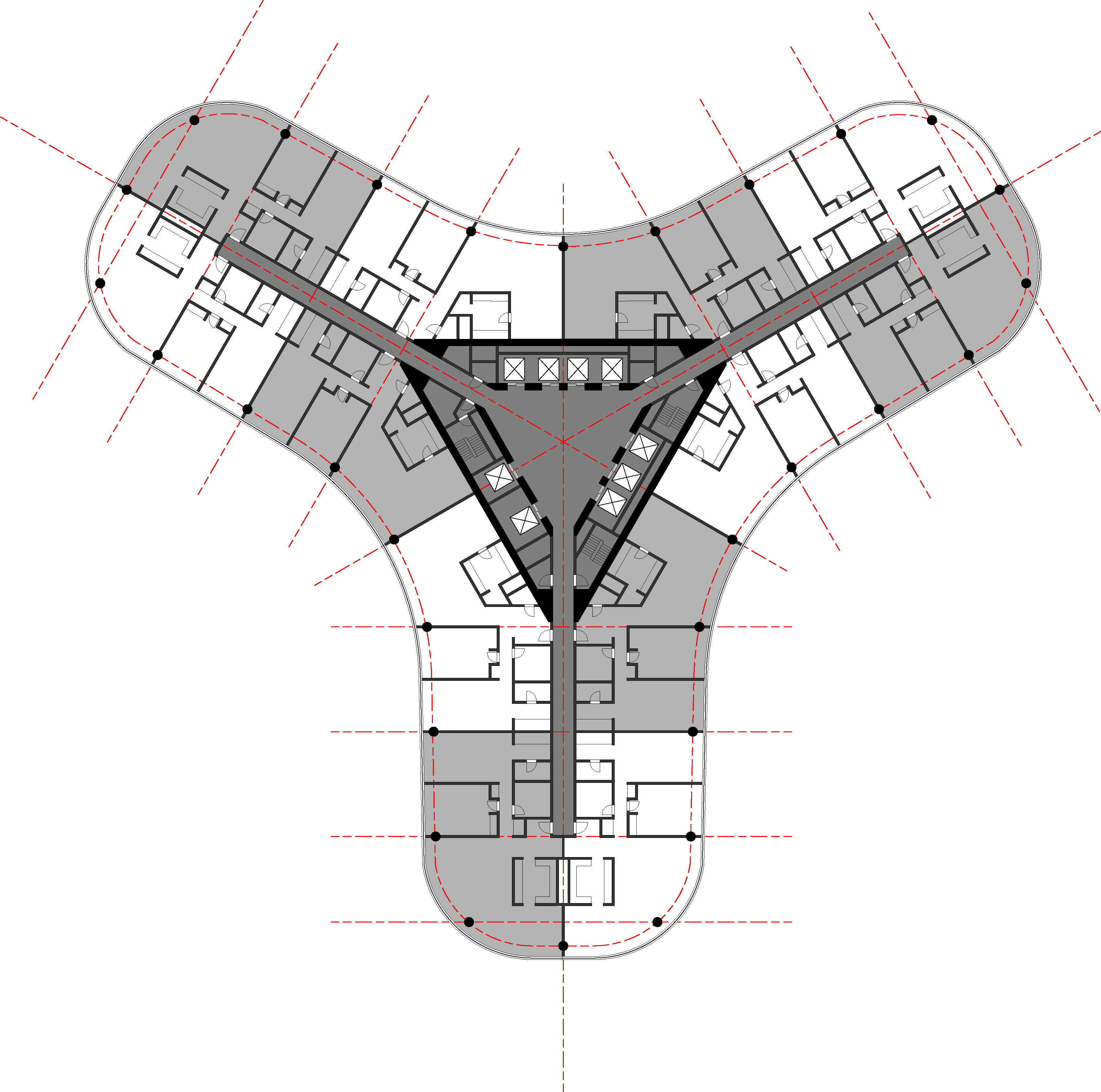
The scheme’s three arms implied a triangular core— structurally efficient but difficult to arrange. Schipporeit and Heinrich turned its elevators toward a central lobby on each floor that led through the core’s corners to radial hallways, with fire stairs and service shafts wedged into the triangle’s vertices. The apartments were laid out to maintain an even depth tangential to the corridors and core walls. The resulting soft transitions from the tower’s curved corners to its long re-entrant curves created a sleek form that, wrapped in a black aluminum and dark glass curtain wall, was arresting and allusive. Critics would compare this curving glass wall to Mies’ 1922 Glass Skyscraper’s curving concrete floors and transparent glass walls. Schipporeit and Heinrich were happy to claim this lineage, but this was a superficial comparison. Mies’ early schemes would have stood just 30 floors tall, less than half Lake Point’s height, and he never developed mechanical services or lateral bracing for them. Their floor-to-ceiling glass curtain walls without intermediate mullions remained infeasible even in 1965.
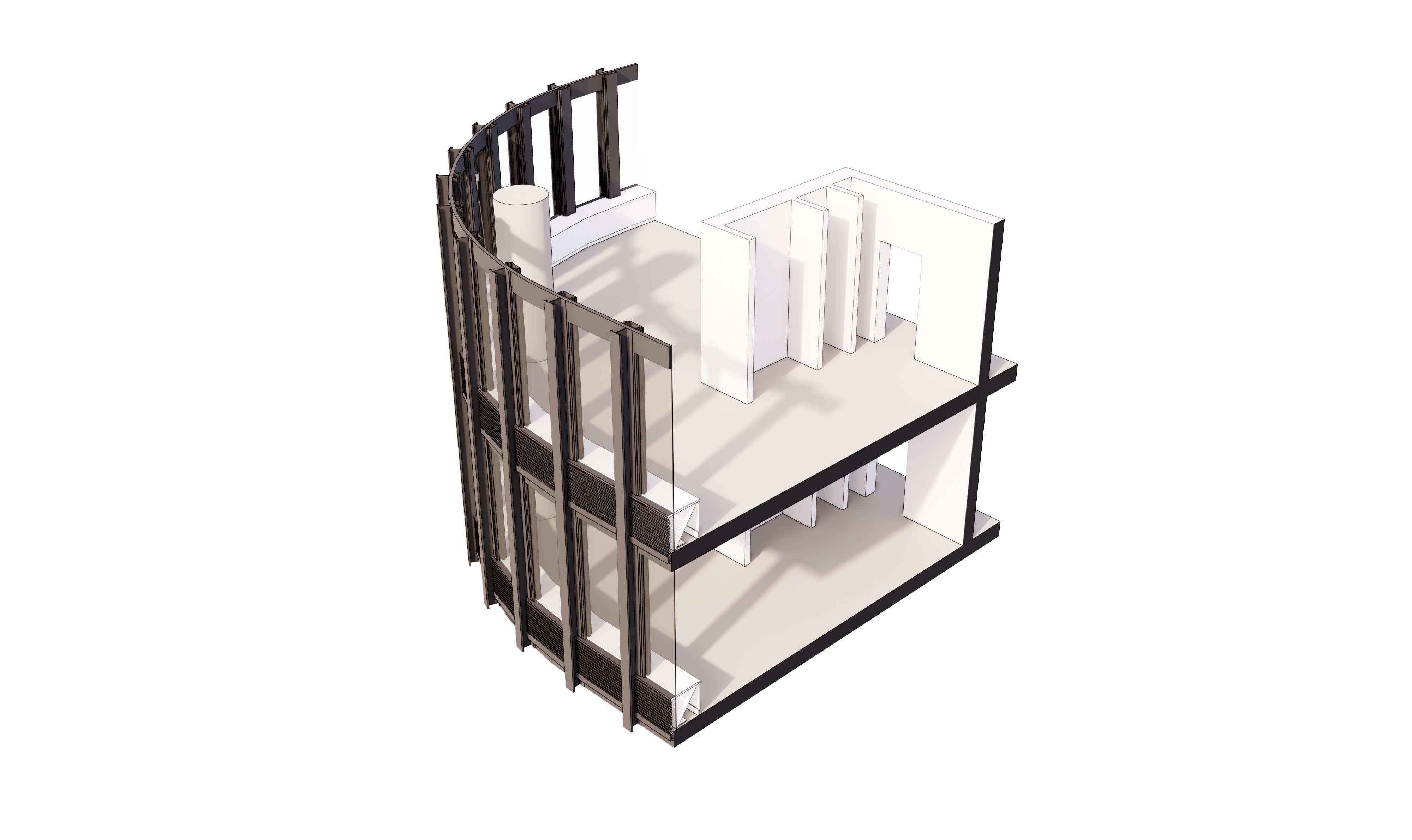
Schipporeit and Heinrich’s curtain wall experience with Mies gave them a good understanding of their infiltration, condensation, and thermal problems. Schipporeit recalled constant visits to the Esplanade Apartments to survey and propose fixes for leaks. Improved extrusions and sealants addressed these problems but combining code-required natural ventilation with mechanical heating and cooling loaded curtain walls with functions that competed for space. Schipporeit had developed integral, knee-height cabinets for the Detroit and Newark projects that could accommodate either fan coil units or operable, grilled apertures supplying fresh air. He and Heinrich adopted this detail for Lake Point Tower, with cabinets that alternate between housing electric fan coil units and screened openings, both integrated with the curtain wall sill panels.[vi] Each window panel runs from one cabinet’s top to the next floor, framed by two horizontal mullions for each story, all set behind a screen of vertical aluminum I-beams. The result is a delicate, woven texture like the Esplanade and Commonwealth curtain walls—but wrapping an evocative form. The same cladding panel repeats more than 11,000 times and the building’s lack of sharp corners means no special detailing was needed, as in Mies’ towers, to end one plane and begin another.[vii]
The undulating tower was topped by a rooftop mechanical unit and, above that, a circular pavilion containing a private lounge for residents. At the base, the podium was designed to accommodate 700 cars and retail facilities within a minimalist brick box—often criticized for its forbidding, 30-foot-high walls, which were more appropriate in the building’s original context of grim industrial buildings and abandoned docks. The base does contain one piece of immense structural drama—the 108’ clear span that forms the automotive drop off and leads on to the ‘rotunda’ on the Grand Avenue side, while the podium’s roof houses a garden designed by Caldwell.
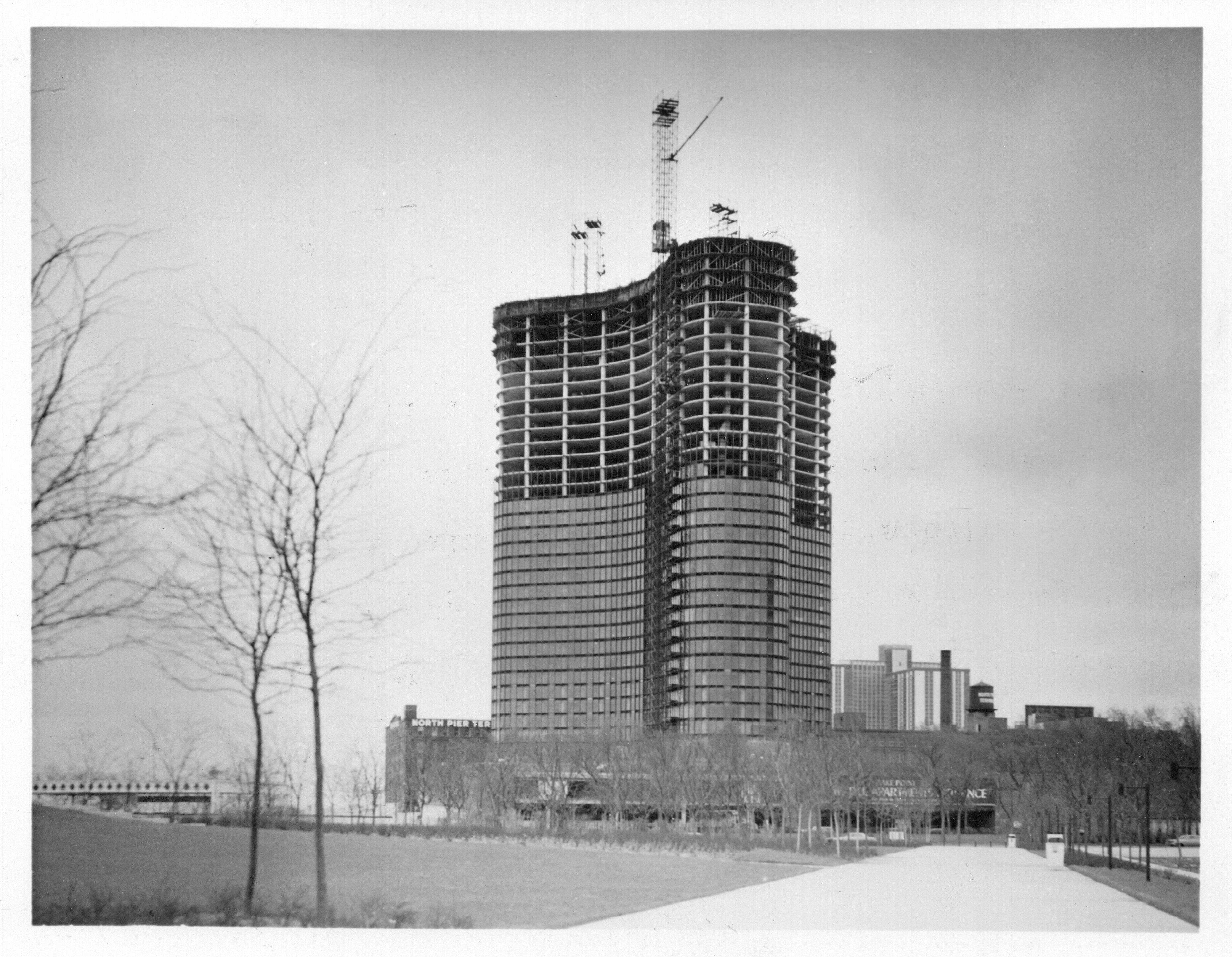
At 70 stories, Lake Point was one of several Chicago structures to claim the title of world’s tallest reinforced concrete structure.[viii] William Schmidt, Chicago’s most prolific flat-plate concrete engineer, designed the tower’s core walls to taper from 30” at the base to 12” at the 56th floor, above which they are replaced by simple columns. Eight-inch lightweight concrete slabs connect to the core and columns with reinforced joints to form a monolithic, wind-resistant structure. Schmidt specified high-strength concrete throughout the columns and core walls, minimizing their bulk and weight, and these savings allow the entire building to sit on a layer of good hardpan 90’ below the surface, tied to the core walls with a 24’ deep grade beam. Schmidt deployed a network of strain gauges throughout the foundations and superstructure to test his calculations after the building was occupied, making the building a laboratory for wind engineering for years after its completion.[ix]
Crane Construction began work in November 1965 as the project faced protests upset at its intrusion on the lakefront. Lake Point was the third project to be built east of Lake Shore Drive, after Outer Drive East and Solomon, Cordwell, and Buenz’ Harbor Point Tower, both at the end of the extended Randolph Street. For decades, Chicago builders had a gentleman’s agreement that no construction would take place between the Drive and the actual Lake—not that there were that many potential sites wedged between the two—and Lake Point drew pointed arguments about the tradition of a public shoreline.[x] These were matched, however, by genuine fascination as the tower grew out of its foundations at the rate of a floor every three days, reaching the 16th story by October, 1966 and the 29th by January, 1967.[xi] Construction was slowed by a building trades’ mechanics strike in January, 1967 and the operating engineer’s strike that spring. But by the end of 1967 the structure was topped out, with Daley praising the project’s “young entrepreneurs for another fine edifice for the future of urban living.” By then it was occupied by over 100 tenants, who moved into the lower floors as construction continued above them.[xii] More than half of the building’s units were leased by the time upper floors were completed in April 1968. Its rooftop lounge— “a masculine flavor carried out in a French Norman interior”—and a street-level steak restaurant sealed the building’s appeal when they opened in 1970.[xiii]
Lake Point Tower won the local AIA chapter’s top architectural award and was one of fourteen projects recognized with national AIA awards in 1970. Hartnett and Shaw planned expansions of the original in 1965, when Schipporeit and Heinrich proposed two duplicates of the three-armed tower to the south and west of the original and in 1971, when they modeled three boomerang-shaped slabs flanking the entry to Ogden Slip.[xiv] None of these proceeded beyond massing studies, but Schipporeit and Heinrich did collaborate with Hartnett and Shaw on one other large project, the 22-story State National Bank at Orrington and Davis in downtown Evanston (1968-69), a more doctrinaire Miesian prism, after which Heinrich left to pursue teaching full time.[xv] Schipporeit continued designing commercial and residential towers, including the 13-story Eisenhower Tower in Maywood (1973), the mid-rise Atrium Village on Division Street and 18-story One Rotary Center in Evanston (1977), the 33-story Asbury Plaza in River North (1981), and the 38-story Lake Shore Tower on east Ohio Street (1986). His design for the Cor-ten clad parking garage north of Mies’ IBM Building (1974) wrapped vertical cladding elements around the elevated sweep of Wabash Ave. in a subtle nod to IBM’s vertical mullions, repeating in principle the visual effect of Lake Point Tower’s articulate aluminum piping.
[i] See the outstanding Edward Windhorst and Kevin Harrington, Lake Point Tower: A Design History. (Chicago: Chicago Architecture Foundation, 2009) for an authoritative, detailed history of the project.
[ii] “Build a Room with Aluminum Panels?: Versatility Noted.” The Christian Science Monitor, July 06, 1962. 12.
[iii] Interview with George Schipporeit, Illinois Institute of Technology Architectures Studios. 10 October 2012, 1600-1800.
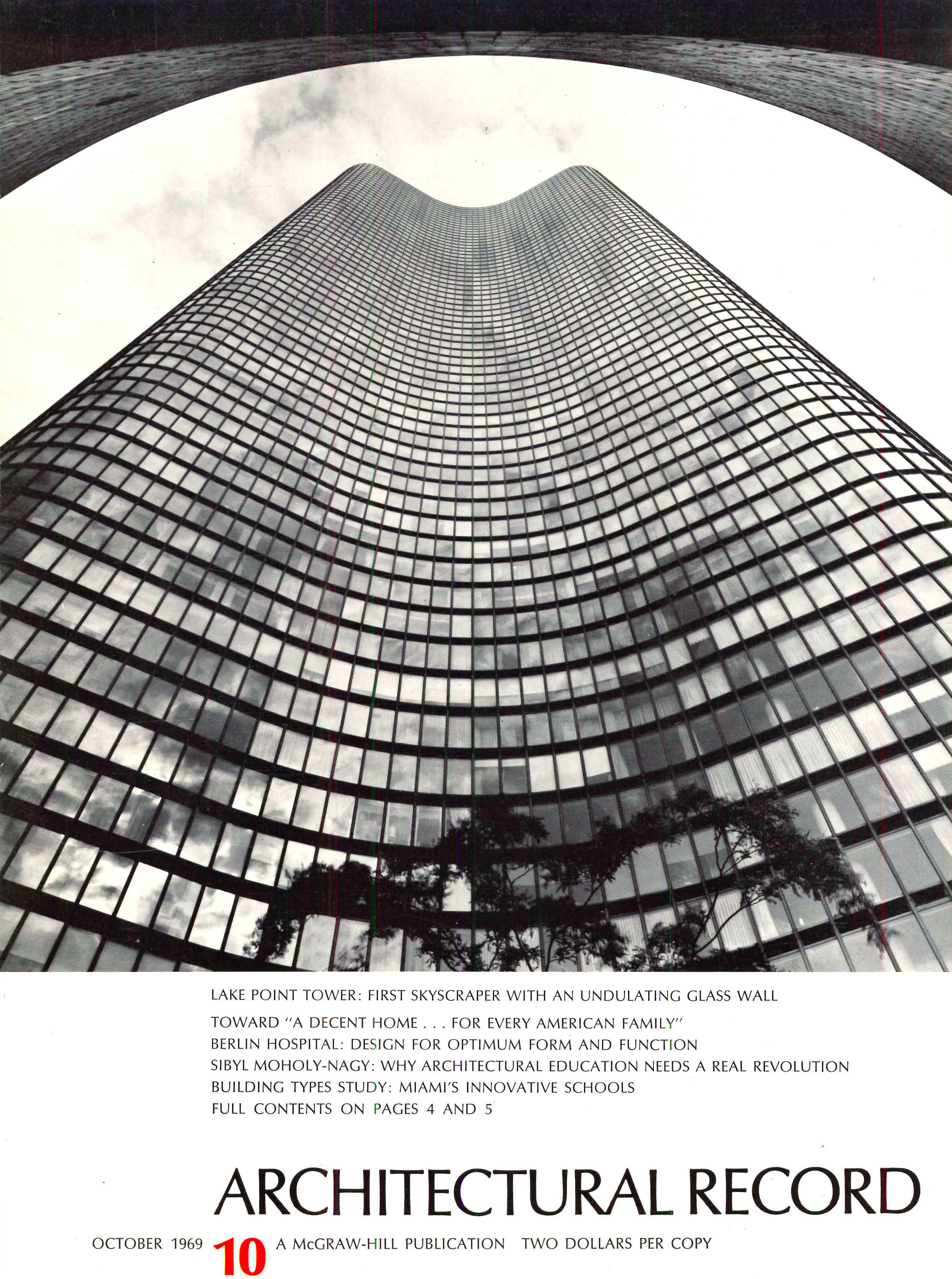
[iv] “Lake Point Tower: The First Skyscraper With an Undulating Glass Wall.” Architectural Record, Vol. 146, no. 4. Oct., 1969. 130.
[v] “How High to Build? Need Tells.” Chicago Tribune, Feb. 8, 1970. E1 and Edward Windhorst and Kevin Harrington, Lake Point Tower: A Design History. (Chicago: Chicago Architecture Foundation, 2009). 6.
[vi] Display ad, “All Electric Design [Lake Point Tower].” Architectural Record, Vol. 146, no. 4. Oct., 1969. 278-279.
[vii] “Lake Point Tower: The First Skyscraper With an Undulating Glass Wall.” Architectural Record, Vol. 146, no. 4. Oct., 1969. 130 and “Tallest Apartment Tower Will have Aluminum Skin.” New York Times, June 4, 1967. 1.
[viii] “Chicago Keeps Building Them High with Concrete.” Chicago Tribune, May 15, 1966. F1.
[ix] “New Tower to be a Giant Test Station.” Chicago Tribune, Jan. 9, 1966. 1-e1 and Barbara Schmidt Hornkohl, “The Structural Engineer: A Retrospective of the Engineering of William Schmidt” in Nancy Gavlin, ed., Engineering in the City of the Century. (West Lafayette: Purdue University, 1998).
[x] “On The Streets.” Chicago Tribune, Oct. 28, 1965. 1-e9.
[xi] Alvin Nagelberg, “Reveal Floor Plans, Rent Schedules for Lake Tower.” Chicago Tribune, Oct. 7, 1966. D11 and “Construction Lags: 70,000 Men Off Job.” Chicago Tribune, Jan. 28, 1967. B7.
[xii] Alvin Nagelberg, “Lake Point Twinkles on Skyline.” Chicago Tribune, Dec. 9, 1967. D7; Alvin Nagelberg, “Lake Point Topped Out.” Chicago Tribune, Dec. 29, 1967. C9; and Glenn Fowler, “Eager Tenants Lived in Tower as it Went Up: Tenants at Topping-Out.” New York Times, Feb. 11, 1968. 2.
[xiii] Kay Loring, “Lake Point Tower Opens Continental Restaurant.” Chicago Tribune, Aug. 2, 1970. F5.
[xiv] Alvin Nagelberg, “Plan Lake Shore Dr. Apartments.” Chicago Tribune, June 23, 1971. C9.
[xv] “Developer Tells Need for Evanston Tower.” Chicago Tribune, June 18, 1967. 1-d1.
 architecturefarm
It looks lonely.
LikeLiked by 1 person