postwar chicago skyscraper of the week: IBM’s “evangelical modernism.”

[Chicago Skyscrapers, 1934-1986, published by University of Illinois Press, is out now–available on Bookshop.org and Amazon.com, among other outlets.

IBM (Office of Mies van der Rohe, 1968-71)

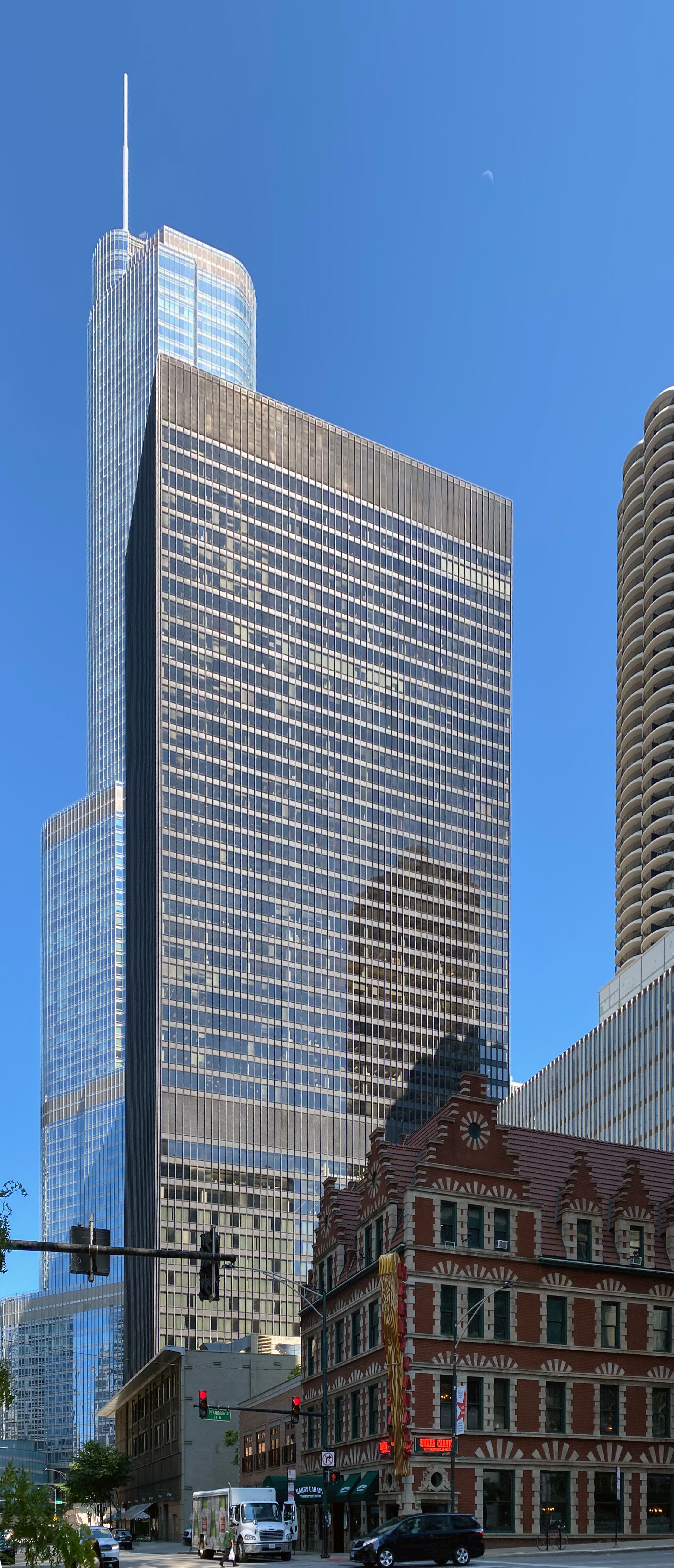
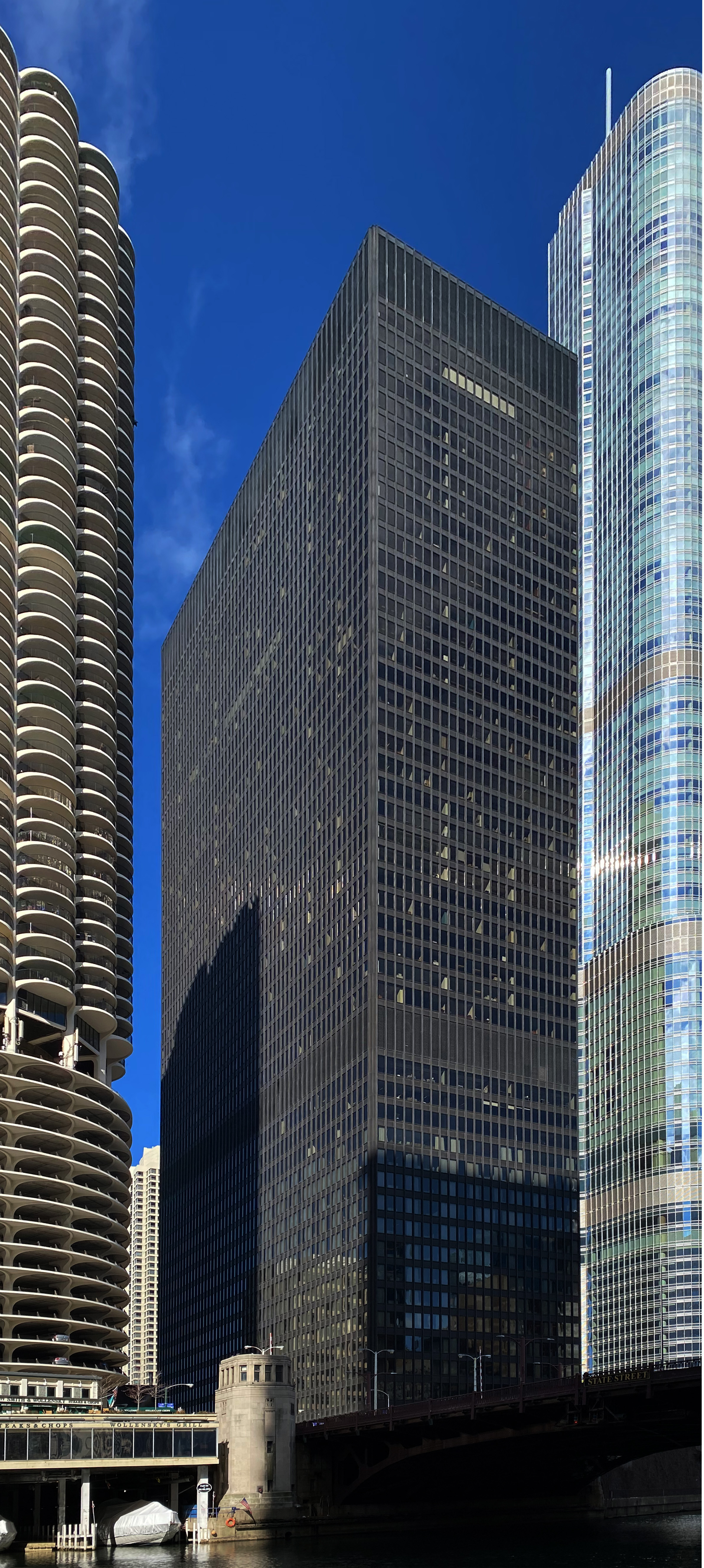
Mies’ ongoing influence had its paradigm cases in projects carried on by his office after his death.  By the mid-1960s, the incomplete Federal Center was his sole building in the Loop proper and his only Chicago high-rise besides the Metropolitan Structures’ apartments.  IBM, meanwhile, was building regional and national office buildings that reflected its successful mainframe computer business.  From Marcel Breuer’s research laboratory at La Gaude, France, to SOM’s “heavyweight compound” in Armonk, IBM saw architecture as marketing— “we were trying to look like what we produced,” Chairman Thomas Watson recalled.[i]  The company first looked at the irregular site on the Chicago River between State and Wabash in November 1966, taking an option to buy it from the Field Estate, which also owned the Sun-Times newspaper headquartered across Wabash.  They approached Mies’ office to design a 1.8 million square foot tower, planning to occupy half as its regional headquarters and to lease the rest.[ii] 

Conterato recalled driving past the squib-shaped block and Mies asking incredulously, “where’s the site?”[iii]  Placing a large building on such a minuscule, oddly-shaped site—just 1.6 acres and boomerang-shaped—was made even more challenging by its neighbors.  To the west, Marina City was now an iconic riverfront presence.  Conterato and Fujikawa were sensitive to its presence and contemplated how such a large building would affect its views from and toward the lake.  To the east, the low-rise, Naess and Murphy-designed Sun-Times building (1955-58) presented no issues above ground. Still, the newspaper had an easement extending underneath the Wabash Drive viaduct into the IBM’s site’s basement story.  Early schemes contorted the tower into a U-shape following Wabash’s curve, avoiding the south end of the site altogether—akin to the arced façade of Mies’ Cullinan Hall in Houston.[iv]  IBM bought a thin slice of Wabash from the City to straighten its site, and the Field Estate pressured the Sun-Times to abandon their basement storage, freeing up a 125’ x 275’ building footprint.  With Mies’ declining health keeping him away from the office, Fujikawa and Conterato sited the building close to the site’s northern edge, leaving a narrow, raised plaza next to Kinzie Street where a lingering railroad right-of-way made foundation work impossible and opening the riverfront to a larger plaza across from Heald Plaza, a park on the south bank that negotiated the River’s turn northward.  Satisfied that its program could be wedged onto the site, IBM exercised its option in September 1967.[v]

Knowing that the office would need expert assistance on such a large project, Mies asked to associate with C.F. Murphy to handle engineering and drawing production.  IBM’s Watson, accompanied by Daley but not the ailing Mies, presented the final, rectilinear massing of 30’ x 40’ structural bays, extended 52 stories and wrapped in familiar dark glass with vertical articulation in June 1968.[vi]  This sat atop a tall lobby and a dead-flat plaza that met the river and Kinzie Street with stark granite walls.  Watson pointed out that, at $40 million, this would be IBM’s most extensive and most expensive building yet.  Daley noted that it would be the third tallest building in the city—but only for the moment—and he paid tribute to Mies, acknowledging his now-universal influence: “Anywhere one goes in this country,” Daley noted, “one finds architecture in the Miesian style.”[vii] 
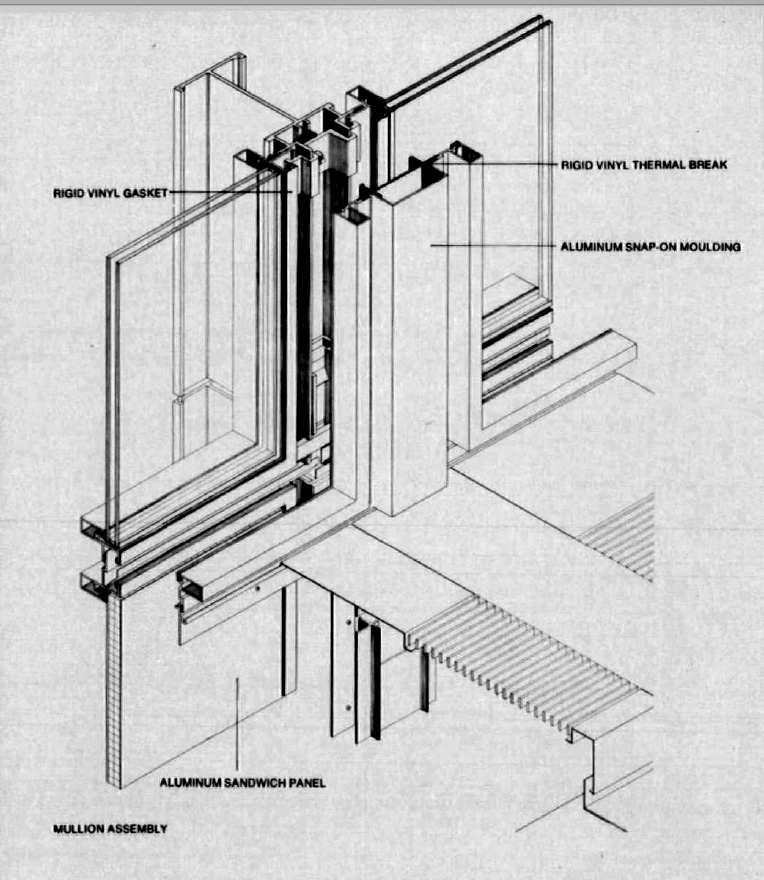
IBM’s familiar massing and articulation belied genuine developments that hinted at innovation within the office’s strict language.  “Each curtain wall should be a further development of the art,” Conterato told the Tribune, reflecting the office’s intention to address curtain walls’ thermal issues within the office’s tectonic system.  IBM was keen to address these, too.  The era’s computers were sensitive to minute changes in temperature and humidity.  Tinted glass and perimeter air conditioning helped, but IBM’s precise environmental standards led Conterato to three significant changes.  First, he dismissed the office’s long-standing allergy to insulated glazing, specifying double-glazed panes throughout and repeating the bronze-tinted solar glass of the Federal Center.  Second, working with Flour City Architectural Metals in Minneapolis, he developed one of the earliest thermally broken curtain wall systems, with continuous polyvinyl chloride gaskets insulating interior elements from the exterior.  Finally, the curtain wall performed as a rain screen, with two layers of water protection.  The outer layer in this system sheds most wind-driven water but incorporates small openings that pressurize voids behind it and thus halt the wind’s ability to drive water in further.  At the rear of these voids, a sealed layer arrests any remaining water, eliminating leaks from differential pressure.[viii]  The complex shapes and seals required were only possible in aluminum, not steel. Mies long-standing objection to aluminum’s application on a steel frame, in favor of material continuity between signifying I-beams outside and signified columns within, here met its technical match.  IBM was the first of Mies’ steel-framed buildings to be aluminum clad, in a system that cost 50% more than a typical curtain wall but that the company estimated would pay for itself in lower operating and repair costs.[ix]  IBM’s need for tight environmental control and its machines’ enormous electrical consumption led Murphy’s office to innovative mechanical system design, too.  The building’s system, developed with Carrier, captured waste heat from lights and computers, returning it to heat exchangers that produced hot water.  More than 1200 internal sensors and a dozen external ones fed an energy management system—run on an IBM 1800 mainframe—that engaged heat pumps to balance temperatures in sunny and shady areas, switched off lights in daylit sections, and turned boilers on or off depending on the outside temperature.[x]  The system reduced energy consumption by nearly 40%, an annual savings of over $600,000.[xi]
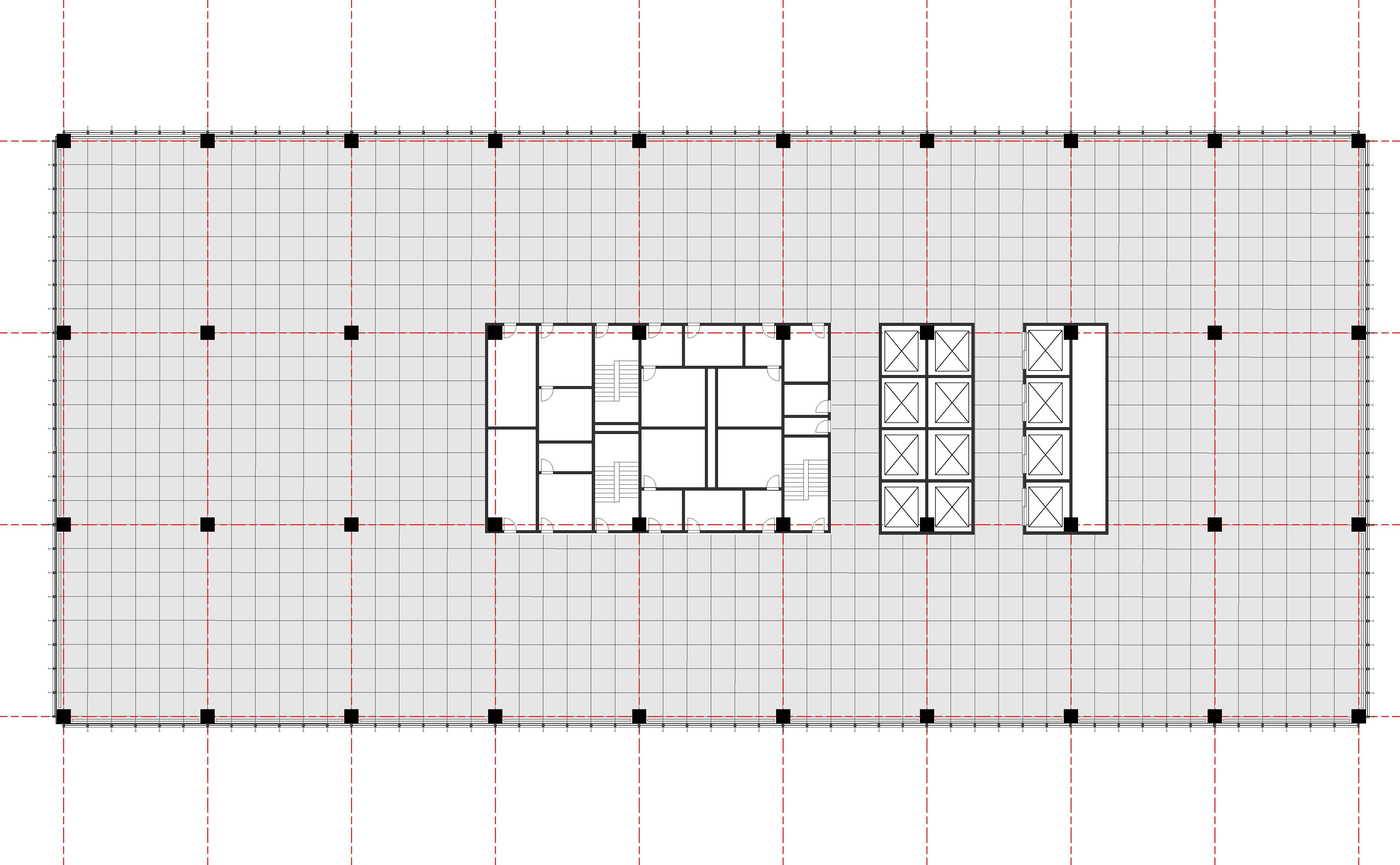
Paschen Construction began work on the site in late 1969, weeks after Mies’ death, hand-digging caissons to avoid disturbing the basement presses of the Sun-Times.  American Bridge set 25,000 tons of steel through October 1970, and the company began moving its employees in a year later.  The building was dedicated by new IBM Chairman T. Vincent Learson, who succeeded Watson in June 1971, and Mayor Daley in a September 1972 ceremony that also unveiled Italian sculptor Marino Marini’s memorial bust of Mies.[xii]  The newly created Federal Energy Administration gave IBM one of its first Energy Excellence Awards in 1975.[xiii] 

[i] Benjamin Forgey, “In the IBM Image: Honoring the Corporation’s Buildings.” The Washington Post, Mar. 24, 1990. 2.

[ii] “I.B.M. May Buy River Tract for Office Building.”  Chicago Tribune, Apr. 20, 1967.  E8.

[iii] Rob Cuscaden, “The IBM Tower.”  Inland Architect, Vol. 16, no. 6.  July, 1972.  10.

[iv] Franz Schulze, Oral History of Carter Manny. (rev. ed., Chicago: Art Institute of Chicago, 2001).  346.

[v] “I.B.M. Buys 1-1/2 Acres on River Front.”  Chicago Tribune, Sept. 28, 1967.  C7.

[vi] Robert Sharoff, Last is More: Mies, IBM, and the Transformation of Chicago.  (Mulgrave, Victoria: Images Publishing, 2014).

[vii] Robert Sharoff, Last is More: Mies, IBM, and the Transformation of Chicago.  (Mulgrave, Victoria: Images Publishing, 2014). 67.

[viii] “I.B.M. Design Innovations Told.”  Chicago Tribune, Jul. 20, 1969.  D1.  The claim for IBM’s primacy in these areas is made by Cuscaden, op. cit.

[ix] “IBM Building Designed for Comfort AND Beauty.”  Chicago Tribune, Oct. 18, 1970.  E1. 

[x] “IBM Building Nears Completion on River.”  Chicago Tribune, Aug. 29, 1971.  D1.

[xi] Cuscaden, op. cit. 12.  

[xii] “IBM Building Nears Completion on River.”  Chicago Tribune, Aug. 29, 1971.  D1; Alvin Nagelberg, “IBM Starts Office Move.”  Chicago Tribune, Oct. 23, 1971.  B7; and “IBM Building’s Architect is Honored.” Chicago Tribune, Sept. 21, 1972. 1-c9.

[xiii] Michele Gaspar, “IBM Plaza Boasts Energy Brain.”  Chicago Tribune, Apr. 3, 1977.  W_B2C.
postwar chicago skyscraper of the week: time-life

[Chicago Skyscrapers, 1934-1986, published by University of Illinois Press, is out now–available on Bookshop.org and Amazon.com, among other outlets.

Time-Life, Harry Weese Associates (1968-70)

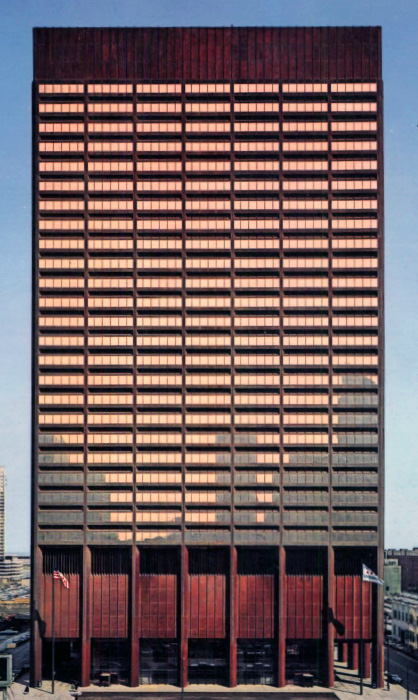
Weese’s most remarkable commercial skyscraper balanced Chicago traditions of ordered planning, plain-spoken façade grids, and robust materiality with sumptuous public spaces and articulated façades.  Time-Life’s subscription services and Chicago bureau had outgrown space it had occupied for two decades, at 540 N. Michigan.  Arthur Rubloff encouraged the company to pioneer development of the decaying industrial district between Michigan Avenue and the lake.  Lake Point Tower, rising to the east, was encouraging.  Rubloff recognized the potential gains in traffic for his interests on North Michigan if Streeterville saw parallel commercial investment.[i]  Time-Life settled on a 40,000 square foot site on Fairbanks Court between Ohio and Grand.  They estimated the company would need a half million square feet, much of it for a subscription department that had to be available at their desks precisely at 9:00 when telephone lines opened and was finished at exactly 5:00.  This precision exacerbated rush-hour elevator congestion, requiring many more cabs than would be in use throughout the day.

Time-Life’s Books editor (and Architectural Forum’s publisher) Joseph Hazen argued that the new building had to be of exceptional architectural quality: “because our site is in the midst of an industrial slum, our building must set the right tone for the future redevelopment of the entire area.”  Rather than a “steel and glass stereotype,” he suggested that the new building should have a “richer, more textured façade, rendered in warmer materials.”  The company contacted nine local firms, interviewing four and selecting Weese for his “imaginative, resourceful, creative” approach to architectural problems—a decision, Hazen recalled, “of the heart as well as the mind.”[ii]  Weese prepared seven schemes ranging from low, 14-story blocks that required fewer elevators but stranded operators far from windows to 27 story designs that faced efficiency problems, requiring 18 elevators to handle rush hour peaks.[iii]  Time-Life wanted column-free space and windows for its employees, eliminating the lower schemes.  Instead, working with mechanical engineers Cosentini and Otis Elevators, Weese revived a tandem-cab solution that had been tried in a New York tower in 1932 to make the taller scheme feasible.  By stacking two cabs on top of one another in the same shaft—one serving even floors and one odd—this system did more than double capacity.  Because elevator speed depends on the time spent discharging passengers, double-deck cabs cut ‘on-station’ time in half, speeding overall travel times.  This arrangement required a double-floor lobby so that arriving employees could sort themselves into even and odd floors, but it provided off-peak flexibility, when the system could be switched to more typical operation with one cab per shaft serving all floors.  While the system required more expensive, larger motors to hoist dual cabs, it reduced core sizes by a third, in Weese’s estimate.[iv]

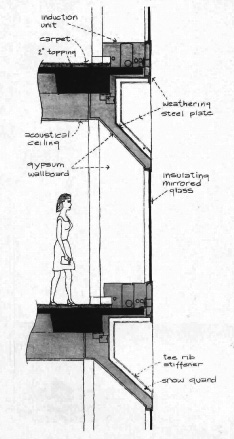
Time-Life’s exterior, meanwhile, developed from the company’s desire for richer materials.  Ben Weese and project manager Jack Hartray took advantage of concrete’s malleability to combine structure and skin into a unique, expressive curtain wall.  Weese had admired the Civic Center’s Cor-Ten exterior as it rose in the Loop, experimenting with the alloy on a cantilevered house near Green Bay while Time-Life was being designed.  The office developed prefabricated, bay-width panels that could be quickly erected, allowing crews to insulate and glaze the facades from inside.  While more expensive than aluminum, Time-Life’s managers appreciated its warm tones and sturdy appearance.  The project’s contractor, Turner Construction, thought the additional material expense would be offset by the panels’ rapid on-site assembly.  To stiffen each element during transportation and lifting, Weese’s office designed folded spandrel panels that, once in place, gave the façade a rhythmic pattern of shadowed recesses, complemented by gold-filmed insulated glass produced by PPG and New Jersey-based Kinney Vacuum Coatings that complemented the ruddy hue of the Cor-Ten cladding.  Weese and Hartray further addressed glare issues on these elevations by limiting window sizes with upstand induction units at sill level and sloping ceilings that followed the folded spandrels above.  The columns, on the other hand, taper toward the façade, so that the windows expand horizontally while contracting vertically.[v]

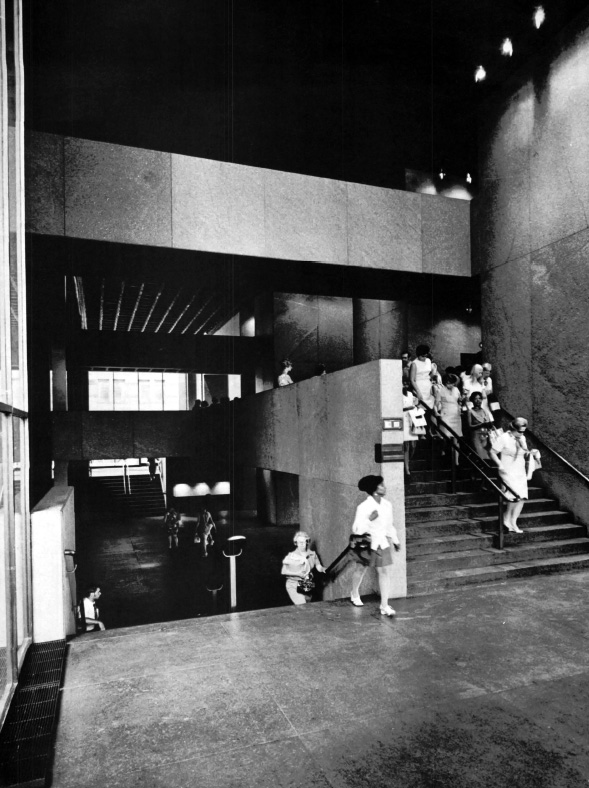
The building’s entrance lobby expanded the delicate jewel-boxes of Mies’ towers to “massive, Piranesian” scale.  Its double-height space drops away from the street into a split-level arrangement that provides stair and escalator access to the elevator boarding levels, its subterranean floor and shaft walls rendered in beige granite that also forms the exterior pavement.  Giant, Cor-Ten clad columns rise past this glass lobby and three floors of mechanical and warehouse space before engaging the façade panels of the main tower block.  The resulting mass recalls Mies—but by way of Brownson’s Civic Center and the layered structural façades of Saarinen’s Deere Headquarters in Moline (1964).  The lobby space was—at Weese’s urging—the site of the ‘Chicago Seven’ counter-exhibition to 100 Years of Chicago Architecture in 1976, highlighting his role between mainstream modernism and the ‘mavericks’ whose work was on display—including his own.[vi]  Time-Life won a 1973 national AIA honor award, recognized for its ‘pleasing proportions’ and ‘great sophistication in the use of materials.”[vii] 

Images from Architectural Forum, Sept., 1970.


[i] Alvin Nagelberg, “Time & Life to Build on Near North Side.”  Chicago Tribune, Mar. 7, 1967.  E5.

[ii] Kathleen Murphy Skolnik in Robert Bruegmann, ed., The Architecture of Harry Weese.  (New York: Norton, 2010).  150-151.

[iii] “News of Realty: Building Planned.” New York Times, Mar. 8, 1967.  71.

[iv] “Time-Life Building Elevators to Serve Two Floors at Once During Rush Hours.”  Chicago Tribune, Dec. 22, 1968.  D1 and John Morris Dixon, “Thirty-Story Slab of Ingenuity.”  Architectural Forum, Vol. 133, no. 2.  Sept., 1970.  20-27.

[v] John Morris Dixon, “Thirty-Story Slab of Ingenuity.”  Architectural Forum, Vol. 133, no. 2.  Sept., 1970.  22 and “Time-Life Buildng is Special.”  Chicago Tribune, June 8, 1969.  D1.  See, too, Process Architecture, no. 11 [“Harry Weese: Humanism and Tradition.”]  1979.  68-75.

[vi] “Show 1: ‘Mavericks’ on View at Time-Life Building.” Chicago Tribune, May 3, 1976. 1-e16.

[vii]  “Architects Honor Time-Life Building, St. Procopius Abbey.” Chicago Tribune, Apr. 30, 1973. 16

[viii] Elizabeth Brenner, “200 S. Wacker is Planned for Eye Appeal.” Chicago Tribune, Apr. 15, 1979. 1-s_b1 and Gary Washburn, “Big Office Building to Rise: His Determination Towers Over Chicago.” Chicago Tribune, Aug. 13, 1978. 1-n_b1.

[ix] Kathleen Murphy Skolnik in Robert Bruegmann, ed., The Architecture of Harry Weese.  (New York: Norton, 2010).  176-179.

[x] Paul Gapp, “City’s Magnificent Mile Gets a Touch of Crass.” Chicago Tribune, May 28, 1978. 1-e3

[xi] Paul Gapp, “New High-Rise Towers Over Chicago River–and Sinks.” Chicago Tribune, Apr 2, 1978. 1-e2

[xii] “Newberry Plaza a Supersized Project.”  Chicago Tribune, Oct. 8, 1972.  D1; “40-Story Condo to Rise on Lake Shore Dr.” Chicago Tribune, July 29, 1967. 1-n_a6 and “Plan 28-Story Apartments at Belmont and Sheridan.” Chicago Tribune, Feb 14, 1964. 1-c5.

postwar chicago skyscraper of the week–333 w. wacker

[Chicago Skyscrapers, 1934-1986, published by University of Illinois Press, is out now–available on Bookshop.org and Amazon.com, among other outlets.

333 W. Wacker Dr. (KPF/Perkins & Will, 1979-83)

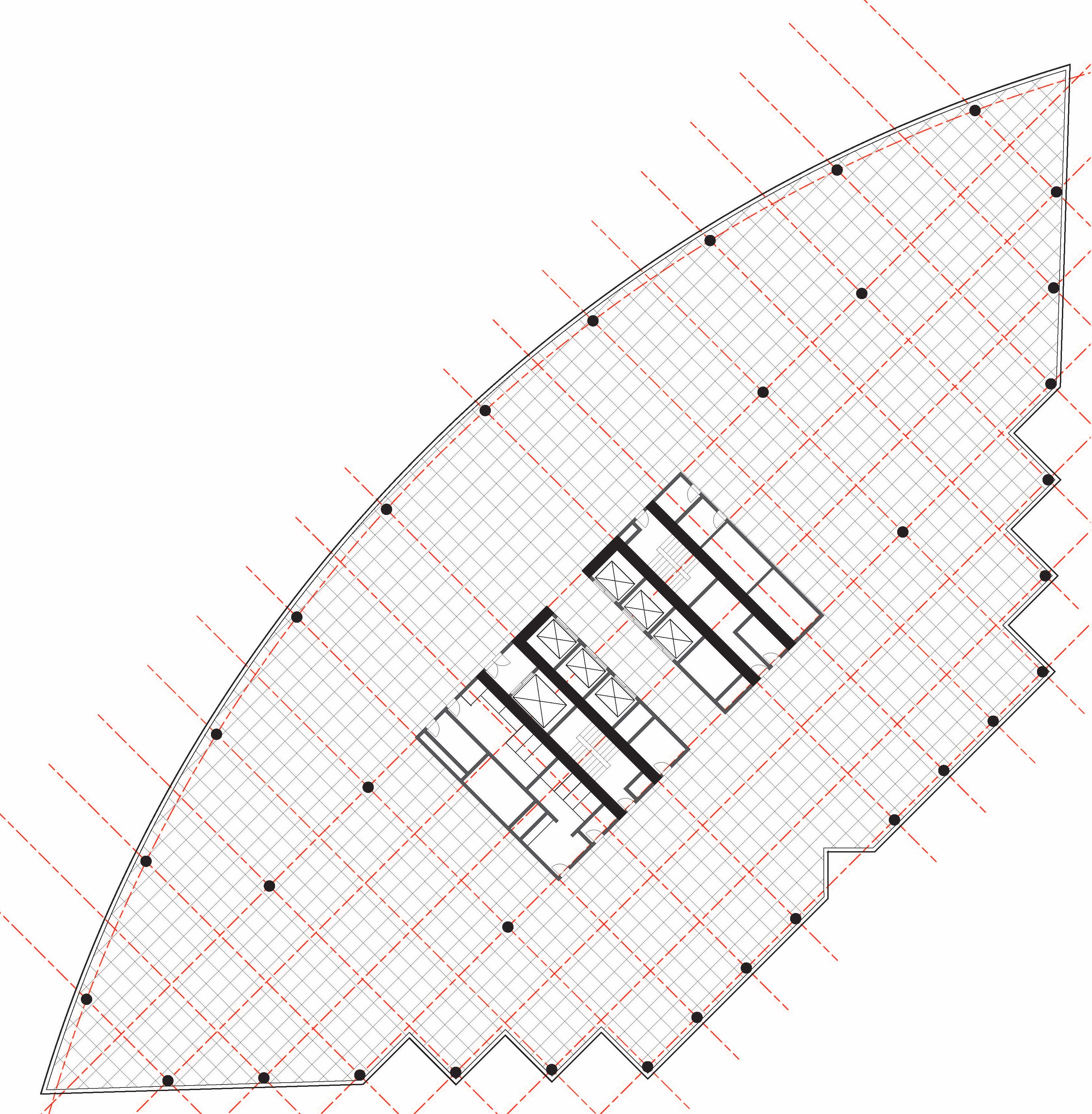
An early postmodern marriage of glass technology to “romantic” skyscraper form was the sweeping glass arc developed by Urban Investment and Development for the triangular lot between Wacker Drive, Franklin, and Lake Streets.  After the success of Water Tower Place, Philip Klutznick and his son, Thomas, pursued an aggressive downtown development program to match their long suburban track record.  Even with the late-1970s market lull, the younger Klutznick saw continued potential in the Loop, “the development area” in Chicago, he thought, “for maybe the next decade.”[i]  The Wacker Drive site was laden with local history and held great promise for its river views and city-wide visibility. Still, its awkward, triangular geometry had left it occupied only by small warehouses and parking lots. 

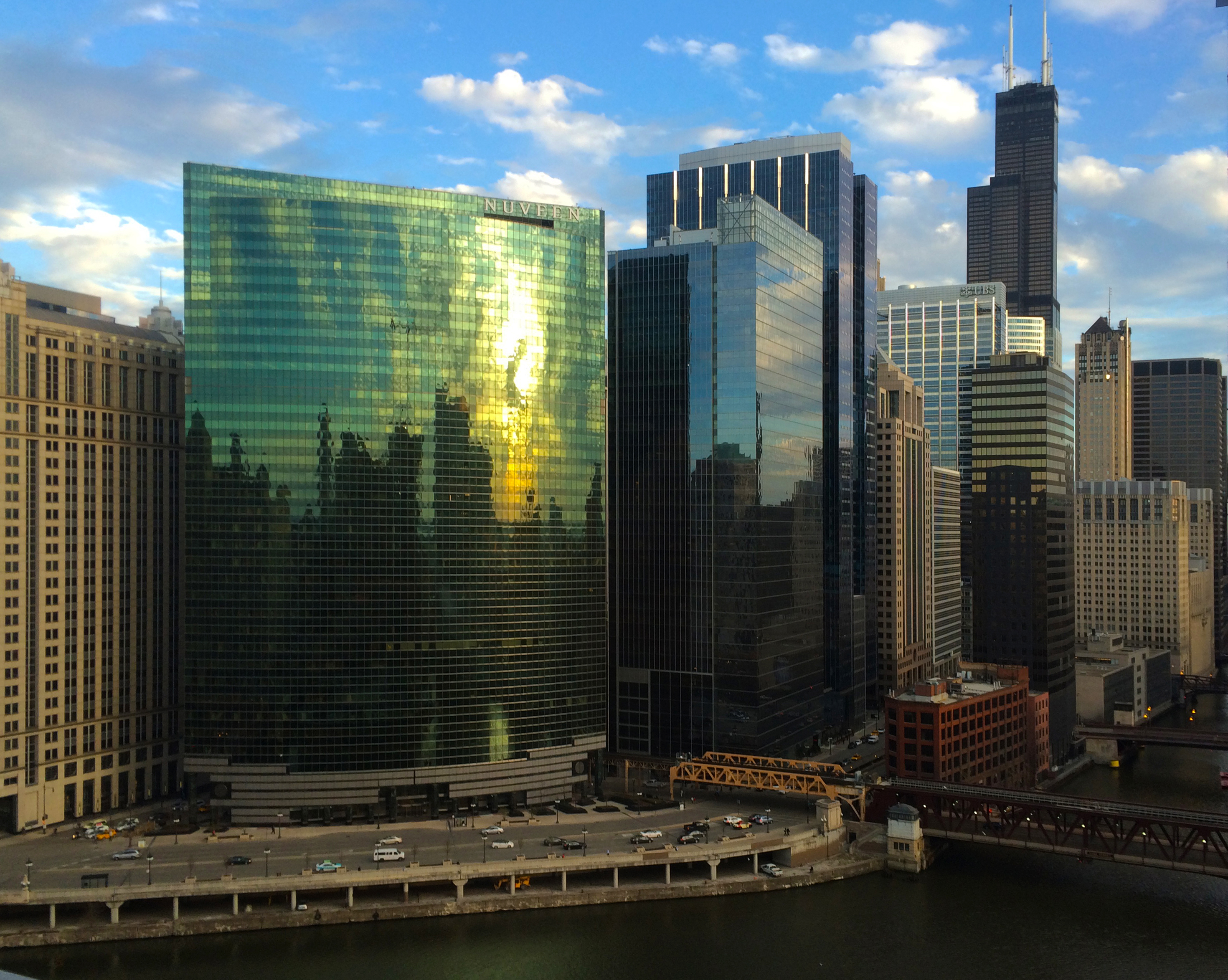
In June 1980, UIDC purchased the block and hired an upstart New York firm to design a 36-story “high-rise similar in shape to New York’s Pan Am Building,” wedging 900,000 square feet of lettable space into its confines.  The design and management core of John Carl Warnecke’s New York office—Eugene Kohn, William Pedersen, and Sheldon Fox—had started their own firm in the 1976 economic downturn.  By 1980 their portfolio contained just two high-rises: a 15-story building in Upper Manhattan for ABC and a 23-story office tower in Lexington, KY.  Their pedigree with Warnecke was convincing, however, and UIDC asked them to team with Perkins & Will.  UIDC senior vice president George Goldman previewed the project in 1980, hinting at a green glass tower that would be “an extremely interesting, dramatic building, very slick, wrapping around the site.”[ii]  Cupples won the contract for the six acres of curtain wall, including insulated glass panes of Sunglas, a Ford automotive product that used a reflective metallic oxide film to reduce solar gain by 2/3.[iii]  KPF specified a deep emerald green in two different shades for spandrel and vision panels, emphasizing the horizontal sweep of the riverfront facade rather than its vertical proportions—or its division into structural or cladding bays.  The building’s form, published for the first time in November 1981, was “slick” but compelling.  Ford’s glass would wrap around an arcing elevation along Wacker, framed by slender, flat returns at its corners and an angular, sawtooth volume on the southwest. At its base, KPF further emphasized this combination of rich materiality with sculptural form, with generous stairs at the Lake/Franklin corner and two stories of granite and round, stainless steel louvers, far from the minimal entries that marked modern Loop skyscrapers.  This was the “romantic” approach championed by critic Paul Gapp—an abstract, technically-fluent vocabulary responding to its site in a singular, legible form.[iv]  “Exhilarating and rational,” in the words of New York Times’ critic Paul Goldberger, 333 became an iconic presence on the skyline.[v]  While its floor plans made it “one of the most challenging configurations of any of the new downtown office buildings,” according to one space planner, 333 W. Wacker gained prestige clients, including American Bell.  UIDC moved its offices into the building when it was completed in 1983, and the next year it was recognized with a national AIA Honor Award .[vi]


[i] Gary Washburn, “Firm Planning Projects Here, in 5 Other Cities.”  Chicago Tribune, July 15, 1979.  E1.

[ii] Gary Washburn, “Developer May Build Wacker Dr. High-Rise.”  Chicago Tribune, June 20, 1980.  C7.

[iii] “6 Acres of Glass by Ford to Cover High-Rise Here.”  Chicago Tribune, Nov. 1, 1981.  S_B2.

[iv] “6 Acres of Glass by Ford to Cover High-Rise Here.”  Chicago Tribune, Nov. 1, 1981.  S_B2 and “Glass Curtain Wall Rigorously Tested.”  Chicago Trinune, Aug. 23, 1981.  N_B2C.

[v] Paul Goldberger, “A New York Firm Sets the Style in Chicago: Architecture View Given the Plethora of Kohn Pedersen Fox Buildings, it is Hard Not to Feel that a Different Sensibility has Taken Over the Town.” New York Times, Sep 30, 1990. 1 and Paul Gapp, “Architecture: A Gusty New Yorker and his Taut Green Giant on the River.”  Chicago Tribune, Oct. 23, 1983.  See, too, Jim Murphy, “Cornering the Loop: 333 Wacker Drive, Chicago.” Progressive Architecture, no. 10, Oct. 1983, p. 78.

[vi] “Tower Brings Out the Best in Space Planners, Designers.”  Chicago Tribune, July 8, 1984.  W_B1B; “Realty Briefs: Bell Finds a Home.”  Chicago Tribune, Aug. 14, 1983.  W_B2 and Paul Gapp, “3 Chicago Buildings Win Design Excellence Award.”  Chicago Tribune, May 3, 1984.  D_A11.

postwar chicago skyscraper of the week: 55 w. wacker (blue cross/blue shield)

[Chicago Skyscrapers, 1934-1986, published by University of Illinois Press, is out now–available on Bookshop.org and Amazon.com, among other outlets.

Blue Cross/Blue Shield (C.F. Murphy, 1966-68).

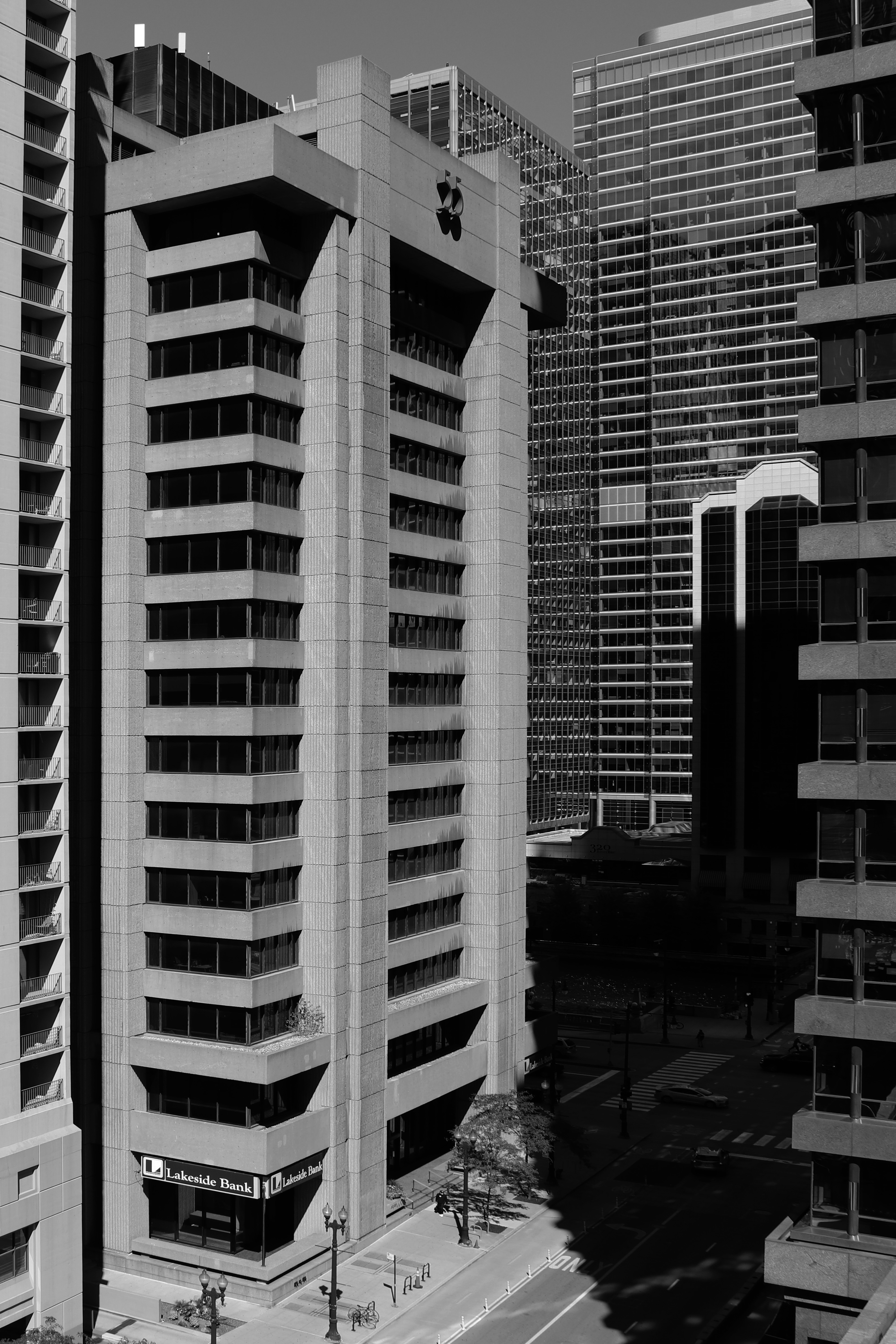
If SOM’s Gateway projects seemed repetitive or formulaic, no such critique could be applied to C.F. Murphy’s riverfront statement Blue Cross/Blue Shield.  The 15-story concrete tower then being built at Wacker and Dearborn, wrote the Tribune, in December, 1967, “may not be the biggest building around, but it has enough interesting facets to keep it from being lost in the crowd.”[i]  Otto Stark, its designer, described it as a “piece of sculpture to be a focal point for the view along the Chicago River,” and with massive, solid concrete shafts exposed around its perimeter it was, on its opening a year later, a striking exception to Chicago’s Miesian rule, joining the U.S. Gypsum building in its stubby massing and distinctive approach.  Stark, a University of Illinois graduate, had worked with Walter Netsch on the Air Force Academy at SOM, moving to C.F. Murphy with Stan Gladych to work on O’Hare Airport in 1960.  In 1962, he had been on a team with Murphy colleagues Gertrude Kerbis, W.C. Wong, T.C. Chang, and Chan Sit that produced a steel-and-glass competition entry for Boston City Hall that had been one of eight finalists.[ii]  Their scheme’s long, frontal plaza and dark bronze curtain walls bore comparisons to the Seagram’s Building but Stark was a self-proclaimed Paul Rudolph devotee, an influence that showed in his designs for student unions at DePaul and the University of Illinois’ Medical School.[iii]

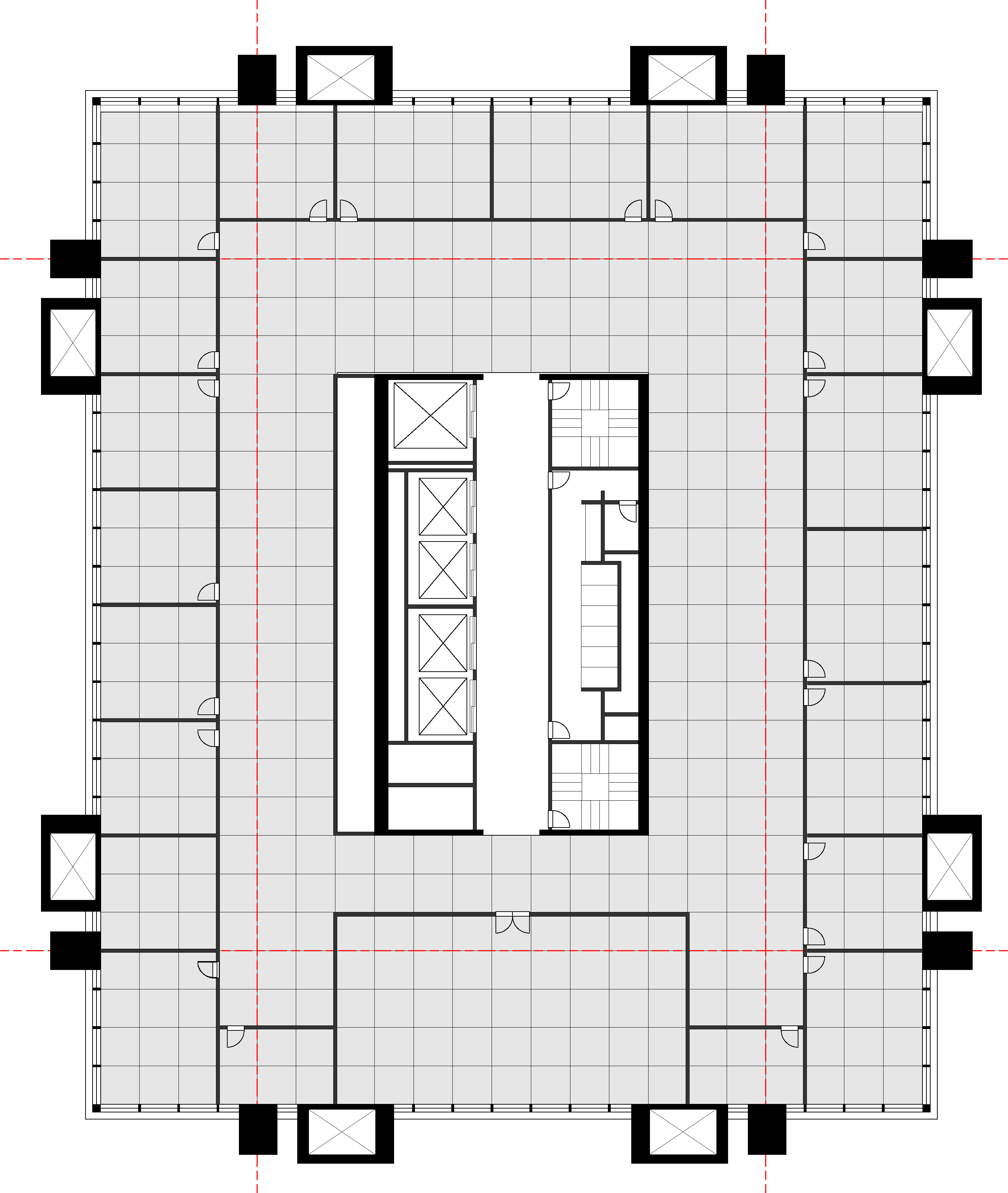
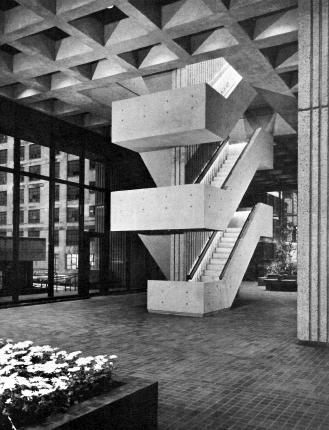
Rudolph’s approach of turning a typical central core building inside out, expressing vertical services in concrete shafts on the exterior, suited Blue Cross/Blue Shield’s desire for open floor plates.  Pressed to the exterior of the quarter-block site, eight shafts accommodated the buildings mechanical chases.  Stark left the building’s elevators, fire stairs, and toilet rooms in a smaller central core, but a compact one that maximized floor depths around it.  Symmetrically arranged, the exterior shafts also provided the building’s main structure, eliminating interior columns providing ducted air and chilled or hot water near perimeter induction units, eliminating horizontal duct and pipe runs.  Upstand concrete sill beams spanning 60’ on the long, east and west facades and 35’ on the north and south accommodated induction units in cabinets under the windows, and the giant hollow piers allowed 20’ cantilevered corners that offered dramatic views up and down the River.  The lobby was highlighted by a dramatic, rectilinear scissor stair, an exposed waffle slab ceiling, and sculpture by Louise Nevelson, all against a backdrop of dark teak furnishings, deep brown brick flooring, and lush plantings.[iv]

Stark sought help from I.M. Pei’s office in establishing mixtures and finishes for the building’s exposed concrete throughout; Pei had a global reputation for concrete expertise and Murphy’s office was coordinating with them on O’Hare’s control tower at the time.[v]  Stark specified a bush-hammered finish for the building’s vertical elements, exposing aggregate and providing a deeply textured surface, while leaving girders and soffits with a softer, sandblasted surface.  This delineated bearing and spanning elements, combining Murphy’s reputation for crisp, precise detail with a tactile sense and some of the Loop’s finest concrete.  Its “muscular, positive architectural statement,” softened with overstuffed lounge furniture and a colorful palette of office furnishings, was unlike the “massive square glass structures of many new office buildings,” in the words of the Defender, but it was not entirely alien.[vi]  Other concrete structures in Chicago expressed the plastic nature of this material—the haunched slabs of SOM’s first Hartford Building, for instance, or the voluptuous curves of Marina City (see Chapter 6) across the River.  Blue Cross’ giant-order concrete shafts and story-and-a-half cornice had a Chicago pedigree, too.  Frank Lloyd Wright’s Larkin Building in Buffalo (1904) owed its exterior massing to its vertical service cores, which wrapped a deeply articulated brick skin around air shafts and staircases.  Inland Steel’s external service core was also a precedent; Louis Kahn acknowledged its diagrammatic power in his influential ‘servant/served’ parti of Richards Medical Laboratories (1957-1960), which in turn influenced Rudolph’s sculptural Art and Architecture Building at Yale (1963), Stark’s clear precedent.


[i] “New Blue Cross Building Promises to Stand Out.”  Chicago Tribune, Dec. 24, 1967.  B7.

[ii] in “Designs of the Other Seven Finalists.” Boston Globe, May 4, 1962. 17and Brian M. Sirman,  Concrete Dreams: Architecture, Politics, and Boston’s New City Hall, (Dissertation, Boston University.  Ann Arbor; UMI, 2014)

[iii] Otto Stark.  Architect Otto Stark: Standing by Design.  (Chicago: Stark Associates Architects, 2017).

[iv] “Strength and Cohesiveness for a Crowded Block in Chicago: Blue Cross-Blue Shield.”  Architectural Record, Vol. 148, no. 1.  July, 1970.122-125.

[v] Franz Schulze, Oral History of Carter Manny (rev. ed., Chicago: Art Institute of Chicago, 2001).  380.

[vi] “15-Story Building Opened by Blue Cross, Blue Shield.”  Chicago Daily Defender, Dec. 4, 1968.  4 and “New Blue Cross Building Promises to Stand Out.”  Chicago Tribune, Dec. 24, 1967.  B7.