[Chicago Skyscrapers, 1934-1986, published by University of Illinois Press, is out now–available on Bookshop.org and Amazon.com, among other outlets.
Continued from last week:
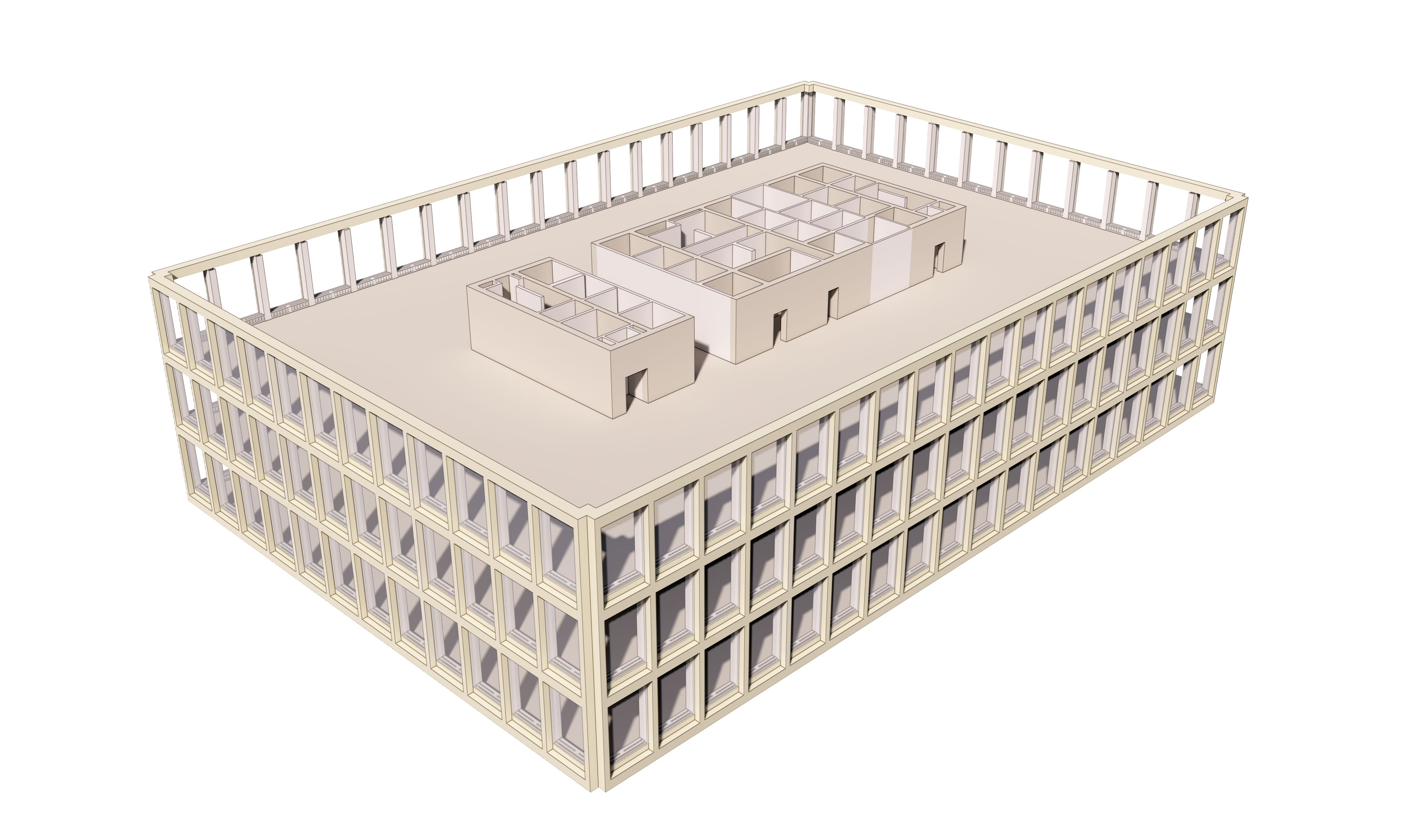
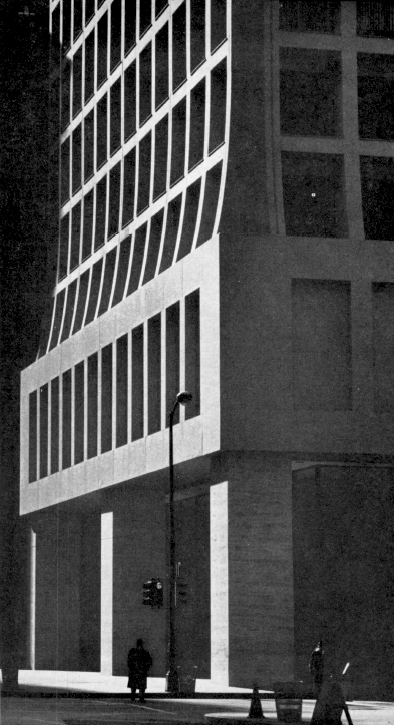
Brunswick’s tightly spaced columns around its perimeter presented a ground-level architectural problem. Generous dimensions for office windows would be restrictive enclosing a lobby looking out onto a large civic plaza. SOM thus faced a conundrum: how to open the building’s base in a structural system that relied on closely spaced columns. Pei and Komendant’s walls at Kips Bay set narrowly spaced columns sit on deep girders, transferring loads over wider bays at ground level. This made even more sense with Chicago’s difficult clay soil. Fewer columns meant fewer caissons, saving excavation costs. Other tall buildings in the Loop had used transfer girders below grade to spread loads from normally spaced columns above onto more widely spaced caissons below. Graham and Goldsmith moved this element out of the ground to the lobby’s ceiling level.[i] Kips Bay was just 20 stories tall, and its ground-level lobbies and entries were scaled to residential standards. Carrying a building nearly twice as tall and with larger spans at ground level, Brunswick’s transfer structure had to be exponentially larger. SOM’s preliminary designs showed a Vierendeel truss supported by nine tapering columns—like their New York office’s Beinecke Library at Yale. However, as Brunswick’s scheme developed, its lobby grew taller and the Vierendeel truss deeper. The expressive, tapering pin supports were simplified and enlarged into simple square columns. In the final design, 24’ tall transfer trusses enclosed a double-height mechanical floor. They spanned 57’ from column to column—a colossal structural element articulated with expressed vertical chords matching the mullion-columns above.[ii] To resist the enormous shear loads imposed by 36 floors above, the transfer truss also needed to be thick—7’-6”—leaving a large setback on its top surface. Goldsmith resolved this with a curved taper to the mullion-columns, pronounced in the story above the transfer girder and smoothed into a gradual slope that matches each mullion-column’s cross-section to the diminishing loads it carries as it ascends. To many, this geometry mimicked the Monadnock’s curved, tapering bearing walls, four blocks south. Goldsmith denied a direct inspiration, but Graham suggested at least a philosophical continuity between the two. “The Monadnock building could be called a tube too,” he argued, as its famous brick exterior carries gravity and wind loads, assisted by a lighter steel structure within.[iii]
Brunswick’s exterior tube and interior shear walls are connected by stiff floor diaphragms. One-way pan joists handle the 37’ spans from perimeter to core, supplemented by two-way waffle slabs at the corners. This allowed the exterior frame to handle most of the lateral loads in the top portion of the tower and the core walls to take up shear loads as they increased toward the building base, a synergetic behavior Khan and Iyengar termed “frame-shear wall interaction.”[iv] To accommodate up to 1-1/4 inches of thermal expansion in the outer tube, Khan developed hinge details at the junctions between floor and perimeter walls, restraining them horizontally while allowing them to expand and shrink during extreme weather.[v]
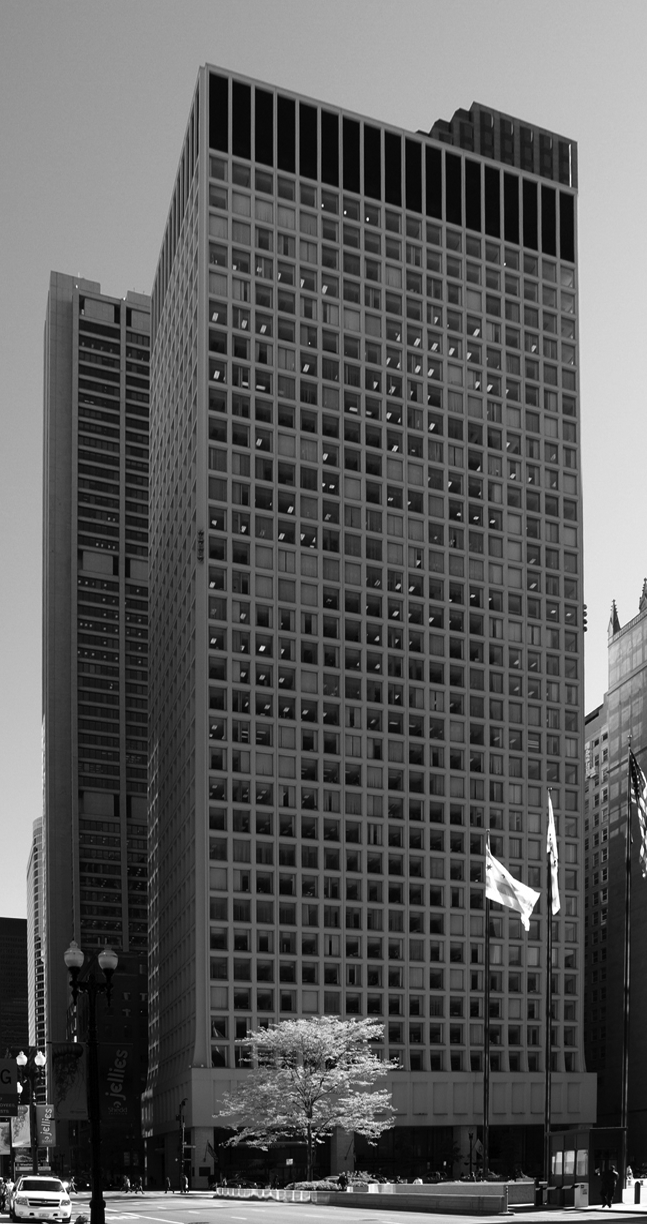
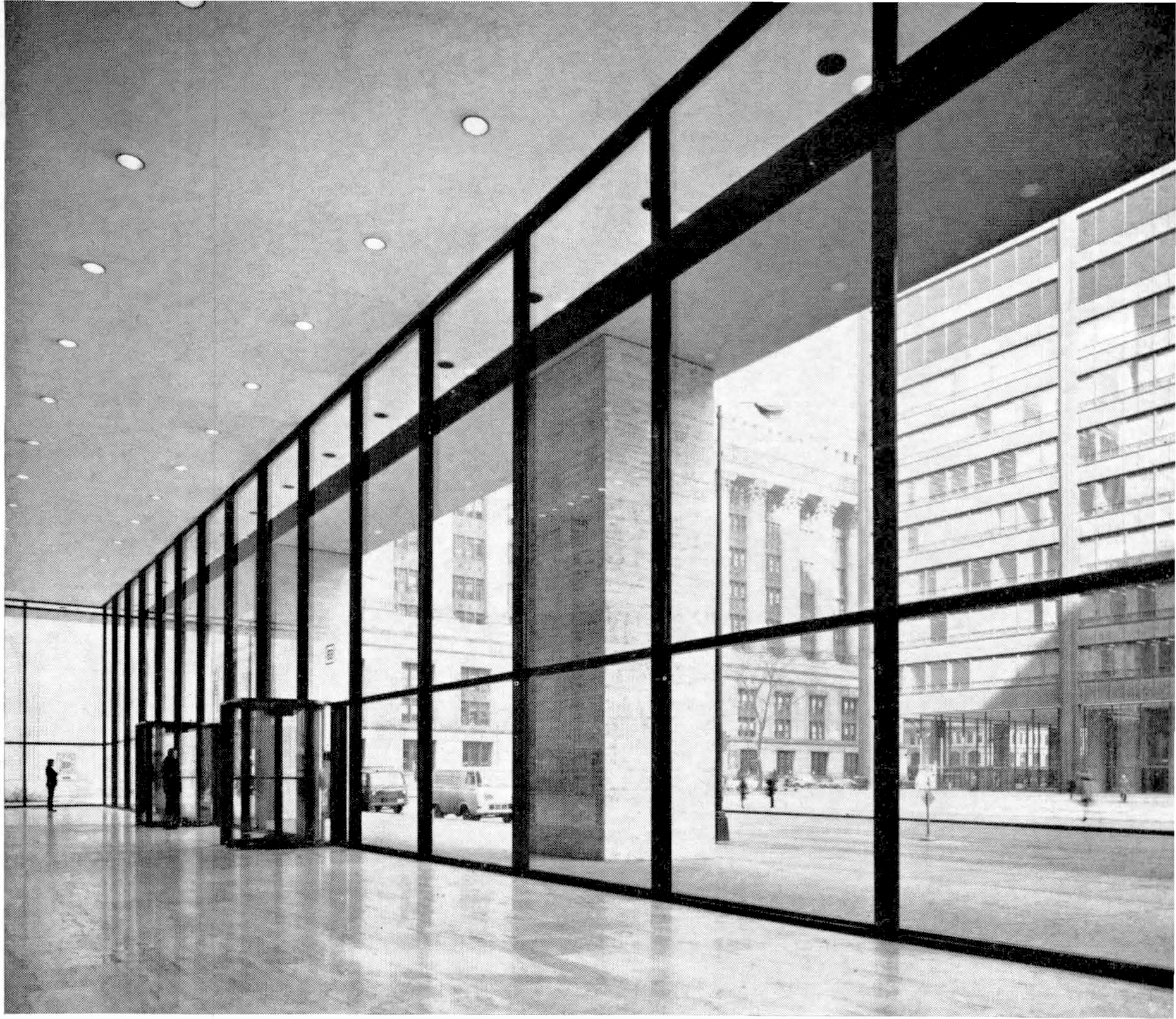
Brunswick opened to mixed reviews in April 1965. Budget concerns eliminated travertine that Graham had intended to clad the entire structure, like the granite veneer at Hartford. The exposed concrete structure had its own clarity. Still, it remained on the giant, seven-foot square piers at the lobby level, creating a material discontinuity that makes the base appear fragile compared with the solid structure above. Architectural Forum compared the Brunswick to Eero Saarinen’s headquarters for CBS a year after its opening, noting that the two structures revived bearing wall structures for tall buildings, transforming their structural perimeters from “punctured walls” to “light columns” of reinforced concrete. While Forum felt that Brunswick’s structural expression was purer than CBS’, which paired columns with vertical risers like the Equitable’s, Forum found the “enormous unity” of Saarinen’s stark, granite-clad shaft more satisfying.[vi] Brunswick’s structural innovations made Khan rethink tall building structures, turning conventional frames inside out. The tube structure would become an SOM trademark. The challenging transition from a perforated bearing wall to a broad, open lobby would evolve through the firm’s work in Chicago and elsewhere. The Brunswick was also a powerful re-interpretation of Chicago traditions, a concrete rejoinder to the fine steel grains of the Harris and Continental. Carl Condit thought its concrete frame showed a “combination of the traditional masonry bearing wall and the articulated or cellular wall developed by the Chicago school for steel-framed construction” that brought back—in a new dialect— “the texture, depth, and mass that we miss in the featureless and brittle curtain of enameled steel and glass.”[vii]
[i] “A Tale of Two Towers.” Architectural Forum, April, 1966. 29-30.
[ii] Promotional Brochure, “Materialite® Lightweight Concrete Aggregate.” General Dynamics Corporation, Chicago. N.d.
[iii] Betty Blum [????], “Oral History of Bruce J. Graham.” Art Institute of Chicago Architects’ Oral History Project. 89.
[iv] “Brunswick Building, Chicago, Illinois (USA).” IABSE Structures. Vol. 6, 1982.
[v] “Brunswick Building, Chicago, Illinois (USA).” IABSE Structures. Vol. 6, 1982.
[vi] “A Tale of Two Towers.” Architectural Forum, April, 1966. 28-37.
[vii] Carl W. Condit, “The New Architecture of Chicago.” Chicago Review, 17:2/3, special issue on New Chicago Writing and Art. 1964. 115-116.
 architecturefarm