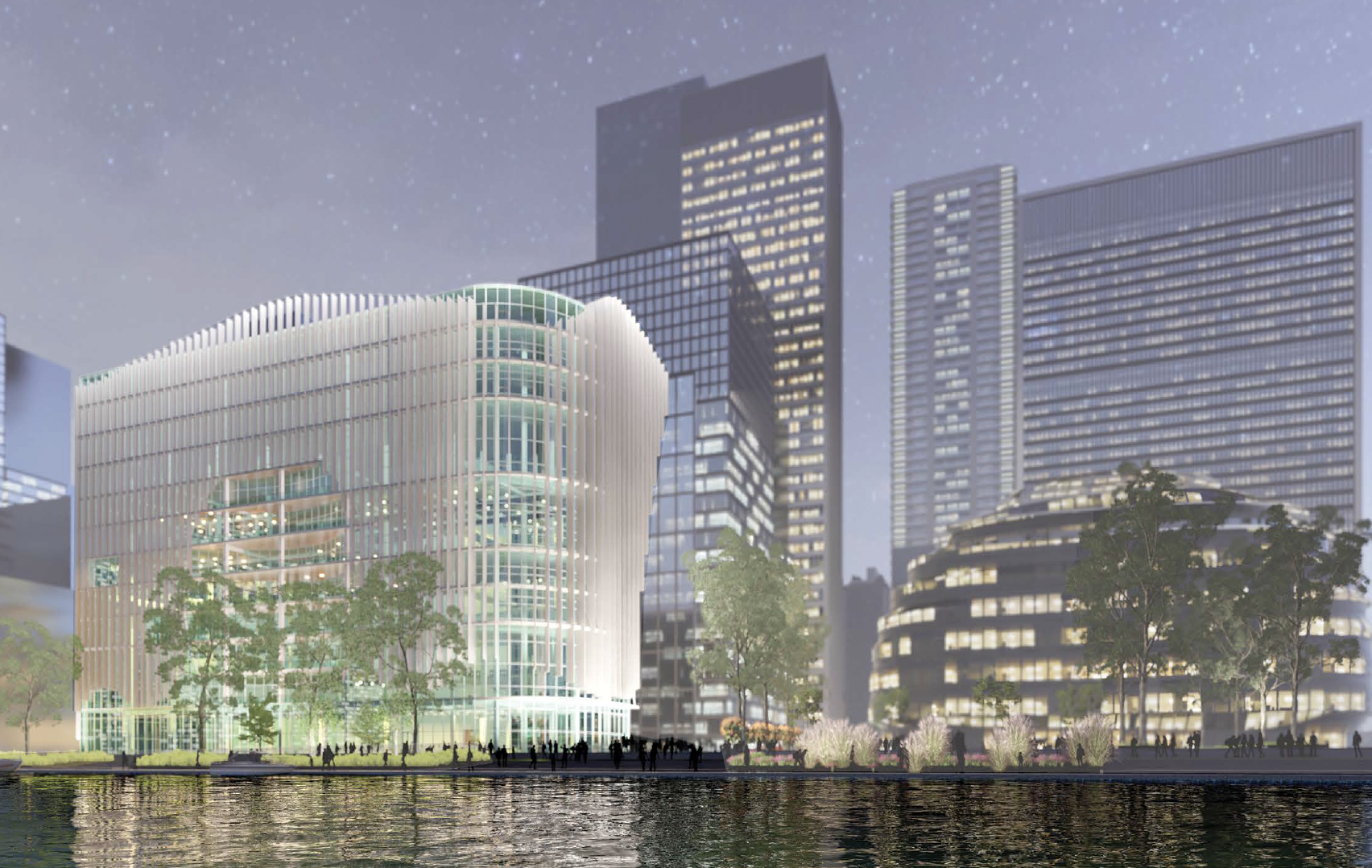
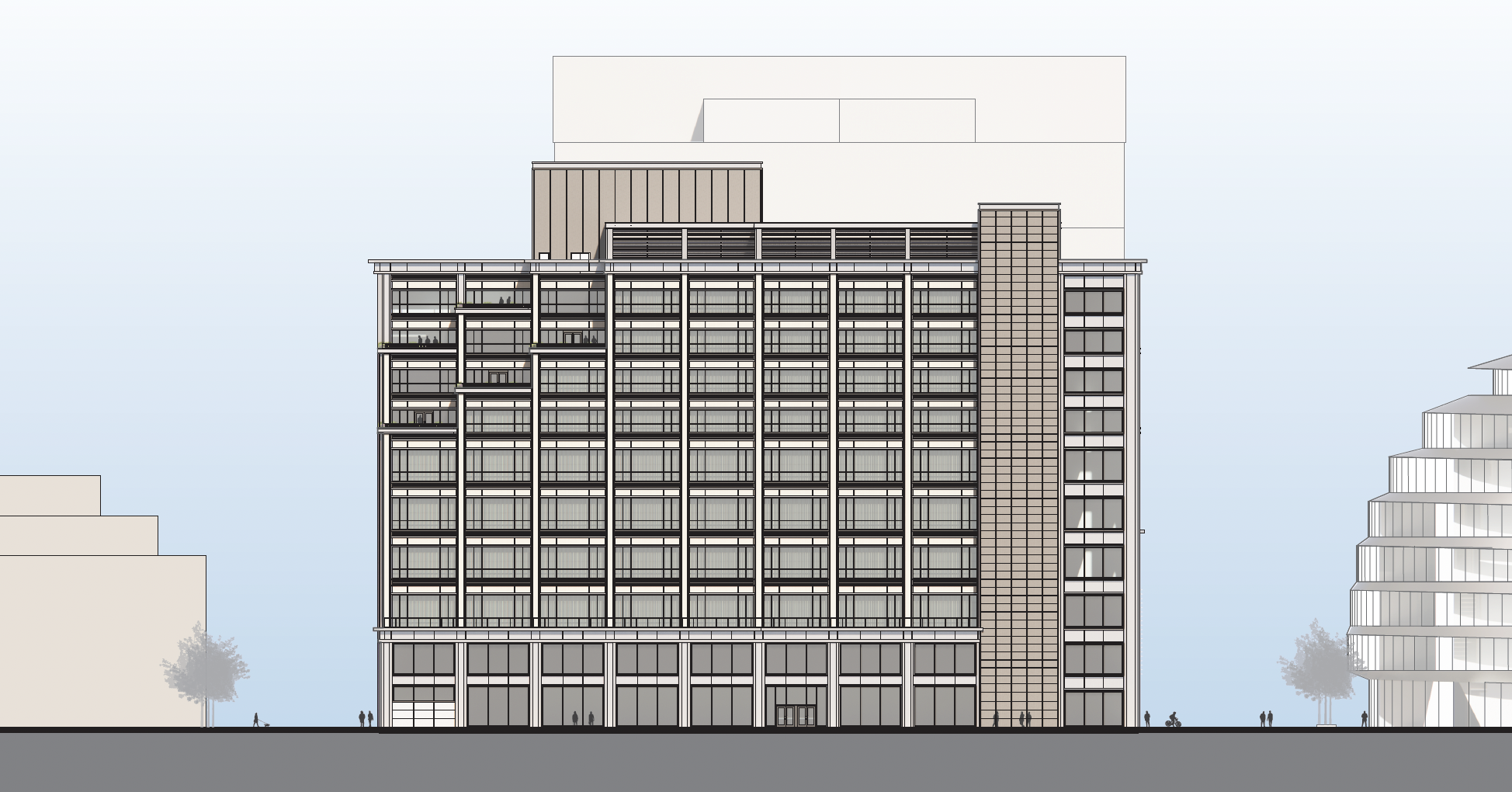
A strong studio semester in the books. Thanks to the Discovery Partners Institute, Related Midwest, OMA, and the Chicago Architecture Center, our spring studio looked at a spinoff to the new DPI building announced last year for The 78, Related’s new development along the Chicago River’s South Branch.
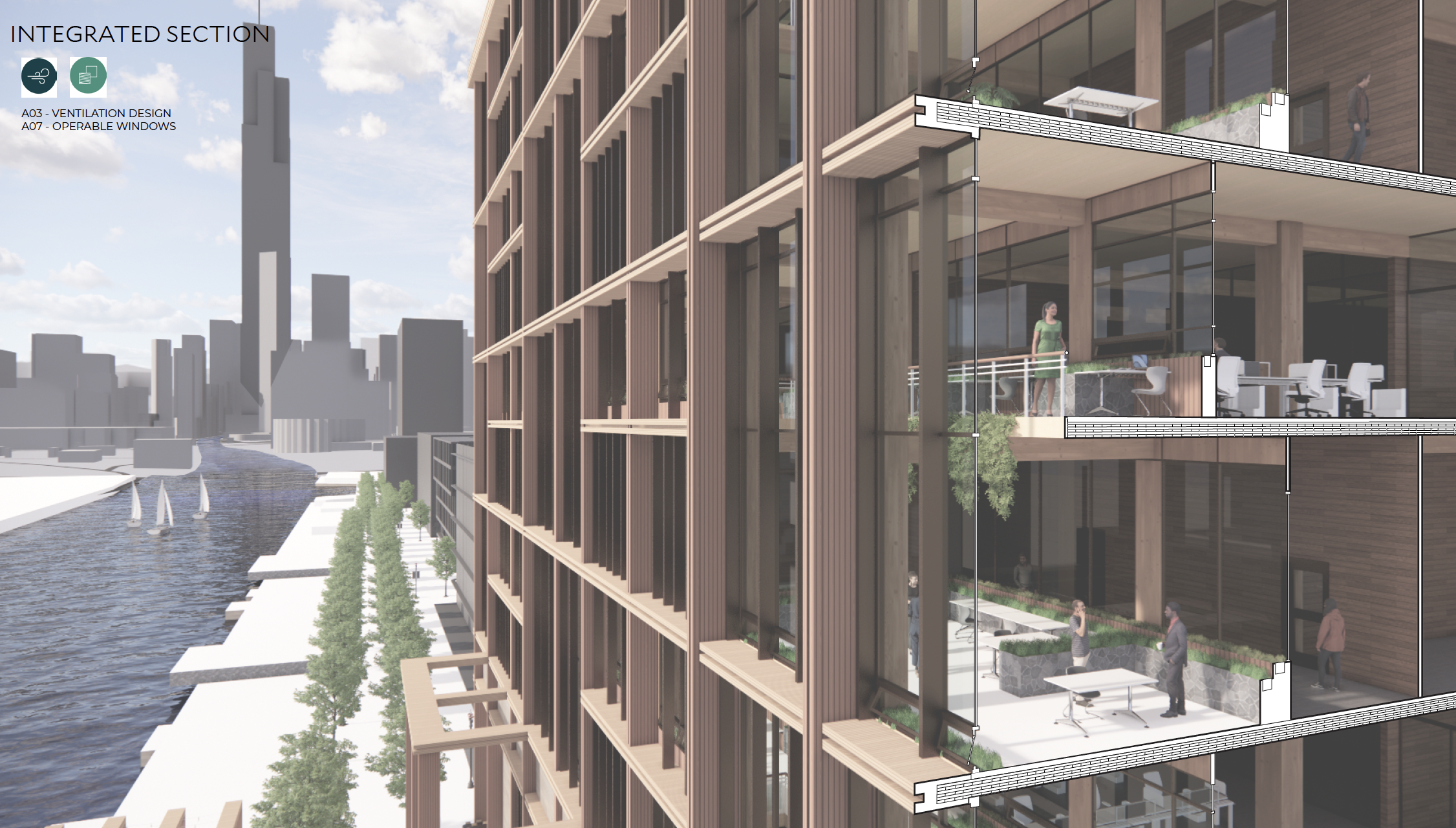
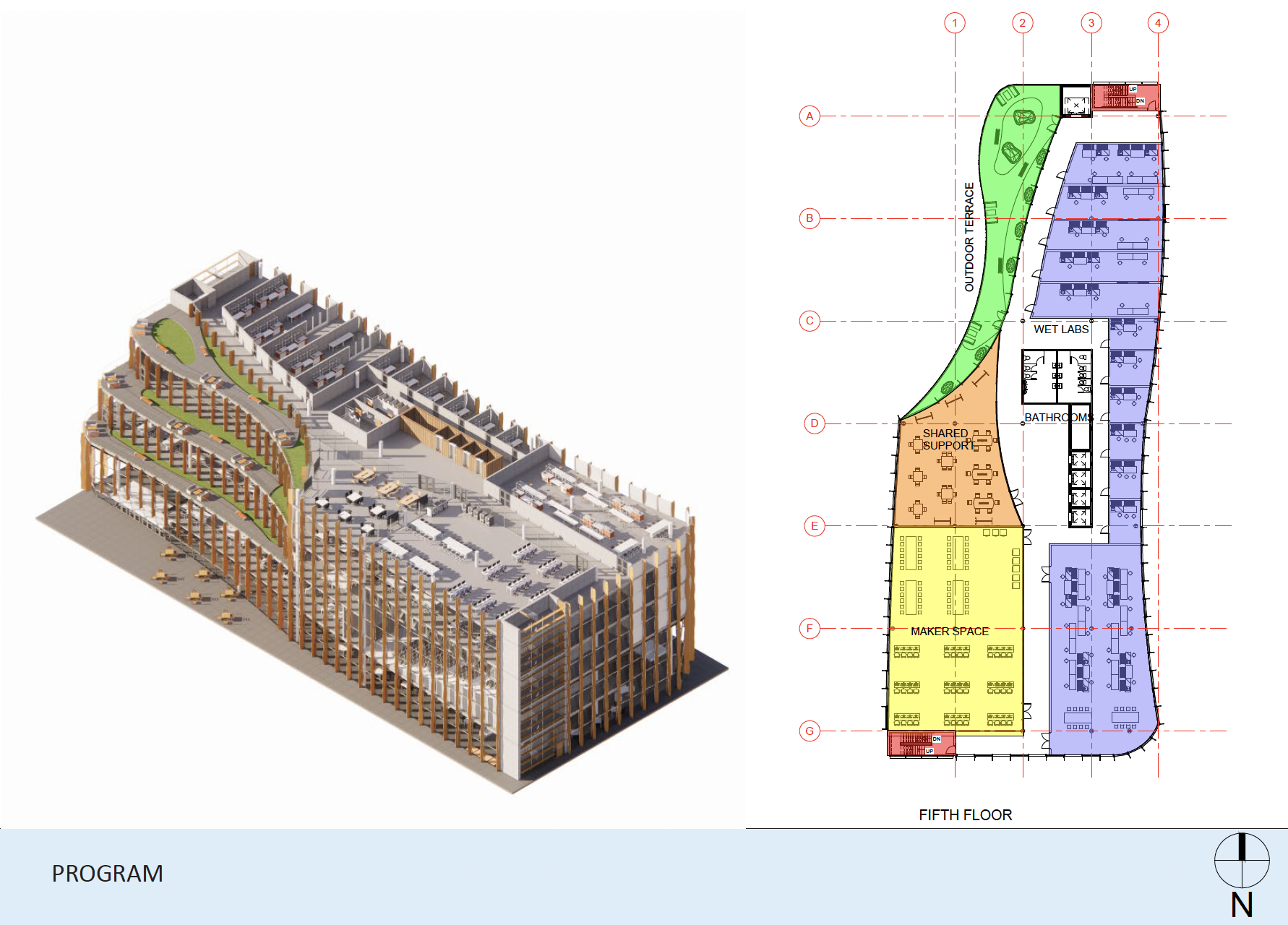
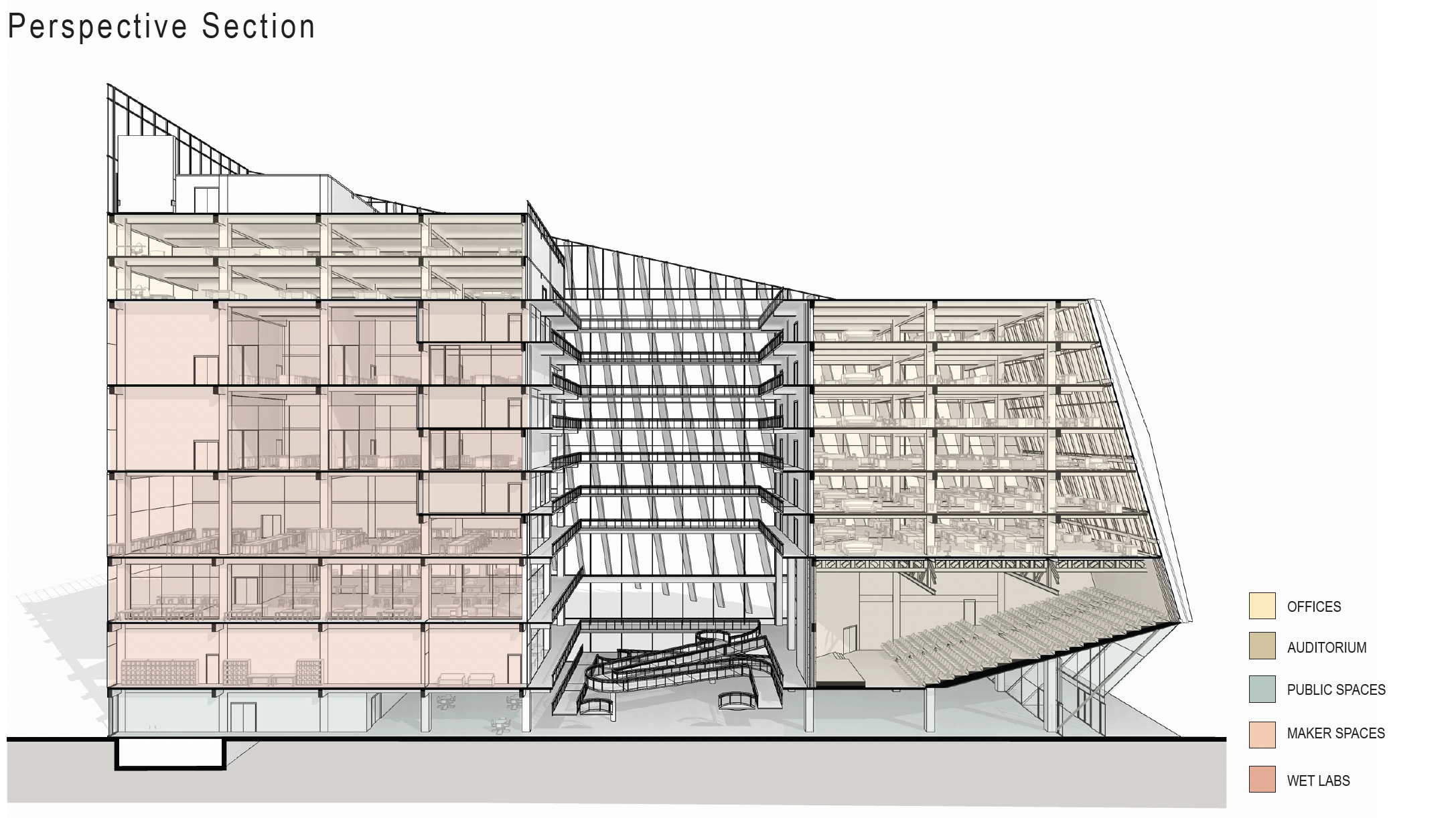
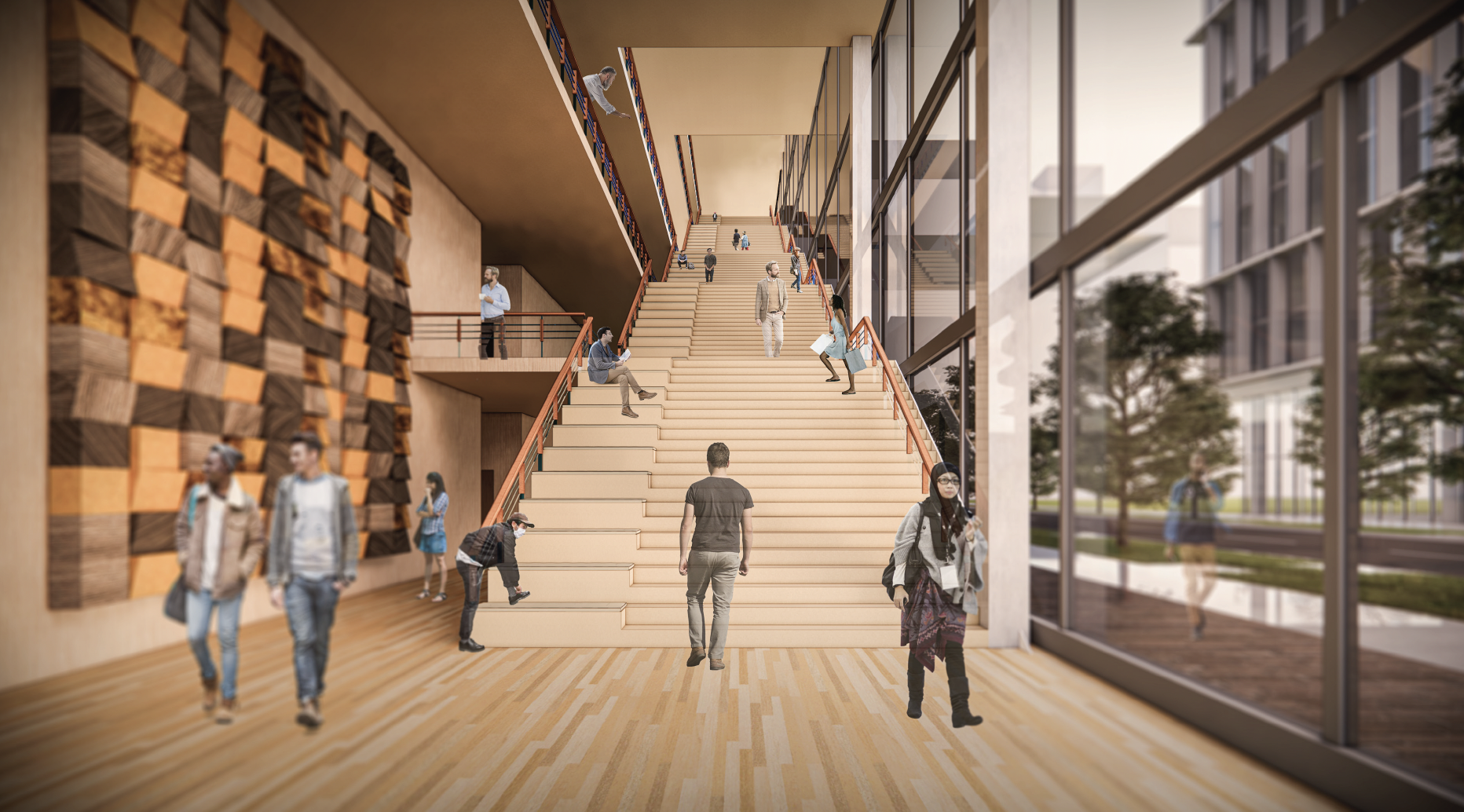
The premise is that researchers will need to take work done by DPI to commercial markets and that it makes sense for an Accelerator/Incubator to be convenient to the new DPI building as a ‘stair step’ for burgeoning companies. Our program looked at what such a building would look like and what it would need beyond the requirements of a simple office building. The mix of public spaces, presentation facilities, collaborative work areas, wet labs, and maker spaces proved inspiring and challenging. Teams dove into research on these elements, precedents, and the history and current demography of the site and neighborhood, and they extended a lot of the initial thinking by looking at mass timber, passive ventilation, and solar shading, among other aspects of sustainable design.
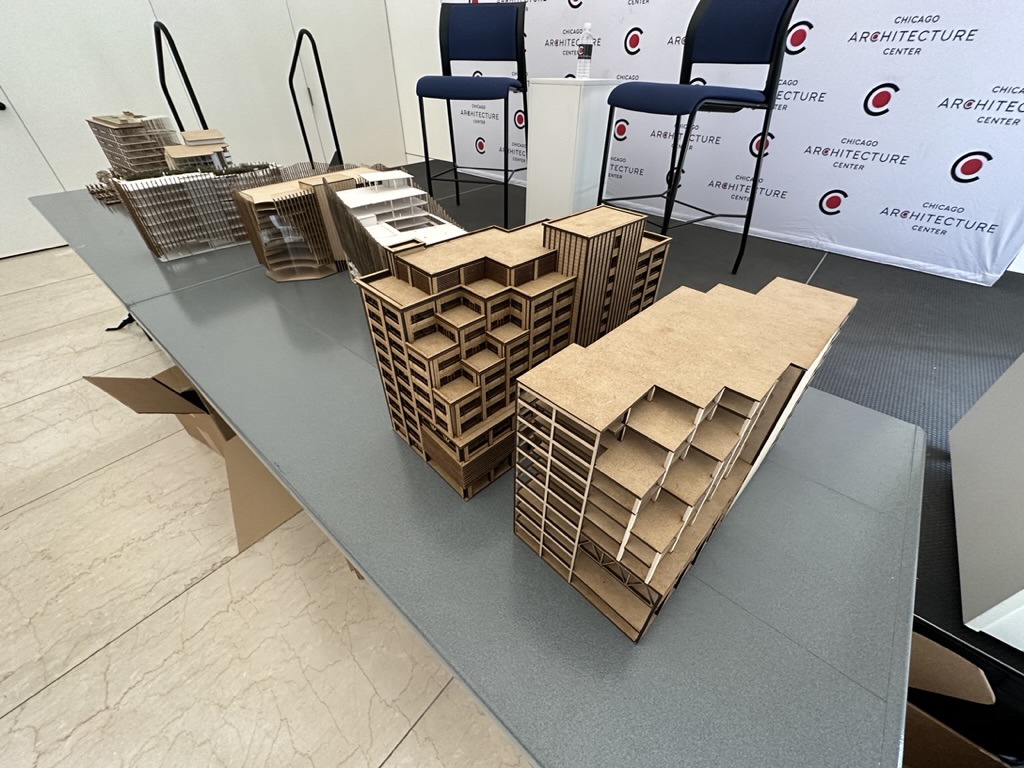
Teams presented to an all-star jury earlier this month in the CAC lecture hall. Highlights below–I’d say “hire these folks,” but (not surprisingly) most are already spoken for. A bunch of rock stars…
Kyle Bean and Simon BrinkoetterKinjal Bhojani and Joseph HarmonCristina Dekker and Sirisha Reddy Chittoor MuniJosh Domingo and Laura PressleyAishwarya Patwardhan and Samruddhi ShirdhankarMichelle Martinez and Pat DillonMike Rivera and Ray Wysocki
[Chicago Skyscrapers, 1934-1986, published by University of Illinois Press, is out now–available on Bookshop.org and Amazon.com, among other outlets.
Market Street’s transformation into the corporate boulevard of Wacker Drive received a boost when the Connecticut-based Hartford Fire Insurance Company purchased the riverfront block between Monroe and Adams in September 1958, joining Sinclair, Morton Salt, America Fore, and Mutual Trust in investing in the west Loop.[i] Unlike those companies, though, Hartford planned to take just 200,000 square feet of its planned 700,000 for regional offices, dedicating more than 70% of the structure to pure speculation—further “expression of confidence in the future of the central city,” according to the now omnipresent Mayor Daley at the project’s announcement.[ii] Hartford selected Skidmore, Owings, and Merrill as architects, giving them a new, existential challenge. Inland Steel and Harris Bank had both been headquarters buildings. Hartford, however, had to meet this more stringent, speculative budget. Bruce Graham recalled that New York developers—particularly Erwin Wolfson (see Gateway Center, below)—were eyeing Chicago. New York Contractors and architects like Morse Diesel and Emery Roth were used to tighter budgets and more efficient designs. Graham recognized them as potential threats from abroad and set out to prove that local architects could design “developer” buildings.[iii] Arthur Rubloff’s presence as Hartford’s local agent attested to the project’s commercial intentions.
(c) SOM
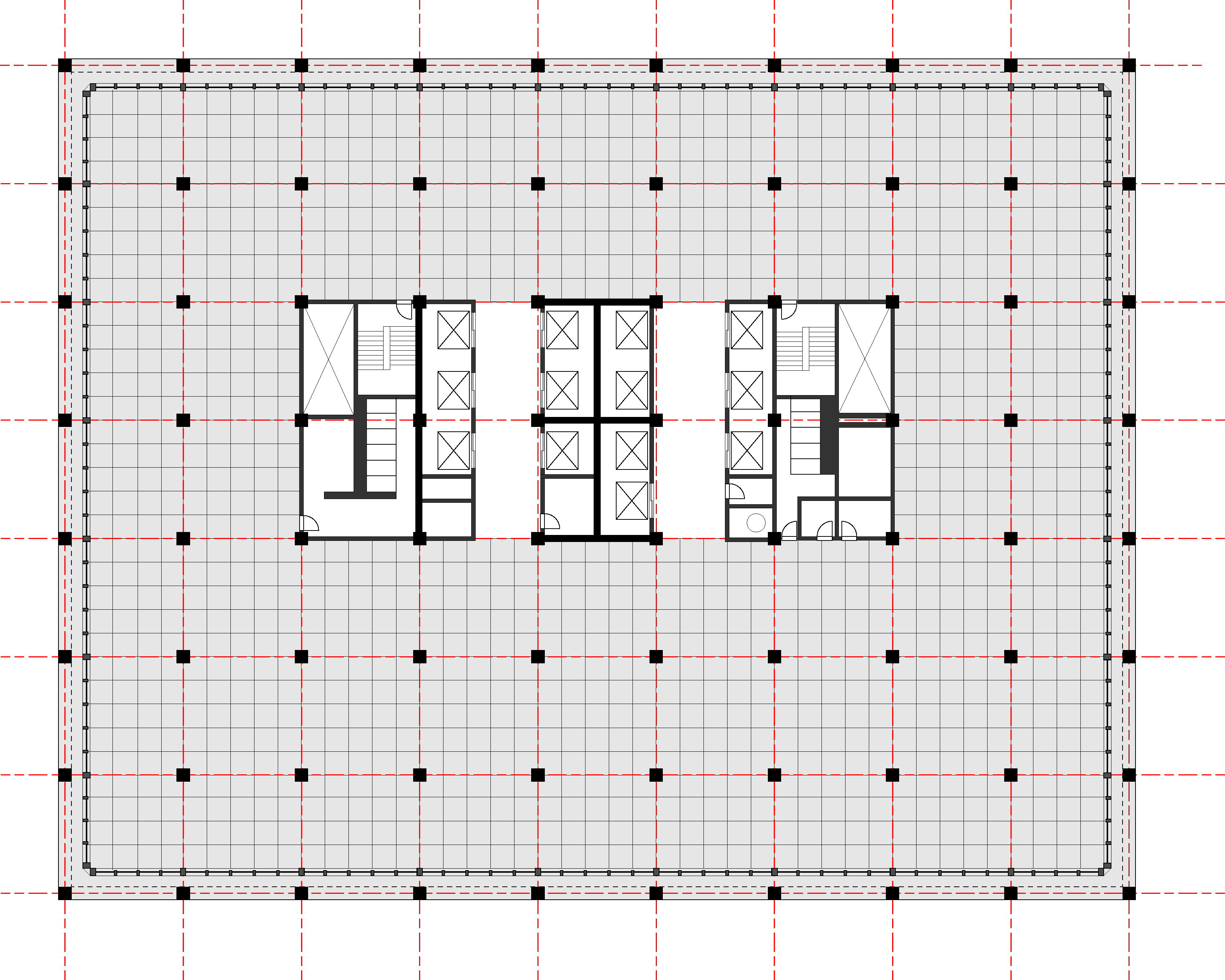
By 1958, Graham knew residential high-rise construction had proven flat slab concrete’s economic efficiency, particularly as contractors developed reusable formwork that could be ‘flown’ from one story to the next. Even with steel’s ability to integrate mechanical systems, Graham recognized that with simple, reusable formwork, concrete could compete with steel because of its lower material costs. SOM’s scheme, presented in August 1959, was essentially a concrete loft building, repeating a 21’-8” square structural bay over a 7 x 9 grid, with shallow haunches at column connections that provided stiff, moment-resisting connections for lateral resistance. Graham divided this structural bay into 4’-4” planning modules, arrayed around a central concrete core offset to one side. This created deep enough floors for open-plan offices on the south and more traditional executive and clerical suites on the north.
Architectural Record, Sept., 1961.
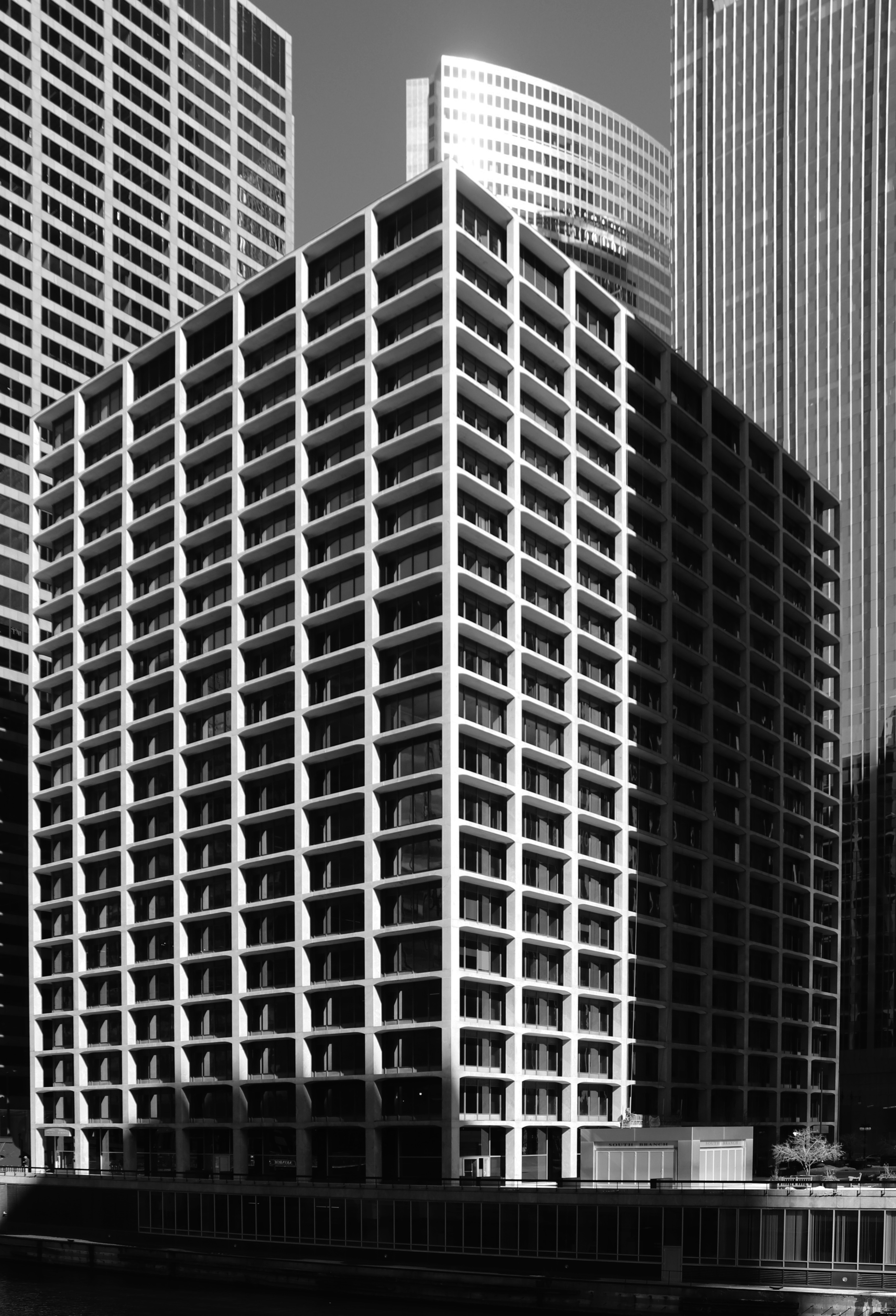
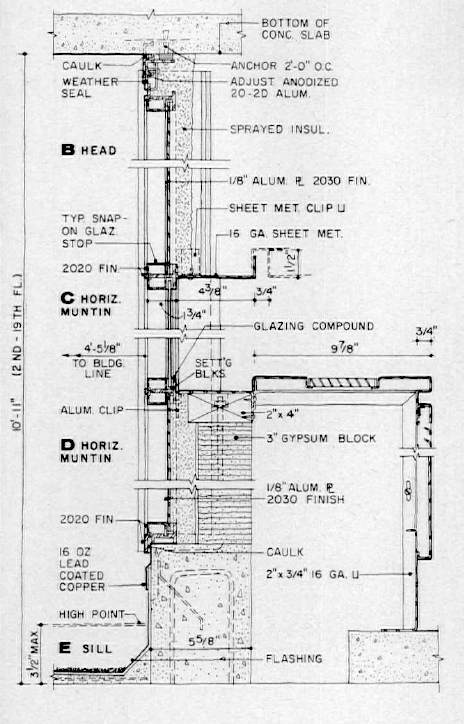
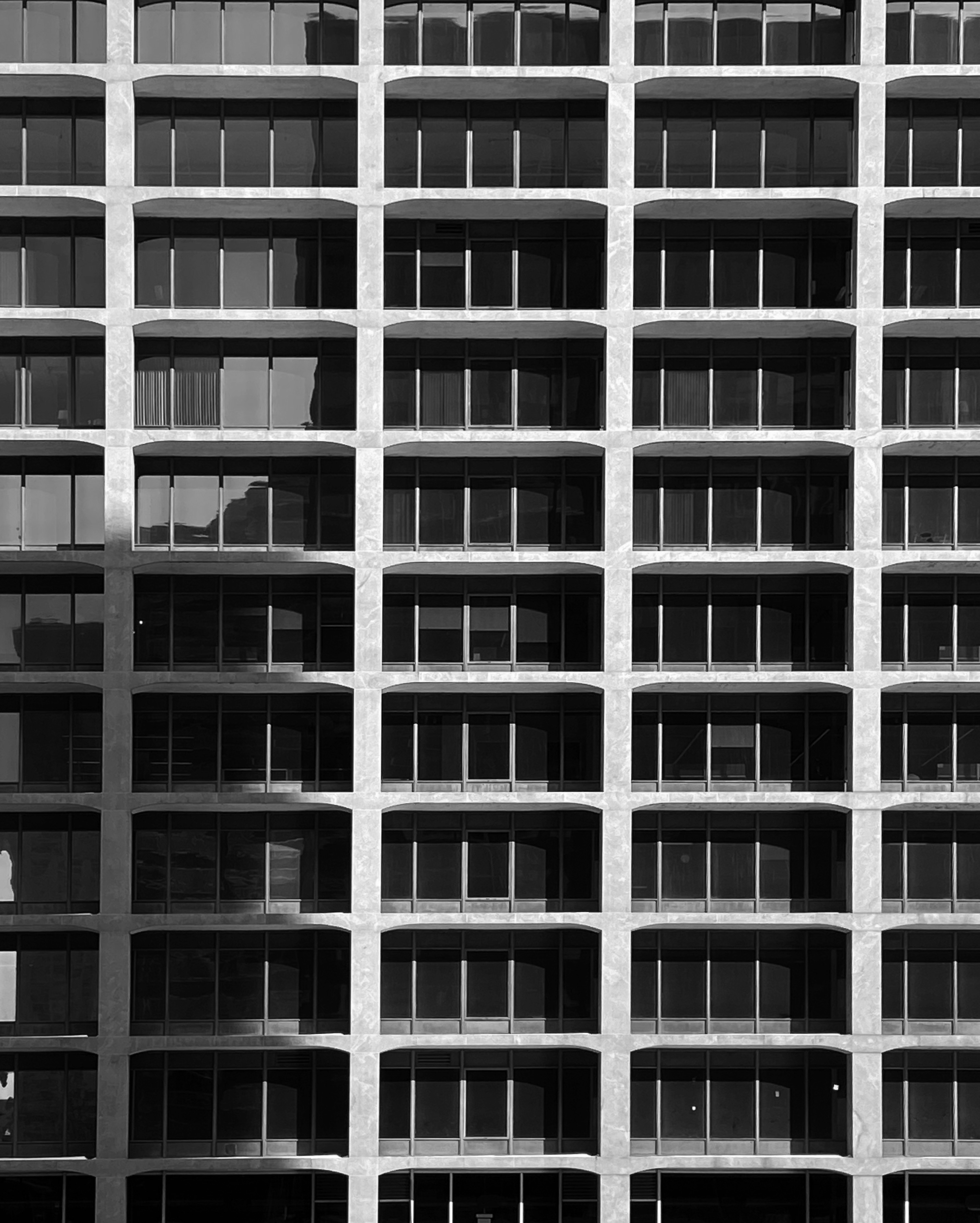
Hartford’s slabs were designed thick—up to 12”—but they did not require dropped beams, which allowed simple, flat formwork. Its mechanical systems were confined to an 18” zone beneath these, allowing 9’-0” floor-to-ceiling heights throughout within a floor-to-floor dimension of just 11’-6”—a tighter integration than Inland’s deep steel solution.[iv] Graham’s real innovation was to pull these structural slabs out beyond the building’s enclosure by a full 4’-4” module, making the concrete frame, rather than the curtain wall, the primary exterior element. This sacrificed a perimeter strip of floor space. Still, Graham argued that it gained solar shading and eliminated expensive window-washing equipment since cleaning crews could stand on the extended slabs. It also saved cladding costs since each story could be enclosed with floor-to-ceiling storefronts instead of a continuous curtain wall, making waterproofing simpler and allowing workers to assemble each panel from both sides during construction—without scaffolding.[v] Tinted glass and dark-bronze anodized sill panels and mullions assured that the concrete frame, dressed in 2” slabs of Minnesota granite, would stand out. Graham matched its visibility with subtle attention to detail. Hartford’s columns diminish as they rise, though, unlike the visible steps in Mies’ concrete structures, they step back gradually every two to four floors. Corner columns taper from their interior faces, leaving their exterior lines vertical, and slabs conceal offsets throughout, giving the illusion that each column narrows continuously from base to top, a visual refinement Graham would repeat in his later concrete work.[vi]
At 20 stories, Hartford was the tallest of the new buildings on Wacker, rivaling structures in the center of the Loop for height and adding, as Daley put it, “another gem to the crown of new Wacker Drive.”[vii] It did prove that Chicago architects could design “strictly speculative buildings” while maintaining their trademark “bold and graceful expression of structure.”[viii] Concrete here proved itself as a commercial alternative to steel, capable of more immediate formal expression and greater monolithic behavior presenting a “sense of ultimate structural integrity,” according to Carl Condit. Compared to Inland Steel’s “celebration of technique,” the haunched concrete slabs here represented “technique itself”—a subtle allusion to Montgomery Schuyler’s praise for the Monadnock as “the thing in itself”—If one could look past the granite sheathing,[ix]
Opened in April 1961, Hartford attracted prestige lessees, including paper companies Weyerhaeuser and St. Regis, along with IBM, Armour & Co., Western Electric, and State Mutual Life Insurance. In 1966, Hartford commissioned a second building from SOM on the southern half of its block. Planned for 26 stories, demand pushed it to 33 stories by the time it broke ground in late 1968.[x] Also of reinforced concrete, this building was clad in a more conventional curtain wall that concealed and contained its structure. The swell of this structure’s dark stone cladding around its lower columns alluded to the first building’s subtle expression, distinguishing between vertical elements that are pure cladding, which sit flat on the building’s skin, and those that are bearing, which meet the ground with entasis-like tapers that express the increasing loads, and thus greater required cross-sections, of the columns within.
[i] “4th Insurance Firm to Build on Wacker Dr.” Chicago Daily Tribune, Sept. 17, 1958. 19.
[ii] James Gavin, “Future $20,000,000 Hartford Fire Building.” Chicago Daily Tribune, Aug. 5, 1959. B7.
[iii] Betty J. Blum, Oral History of Bruce John Graham. (Chicago: Art Institute of Chicago, 1998), 103-106 and Betty Blum, Oral History of William Hartmann (rev. ed., Chicago: Art Institute of Chicago, 2003), 115-116.
[iv] “New Pattern for a Tall Building [Hartford].” Architectural Record, Vol. 130, no. 3. September, 1961. 121-126.
[v] Betty J. Blum, Oral History of Bruce John Graham. (Chicago: Art Institute of Chicago, 1998), 103-106. See, too, Ernst Danz, SOM: Architecture of Skidmore, Owings & Merrill, 1950-1962. (New York: Praeger, 1963). 170-173.
[vi] Betty J. Blum, Oral History of Srinivasa (Hal) Iyengar. (Chicago: Art Institute of Chicago, 2008). 19-20.
[vii] James Gavin, “Future $20,000,000 Hartford Fire Building.” Chicago Daily Tribune, Aug. 5, 1959. B7.
[viii] “New Pattern for a Tall Building [Hartford].” Architectural Record, Vol. 130, no. 3. September, 1961. 122.
[ix] Carl W. Condit, “The New Architecture of Chicago.” Chicago Review, 17:2/3, special issue on New Chicago Writing and Art. 1964. 111, 114 and Carl W. Condit, “The Rise of the New Chicago.” Chicago Tribune. Mar. 27, 1966. N34.
[x] “Hartford to Build.” Chicago Tribune, Oct 03, 1967. 1-c7 and “Hartford Going Up.” Chicago Tribune, Nov. 17, 1968. D1.
A real thrill last night to be interviewed by Chicago radio legend John Landecker about the new skyscraper book…full link here. Easy to talk when the subject matter is right outside the window…
[Chicago Skyscrapers, 1934-1986, published by University of Illinois Press, is out now–available on Bookshop.org and Amazon.com, among other outlets.
Richardson’s long, slender blocks were featured in the Museum of Modern Art’s 1950-51 exhibition of SOM’s work, drawing praise from critic Aline Louchheim, among others.[i] Richardson left the firm in 1951 to take up a teaching career. When Owings also departed for California, in the wake of his Plan Commission resignation, the scheme lost its champions. Nervous about the galleries’ maintenance in winter and releasing so many units onto the market at once, New York Life asked SOM to break Richardson’s scheme into four smaller, 21-story blocks that could be built in phases.[ii] While the office redesigned these, the local investment groups backed out of their agreements on the site’s southeastern parcels. New York Life also agreed to develop those, asking SOM to design five new blocks and prioritizing these while the north blocks were redesigned.[iii] The southern blocks were straightforward, planned around central corridors with workmanlike facades rendered in steel-framed curtain walls, asbestos-cement spandrel panels, and metal-framed windows, broken up by occasional balconies with solid concrete end walls faced in plain gray brick. Two blocks, at 533 and 555 E. 33rd Place, were started in early 1952 and opened to tenants in June 1953, a “major milestone” but an architectural disappointment—the Architect and Building News noted that these were “kept as simple as possible.”[iv] At $74 to $143 per month ($735 to $1418), the units met New York Life’s middle-class targets, however, and they offered amenities not available to most South Side residents: gas kitchen ranges and electric refrigerators as well as master television antennas and outlets for tenant-supplied electric air conditioners.[v] If not the dramatic “skyscrapers on their sides” that Richardson’s scheme had promised, these simple blocks were attractive to prospective renters; leasing agents Draper and Kramer received 1300 inquiries for their 238 apartments.[vi] Only about 10% of the first year’s leases went to white residents, though, and critics argued that Lake Meadows was—intentionally or not—concentrating Black residents in areas that, while no longer slums, were still ghettoes.[vii]
Two more of these simpler blocks were built in 1953-54, but after five years, the original northern site still sat vacant. New York Life faced bureaucratic delays and faced the daunting prospect of turning its rubble-strewn expanse into an attractive neighborhood. Critics remained skeptical about Lake Meadows’ prospects and—in the words of Architectural Forum—whether the “Negro market can pay.”[viii] “It has taken New York Life six years to get its idea to where it stands today,” Forum reported, “still barely 25% complete.” Now “controversial and beleaguered,” the project had fewer than 500 occupied units and over a hundred acres of empty land, still surrounded by “the toughest, most criminal slums in Chicago,” discouraging interest in the ‘pioneering’ project.[ix] New York Life adjusted its strategy, first building the 17-acre shopping center in the site’s southwest corner. The center—a slice of the “suburbs in the city”—opened in 1954. Downtown retailer Goldblatt’s established an anchor store there, which boosted the project’s reputation. Reassured, in April 1955, New York Life announced it would finally, start construction on two of the north site’s 21-story blocks.
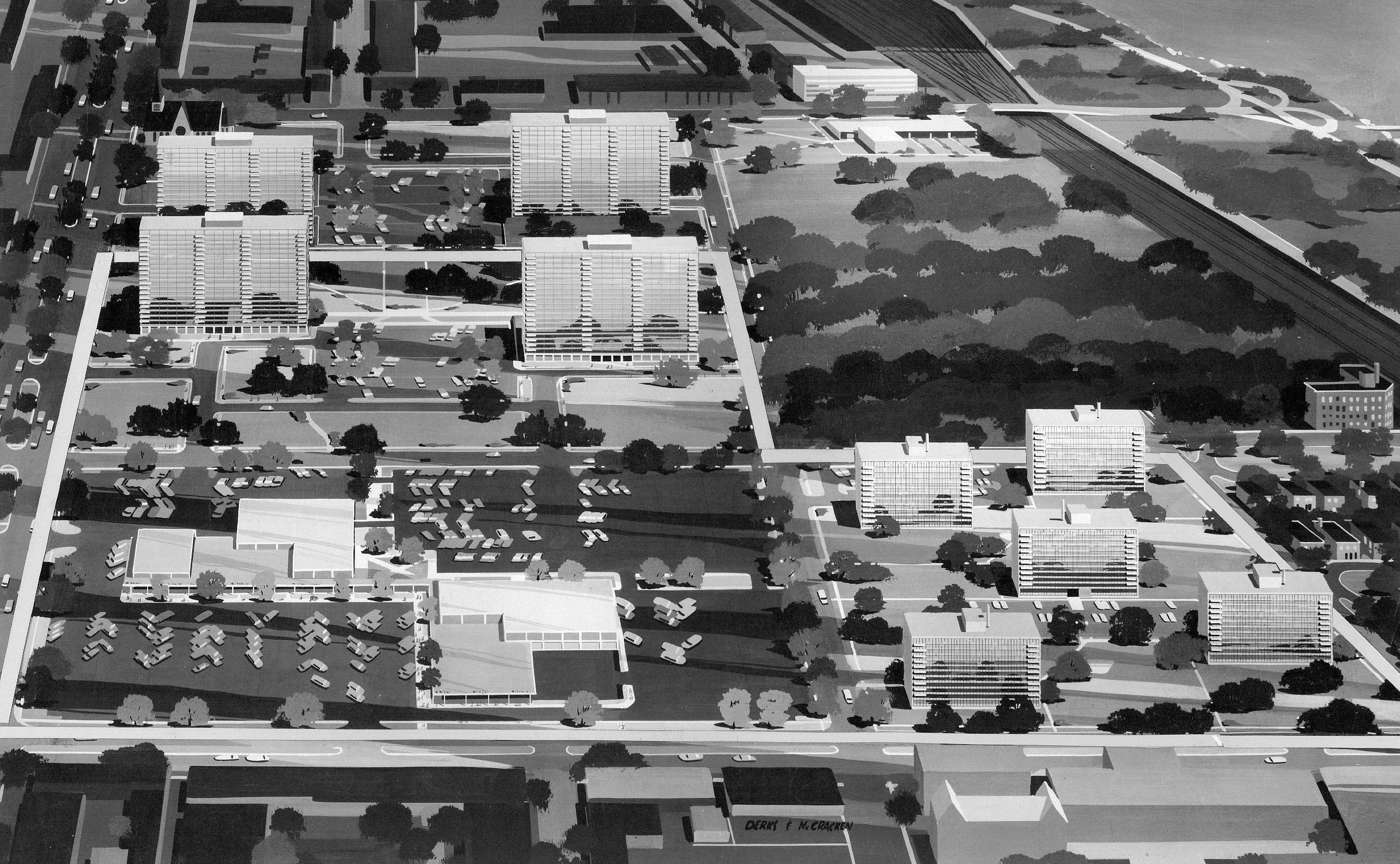
Mayor Daley, then in office for just over a year, helped break ground for the first two northern blocks in May 1956. Nelson announced that New York Life would begin construction on the second pair in late 1956, along with 40 low-rise duplexes and a final, higher-end 12-story block on the development’s eastern side. While not as striking or innovative as Richardson’s giant slabs, the taller blocks made extensive use of curtain walls, improving on the first phase’s solid end walls to provide wrap-around views of the lake and city. Each apartment had a balcony, and the blocks’ arrangement allowed for the large, open space between them that Richardson had envisioned. Encouraged, by 1957, the Daley administration authorized half a dozen more land clearance projects on the Lake Meadows model and began considering another eight. As the taller blocks opened, Draper and Kramer launched a more balanced publicity campaign; 30% of its new leases went to white tenants, making the new buildings “outstanding exceptions” to Chicago’s segregated market.[x]
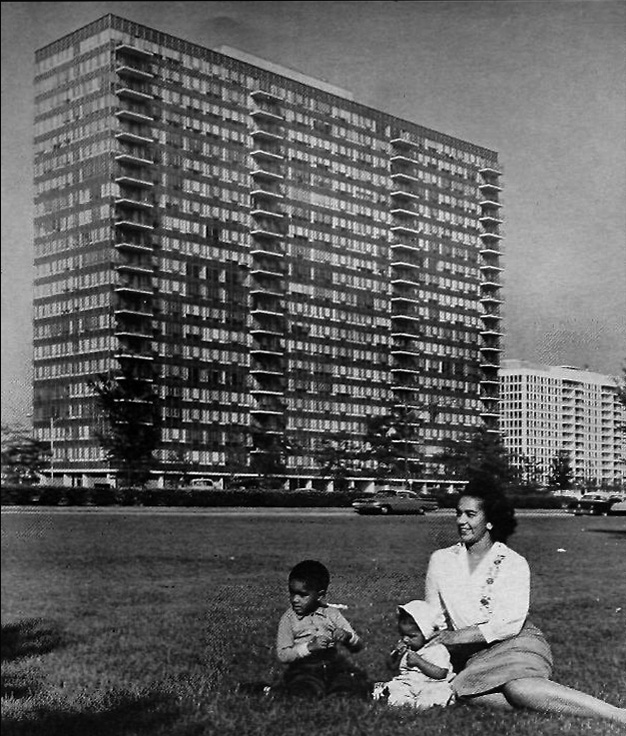
A clubhouse and business center opened in 1959 and 1960, and after twelve years, Lake Meadows was complete.[xi] “Elevator apartment buildings stand where teeming, unsanitary, and unsafe stone front walkups once stood,” wrote the Tribune’s Sheila Wolfe in 1959. Ebony praised the project’s opening in 1960:
“Some 7000 Chicagoans enjoy the spaciousness of suburban living, though only three miles from the teeming Loop. Active participants in the nation’s biggest and most successful venture in high-grade interracial housing, they are the envied residents of Lake Meadows—Chicago’s futuristic South Side development near Lake Michigan’s shores.”[xii]
But the project’s long saga drew critics who contrasted its extraordinary costs with its limited achievement. Even the Land Clearance Commission’s chairman, Phil Doyle, admitted that the ultimate cost to the city in clearance, infrastructure, and tax losses while the land sat fallow had been between $55 and $60 million, or $30,000 per unit, making Lake Meadows more heavily subsidized than the city’s public housing.[xiii] The Defender’s Doc Young lamented that while “the rich and middle class” lived “side by side,” there “were no poor” in Lake Meadows; its “country-like spaciousness” was possible only because the city moved more than 7000 residents out and replaced them with just 4000. On the other hand, Architectural Forum thought that Lake Meadows had not done enough. At the project’s outset, New York Life estimated 19,000 families on the South side could afford its rents; as massive as it was, Lake Meadows accommodated just 10% of them.[xiv]
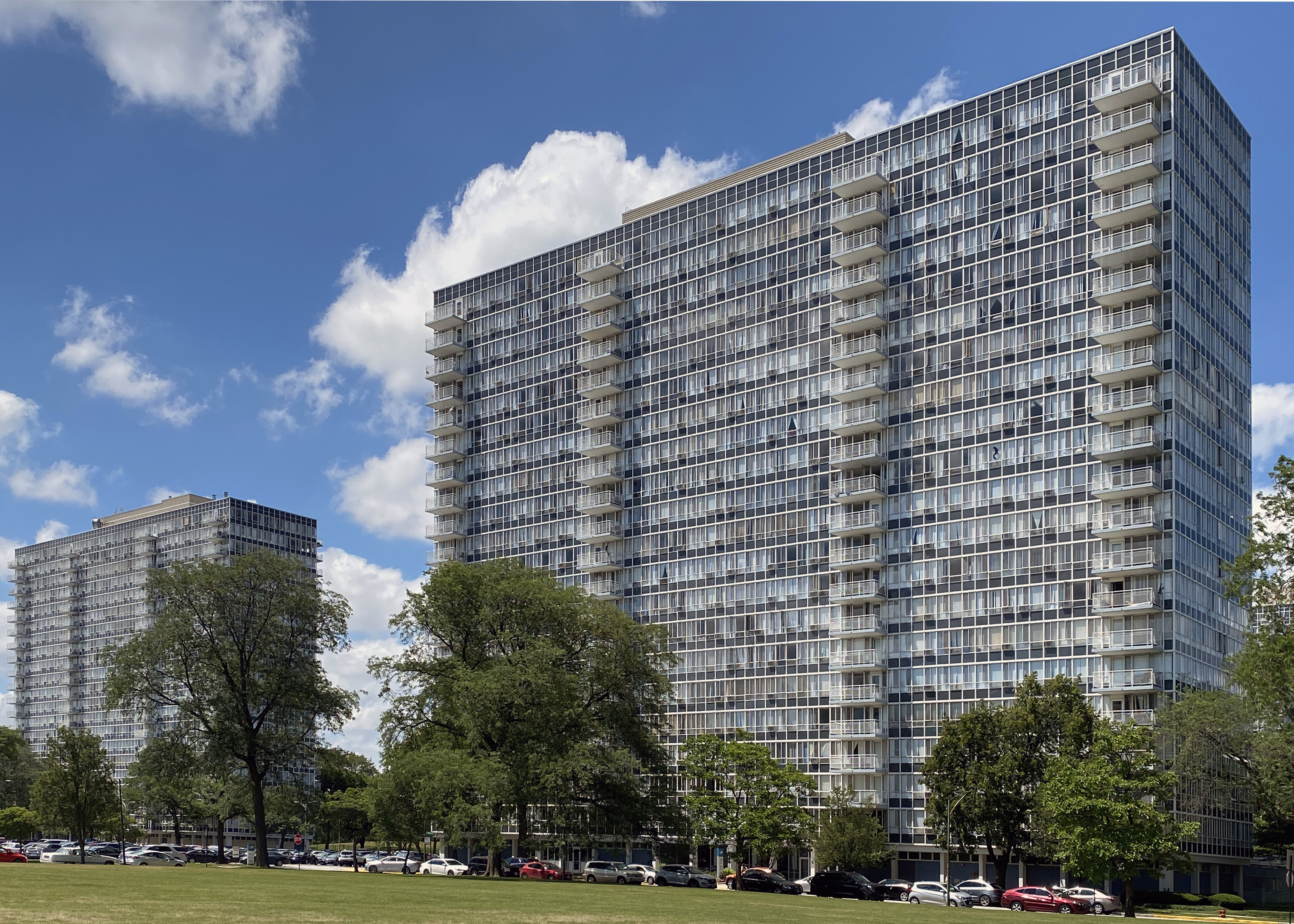
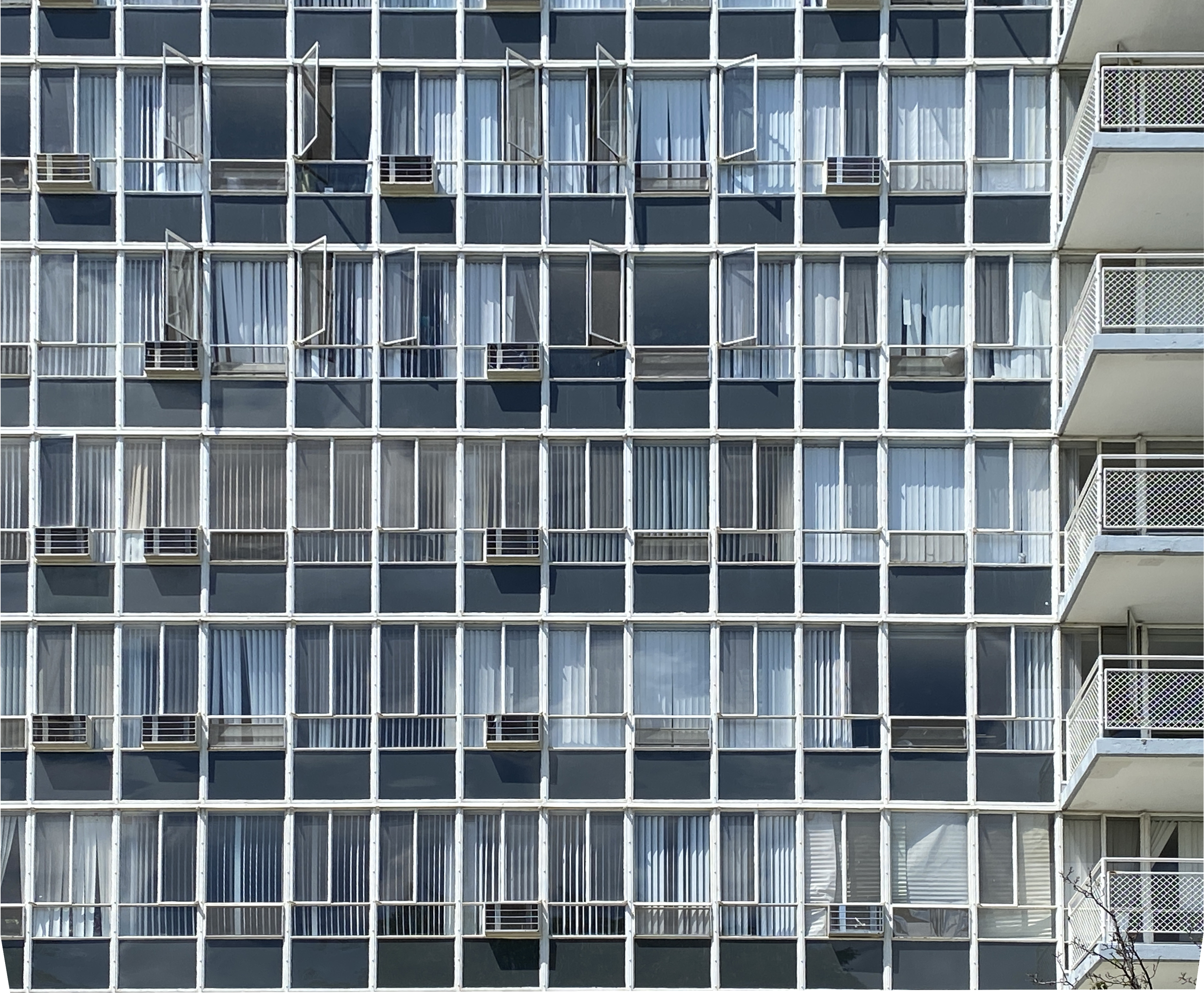
Efforts to house more prospective middle-class residents were repeated in the five diagonally sited blocks of Prairie Shores, north of Lake Meadows and adjacent to Michael Reese Hospital, which financed the project. Intended as a buffer for the hospital and housing for its doctors and staff, Prairie Shores was more compact and marketed more broadly than Lake Meadows. Designed by Loebl, Schlossman, and Bennett and built between 1957 and 1961, its 20-story blocks featured floor-to-ceiling windows that opened every one of its 1700 apartments to skyline or lake views. Demand was fierce; the first two blocks were rented immediately when they opened in 1960, and the last three buildings were rushed to completion. Draper and Kramer, the project’s rental agents, again made a concerted effort at racial balance, advertising the “New South Side” to northside whites as Chicago’s “original Gold Coast.” With “unbelievably low rentals” of $112 for one-bedroom units ($1000 in 2020) and priority for Michael Reese’s doctors and staff, Prairie Shores opened with 80% white and 20% Black residents–within a few percent of the city’s demographic split at the time.[xv] HOMES, Inc., a non-profit group advocating against housing segregation, praised Lake Meadows and Prairie Shores for “harmonious housing integration” in 1961.[xvi]
[i] “Big South Side Area is Getting Her Face Lifted [Lake Meadows].” Chicago Daily Tribune, Sept. 23, 1951. W_A7 and Aline B. Louchheim, “Architecture of and for Our Day.” New York Times, Sept. 24, 1950. X9.
[xv] See, for instance, “Chicago’s New Near South Side [Display Ad].” Chicago Daily Tribune, June 8, 1958. 20.
[xvi] Sheila Wolfe, “Vast Project Changes Face Of South Side.” Chicago Daily Tribune, June 4, 1959. 1-s6and “More Interracial Dwellings is Summertime Project of Home, Inc.” Chicago Daily Defender, June 26, 1961. 5.
“Lake Meadows: Suburb Within a City.” Ebony, vol. 16, no. 2, Dec. 1960.
[Chicago Skyscrapers, 1934-1986, published by University of Illinois Press, is out now–available on Bookshop.org and Amazon.com, among other outlets.
Lake Meadows (1950-61), SOM
“A frequent and false contention of public housing advocates,” wrote the Tribune’s editorial board in 1944, “is that government has to undertake the job of slum clearance, with all the waste, tax evasion, political favoritism, and social worker interference in the lives of tenants that public housing seems unable to escape.”[i] The conservative Tribune saw red in any large government project, but its editorial board found public housing particularly suspect, arguing for free market solutions to Chicago’s housing problems. The paper strongly supported Illinois’ Neighborhood Redevelopment Act, passed in 1941 but tied up in lawsuits until 1948, which allowed municipalities to condemn and clear so-called ‘blighted land’ and convey it to private developers.[ii] Using eminent domain, a housing authority could condemn a ‘slum’ and purchase its land at market rates. It could then sell this land at a loss to private developers who would, at their risk, build housing that they would then rent at agreed-upon, below-market rates. The city’s initial expense would be recouped by taxes from improved properties, while the developers’ profit would be assured by the land’s low purchase price. Combining condemnation with private investment in the service of affordable housing seemed to square the circle of Chicago’s housing problem, promising much-needed modern accommodation without requiring the city to construct it.
Equitable and New York Life expressed interest in Chicago housing as early as 1945 but remained sidelined until the Act’s legal status was resolved.[iii] New York Life, then completing the Fresh Meadows development in Queens, announced in July 1948 that they would invest $18,000,000 on a 100-acre redevelopment project for 1400 new, high-rise apartments. Between 31st and 25th streets, the Illinois Central’s tracks, and South Park Way (now Martin Luther King Boulevard), the site was home to more than 3500 families in some of the city’s most dilapidated housing. Chicago and the state of Illinois agreed to split the $3,000,000 cost of purchasing and razing the existing neighborhood, which New York Life would purchase for just $500,000.[iv] Two smaller parcels in the site’s southeast corner were sold at similar discounts to Black insurance firms and South Side families who planned to build single-family homes.[v] The Kennelly administration announced a federal grant to support the land purchase in July 1949. That August, New York Life announced that Skidmore, Owings, and Merrill, designing their block-long Manhattan House in New York’s Lenox Hill, would also design the Chicago development.[vi] Honoring their pioneering—though, as the Defender pointed out, segregated—project in Queens, New York Life announced that the Chicago project would be called “Lake Meadows.”[vii]
However, New York Life would not commit until two obstacles were removed. The first was the ongoing building code controversy. The company’s vice president for development, Otto L. Nelson, Jr., told the Tribune in July 1948 that plans wouldn’t be drawn up until material questions—especially regarding drywall—were resolved, “dangling,” as one reporter put it, “an attractive bait before house-hungry Chicagoans.”[viii] A year and a half would pass before the new code was adopted. More specific to Lake Meadows, however, was Cottage Grove Avenue, a diagonal traffic artery that sliced across the project site. Closing minor east-west streets passed the city council without issue but Cottage Grove was one of the South Side’s major traffic routes. The Chicago Plan Commission, led by Nathaniel Owings, reviewed New York Life’s request to vacate the street in late 1950. Opponents latched on to Owings’ clear conflict of interest in approving condemnation for a project his company was designing. He resigned from the Commission in frustration, though the Cottage Grove closure passed.[ix]
The Cottage Grove controversy stirred other objections. Land acquisition costs mounted as the city purchased and razed the neighborhood piecemeal, ballooning to $11 million. Other aspects of the plan drew fire from housing activists. Lake Meadows, they pointed out, would house just half the neighborhood’s former population and the units’ projected rents, between $77 and $150 a month ($840 and $1650 in 2020 figures), were on par with the extortionate rates charged for ‘kitchenette’ apartments.[x] Only a quarter of the existing residents would qualify for public housing elsewhere—and they would face long waits for replacement units in projects like Dearborn Homes. Those ineligible for public housing would be relocated to “equivalent dwellings” in ‘blighted’ neighborhoods no better than those they had left.
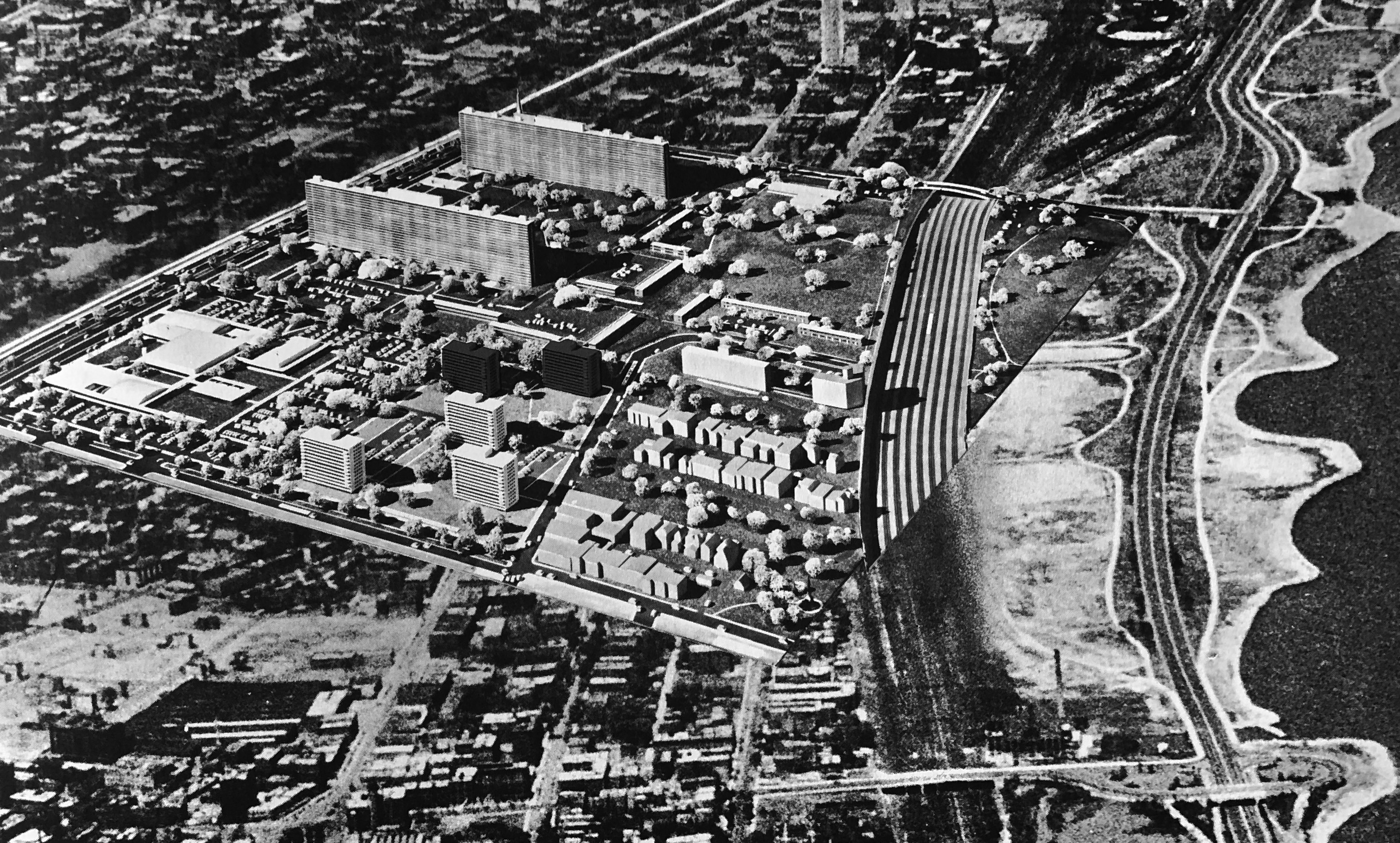
Lake Meadows. Early scheme by Ambrose Richardson, 1950. (SOM)
These critiques smoldered as SOM’s initial designs made a more favorable public impression. Their “suburb in the city” grew from a tour of European housing developments by SOM architect Ambrose Richardson (1917-1995) and New York Life manager Jack Gurney. The resulting masterplan and building plans, revealed in July 1950, reflected their research, with ten long, low bars of two-story row houses surrounding two massive, 23-story Corbusier-inspired slabs, each a third of a mile long and just 40’ deep. These bracketed a vast central garden, raised above an underground parking garage and complemented by a suburban-scale shopping mall in the site’s southwestern corner. The slabs accommodated 1288 apartments along 9’-8” deep exterior corridors, called “sidewalks in the sky” by SOM, that would double as outdoor play spaces. The narrow plan allowed unit plans one room deep, allowing natural ventilation, with kitchens adjacent to the units’ entries, putting parents in direct line of sight to children playing on the galleries. Their elevations were repetitive along their entire façades, with continuous, shaded ribbon windows taking full advantage of southern sunlight.[xi] “These will be some of the best apartments in Chicago,” noted Architectural Forum, praising the replacement of “dismal” enclosed hallways by outdoor galleries.[xii] The Defender noted another advance over Lake Meadows’ New York counterparts; “Lake Meadows,” it reassured readers, “will know ‘no discrimination or segregation based upon race, creed, color or national origin.”[xiii] (cont.)
Lake Meadows. Early scheme by Ambrose Richardson. Elevation and plan from Architectural Forum, August, 1950.
[i] “Slum Clearance by Private Enterprise.” Chicago Daily Tribune, May 29, 1944. 6.
[ii] “Chicago Housing Plan Cleared by Supreme Court.” Chicago Daily Tribune, Mar. 19, 1948. 24.
[iii] Edward Schreiber, “Two Insurance Firms May Ask Housing Sites: Consider Investing in Chicago.” Chicago Daily Tribune, Dec 7, 1945. 39.
[iv] “1,800 Flats Will Be Built On South Side.” Chicago Daily Tribune, Jul 22, 1948. 1-b6.
[v] “Redevelopment Project No. 1.” Chicago Daily Tribune, July 30, 1949. 8.
[vi] “Pick Architects for 1,400 Unit Apartment Job.” Chicago Daily Tribune, Aug. 16, 1949. 17 and “Big South Side Area is Getting Her Face Lifted [Lake Meadows].” Chicago Daily Tribune, Sept. 23, 1951. W_A7.
[vii] “New York Life’s Lake Meadows to be Last Word in Modern Living.” The Chicago Defender, July 22, 1950. 14.
[viii] Clayton Kirkpatrick, “4 Years Drag By and No Building Codes in Sight.” Chicago Daily Tribune, Aug. 29, 1948. 5.
[ix] “Owings Quits Plan Board as Probe Impends.” Chicago Daily Tribune, Jan. 11, 1951 and “Mr. Owings and the Plan Commission.” Chicago Daily Tribune, Oct. 10, 1950. 18.
[xi] Thomas Buck, “Mammoth Slum Building Plan Given Council.” Chicago Daily Tribune, July 13, 1950. 12 and “New York Life’s Lake Meadows to be Last Word in Modern Living.” Chicago Defender (National Edition), July 22, 1950. 14.
[Chicago Skyscrapers, 1934-1986, published by University of Illinois Press, is out now–available on Bookshop.org and Amazon.com, among other outlets.
1000 N. Lake Shore Dr. (1953), Sidney Morris
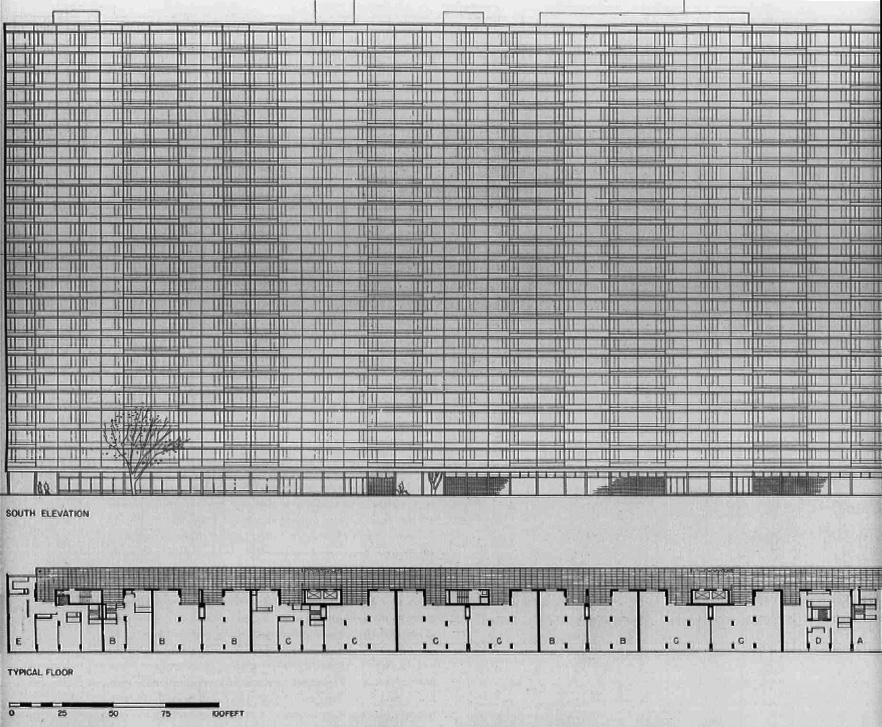
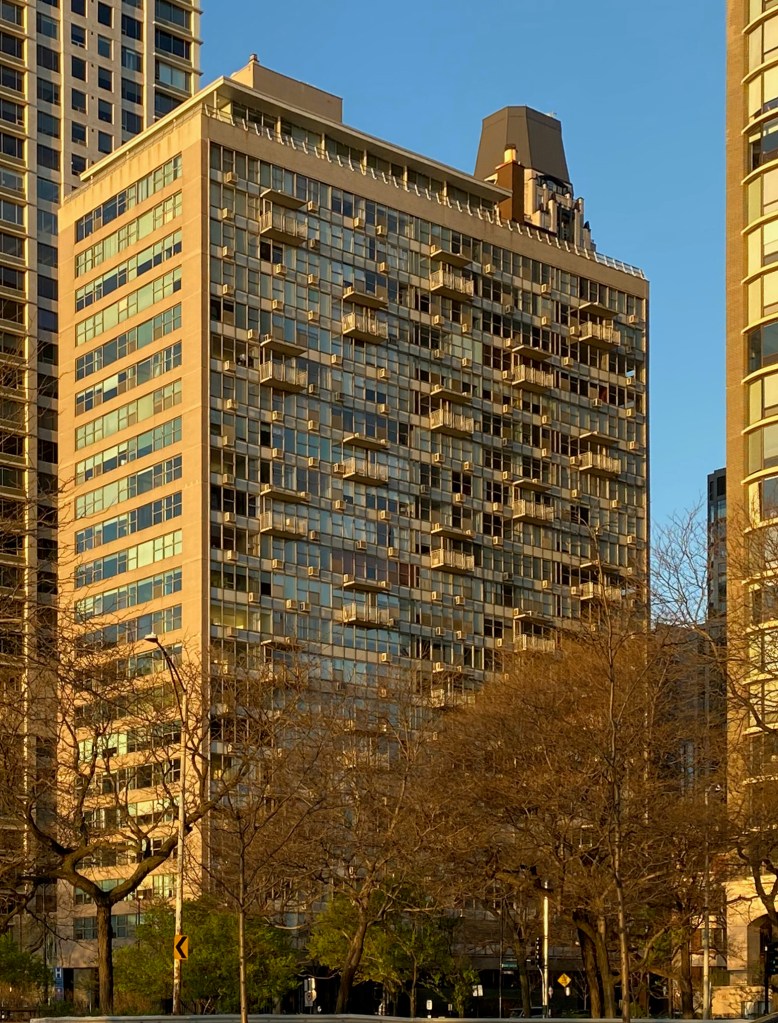
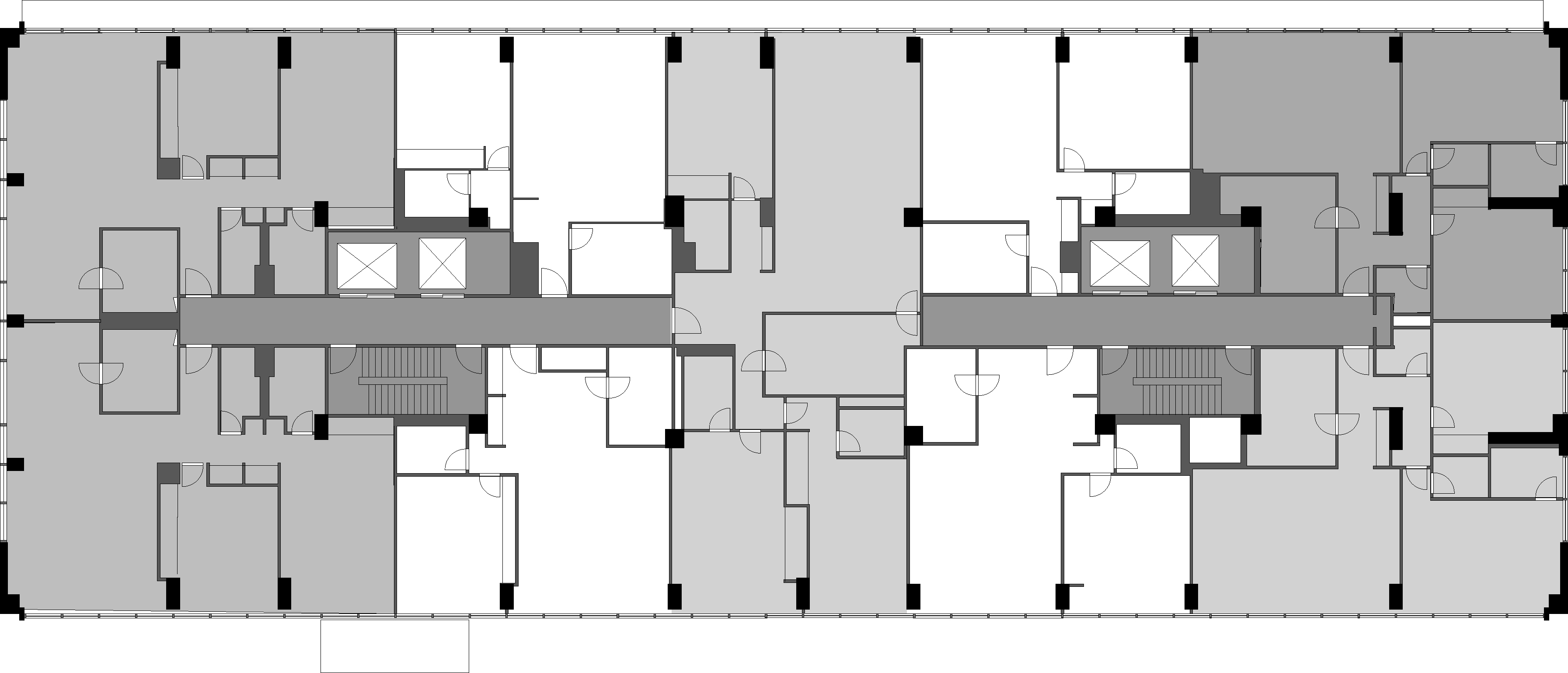
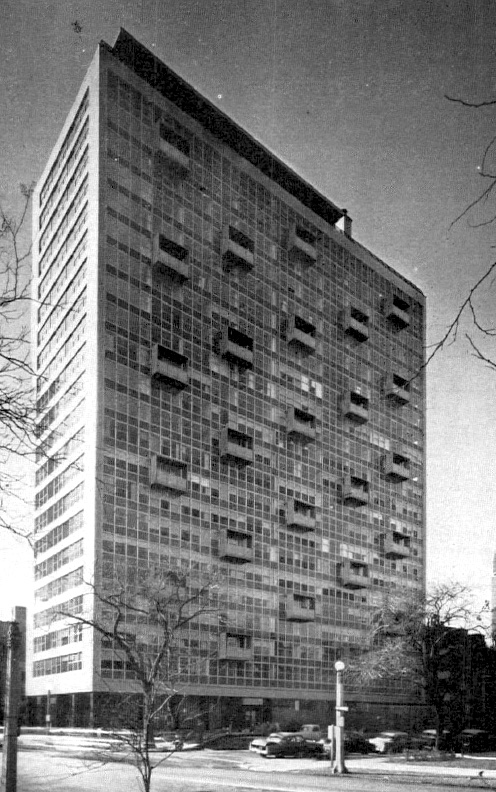
Mies’ apartments took center stage in coverage of Chicago’s apartment building, but other developments were influential locally, in architectural and financial terms. The 23-story slab that replaced the 1900 Edith Rockefeller McCormick mansion was the earliest among these. Harold Perlman, a lawyer and philanthropist who had established a reputation for fighting insidious banking practices, purchased the mansion and the entire block on which it sat in 1953. The site was among the most prestigious in the city, at the corner of Michigan Avenue, Oak Street, and Lake Shore Drive, with views over Oak Street Beach and along the ‘millionaire’s row” of East Lake Shore Drive that wrapped around the northern edge of Streeterville. Perlman had invested in a shopping center at Lincoln and McCormick designed by architect Sidney Morris, who had a small but growing practice that had focused entirely on single-family homes and low-rise retail development, in particular for some of the CHA’s outlying projects, and he hired Morris to design a scheme for the site. After an initial effort of 200 units in a 24-story block, published in the Tribune in December 1952, Perlman retreated slightly, announcing plans for a building one story shorter and with seventeen fewer units, developed by Morris with in collaboration with Shaw, Metz, and Dolio in May 1953.[i] Morris described the project’s massing as a response to the site’s unparalleled views, its open southern exposure and the desire to take advantage of lake breezes in summer, and the relative privacy of Bellevue Place. This residential street intersected the Drive at the north edge of the site. The result was a tall slab oriented perpendicular to the Lake—seemingly contradicting the desire for views—but arranged around two elevator cores so that most units either had corner exposure or, in the center of the block, were open to both the north and south facades. This took advantage of the relatively low construction around the block—which would change quickly in the ensuing boom years—while orienting most units away from the traffic noise on the busy Drive to the east. Morris’ facades borrowed from contemporary curtain wall practice, with aluminum, porcelain enameled steel [???] and glass curtain walls on the north and south facades, the latter expanded with long, horizontal sunshades that offered protection from the summer sun while allowing low winter sun to penetrate the living, dining, and sleeping rooms organized along this edge.[ii] The 187 apartments ranged from one to three bedrooms, arranged around wet cores that clustered around the two pairs of elevator shafts and fire stairs at roughly quarter points of the plan and pushed to the outer, east and west walls of the slab in the western corner units, where views were least impressive. Units on the east lake end tucked their kitchens and baths inward so that dining and living rooms could take advantage of the lake views—the end wall here was rendered in long strip windows that “framed a shore view that rivals the Riviera or Rio’s Copacabana Beach,” an optimistic pitch, but one that reflected the appeal of the site. However, the building’s signature features were two dozen randomly placed balconies on the north façade that cantilevered out from various bedrooms and living rooms. Capped with sheltering roofs, these replicated on a smaller scale the elaborate roof terraces of neighboring 1920s co-op towers on the Drive. They marked the first true balconies in Chicago apartment construction. While climatically questionable, the provision of a small outdoor space to sit or to grill would become a standard feature of the city’s private high rises, offering architectural variety and richness that would form a counterpoint to the flat curtain wall—but at the same time presenting environmental issues that required careful detailing and insulation to prevent excessive heat loss in winter.
Frank Kornacker engineered the building’s structure, which featured a composite column design for the lower half of the structure and simply reinforced concrete for the remainder. The floor slabs included copper coils for radiant heating, controlled by individual units’ thermostats, which were a new enough feature that Honeywell used the building for its local advertising.[iii] Cooling presented Morris and Perlman with a conundrum. While the technology to cool apartments with centrally-chilled water was becoming more affordable, it was not yet a full-on expectation of even luxury apartment tenants—only 40 tenants in Mies’ 860-880 building had opted for installing either room or unit machines.[iv] Individual units protruding from building elevations were unsightly (Mies had these specially designed to be fully inside the units, taking up valuable space but saving the buildings’ crisp facades from random intrusions of the inevitable metal boxes), but options for central chilling proved untenable; Morris considered using the copper heating coils embedded in each slab for chilling as well but recognized that there would be inevitable problems with condensation on the resulting cold slabs. Providing ducted chilled air, as in a typical air-conditioned office building, proved similarly uneconomical, as it would have required significant sectional space over corridors and interior rooms that would have pushed floor-to-floor heights up; the combined cost of extra exterior walls, fire stairs, and shafts would not, Perlman felt, be reflected in higher rents. Ultimately the building was provided with no central air conditioning; additional high-voltage outlets were provided near windows to allow individual tenants to install their own self-contained units, but Morris bemoaned the effect they would have on the building’s elevations, trying unsuccessfully to design specialized interior units similar to those developed for 860-880.[v] 1000 N. Lake Shore would, however, be one of the last tall developer buildings in Chicago to forego air conditioning. There were projects under construction even as it opened that found ways to handle the budgetary and architectural issues that frustrated Morris here.
Construction began in May 1953 and was complete by August 1954.[vi] Its rapid construction was matched by enthusiastic rentals; aimed squarely at the expanding luxury market, tenants were required to advance six months’ rent and to sign five-year leases. But even with these high financial bars and commitments, two-thirds of the project’s units were rented in March 1954, nearly five months before tenants could move in. The building’s demographics reflected Perlman’s predictions, with professional singles and couples forming the majority and only six children among the 183 apartments.[vii] Those tenants found a wealth of high-end finishes and amenities in the finished building, which was marketed as a cosmopolitan counterpoint to the stodgier 1920s co-ops that it joined on the Drive. A marketing brochure managed to mention “the beauty of Parisian boulevards” and the “sophistication of New York’s E. 50s” alongside references to the French Riviera and the building’s Niemeyer-esque “Brazilian Brises-Soleil” on its south façade. Alongside this were mentions of the design’s combination of traditional materials, such as sidewalks of Vermont slate and column covers of Norwegian granite, with technically-advanced elements, such as heat-absorbing glass and “fine handsome aluminum” that formed the curtain wall and its operable windows.[viii] At its base, a stepped entrance along Lake Shore Drive was highlighted by a cast bronze relief. At the same time, an asymmetrical entry on Bellevue Place provided access, through a wood-paneled lobby, to the two elevator cores.
“Eight Chicago Apartments.” Architectural Forum, November, 1955.
Architectural Forum’s apartment panel found faults with Morris’ design, from its massing that addressed Bellevue Place instead of the lakefront to its “dinky balconies” that made for “timid decoration.” Its end walls, despite the broad strip windows along the eastern, lake-facing facade, were for Yamasaki symptomatic of an ‘indecision as to whether to go to a masonry or glass building,’ a quandary that would continue to define architects’ approaches to apartment blocks—should they emulate the “glass houses” that had proven popular but that illustrated the inherent privacy and environmental problems in pure curtain walls? Or should they adopt the other Chicago paradigm, the Promontory block with its more limited windows and the frank acceptance of blank walls covering service areas? Morris, to his credit, distinguished between the panoramic east end and the western arrangement of bedrooms and bathrooms; Yamasaki’s critique was only applicable, really, to the decision not to carry the curtain wall all the way around the building’s eastern end. Yet the random balconies and the asymmetries of the ground floor, while “laudable” in their “attempt to provide some fun in the design,” were, for the panel, “not very well carried through.”[ix] Whatever its architectural faults, Perlman found the combination of the Lake Shore Drive site and of Morris’ planning successful enough that he would develop the 55-story 1000 Lake Shore Plaza on the same block in 1964, selling both of them in 1969 as he abandoned his development career to focus on his law practice.
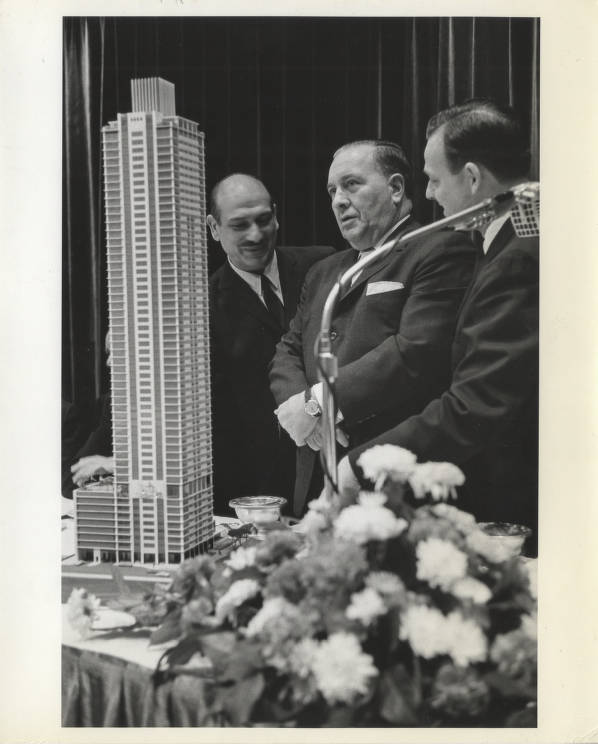
Mayor Richard J. Daley with model of 1000 N. Lake Shore Drive Plaza, an extension of the original 1000 N. Lake Shore Dr. building–also designed by Sidney Morris, this tower briefly held the record for the world’s tallest concrete structure.
[i] Al Chase, “Plan Flats on Famed Gold Coast Block.” Chicago Daily Tribune, Dec 3, 1952. 1.
[ii] Sidney H. Morris & Associates. 1000 Lake Shore Drive [Building Brochure]. McNally and Quinn Records, Series I, Box.FF 2.35, Ryerson and Burnham Libraries, The Art Institute of Chicago. 1953?
[iii] Al Chase, “Successor to Lake Front Mansion.” Chicago Daily Tribune, May 12, 1953. B7; see, too, “Honeywell Thermostats [Display Ad].” Chicago Daily Tribune, Oct 20, 1953. 1-a7.
[iv] “Mies van der Rohe’s New Buildings.” Architectural Forum, Vol. 97, no. 5. November, 1952. 101.
[v] Joseph Egelhof, “Scan Central vs. Unit Air Conditioning.” Chicago Daily Tribune, Sept. 18, 1953. C9.
[vi] Al Chase, “Successor to Lake Front Mansion.” Chicago Daily Tribune, May 12, 1953. B7 and Al Chase, “ ‘1000 Building’ Rising, Filling at Rapid Pace.” Chicago Daily Tribune, Mar. 27, 1954. A5.
[vii] Al Chase, “ ‘1000 Building’ Rising, Filling at Rapid Pace.” Chicago Daily Tribune, Mar. 27, 1954. A5.
[viii] Sidney H. Morris & Associates. 1000 Lake Shore Drive [Building Brochure]. McNally and Quinn Records, Series I, Box.FF 2.35, Ryerson and Burnham Libraries, The Art Institute of Chicago. 1953?
[ix] “Eight Chicago Apartments.” Op. cit., 142, 147.


 architecturefarm