[Chicago Skyscrapers, 1934-1986, published by University of Illinois Press, is out now–available on Bookshop.org and Amazon.com, among other outlets.
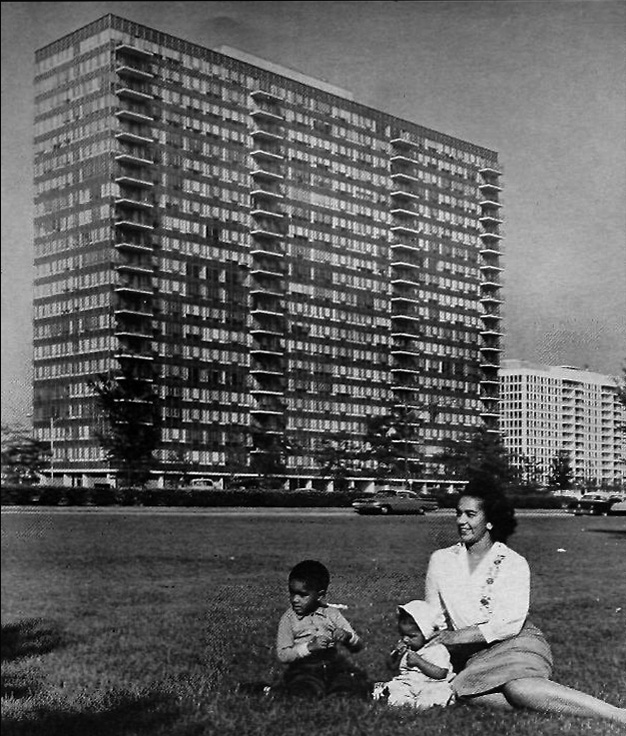
Lake Meadows (1950-61), SOM
“A frequent and false contention of public housing advocates,” wrote the Tribune’s editorial board in 1944, “is that government has to undertake the job of slum clearance, with all the waste, tax evasion, political favoritism, and social worker interference in the lives of tenants that public housing seems unable to escape.”[i] The conservative Tribune saw red in any large government project, but its editorial board found public housing particularly suspect, arguing for free market solutions to Chicago’s housing problems. The paper strongly supported Illinois’ Neighborhood Redevelopment Act, passed in 1941 but tied up in lawsuits until 1948, which allowed municipalities to condemn and clear so-called ‘blighted land’ and convey it to private developers.[ii] Using eminent domain, a housing authority could condemn a ‘slum’ and purchase its land at market rates. It could then sell this land at a loss to private developers who would, at their risk, build housing that they would then rent at agreed-upon, below-market rates. The city’s initial expense would be recouped by taxes from improved properties, while the developers’ profit would be assured by the land’s low purchase price. Combining condemnation with private investment in the service of affordable housing seemed to square the circle of Chicago’s housing problem, promising much-needed modern accommodation without requiring the city to construct it.
Equitable and New York Life expressed interest in Chicago housing as early as 1945 but remained sidelined until the Act’s legal status was resolved.[iii] New York Life, then completing the Fresh Meadows development in Queens, announced in July 1948 that they would invest $18,000,000 on a 100-acre redevelopment project for 1400 new, high-rise apartments. Between 31st and 25th streets, the Illinois Central’s tracks, and South Park Way (now Martin Luther King Boulevard), the site was home to more than 3500 families in some of the city’s most dilapidated housing. Chicago and the state of Illinois agreed to split the $3,000,000 cost of purchasing and razing the existing neighborhood, which New York Life would purchase for just $500,000.[iv] Two smaller parcels in the site’s southeast corner were sold at similar discounts to Black insurance firms and South Side families who planned to build single-family homes.[v] The Kennelly administration announced a federal grant to support the land purchase in July 1949. That August, New York Life announced that Skidmore, Owings, and Merrill, designing their block-long Manhattan House in New York’s Lenox Hill, would also design the Chicago development.[vi] Honoring their pioneering—though, as the Defender pointed out, segregated—project in Queens, New York Life announced that the Chicago project would be called “Lake Meadows.”[vii]
However, New York Life would not commit until two obstacles were removed. The first was the ongoing building code controversy. The company’s vice president for development, Otto L. Nelson, Jr., told the Tribune in July 1948 that plans wouldn’t be drawn up until material questions—especially regarding drywall—were resolved, “dangling,” as one reporter put it, “an attractive bait before house-hungry Chicagoans.”[viii] A year and a half would pass before the new code was adopted. More specific to Lake Meadows, however, was Cottage Grove Avenue, a diagonal traffic artery that sliced across the project site. Closing minor east-west streets passed the city council without issue but Cottage Grove was one of the South Side’s major traffic routes. The Chicago Plan Commission, led by Nathaniel Owings, reviewed New York Life’s request to vacate the street in late 1950. Opponents latched on to Owings’ clear conflict of interest in approving condemnation for a project his company was designing. He resigned from the Commission in frustration, though the Cottage Grove closure passed.[ix]
The Cottage Grove controversy stirred other objections. Land acquisition costs mounted as the city purchased and razed the neighborhood piecemeal, ballooning to $11 million. Other aspects of the plan drew fire from housing activists. Lake Meadows, they pointed out, would house just half the neighborhood’s former population and the units’ projected rents, between $77 and $150 a month ($840 and $1650 in 2020 figures), were on par with the extortionate rates charged for ‘kitchenette’ apartments.[x] Only a quarter of the existing residents would qualify for public housing elsewhere—and they would face long waits for replacement units in projects like Dearborn Homes. Those ineligible for public housing would be relocated to “equivalent dwellings” in ‘blighted’ neighborhoods no better than those they had left.
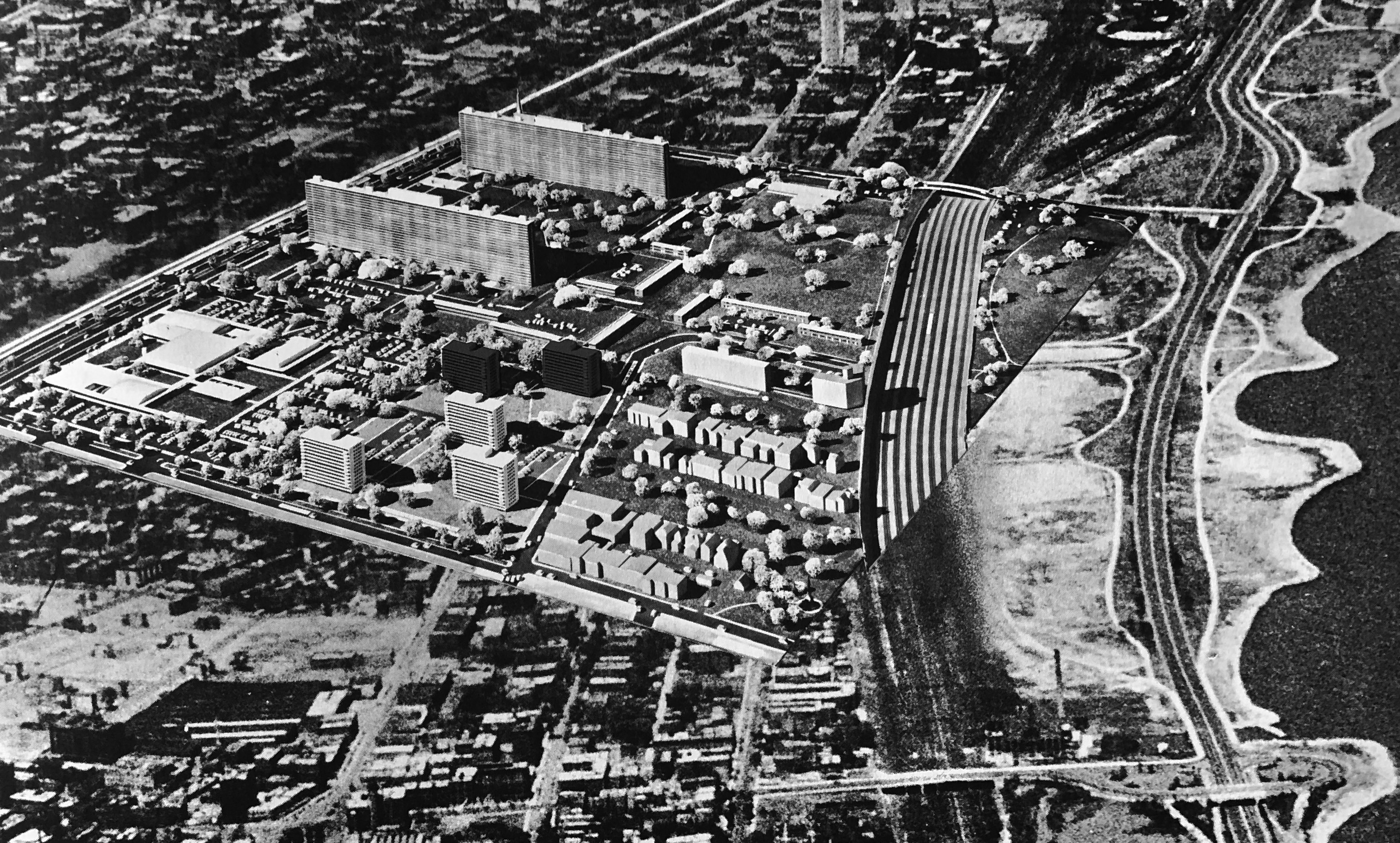
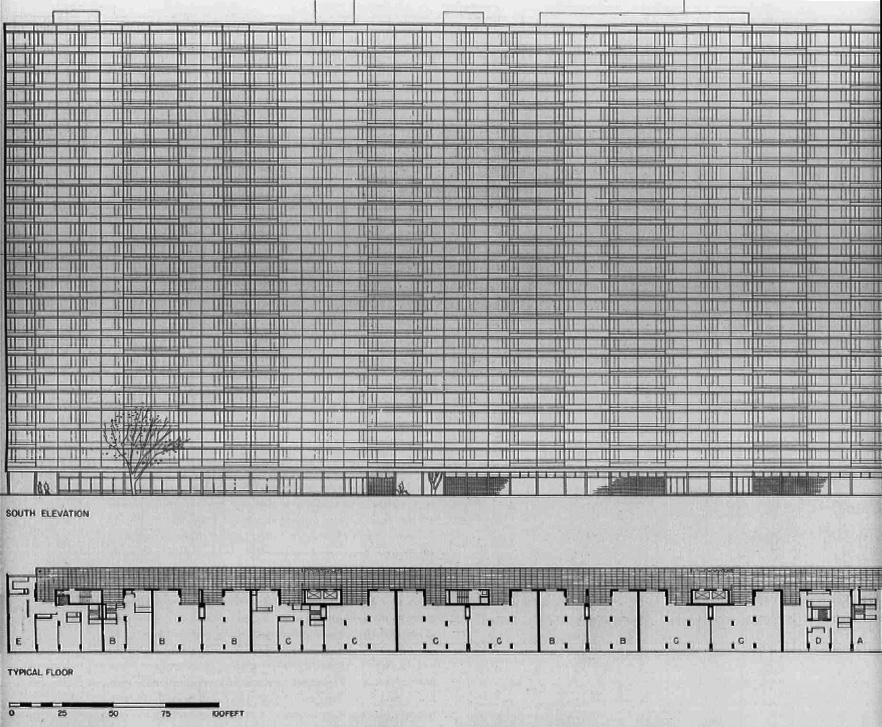
These critiques smoldered as SOM’s initial designs made a more favorable public impression. Their “suburb in the city” grew from a tour of European housing developments by SOM architect Ambrose Richardson (1917-1995) and New York Life manager Jack Gurney. The resulting masterplan and building plans, revealed in July 1950, reflected their research, with ten long, low bars of two-story row houses surrounding two massive, 23-story Corbusier-inspired slabs, each a third of a mile long and just 40’ deep. These bracketed a vast central garden, raised above an underground parking garage and complemented by a suburban-scale shopping mall in the site’s southwestern corner. The slabs accommodated 1288 apartments along 9’-8” deep exterior corridors, called “sidewalks in the sky” by SOM, that would double as outdoor play spaces. The narrow plan allowed unit plans one room deep, allowing natural ventilation, with kitchens adjacent to the units’ entries, putting parents in direct line of sight to children playing on the galleries. Their elevations were repetitive along their entire façades, with continuous, shaded ribbon windows taking full advantage of southern sunlight.[xi] “These will be some of the best apartments in Chicago,” noted Architectural Forum, praising the replacement of “dismal” enclosed hallways by outdoor galleries.[xii] The Defender noted another advance over Lake Meadows’ New York counterparts; “Lake Meadows,” it reassured readers, “will know ‘no discrimination or segregation based upon race, creed, color or national origin.”[xiii] (cont.)
[i] “Slum Clearance by Private Enterprise.” Chicago Daily Tribune, May 29, 1944. 6.
[ii] “Chicago Housing Plan Cleared by Supreme Court.” Chicago Daily Tribune, Mar. 19, 1948. 24.
[iii] Edward Schreiber, “Two Insurance Firms May Ask Housing Sites: Consider Investing in Chicago.” Chicago Daily Tribune, Dec 7, 1945. 39.
[iv] “1,800 Flats Will Be Built On South Side.” Chicago Daily Tribune, Jul 22, 1948. 1-b6.
[v] “Redevelopment Project No. 1.” Chicago Daily Tribune, July 30, 1949. 8.
[vi] “Pick Architects for 1,400 Unit Apartment Job.” Chicago Daily Tribune, Aug. 16, 1949. 17 and “Big South Side Area is Getting Her Face Lifted [Lake Meadows].” Chicago Daily Tribune, Sept. 23, 1951. W_A7.
[vii] “New York Life’s Lake Meadows to be Last Word in Modern Living.” The Chicago Defender, July 22, 1950. 14.
[viii] Clayton Kirkpatrick, “4 Years Drag By and No Building Codes in Sight.” Chicago Daily Tribune, Aug. 29, 1948. 5.
[ix] “Owings Quits Plan Board as Probe Impends.” Chicago Daily Tribune, Jan. 11, 1951 and “Mr. Owings and the Plan Commission.” Chicago Daily Tribune, Oct. 10, 1950. 18.
[x] “Chicago Redevelops.” Architectural Forum, Vol. 93, no. 2. August, 1950. 100 and “Eight Chicago Apartments.” Architectural Forum, vol. 103, no. 5. November, 1955. 143.
[xi] Thomas Buck, “Mammoth Slum Building Plan Given Council.” Chicago Daily Tribune, July 13, 1950. 12 and “New York Life’s Lake Meadows to be Last Word in Modern Living.” Chicago Defender (National Edition), July 22, 1950. 14.
[xii] “Chicago Redevelops [Lake Meadows].” Architectural Forum, Vol., 93, no. 2. August, 1950. 98.
[xiii] New York Life’s Lake Meadows to be Last Word in Modern Living.” Chicago Defender (National Edition), July 22, 1950. 14.
 architecturefarm