[Chicago Skyscrapers, 1934-1986, published by University of Illinois Press, is out now–available on Bookshop.org and Amazon.com, among other outlets.
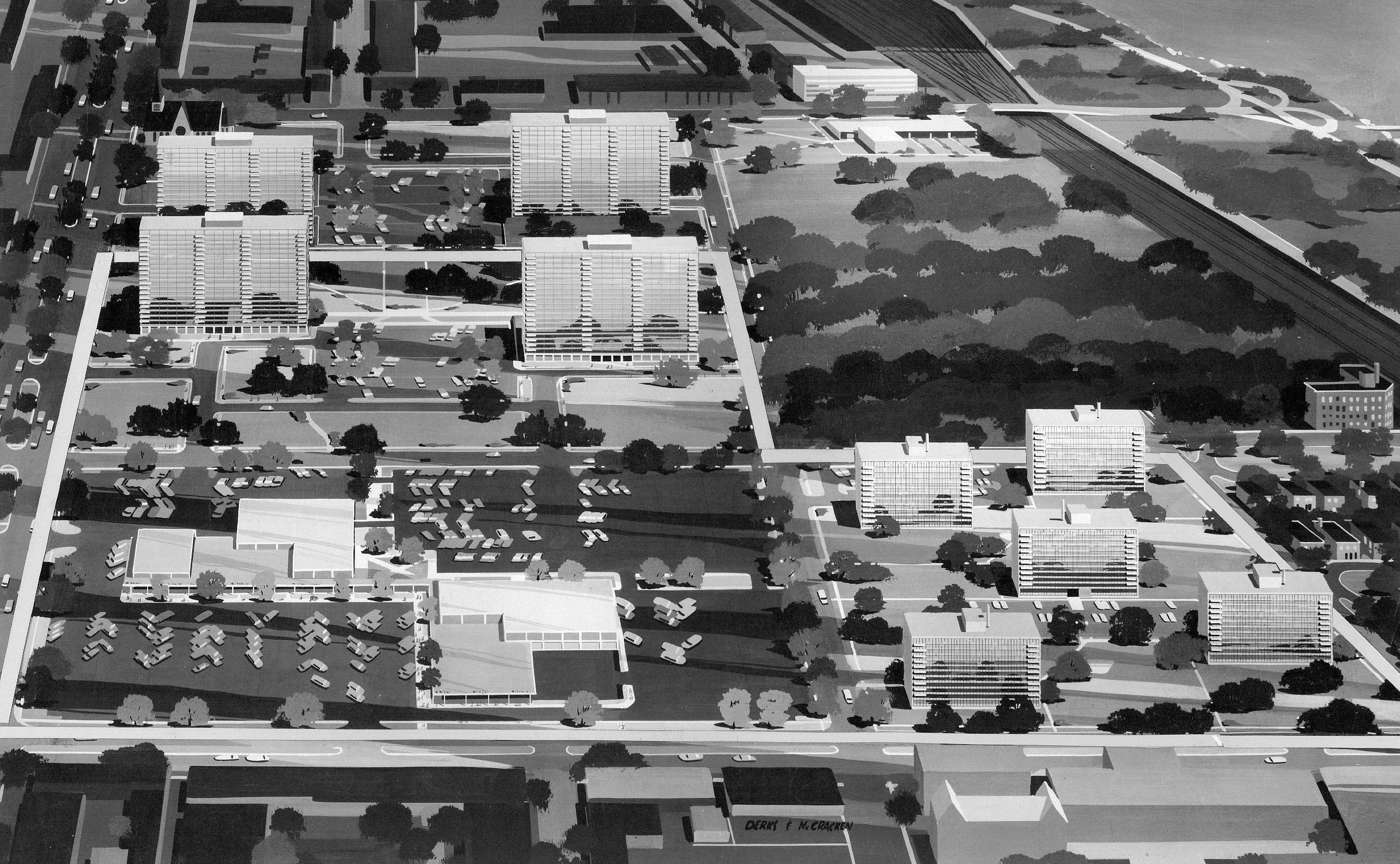
Richardson’s long, slender blocks were featured in the Museum of Modern Art’s 1950-51 exhibition of SOM’s work, drawing praise from critic Aline Louchheim, among others.[i] Richardson left the firm in 1951 to take up a teaching career. When Owings also departed for California, in the wake of his Plan Commission resignation, the scheme lost its champions. Nervous about the galleries’ maintenance in winter and releasing so many units onto the market at once, New York Life asked SOM to break Richardson’s scheme into four smaller, 21-story blocks that could be built in phases.[ii] While the office redesigned these, the local investment groups backed out of their agreements on the site’s southeastern parcels. New York Life also agreed to develop those, asking SOM to design five new blocks and prioritizing these while the north blocks were redesigned.[iii] The southern blocks were straightforward, planned around central corridors with workmanlike facades rendered in steel-framed curtain walls, asbestos-cement spandrel panels, and metal-framed windows, broken up by occasional balconies with solid concrete end walls faced in plain gray brick. Two blocks, at 533 and 555 E. 33rd Place, were started in early 1952 and opened to tenants in June 1953, a “major milestone” but an architectural disappointment—the Architect and Building News noted that these were “kept as simple as possible.”[iv] At $74 to $143 per month ($735 to $1418), the units met New York Life’s middle-class targets, however, and they offered amenities not available to most South Side residents: gas kitchen ranges and electric refrigerators as well as master television antennas and outlets for tenant-supplied electric air conditioners.[v] If not the dramatic “skyscrapers on their sides” that Richardson’s scheme had promised, these simple blocks were attractive to prospective renters; leasing agents Draper and Kramer received 1300 inquiries for their 238 apartments.[vi] Only about 10% of the first year’s leases went to white residents, though, and critics argued that Lake Meadows was—intentionally or not—concentrating Black residents in areas that, while no longer slums, were still ghettoes.[vii]
Two more of these simpler blocks were built in 1953-54, but after five years, the original northern site still sat vacant. New York Life faced bureaucratic delays and faced the daunting prospect of turning its rubble-strewn expanse into an attractive neighborhood. Critics remained skeptical about Lake Meadows’ prospects and—in the words of Architectural Forum—whether the “Negro market can pay.”[viii] “It has taken New York Life six years to get its idea to where it stands today,” Forum reported, “still barely 25% complete.” Now “controversial and beleaguered,” the project had fewer than 500 occupied units and over a hundred acres of empty land, still surrounded by “the toughest, most criminal slums in Chicago,” discouraging interest in the ‘pioneering’ project.[ix] New York Life adjusted its strategy, first building the 17-acre shopping center in the site’s southwest corner. The center—a slice of the “suburbs in the city”—opened in 1954. Downtown retailer Goldblatt’s established an anchor store there, which boosted the project’s reputation. Reassured, in April 1955, New York Life announced it would finally, start construction on two of the north site’s 21-story blocks.
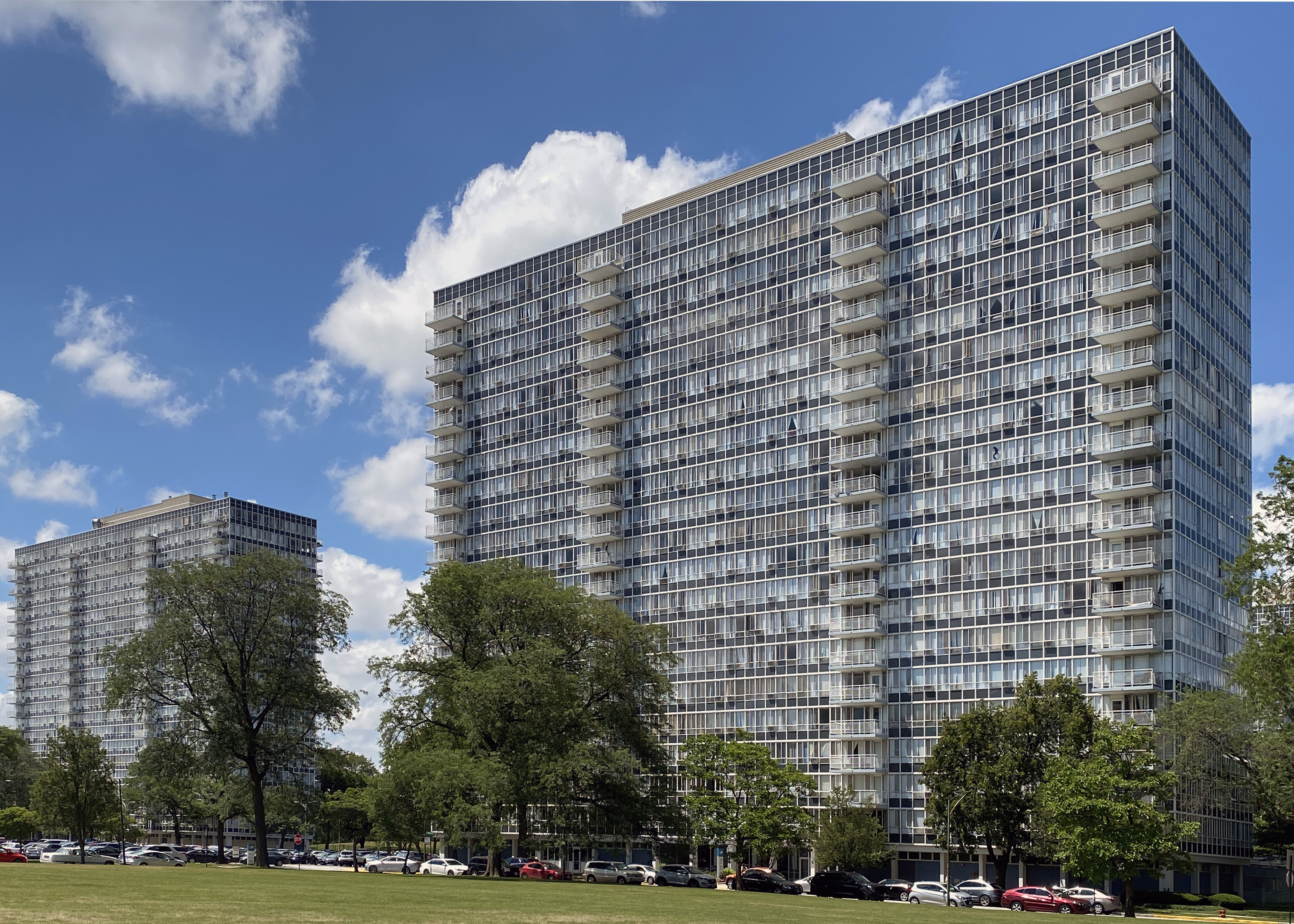
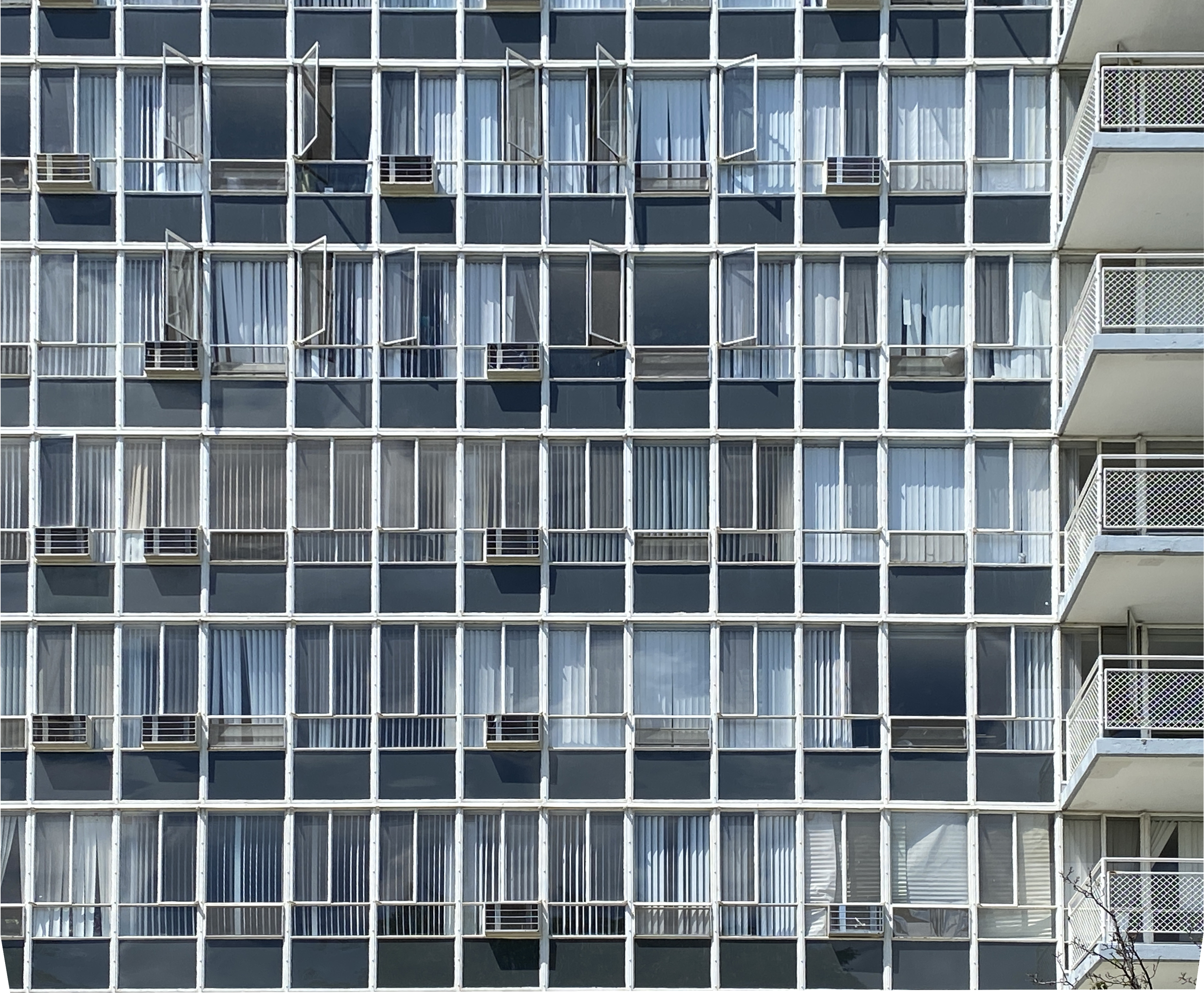
Mayor Daley, then in office for just over a year, helped break ground for the first two northern blocks in May 1956. Nelson announced that New York Life would begin construction on the second pair in late 1956, along with 40 low-rise duplexes and a final, higher-end 12-story block on the development’s eastern side. While not as striking or innovative as Richardson’s giant slabs, the taller blocks made extensive use of curtain walls, improving on the first phase’s solid end walls to provide wrap-around views of the lake and city. Each apartment had a balcony, and the blocks’ arrangement allowed for the large, open space between them that Richardson had envisioned. Encouraged, by 1957, the Daley administration authorized half a dozen more land clearance projects on the Lake Meadows model and began considering another eight. As the taller blocks opened, Draper and Kramer launched a more balanced publicity campaign; 30% of its new leases went to white tenants, making the new buildings “outstanding exceptions” to Chicago’s segregated market.[x]
A clubhouse and business center opened in 1959 and 1960, and after twelve years, Lake Meadows was complete.[xi] “Elevator apartment buildings stand where teeming, unsanitary, and unsafe stone front walkups once stood,” wrote the Tribune’s Sheila Wolfe in 1959. Ebony praised the project’s opening in 1960:
“Some 7000 Chicagoans enjoy the spaciousness of suburban living, though only three miles from the teeming Loop. Active participants in the nation’s biggest and most successful venture in high-grade interracial housing, they are the envied residents of Lake Meadows—Chicago’s futuristic South Side development near Lake Michigan’s shores.”[xii]
But the project’s long saga drew critics who contrasted its extraordinary costs with its limited achievement. Even the Land Clearance Commission’s chairman, Phil Doyle, admitted that the ultimate cost to the city in clearance, infrastructure, and tax losses while the land sat fallow had been between $55 and $60 million, or $30,000 per unit, making Lake Meadows more heavily subsidized than the city’s public housing.[xiii] The Defender’s Doc Young lamented that while “the rich and middle class” lived “side by side,” there “were no poor” in Lake Meadows; its “country-like spaciousness” was possible only because the city moved more than 7000 residents out and replaced them with just 4000. On the other hand, Architectural Forum thought that Lake Meadows had not done enough. At the project’s outset, New York Life estimated 19,000 families on the South side could afford its rents; as massive as it was, Lake Meadows accommodated just 10% of them.[xiv]
Efforts to house more prospective middle-class residents were repeated in the five diagonally sited blocks of Prairie Shores, north of Lake Meadows and adjacent to Michael Reese Hospital, which financed the project. Intended as a buffer for the hospital and housing for its doctors and staff, Prairie Shores was more compact and marketed more broadly than Lake Meadows. Designed by Loebl, Schlossman, and Bennett and built between 1957 and 1961, its 20-story blocks featured floor-to-ceiling windows that opened every one of its 1700 apartments to skyline or lake views. Demand was fierce; the first two blocks were rented immediately when they opened in 1960, and the last three buildings were rushed to completion. Draper and Kramer, the project’s rental agents, again made a concerted effort at racial balance, advertising the “New South Side” to northside whites as Chicago’s “original Gold Coast.” With “unbelievably low rentals” of $112 for one-bedroom units ($1000 in 2020) and priority for Michael Reese’s doctors and staff, Prairie Shores opened with 80% white and 20% Black residents–within a few percent of the city’s demographic split at the time.[xv] HOMES, Inc., a non-profit group advocating against housing segregation, praised Lake Meadows and Prairie Shores for “harmonious housing integration” in 1961.[xvi]
[i] “Big South Side Area is Getting Her Face Lifted [Lake Meadows].” Chicago Daily Tribune, Sept. 23, 1951. W_A7 and Aline B. Louchheim, “Architecture of and for Our Day.” New York Times, Sept. 24, 1950. X9.
[ii] “Lake Meadows Rises as Negro Market Proves Worrisome.” Architectural Forum, November, 1954. 35.
[iii] “Big South Side Area is Getting Her Face Lifted.” Chicago Daily Tribune, Sept. 23, 1951. N_A7.
[iv] “Lake Meadows Development, Chicago.” The Architect and Building News, vol. 209. January, 1956. 40-46.
[v] “Lake Meadows to Open Up Tax Paying Housing.” Chicago Daily Tribune, June 21, 1953. 41.
[vi] “Lake Meadows Project Draws 1300 Queries.” Chicago Daily Tribune, Nov. 9, 1952. S_A1.
[vii] Thomas Buck, “90% Of N. Y. Life Housing Tract Under Contract.” Chicago Daily Tribune, May 12, 1952, pp. 2-a2.
[viii] “Lake Meadows Rises as Negro Market Proves Worrisome.” Architectural Forum, November, 1954. 35.
[ix] “Lake Meadows Rises as Negro Market Proves Worrisome.” Architectural Forum, November, 1954. 35.
[x] Homer Smith, “Chicago’s is Black Belt Expands, but Never Cracks.” Chicago Daily Defender, May 20, 1963. 9.
[xi] Thomas Buck, “Chicago Spirit Meets a Challenge.” Chicago Daily Tribune, Nov. 9, 1958. 12.
[xii] “Lake Meadows: Suburb Within a City.” Ebony, vol. 16, no. 2, Dec. 1960. 27–37.
[xiii] Sheila Wolfe, “Vast Project Changes Face of South Side: Millions Spent to Clear, Rebuild 732 Acres.” Chicago Daily Tribune, Jun 4, 1959. 1-s6.
[xiv] “Chicago Redevelops [Lake Meadows].” Architectural Forum, Vol., 93, no. 2. August, 1950. 98-105.
[xv] See, for instance, “Chicago’s New Near South Side [Display Ad].” Chicago Daily Tribune, June 8, 1958. 20.
[xvi] Sheila Wolfe, “Vast Project Changes Face Of South Side.” Chicago Daily Tribune, June 4, 1959. 1-s6and “More Interracial Dwellings is Summertime Project of Home, Inc.” Chicago Daily Defender, June 26, 1961. 5.
 architecturefarm