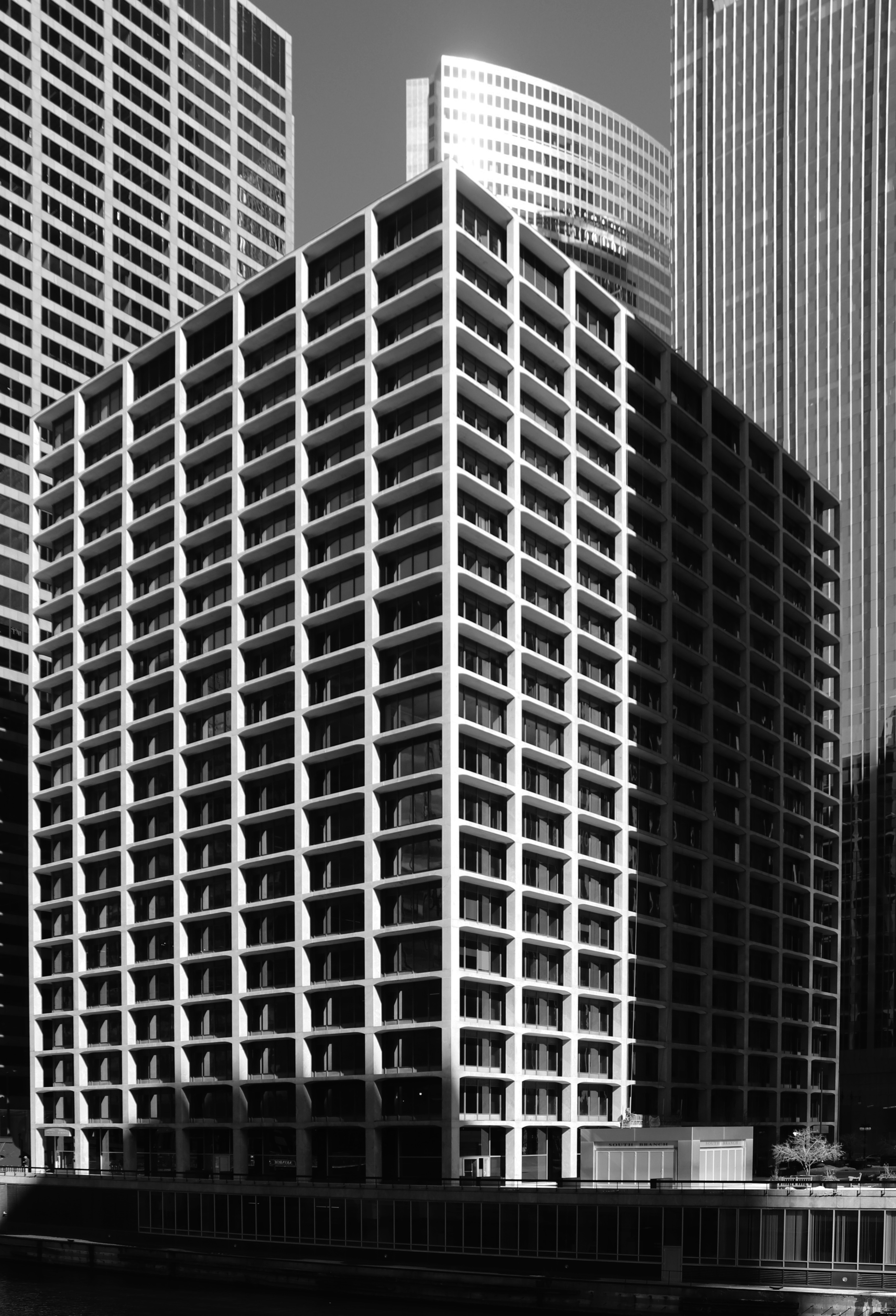
Hartford I, SOM, 1961
[Chicago Skyscrapers, 1934-1986, published by University of Illinois Press, is out now–available on Bookshop.org and Amazon.com, among other outlets.
Market Street’s transformation into the corporate boulevard of Wacker Drive received a boost when the Connecticut-based Hartford Fire Insurance Company purchased the riverfront block between Monroe and Adams in September 1958, joining Sinclair, Morton Salt, America Fore, and Mutual Trust in investing in the west Loop.[i] Unlike those companies, though, Hartford planned to take just 200,000 square feet of its planned 700,000 for regional offices, dedicating more than 70% of the structure to pure speculation—further “expression of confidence in the future of the central city,” according to the now omnipresent Mayor Daley at the project’s announcement.[ii] Hartford selected Skidmore, Owings, and Merrill as architects, giving them a new, existential challenge. Inland Steel and Harris Bank had both been headquarters buildings. Hartford, however, had to meet this more stringent, speculative budget. Bruce Graham recalled that New York developers—particularly Erwin Wolfson (see Gateway Center, below)—were eyeing Chicago. New York Contractors and architects like Morse Diesel and Emery Roth were used to tighter budgets and more efficient designs. Graham recognized them as potential threats from abroad and set out to prove that local architects could design “developer” buildings.[iii] Arthur Rubloff’s presence as Hartford’s local agent attested to the project’s commercial intentions.
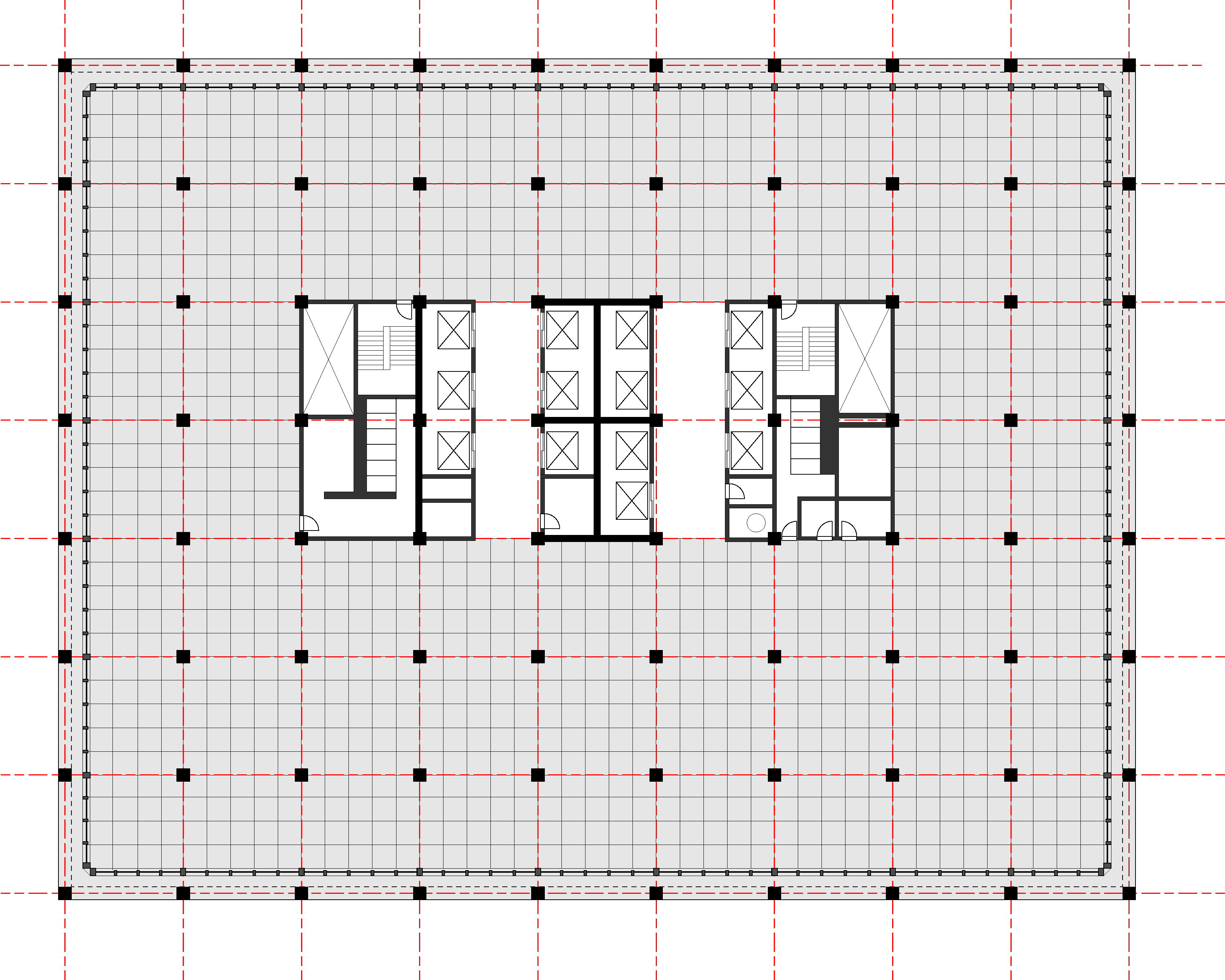
By 1958, Graham knew residential high-rise construction had proven flat slab concrete’s economic efficiency, particularly as contractors developed reusable formwork that could be ‘flown’ from one story to the next. Even with steel’s ability to integrate mechanical systems, Graham recognized that with simple, reusable formwork, concrete could compete with steel because of its lower material costs. SOM’s scheme, presented in August 1959, was essentially a concrete loft building, repeating a 21’-8” square structural bay over a 7 x 9 grid, with shallow haunches at column connections that provided stiff, moment-resisting connections for lateral resistance. Graham divided this structural bay into 4’-4” planning modules, arrayed around a central concrete core offset to one side. This created deep enough floors for open-plan offices on the south and more traditional executive and clerical suites on the north.
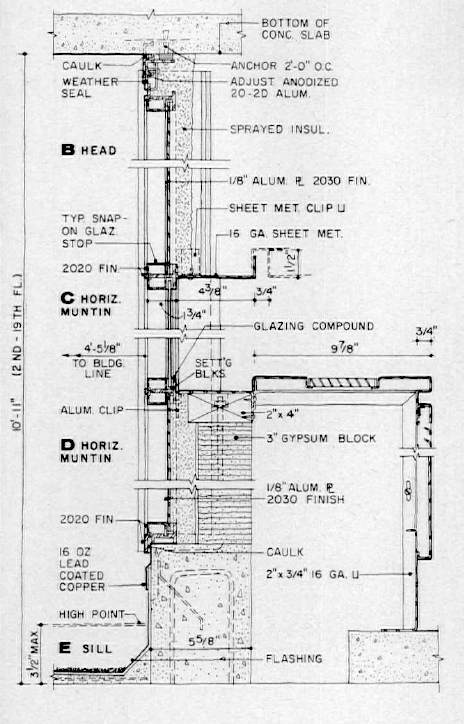
Hartford’s slabs were designed thick—up to 12”—but they did not require dropped beams, which allowed simple, flat formwork. Its mechanical systems were confined to an 18” zone beneath these, allowing 9’-0” floor-to-ceiling heights throughout within a floor-to-floor dimension of just 11’-6”—a tighter integration than Inland’s deep steel solution.[iv] Graham’s real innovation was to pull these structural slabs out beyond the building’s enclosure by a full 4’-4” module, making the concrete frame, rather than the curtain wall, the primary exterior element. This sacrificed a perimeter strip of floor space. Still, Graham argued that it gained solar shading and eliminated expensive window-washing equipment since cleaning crews could stand on the extended slabs. It also saved cladding costs since each story could be enclosed with floor-to-ceiling storefronts instead of a continuous curtain wall, making waterproofing simpler and allowing workers to assemble each panel from both sides during construction—without scaffolding.[v] Tinted glass and dark-bronze anodized sill panels and mullions assured that the concrete frame, dressed in 2” slabs of Minnesota granite, would stand out. Graham matched its visibility with subtle attention to detail. Hartford’s columns diminish as they rise, though, unlike the visible steps in Mies’ concrete structures, they step back gradually every two to four floors. Corner columns taper from their interior faces, leaving their exterior lines vertical, and slabs conceal offsets throughout, giving the illusion that each column narrows continuously from base to top, a visual refinement Graham would repeat in his later concrete work.[vi]
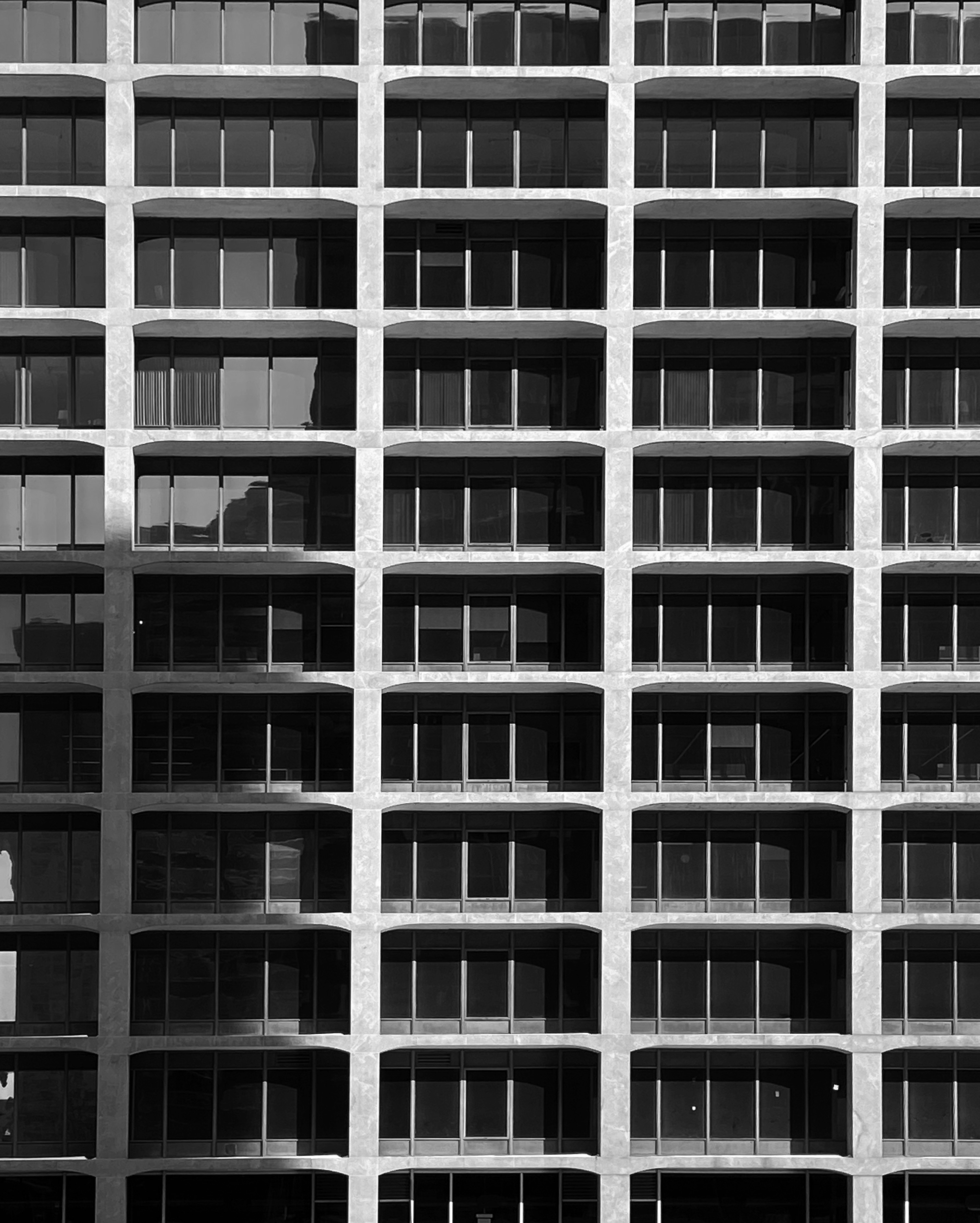
At 20 stories, Hartford was the tallest of the new buildings on Wacker, rivaling structures in the center of the Loop for height and adding, as Daley put it, “another gem to the crown of new Wacker Drive.”[vii] It did prove that Chicago architects could design “strictly speculative buildings” while maintaining their trademark “bold and graceful expression of structure.”[viii] Concrete here proved itself as a commercial alternative to steel, capable of more immediate formal expression and greater monolithic behavior presenting a “sense of ultimate structural integrity,” according to Carl Condit. Compared to Inland Steel’s “celebration of technique,” the haunched concrete slabs here represented “technique itself”—a subtle allusion to Montgomery Schuyler’s praise for the Monadnock as “the thing in itself”—If one could look past the granite sheathing,[ix]
Opened in April 1961, Hartford attracted prestige lessees, including paper companies Weyerhaeuser and St. Regis, along with IBM, Armour & Co., Western Electric, and State Mutual Life Insurance. In 1966, Hartford commissioned a second building from SOM on the southern half of its block. Planned for 26 stories, demand pushed it to 33 stories by the time it broke ground in late 1968.[x] Also of reinforced concrete, this building was clad in a more conventional curtain wall that concealed and contained its structure. The swell of this structure’s dark stone cladding around its lower columns alluded to the first building’s subtle expression, distinguishing between vertical elements that are pure cladding, which sit flat on the building’s skin, and those that are bearing, which meet the ground with entasis-like tapers that express the increasing loads, and thus greater required cross-sections, of the columns within.
[i] “4th Insurance Firm to Build on Wacker Dr.” Chicago Daily Tribune, Sept. 17, 1958. 19.
[ii] James Gavin, “Future $20,000,000 Hartford Fire Building.” Chicago Daily Tribune, Aug. 5, 1959. B7.
[iii] Betty J. Blum, Oral History of Bruce John Graham. (Chicago: Art Institute of Chicago, 1998), 103-106 and Betty Blum, Oral History of William Hartmann (rev. ed., Chicago: Art Institute of Chicago, 2003), 115-116.
[iv] “New Pattern for a Tall Building [Hartford].” Architectural Record, Vol. 130, no. 3. September, 1961. 121-126.
[v] Betty J. Blum, Oral History of Bruce John Graham. (Chicago: Art Institute of Chicago, 1998), 103-106. See, too, Ernst Danz, SOM: Architecture of Skidmore, Owings & Merrill, 1950-1962. (New York: Praeger, 1963). 170-173.
[vi] Betty J. Blum, Oral History of Srinivasa (Hal) Iyengar. (Chicago: Art Institute of Chicago, 2008). 19-20.
[vii] James Gavin, “Future $20,000,000 Hartford Fire Building.” Chicago Daily Tribune, Aug. 5, 1959. B7.
[viii] “New Pattern for a Tall Building [Hartford].” Architectural Record, Vol. 130, no. 3. September, 1961. 122.
[ix] Carl W. Condit, “The New Architecture of Chicago.” Chicago Review, 17:2/3, special issue on New Chicago Writing and Art. 1964. 111, 114 and Carl W. Condit, “The Rise of the New Chicago.” Chicago Tribune. Mar. 27, 1966. N34.
[x] “Hartford to Build.” Chicago Tribune, Oct 03, 1967. 1-c7 and “Hartford Going Up.” Chicago Tribune, Nov. 17, 1968. D1.
 architecturefarm