[Chicago Skyscrapers, 1934-1986, published by University of Illinois Press, is out now–available on Bookshop.org and Amazon.com, among other outlets.
Standard Oil (Edward Durrell Stone/Perkins & Will, 1968-1973).
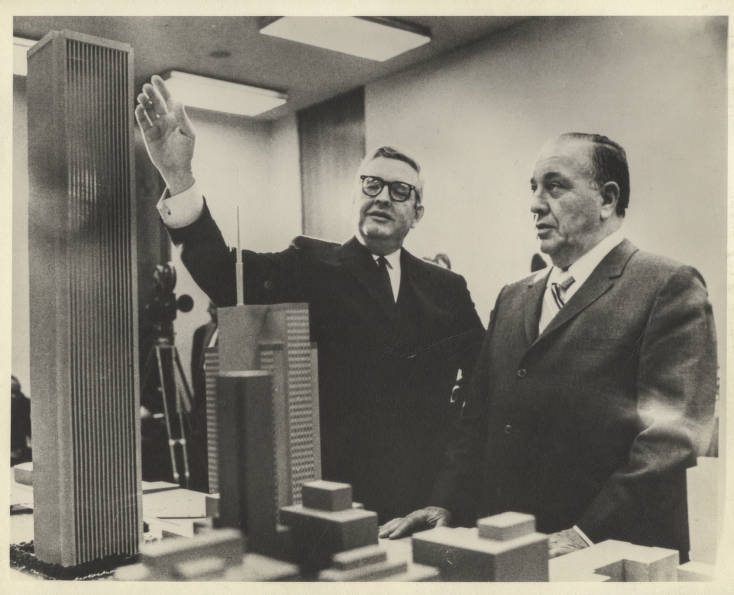
Standard Oil of Indiana began as an offshoot of John Rockefeller’s Standard Oil trust after it was broken up in 1911. From its inception, it had occupied a 13-story Marshall and Fox-designed building at 910 South Michigan, but postwar growth had forced it, like Sears, to lease offices throughout the city. Standard revealed plans in September 1968 to build over the Illinois Central rail yards east of the Prudential Building. Negotiations took place throughout 1969 to develop the railroads’ air rights into what would become Illinois Center, but Standard proceeded independently, ignoring that project’s zoning and size recommendations.[i] In March 1969, the company announced that it would build 2 million square feet of office space on its site, to be designed by two architectural firms: Chicago-based Perkins & Will, and New York-based Edward Durrell Stone.[ii]
This pairing was notable for being well outside the city’s Miesian architectural culture. Perkins & Will’s partnership with C.F. Murphy on First National Bank had been a stylistic anomaly—its commercial reputation still rested with the diamond-planned U.S. Gypsum Building, and it was working on 230 Monroe Street at the time, a 28-story steel-framed building rendered in black aluminum and bronze glazing with angled column covers that recalled Saarinen’s CBS Building in New York.[iii] Stone, meanwhile, was enjoying the high point of his long, varied career. An Arkansas native, he had been an early proponent of the International Style, associating with Phillip Goodwin on the Museum of Modern Art and designing modernist houses in New York and suburban Boston. His postwar work, however, had been eclectic. After worldwide acclaim for the ornate screens and gold-tinged columns of his temple-like American Embassy in New Delhi, Stone’s designs combined formal planning with material opulence. His greatest cultural commission, the Kennedy Center in Washington, and his first skyscraper, the marble-shafted General Motors Building at the southwest corner of Central Park in Manhattan, were popular with the public—and lambasted by critics—for their ersatz formalism and decorative elements. Ada Louise Huxtable, writing about General Motors’ acres of marble cladding and finishes, assailed its “pretentiously ordinary…Throwback Classicism” as “Furniture Store Posh.” Its sturdy-looking marble columns were, she pointed out, a “seven-eighths inch…veneer” concealing the actual structure to “disguise and diminish one of the great art forms of our day,” with “overlays of low-level corn and pseudo-grandeur.”[iv] Stone relished his iconoclastic reputation, though, telling the press that Standard Oil would not defer to Chicago’s traditions. “The glass box design for office buildings has run its course,” he prophesied, promising a “permanent look” for Standard Oil.[v]
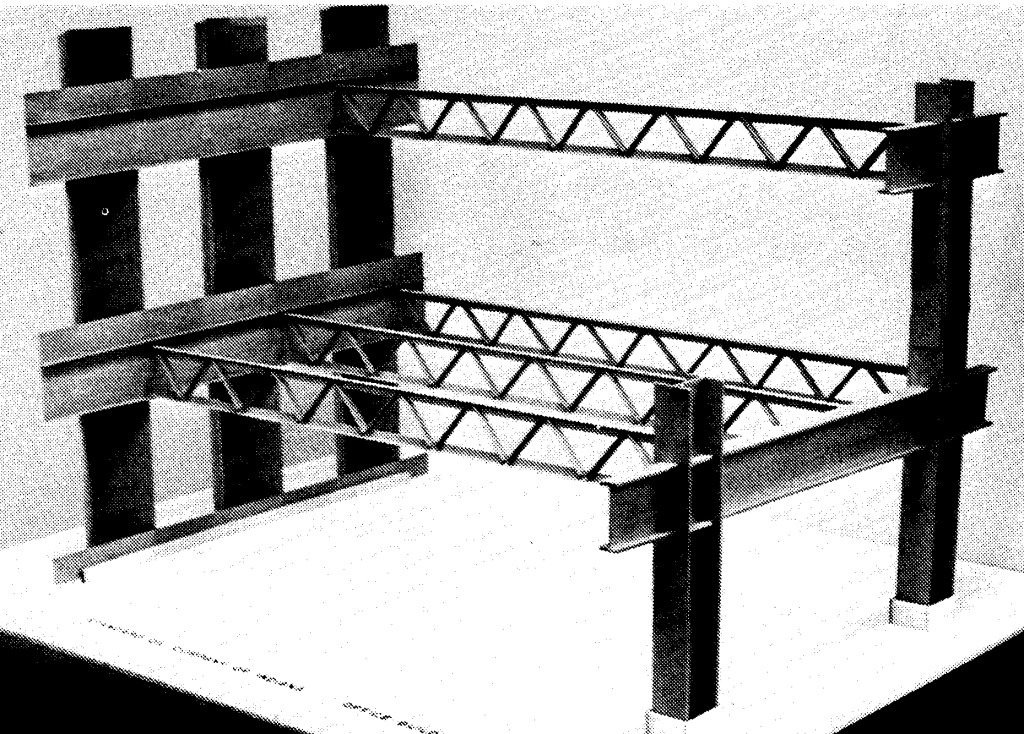
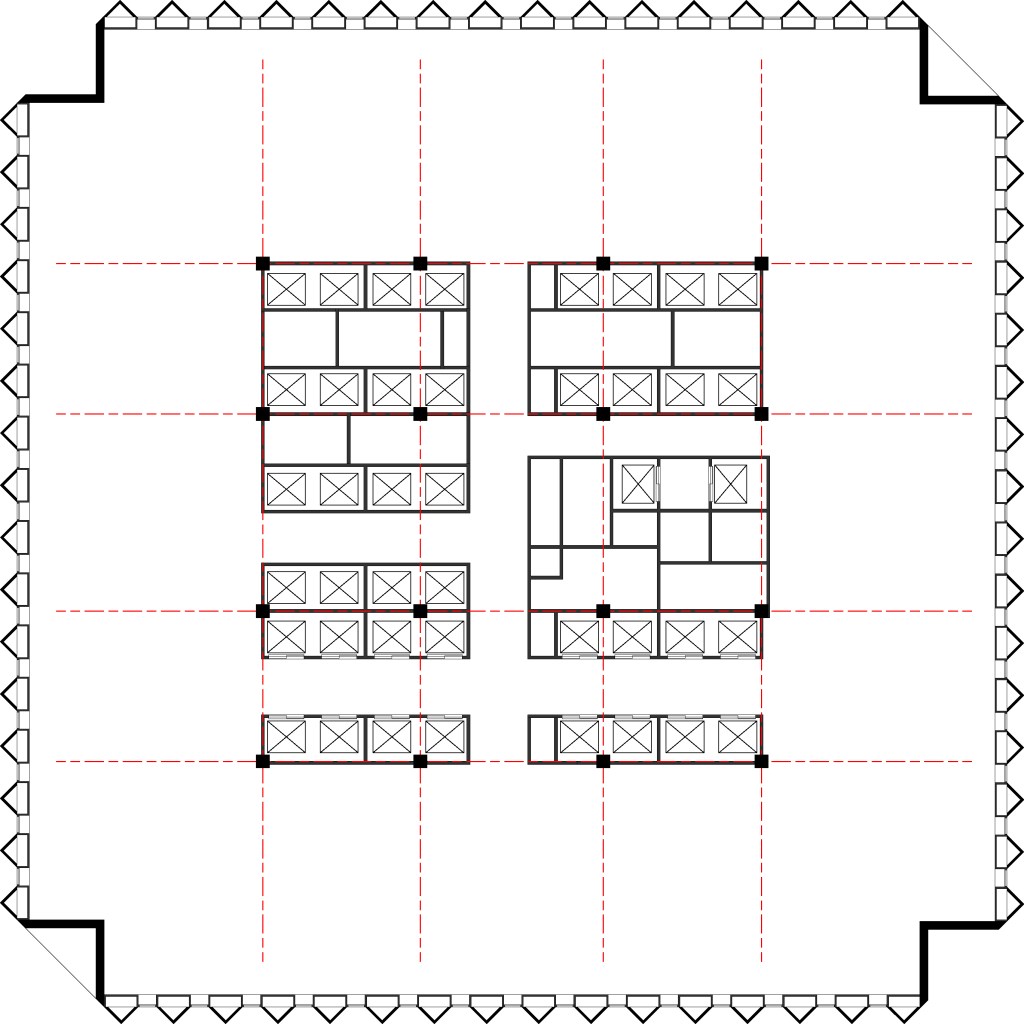
The two firms worked through 1969 to adapt Stone’s formula to Standard Oil’s program as it grew to 3,200,000 gross square feet of corporate and tenant space. Stone proposed spreading this over 80 floor plates of 40,000 square feet each. The project benefitted from SOM’s former head of structural design, Al Picardi, who joined Perkins + Will in 1967. Picardi had overseen Khan’s tube structures and he applied that experience here. As impressive a structural system as the Hancock was, he wondered whether “it would be possible to develop a structural system with efficient tube action, yet simplify the fabrication and erection problems?” A “natural concept to consider,” he concluded, would treat the exterior frame as “steel plate walls with openings only large enough to accommodate architecturally acceptable vision panels.” The result would distribute material evenly around the building’s perimeter, instead of concentrating it in discrete, heavy columns– a scheme more like the perimeter structures being designed in concrete by Dubin, Dubin, Black, and Moutoussamy or Leslie Robertson’s tightly spaced steel columns at the World Trade Center. Picardi designed a tube of 64 broad, triangular folded plates, 10 feet on center, each wrapping a vertical shaft accommodating ducts or pipes, with 5’-0” windows and induction units between them. These plates were shop-welded in three-story lengths and field-bolted to 5’-6” deep spandrel beams, forming a planar wall of deeply corrugated steel on each of the building’s four sides. Within, a grid of sixteen columns formed a 95’ square core and 45’-0” bays, spanned with 38-inch open web steel joists large enough to accommodate ductwork services. The building’s corners consisted of rigid steel plates forming nine-foot-deep re-entrant angles, making the tower into a stiff-edged box.[vi] Picardi claimed nearly the same material efficiency as the Hancock but with significant fabricational savings due to its simpler geometry. Standard Oil has just one basic floor shape, multiplied over the building’s full height, with none of the Hancock’s sloping walls, making it “simpler in design, less expensive to fabricate, and easier to erect than conventional or previous tube systems.”[vii] Stone and Perkins & Will planned a simple cladding scheme for the building, replicating the white marble columns and dark spandrels and glass that had wrapped U.S. Gypsum and General Motors.[viii]
Turner Construction won the contract to build this simple but massive structure, breaking ground on April 1970 as a helicopter hovered at the tower’s planned 1,136 foot height.[ix] Ten caissons on each face and 16 under the core were tied together with an eggcrate of girders similar to the Hancock’s, while a slurry wall similar to Sears’ formed the building’s basements.[x] Steelwork began fabrication while foundations were being completed. Once steel assembly began, in May 1971, Turner had a continuous feed of pre-welded column panels, spandrel girders, and trusses. One piece arrived every seven minutes, ready to be hoisted into place by one of four climbing derricks. As the building’s 53,000 tons of steelwork rose, cladding followed. Stone selected Italian Carrara marble to cover the building’s columns—more than 18 acres of it, in 1-1/4” thick slabs.[xi] While the job suffered through the same strikes that delayed Sears, Standard Oil also had to contend with Italian labor unrest that delayed marble deliveries. As Standard moved into the tower’s lower floors in March and April 1973, the upper seven stories remained uncovered until July. Tenants began moving into those floors in October, and the plaza’s “dazzling” pattern of marble and granite was completed soon afterwards, though it only received its signature acoustic sculpture by Harry Bertoia in 1975.[xii] The building’s final days of construction were marked by a dramatic, ominous accident. In December 1973, scaffolding on the 82nd floor broke loose in high winds, tearing a 350-pound piece of marble from the building and sending it plunging through the Prudential’s roof. No one was injured, but emergency inspections delayed the project’s completion.[xiii]
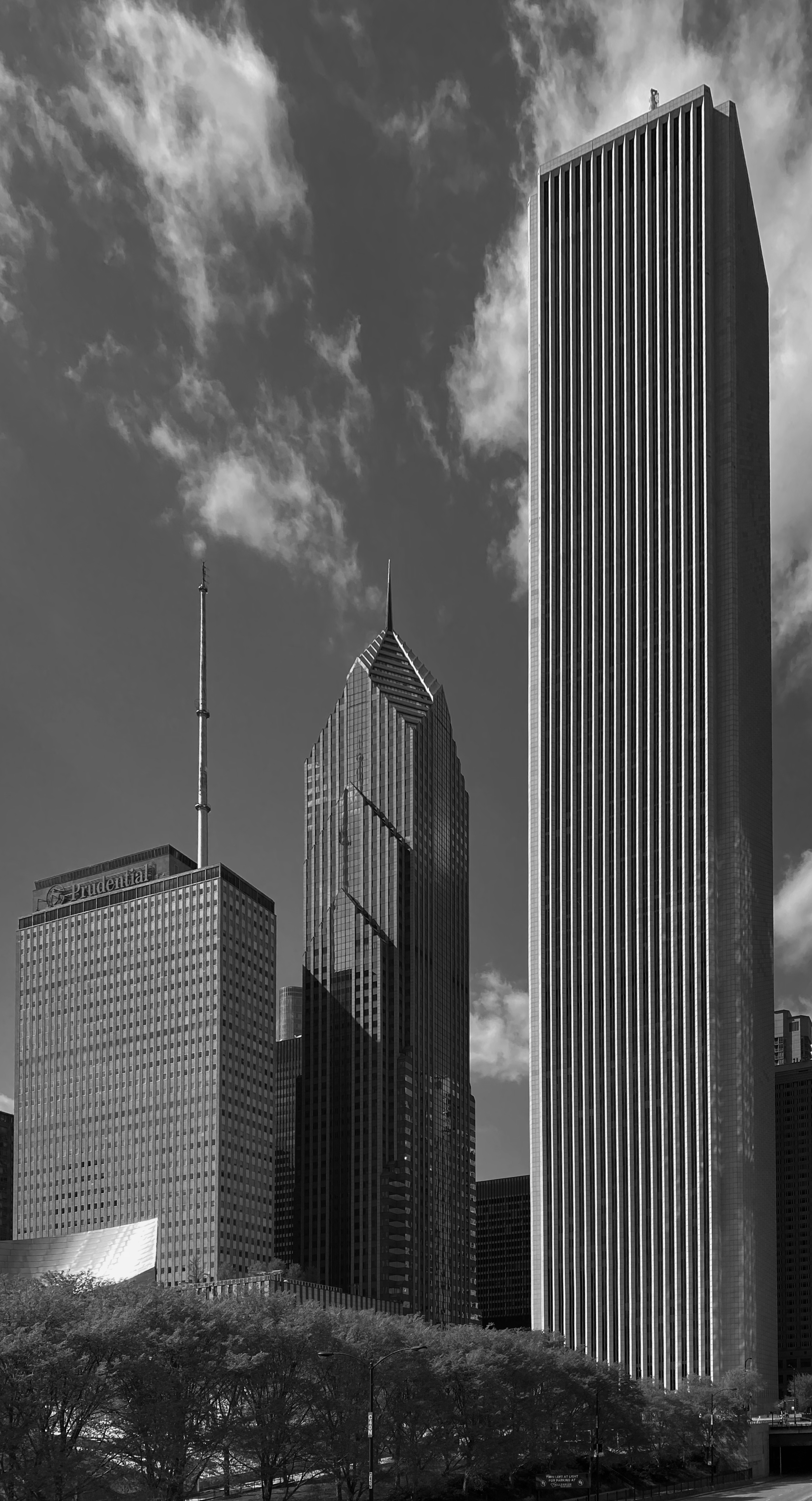
Standard Oil’s opening occurred amidst the same uncertainty about the Loop’s commercial market that had worried Sears’ backers. Unlike Sears, though, less than a third of Standard Oil’s upper floors were under contract at its opening.[xiv] Its leasing agent, Frank Whiston, kept rents high, hoping that the building would attract tenants based on prestige, but the 1973 energy crisis put Standard’s future in doubt, too. The AIA honored the tower for its engineering, but architectural critics were scathing. A local AIA committee auditing the Illinois Center project critiqued it for nearly doubling the city’s floor area ratio development guidelines for Illinois Center of 14:1.[xv] Stone himself gave the building a luke-warm reaction, remarking only that “it’s good looking” on seeing the project firsthand. The Tribune’s Paul Gapp, on the other hand,was furious. “The Standard Oil Building,” he wrote, “is perhaps the worst thing that has happened to Chicago’s skyline in the last 30 years.” The Prudential’s “headstone by the Lake” was now matched, in Gapp’s view, by Stone’s scale-less, “unbroken verticality.” Its blazing contrast between brilliant white marble and the narrow, dark recesses hid any sense of floor-to-floor rhythm or Picardi’s ingenious structural fabric behind facile elevational stripes. “If you stare at the building from a short distance for more than 15 seconds,” Gapp complained, “it is almost disorienting.”[xvi]
Standard Oil’s thin veneer of Carrara marble became infamous. After the 1973 accident, maintenance engineers noticed that winter freeze-thaw cycles were already causing panels to warp and buckle. In 1988, the company (renamed Amoco) installed stainless steel straps to prevent cracked panels from falling off. The next year they announced that all 43,000 panels would be replaced with hardier, Carolina granite at a cost of $80 million. Forensic engineers blamed bolt details that hadn’t allowed adequate expansion and contraction, but the fragility of the marble—the very delicacy that Stone and Perkins & Will had championed—was cited as a contributing factor.[xvii]
[i] “Indiana Standard Picks Chicago Site.” The New York Times, Sept. 8, 1968. F17.
[ii] “Standard Oil (Ind.) Selects 2 Architects.” Chicago Tribune, Mar. 14, 1969. 1-c11.
[iii] See “Anticipating Inflation Results in High Quality at Reasonable Costs.” Chicago Tribune, Sept. 13, 1970. 1-e1 and “City Keeps Growing.” Chicago Tribune, Aug 10, 1969. 1-d1for coverage of 230 W. Monroe.
[iv] Ada Louise Huxtable, “The Newest Skyscraper in Manhattan: G.M. Building Draws Crowds, But Gets Mixed Reviews.” New York Times, Oct. 1, 1968. 57.
[v] Edward D. Stone and Alvin Nagelberg. “Architect Throws Verbal Barbs At New Buildings Made Of Glass.” Chicago Tribune, Jan 11, 1970. 1-e9.
[vi] E. Alfred Picardi, “Structural System—Standard Oil of Indiana Building.” Journal of the Structural Division, ASCE. Vol. 99, no. ST4. Apr., 1973. 42-51.
[vii] Alvin Nagelberg, “Simplicity is Key to Standard Tower: Design is a Big Step Forward.” Chicago Tribune, Feb 08, 1970. 1-e1.
[viii] “Double-Deck Elevators Set for Building.” Chicago Tribune, June 11, 1970. E9.
[ix] “Standard Oil Turns Ground Here Monday.” Chicago Tribune, Apr. 4, 1970. A9.
[x] “Ready Steel Work for 80-Story Tower.” Chicago Tribune, May 2, 1971. D1.
[xi] Genevieve Flavin, “80 Stories of Mighty Stan.” Chicago Tribune, July 16, 1972. H28.
[xii] “Marble-less Big Stan Can Now Finish Coat.” Chicago Tribune, July 13, 1973. C9 and Alan G. Artner, “Sounding Out the World of Sculpture’s Bertoia.” Chicago Tribune, Feb. 16, 1975. E17.
[xiii] “Huge Slab Falls Off Big Stan.” Chicago Tribune, Dec 26, 1973. 1.
[xiv] Alvin Nagelberg, “Downtown ‘Giants’ Vying for Office Space Tenants.” Chicago Tribune, Apr. 8, 1973. W_A1.
[xv] Stan Ziemba, “Cite Poor Plan: Experts Rap I.C. Project.” Chicago Tribune, Aug. 4, 1972. A3.
[xvi] Paul Gapp, “Ambiguous Statement Snarls Center Debate.” Chicago Tribune, June 30, 1974. 1-e3.
[xvii] Michael Arndt, “Amoco Chucks all the Marble on its Tower.” Chicago Tribune, Mar. 7, 1989. 2.
 architecturefarm
Interesting details, as always. To this day it is kind of weird being inside that enormous building and seeing how small and how isolated from each other the window openings are. So many towers provide expansive panoramic views, but not this one.
LikeLiked by 1 person
The windows are oddly scaled from the interior and exterior, for sure. That’s partly a consequence of the tube structure–like 19th century masonry high rises, windows and structure are competing for space on the building skin. But it was handled better by others exploring the idea–esp. Graham and Khan at Sears and Hancock.
LikeLike