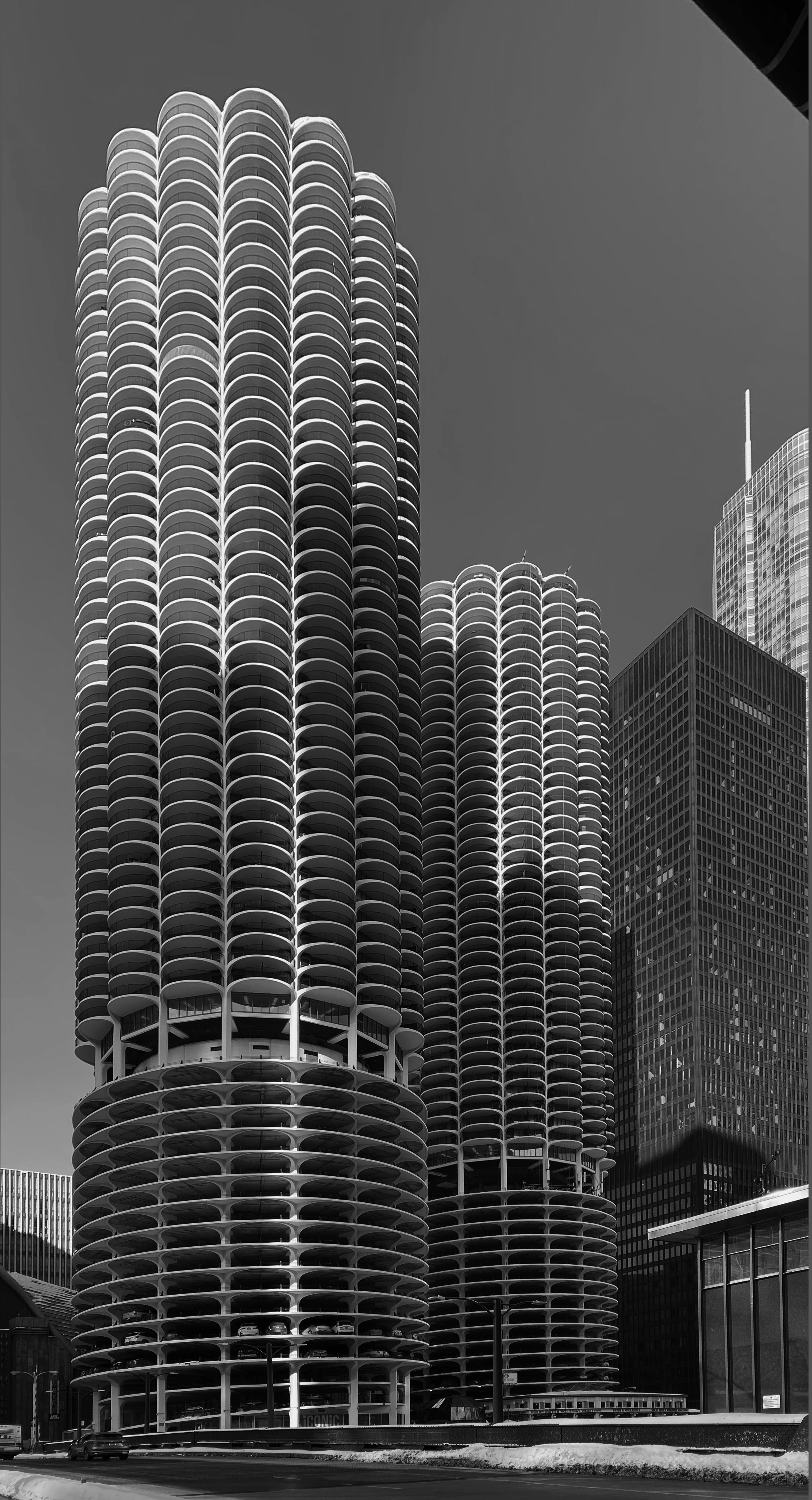
In Situ is an ongoing project with Carol Willis of New York’s outstanding Skyscraper Museum and Bill Baker, Emeritus Partner at SOM Chicago, to look at the history of the concrete skyscraper. Most historians have focused on steel as the key material development in tall building construction, and while that was the case at the end of the nineteenth century, Carol makes the argument that concrete has been the more important, even the defining innovation that has allowed many of the 20th and (especially) 21st century’s greatest achievements.
We’re working toward an exhibition sometime in the late Fall, but as part of the conversation, Carol has commissioned a series of conversations with historians, architects, and engineers that will look at some key moments in concrete skyscraper development. We’ve just had the first two of these. Earlier this month, Chicago architect Geoffry Goldberg talked about Marina City, designed by (and, in large part, inspired by) his father, architect Bertrand Goldberg:
Earlier this week, Bill Baker and I talked about two other Chicago skyscrapers–almost exactly contemporary with Marina City–that have been largely left out of the standard histories. Chestnut-DeWitt Apartments and the Brunswick Building in Chicago were important moments in the development of the tube structure. Architects Myron Goldsmith and Bruce Graham worked with engineers Hal Iyengar and Fazlur Khan to distill these buildings’ structures onto their exterior skins–clearing space for programmatic flexibility while discovering new synergies that came with thinking of the towers’ structures as structural ‘organisms’ instead of collected structural elements:
We have more of these planned–the next two will take place at the end of July and August, respectively, and will cover high rises farther afield–watch this space (and the Skyscraper Museum’s page) for further details…
 architecturefarm