[Chicago Skyscrapers, 1934-1986, published by University of Illinois Press, is available now on Bookshop.org and Amazon.com, among other outlets. This week’s post follows up on my discussion with Adam Rubin at the Chicago Architecture Center at the book’s launch event, where we talked about the roster of unsung heroes in the city’s postwar building culture–Milton Schwartz is one of the era’s most intriguing characters. His tour de force apartment tower deserves far more credit than historians have been willing to give it…]
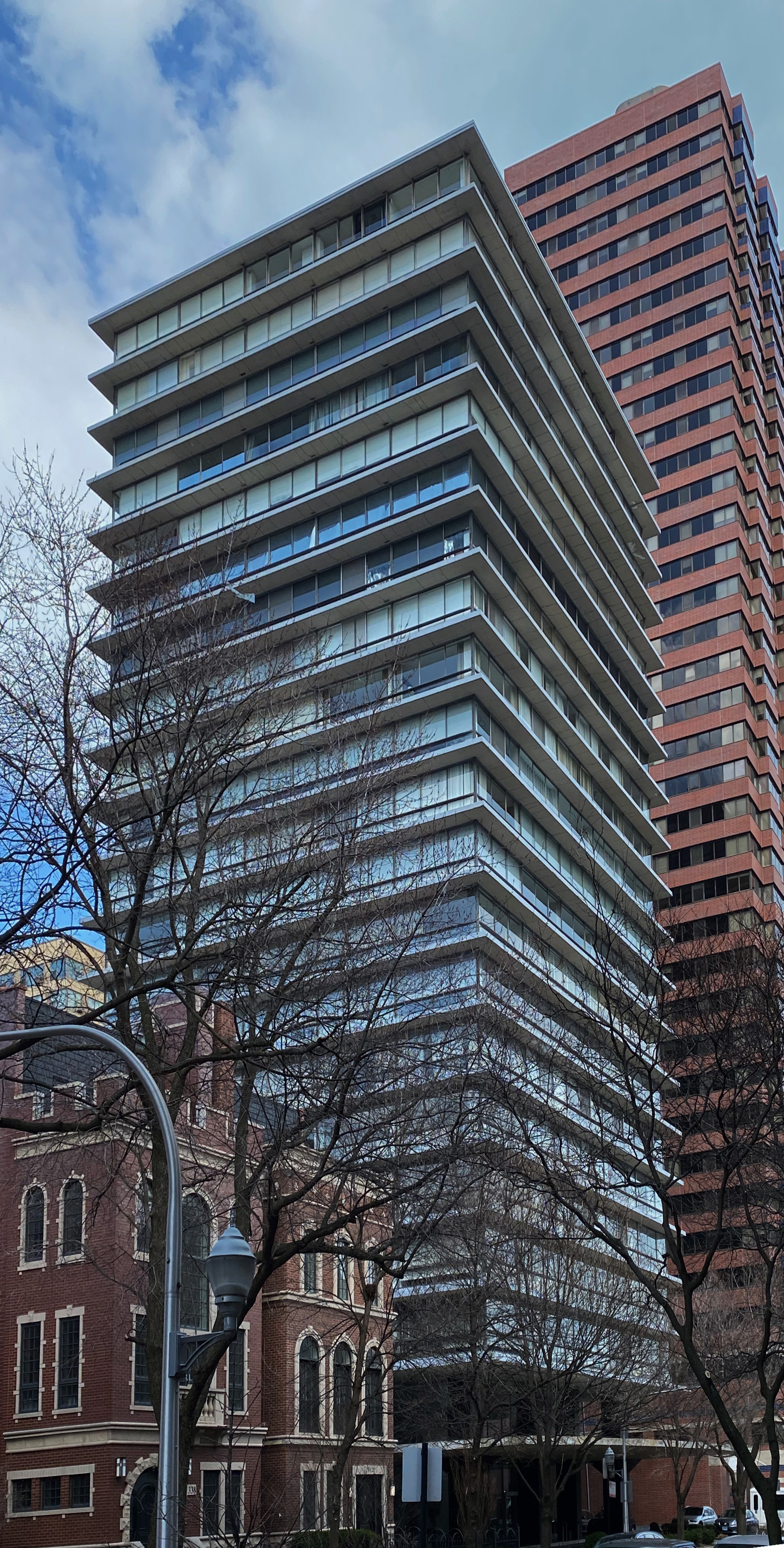
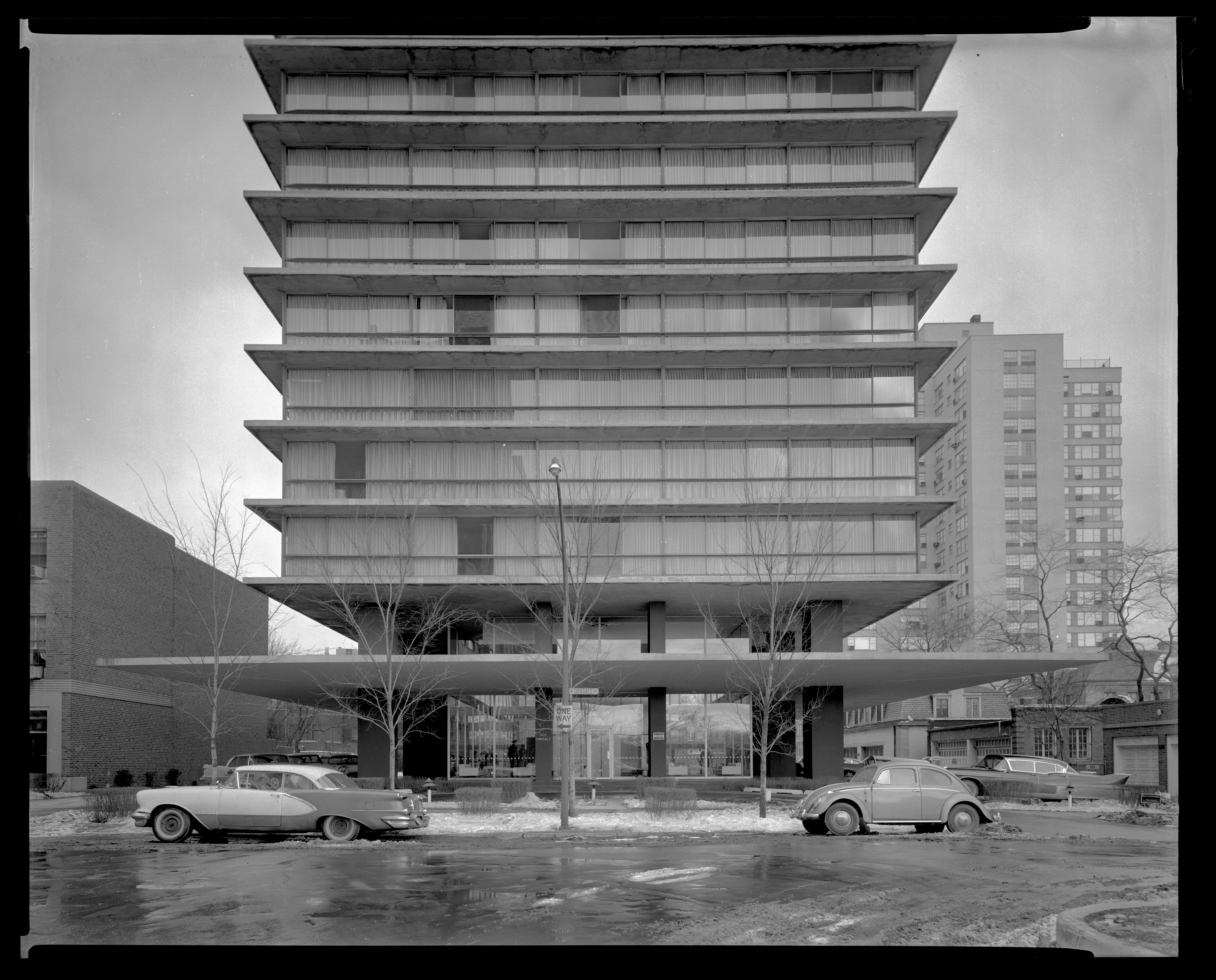
“One man’s dream,” according to Forum’s panel, a striking tower two blocks north of Lincoln Park expanded on 1000 Lake Shore’s glass walls and concrete brise-soleils while demonstrating air conditioning’s potential for apartment design. Its architect-developer, Milton Schwartz, grew up in a Chicago family that owned a plumbing and heating business. He attended the University of Illinois’ architecture program, leaving in 1947 to work for the family and as a general contractor, earning his professional license in 1952. Living at the corner of Commonwealth and Oakdale, he bought an adjacent site from realtor Jerrold Wexler. Just 26 and inspired by Frank Lloyd Wright’s lecture at Illinois on heliocentric design, Schwartz drew up a circular scheme with cantilevered floor slabs reminiscent of Wright’s Johnson Wax laboratory tower in Racine (1944-1950) to form large, overhanging sunshades, surpassing Wright’s in its transparency, with “outside walls entirely of glass, with no column obstructions.” Unlike 1000 Lake Shore, Schwartz—confident in his family’s expertise—proposed that the tower be “completely air conditioned,”.[i]
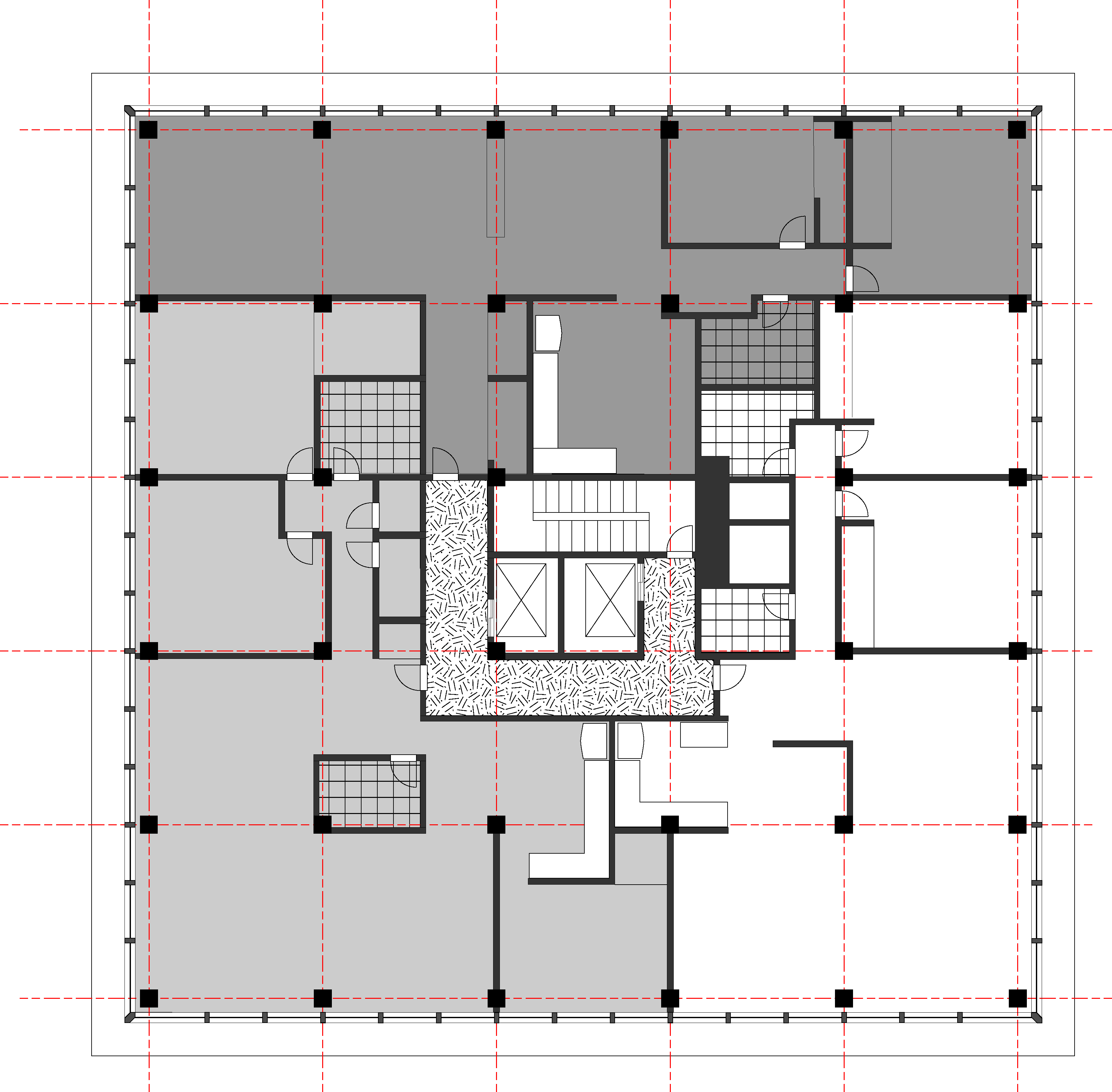
The round form did not find willing lenders. Instead, Schwartz worked with structural engineer Henry Miller on a square version, seventeen stories high, with floor slabs that cantilevered 3’-4” beyond its all-glass walls. Miller supported this on 36 columns that transferred through story-tall shear walls at the third floor to just 12 columns and a central elevator core at the ground level, providing a dramatic, 20’ overhanging porte-cochere—an “outlandish underpinning,” according to Forum’s panel. Above, aluminum and plate glass storefronts made up floor-to-ceiling windows, with operable sashes at the center of each column bay.[ii] Dovenmuhle, Inc., gave Schwartz an $800,000 mortgage and Schwartz’ own contracting firm constructed it from 1953-54.[iii]
320 Oakdale’s 75’ x 75’ floors held just two or three two- and three-bedroom apartments each. Bathrooms, kitchens, and closets were planned tight to the central core, with the rest of the units opening to its continuous glass walls. Schwarz combined the units’ living and dining rooms, sensing suburban ranch homes’ open plan appeal to families and the potential for dramatic, open-cornered views.[iv] To save weight, floor slabs of lightweight concrete blocks rested on 8-1/2” deep poured-in-place concrete joists. Ceilings were plastered onto these, saving height and framing costs. Schwartz’ father and uncle installed perimeter fan coil units that supplied hot or cold water and developed a radiant slab for the ground-level parking, circulating warmed freon to heat cars from below.[v]
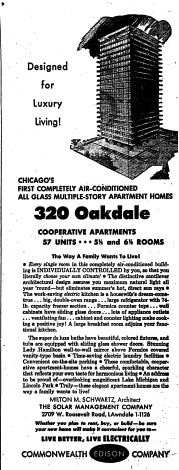
“Chicago’s First Completely Air-Conditioned All Glass Multiple Story Apartment Homes,” announced Schwartz’ advertising campaign in the spring of 1954. Co-sponsored by Commonwealth Edison, his ads pitched the units, available as cooperatives for between $32,000 and $38,000 ($315,000 and $374,000), to a more child-friendly clientele than Greenwald or Perlman, offering competition for the suburbs’ convenience and open space. With Lincoln Park and the lakefront so close, Schwartz’ advertising enthused, “these elegant apartment homes are the way a family wants to live!”[vi] The building’s air conditioning system was a major selling point— “Every single room in this completely air-conditioned building is Individually Controlled by you, so that you literally choose your own climate!”—as were appliances and amenities that were standard features of new suburban homes. “The work-saving electric kitchen,” his ads promised, would be “a housewife’s dream-come-true.”[vii] These amenities were matched by reasonable co-op fees. Schwartz required a 60% down payment but offered low monthly assessments of $200 ($2000), dropping to $30 ($300) after the five-year construction mortgage had been paid down. 320 Oakdale attracted the families he had targeted; demand for the project’s three-bedroom units outpaced that for one- and two-bedroom units. Schwartz was reduced to showmanship to sell the smaller apartments, installing high-intensity lights in every room of the vacant units that turned the tower into a beacon to evening commuters on Lake Shore Drive in late 1954.[viii]
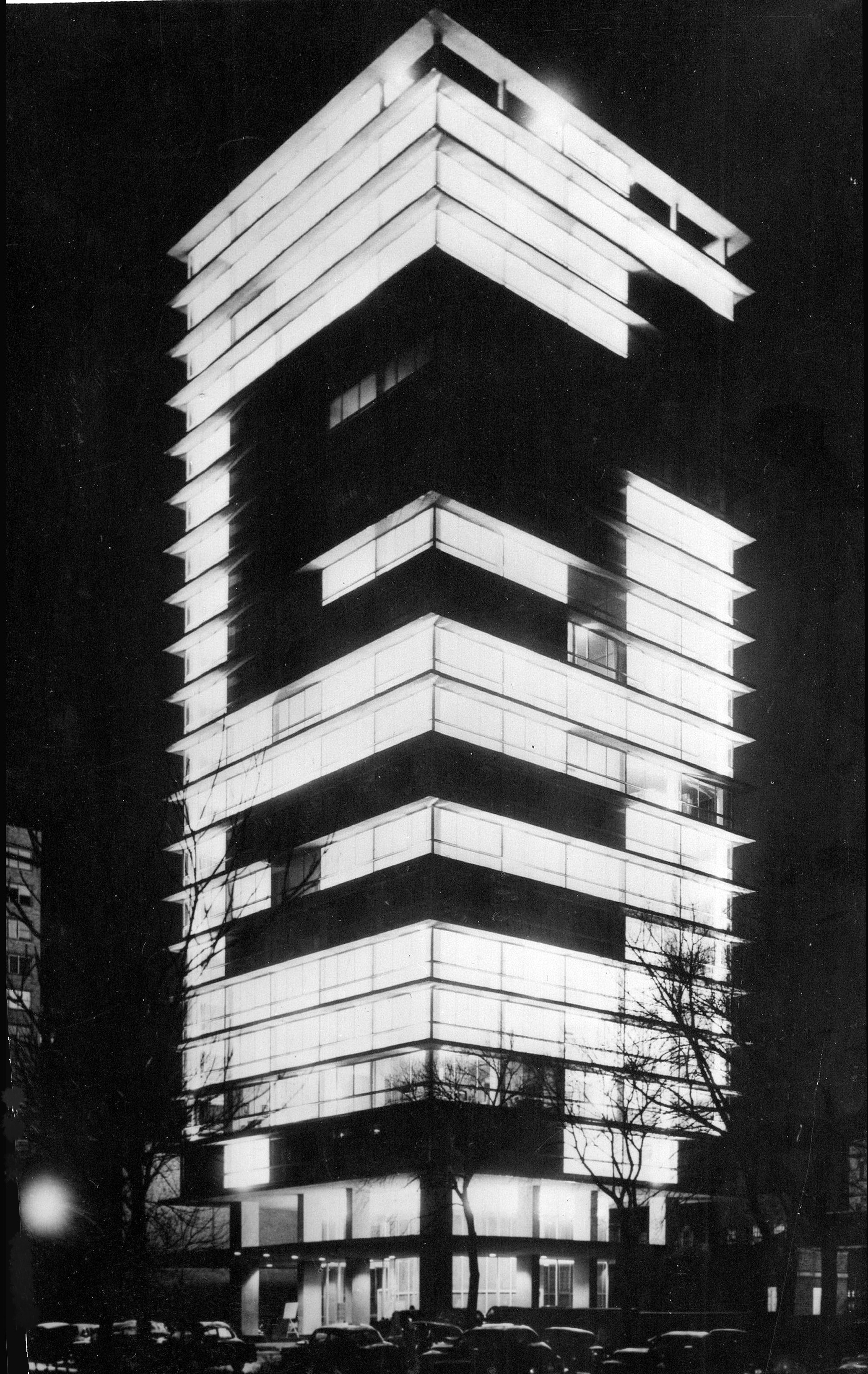
That stunt “managed to sell one or two apartments, but it left more conservative architectural critics nonplussed.[ix] Forum’s panel regarded the project grudgingly, calling the long horizontals “awkward” and pointing out that the 360° sunshades “make no sense…except on the south face.” Much of 320 Oakdale’s design was prescient, though. Its cantilevered sunshades, reinterpreted as occupied balconies, would emerge in Marina City (see below), a project that realized Schwarz’ abandoned dream of a cylindrical tower. Its large units’ success showed how high-rises could compete with suburban ranch homes, and Miller’s structural accommodation of automotive traffic recognized the car’s increasing presence. Most importantly, 320 Oakdale proved the viability of glass curtain walls and air conditioning in residential high rises. Schwarz had the technical ability close enough to hand that he understood how cladding, air conditioning, and solar shading could be integrated in ways that Greenwald and Perlman had not. Forum may have considered the tower “outlandish,” but Schwartz’ ‘dream’ set new comfort standards for Chicago apartments.
320 Oakdale was one of several important turning points in curtain wall and air conditioning nationwide. Window air conditioners saw sales spike during the hot summer of 1952 and “are you air-conditioned?” challenged “politics, baseball, and Russia as something to talk about,” according to the New York Times.[x] Chicago hosted the American Society of Heating and Ventilating Engineers’ annual conference in January, 1953, which the organization billed as “air conditioning’s biggest year.”[xi] Used to mechanical comfort in offices, stores, and theaters, Chicagoans also began to demand it in their homes.
[i] Al Chase, “Building Using Big Glass Area Under Study.” Chicago Daily Tribune, Dec. 21, 1952. A7.
[ii] “Eight Chicago Apartments: Nineteen Glass Tiers Sitting on a Cantilever.” Architectural Forum, vol. 103, no. 5. November, 1955. 149.
[iii] “Real Estate Notes,” Chicago Daily Tribune, Feb. 27, 1954. A5; Al Chase, “21-Story Co-op with Walls of Glass Rising.” Chicago Daily Tribune, May 31, 1953. A9.
[iv] See floor plan published in “Eight Chicago Apartments: Nineteen Glass Tiers Sitting on a Cantilever.” Architectural Forum, vol. 103, no. 5. November, 1955. 149.
[v] Schwartz Oral History, 21.
[vi] Display Ad: “Designed for Luxury Living! [320 Oakdale]” Chicago Daily Tribune, May 23, 1954. E8.
[vii] Display Ad: “Designed for Luxury Living! [320 Oakdale]” Chicago Daily Tribune, May 23, 1954. E8.
[viii] “Eight Chicago Apartments: Nineteen Glass Tiers Sitting on a Cantilever.” Architectural Forum, vol. 103, no. 5. November, 1955. 149.
[ix] “Glass Tower Doesn’t Hide its Light.” Chicago Daily Tribune, Nov. 25, 1954. G6.
[x] C. B. Palmer, “The A B C and the X of Air Conditioning: The Elements and Benefits are Simple; the Unknown Quantity is the Future. the ABC and the X of Air Conditioning.” New York Times, July 27, 1952. 2.
[xi] Russell Freeburg, “Homes Are Air Conditioning’s New ‘Frontier’: Fair of ’33 Gave Big Boost To Industry.” Chicago Daily Tribune, Jan. 23, 1953. 1-b5.
 architecturefarm
Pingback: 320 Oakdale Featured in Publication – 320 Oakdale