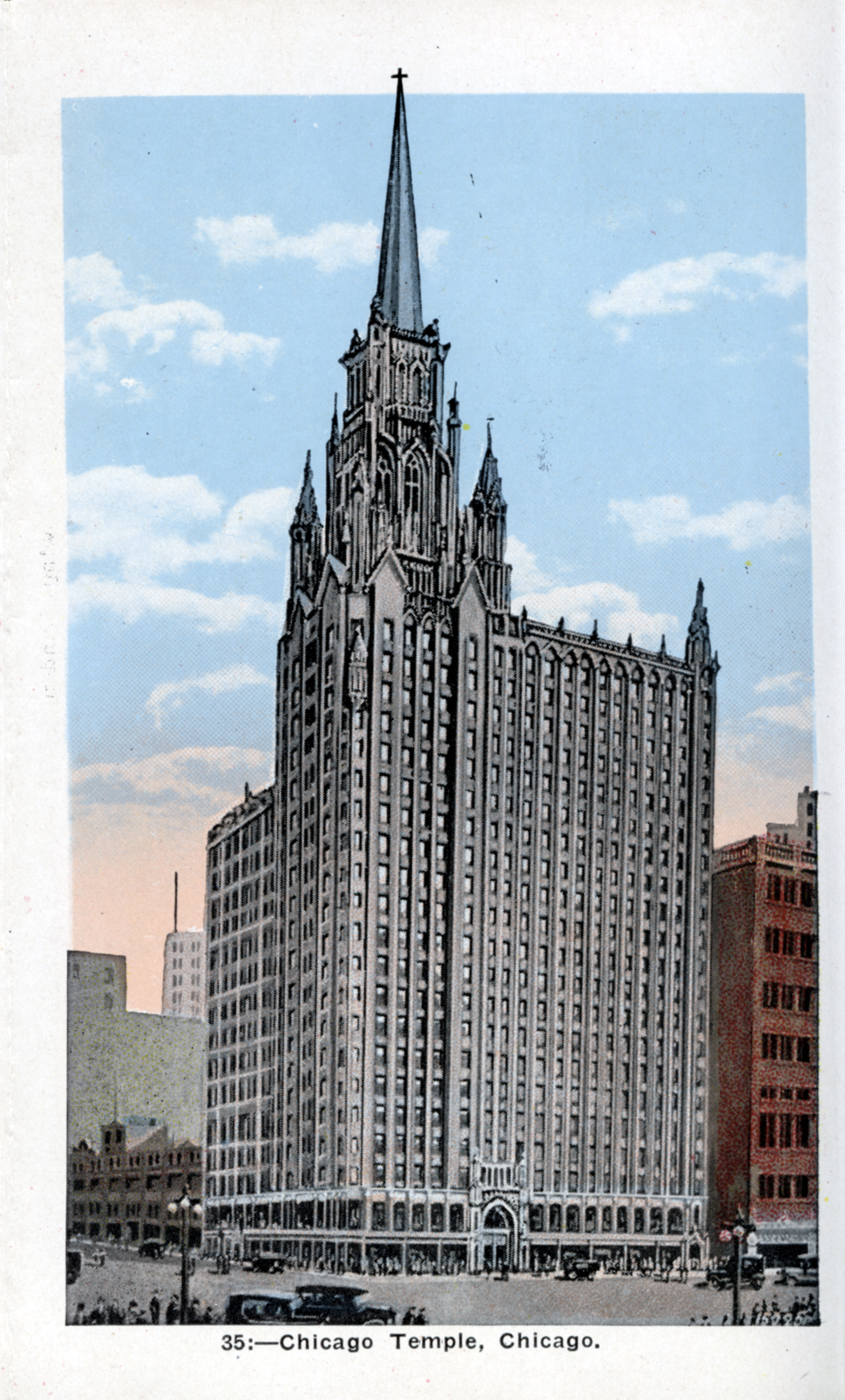
I was honored to be part of the Chicago Temple’s 100th birthday celebrations earlier this month. UIC’s Robert Bruegmann, Lee Bey from the Sun-Times, and the Chicago History Museum’s Rebekah Coffman, and I all offered context to the 556-foot skyscraper church (or is that skyscraper/church?). I’ve written about the Temple in Chicago Skyscrapers, 1871-1934 and on ArchitectureFarm here; this was a chance to dive more deeply into the politics—and scandal!—surrounding the tower’s permitting and its ultimate effect on the city’s skyline.
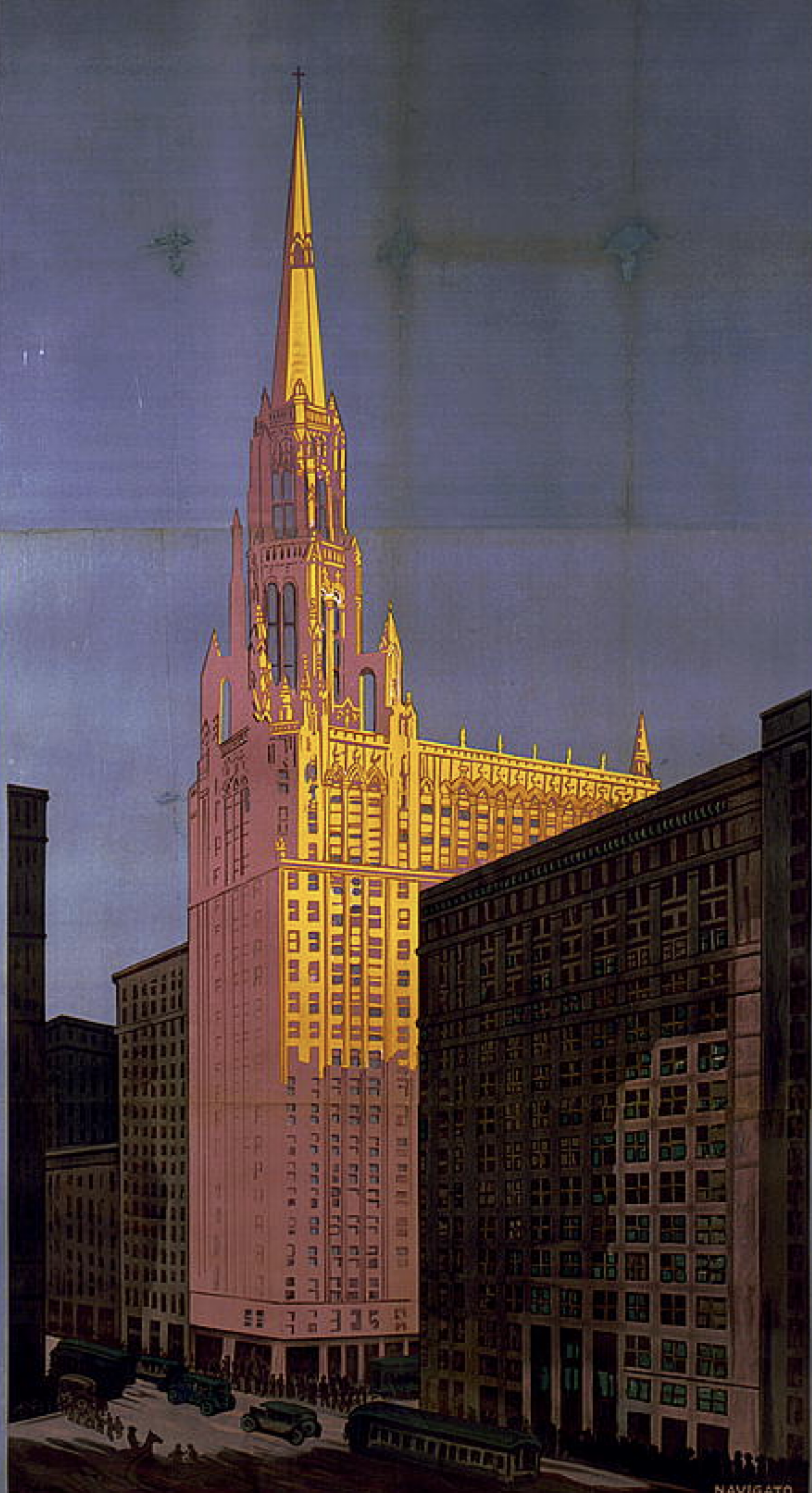
“METHODISTS SEE DREAM REALIZED IN LOOP TEMPLE,” announced headlines in the Chicago Tribune in March 1922, alongside a rendering showing a skyscraper church—260 feet of commercial office space sandwiched between a new sanctuary for the First Methodist Episcopal Church on the ground floor, and a 140-foot spire atop the commercial block.[1]
The early 1920s were banner years for skyscraper construction, but Chicago’s efforts were hindered by a building code that had resolutely capped building height. While the limit was raised and lowered several times, it hovered between 200 and 265 feet during the 1910s, frustrating downtown developers with the technology to build higher. Led by landowners in surrounding wards who sought to “press out” the Loop’s land value, the building height limit left Chicago a city of flat tops, far lower than the 792-foot tall Woolworth Building that New York boasted. Completed in 1913, it wrested the title of “world’s tallest” from Chicago—seemingly for good.
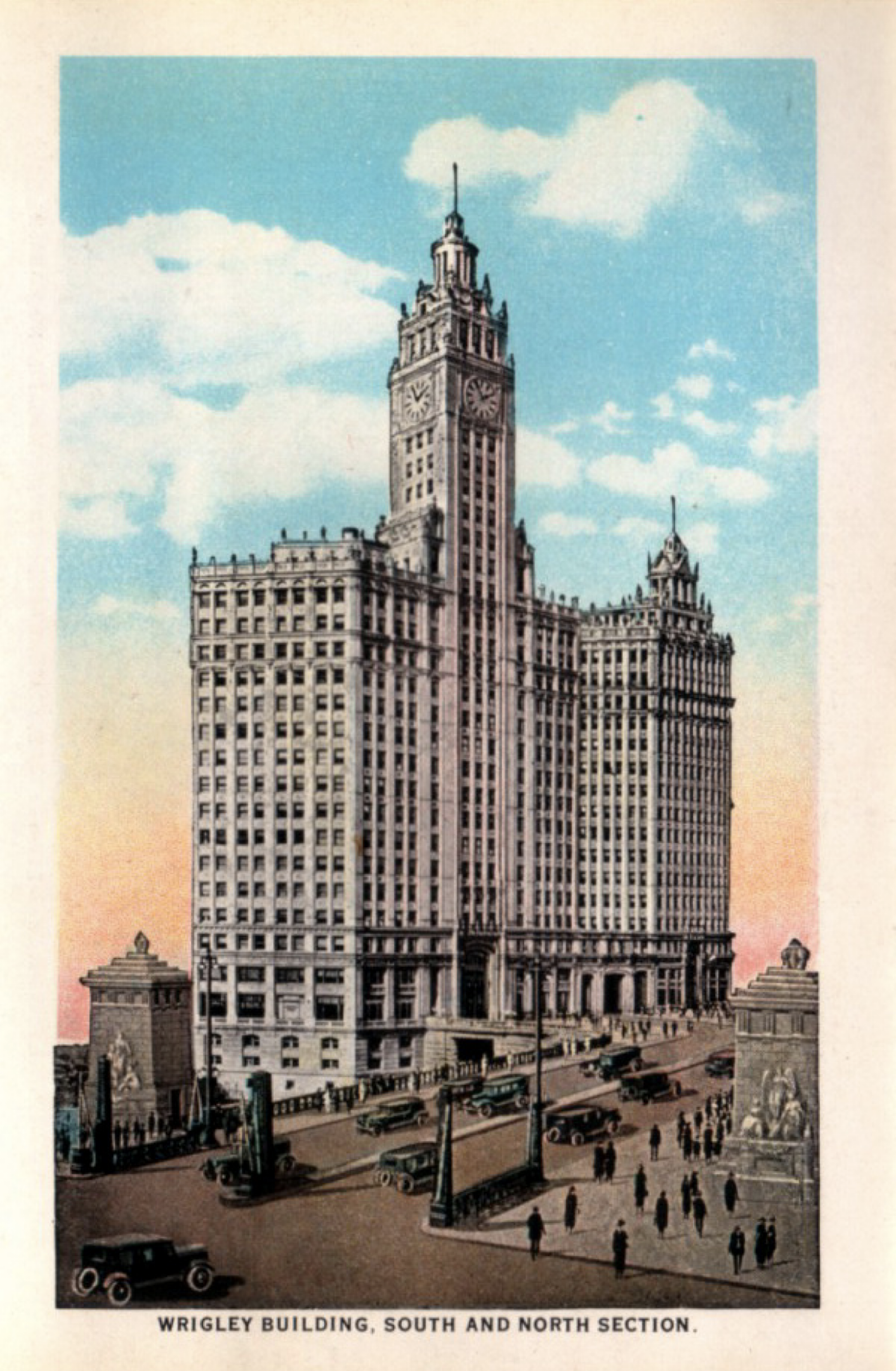
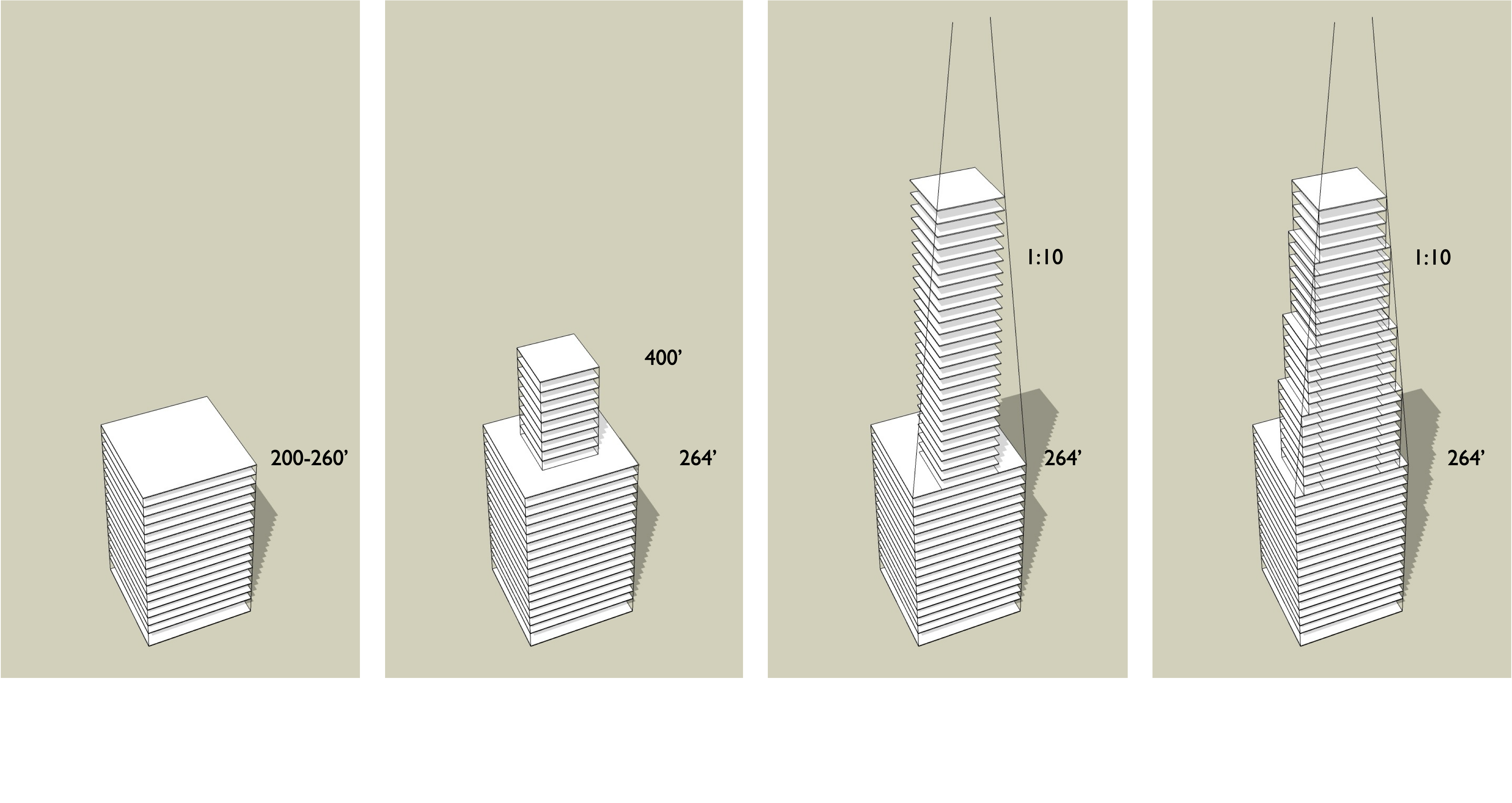
The city grudgingly allowed an exception in 1920, permitting “spires” to rise above the absolute limit (then set at 260 feet) to 400 feet, provided they did not occupy more than 25% of the “building frontage.” The Wrigley Building, designed by Graham, Anderson, Probst, and White and completed in 1921, was the first and most visible tower to exploit this loophole. Holabird and Roche, the architects for the Chicago Temple, proposed this strategy for the new building; the commercial block would touch the cornice height restriction, while the spire would exactly hit the ultimate 400’ limit.
Within a month, however, Chicago’s Building Commissioner, C.A. Bostrom, announced that the Methodists’ permit would be denied. The tower’s width was based on 25% of the total frontage of the lot along Washington and Clark Streets. The code, Bostrom argued, required the spire’s width to be based only on the main frontage. Given the skinny lot’s frontage on Washington, the spire could, effectively, be nothing more than a flagpole. Just one day later, however, Bostrom seemed to relent and then, after eight months, announced that the Church had been granted a permit for a 556-foot spire—a foot taller than the Washington Monument and far taller than any building in Chicago, religious or commercial.
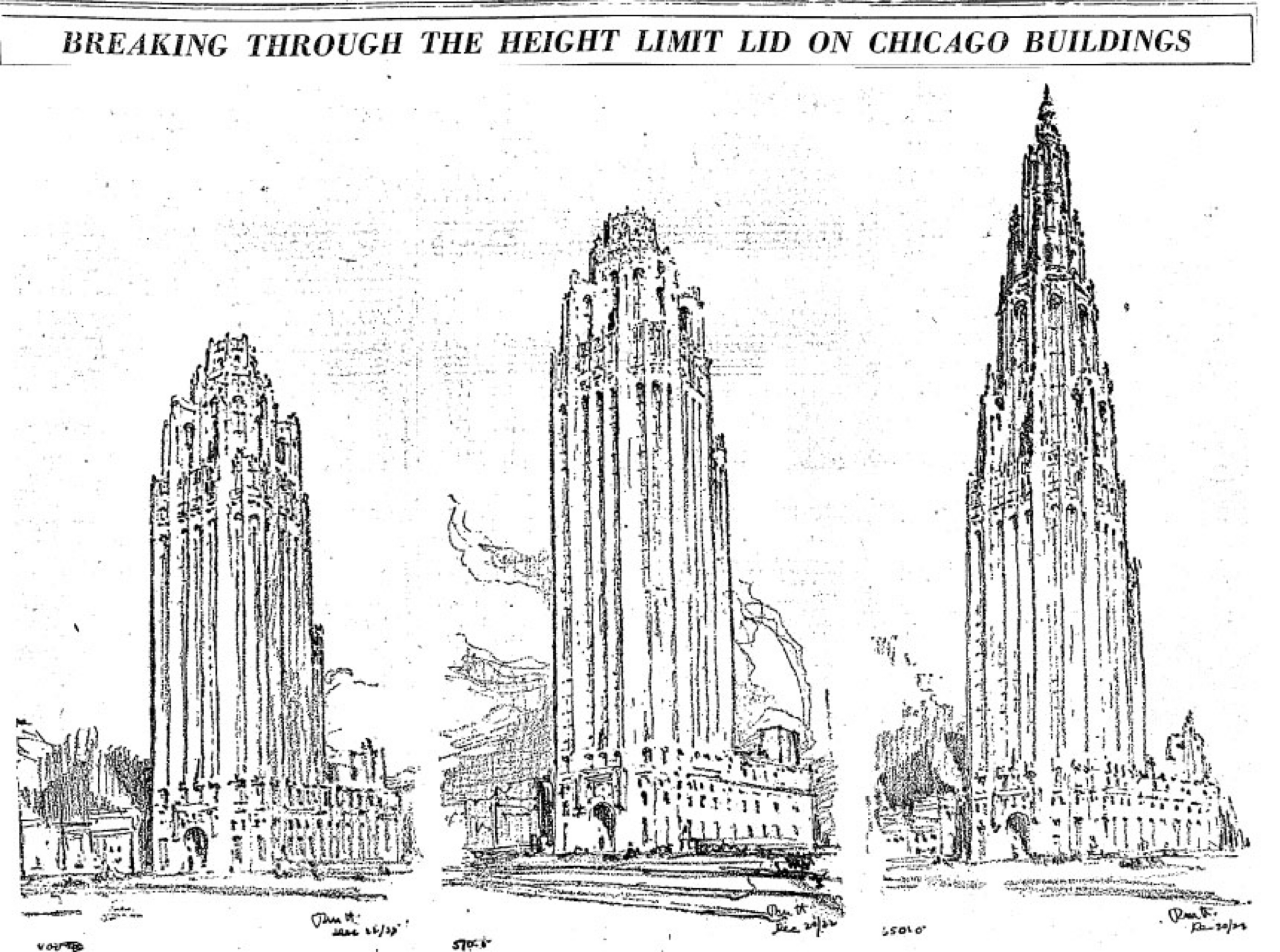
Other building owners were apoplectic at this exception—far beyond anything permitted up to that point in the city. The Tribune, which had just announced its code-compliant tower and spire, designed by Hood and Howells to reach precisely 400 feet with its gothic tower centered in the plan and exactly 25% as wide as its main front, was particularly vexed. “The Methodists,” the paper wrote, “have found the way to break through the 400-foot crust which truncates Chicago architecture.”
“In obtaining the grant of this spectacular exception to the provisions of the existing building ordinance the Methodists have done a big thing for art and inspiration in Chicago. Its value as a precedent is obvious and will prove a source of encouragement to architects…
“Meanwhile the ordinance stands just as it did. Every exception to it that is made in behalf of builders and of art must be a special order of council. That many such exceptions can be made without causing tedious and costly litigation seems improbable. In short, the projectors of the great temple in the loop have brought to a head a situation that long has been commercially irksome and artistically deadening. Thorough revision of an ordinance which creates conditions so benighted now appears inevitable.”[2]
The paper commissioned Hood and Howells to draw up versions of the Tribune Tower at 570 and 650 feet high. “The churchmen will find that there are others who have as much at heart as they have in the cause of beauty in city buildings,” they wrote, threatening to beat the Methodists to the title of the tallest building in Chicago.
What happened? Why would the Temple receive permission not just to build their planned design but also to exceed the limitations of every other city tower? The answer may lie in news reports of the original denial. Just after Bostrom’s initial decision, reporters queried whether “the difficulties over the permit have any connection with the refusal of the Methodist ministers to indorse the Rev. John H. Williamson, city hall law enforcer, whose please for law enforcement have been mingled with speeches lauding Mayor Thompson.”[3]
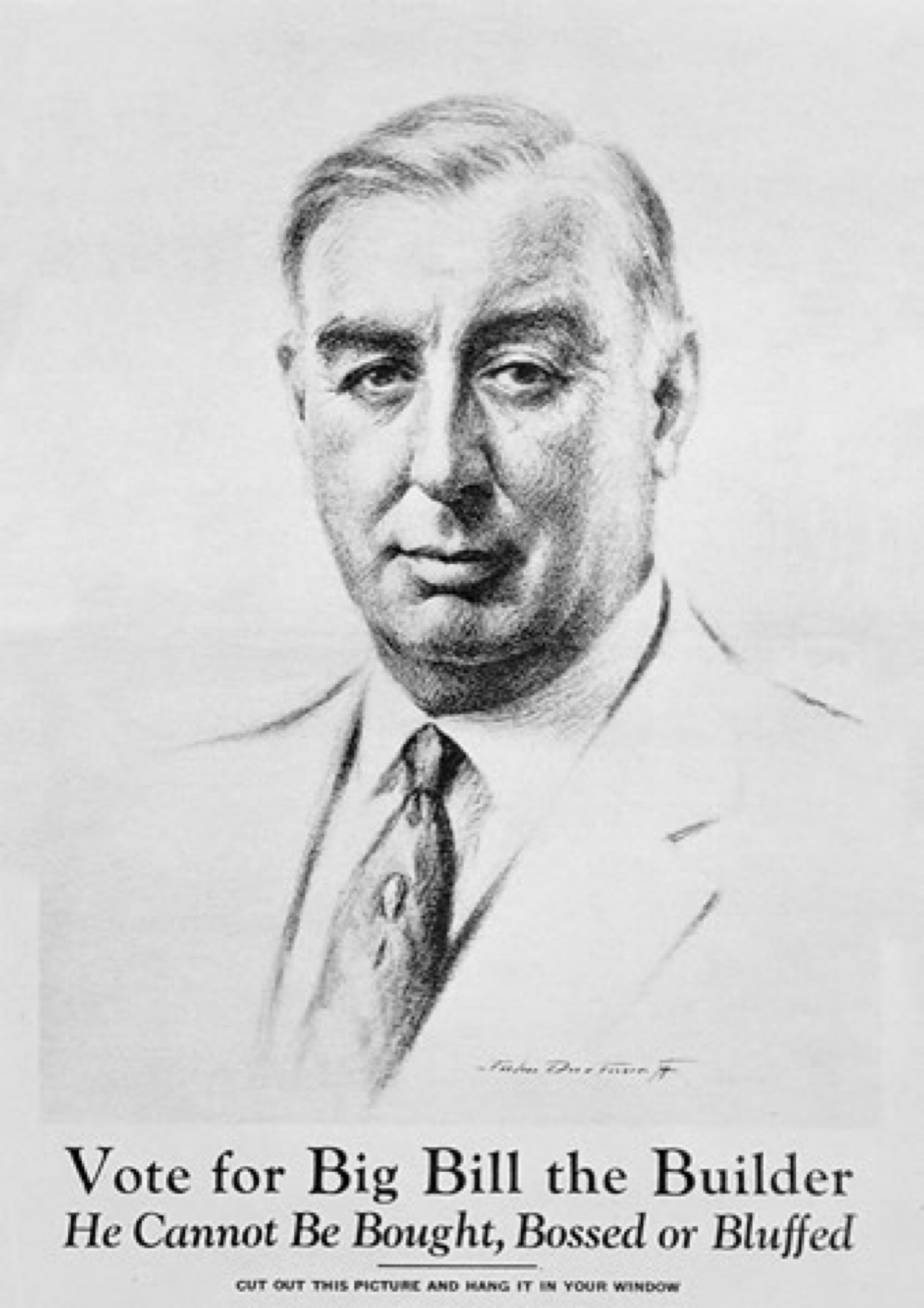
Therein lies a tale, one that could only happen in Chicago. Mayor Thompson was William Hale Thompson, by later accounts, “not only the most corrupt politician in America but the most corrupt politician in Chicago.” Thompson, a “non-practicing Methodist” by his admission, had risen to power in 1915 partly by courting the “temperance vote,” a bloc of largely Methodist voters who pushed for prohibition. His campaign had promised to enforce Sunday blue laws that were already on the books but widely ignored, and the early years of his mayoralty were marked by a prominent campaign to do so. Keen to hang on to this vital demographic, Thompson campaigned for re-election in 1919 by appealing directly to the Methodists in campaign rallies, some of them held within the First Church itself. Clergy grew increasingly skeptical as they saw saloons remaining suspiciously open on Sundays, drawing connections between those and a notoriously corrupt police force led by Commissioner F.W. Fitzmorris.
As the next election drew near, Thompson responded by installing a Methodist minister, Rev. Williamson, as a “super law enforcer.” Williamson drew a $10,000 salary with no clear portfolio of responsibilities, but he was brought out to stand with the Mayor and denounce alcohol and other vices regularly. First Methodist minister, John Thompson, finally had enough, declaring in March 1922 that Williamson’s hire had been mere window dressing—“a political trick and not on the square,” in his words.[4] Williamson, for his part, seems not to have understood his assignment. Throughout the summer, he announced investigations into bribes paid by saloon owners and a gambling ring run by higher-ups in the police force. Thompson summarily fired Williamson, and in early December, he implicated the Mayor and Police Commissioner in a prostitution ring being run in the Levee, the city’s vice district.[5] Fitzmorris resigned. Thompson announced in January 1923 that he would not run for Mayor again.[6] All of this took place while the controversy over the Methodist’s tower simmered behind the closed doors of the Building Department. There is no direct evidence that the Methodists were “squeezed” in April when Bostrom denied their permit or that the 556-foot exception was granted to buy their goodwill amid a lurid Mayoral scandal, even by Chicago standards. However, it is hard not to see those decisions in this context.
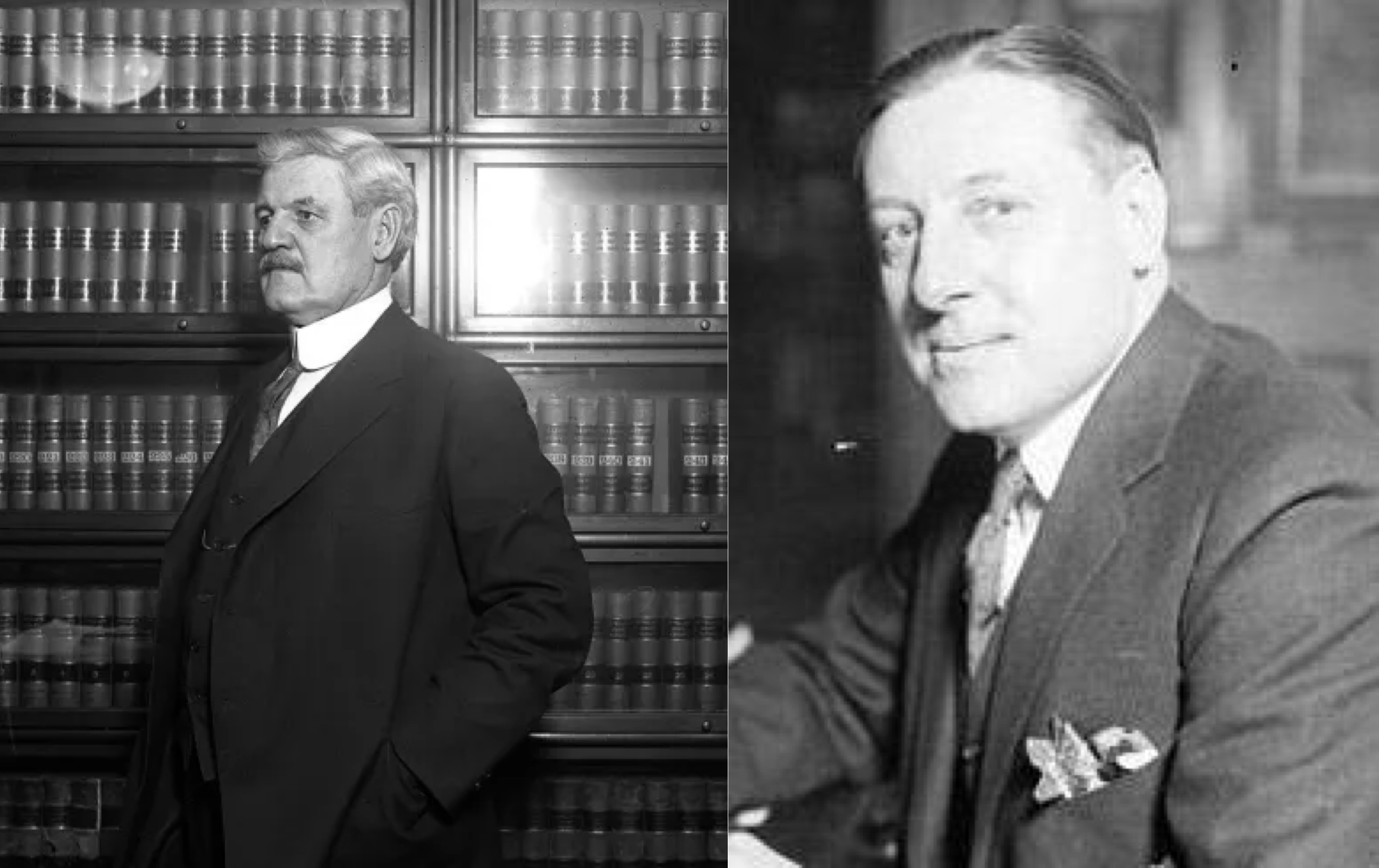
The April 1923 election was a race between two candidates promising to clean up city government and to put the brakes on the development that threatened, to many, to change the Loop and its surroundings into “Skyscraperville.” William E. Dever, a former judge, ran as a Democrat against Thompson’s replacement, a city tax assessor named Arthur Lueder. While the Tribune campaigned for “a realtor for Mayor,” hoping that Lueder would continue Thompson’s laissez-faire approach to development, Dever, however, won handily.
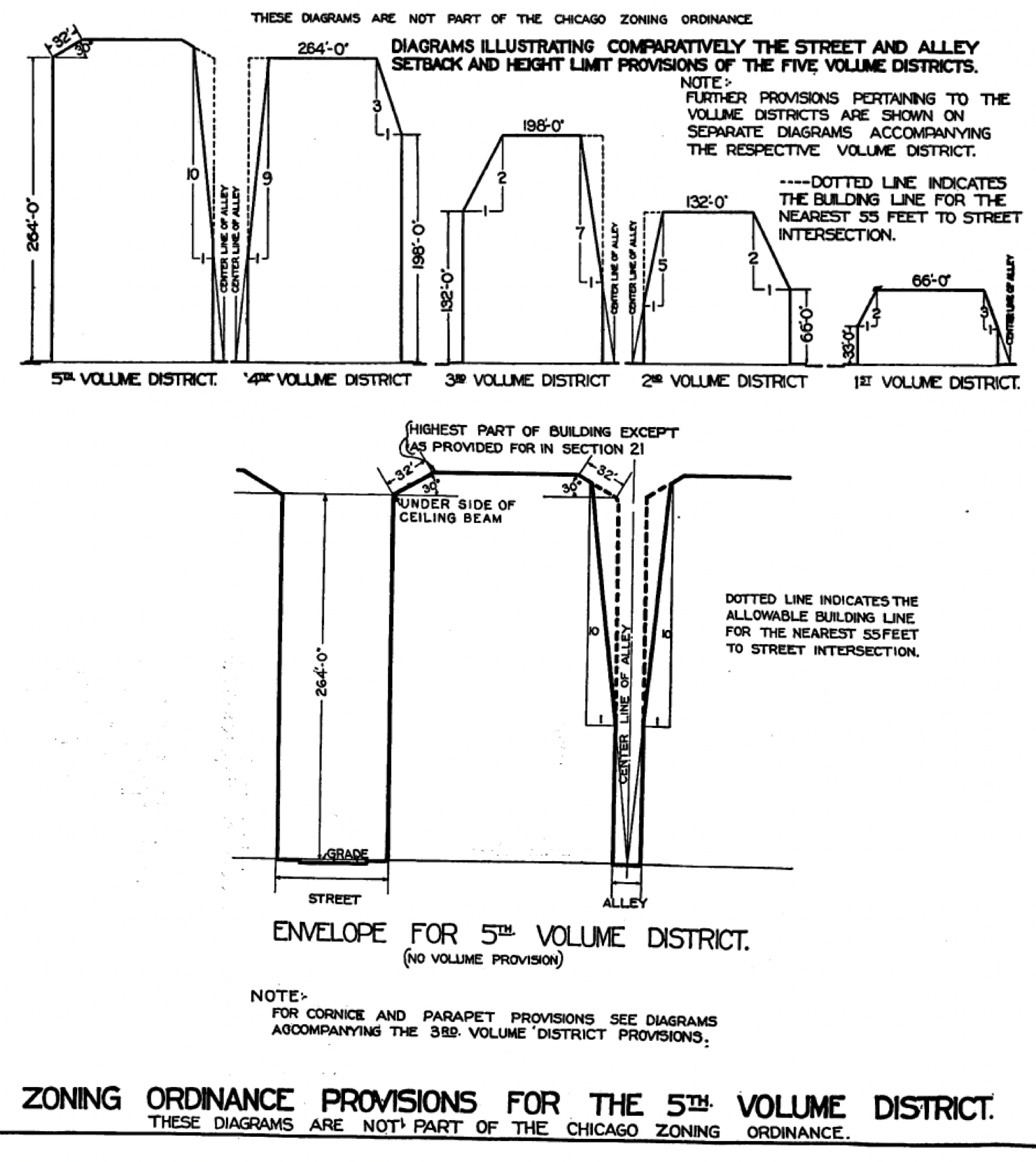
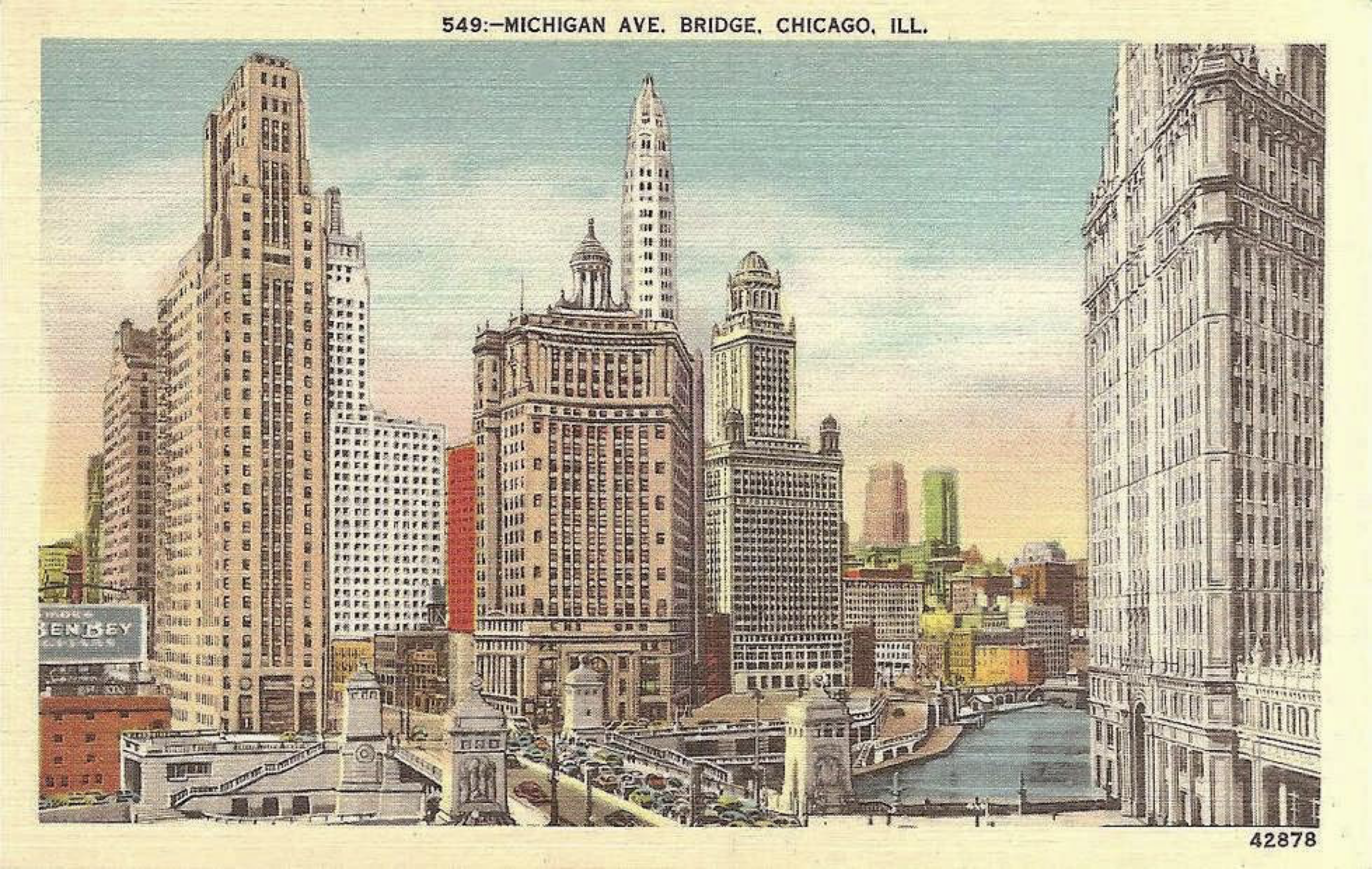
Chicago’s city council was also radically reshaped in that election as the aldermanic structure changed from 35 wards with two representatives each to 50 wards with just one alderman apiece. About to be swept out wholesale, the departing council rushed through the city’s new Zoning Ordinance, which the city’s Real Estate Board had primarily assembled. Initially recommending a strict 265-foot limit, the Board had made a last-minute suggestion, authored by architect George Nimmons, that would allow “setbacks” above this cornice as long as they met certain area limitations and were contained within a 4:1 slope measured vertically from the cornice limit. Two days after the election, the lame-duck city council enacted the new Ordinance with this exception, but—in what was perhaps a spirit of generosity or an effort to please developers and owners who might be convinced to fund departing aldermen’s future campaign coffers—they increased Nimmons’ recommended slope to 10:1. The resulting “block and towers,” “setback skyscrapers,” or “streamlined pylons” quickly became a signature of Chicago during the roaring 20s, marking, in particular, the panorama surrounding the newly finished Michigan Avenue Bridge; The London Guarantee Building, 333 N. Michigan, Mather Tower, and the Jeweler’s Building all feature cornices at 265 feet, with towers above that—often precisely—meet the setback lines of the expanded “Nimmons Loophole.”
POSTSCRIPT: Prohibition passed nationally in 1920. After publicly re-confirming his Methodist faith, William Hale Thompson survived the vice scandal and was re-elected as Chicago’s Mayor, defeating William Dever in 1927. Thompson’s campaign was partly bankrolled by proceeds from bootlegging operations in Chicago. The Chicago Temple remained the tallest building in Chicago until 1930 when the 605’ Board of Trade opened.
[1] Norton, W. B. “Loop’s Spiritual Fortress: Methodists See Dream Realized in Loop Temple.” Chicago Daily Tribune, Mar 26, 1922. 6.
[2] James O’Donnell, Bennett. “M. E. Building Opens New Era Of Sky Scrapers.” Chicago Daily Tribune, Dec 27, 1922. 1.
[3] “New First M. E. Church Permit Tangle Bared.” Chicago Daily Tribune, Apr 28, 1922. 7.
[4] Norton, W. B. “Seeks Probe Of Appointment of Rev. Williamson: M. E. Pastor Sees Joker in Enforcer Job.” Chicago Daily Tribune, Mar 20, 1922. 10.
[5] “Rev. Williamson Hears ‘High Cops’ Take Vice Graft: So Enforcer Aims To Start Something.” Chicago Daily Tribune, Sep 07, 1922. 17.
[6] “Thompson Won’t Run Again: Mayor Quits Race.” Chicago Daily Tribune, Jan 26, 1923. 1.
 architecturefarm