“american architecture” part 2

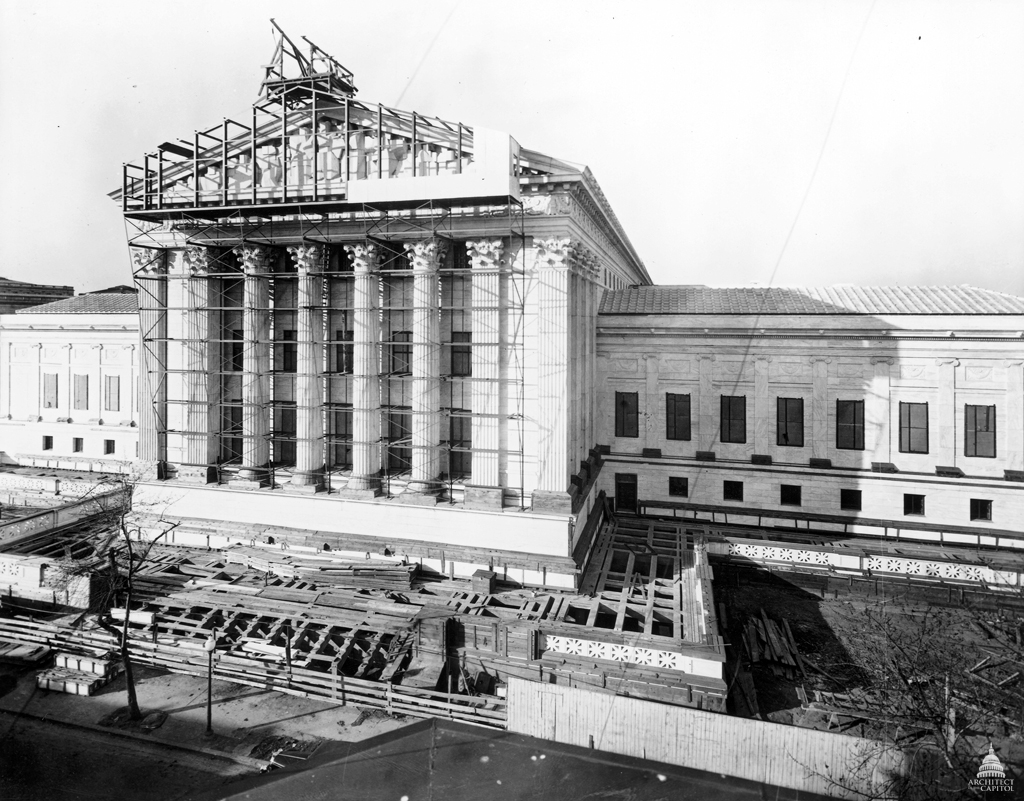
Construction of the U.S. Supreme Court Building in December, 1933. (Architect of the Capitol).

(Update: The New York Times weighs in on some of this here today).

Greenough’s argument against “the adoption of admired forms and models for purposes not contemplated in their invention,” particularly the use of classical architecture for modern programs, found a resonant application nearly a century after his death when the Maison Carree was once again the model for a monumental government structure.

The Supreme Court building was a pet project of Chief Justice and former President William Howard Taft. Long housed within the Old Senate Chamber in the U.S. Capitol, the Court, Taft believed, needed its own monumental presence signifying its coequal nature as one of three branches of government. There was general agreement that it deserved a presence in Washington to balance that of the legislative Capitol and executive White House. Still, Taft injected a personal agenda into the design. He believed that the Court needed surroundings emphasizing the “purity, eternity, and the majesty of law” rather than the casual surroundings of its temporary homes, which encouraged casual deliberation.[1]

Taft engineered the appointment of Cass Gilbert to the project in 1926. Gilbert had distinguished himself as a first-rate classicist, adopting the dome of St. Peter’s Basilica to the Minnesota State House in 1896-1905 and the Trevi Fountain to the facade of the U.S. Custom House on Lower Broadway in New York in 1901-1907. He also designed the world’s tallest building at the time, the Woolworth in New York (1910-1913). Gilbert ran in elite circles and came to espouse nationalist, even exceptionalist, politics.[2] He had supported Taft in his doomed bid for a second term as U.S. President, campaigning against his opponents-Democrat Woodrow Wilson and Republican Theodore Roosevelt–as “radical socialist-pacifists.” During WWI, however, he became an isolationist, eventually opposing U.S. involvement, and his conservatism intensified. As Blodgett recounts, he courted Mussolini, paying il Duce a fawning visit during the 1920s and deepening his belief that Roman architecture, in particular, carried with it a moral force very much in line with his hardening politics. Speaking to the American Academy of Arts and Letters in 1930, he railed against modern architecture and called for a wholesale return to classical models:

“There are paths that lead back to barbarism and it is among the functions of this Academy to . . . guide public taste toward the paths that lead to the higher realms of Arts and Letters and warn them against perversion.”[3]

Taft concurred, pushing for Gilbert’s appointment even as the Depression took hold. He recognized that the expense would be enormous but insisted on the marble and stonework that would produce an authentic (if steel-framed) classical building. For his part, Gilbert created a recognizable homage to Jefferson’s State Capitol and, thus, to the Maison Carree. Gilbert echoed Greenough in recognizing that the building would have to be both monumental and functional:

“[I]t must, so far as possible, have all the beauty, charm and dignity of the Lincoln Memorial, and all the practical qualities of a first-rate office building – a combination rather difficult to achieve, but nevertheless possible.”

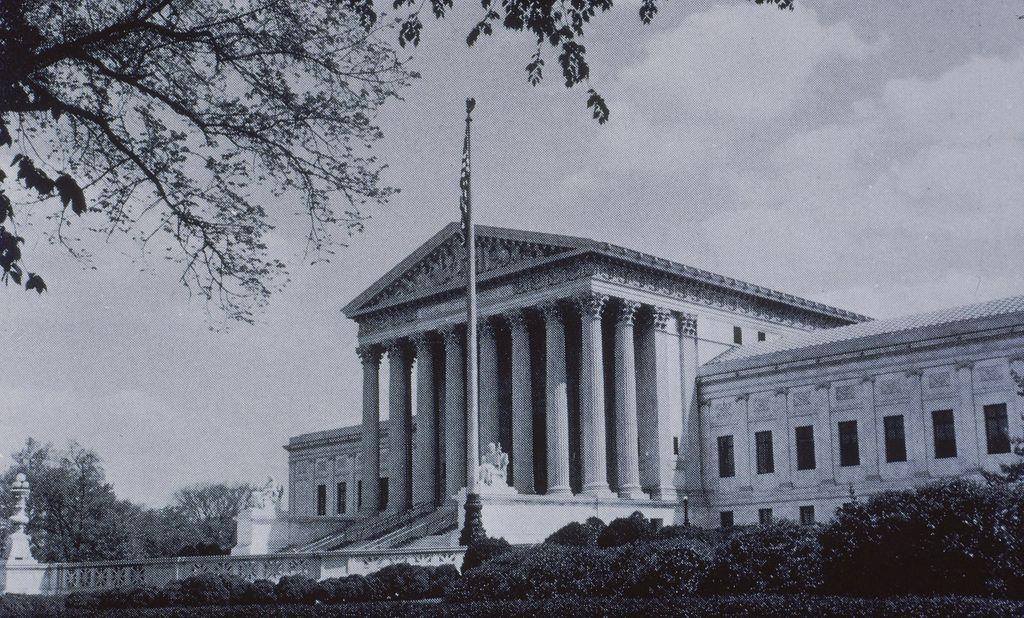
But the design he produced for Taft in 1929 showed that he fell on the side of monumental expression rather than Greenough’s proto-modern call for a more functional articulation:
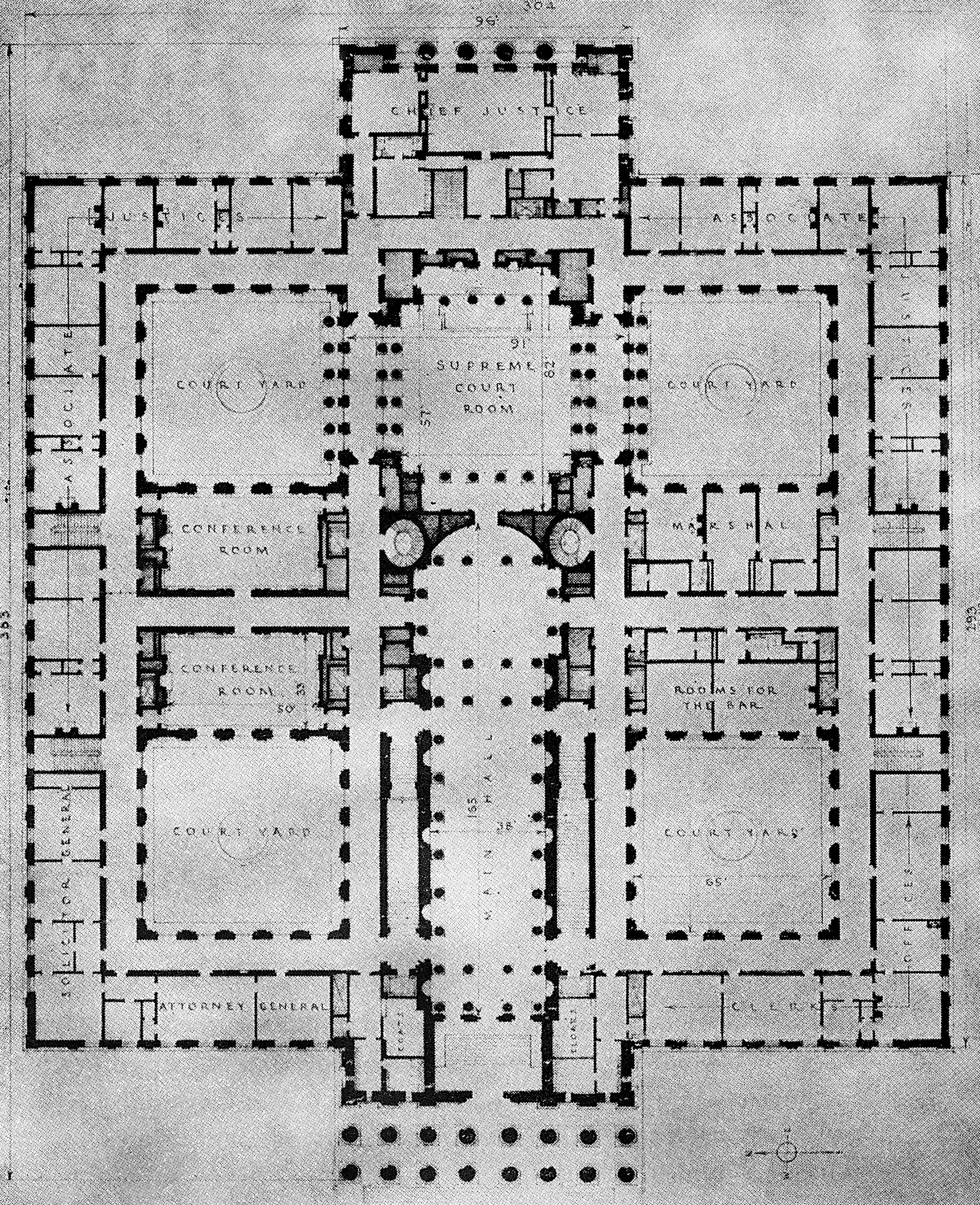
https://www.jstor.org/stable/community.13560845
United States Supreme Court Building, Cass Gilbert, 1928-1935. Avery Architectural Library/Artstor.https://www.jstor.org/stable/community.16511667

Both Taft and Gilbert died before the building was completed, but the end product brilliantly illustrated one pole of Greenough’s formula: a sublime, overpowering image of authority that cloaked its complex functions behind a symbol of ancient power and authority. As Robert Post noted, the religious overtones of the temple front were matched by the ritualistic nature of the inner sanctum:

“The Old Senate Chamber had exuded a distinctly different flavor. It was infused with an “easy informality.” Justices “often strolled through the public halls, and the procession from the robing room to the courtroom proper was a twice-daily spectacle which tourists always tried to see.” In the Court’s new home, by contrast, Gilbert deliberately screened off from public view the justices’ quarters, entries, and exits.  The justices became visible to “the public gaze” only when they magically appeared from behind red curtains to take their seats on the bench, fully robed. In the new courthouse, law became spectacle, detached from ordinary human interaction. Gilbert’s building symbolized an ideal of judicial office that stressed formality, abstraction, and authority. In such a setting, the pronouncements of a judge are no longer a communal project. They are instead disinterested words from above or beyond.”[4]

Speeches at the building’s cornerstone ceremony made this explicit.  Guy A. Thompson, then president of the American Bar Association, called it “a monument to justice…justice that is the final attribute of God himself…. This will be her temple. Here her shrine will be. Here she shall abide.”[5]

Not all of the Court’s residents approved. More liberal justices found it pretentious and oppressive. At the cornerstone ceremony, Chief Justice Charles Evans Hughes said that the Court’s old, casual chambers would be “left with keen regret” and that it would “be a long time, indeed before this beautiful building can boast of the spiritual endowment which has blessed the old home.”[6] Louis Brandeis was more forceful; according to one of his clerks, he “detested” that it represented “everything ‘Roman’ about Washington.”[7] Brandeis preferred the “Greek” vision of the polis and missed the informal scale of the Court’s former home; for him, the Court building should have emphasized the empowerment, rather than the submission, of the populace. The choice of a building from Imperial Rome, rather than Republican—constructed, in part, as a statement of the empire’s conquering power over the native inhabitants of southern France—was for Brandeis a clear statement of power over reason or, in Greenough’s phrase, an “appropriation…displaying only wealth” instead of a “sure product of adaptation, character, and expression,” the formulation that Greenough argued would be uniquely American.
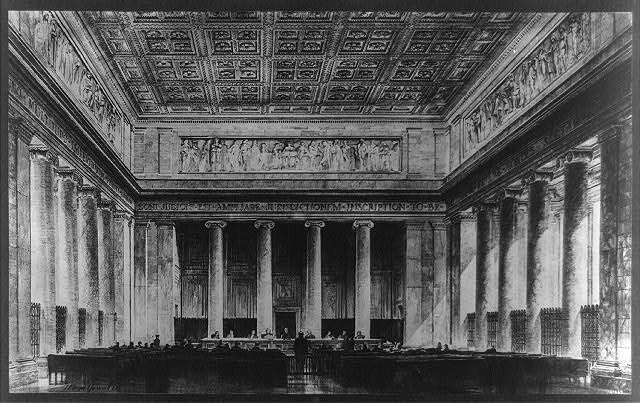
Interior of the Chamber of the Supreme Court, sketch. Date/artist unknown. Library of Congress.https://www.loc.gov/pictures/item/2024665729/resource/

As if to make the point, Gilbert specified Vermont and Georgia marble for the Court’s exterior, albeit as a veneer applied to a steel frame. However, when it came to columns in the Court’s chambers, he felt American stone would not suffice and insisted on Italian marble from quarries in Siena. This, alone, seems an odd choice for an ardent nationalist.  The lengths Gilbert went to obtain that marble are even more striking; in 1933, Gilbert again traveled to Rome and met personally with Mussolini to procure the stone he desired.

Much of federal architecture since Gilbert’s imperial court building has aimed at functional expression, with mixed results. Marcel Breuer’s HUD Building (1968) is arguably a “sure product” of its program–a functional home for a bureaucracy. Neither as iconic nor monumental as the Supreme Court, it–and other functionally expressive structures–have gained appreciation in recent years by admirers of “brutalism” and other modernist approaches. Greenough would have far preferred the robust honesty of Breuer’s facade to Gilbert’s pomposity. And H.H. Richardson’s aggressively detailed stone facades, willingness to work with asymmetry when called for by a program, and commitment to ornamental development of constructive and functional necessities might–possibly–mark him out as a proto-brutalist in the most American sense.
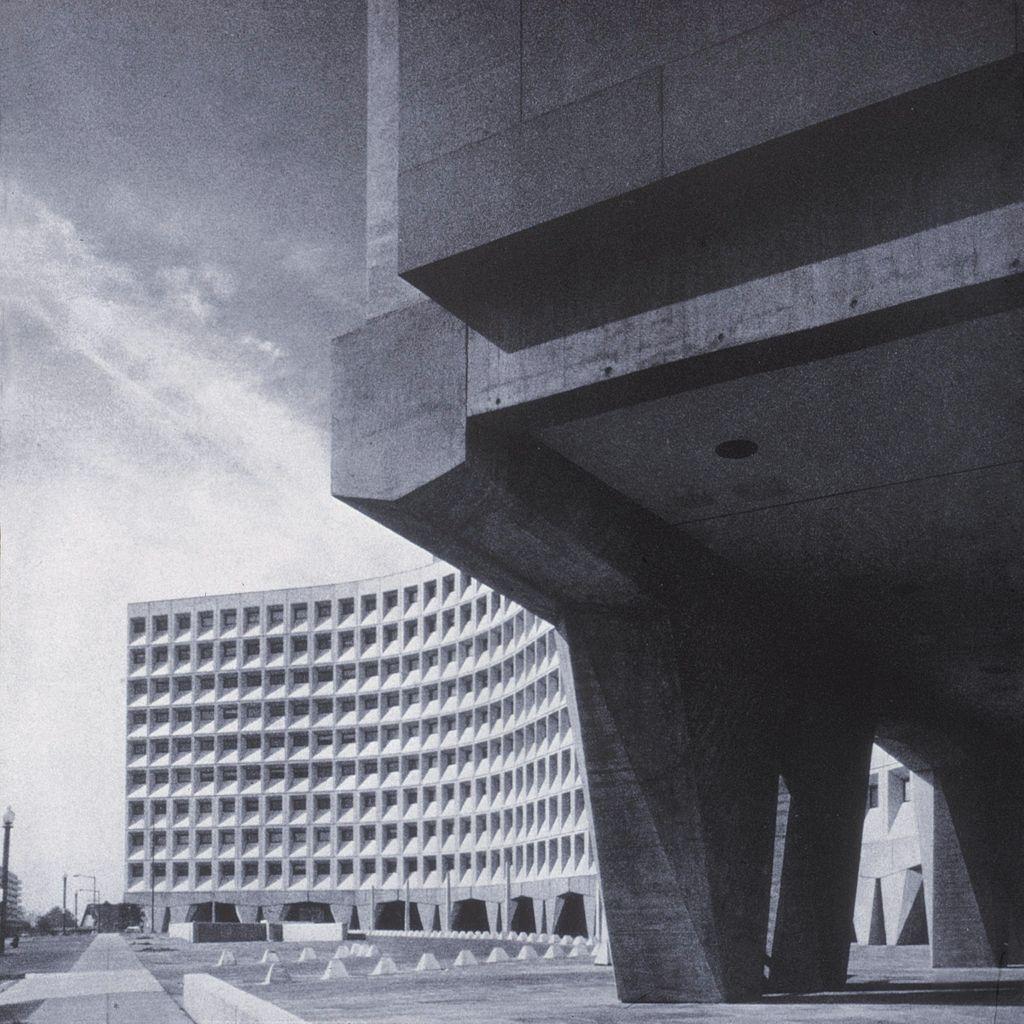
Department of Houysing and Urban Development Headquarters, Washington, D.C. Marcel Breuer, 1963-1968. ARTSTOR.https://www.jstor.org/stable/community.13924936

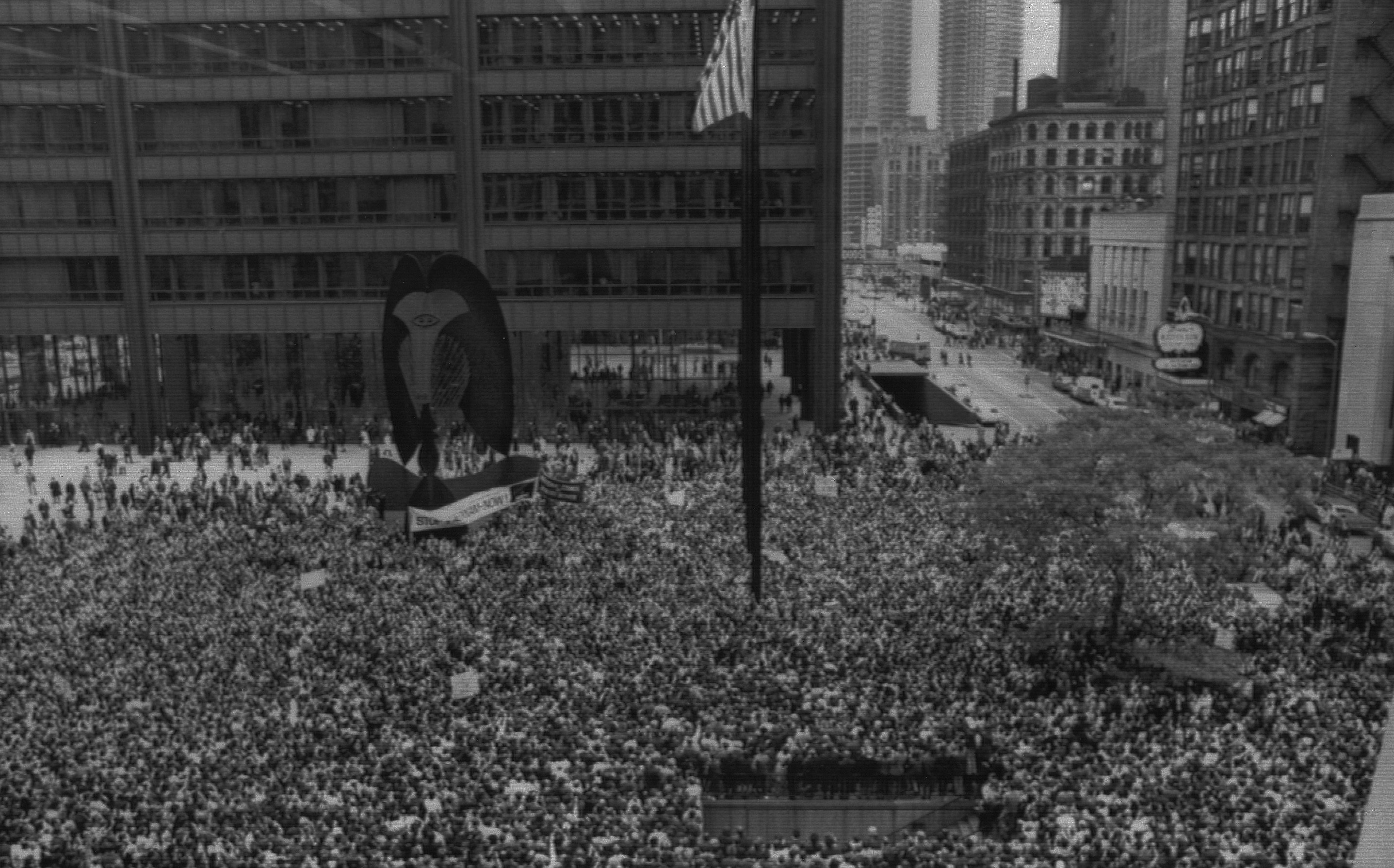
There are, however, examples of modern court buildings that pair frank statements of process and bureaucracy with genuine civic monumentality.  Just blocks apart, Chicago boasts two of them in Mies van der Rohe’s Federal Center (1961-74) and the Richard J. Daley Civic Center (1961-67).  Nothing could speak more to the repetitive, even numbing processes that dominate actual courthouse business than the Federal Center’s relentless staccato facades. Still, the composition of those around a finely scaled plaza that invites public activities ranging from farmers’ markets to vocal protests is a precise architectural framing of the courthouse’s dual nature.  There’s a great anecdote from its design involving early schemes that would have telegraphed the position of the double-height courtrooms within the building.  Greenough would undoubtedly have approved of this, but Mies insisted on carrying the same cladding pattern across the entire façade, leaving the monumental expression in the plaza itself.[8]  The Daley Center is more expressive; its 96’ spans, designed to accommodate column-free courtrooms, are exceptional examples of a structural function creating a monumental effect without recourse to traditional style or ornament.  Like at the Federal Center, the plaza in front became the city’s principal place of civic celebration, protest, and commemoration from its opening.
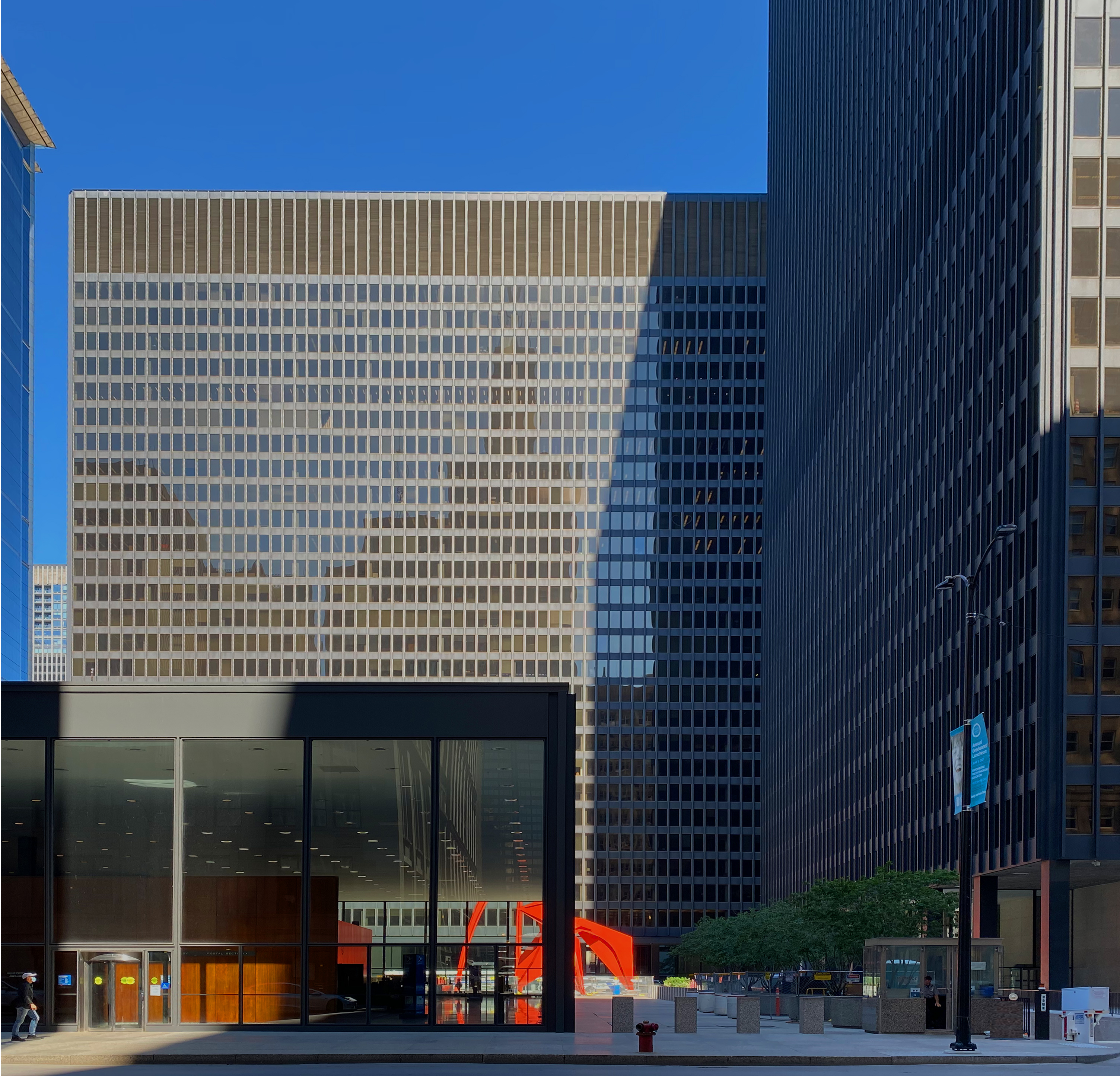
Federal Center, Chicago, IL. Mies van der Rohe et al., 1961-64.
Chicago Civic Center [Richard J. Daley Center] during Vietnam War protest, 1969. Associated Press.

One other thing to note. The Virginia State Capitol and the Supreme Court were constructed during periods of profound national anxiety; Jefferson designed amidst the early rumblings of American independence–1785-1788. One can understand being keen to build something “permanent and timeless.” Similarly, Gilbert and Taft both saw “bolshevism” and socialism as real threats to their vision of America; the fact that the marble temple was built in the depths of the most significant economic depression the country had seen adds context to their anxious aesthetic conservatism. In contrast, Richardson’s greatest civic works came in the 1880s, an era of rapid economic expansion and relative security; Washington’s modernist government buildings and the two Chicago examples were built in the 1950s and 1960s, maybe the most optimistic era the country has seen. The confidence of those decades is reflected by Greenough’s prescription for having the architectural conviction to ‘speak plainly’ about the functional and material ‘stuff’ that we have to work with. How we make an “American Architecture” has always been caught between these two poles.


[1] Post, Robert C. “Creating a New Supreme Court Building.” The Taft Court: Making Law for a Divided Nation, 1921–1930. Cambridge: Cambridge University Press, 2023. 550–594.

[2] See Blodgett, Geoffrey. “Cass Gilbert, Architect: Conservative at Bay.” The Journal of American History 72, no. 3 (1985): 615–36.

[3] ibid., 629.

[4] Post, op. cit.,

[5] Quoted in Keeffe, Arthur John. “The Marble Palace at 50.” American Bar Association Journal, vol. 68, no. 10, 1982. 1224–29.

[6] “Corner Stone Laid at Supreme Court.” The Washington Post (1923-1954), Oct 14, 1932. 3.

[7] David Riesman, quoted in Blodgett, op. cit., 634

[8] Famously, the trial of the Chicago Seven took place in the Dirksen Courthouse, where Judge Hoffman scolded attorney William Kunstler for casually leaning on the petitioner’s lectern: “You know, Mr. Mies van der Rohe designed that lectern for the use of counsel and I wish you would stay behind it, sir.”  The Beaux-Arts “courthouse” used for the 2020 film, The Trial of the Chicago Seven, was actually Newark, New Jersey’s City Hall.
“american architecture” (part 1)

Every four or eight years, the age-old question “in what style should we build” seems to enter political discourse; modernism (or in the current iteration, a straw-man “brutalism”) and classicism come to stand in for left vs. right in a way that seems to encapsulate arguments about individualism, tradition, beauty, and whatever else is the argument du jour.

To be clear: there is good classicism and good modernism. There is bad classicism and bad modernism. But looking under the hood at the moral argument–that, somehow, one of these two is genuinely bad for the national soul–leads to an interesting and, IMHO, vastly underrated moment in architectural theory.

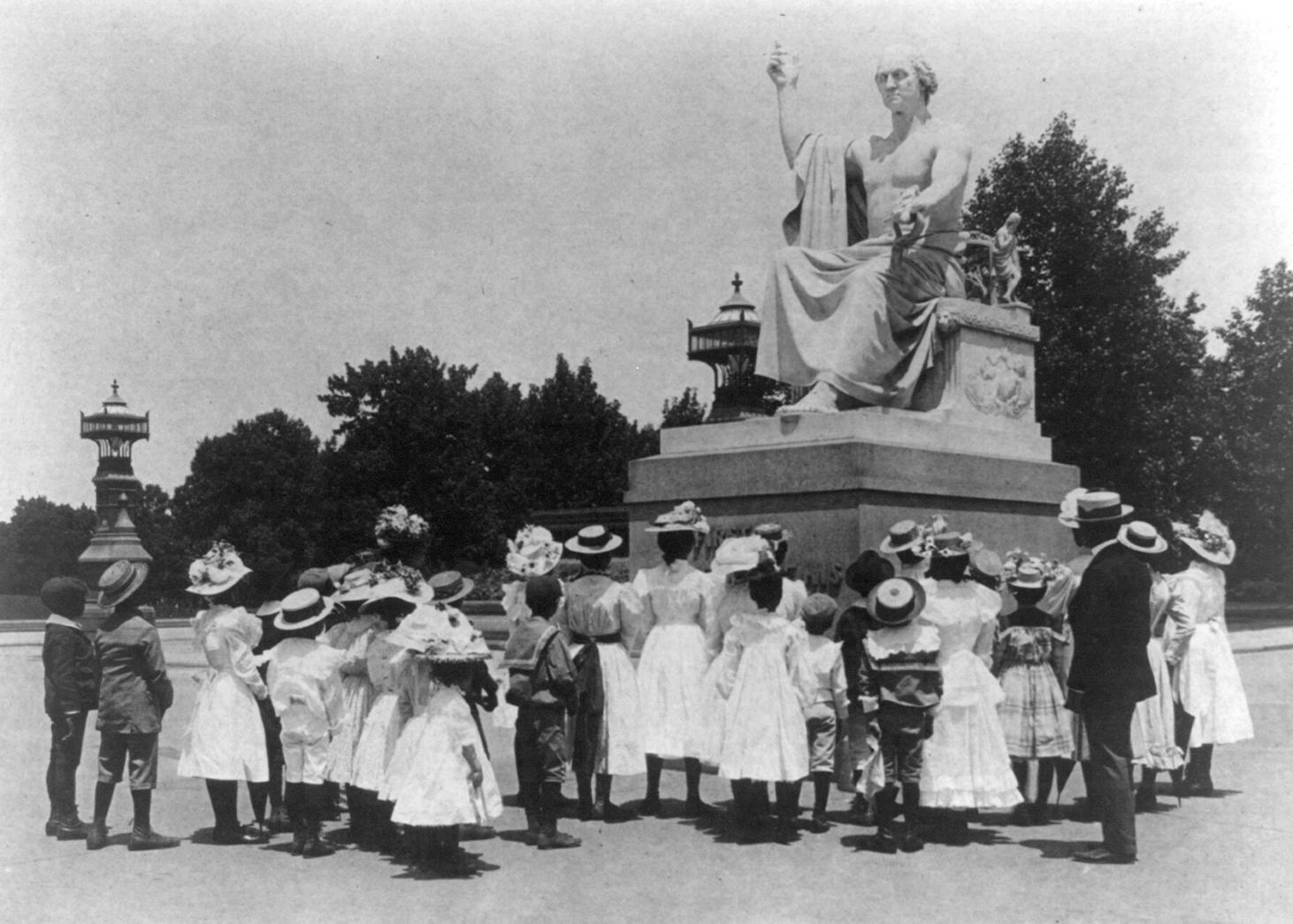
Horatio Greenough was one of America’s most skilled and prolific classical sculptors in the 1830s and 1840s. Trained at Harvard and through extended study trips in Rome and Florence, his style was that of a sculptural philologist, looking to translate ancient precedents into modern subjects. His sculptors of Revolutionary War-era heroes, including Washington and Lafayette, stood in or around the United States Capitol for generations.

Horatio Greenough, George Washington, 1843. Image ca. 1899, Frances Benjamin Johnson. Library of Congress.

But when it came to architecture, Greenough was anything but a traditionalist. In his 1843 essay, “American Architecture,” he critiqued the nation’s architectural development to that point as a betrayal of the independent, enlightenment-based roots of the still-young country:

“The mind of this country has never been seriously applied to the subject of building. Intently engaged in matters of more pressing importance, we have been con tent to receive our notions of architecture as we have received the fashion of our garments, and the form of our entertainments, from Europe.”

For sculpture, looking to Europe was fine–making the case that our political roots lay in Greek and (Republican) Roman principles could be illustrated by, say, a sculpture of Washington in sandals and a toga. But architecture, Greenough thought, was fundamentally different. The purity of Greek temples lay in their essentially sculptural quality–they were primarily monuments, designed primarily to evoke spiritual and emotional reactions, not so much to house any sort of complex function. Attempting to adapt their simple, if articulate, forms to increasingly complex functions was, for Greenough, a mistake that had roots in the Roman world’s adoption of Greek styles to mismatched uses:

“If we trace architecture from its perfection, in the days of Pericles, to its manifest decay in the reign of Constantine, we shall find that one of the surest symptoms of decline was the adoption of admired forms and models for purposes not contemplated in their invention. The forum became a temple, the tribunal became a temple, the theatre was turned into a church; nay, the column, that organized member, that subordinate part, set up for itself, usurped unity, and was a monument!”

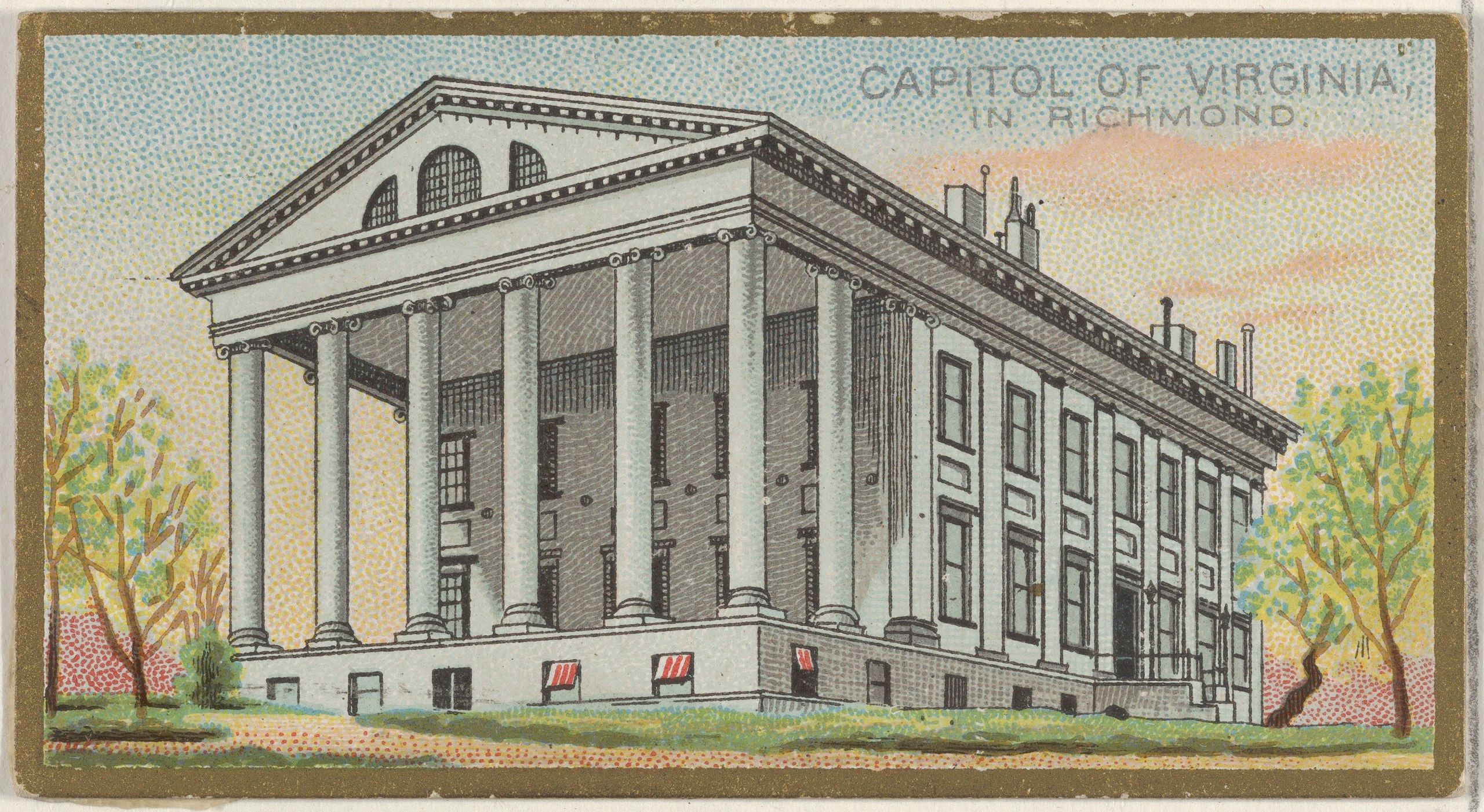
Virginia State Capitol, Richmond, VA. Thomas Jefferson and Charles-Louis Clérisseau, 1785-88. General Government and State Capitol Buildings series (N14) for Allen & Ginter Cigarettes Brands. Metropolitan Museum of Art/Wikimedia.

Greenough had in mind buildings like Jefferson’s Virginia State Capitol, based on the Roman temple at Nimes, France, which was, of course, already based on Greek precedents. The problem? Greek temples did not have the formal agility to reflect the more complicated functions of, say, a State Capitol (or, for that matter, a town bank). In trying to adopt forms to function, he wrote,


“…we have shorn them [Greek precedents] of their lateral colonnades, let them down from their dignified platform, pierced their walls for light, and, instead of the storied relief and the eloquent statue which enriched the frieze, and graced the pediment, we have made our chimney tops to peer over the broken profile, and tell by their rising smoke of the traffic and desecration of the interior.”

Greenough then extrapolated a broader program for American architecture from this complaint. Uniquely freed from what he saw as cultural constraints, he thought Greek temples and Gothic cathedrals would always be “strangers.” Worse, the speed with which America had to build and the lack of time and labor available to invest in the ornament and sculpture that articulated those monuments would always mean that our imitations would “depart from its original beauty and propriety as widely as the crippled gelding of a hackney coach differs from the bounding and neighing wild horse of the desert.”

First Congregational Church Old Saybrook, built 1840. MMDA Photos.

Instead, Greenough proposed, American architects should look to more universal examples:

Let us consult nature, and in the assurance that she will disclose a mine, richer than was ever dreamed of by the Greeks, in art as well as in philosophy…. If, as the first step in our search after the great principles of construction, we but observe the skeletons and skins of animals, through all the varieties of beast and bird, of fish and insect, are we not as forcibly struck by their variety as by their beauty? There is no arbitrary law of proportion, no unbending model of form….

Greenough also suggested another analogy, that of the machine–particularly the most advanced machines being built at the time, symbols of American engineering and technology:

Observe a ship at sea! Mark the majestic form of her hull as she rushes through the water, observe the graceful bend of her body, the gentle transition from round to flat, the grasp of her. keel, the leap of her bows, the symmetry and rich tracery of her spars and rigging, and those grand wind muscles, her sails! Behold an organization second only to that of an animal, obedient as the horse, swift as the stag, and bearing the burden of a thousand camels from pole to pole!  What Academy of Design, what research of connoisseurship, what imitation of the Greeks produced this marvel of construction?

These two models–nature and the machine–were also touted by the great French theorist Viollet-le-Duc as ideal sources for the new principles necessary to develop authentic architecture in the face of industrial construction and materials.

Greenough anticipated so much in this essay–there are echoes of Darwin in his description of natural adaptation–sixteen years before Origin of Species–and he uses the phrase “organic” to describe not a metaphorical inspiration from nature (buildings that ‘look like’ plants or animals) but an analogical one: “formed to meet the wants of their occupants.” Most remarked upon has been Greenough’s anticipation of Louis Sullivan’s “form follows function.” There’s no doubt that Sullivan knew of Greenough’s writings, but the 1896 “Tall Building Artistically Considered” was primarily a visual argument–“proud and soaring things.” Greenough goes slightly further, agreeing with Viollet-le-Duc that all aspects of the design, from massing and arrangement to proportion and detail, should rigorously adhere to functional precepts. Sullivan, remember, was Beaux-Arts trained, and buildings like the Wainwright in St. Louis retain some of his preference for symmetry, rhythm, and classical proportion. Greenough thought more radical aesthetic potential lay in throwing out all of these compositional niceties and finding, instead, architectural meaning and beauty within the principles underlying building:

“…let us begin from. the heart as a nucleus and work outward.; The most convenient size and arrangement of the rooms that are to constitute the building being fixed, the access of the light that may, of the air that must, be wanted; being provided for, we have the skeleton of our building. Nay, we have all excepting the dress. The connexion and order of parts, juxtaposed for convenience, cannot fail to speak of their relation and uses. As a group of idlers on the quay, if they grasp a rope to haul a vessel to the pier, are: united in harmonious action by the cord they seize, as the slowly yielding mass: forms a thorough bass to their livelier movement, so the unflinching adaptation of a building to its position and use gives, as a sure product of that adaptation, character, and expression.”

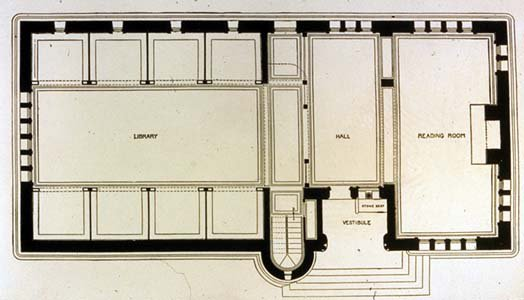
What would that look like? The closest example I can find that’s remotely contemporary is the work of H.H. Richardson, whose “romanesque” style certainly recalls ancient precedent, but in spirit more than detail. The semi-circular arches and peaked roofs that characterize his designs don’t have the academic adherence to Roman forms that, say, Jefferson’s did; instead, Richardson developed compositions out of functional arrangements, and ornamental styles out of the techniques used to shape the sandstone and granite that were native to the New England region in which he practiced. The Crane Library in Quincy, MA., is a great example of this; the functional division of the building–entry, stacks, reading room, staircase–is clearly the basis of the building’s asymmetrical, very not-Roman composition:

H.H. Richardson, Thomas Crane LIbrary, Quincy, MA. 1882. Photo by emw

Greenough concluded by arguing that a truly American architecture, a democratic one, would spring from this sort of plain-spokenness, a confidence that such honesty in massing, proportion, and detail would appeal to the particularly American common sense and that we, as a nation, would come to find beauty in functionality:

If this anatomic connexion and proportion has been attained in ships, in machines, and, in spite of false principles, in such buildings, as make a departure from it fatal, as in bridges and in scaffolding, why should we fear its immediate use in all construction? As its first result, the bank would have the physiognomy of a bank, the church would be recognized as such, nor would the billiard room and the chapel wear the same uniform of columns and pediment.

There was also a moral dimension to this argument. Dressing buildings up in styles and ornament that weren’t native or that were borrowed from another culture had the whiff of dishonesty to it, betraying (or, perhaps, instilling) a lack of character:

The monuments of Egypt and of Greece are sublime as expressions of their power and their feeling. The modern nation that appropriates them displays only wealth in so doing. The possession of means, not accompanied by the sense of propriety or feeling for the true, can do no more for a nation than it can do for an individual. The want of an illustrious ancestry may be compensated, fully compensated; but the purloining of the coat of arms of a defunct family, is intolerable.

That sense of unearned wealth hews nicely to the Protestant work ethic permeating much of early America–adopting the fancy ‘clothing’ of ancient models is an inheritance, not an achievement. Greenough closed with an appeal to another fundamentally American tenet, the right to express his opinion, and in so doing, he hinted that the Greek Revival architecture he was arguing against was unlikely to survive a rigorous, generational inquiry into what a truly “American Architecture” should be.

(Continued here.)

spring 2025 studio–consumers and century

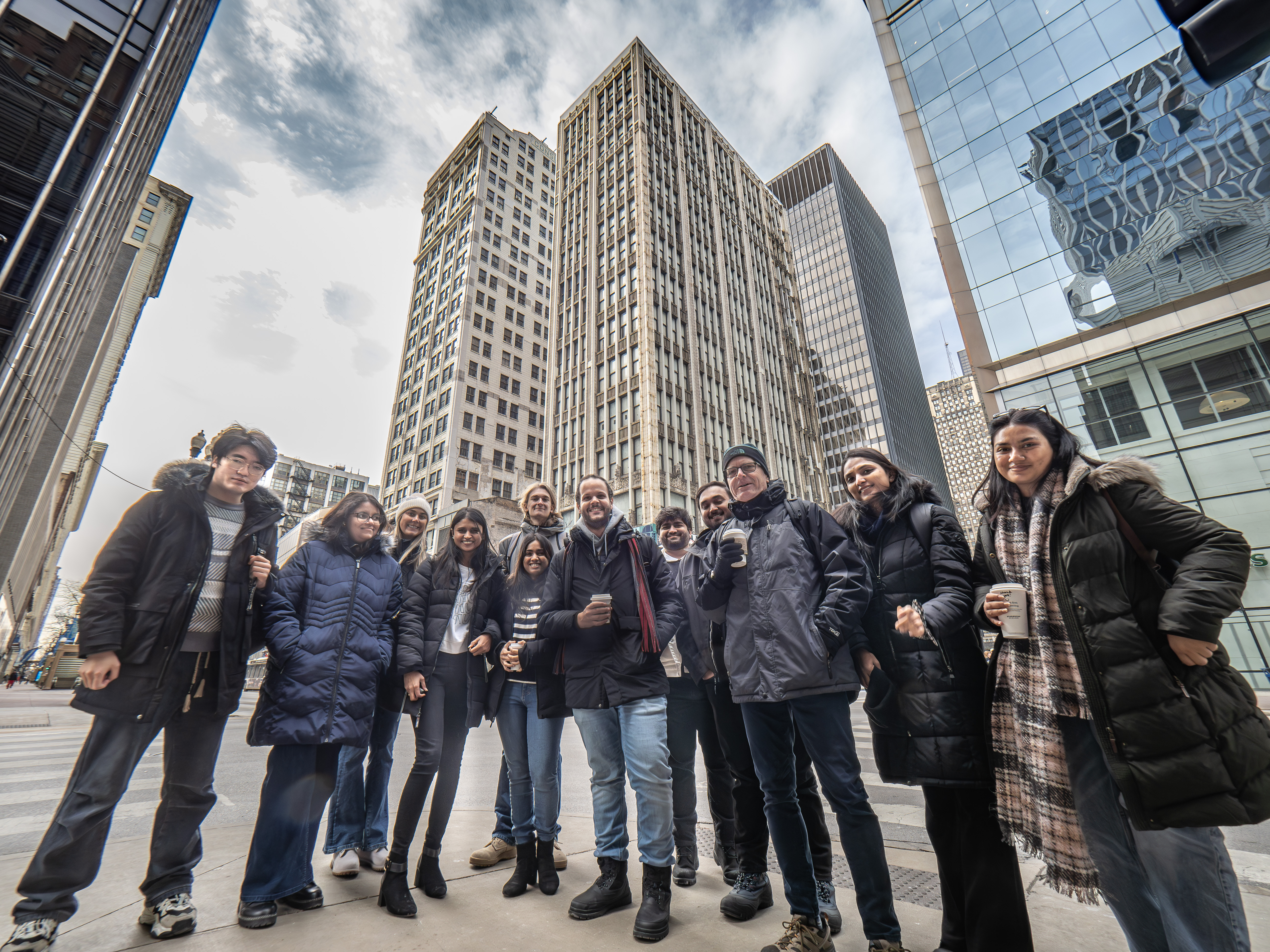
Photo: Ken DeMuth

So, define “high-rise studio…”

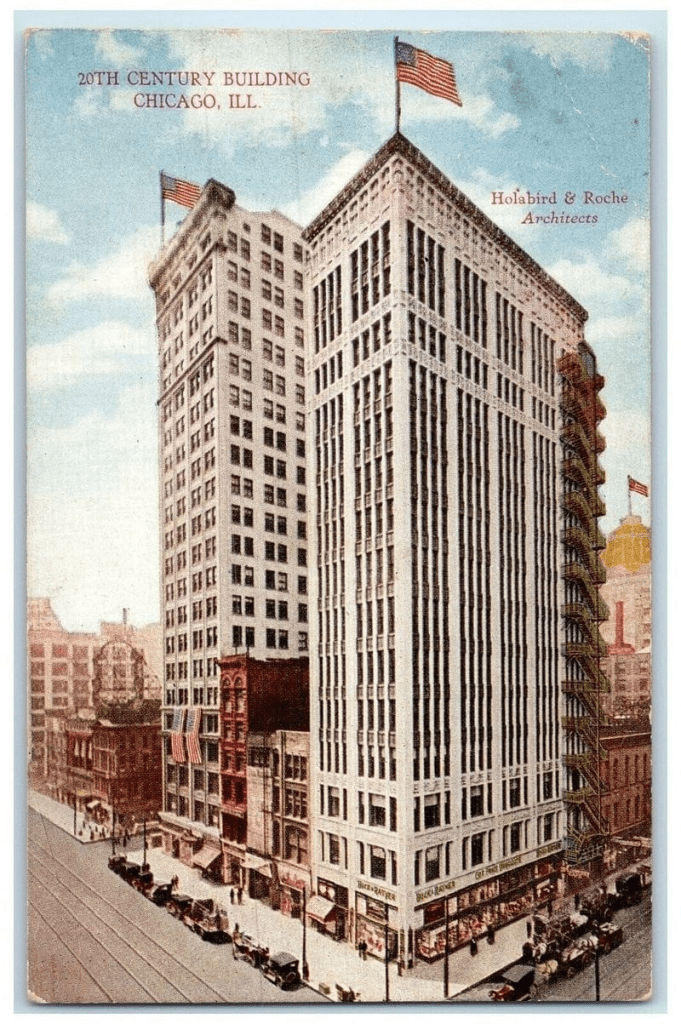
Preservation folks will recognize the buildings in the back there as the cause du jour. The Century Building (front, Holabird and Roche, 1915) and its taller sibling, the Consumers (behind, Mundie & Jensen, 1913), were typical of the commercial buildings constructed along State Street as it enjoyed renewed status as the city’s main retail thoroughfare. The two aren’t particularly distinguished, but they’re almost perfect representatives of the type, with tall retail storefronts, convenience offices on the second and third floors, and repetitive lease space from there to the attics. The Century is almost unique in its neo-Gothic styling for its time–relentlessly vertical, as opposed to the more stolid Consumers, which is strictly Burnham-esque mercantile classicism.

Preservation Chicago

Unfortunately for the two buildings, they’re immediately adjacent to the Dirksen Federal Building and Courthouse. The GSA purchased them in other early 2000s and vacated them, seeing their proximity as a security risk. The two have sat, empty, ever since, with all the deterioration from a lack of occupancy that you’d expect. Preservation Chicago named the two to their 2023 “Most Endangered” list despite plenty of interest in converting their relatively small lease spans and floor plates into apartments.

The federal government made no secret of its plan to demolish the two, which would actually open up a more significant security issue. The City of Chicago, in response last year, landmarked the two back in April, 2024, essentially forcing the GSA’s hand. They responded with a Request for Proposals that comes with a handful of onerous restrictions, including a ban on residential programs, which they see as potentially providing bad actors with open views of the courthouse offices and loading operations on Quincy Street.

OK, fair enough, but what if…you could convince the GSA to design its way around those issues? That’s the premise of our spring studio–provide hotel and short-term apartment accommodation in the two buildings while taking the security concerns seriously. Last week, we met on site with Ken DeMuth of Pappageorge Haymes, one of the city’s leading designers in converting this era of skyscrapers into residential uses, as well as Mark Kuberski of Central Building and Preservation and Rachel Will of Wiss, Janney, Elstner–two of Chicago’s most knowledgeable preservation engineers, especially when it comes to the terra cotta cladding that (barely) covers the two towers.

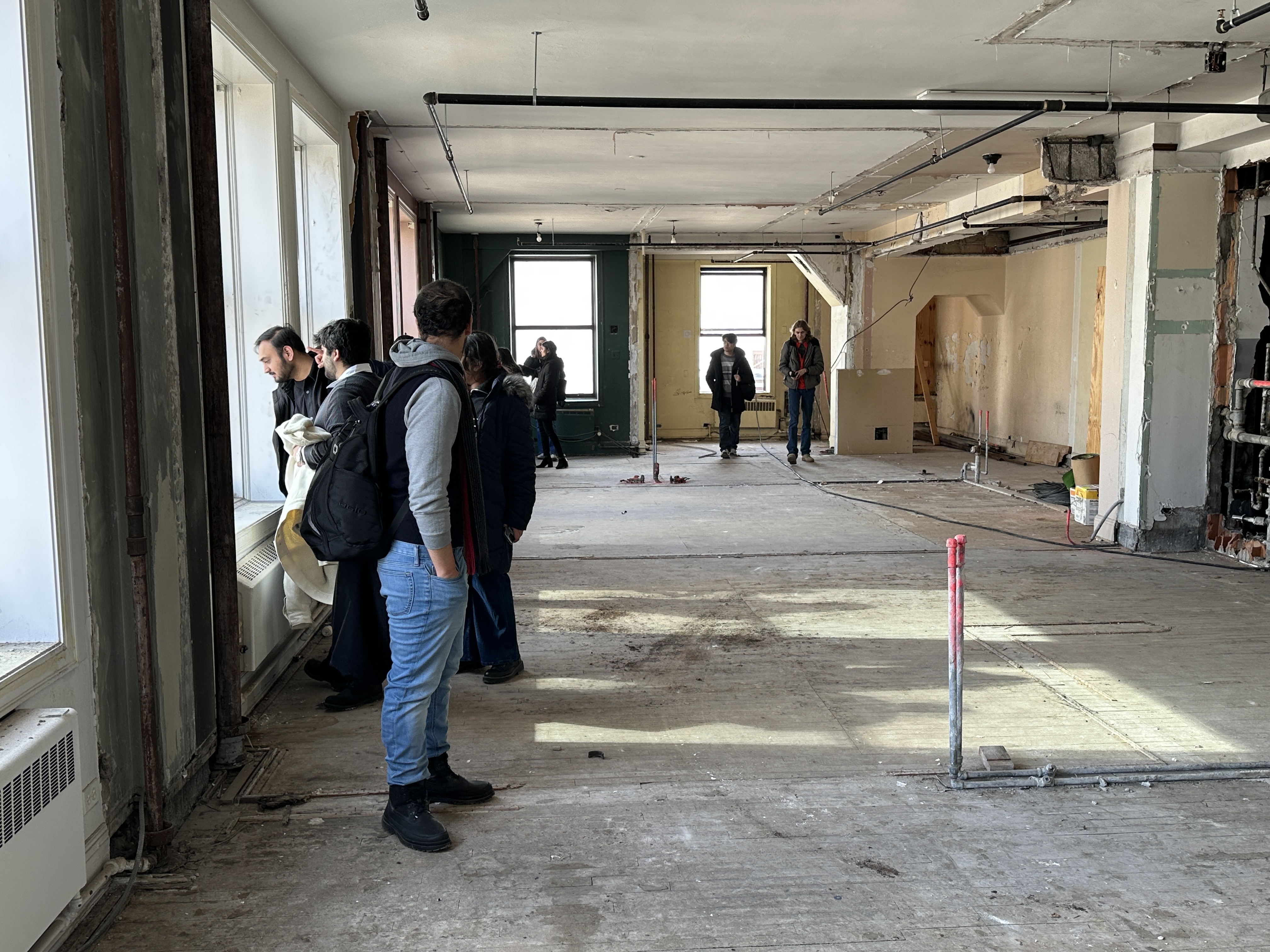
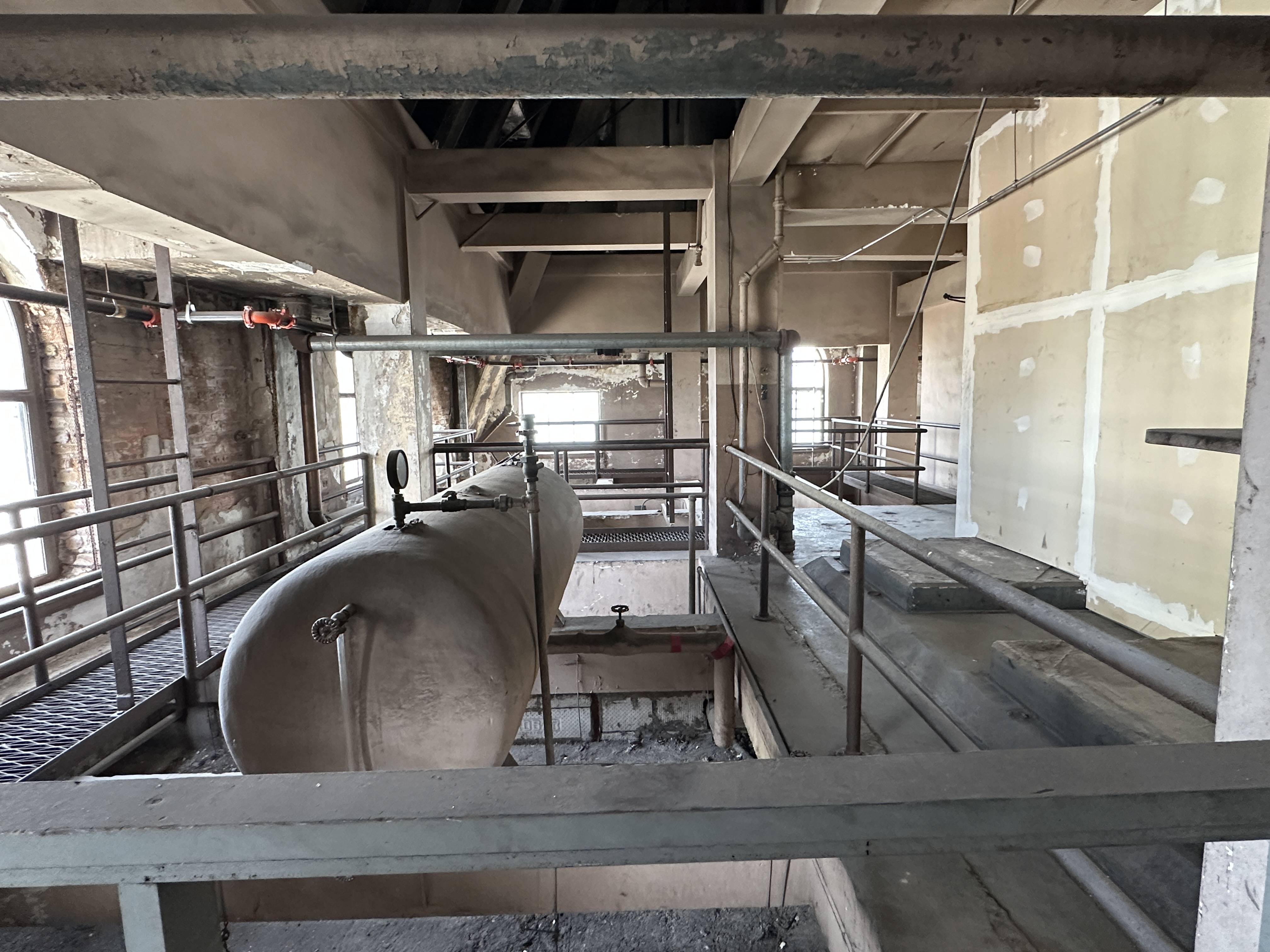
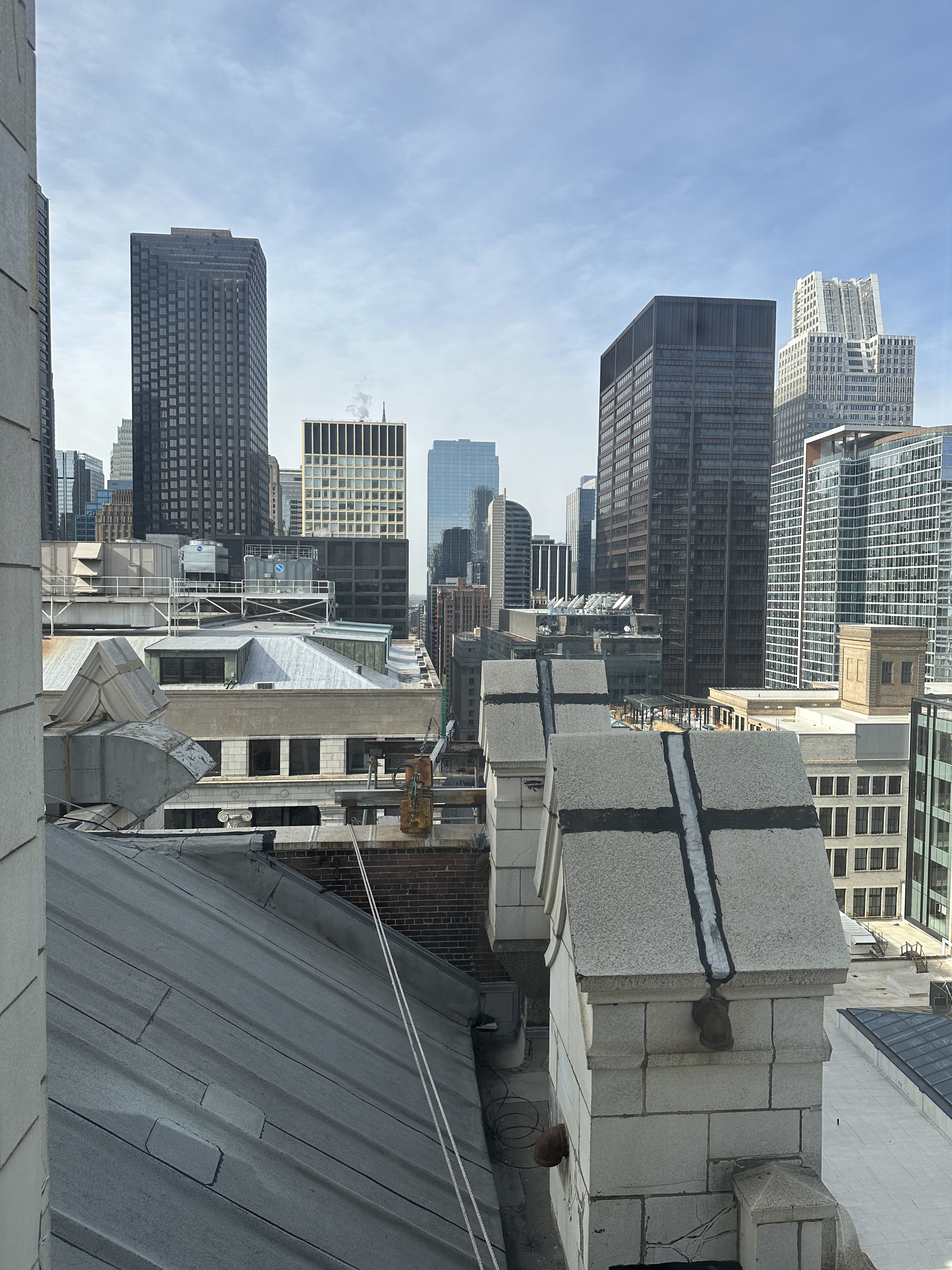
Not surprisingly, the GSA was not enthusiastic about students touring the buildings, but Ken got us into the Pittsfield Building, where residential conversion plans have been ongoing, so we got to see first hand what a vacated office building of (about) the same era presents in terms of spaces and details–including a bucket-list level visit to the mechanical penthouse in the peak of the tower, which would provide any rooftop apartment with a ready-made conversation pit:

We’ll see what this group comes up with, but we’re hoping to show that there’s room for cleverness in addressing the real security issues here, and to be part of the conversation about how important saving even these, ‘vernacular commercial’ structures will be to maintaining the Loop’s sense of history.

Watch this space…