(Update: The New York Times weighs in on some of this here today).
Greenough’s argument against “the adoption of admired forms and models for purposes not contemplated in their invention,” particularly the use of classical architecture for modern programs, found a resonant application nearly a century after his death when the Maison Carree was once again the model for a monumental government structure.
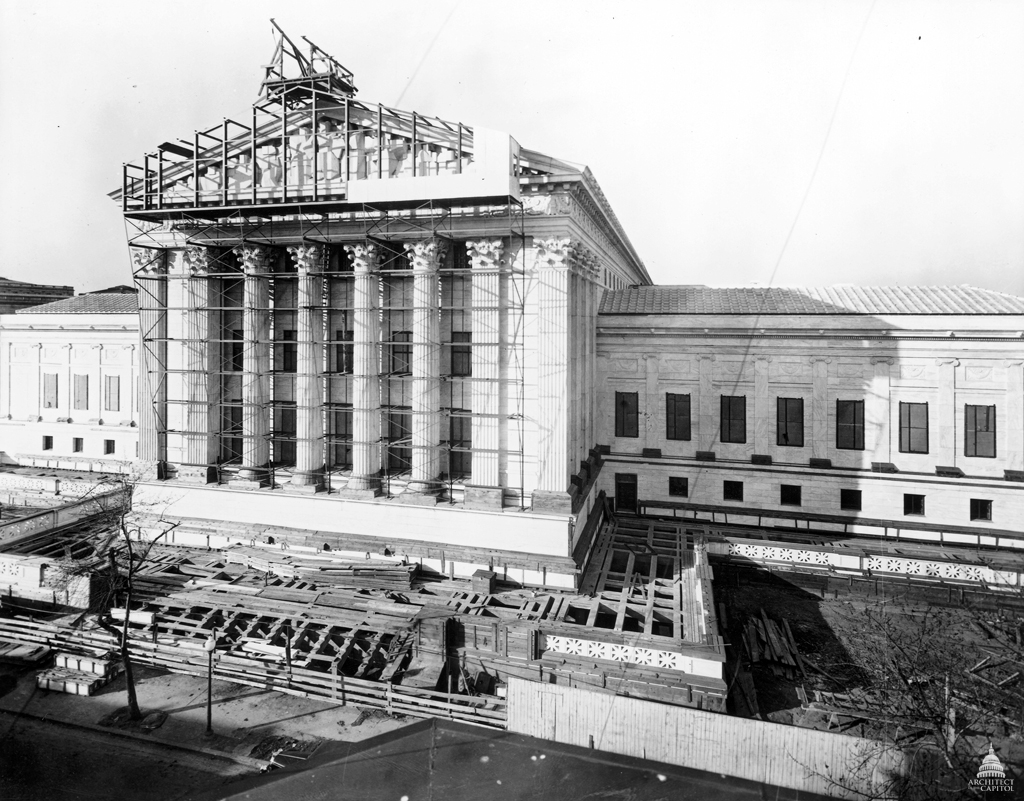
The Supreme Court building was a pet project of Chief Justice and former President William Howard Taft. Long housed within the Old Senate Chamber in the U.S. Capitol, the Court, Taft believed, needed its own monumental presence signifying its coequal nature as one of three branches of government. There was general agreement that it deserved a presence in Washington to balance that of the legislative Capitol and executive White House. Still, Taft injected a personal agenda into the design. He believed that the Court needed surroundings emphasizing the “purity, eternity, and the majesty of law” rather than the casual surroundings of its temporary homes, which encouraged casual deliberation.[1]
Taft engineered the appointment of Cass Gilbert to the project in 1926. Gilbert had distinguished himself as a first-rate classicist, adopting the dome of St. Peter’s Basilica to the Minnesota State House in 1896-1905 and the Trevi Fountain to the facade of the U.S. Custom House on Lower Broadway in New York in 1901-1907. He also designed the world’s tallest building at the time, the Woolworth in New York (1910-1913). Gilbert ran in elite circles and came to espouse nationalist, even exceptionalist, politics.[2] He had supported Taft in his doomed bid for a second term as U.S. President, campaigning against his opponents-Democrat Woodrow Wilson and Republican Theodore Roosevelt–as “radical socialist-pacifists.” During WWI, however, he became an isolationist, eventually opposing U.S. involvement, and his conservatism intensified. As Blodgett recounts, he courted Mussolini, paying il Duce a fawning visit during the 1920s and deepening his belief that Roman architecture, in particular, carried with it a moral force very much in line with his hardening politics. Speaking to the American Academy of Arts and Letters in 1930, he railed against modern architecture and called for a wholesale return to classical models:
“There are paths that lead back to barbarism and it is among the functions of this Academy to . . . guide public taste toward the paths that lead to the higher realms of Arts and Letters and warn them against perversion.”[3]
Taft concurred, pushing for Gilbert’s appointment even as the Depression took hold. He recognized that the expense would be enormous but insisted on the marble and stonework that would produce an authentic (if steel-framed) classical building. For his part, Gilbert created a recognizable homage to Jefferson’s State Capitol and, thus, to the Maison Carree. Gilbert echoed Greenough in recognizing that the building would have to be both monumental and functional:
“[I]t must, so far as possible, have all the beauty, charm and dignity of the Lincoln Memorial, and all the practical qualities of a first-rate office building – a combination rather difficult to achieve, but nevertheless possible.”
But the design he produced for Taft in 1929 showed that he fell on the side of monumental expression rather than Greenough’s proto-modern call for a more functional articulation:
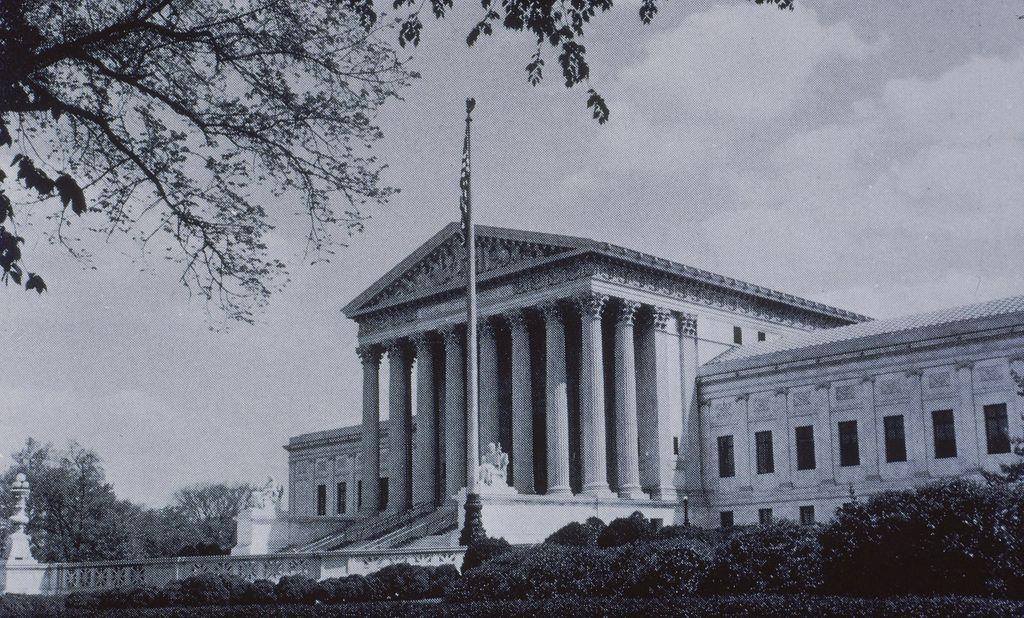
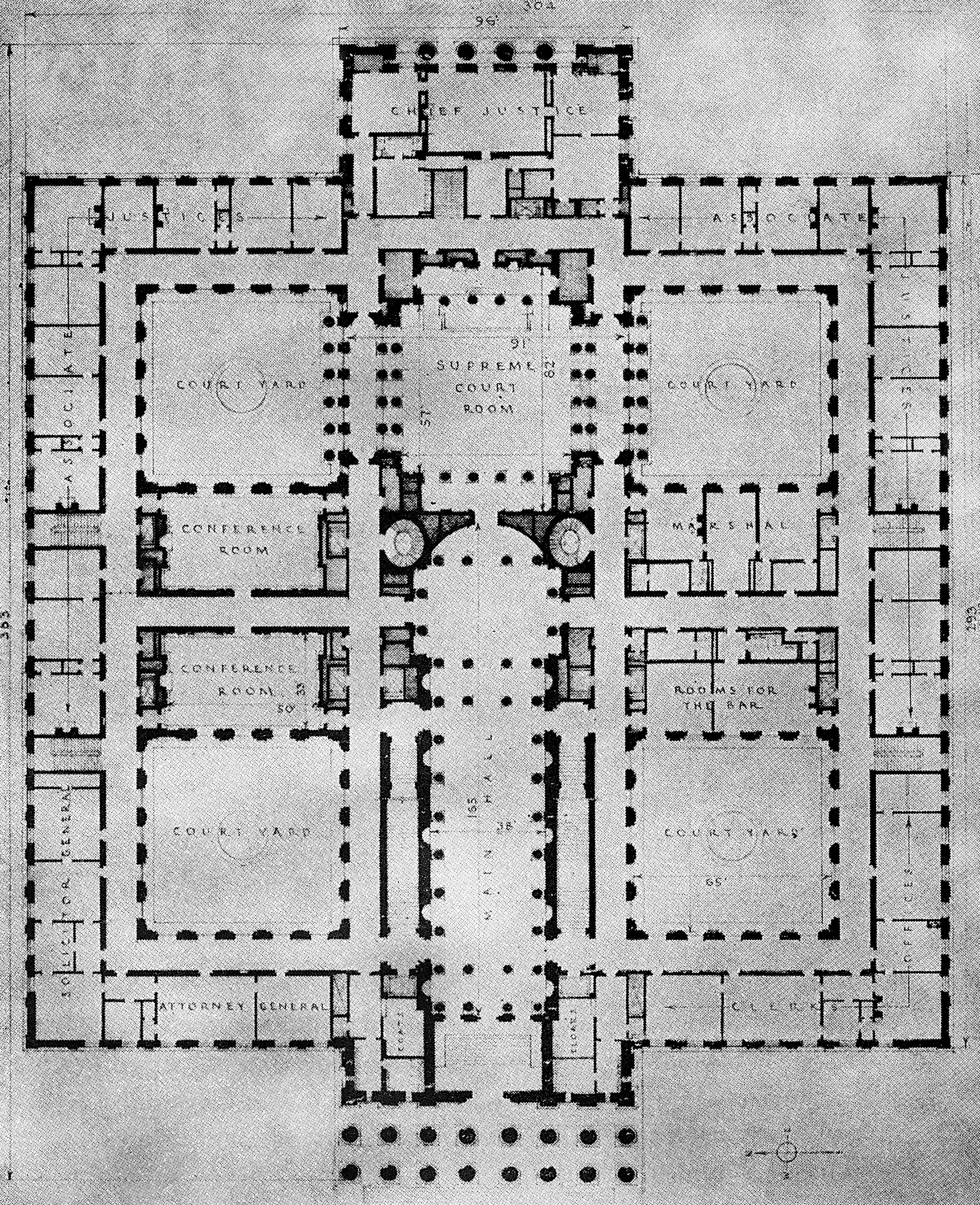
Both Taft and Gilbert died before the building was completed, but the end product brilliantly illustrated one pole of Greenough’s formula: a sublime, overpowering image of authority that cloaked its complex functions behind a symbol of ancient power and authority. As Robert Post noted, the religious overtones of the temple front were matched by the ritualistic nature of the inner sanctum:
“The Old Senate Chamber had exuded a distinctly different flavor. It was infused with an “easy informality.” Justices “often strolled through the public halls, and the procession from the robing room to the courtroom proper was a twice-daily spectacle which tourists always tried to see.” In the Court’s new home, by contrast, Gilbert deliberately screened off from public view the justices’ quarters, entries, and exits. The justices became visible to “the public gaze” only when they magically appeared from behind red curtains to take their seats on the bench, fully robed. In the new courthouse, law became spectacle, detached from ordinary human interaction. Gilbert’s building symbolized an ideal of judicial office that stressed formality, abstraction, and authority. In such a setting, the pronouncements of a judge are no longer a communal project. They are instead disinterested words from above or beyond.”[4]
Speeches at the building’s cornerstone ceremony made this explicit. Guy A. Thompson, then president of the American Bar Association, called it “a monument to justice…justice that is the final attribute of God himself…. This will be her temple. Here her shrine will be. Here she shall abide.”[5]
Not all of the Court’s residents approved. More liberal justices found it pretentious and oppressive. At the cornerstone ceremony, Chief Justice Charles Evans Hughes said that the Court’s old, casual chambers would be “left with keen regret” and that it would “be a long time, indeed before this beautiful building can boast of the spiritual endowment which has blessed the old home.”[6] Louis Brandeis was more forceful; according to one of his clerks, he “detested” that it represented “everything ‘Roman’ about Washington.”[7] Brandeis preferred the “Greek” vision of the polis and missed the informal scale of the Court’s former home; for him, the Court building should have emphasized the empowerment, rather than the submission, of the populace. The choice of a building from Imperial Rome, rather than Republican—constructed, in part, as a statement of the empire’s conquering power over the native inhabitants of southern France—was for Brandeis a clear statement of power over reason or, in Greenough’s phrase, an “appropriation…displaying only wealth” instead of a “sure product of adaptation, character, and expression,” the formulation that Greenough argued would be uniquely American.
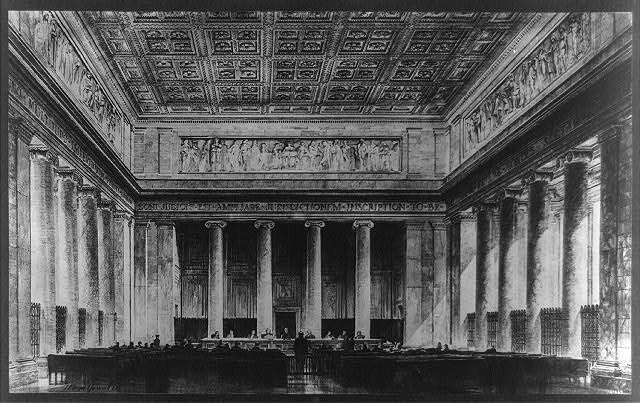
As if to make the point, Gilbert specified Vermont and Georgia marble for the Court’s exterior, albeit as a veneer applied to a steel frame. However, when it came to columns in the Court’s chambers, he felt American stone would not suffice and insisted on Italian marble from quarries in Siena. This, alone, seems an odd choice for an ardent nationalist. The lengths Gilbert went to obtain that marble are even more striking; in 1933, Gilbert again traveled to Rome and met personally with Mussolini to procure the stone he desired.
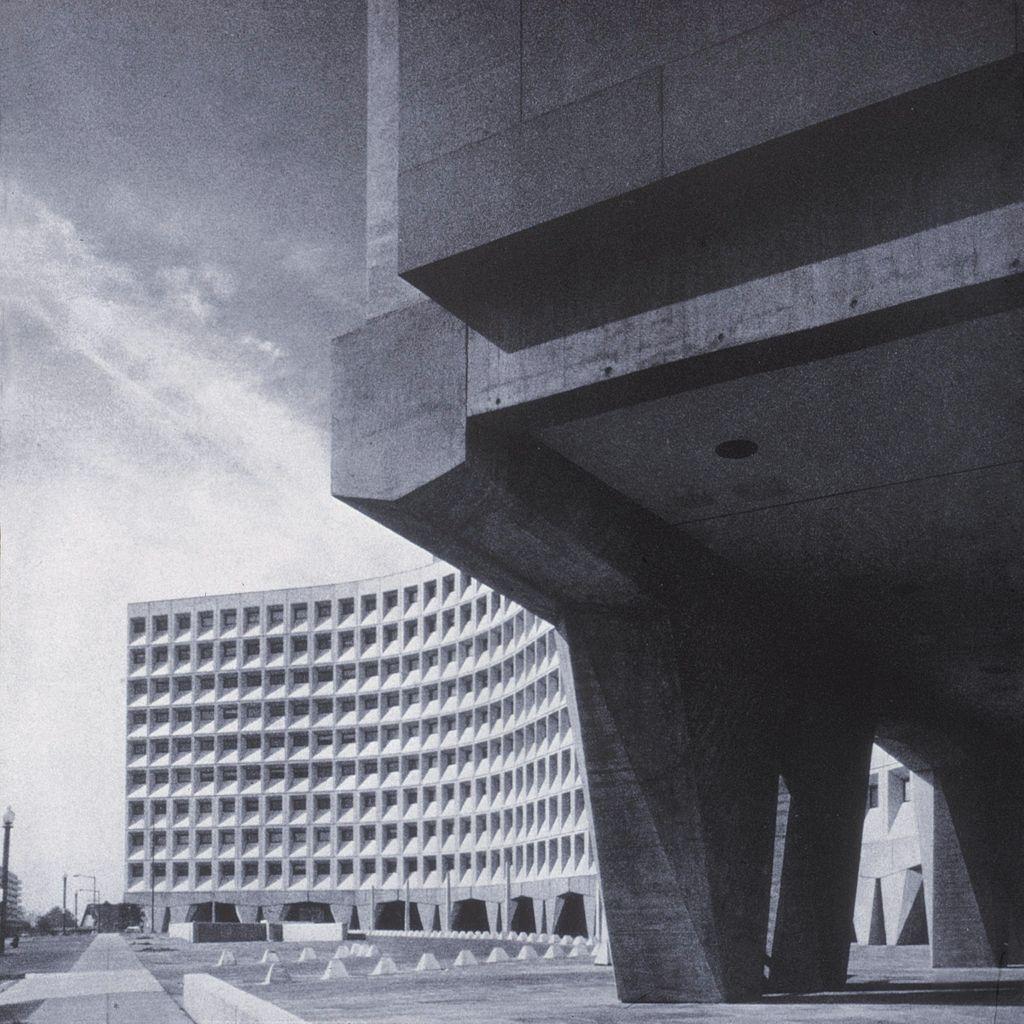
Much of federal architecture since Gilbert’s imperial court building has aimed at functional expression, with mixed results. Marcel Breuer’s HUD Building (1968) is arguably a “sure product” of its program–a functional home for a bureaucracy. Neither as iconic nor monumental as the Supreme Court, it–and other functionally expressive structures–have gained appreciation in recent years by admirers of “brutalism” and other modernist approaches. Greenough would have far preferred the robust honesty of Breuer’s facade to Gilbert’s pomposity. And H.H. Richardson’s aggressively detailed stone facades, willingness to work with asymmetry when called for by a program, and commitment to ornamental development of constructive and functional necessities might–possibly–mark him out as a proto-brutalist in the most American sense.
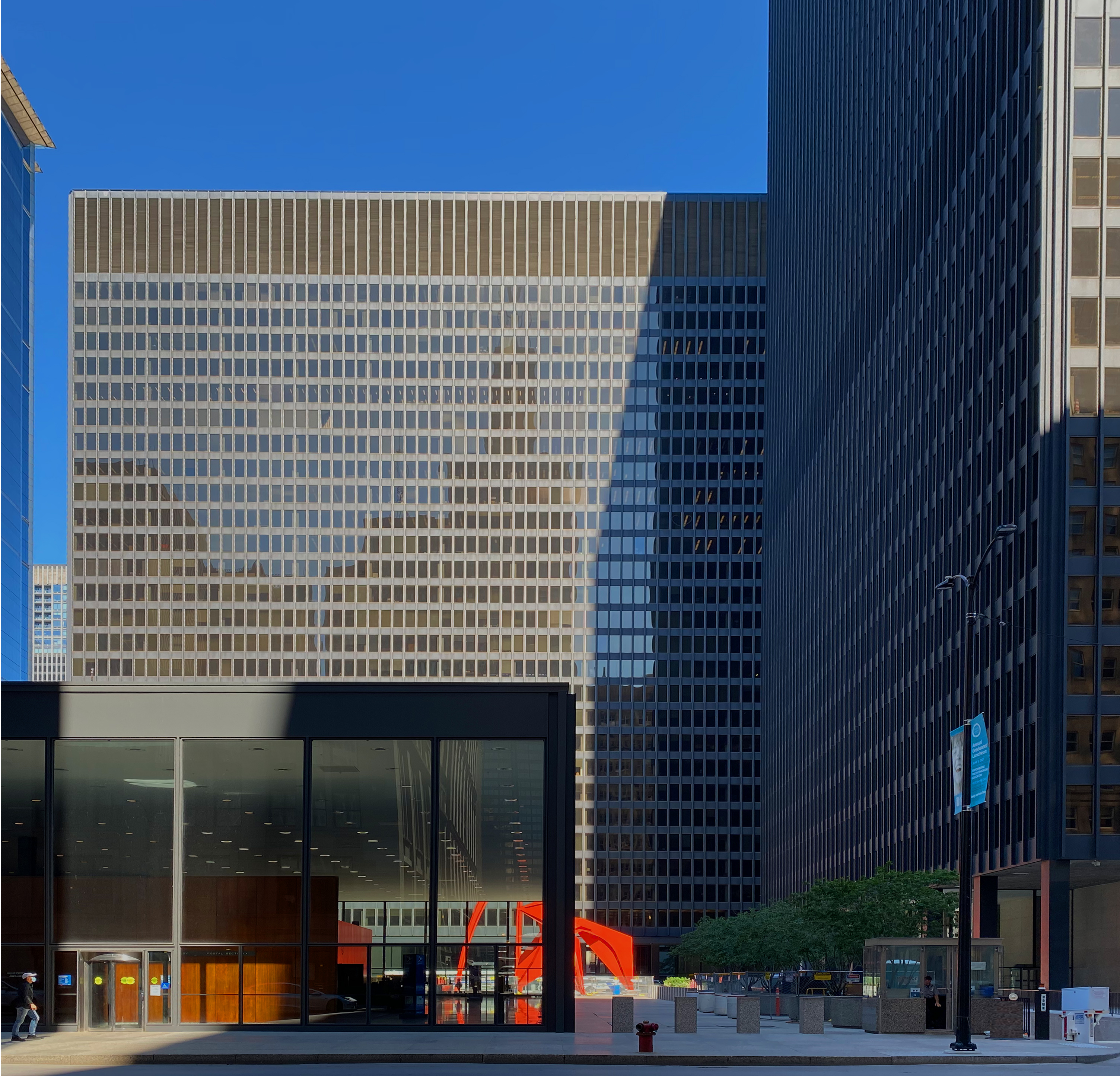
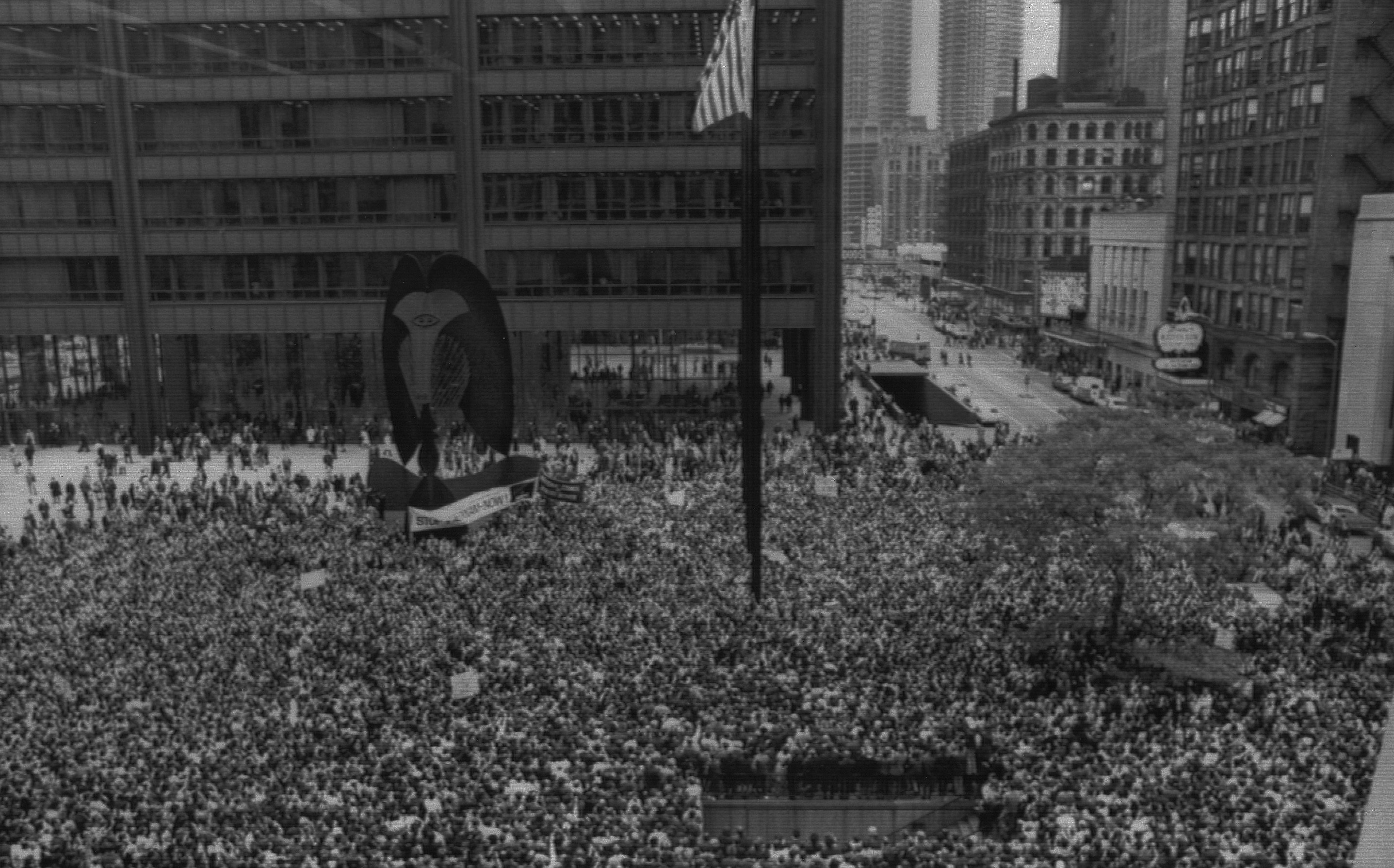
There are, however, examples of modern court buildings that pair frank statements of process and bureaucracy with genuine civic monumentality. Just blocks apart, Chicago boasts two of them in Mies van der Rohe’s Federal Center (1961-74) and the Richard J. Daley Civic Center (1961-67). Nothing could speak more to the repetitive, even numbing processes that dominate actual courthouse business than the Federal Center’s relentless staccato facades. Still, the composition of those around a finely scaled plaza that invites public activities ranging from farmers’ markets to vocal protests is a precise architectural framing of the courthouse’s dual nature. There’s a great anecdote from its design involving early schemes that would have telegraphed the position of the double-height courtrooms within the building. Greenough would undoubtedly have approved of this, but Mies insisted on carrying the same cladding pattern across the entire façade, leaving the monumental expression in the plaza itself.[8] The Daley Center is more expressive; its 96’ spans, designed to accommodate column-free courtrooms, are exceptional examples of a structural function creating a monumental effect without recourse to traditional style or ornament. Like at the Federal Center, the plaza in front became the city’s principal place of civic celebration, protest, and commemoration from its opening.
One other thing to note. The Virginia State Capitol and the Supreme Court were constructed during periods of profound national anxiety; Jefferson designed amidst the early rumblings of American independence–1785-1788. One can understand being keen to build something “permanent and timeless.” Similarly, Gilbert and Taft both saw “bolshevism” and socialism as real threats to their vision of America; the fact that the marble temple was built in the depths of the most significant economic depression the country had seen adds context to their anxious aesthetic conservatism. In contrast, Richardson’s greatest civic works came in the 1880s, an era of rapid economic expansion and relative security; Washington’s modernist government buildings and the two Chicago examples were built in the 1950s and 1960s, maybe the most optimistic era the country has seen. The confidence of those decades is reflected by Greenough’s prescription for having the architectural conviction to ‘speak plainly’ about the functional and material ‘stuff’ that we have to work with. How we make an “American Architecture” has always been caught between these two poles.
[1] Post, Robert C. “Creating a New Supreme Court Building.” The Taft Court: Making Law for a Divided Nation, 1921–1930. Cambridge: Cambridge University Press, 2023. 550–594.
[2] See Blodgett, Geoffrey. “Cass Gilbert, Architect: Conservative at Bay.” The Journal of American History 72, no. 3 (1985): 615–36.
[3] ibid., 629.
[4] Post, op. cit.,
[5] Quoted in Keeffe, Arthur John. “The Marble Palace at 50.” American Bar Association Journal, vol. 68, no. 10, 1982. 1224–29.
[6] “Corner Stone Laid at Supreme Court.” The Washington Post (1923-1954), Oct 14, 1932. 3.
[7] David Riesman, quoted in Blodgett, op. cit., 634
[8] Famously, the trial of the Chicago Seven took place in the Dirksen Courthouse, where Judge Hoffman scolded attorney William Kunstler for casually leaning on the petitioner’s lectern: “You know, Mr. Mies van der Rohe designed that lectern for the use of counsel and I wish you would stay behind it, sir.” The Beaux-Arts “courthouse” used for the 2020 film, The Trial of the Chicago Seven, was actually Newark, New Jersey’s City Hall.
 architecturefarm
If Federal guidelines specified that all new American government buildings should be designed to “emulate and replicate European temples built for pagan worship” would the public embrace that tradition?
LikeLiked by 1 person
One would hope not!
LikeLike
Tom, Loved reading this post! As a DC resident (and careful observer of the CFA and other bureaucratic, political, and design entities in the district), this context and storytelling is really great–even as the mood and outlook in DC is pretty dire and dim. Thanks for your clear, precise, and descriptive writing about architecture.
Hope you’re well! Michael
LikeLiked by 1 person
Good to hear from you, Michael—DC is where all of this means the most. Hang in there!
LikeLike
As always, thanks Tom for another insightful look into architecture and our historical past. Timely of course that this installment should end on the Fed Center.
I was reminded of the classical style that Solon Beman provided at the Columbian Exposition’s Mining Building that became the stylistic template for the Church of Christ, Scientist. Was God in the details? In contrast, H&R’s City Hall & County Building got its distinctive base not just from classical precedent but from programming realities requiring a bigger footprint at the lower stories.
Kenneth De Muth
AIA Partner
Pappageorge Haymes Partners
640 North Lasalle Suite 400 Chicago Illinois 60654 312 316 5216 cell 312 650 7316 office kdemuth@pappageorgehaymes.com http://www.pappageorgehaymes.com
Chicago | Austin
>
LikeLike
Good pair of examples there. Gilbert, of course, saw nothing wrong with plopping St. Peter’s dome on top of the Minnesota State Capitol…the separation of church and state there being a mortar joint, at best! I’ll have to dig into Beman’s church…
LikeLiked by 1 person