As part of our research for the Skyscraper Museum’s Modern Concrete Skyscraper exhibition, Carol Willis and I worked to understand how and why Chicago became the acknowledged center of high-strength and high-rise concrete design for much of the last half of the 20th century. What follows has relied on perspectives and input from conversations and virtual lectures held with, among others, Bill Baker, Paul James, Kim Clawson, Ken DeMuth, Geoffrey Goldberg, Matthys Levy, Joseph Colaco, and, especially, the late Charlie Thornton. Many of those conversations are available in video form on the Skyscraper Museum’s website.
Supertalls and Industry Changes
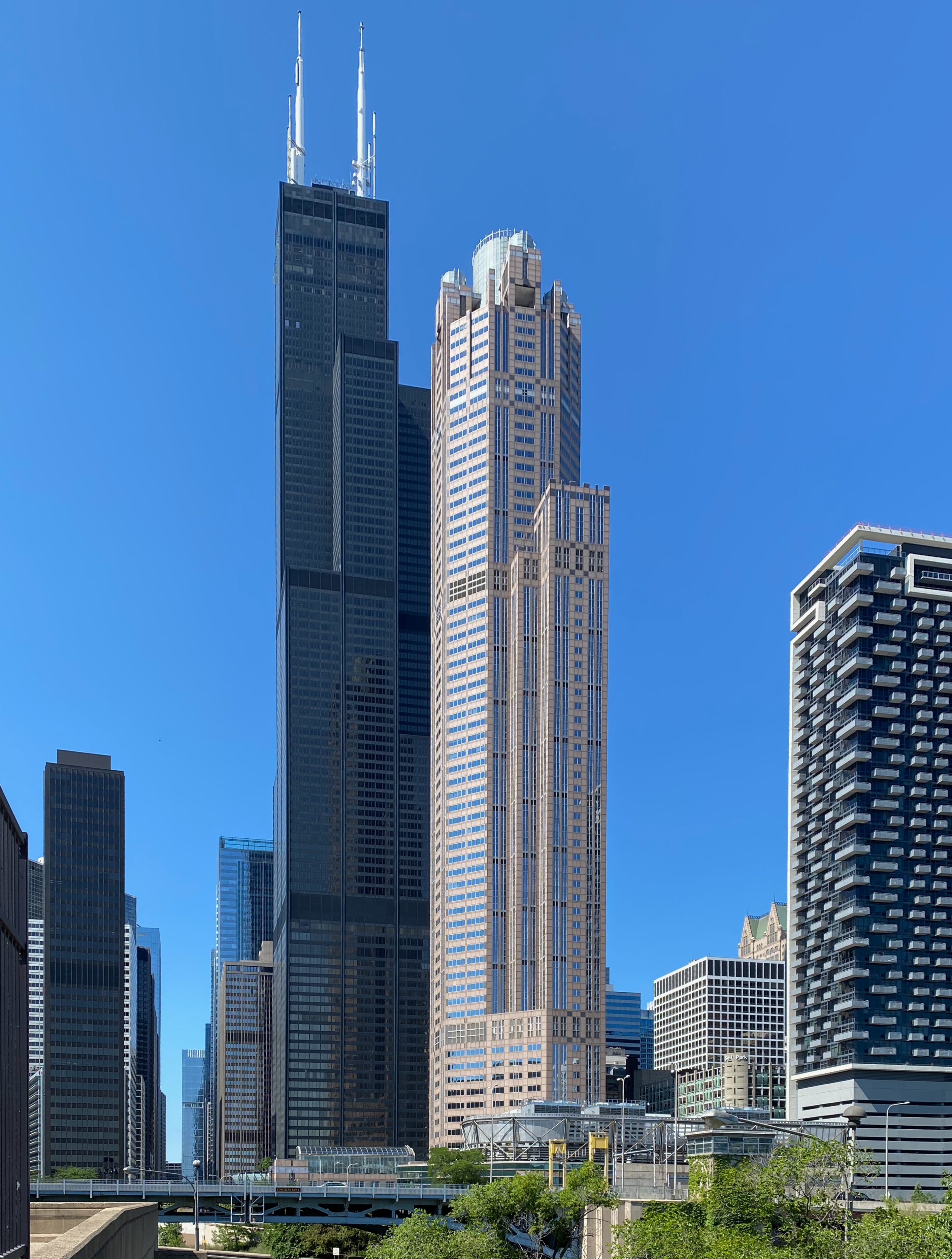
At 961′, 311 S. Wacker reclaimed the title of “world’s tallest reinforced concrete building” for Chicago in 1990, after a short reign by Toronto’s Scotia Tower (Webb, Zefara, Menkes, Housden, 1988, 902′). 311 S. Wacker was, however, designed by New York architects KPF and a Dallas engineering firm; the contractor was Charlotte-based. Its structural system, a frame-shear-wall interactive design, “was developed in the 1960s,” according to one-time PCA engineer Mark Fintel.[ii] High-strength knowledge had diffused well beyond Chicago by the 1980s and plateaued. Changes to the industry saw the Portland Cement Association and Materials Service evolve; PCA spun off its research arm into Construction Technology Laboratories, Inc., and General Dynamics, the conglomerate that had owned Materials Service since the Crown family engineered a financial merger, taking the larger company over in 1959, gradually distanced itself from the construction market, finally selling Materials Service to Hanson, a large aggregate supplier, in 2006, Hanson was acquired, in turn, by the international materials supply corporation Heidelberg the following year.[iii] While the McCook quarry remained active under the Heidelberg name, the Thornton pit was taken over as a surface reservoir for Chicago’s Deep Tunnel stormwater project.
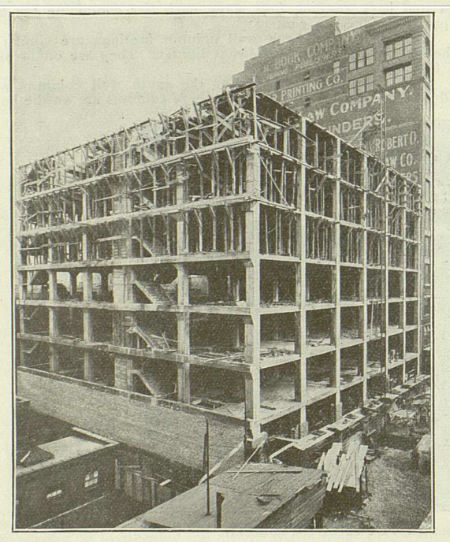
Structural design for high rises evolved, as well. Concrete and steel construction economics have always balanced time, cost, and labor. As the speed of curing, strengthening, and formwork placement increased through the 1980s, many traditional hurdles to building tall concrete disappeared. Steel’s globalization also made it a more volatile commodity. Hybrid forms that optimized construction schedules, materials costs, and labor emerged in Chicago and elsewhere, particularly so-called “composite” construction that paired the shear resistance and fire protection of concrete cores with the rapidity and light weight of steel framing. Composite structures were not new—Emperger columns and combinations of steel and concrete framing meant that engineers and builders had experience with hybrid performance and forming as early as the 1926 American Furniture Mart in Chicago.
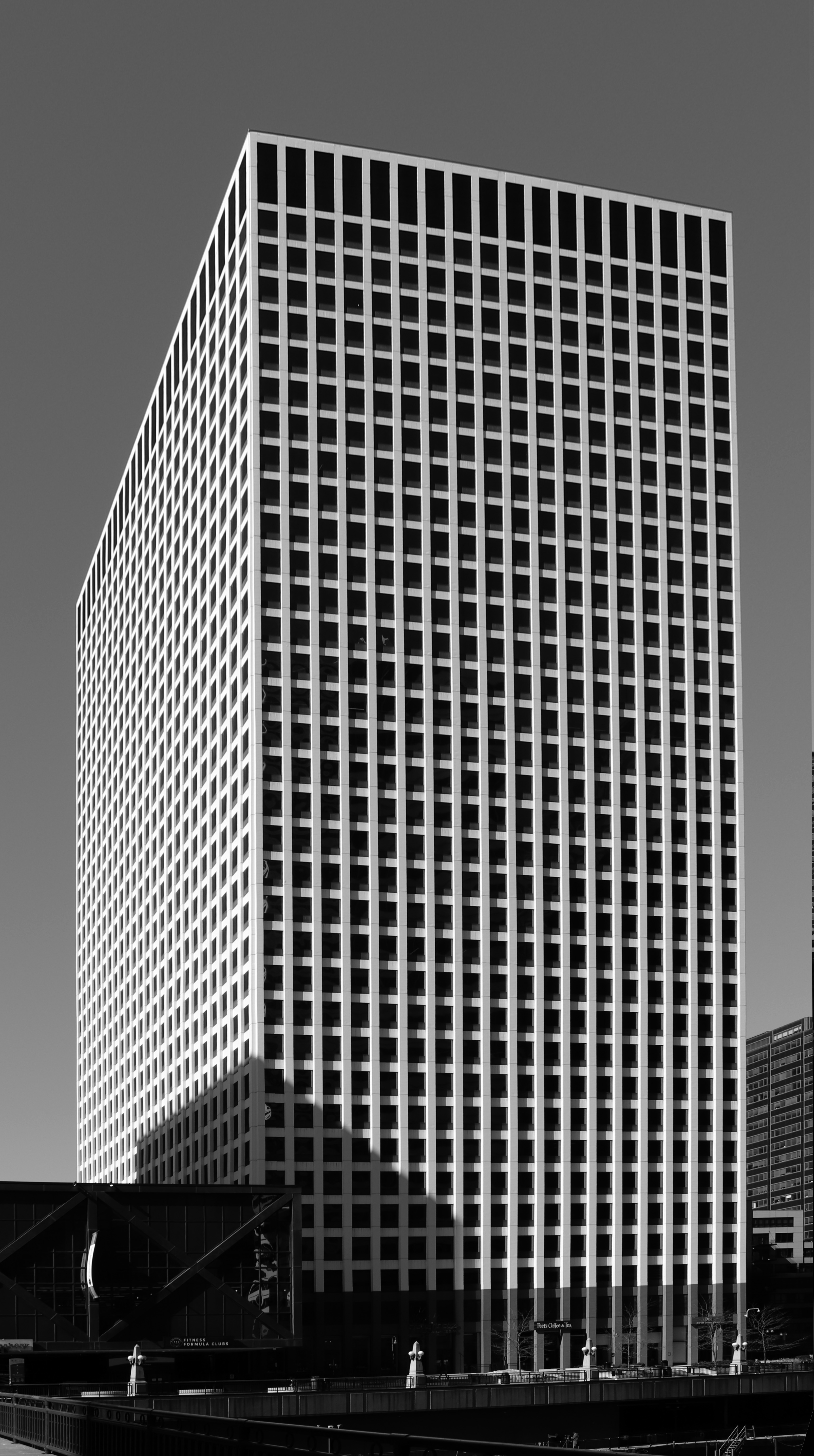
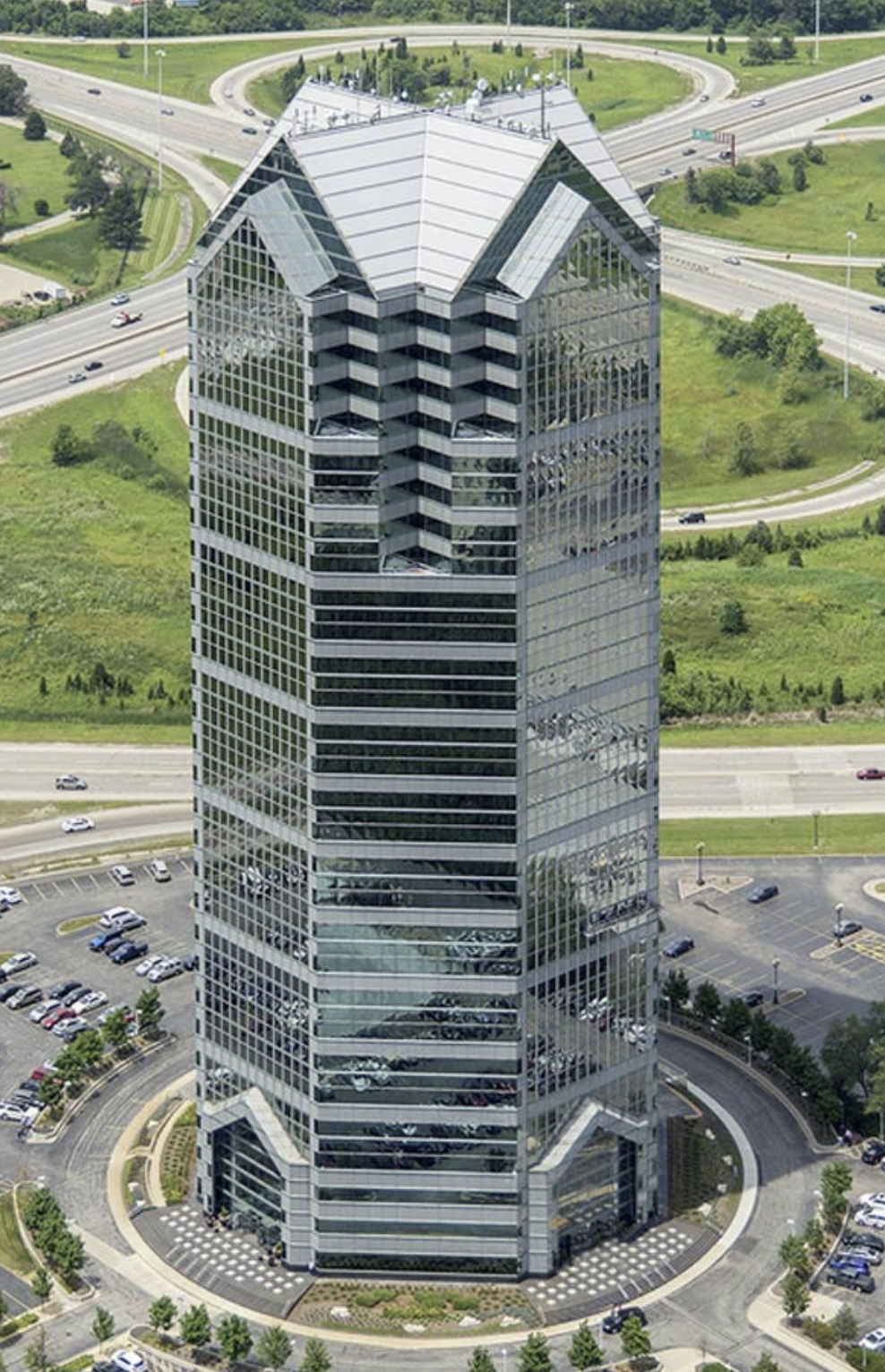
Later, hybrids included SOM’s Gateway Center III, adjacent to Chicago’s Union Station, which paired a rigid concrete tube exterior with a lightweight internal core. This was partly a response to the irregular layout of railroad tracks underneath, but its construction demonstrated that pouring and erecting schedules could be coordinated and that the structural results were promising. Interest in optimizing construction speed, material, labor expenses, and building weight led engineers to new hybrids that took advantage of concrete’s improving speed and performance. Developer Miglin-Beitler’s Oakbrook Tower (1987), a 34-story office building designed by Helmut Jahn in the western suburbs, was one of the first that was consciously designed with a rigid concrete core and a lighter steel frame; the core was started first, providing stability, and the steel ‘caught up’ around it. Tacit agreements with steelworkers in New York, where union arrangements stipulated that no work could be done above the topmost steel crew, made this construction impossible there, but it quickly proved itself in Chicago.[iv]
As strengths continued to rise, pumping grew more efficient, and curing times were reduced through new admixtures. Concrete became more competitive for commercial towers in Chicago. Miglin-Beitler’s 1988 “Skyneedle” proposal was one of several unrealized projects for the city that sought to take fuller advantage of concrete’s newly achievable strength and speed. The site at the corner of Madison and Wells was just 40,000 square feet—too small to allow a conventionally-framed tower. But with stronger concrete and advanced calculation techniques, engineers Thornton Tomasetti developed a stiff, solid concrete core with bracing perimeter fin columns to brace and support a 2000-foot tower “by taking advantage of the mass and stiffness of the high-strength concrete that is available in the Chicago area and combining it with the advantages of a structural steel floor system with its inherent strength, speed of construction and flexibility to allow tenant changes.”[v] The exterior fins were connected to the core by haunched concrete link beams and three pairs of intersecting, two-story deep cross walls at regular vertical intervals. Further stiffening the slender structure was done with steel Vierendeel trusses that filled in between the fin columns on the building perimeter, making the structure a complex collection of techniques—stiff core, perimeter shear walls, and outrigger columns. The interactions of these various elements in three dimensions were calculable only with the help of new computer technology; engineer Charlie Thornton noted that the software running on the firm’s VAX-11/750 mainframe was “like an SST” compared with earlier generation’s “Model T” programs. This, he explained, allowed them to calculate the structure’s behavior in multiple dimensions instead of “uncoupling” north-south and east-west systems to allow manual, linear calculations.[vi]
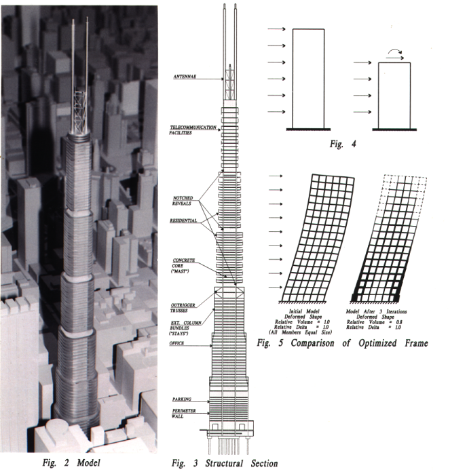
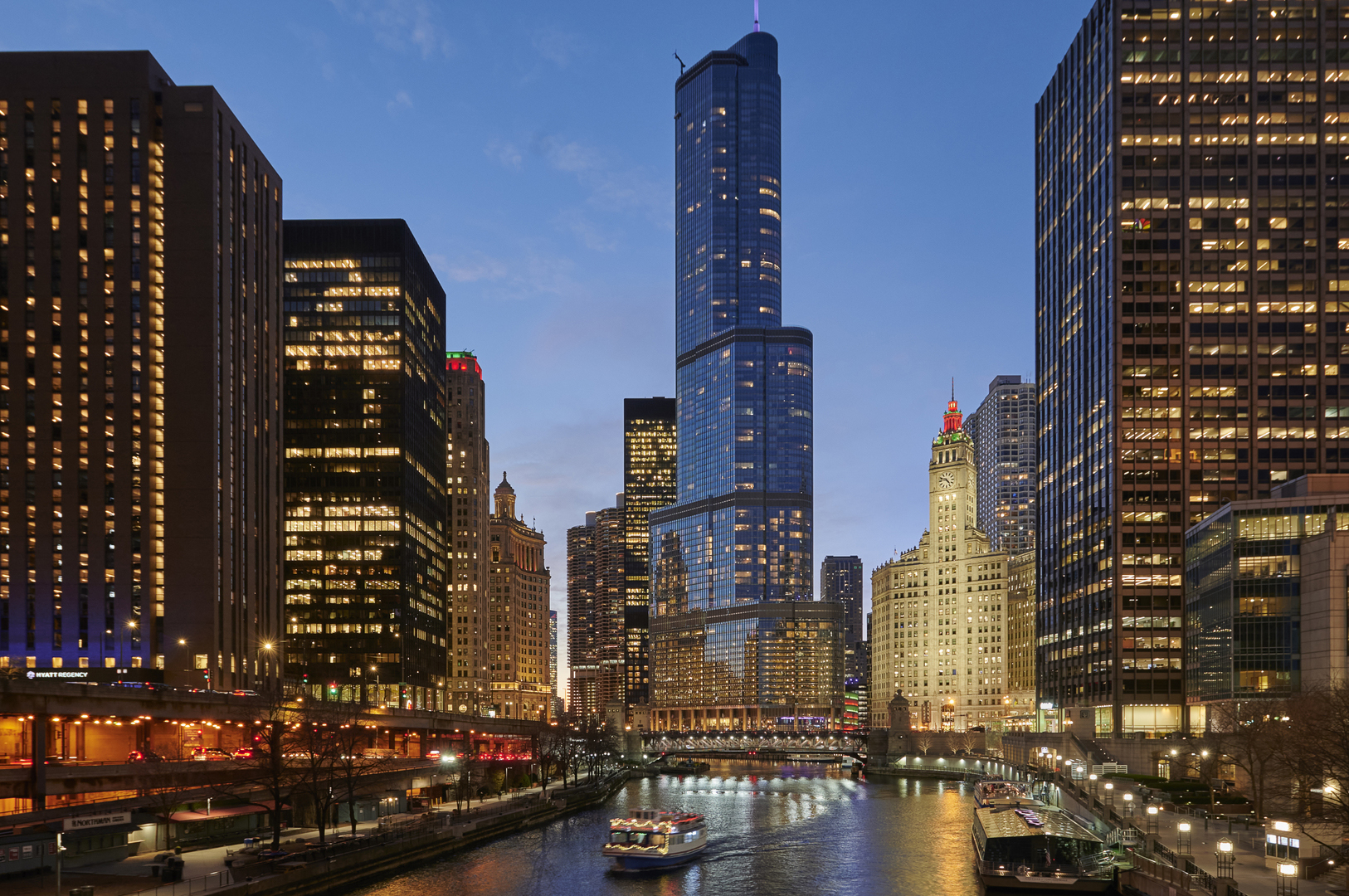
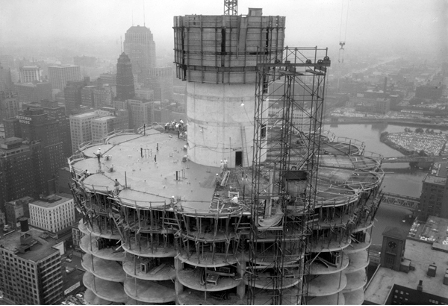
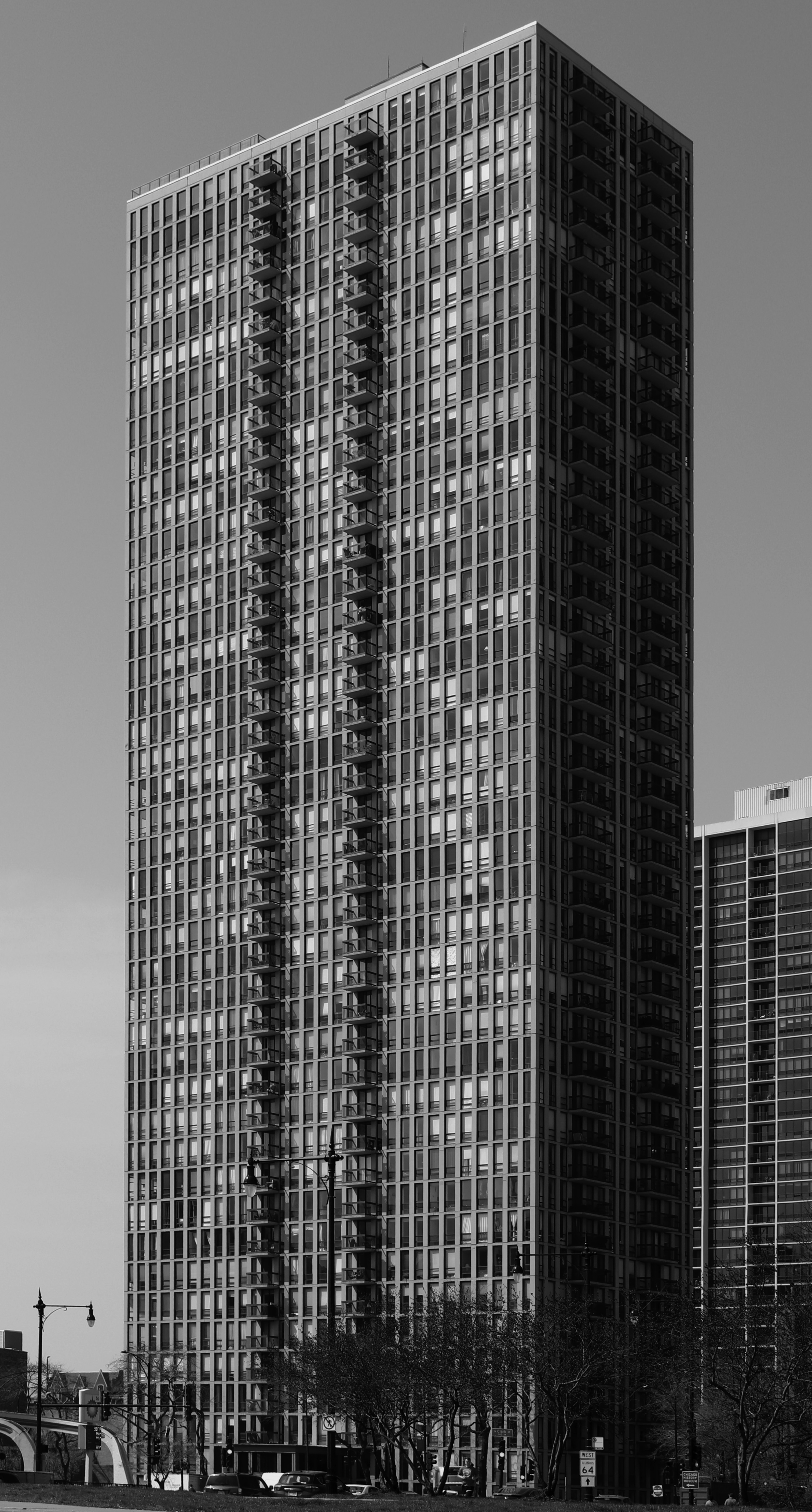
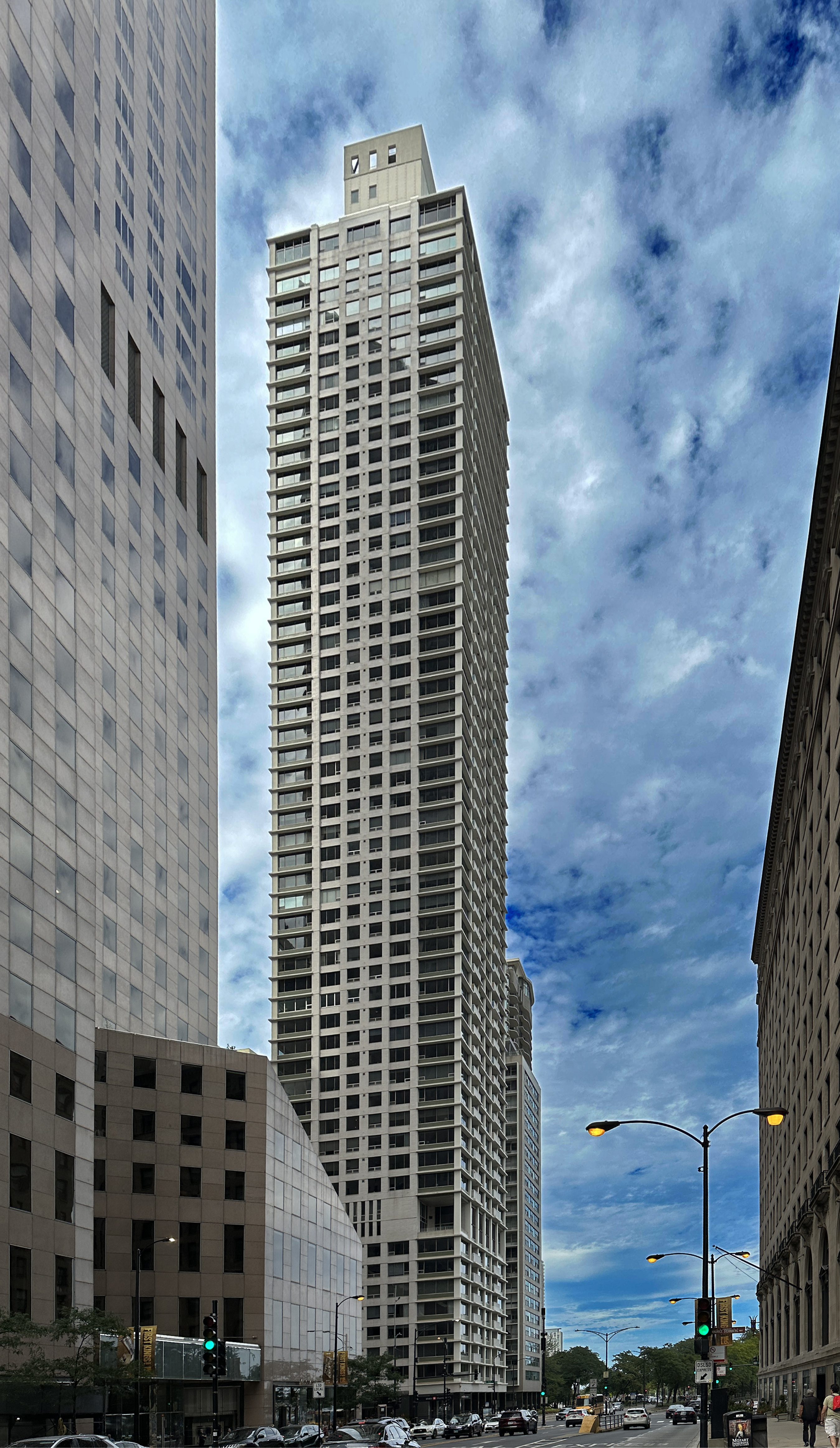
Thornton Tomasetti were New York-based, and the Skyneedle’s architects, Cesar Pelli & Associates, were located in New Haven. Still, expertise in Chicago was also vital to supertall concrete and hybrid structures for the city. SOM’s 7 South Dearborn (1999), engineered by a team led by William F. Baker, developed a “stayed mast” system on the 33,000 square foot site for another 2000’ tower scheme. This system improved on the Miglin-Beitler tower concept by substituting steel perimeter columns for the earlier project’s concrete fins, taking up less space and connecting them to the central core—just 66’ square—with outrigger trusses. The design relied on 12,000psi concrete and advanced digital techniques, including aerodynamic analysis and multifactor optimization, which Baker credited with “breaking through several barriers that have limited buildings in the 100+ story range,” mainly drift and spatial efficiency on lower floors.[vii] While 7 South Dearborn remained unbuilt in the aftermath of 2001, the concept of a stiff core, braced by vertical elements set at the building perimeter—or, at least, a distance far enough to establish a reasonable moment arm—was a key step in the “buttressed core” that Baker and the SOM engineering team developed for Tower Palace III in Seoul, South Korea (2004), and the 2700’ Burj Khaliffa in Dubai (2010).[viii] Chicago has continued to build tall concrete—SOM’s 1362’ 401 N. Wabash, completed in 2009, relies on a core-and-outrigger system with two-story walls of 16,000 psi concrete connecting the core to perimeter columns. McHugh Construction and Materials Service collaborated on the tower’s concrete mixes and pours, carefully selecting high-strength limestone, using admixtures to create a particularly dense product, and employing a 680-horsepower concrete pump to move 6000 pounds of concrete per minute to the upper floors. Self-jacking formwork on the core and specially produced formwork enabled a pour rate of one floor every three days. The tallest building constructed in Chicago since 1974, 401 N. Wabash sits just 400 feet from Marina City. The two projects provide a convenient illustration of concrete’s evolution as a structural material and of the collaborative engineering and construction communities in Chicago that raised concrete to ever-new heights.
[i] “High Strength High Rise.” Civil Engineering, March, 1988. 63-65.
[ii] Lorraine Smith, Janice Tuchman, and Jeffrey Trewhitt. “All-Concrete Design Fits Bill for 946-Ft Tower.” Enr, vol. 220, no. 5, 1988. 42.
[iii] Bob Tita,“Material Service sold to Hanson.” Crain’s Chicago Business, June 19, 2006.
[iv] Paul James interview with the author, 25 Oct 2024.
[v] Charles Thornton, Udom Hungspruke, and Jagdish Prasad, “The Miglin-Beitler tower Chicago, IL (USA).” IABSE Congress Report, Vol. 14, 1992. 272-282.
[vi] Ellis Booker, “Computers Help Shape Chicago Skyline.” Computerworld vol.23. Aug 14, 1989. 25.
[vii] William F. Baker, Robert C. Sinn, Lawrence C. Novak, and John R. Viise, “Structural Optimization of 2000-Foot Tall 7 South Dearborn Building.” Advanced Technology in Structural Engineering, Proceedings of Structures Congress 2000. (Reston, VA., American Society of Civil Engineers, 2000). 1-8.
[viii] William F. Baker, P.E., S.E., F.ASCE, and James J. Pawlikowski, S.E., LEED AP, M.ASCE, “Higher and Higher: The Evolution of the Buttressed Core.” Civil Engineering, Oct., 2012.
 architecturefarm