(A version of this appears in Chicago Skyscrapers, 1934-1986. Dusting this off as Kluczynski Building has–supposedly–been on the list of federal properties the current administration is looking to sell). (Update—Or not).
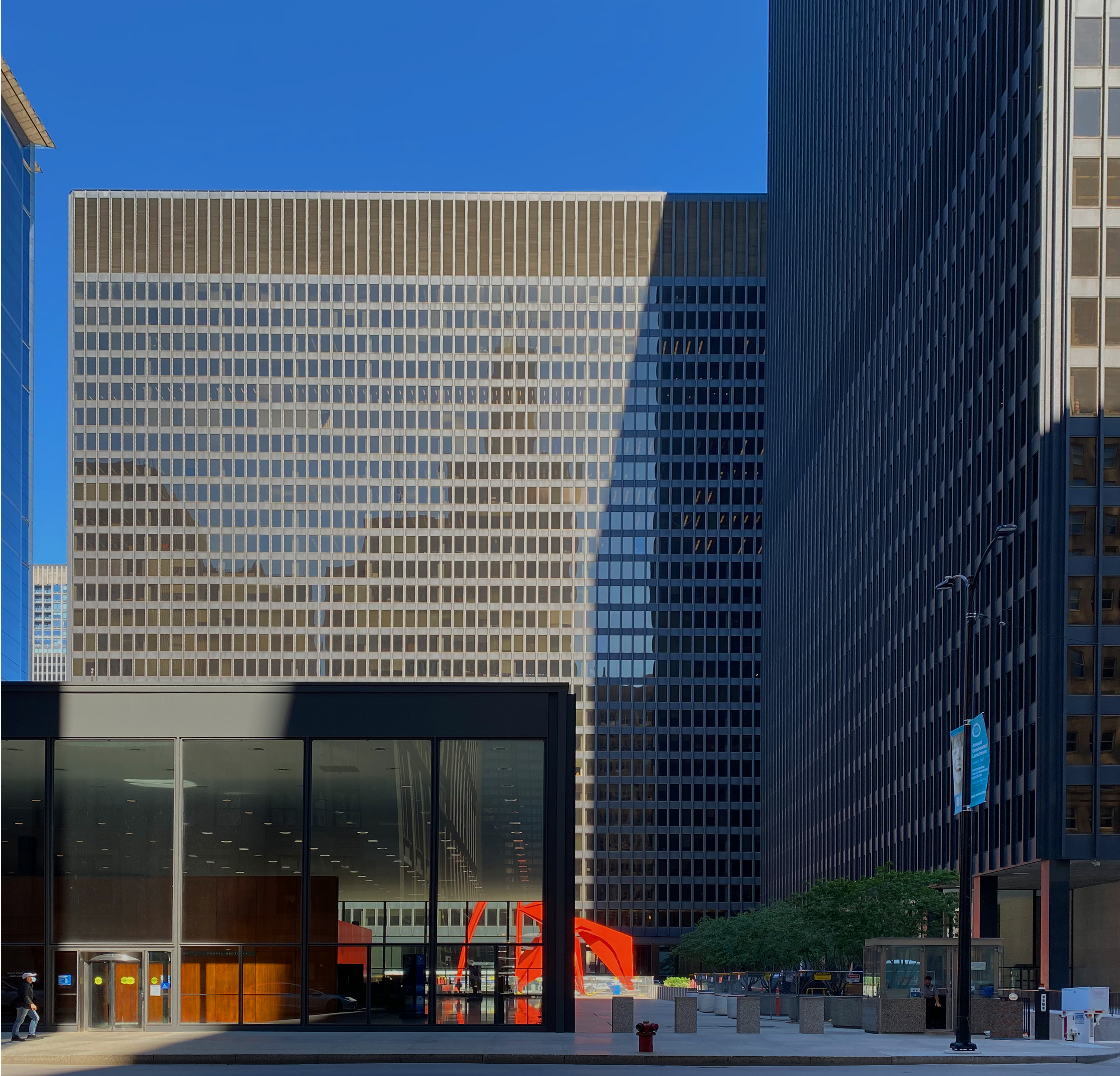
Everett McKinley Dirksen Building, John C. Kluczynski Building, and United States Post Office (Chicago Federal Center Architects, a joint venture of Schmidt Garden & Erickson, Ludwig Mies van der Rohe, C.F. Murphy Associates and A. Epstein & Son, 1958-1974).
The first of the city’s postwar civic monuments to be announced would take the longest to realize, outliving its key architect and leaving a block-wide hole in the Loop for much of the decade. The need for new federal offices in Chicago was acute. Plagued by cost and schedule overruns, Henry Ives Cobb’s 1905 Federal Building and Post Office was obsolete when it opened. Burnham and Bennett suggested its replacement just four years later, calling it “already inadequate” and proposing “a building exclusively for that one purpose…the dignity and the business of the United States courts.”[i] The Post Office moved to its Graham, Anderson, Probst, and White building west of the River in 1932, but the Cobb building’s clumsy, cross-axial plan remained crowded and inefficient even as just a courthouse. Illinois Senator Everett Dirksen and Representative Sidney Yates sponsored legislation to build new government buildings nationwide in 1957, and in December 195,8 the General Services Administration announced a $98 million Federal complex for Chicago.[ii]
Where such a massive investment would go was controversial. The Central Area Plan, released just four months earlier, suggested a new Federal Center along the River, between Dearborn and LaSalle—a gentle nod toward Rubloff’s Fort Dearborn vision. Daley and Ira Bach hoped to anchor the North Loop as a political center, rejuvenating this run-down part of downtown. The Central Area Committee, however, sought to anchor the South Loop with this captive population, seeing it as a buffer to South Side ‘blight’ and predicting that several thousand government employees would support retail development south on State Street. Holman Pettibone made the case that a federal presence there would also spur development along Congress, supporting two other Plan elements—a new University of Illinois Campus, planned for a large tract of railroad land just southwest of the South Loop site, and the consolidated railway terminal being planned a few blocks west on Jackson.
The GSA disappointed both sides in January 1959 by selecting the southern site, but only for one phase of the overall project: a 1,300,000 square foot building containing new courtrooms and half its required office space, to be combined on the half-block east of the existing courthouse. According to administrator Franklin Floete, this would allow the existing courthouse to remain open while the new structure was completed, but where the remaining office space would be built was still uncertain. Floete suggested that it could be built in a second phase on the site of the Cobb building or elsewhere in the Loop if the GSA could get a good price for that building’s site.[iii] For the moment, however, plans for the combined courthouse and office building would be a “five story base, with…twin towers rising above that level.” The GSA solicited bids from architects to develop the idea further in April 1959.[iv]
Charles Genther of PACE convinced Mies to present their joint qualifications. Mies had rarely entered competitions, but 1959 was a turning point. He had retired as Director of the Department of Architecture at IIT in September 1958, forced out after 21 years by internal politics. Herbert Greenwald had died in February, leaving the office without its primary client, and his daughter, Waltraut, who had moved to Chicago to be with him, was ill with cancer and would die that November.[v] With neither the IIT’s Director’s salary to bolster it nor the steady income from Greenwald’s projects, his office shrank. Yet he enjoyed global acclaim after the Seagram’s opening, traveling to Europe in Spring 1959 to receive honors and awards in England and Germany. At 72, he could well have closed his office and enjoyed a comfortable retirement, but word came on this trip that the GSA had selected him as part of a carefully picked architectural team. PACE, however, wasn’t included. Instead, the GSA asked Mies to collaborate with Schmidt, Garden, Erickson, C.F. Murphy, and A. Epstein & Sons. PACE had hedged its bets, secretly submitting an independent bid, an ethical lapse that Mies felt left him free to take the project without them; the two firms would not work together again. The GSA announced the team in May 1959, along with word that the second phase would, in fact, be built on the site of the old courthouse.[vi]
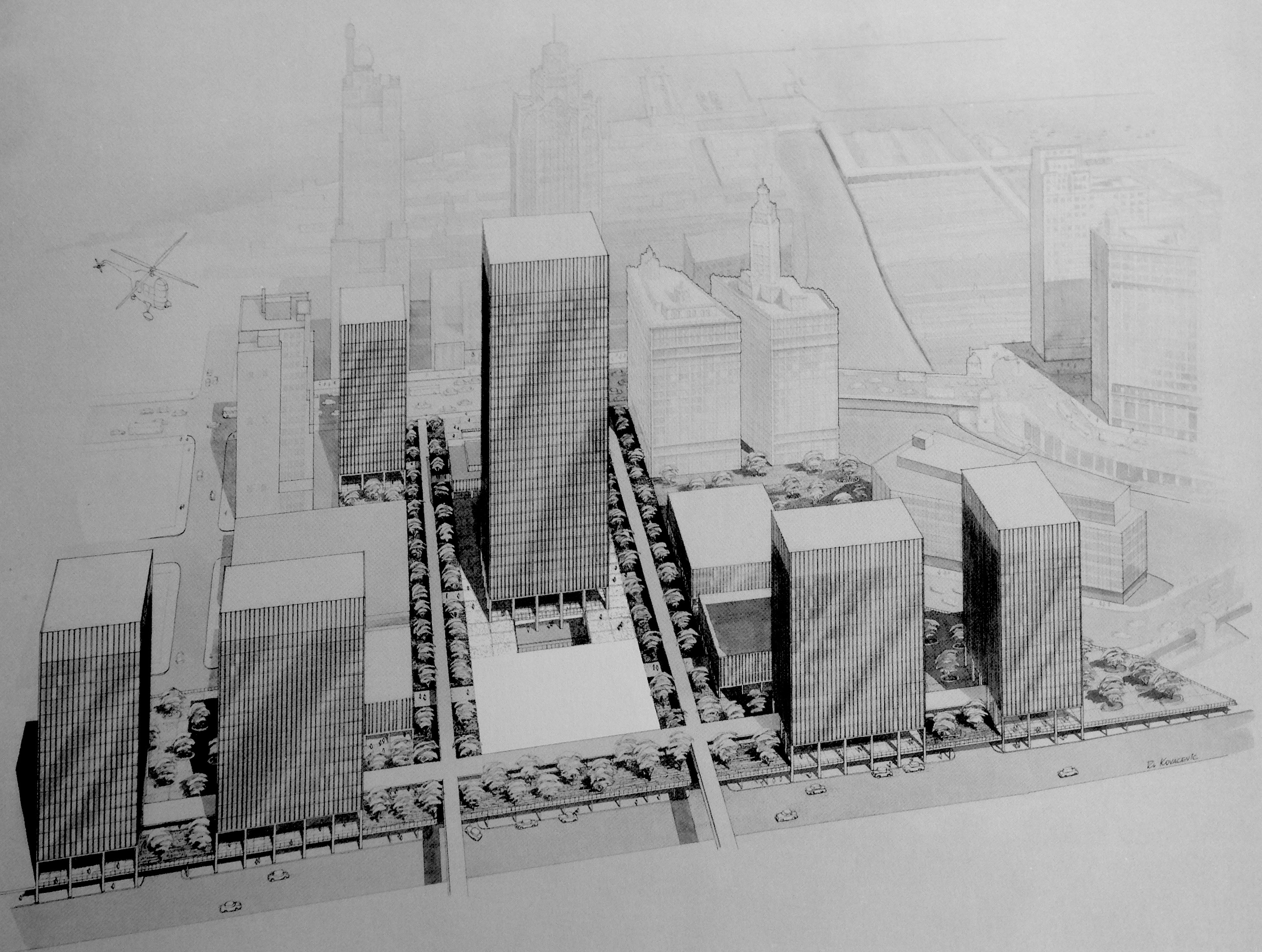
Mies’ office team for the project included Gene Summers, Bruno Conterato, and Joseph Fujikawa. They presented three schemes to the GSA: one combining the two phases into a single, 56-story tower containing offices and courtrooms, a second for a 30-story courthouse and office tower on the eastern site and a taller block to be built later on the full block opposite, and a third, variant of the two-building scheme that split the remaining office program into two blocks, symmetrically disposed and framing the first structure. Mies and his team preferred the first scheme for the full-block plaza it allowed, but realized it presented intractable problems. Not only could it not be phased as the GSA planned, it would have been among the tallest buildings in the Loop—monumental, for sure, but overbearing for government agencies wanting to seem approachable. GSA’s advisers picked the second scheme of two tall buildings fronting an asymmetrical plaza instead.
With the new courthouse forming a wall along Dearborn, Mies concluded that the second phase should be taller, terminating the plaza to the south and concealing the eclectic row of buildings opposite Jackson Street, which included the Monadnock and Mundie and Jensen’s beaux-arts 1926 Union League Club. On the other hand, the plaza’s north side would open toward Holabird and Roche’s 1895 Marquette building. The final structure, a low, clear-span post office, would take up the western 2/3 of the full block, adding a final edge to the plaza and forming a horizontal foil to the two vertical structures. Mies paid particular attention to the three elements’ proportions: the post office was square in plan, the courthouse almost square in elevation—383 feet tall (357 feet from the top of its colonnade) by 368 feet wide—and the second phase’s elevation just taller than a double square—547 feet by 228 feet.[vii]
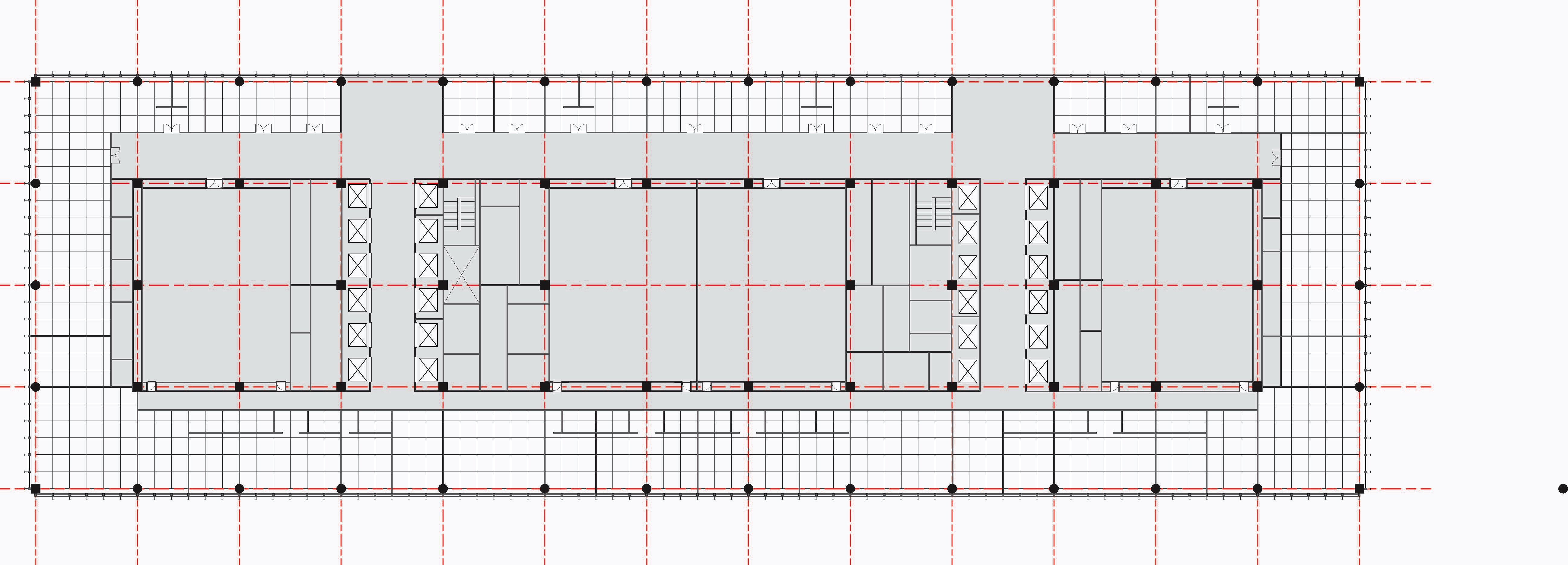
Mies’s team developed the courthouse block through 1960 in a split-core arrangement, with double-height courtrooms on the building’s upper levels filling in as low-rise elevators dropped off at the 16th floor. The building was planned around 28-foot structural bays of steel columns and girders, each divided into a 6 x 6 grid of 4’-8” modules. Courtrooms and cores were concentrated toward the floor plates’ centers, with private corridors for judges and jurors along the east façade and public corridors overlooking Dearborn. Prisoner circulation and holding cells were contained in the cores, with elevators connecting to a secure garage in the basement. The split cores framed the axis of Quincy Street through the glass lobby at street level, a grand space rendered in flame-finished granite, stainless steel, and a white plaster ceiling—the 860-880 lobby scheme expanded to city scale.[viii]
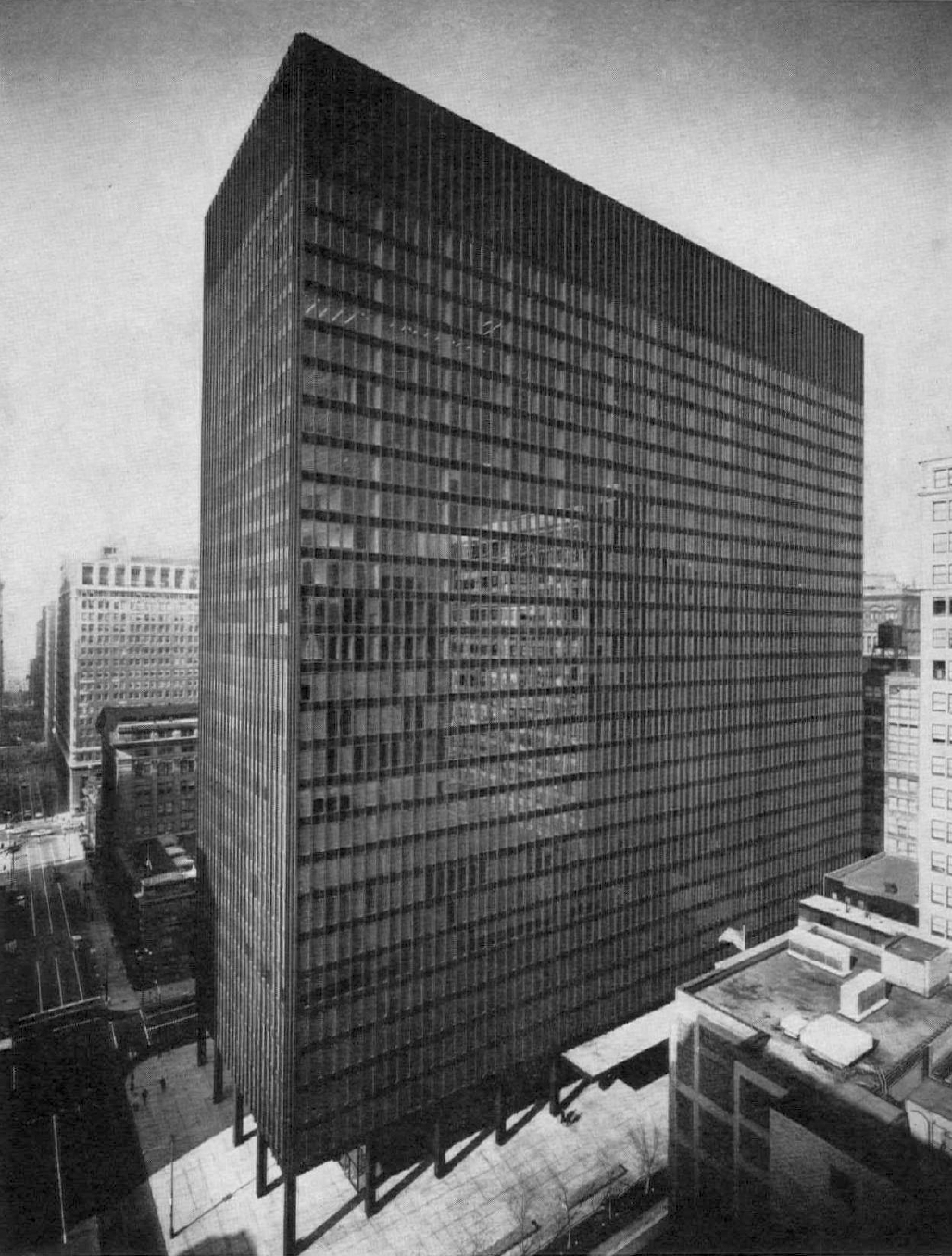
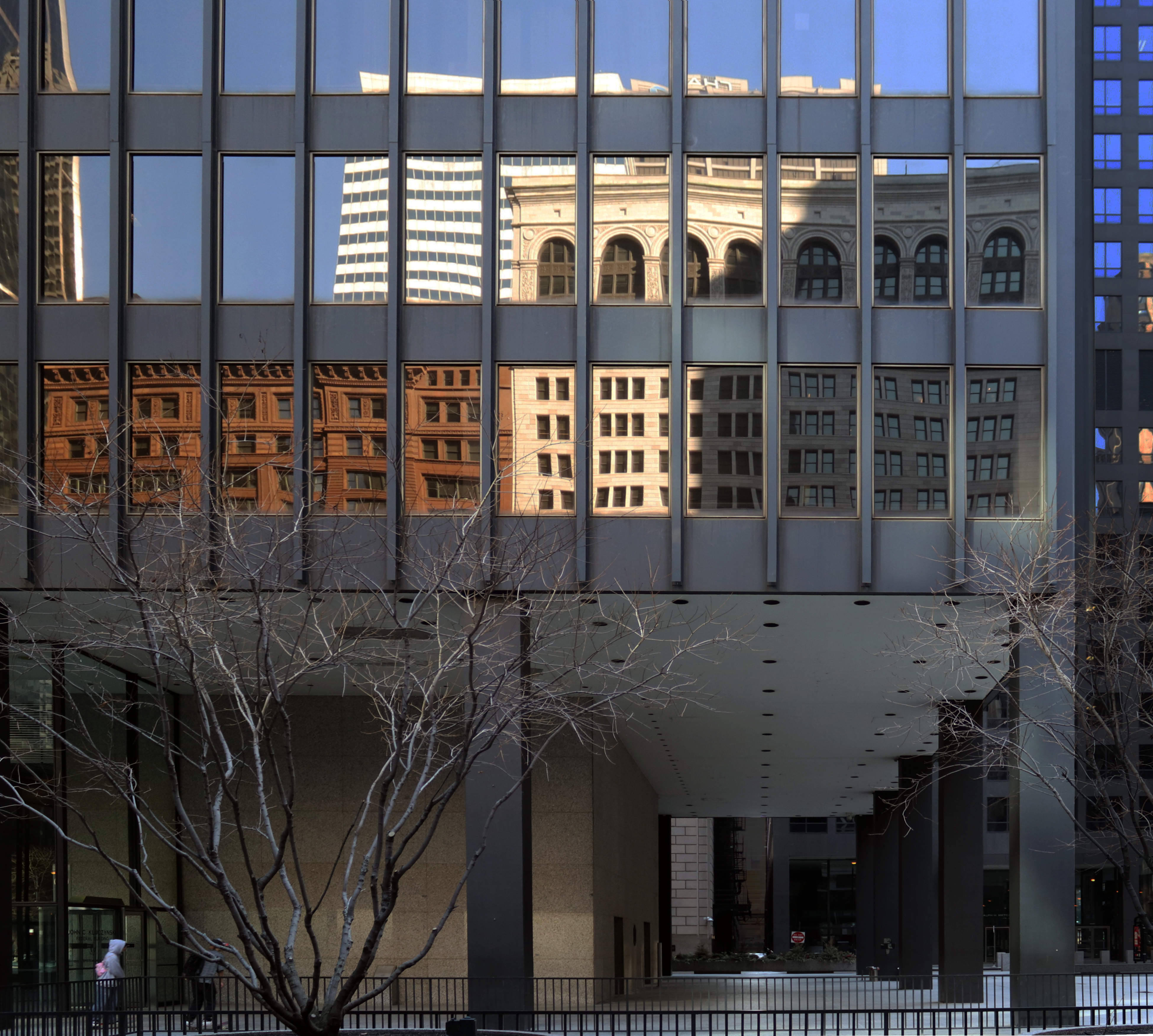
Summers sketched cladding options that telegraphed these double-height courtrooms onto the broad Dearborn Street elevation, but Mies overruled this expressive approach. Instead, the curtain walls continued the evolution of the 860-880 system, with floor-to-ceiling glass framed in aluminum and stiffened by exterior I-beam shapes. By 1960, steel curtain walls had been superseded by aluminum; Mies, however, insisted that steel frames should be rendered in like material.
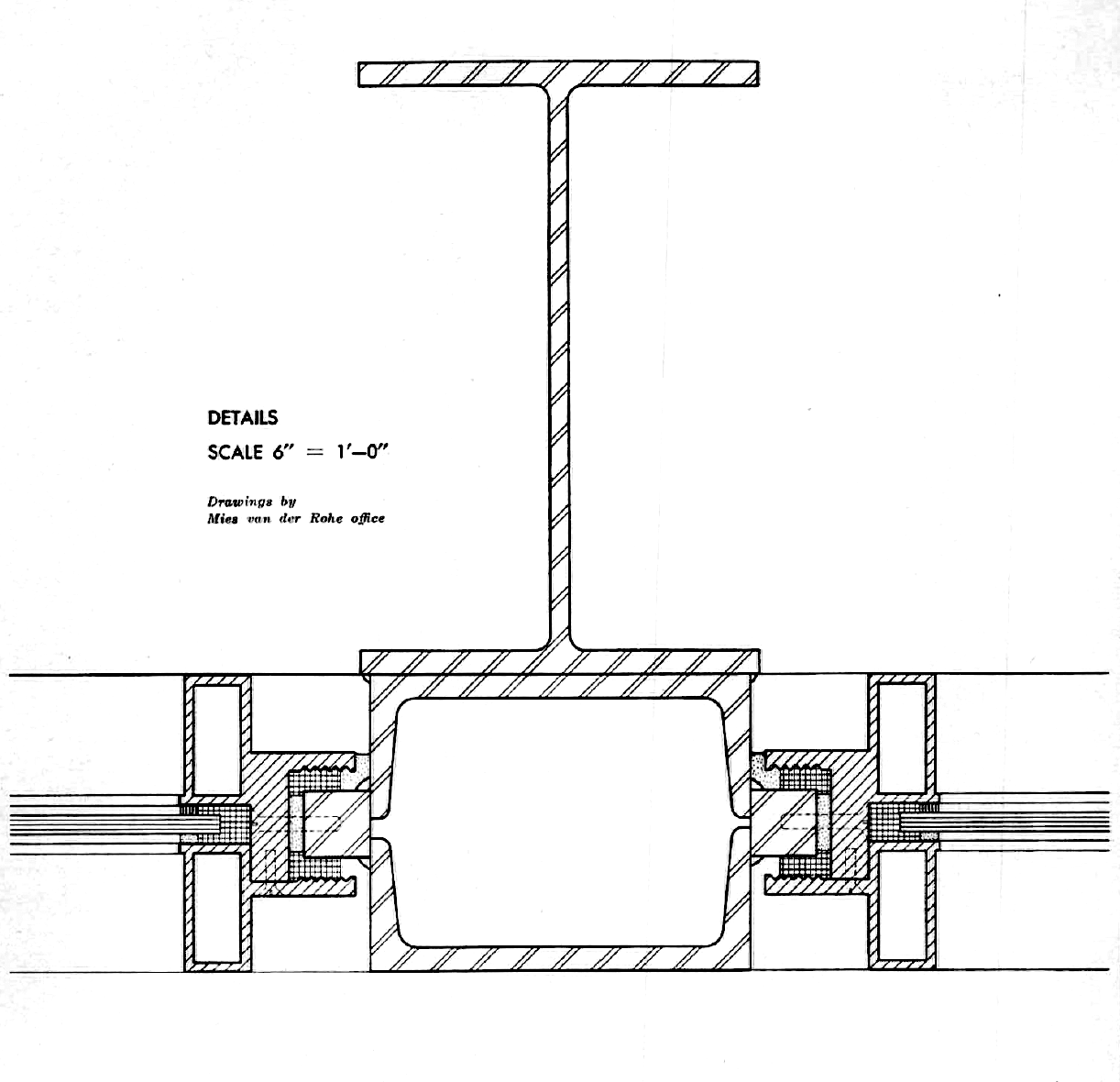
Two steel channels form each mullion’s chassis, with square bars welded to either side framing aluminum stops that hold single sheets of plate glass. A standard W8 shape welded to the main chassis provides vertical articulation, while floor and ceiling finishes were detailed to align with window tops and bottoms. The system is punctuated by narrow shadowgaps surrounding each window frame, highlighting their infill nature and the change between aluminum mullion and steel support. The resulting façade shows Mies’ preference for steel’s continuity and texture over the gap-detailed aluminum cladding on Esplanade and Commonwealth, clarified with shadowgaps that would see further evolution at the Home Federal building in Des Moines (1960-63) and the Toronto Dominion Center (1965). Construction, by Paschen Contractors, began in 1962 and proceeded quickly, enabled by the design’s standardized details. The enclosure was finished a month ahead of schedule, and the building was dedicated in October 1964.
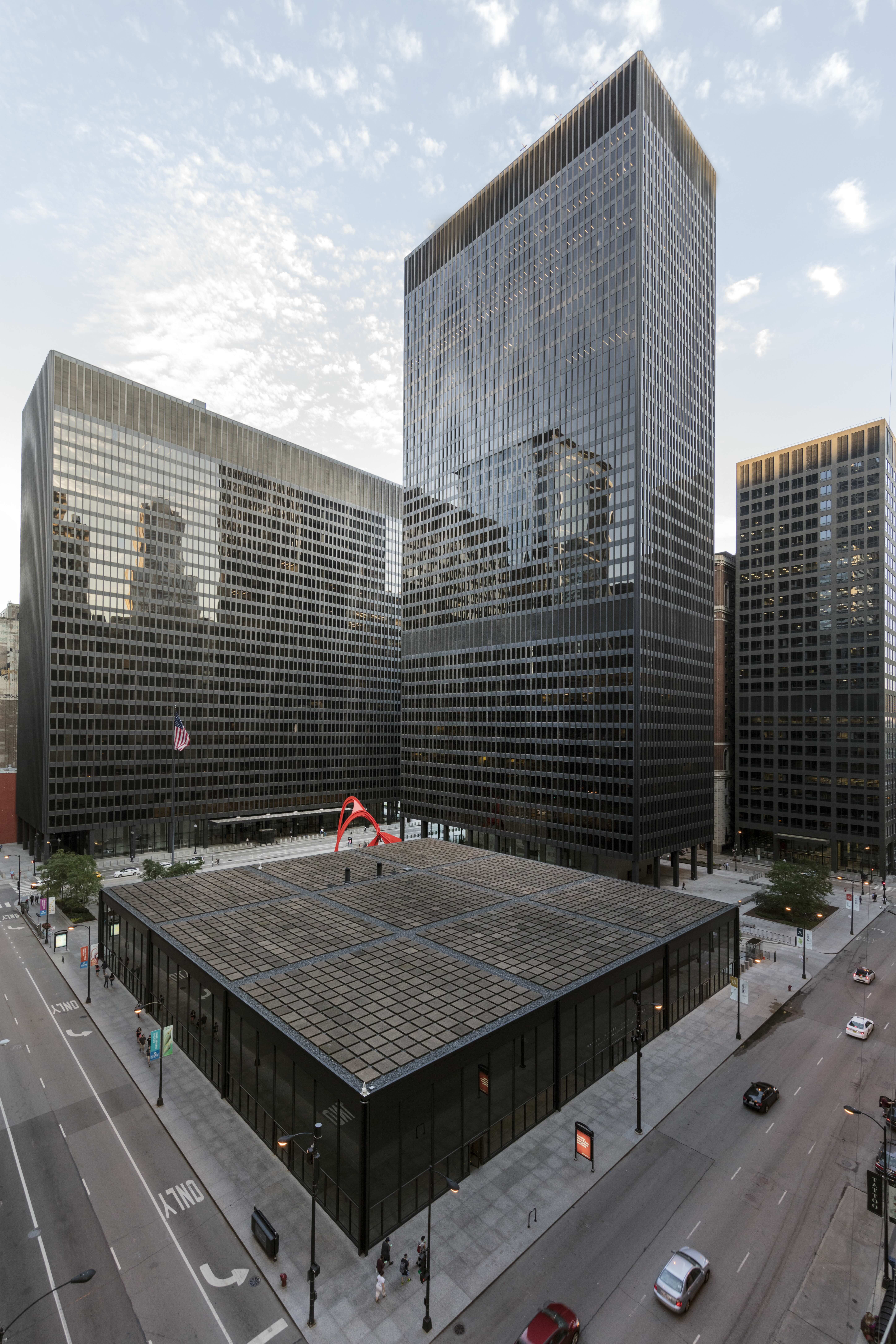
The same architectural and engineering team was awarded contracts for the second tower and post office in August 1963. Paschen began demolishing Cobb’s courthouse in January 1965, and the GSA accepted the team’s detailed designs for the post office and office building the next month.[ix] Paschen, now in a joint venture with Gust Newberg, finished the substructure in late 1966, at which point Congress, facing rising labor costs and funding an increasingly dire war in Vietnam, slashed the federal building budget, halting work. For three and a half years, the site sat vacant, the roof of the substructure serving as a parking lot.[x] U.S. Representative John Kluczynski, a Chicago Democrat, led a charge in 1969 to resume work on the building, but the Nixon administration held contracts until 1971.[xi] Detailed with the same steel and aluminum cladding system as the courthouse, the office building and post office were completed in October 1975, graced by the red steel “Flamingo,” by Alexander Calder.[xii]
The Federal Center’s construction outlasted its primary architect and two political champions. Everett Dirksen died weeks after Mies, in September 1969. Senate Republicans voted to name the entire complex for him, but Democrats objected, suggesting that the two tall buildings should be bipartisan. The Everett McKinley Courthouse was dedicated in May 1970, and the office building was nearly named for Illinois’ “fighting liberal,” Senator Paul Douglas, who had lost to Republican Charles Percy in 1967. Illinois’ House delegation argued that they should be represented as well as Senators, though, and after Kluczynski died in March 1974, Congress agreed that the newer building should bear his name.
[i] Daniel H. Burnham and Edward H. Bennett, Plan of Chicago. (rep. New York: Princeton Architectural Press, 1993. 117.
[ii] “Site Selection for New U.S. Buildings Near.” Chicago Tribune, Dec. 10, 1958. B4.
[iii] “Federal Building Site Picked.” Chicago Daily Tribune, Jan. 7, 1959. 1.
[iv] “U. S. Acquires Loop Site For Courthouse.” Chicago Daily Tribune, Apr. 1, 1959. 1-c11.
[v] Schulze and Windhorst, 342.
[vi] “2d Federal Building for Loop is Ok’d.” Chicago Daily Tribune, May 29, 1959. 1.
[vii] Figures from Peter Carter Mies van der Rohe at Work. (London: Phaidon, 1999). 69, 134.
[viii] “Mies Designs Federal Center.” Architectural Record, March, 1965. 128, 132.
[ix] “U.S. Accepts Design for Chicago Center.” Chicago Tribune, Feb. 12, 1965. 44.
[x] Philip Warden, “O.K. Funds for U.S. Building.” Chicago Tribune, May 7, 1969. 8.
[xi] “Sign U.S. Building Pacts Today.” Chicago Tribune, Aug. 5, 1971. 3.
[xii] Pauline A. Saliga, Oral History of Gene Summers (Chicago: Art Institute of Chicago, 1993).
 architecturefarm