As part of our research for the Skyscraper Museum’s Modern Concrete Skyscraper exhibition, Carol Willis and I worked to understand how and why Chicago became the acknowledged center of high-strength and high-rise concrete design for much of the last half of the 20th century. What follows has relied on perspectives and input from conversations and virtual lectures held with, among others, Bill Baker, Paul James, Kim Clawson, Ken DeMuth, Geoffrey Goldberg, Matthys Levy, Joseph Colaco, and, especially, the late Charlie Thornton. Many of those conversations are available in video form on the Skyscraper Museum’s website.
Early Concrete in Chicago
Even as the city’s earliest iron frames emerged in structures like the Home Insurance and Rookery, Chicago’s builders experimented with 19th-century versions of concrete—mainly as a replacement for natural stone. Like the history of terra cotta fireproofing businesses in Chicago, the 1871 fire inspired entrepreneurs and inventors to join the massive rebuilding effort. Portland cement, a mixture of crushed limestone and calcium silicates, was first patented in England in 1824 and gradually improved over the following decades, forming a crucial ingredient in producing strong “artificial stone” that won favor for its resistance to fire and manufacturing processes that limited labor costs. By 1876, there were more than 100 buildings with artificial stone fronts or structural elements in Chicago and five manufacturers, among them Ransome and Smith, an enterprise of concrete pioneer Ernest Ransome.[i] Ransome himself relocated to the city from 1890 to 1895 before settling in New York City in 1896. Ransome and others patented systems for fireproof concrete floors, reinforced with twisted or shaped steel bars, in the late 1890s that became the basis for more comprehensive building systems.[ii] Ransome’s patented system was used for the first reinforced concrete skyscraper, the Ingalls Building in Cincinnati, in 1903-5. Builders in Chicago and elsewhere quickly saw the advantages of the hybrid material’s durability and strength. Montgomery Ward’s 2,000,000 square foot Catalogue House, designed by Schmidt, Garden, and Martin, deployed a concrete frame over a winding, six-acre site along the Chicago River in 1908, and Studebaker built a seven-story building at Michigan and 21st Street in 1909 that used paneled slabs to span 24’ x 24’ column bays.[iii] Henry Ericsson, the city’s Commissioner of Buildings, was fascinated by the new material’s fire resistance but concerned about its structural performance and durability. After commissioning laboratory experiments from Arthur Talbot at the University of Illinois and W.K. Hatt at Purdue University in 1911, he drafted one of the first building codes in the United States to address flat-slab construction, which had vexed engineers because of its hyperstatic performance. “Owing to the complication of methods used in designing reinforced concrete flat slab or girderless floor systems,” Cement Age noted,
“…there is little agreement among designers of this type of construction in determining the thickness and reinforcement of flat lab floors. Therefore, the ruling drawn up by the Chicago Building Department should prove both rational and simple, since it is the result of nearly four years’ study and testing.”[iv]
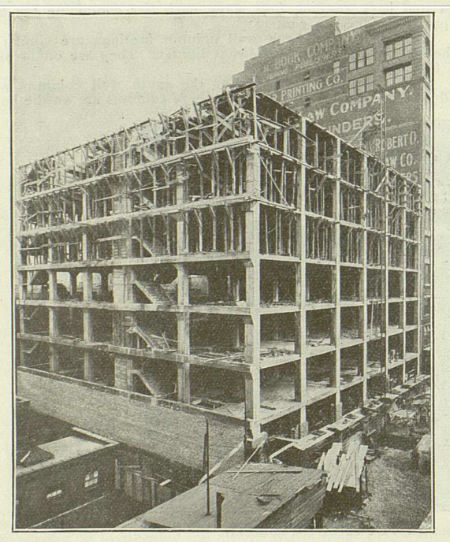
While reliant on rules of thumb instead of mathematical analysis, the code gave builders and engineers confidence in the material; 1911-12 saw half a dozen major warehouse, manufacturing, and office structures built concrete in Chicago. “Never before in the city’s history,” reported the journal Concrete, “have cement and crushed stone played so prominent a part in building construction.” Among these were the Sharples Cream Separator Building, designed for 225 psf loads, the Rand-McNally Building, which reached a height of ten stories, and the Dwight Paper Co., another ten-story structure that rose at a record rate of one floor per week.[v] Laboratory research at Purdue and Illinois was supplemented by extraordinary static and dynamic testing supervised by Talbot and others on the Western Newspaper Union Building. This 1910 nine-story concrete structure was demolished in 1917 as part of the city’s Union Station project, and it served as a test bed for developing theories and rules of thumb for concrete engineering. The structure’s floor slabs withstood over 900 psf loads, suggesting that the city’s codes and engineering practices were overly conservative.[vi]
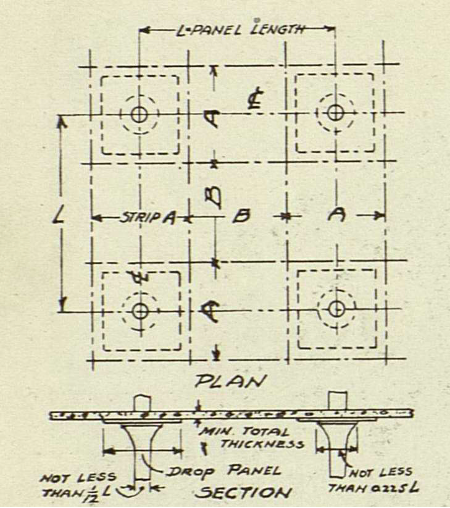
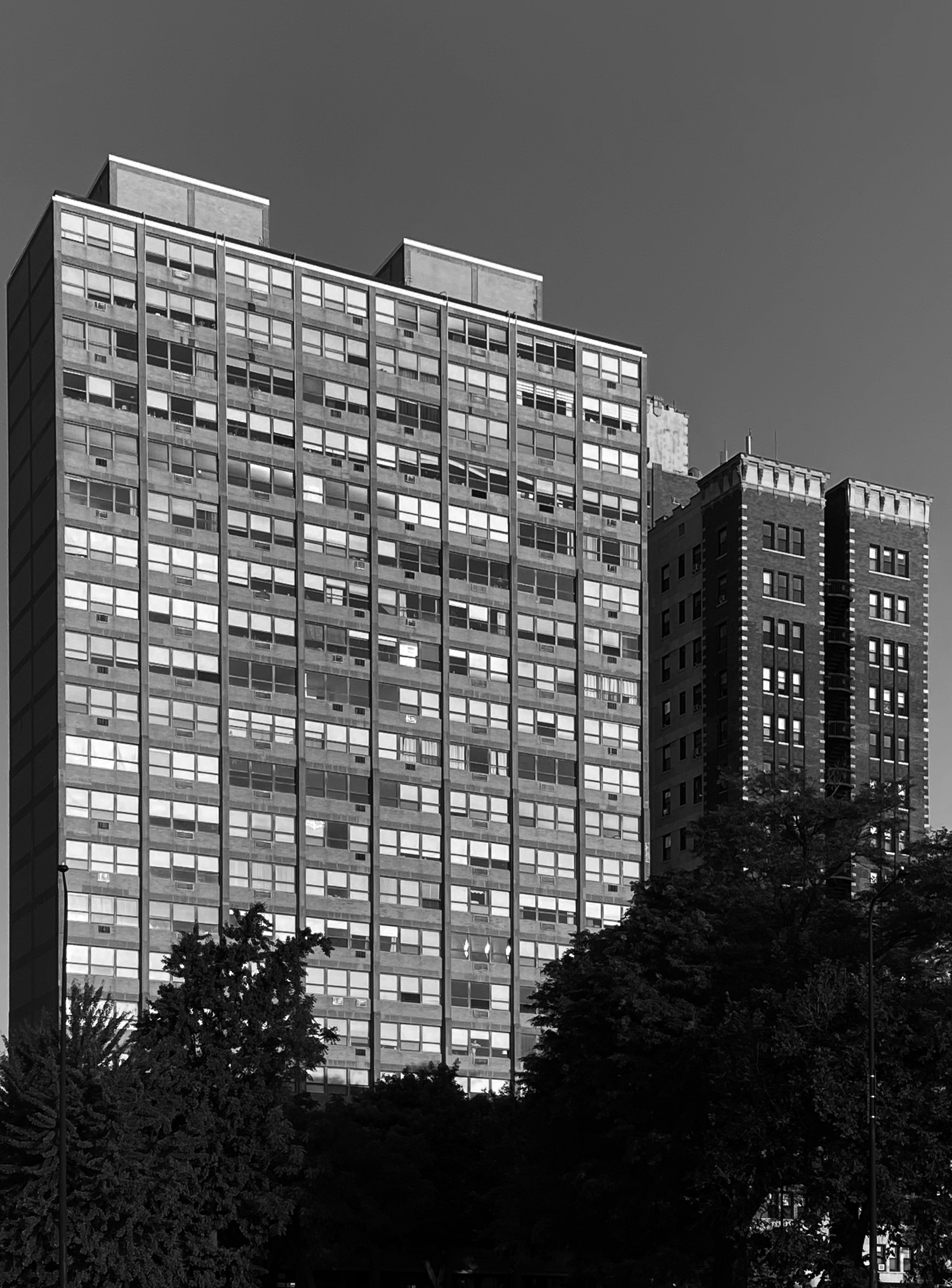
Flat slab construction saw a natural market in residential high rises in the 1910s and 1920s as advances in reinforcement allowed thinner structural depths than steel construction, maximizing the number of floors possible within a given height. The original Edgewater Beach Hotel, built to designs by Marshall and Fox in 1917, used dense reinforcement mats to resist punching shear, eliminating the mushroom capitals and drop panels of typical industrial construction.[vii] Similar reinforcing was used in the all-concrete Bournique Apartments on Goethe St. in 1916.[viii] Concrete became standard for Chicago’s high-rise residential construction, such as the 22-story Powhatan and Narragansett Apartments (both 1929) as its malleability allowed designers to take advantage of the city’s post-1922 setback code while providing reliable fire separation between floors. Its durable, inexpensive construction made it ideal for the city’s public housing projects, beginning with the low-rise Ida B. Wells Homes in 1939 and extending upward into the Chicago Housing Authority’s early high-rise projects, in particular, the Dearborn Homes (1949-50) and Loomis and Ogden Courts (1951, 1953). Mies van der Rohe’s Promontory Apartments (with PACE and Holsman, Holsman, Kleklamp, and Taylor, 1949) featured exposed concrete columns and slabs, suggesting that the material had aesthetic possibilities alongside its affordability and fire resistance.
Marina City
Engineer Henry Miller and architect Milton Schwartz set a record for tall concrete construction with the 40-story Executive House Hotel on Wacker Drive in 1958. Executive House relied on two-foot-thick shear walls of heavily reinforced concrete around its elevator core for stability, but these were hidden behind a slick, stainless steel and glass exterior. More dramatic structural performance and architectural expression came with the 60-story, 588’ tall twin towers of Marina City, built across the River from the Executive House beginning in 1959. Designed by visionary Chicago architect Bertrand Goldberg, Marina City catalyzed advanced concrete construction in Chicago even as it set new urban development and architectural design standards. Goldberg’s design called for cylindrical shafts of apartments that would open outward toward views of the city and the Chicago River with curving, cantilevered balconies. The structure, based on stiff central cores surrounded by rings of columns, all connected with moment-framed girders, was engineered by a team including Frank Kornacker, Bertold Weinberg, and Fred Severud from New York City. Goldberg’s relentlessly circular geometry expanded into three dimensions and produced doubly-curved forms that would have required extensive skilled carpentry. Further issues arose with scheduling; traditional concrete construction would have pushed the schedule out to three or more years, while financing requirements made it necessary to begin renting in 1962.
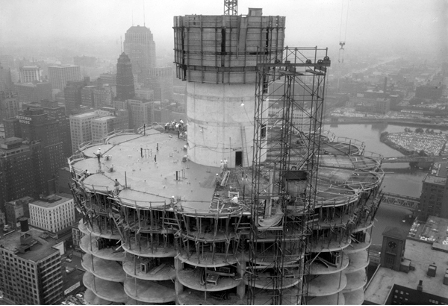
Marina City under construction, showing fiberglass formwork and slip-form core construction. (Chicago History Museum).
McHugh Construction, a local firm founded by bricklayer James McHugh at the turn of the century, had developed concrete expertise through winning bids on Chicago Housing Authority projects throughout the 1950s. By 1960, they had established a reputation for reliable concrete work that supported their successful bid on Marina City. McHugh developed innovative solutions to form Goldberg’s complex, curving shapes and meet the aggressive construction schedule, developing fiberglass formwork that could be mass-produced and used up to 60 times apiece.[ix] They also proposed using the cores as the bases for self-climbing Linden cranes, which could rotate 360° and hoist up to 8,000 pounds—about two cubic yards of concrete—from ground locations up to 90’ distant. McHugh matched the speed of the Linden equipment with an extraordinary coordination of concrete delivery and placement. Ironworkers assembled reinforcement panels on the ground, relying on the Linden’s capacity to lift them, fully assembled, into place. The fiberglass forms were staged to allow them to ‘jump’ three stories above as concrete came to strength. With these advances, McHugh averaged a new floor every two days.[x] Concrete surfaces were left as-struck and painted; the smooth finish imparted by the fiberglass required no additional work, and exposed concrete became a signature element in the building’s space-age aesthetic.[xi] McHugh would go on to use fiberglass formwork in sculpturally rich concrete apartment towers such as 2020 Lincoln Park West (1971) and in “rib-cage” high-rises including Eugenie Square in Lincoln Park (1972); rigid concrete tubes of closely-spaced concrete mullion-columns formed by steel jump forms that matched Marina City’s record for floor construction.
[i] “Building: Concrete and Artificial Stone in Chicago.” Chicago Daily Tribune, Aug. 6, 1876. 10 and “Chicago Manufactures.” The Lumberman’s Gazette, vol. 3, no. 5, 1873, pp. 145.
[ii] Ernest L. Ransome and Alexis Saurbrey. Reinforced Concrete Buildings. (New York [etc.]: McGraw-Hill Book Company, 1912). Chapter 1, “Personal Reminiscences,” 1-18.
[iii] “Two Model Business Structures Now Being Erected in Chicago.” Chicago Daily Tribune, July 18, 1909. I18.
[iv] “Concrete – Cement Age, Vol. 5, no. 5. Nov. 1, 1914. 185, 194.
[v] “Many New Chicago Buildings of Concrete.” Concrete; Feb 1, 1912; vol. 12, no. 2. 27..
[vi] “Unusual Test of Flat-Slab Floor.” The American Architect, Nov. 28, 1917. Vol. 112, no. 2188. 393.
[vii] “The Edgewater Beach Hotel, Chicago, Il.” The American Architect, Sept. 26, 1917. Vol. 112, no. 2179.. 233.
[viii] “New Wrinkle in Building: Radical Departure From Usual Construction Methods Contemplated in Bournique Apartments.” Chicago Daily Tribune, Nov. 19, 1916. 19.
[ix] Richard J. Kirby, “Fiberglas Forms—A Progress Report.” Concrete Construction, July 1, 1962.
[x] “Huge Project Overlooks Chicago River: Compared to Sunflower Climbing Cranes Used.” The Christian Science Monitor, Feb. 2, 1962. 10.
[xi] James M. Liston, “Amazing Marina City.” Popular Science Monthly, Vol. 182, no. 4. April, 1963. 82-85, 194.
 architecturefarm
Hi Thomas,
I’m having trouble finding my reference, but the Empire Building in New York City (Kimball & Thompson, Arch’s, 1896) was reportedly the first building in NYC to use concrete to encase the steel frame as a means for fireproofing and at the time was seen as quite a step forward in skyscraper construction.
Darrin
LikeLiked by 1 person
Interesting—and that checks out, time-wise. Worth digging to see if there is any contemporary press on that. Cast iron and concrete en casement had a short-lived run in early 30s Chicago, but that was more structural than fireproofing, from what I can tell.
LikeLike