As part of our research for the Skyscraper Museum’s Modern Concrete Skyscraper exhibition, Carol Willis and I worked to understand how and why Chicago became the acknowledged center of high-strength and high-rise concrete design for much of the last half of the 20th century. What follows has relied on perspectives and input from conversations and virtual lectures held with, among others, Bill Baker, Paul James, Kim Clawson, Ken DeMuth, Geoffrey Goldberg, Matthys Levy, Joseph Colaco, and, especially, the late Charlie Thornton. Many of those conversations are available in video form on the Skyscraper Museum’s website.
Portland Cement Association and Materials Service Corporation
McHugh’s innovations in formwork, reinforcing, and scheduling were matched by advances in Marina City’s concrete itself, which relied on a low water/cement ratio, lightweight vermiculite aggregate, careful grading, and slag from nearby steel mills to achieve then-remarkable strength, at 5000 psi in its caissons and lower levels, and lightness, at 100 pounds per cubic foot in 3750 and 3000 psi concrete higher up.[i] These advances relied on research conducted by the Portland Cement Association, an industry organization based in Chicago that began providing advice and data to engineers, architects, and builders in 1916.[ii] PCA was founded to compete with the ease of specification and engineering that the American steel industry enjoyed since Carnegie Steel’s ubiquitous handbooks were published in the 1890s. PCA advanced concrete engineering and construction practices from a relatively unsophisticated and inefficient knowledge base to a discipline rivaling steel’s precision and scope by establishing practices, mixes, and standards. Constant experimentation in their laboratory at 33 West Grand Avenue, just north of the Loop, in the prewar years led to reliable knowledge in areas that had previously frustrated contractors and designers alike, producing gradually stronger mixes based on adjustments to water/cement ratios and more reliable interaction between concrete matrices and reinforcing bars. Research scientist Duff Abrams led much of this work, relying on equipment at PCA and the Lewis Institute, one of the academic entities that would merge to form the Illinois Institute of Technology in 1940.[iii] By 1962, PCA had opened a large testing laboratory in Skokie, employing more than 600 engineers and publishing widely on concrete strength, forming, and maintenance.[iv] Other academic collaborations, in particular with the Talbot Laboratories at UIUC, were vital contributions to understanding and improving strength and versatility.
PCA’s proximity to Chicago engineers and contractors alone would have made the city a natural center for innovation, but the local industry provided tangible research efforts in real-world conditions, too. One supplier, Material Service Corporation, adopted practices that ensured knowledge and experience were shared among practitioners throughout the city’s construction and engineering communities. Founded by Henry Crown and two of his brothers in 1919, the company quickly grew to dominate the market for cement and aggregate in Chicago. By mid-century, it owned eight quarries that provided good-quality limestone, four cement factories, and five gravel plants. The stone, sand, and cement from these sources were collected and mixed at 13 distribution yards located strategically throughout the city, ensuring that concrete could be delivered to any construction site in Chicago well within the 90 minutes that was agreed, industry-wide, as the maximum time between initial mixing and placement for concrete.[v] Materials Service developed its own mixing trucks and built a fleet of low-profile barges that could bring gravel from outlying locations via lake and river, saving time by slipping under Chicago’s river bridges; competitors, with larger vessels, were slowed by the time it took for bridges to raise and lower. The company’s primary mixing plant, “Yard One,” was located alongside the River at Chicago Avenue, making it an ideal transfer point for river-borne raw materials and a convenient 15-minute drive for ready-mix trucks to construction sites in the Loop. This proximity gave concrete in Chicago a considerable advantage over cities, where land prices kept ready-mix plants at a much farther distance—across the Hudson River, in New York’s case, and only accessible by tunnels and bridges prone to traffic jams.[vi]
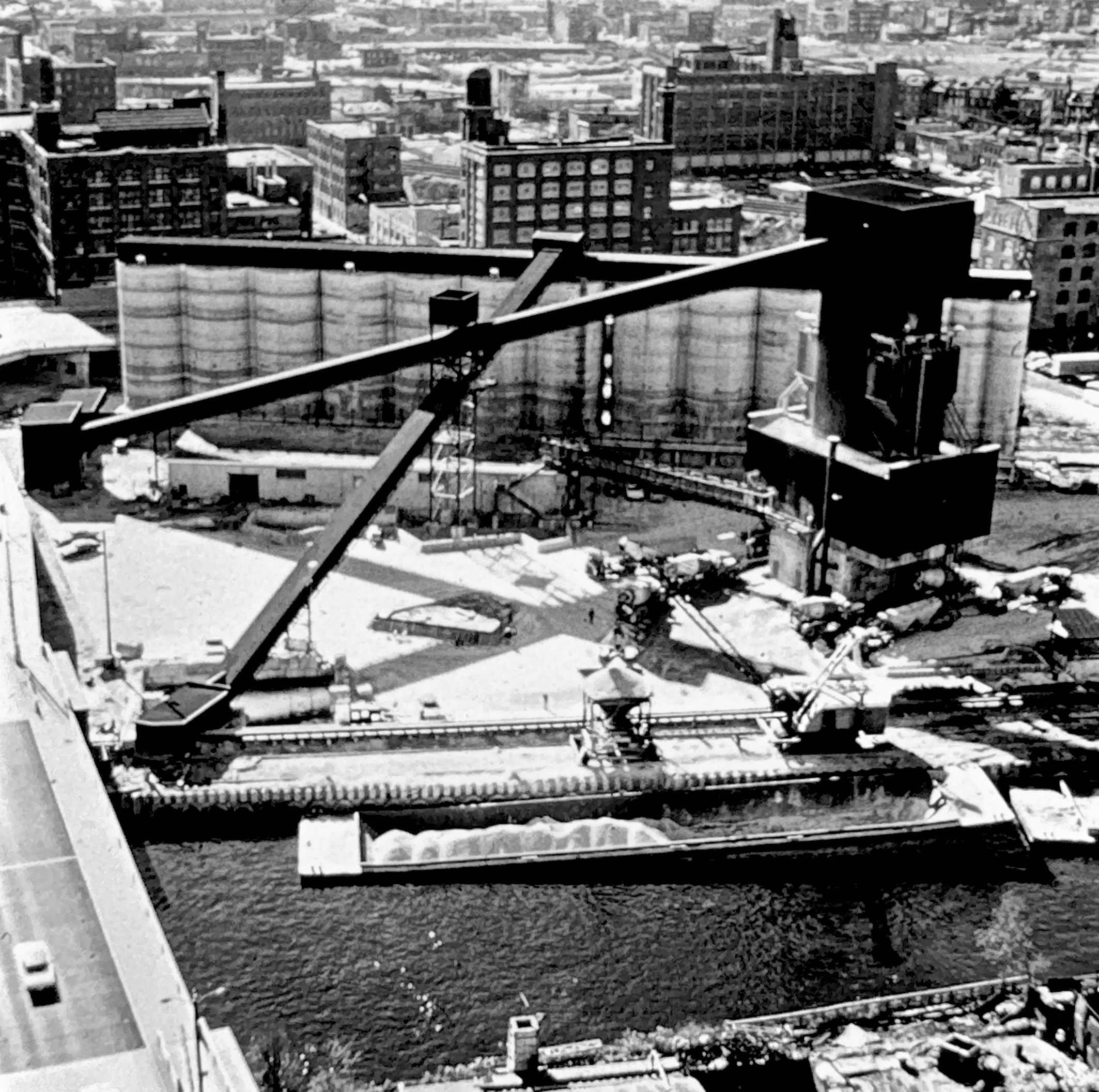
Yard One and Materials Service had provided the strong, rapidly delivered concrete for McHugh at Marina City, and that expertise became the basis for hands-on testing and experiments with mixes, aggregate grading, and admixtures, especially under the leadership of two engineers who became key figures in Chicago’s high-strength concrete development. Technical Marketing Manager Jaime Moreno and Quality Control Manager John Albinger, in conjunction with another industry specialist, Flood Testing Service, led an outreach program that actively fostered collaboration and communication among the city’s contractors, engineers, and architects. Materials Service leveraged their expertise to use job sites as laboratories, often trying to exceed specified strengths in column pours to gradually ratchet up what was achievable.[vii]
Moreno’s program was one of constant refinement, which he and Albinger described in a 1981 Concrete Construction article:
“Selecting the proportions of a high-strength concrete mixture is a combination of art and science. Because of the innumerable types of gradings of aggregates, chemistries of various cements, fly ashes, and admixtures, and the subsequent interaction of any combination of these materials, arriving at the optimum combination is often a matter of trial and error…as in blending blue and yellow to make green, many combinations must be tried to attain the desired mix.”[viii]
Moreno and Albinger contributed papers and columns in technical and industry literature, and Moreno, in particular, was an active member of the Chicago Committee on High Rise Buildings, an industry organization founded in 1968 that brought together skyscraper engineering, design, and construction experts to share best practices. Albinger summarized his company’s ethics in a 2006 reminiscence:
“By design, every job was used to investigate the next higher strength. Either a couple of columns were poured using higher strengths than required, or in situ tests were conducted to measure such attributes as creep or the effect of temperature. By the time the next high-rise was on the drafting table, all interested parties had enough data and confidence to justify using higher strength concrete. The results of all these tests and experiences were shared with the entire concrete community. No single company benefited. Such cooperation is rare in any industry.”[ix]
Moreno and Albinger championed the use of fly ash and superplasticizers in concrete mixes as ways to reduce the amount of water required while achieving low enough viscosity to handle, and much of Materials Service’s research went into fine-tuning proportions of these, along with intensive quality control, to refine and improve strength gradually.[x] The short times required for transporting batches from Yard One were crucial to this program—fresher concrete was more liquid, and the time gained by the proximity of the mixing plant to job sites allowed for precise, careful on-site slump testing.[xi] Chicago’s naturally occurring limestone provided a sound basis for strong concrete—limestone from Materials Service’s quarries at Thornton averaged around 22,000 psi. This was less than granite from eastern sources, but limestone had the advantage of being seamed and, thus, easy to split and crush into useful aggregate.
Flat Slabs and Tubes
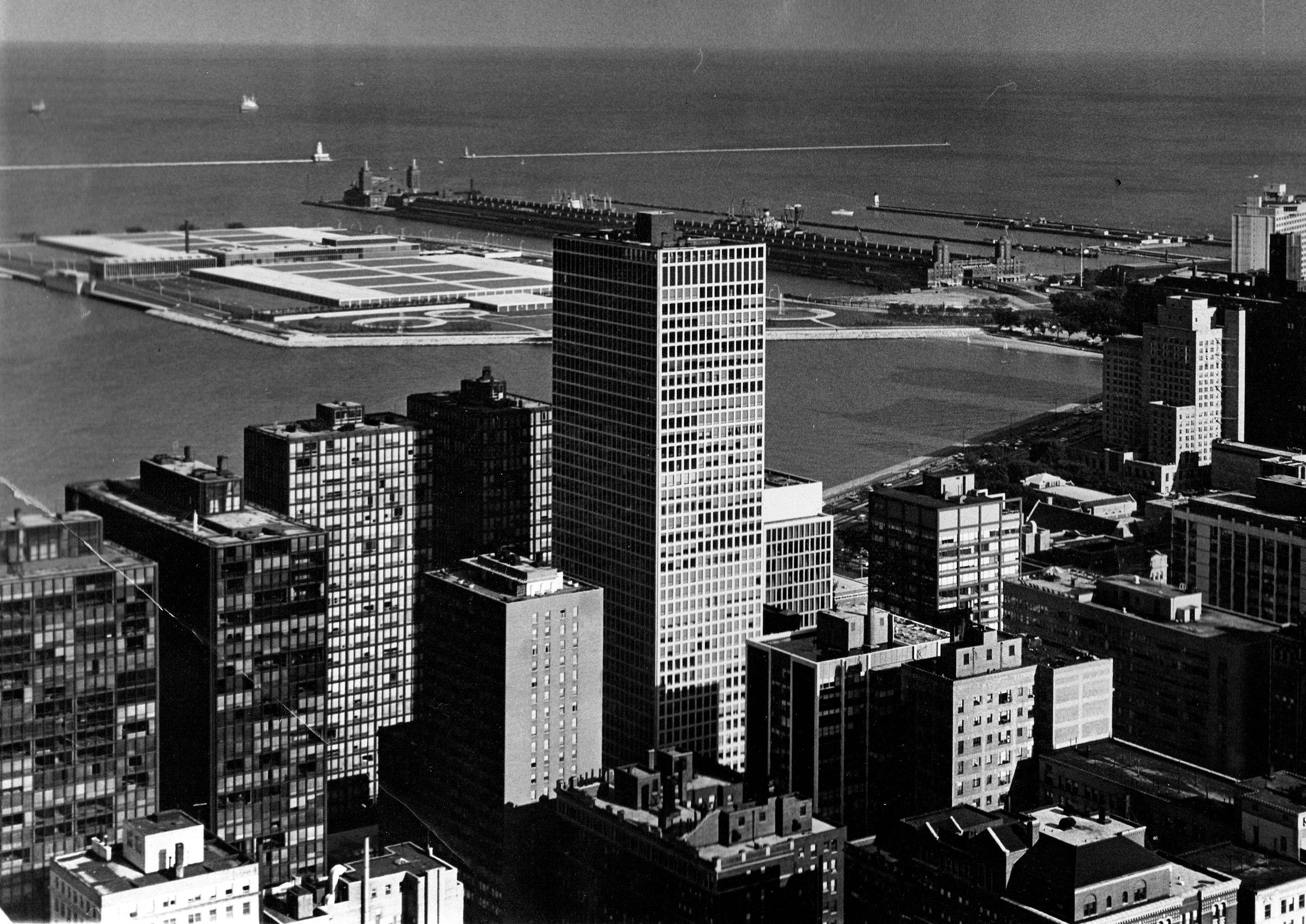
Putting theory into practice, however, demanded clients, builders, and engineers willing to see the drafting table and construction site as laboratories. Chicago’s high-rise community developed an innovation-friendly mindset early; Fazlur Khan, Hal Iyengar, Bruce Graham, and others at SOM experimented with new forms of structural design that led to that firm’s well-known tube structures, beginning with the 1961 Brunswick and DeWitt-Chestnut buildings, both of concrete deployed around those buildings’ extreme perimeters. While the concrete tube represented a radical “return to the bearing wall” in structural engineering, Brunswick used regular 5000 psi concrete on its lower floors and lighter-weight, 4000 psi concrete above. The first Chicago building to reach 6000 psi was 1000 Lake Shore Plaza (1962), a 57-story apartment tower designed by Sidney Morris and engineered by William Schmidt. This building’s relatively small footprint, at just 85’ x 90’, put a premium on floor space and efficiency, driving the need for smaller columns.[xii] While snaring the concrete height record from Marina City, at 590 feet, the jump in concrete strength was relatively easy, adding fly ash and pozzolith to achieve a higher cement-to-water ratio. For the 645’ Lake Point Tower at the foot of Navy Pier, Schmidt’s next project relied on further experimentation and tighter quality control procedures to achieve 7500 psi. As the tower rose, its structure was instrumented with seismographs to provide data on its deflection under wind loading and the long-term effects of creep.[xiii]
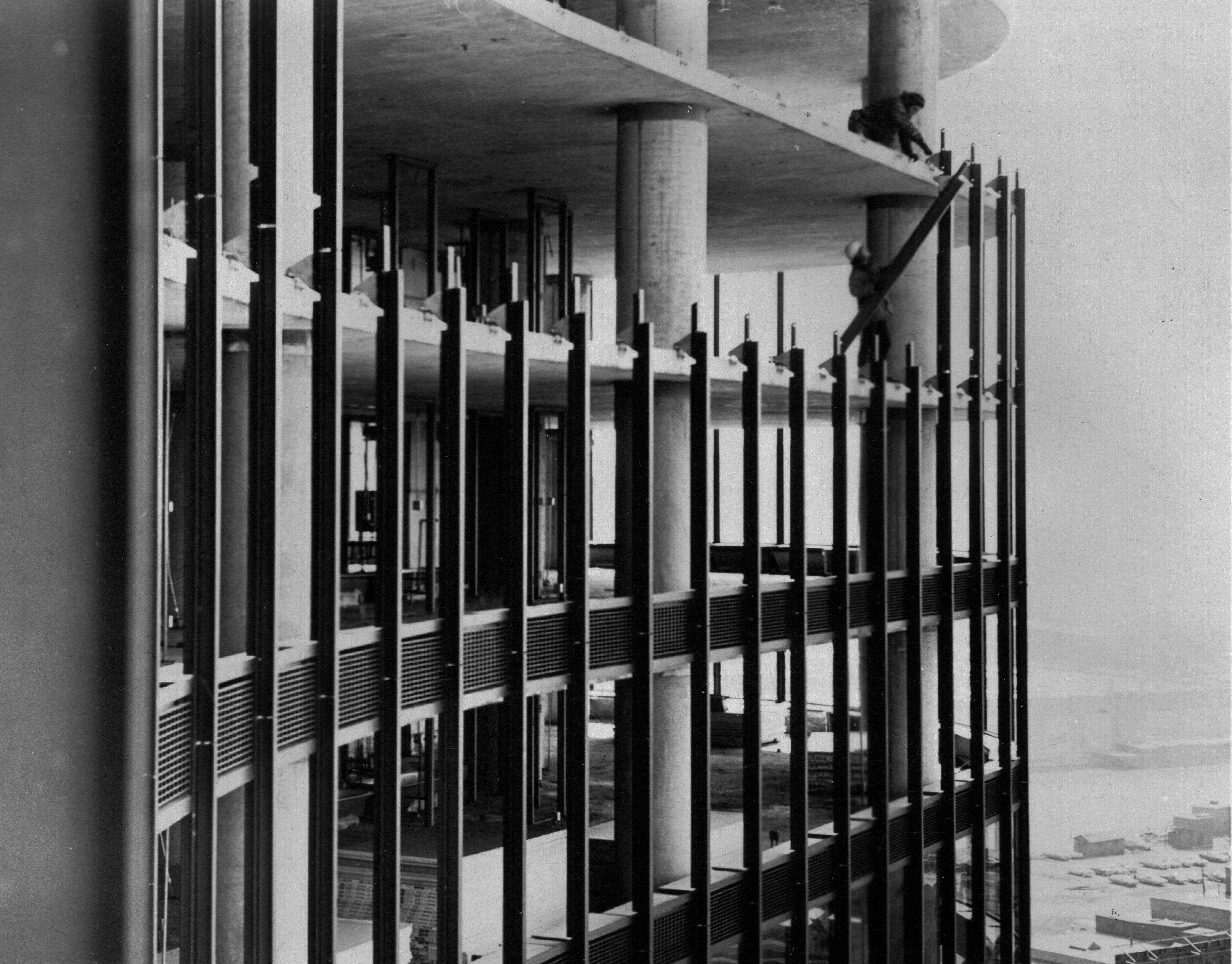
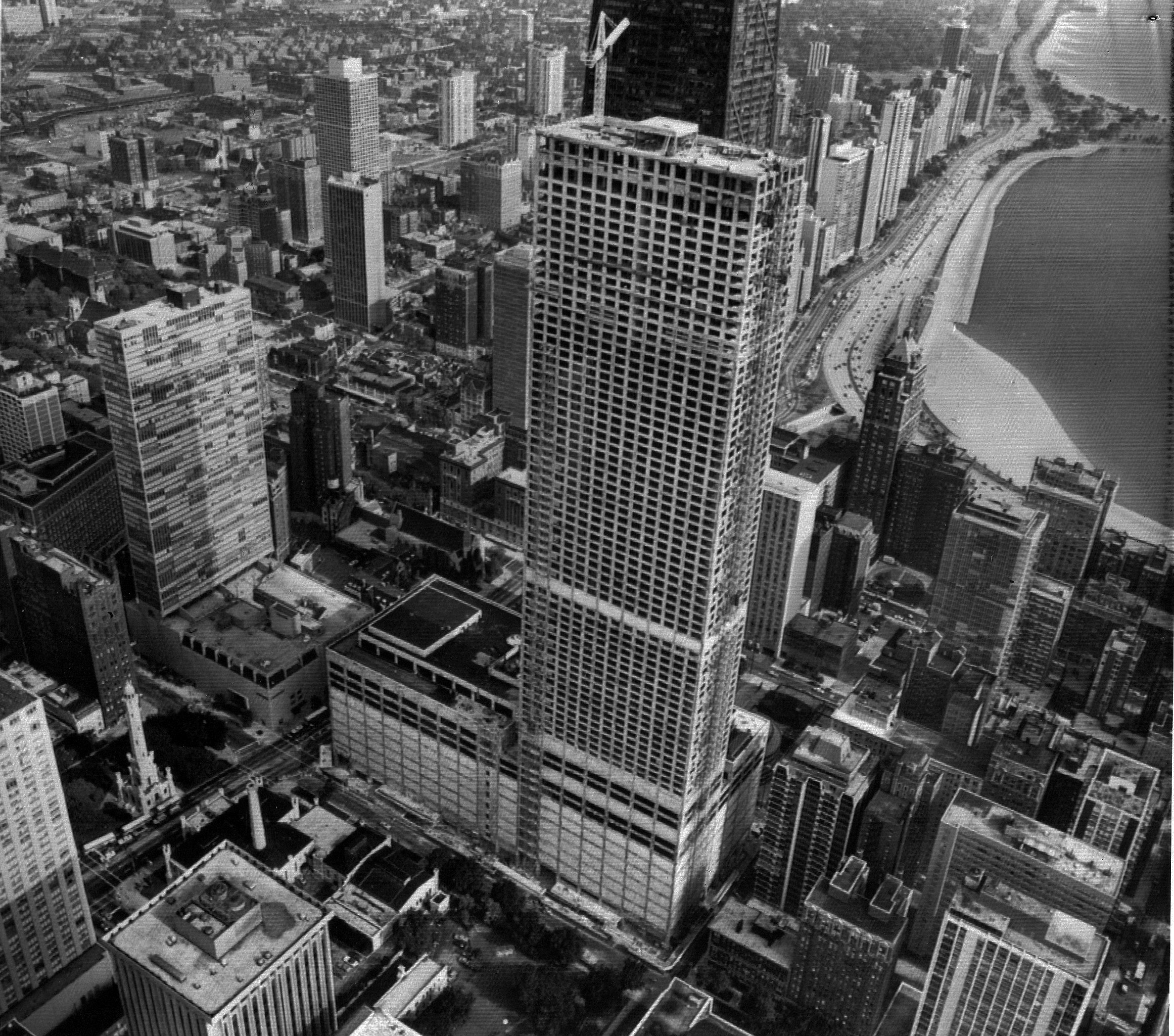
Khan and SOM designed One Shell Plaza, a 714-foot tall tower in Houston that relied on high-strength, lightweight concrete to surpass Lake Point Tower. Still, the height record came back to Chicago in 1975 with the completion of Water Tower Place (Loebl, Schlossman, Bennett, and Dart, architects, C.F. Murphy Associates, engineers), a mixed-use complex composed of a 76-story, 859-foot tower housing a hotel and condominiums atop an eight-story shopping mall and a large theater. This mélange of programs required complex transfer structures to bring the tower’s columns and shear walls to the foundations. To save space on the lower floors and to enable the entire structure to sit on shallow, hardpan caissons instead of deep bedrock foundations, concrete was specified in various weights and strengths throughout: 4000-psi, lightweight concrete for all floor slabs, 6000-psi concrete for the podium structure, and 4000-psi up to 9000-psi for the tower columns. Materials Service provided its most sophisticated mix to date for the latter, incorporating 100 pounds of fly ash per cubic yard to reduce the water-to-cement ratio content to just 36%.[xiv]
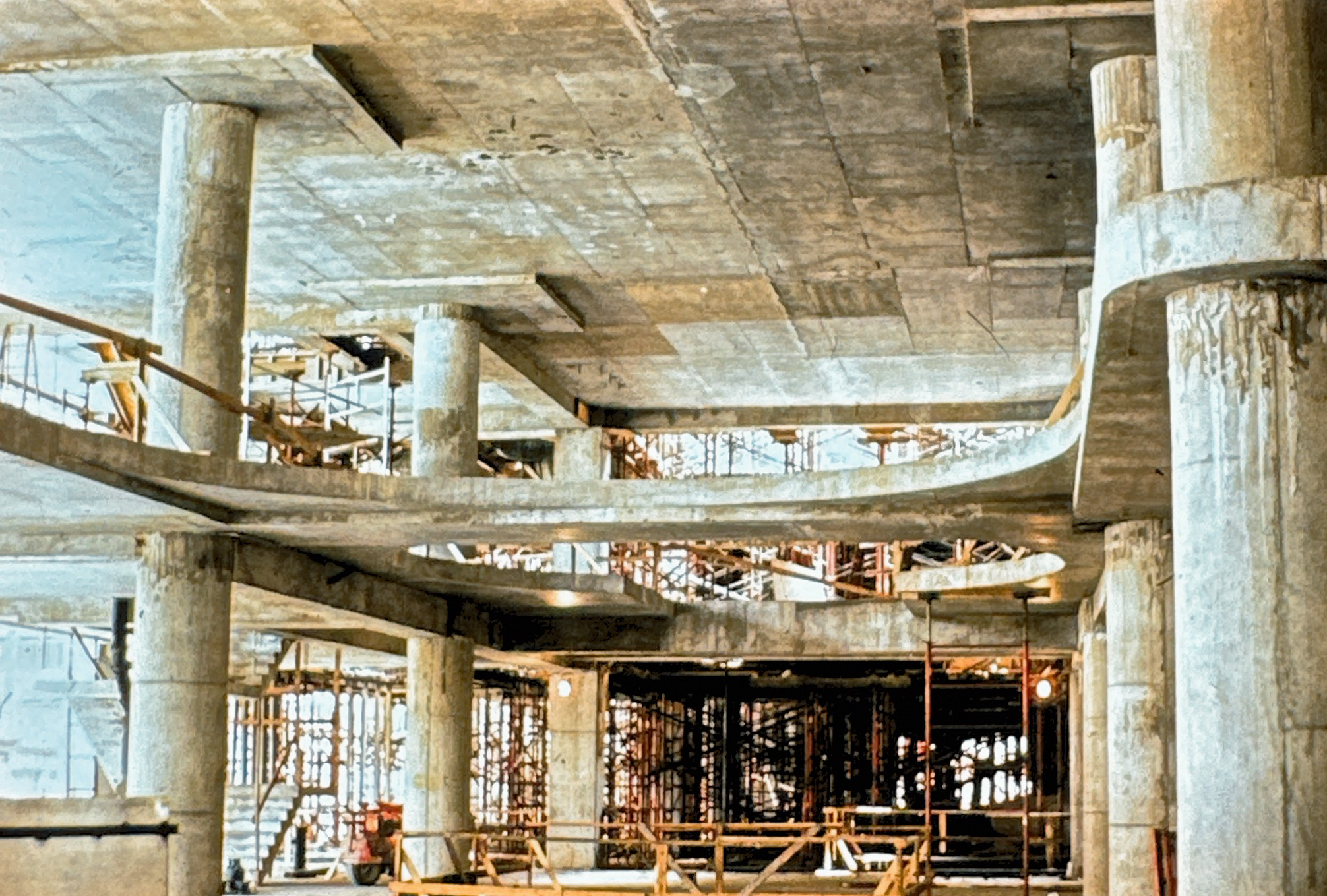
McHugh, the concrete contractors for the project, adhered to strict requirements that saw cylinders from multiple trucks sent to PCA’s Skokie laboratories overnight for testing. Additionally, they developed ‘puddling’ techniques that blended higher-strength column concrete into floor slabs where punching shear forces were highest.[xv] The result was a structure that held the height record for concrete for 14 years, until a pair of Chicago towers—311 S. Wacker Dr., by Kohn Pedersen Fox and Two Prudential Plaza, by Loebl, Schlossman, and Hackl with CBM, structural engineers—surpassed it at 961’ and 915’, respectively, in 1989-90.[xvi] 311 S. Wacker was particularly noteworthy; columns on its lower levels achieved 12,000 psi using microsilica admixtures, and its floor slabs were post-tensioned, requiring 9000 psi compressive strength. Its 8’ thick mat foundation, designed to spread the tower’s load out over 102 caissons below, was the largest single high-strength concrete pour ever, involving 60 trucks coordinated to arrive precisely four minutes apart.[xvii]
[Cont.]
[i] Bertold E. Weinberg, M.ASCE, Resident Engineer, Bertrand Goldberg Associates, quoted in “Marina City.” Civil Engineering, December, 1962. 64.
[ii] Steve Prokopy, “Chicago’s Marina City.” Concrete Products, vol. 114, no. 1, 2011. 18-20.
[iii] “PCA Centennial Celebration Continues.” Concrete International, vol. 38, no. 8, 2016. 16-19.
[iv] Robert L. Bartley, “Strides in Cement: Research Push Pays Off in Stronger, Lighter Concrete for New Uses.” Wall Street Journal, Nov 9, 1962. 1.
[v] Joseph Egelhof, “Supply Firms Fill Chicago’s Building Needs.” Chicago Daily Tribune, Mar. 30, 1952. A7.
[vi] Paul James interview with the author, 25 Oct 2024.
[vii] Pierre-Claude Aitcin and William Wilson, “The Sky’s the Limit: Evolution in Construction of High-Rise Buildings.” Concrete International, Jan., 2015. 45-50.
[viii] John Albinger and Jaime Moreno, S.E., “High-Strength Concrete, Chicago Style.” Concrete Construction, Mar. 1, 1981. N.p.
[ix] John Albinger, “High-Strength Concrete: Fifty Years of Progress.” Concrete Construction, Sept. 9, 2006. N.P.
[x] Arthur H. Nilson quoting Moreno, “Summary of Floor Discussion: Structural Design Considerations for High Strength Concrete,” in S.P. Shah, ed., High Strength Concrete: Proceedings. (Chicago: National Science Foundation, 1979). 217-218.
[xi] Paul James interview with the author, 25 Oct 2024.
[xii] Sherwin Asrow, et al., “Task Force Report # 5: High-Strength Concrete In Chicago High-Rise Buildings.” (Chicago: Chicago Committee on High-Rise Buildings, 1977). 2.
[xiii] “New Tower to be a Giant Test Station.” Chicago Tribune, Jan. 9, 1966. 1-e1.
[xiv] Asrow, op. cit., 45.
[xv] Paul James interview with the author, 25 Oct 2024.
[xvi] Both buildings have significant, unoccupied roof elements, including an 80’ steel spire on Two Prudential that is not counted here.
[xvii] “High Strength High Rise.” Civil Engineering, March, 1988. 63-65.
 architecturefarm
Fascinating story, great that you are telling it, and kind of shocking to realize that such a core history of Chicago’s role in the development of the concrete high-rise has gone so untold until now. PCA had a great campus that intentionally used a variety of concrete types in the structures and landscaping, both as a theme and I think as a weathering experiment. It was entirely demolished just recently. No idea if any of that was relocated.
LikeLiked by 1 person
Thanks! Amazing that there was no outcry over PCA’s demolition–but worth trying to track down some of the remains.
LikeLike