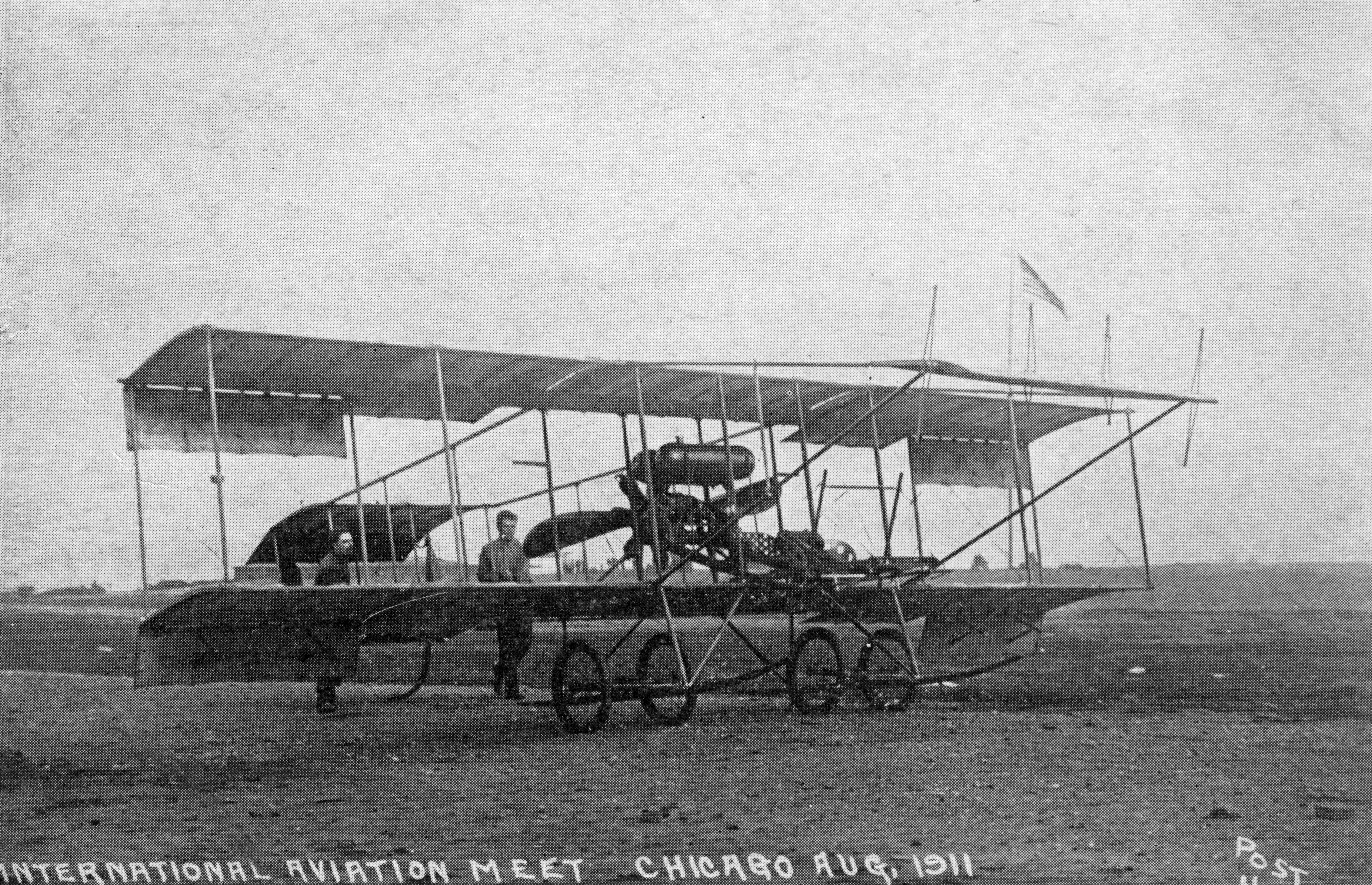
A contestant in Chicago’s first official International Aviation Meet, August, 1911.
With NASCAR racing in Grant Park earlier this summer and Chicago’s annual Air + Water Show warming up over the lake, this seems an appropriate time to point out that Chicago has a long history of racing and aviation in its otherwise pastoral ‘front yard.’
My current research project is a history of Chicago’s airports. Many of the same factors that shaped the city’s skyscrapers–rapidly advancing technology, new commercial imperatives, political friction within and outside the city limits, etc.–were also manifest in the city’s efforts to take advantage of its geographical position. First, as the country’s center of population migrated westward, Chicago was a natural hub for the developing network of air mail routes in the 1920s and for passenger travel in the ensuing decades. As jet aircraft made international travel commonplace in the 1950s and 60s, the city found itself at a natural position on great circle routes to Europe and Asia, spurring the development of O’Hare Airport.
That story’s beginnings take place at the most unlikely of “airports.” In 1910, a failed effort to stage a cross-country aviation race from Chicago to New York made Cicero Field, a half-mile square of turf at Cicero Ave. and 22nd Street, the epicenter of aviation for a summer. Would-be contestants gathered there to assemble their fragile planes and to fly them for paying spectators at nearby Hawthorne Race Track. Cicero Field was owned by Harold McCormick, a scion of the family that had earned its fortune with the original McCormick Reaper and would go on to own the Chicago Tribune. Harold’s fascination with Aviation led to his founding and funding the Aero Club of Illinois, which ran Cicero Field and sponsored local competitions and exhibitions designed to increase public awareness while advancing aviation technology.1
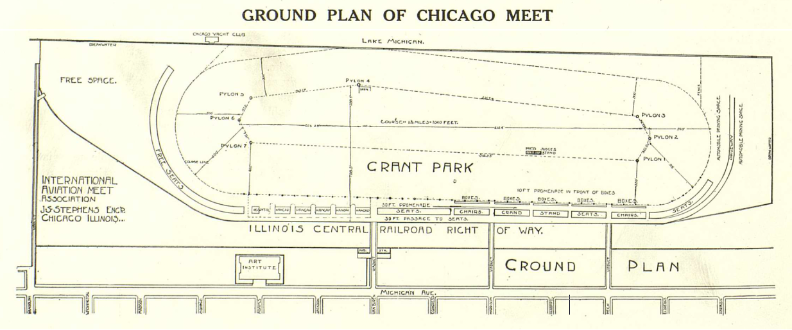
Most of the flying done at Cicero Field was of the “grass mowing” type–short, low-altitude hops in amateur craft, but the influx of national and international aircraft in 1910 led McCormick to propose a larger, more formal exhibition in 1911. That took place in August, turning the newly-completed Grant Park into a hive of flying activity for nine days. McCormick cleverly based prize money on both accomplishments–altitude, speed, and duration, among them–and on total flying time, encouraging participants to keep their machines in the air as much as possible. The 1.3-mile course, laid out from Randolph Street to 12th Street, was a narrow oval lined with seating for 70,000 that allowed spectators to view a constant parade of machinery with the lake as a backdrop in the afternoon sun.2
Geo F. Campbell Wood, “The Chicago Meet.” Aircraft, Aug. 1, 1911. 190.
The meet was an extraordinary success, spurring plans for a second event, held in 1912. But even as it highlighted the rapid progress that had been made in American aviation, it also revealed the problems confronting aircraft builders and pilots; one contestant was killed when the wings of his aircraft collapsed during a high-speed turn in front of the grandstand, and another drowned when his plane crashed a mile offshore.3 After 1912, exhibitions like the Grant Park event faded in favor of more ambitious cross-country races as aircraft became more reliable and their appearance less remarkable.
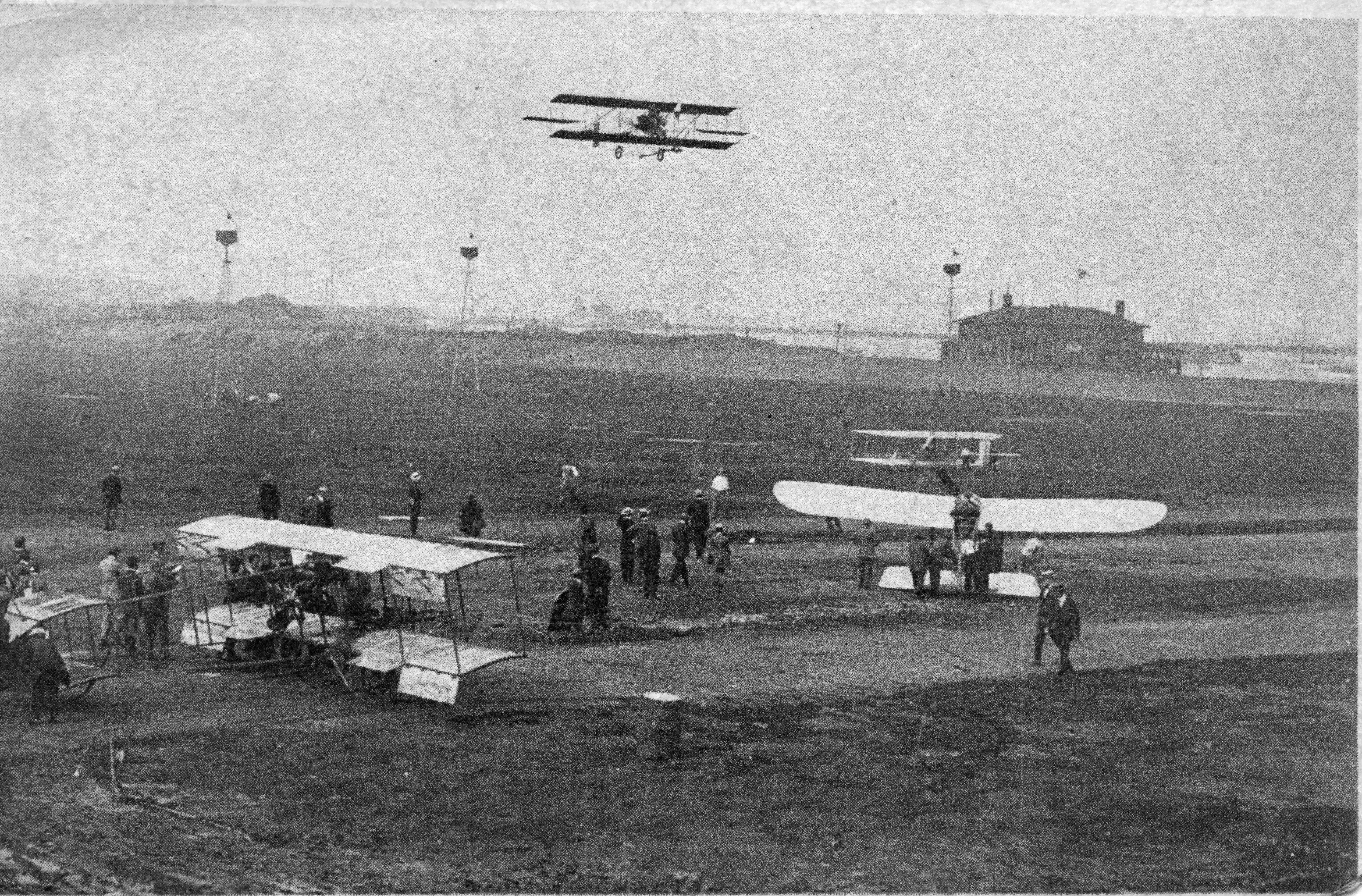
Aircraft aloft and awaiting flight at the International Aviation Meet in Grant Park, 1911. Chicago Yacht Club in the background (Contemporary Postcard, Author’s Collection).
With five international aircraft and their pilots competing, Grant Park can make a claim as Chicago’s first international airport. It would continue to serve as a landing strip for recreational craft and, for a short time, for air mail when that service began in 1918.
A final note. The 1911 and 1912 events took place after a boom in skyscraper construction in the city, and a couple of press accounts that related the aviation meets to the city’s high rises stand out. The first is the entertainment trade journal The Billboard, which reported on aviation mostly in terms of the crowds these exhibitions drew. Chicago, it reported in 1911, was a ready-made arena for such displays:
“There is not another city in America, if indeed in the world, that possesses such a remarkable aviation field right at its doors, as does Chicago in Grant Park, the 160-acre park on the downtown lakefront. where the meet takes place….with the sightseeing space afforded by the skyscraping hotels and commercial buildings along Michigan Avenue, as well as the standing space for the multitude outside the pylons and west of the Illinois Central tracks, over a million people will be able to witness the event.”4
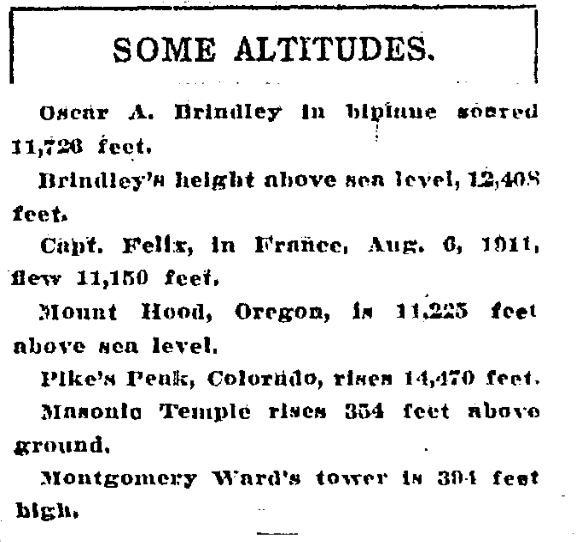
And, marking the turn in public fascination from buildings that appeared to climb skyward to machines that actually did, the Tribune offered some intriguing comparisons5 in reporting on the record altitude achieved by aviator Oscar Brindley during the meet:
Howard Lee Scamehorn, “Balloons to Jets: A Century of Aeronautics in Illinois, 1855-1955.” (Chicago: Regnery, 1957). 53, 81. ↩︎
“Advertisement: International Aviation Meet.” Town & Country, suppl.The Air-Scout, vol. 66, no. 22, Aug. 12, 1911, pp. 2.↩︎
“AVIATORS BADGER AND JOHNSTONE DROP TO DEATH: 50,000 LOOK ON.” Chicago Daily Tribune, Aug. 16, 1911, pp. 1.↩︎
“INTERNATIONAL AVIATION MEET IN CHICAGO.” The Billboard, vol. 23, no. 33, Aug. 19, 1911, pp. 4-4, 55.↩︎
“WORLD RECORD BROKEN; FLIES UP 11,726 FEET: B.” Chicago Daily Tribune, Aug. 19, 1911, pp. 1.↩︎
Your post is a wonderful homage to an assortment of different groups of noble people from different times, who collectively over the past century and a half have worked to make Chicago an invigorating, meaningful, and positive place. This includes the many who labor to transform it into a “city in a garden”, with the Grant Park lakefront being a major focal point of that vision.
It is admirable that this post was timed to coincided with the week of the Chicago Air and Water Show. After 114 years, the Chicago lakefront remains a spectacular venue to do so many things, including providing the rare opportunity to watch aircraft in flight in close proximity in a manner intended to maximize the viewer experience. Your post bumped together some of my interests, including early aviation, architectural history, and the history of Chicago, which generated some thoughts and observations about this exceptionally important, but almost forgotten event:
Location, location, location…and timing…and prior experience: The 1911 event inevitably would have happened, but it would have been somewhere around the perimeter of the city (similar to what occurred at most other cities at that time and for the 1910 Chicago event), but it was fortuitous that the burst of growth in aviation coincided with the comparatively recent completion of the grading of this area of Grant Park, but prior to the massive planting of trees in this area. This openness provided an exceptionally large, clear area for a landing field and low-level racing of aircraft, as well as excellent sightlines of the activities.
The downtown location and the well-developed Chicago area transportation system provided easy access for massive numbers of attendees from the surrounding city and suburbs, which in turn allow the revenue (along with the funding from the backers) to increase both the number different types and purse size of the numerous competition prizes. This in turn created one of the highest attended and greatest total amounts of prize money awarded of any of the major aviation meets in the time prior to World War One, as attested in the pre-war aviation publications.
The prize money and the public exposure in turn helped attract one of the largest number of aircraft (about 32) and one of the most stellar assortments of pilots to participate in the event. The experience of the Chicago business community in the organizing, promoting, and managing the 1893 World Columbian Exhibition presumably made this 1911 event a comparatively easy challenge.
It is well known that the Wright brothers first flew in 1903, and that it was not until 1908 that they finally began making flights that were open to and visible by the public (compelled by the successful public flights of Glenn Curtiss). It must have been thrilling in ways we can only imagine for most of the attendees of both the 1910 and 1911 events to view (and hear!) powered aircraft for the first time. It is reasonable to assume those intense first thrills greatly helped to accelerate the development of the aviation industry, including the multitude of airfields that appeared in and around the Chicago area in the years that followed. Future installments of your new research (on this worthy but previously neglected topic) are eagerly anticipated!
Thanks, Kim! I hadn’t thought about the links between 1893 and 1911, but there’s surely some linkage there–that’s going to send me back to the archives to see if there were personnel who were on both organizing boards.
The Wrights were problematic, especially in Chicago, where they campaigned against the two big air shows on patent infringement grounds. Curtiss was a more generous figure, and he figures prominently in the city’s early aviation history.
 architecturefarm
Re the juxtaposition of an airfield and skyscrapers, how about the army airfield on Governors Island?
LikeLike
I’ll see your Governor’s Island and raise you one Meigs Field…!
LikeLiked by 1 person
Your post is a wonderful homage to an assortment of different groups of noble people from different times, who collectively over the past century and a half have worked to make Chicago an invigorating, meaningful, and positive place. This includes the many who labor to transform it into a “city in a garden”, with the Grant Park lakefront being a major focal point of that vision.
It is admirable that this post was timed to coincided with the week of the Chicago Air and Water Show. After 114 years, the Chicago lakefront remains a spectacular venue to do so many things, including providing the rare opportunity to watch aircraft in flight in close proximity in a manner intended to maximize the viewer experience. Your post bumped together some of my interests, including early aviation, architectural history, and the history of Chicago, which generated some thoughts and observations about this exceptionally important, but almost forgotten event:
Location, location, location…and timing…and prior experience: The 1911 event inevitably would have happened, but it would have been somewhere around the perimeter of the city (similar to what occurred at most other cities at that time and for the 1910 Chicago event), but it was fortuitous that the burst of growth in aviation coincided with the comparatively recent completion of the grading of this area of Grant Park, but prior to the massive planting of trees in this area. This openness provided an exceptionally large, clear area for a landing field and low-level racing of aircraft, as well as excellent sightlines of the activities.
The downtown location and the well-developed Chicago area transportation system provided easy access for massive numbers of attendees from the surrounding city and suburbs, which in turn allow the revenue (along with the funding from the backers) to increase both the number different types and purse size of the numerous competition prizes. This in turn created one of the highest attended and greatest total amounts of prize money awarded of any of the major aviation meets in the time prior to World War One, as attested in the pre-war aviation publications.
The prize money and the public exposure in turn helped attract one of the largest number of aircraft (about 32) and one of the most stellar assortments of pilots to participate in the event. The experience of the Chicago business community in the organizing, promoting, and managing the 1893 World Columbian Exhibition presumably made this 1911 event a comparatively easy challenge.
It is well known that the Wright brothers first flew in 1903, and that it was not until 1908 that they finally began making flights that were open to and visible by the public (compelled by the successful public flights of Glenn Curtiss). It must have been thrilling in ways we can only imagine for most of the attendees of both the 1910 and 1911 events to view (and hear!) powered aircraft for the first time. It is reasonable to assume those intense first thrills greatly helped to accelerate the development of the aviation industry, including the multitude of airfields that appeared in and around the Chicago area in the years that followed. Future installments of your new research (on this worthy but previously neglected topic) are eagerly anticipated!
LikeLike
Thanks, Kim! I hadn’t thought about the links between 1893 and 1911, but there’s surely some linkage there–that’s going to send me back to the archives to see if there were personnel who were on both organizing boards.
The Wrights were problematic, especially in Chicago, where they campaigned against the two big air shows on patent infringement grounds. Curtiss was a more generous figure, and he figures prominently in the city’s early aviation history.
Much more to come, for sure…
LikeLike