As always, happy to weigh in on the latest political news.
Yesterday saw extensive coverage of the remodeling of the “Lincoln bathroom” in a central Washington, D.C., residence, along with historians (amateur and professional) weighing in on the fact that its adjacent bedroom had actually been Lincoln’s office and that the conversion to a guest bedroom happened in the 1940s.
I’ll leave the interior design critique to the professionals. Still, having just given the “Electricity and Sanitation” lecture in my History of Construction class (better known by at least one student as the “Light Bulbs and Poop” lecture, great), I’ll weigh in on the business end of things.
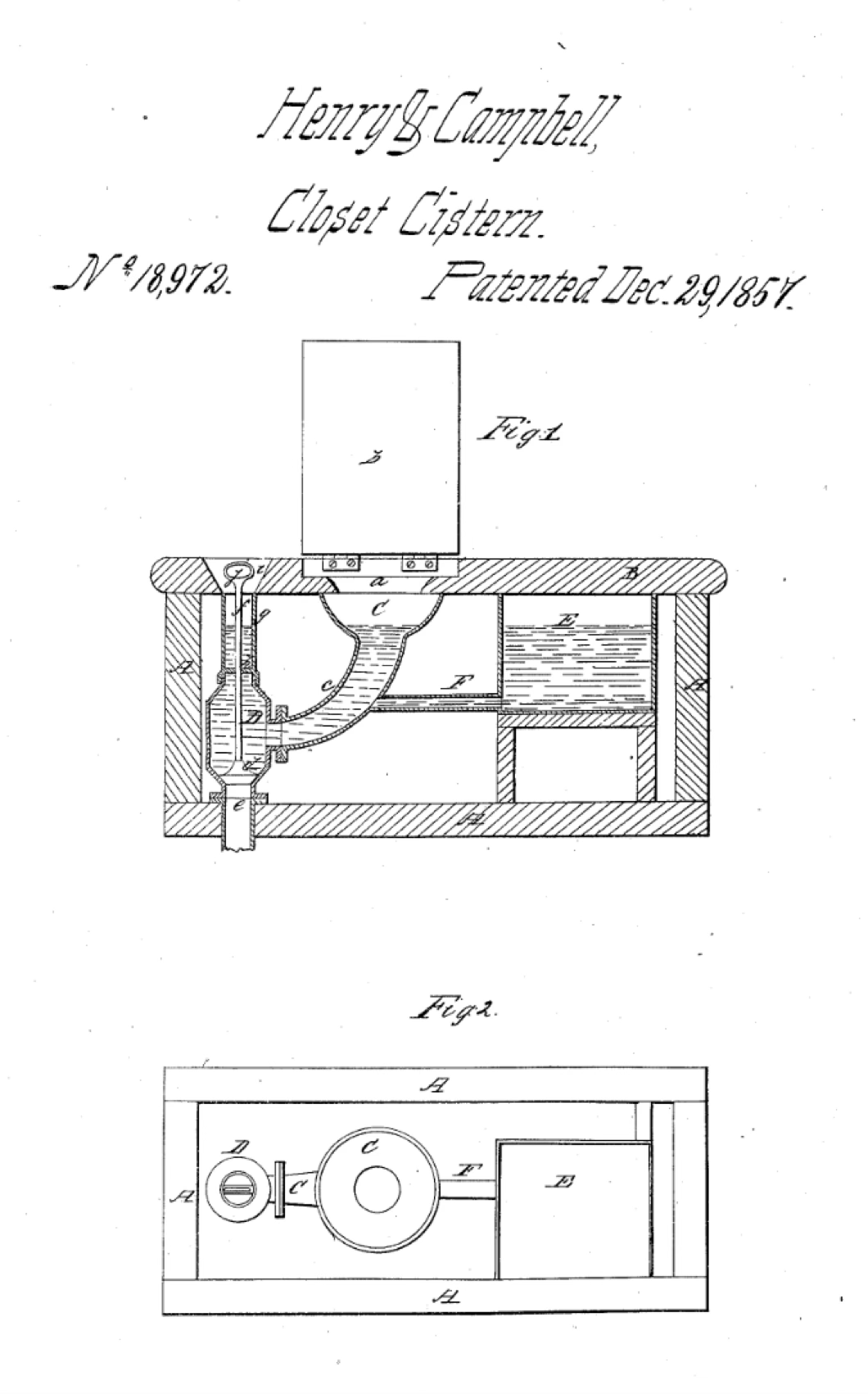
The American flush toilet dates back to this patent, issued in 1857 to James Henry and William Campbell, both of Philadelphia. Almost all the parts of a modern toilet are there–the bowl, the reservoir of fresh water to wash down the contents, and a lever to get the fun started. What’s missing is a trap — a way to keep a water seal above the foul gases in the sewer pipe. That technical innovation had been thought of, as early as 1775, by Scotsman Alexander Cummings, but somehow that didn’t make it into Henry and Campbell’s patent.
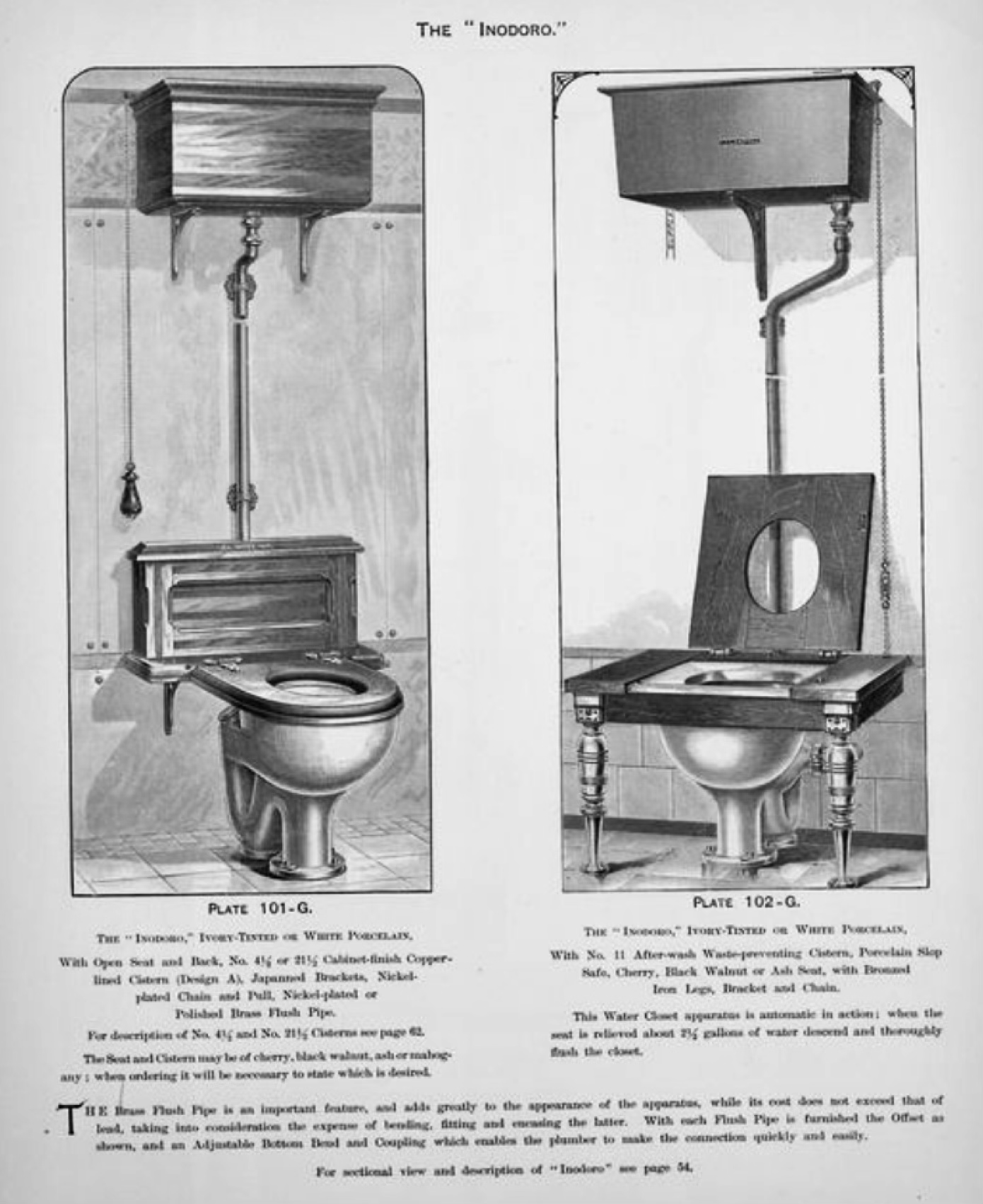
Still, manufacturers added S-traps to fixtures based on that early patent — above are two from J.L. Mott’s Iron Foundry catalogue from 1888. These have a raised tank to improve water pressure, a pull chain for convenient control, and S-traps to keep sewer gases out of the room.
All well and good, but the provision of toilets inside a large Washington residence only got sewage so far. That city, like many of the era, laid pipes to provide fresh water to much of the city in the early 19th century in an effort to address the constant problem of cholera and typhoid outbreaks. But providing ample fresh water had the unfortunate effect of encouraging residents to… use it. Where to take that water once it had been fouled remained a problem, whether it was used for washing, chamber pots, or, later, fancy toilets. Chemical engineer Edward C.C. Stamford noted in 1869 that:
“The present water closet system, with all its boasted advantages is the worst that can be generally adopted, briefly because it is a most extravagant method of converting a mole-hill into a mountain. It merely removes the bulk of our excreta from our houses, to choke our rivers with foul deposits and rot at our neighbors’ doors. It increases the death rate, as well as all other rates, and introduces into our houses, a most deadly enemy, in the shape of sewer gases.” (Scientific American, July 24, 1869).
Stamford and others argued for large landfills, treated with various chemicals, to gradually turn waste water and sewage into compost, but it wasn’t until 1871 that Washington began to build sanitary sewers–until then, water closets (whether Lincoln’s or any other resident of the District) simply discharged into the nearest convenient ditch, canal, creek, or river, all of which festered and contributed to the spread of disease–not to mention a general stink throughout the city. Even early efforts by the city (detailed here) were problematic, combining storm and sanitary sewage into one stream that washed everything into local waterways. Not until 1890 was a single sanitary system built, ensuring that all wastewater in Washington would be discharged downstream from the city into the Potomac.

Like Chicago and many other cities, simply moving the foul discharge as far away from any source of drinking water reduced mortality from waterborne diseases, but it wasn’t until 1938 that Washington built its first treatment plant, which used sedimentation and organic methods to break down and purify the city’s sewage.
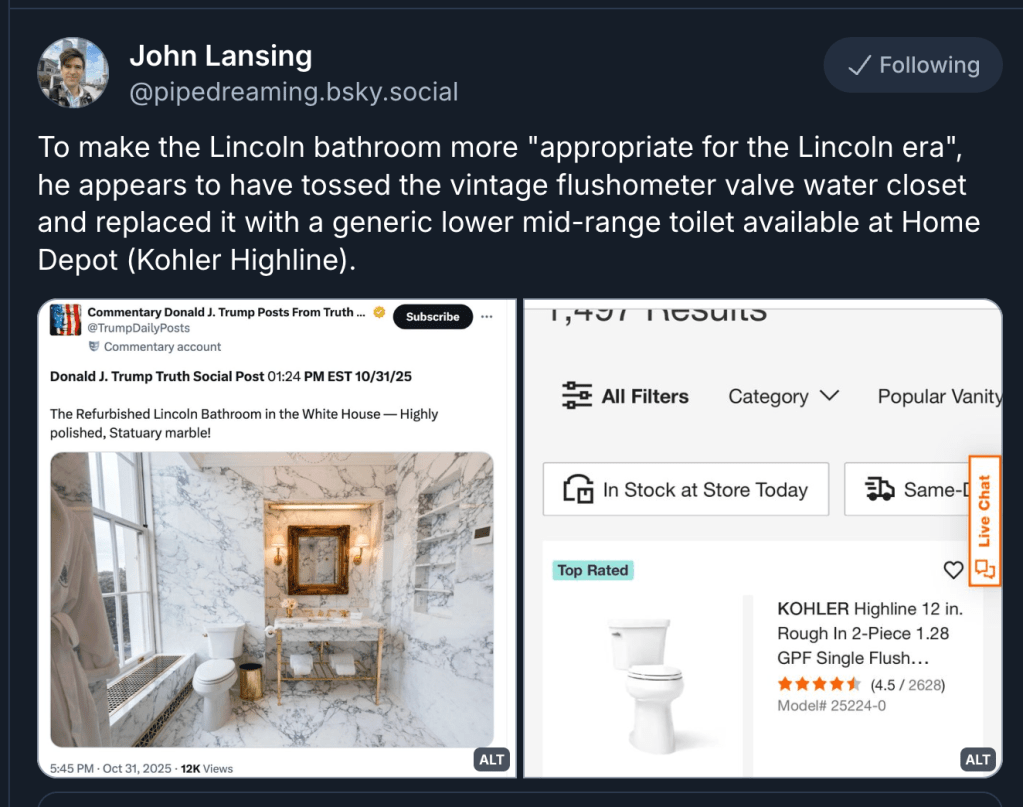
All of which is to say that any effort to restore the “Lincoln bathroom” to its alleged 1860s status probably doesn’t understand the full scope of the issue. Unless the renovation included a handy chamberpot, or a Henry + Campbell, wooden-seated water closet discharging into the Rose Garden, it’s probably best to avoid any talk about authenticity. Especially, as noted by plumbing engineer John Lansing, the choice of water closet appears to be a Home Depot-stocked Kohler Highline model
 architecturefarm