AIA Chicago asked me to write about the current state of high-rise building in Chicago and what the future holds for skyscrapers in a work-from-home era. I had thoughts, but I also talked to several practitioners to see where things stand. The article is in the current issue of Chicago Architect(which should be hitting your mailboxes this week) and is online here…
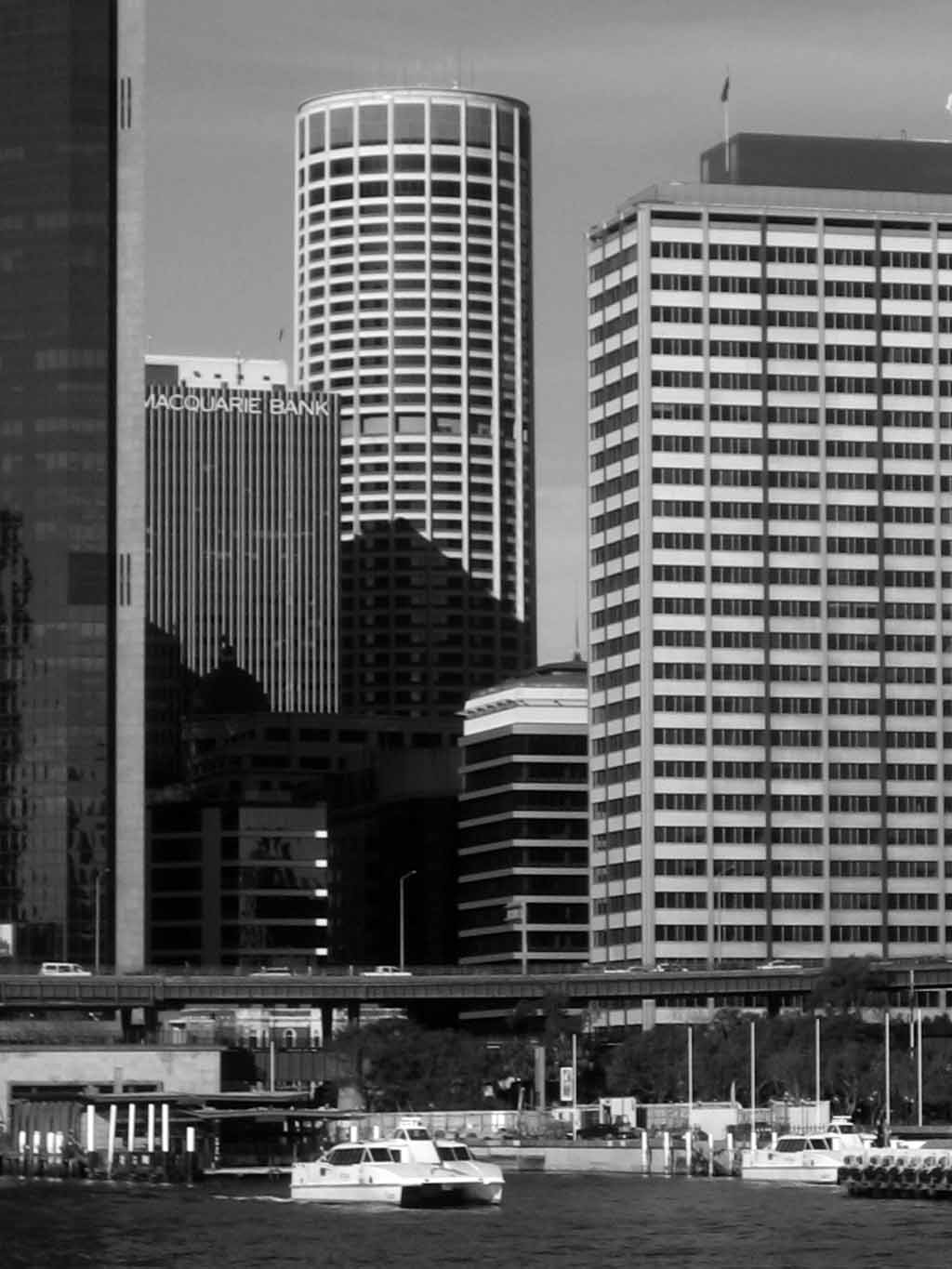
Curator and author Vladimir Belogolovsky will continue the Skyscraper Museum’s In Situ webinar series tonight at 6:00 EDT with a presentation on Australia Square, a collaboration between Harry Seidler and Pier Luigi Nervi that pioneered use of lightweight concrete in high rise structures–and also produced one of the more elegant towers of the era. I’ll be joining in the discussion afterward. Free, but registration required–more details on the Skyscraper Museum’s website here.
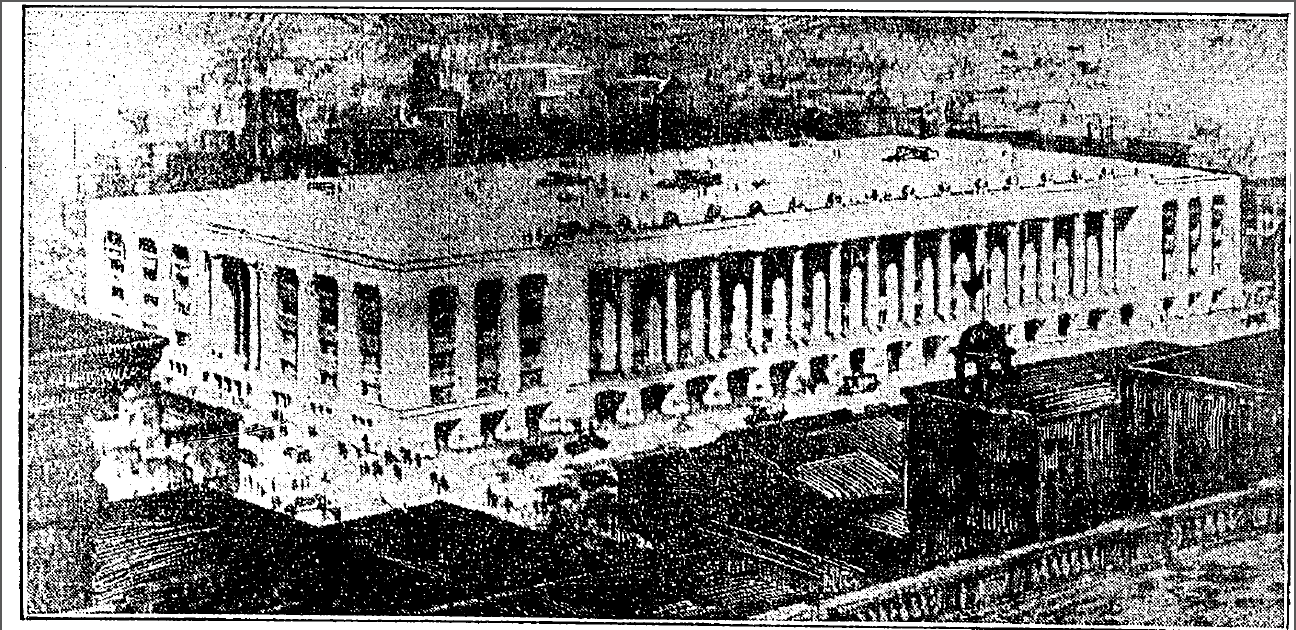
Some scouting for a potential next project, and this frankly adorable news item cropped up. In 1927, Chicago was about to build its long overdue replacement for Henry Ives Cobb’s disastrous 1905 Postoffice and Federal Building. It was also in the midst of the air mail revolution and at the hub of a rapidly expanding network of aviation routes that offered unheard-of speed. The city’s air mail facilities moved from Grant Park (!) to Maywood, but the field there wasn’t convenient to the city–fine for mail being transferred but not great for mail destined for downtown. Plans to base air mail at Chicago Municipal Airport (later Midway) were being developed, but that field was undersized, crowded, and about to endure a decade-long fight over its expansion into a reasonably sized facility.
So, why not combine the new postoffice with the air mail field?
Chicago Tribune, July 21, 1927.
“Plans for new Chicago Postoffice provide landing field for air mail planes” the Tribune announced in July, 1927, along with a rendering–presumably by Graham, Anderson, Probst, and White, but not attributed–of a monumental, neoclassical postoffice for the blocks between Harrison, Polk, Clinton, and Canal streets–with air mail planes wandering around its flat-topped roof.
At six acres, and with a long dimension of just 800 feet, the rooftop was “considered somewhat small for an airport,” but authorities looked at the anticipated schedule for the postoffice and the pace of development in aviation and concluded that “by the time the building is erected the airmen will be able to make it serve their purposes.” Aircraft manufacturers were “now working out the problem of how to stop and start airplanes from a limited area of six acres,” and postal officials were confident that would be solved shortly.
Spoiler alert: It was not. When Municipal did expand from a quarter-mile square to its current mile-square footprint, the primary driver was runway length for new, heavier planes that required more distance to land safely. The new field would feature diagonal 3000 ft. runways–without the proposed postoffice rooftop’s six-story drop at both ends. Similarly, the city’s blithe reassurance that “the height of adjacent buildings would not interfere with the landing of airplanes on the roof” came even as the 555′ Civic Opera Building was breaking ground, less than half a mile north and–definitively–in the flight path of the proposed 600′ runways.
Rooftop airports had been proposed before–there were rumors that the flat top of the Blackstone Hotel would house a runway for airplanes in 1910 (“admittedly,” the Tribune reported regretfully, “not to be used by amateur aeroplanists, for in case of accident the dropping is far and the available spots for alighting are not softer than a well-seasoned cement sidewalk.” And every spiky building top of the 1920s seemed destined to become an airship mooring mast.
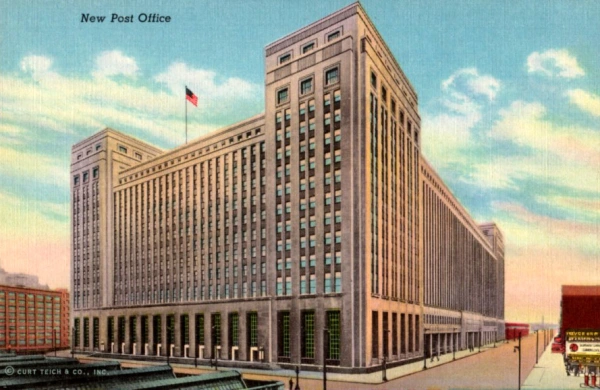
But, alas, cooler heads prevailed. The air mail facility was moved to Municipal later that year (a former air mail pilot named Lindbergh helped inaugurate it), and the postoffice design evolved to the four-towered, vertically-striped behemoth that has enjoyed a rebirth as a giant commercial office building. The erstwhile rooftop runways are, in fact, now an outdoor amenity deck. But even if aircraft aren’t landing on top of the Old Post Office, the building maintains the distinction of being one of the few structures to have an expressway burrowing through it, at least…
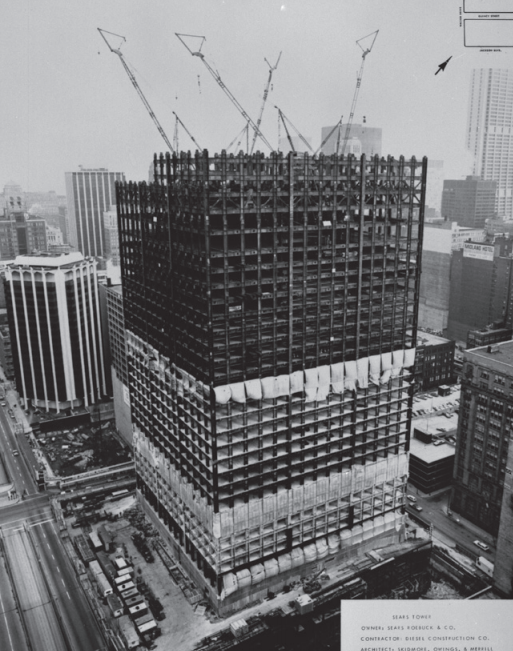
Daniel Safarik invited me to join him on his excellent podcast, Unfrozen, to talk about Chicago Skyscrapers, 1934-1986, and some of the less savory aspects surrounding high-rise construction in the city during the era. We talked about why this book has a subtitle while the previous skyscraper book did not, tall buildings as chess pieces on an urban game board, how speculative development created very different buildings than corporate headquarters building, and why the John Hancock Building’s construction deserves a screenplay. A great conversation…
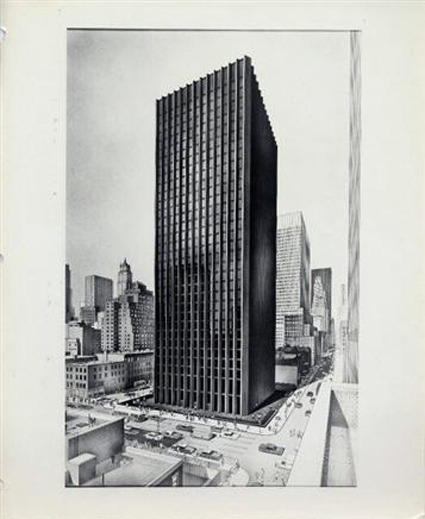
Structural engineer Matthys Levy will be talking about his work for Weidlinger Associates on Eero Saarinen’s CBS Headquarters in New York (1965). Admission is free but registration is required; details on the Skyscraper Museum’s website here.
I’m particularly looking forward to this one. Levy’s talk will be the next in a series leading up to the Museum’s exhibit on Concrete Skyscrapers later this Fall, which I’m helping to curate. CBS is (literally) a dark horse in the canon–a building that deserves a lot more discussion and attention than it’s typically had.
Levy (also literally) wrote the book on structural engineering for students, along with Mario Salvadori. It’s a text that I’ve relied on ever since to explain structural concepts to architects, so speaking with him as we’ve pre-gamed his talk has been particularly welcome. Look forward to seeing many of the ArchitectureFarm regulars “there…”
I’m very happy to share that I’ll be in conversation with Sun-Times architecture critic Lee Bey at the Newberry Library on October 12. Registration opens on Sept. 1. More information is on the Newberry’s website.
Lee’s 2019 book, Southern Exposure: The Overlooked Architecture of Chicago’s South Side, was a constant companion and guidebook as Chicago Skyscrapers, 1934-1986 was coming together; it inspired a lot of long bike rides during the pandemic that led me to important high-rises that I would have missed otherwise. So this is a particularly welcome invitation. Expect to hear about Lake Meadows, South Commons, and why Dubin, Dubin, Black, and Moutoussamy should be far better known than they are…
[Chicago Skyscrapers, 1934-1986, published by University of Illinois Press, is available now on Bookshop.org and Amazon.com, among other outlets. This week’s post follows up on my discussion with Adam Rubin at the Chicago Architecture Center at the book’s launch event, where we talked about the roster of unsung heroes in the city’s postwar building culture–Milton Schwartz is one of the era’s most intriguing characters. His tour de force apartment tower deserves far more credit than historians have been willing to give it…]
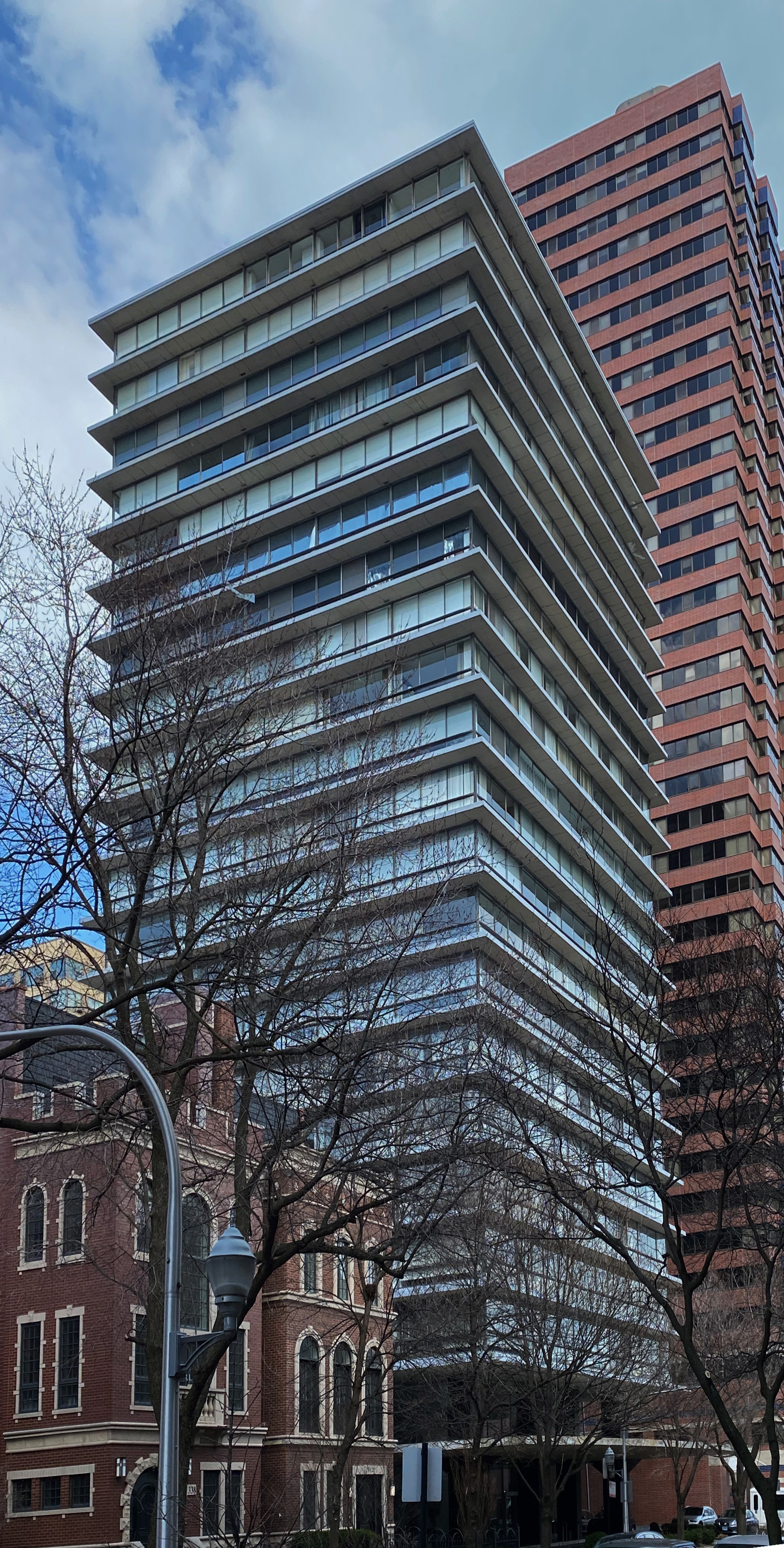
320 Oakdale (1955), Milton Schwartz
“One man’s dream,” according to Forum’s panel, a striking tower two blocks north of Lincoln Park expanded on 1000 Lake Shore’s glass walls and concrete brise-soleils while demonstrating air conditioning’s potential for apartment design. Its architect-developer, Milton Schwartz, grew up in a Chicago family that owned a plumbing and heating business. He attended the University of Illinois’ architecture program, leaving in 1947 to work for the family and as a general contractor, earning his professional license in 1952. Living at the corner of Commonwealth and Oakdale, he bought an adjacent site from realtor Jerrold Wexler. Just 26 and inspired by Frank Lloyd Wright’s lecture at Illinois on heliocentric design, Schwartz drew up a circular scheme with cantilevered floor slabs reminiscent of Wright’s Johnson Wax laboratory tower in Racine (1944-1950) to form large, overhanging sunshades, surpassing Wright’s in its transparency, with “outside walls entirely of glass, with no column obstructions.” Unlike 1000 Lake Shore, Schwartz—confident in his family’s expertise—proposed that the tower be “completely air conditioned,”.[i]
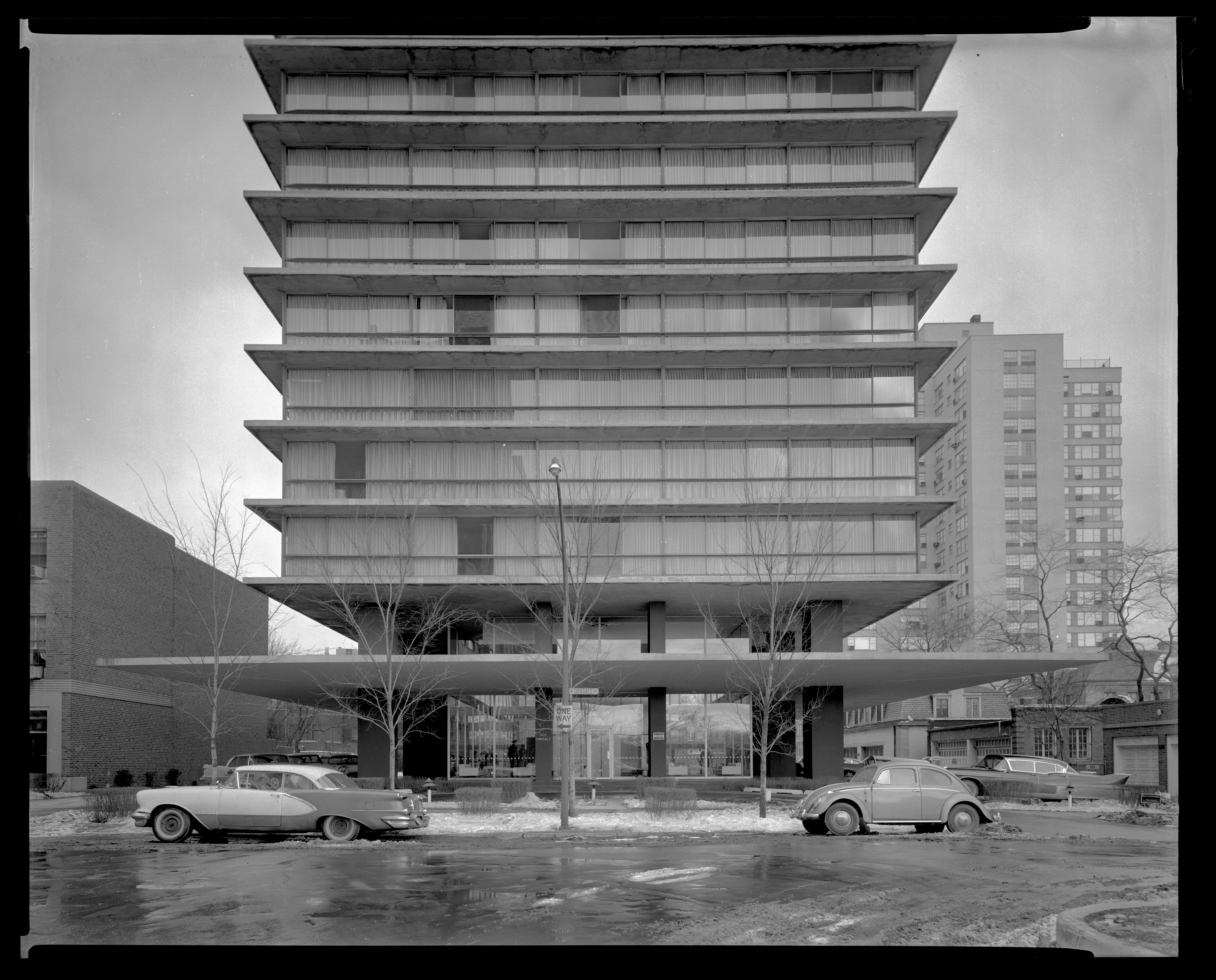
The round form did not find willing lenders. Instead, Schwartz worked with structural engineer Henry Miller on a square version, seventeen stories high, with floor slabs that cantilevered 3’-4” beyond its all-glass walls. Miller supported this on 36 columns that transferred through story-tall shear walls at the third floor to just 12 columns and a central elevator core at the ground level, providing a dramatic, 20’ overhanging porte-cochere—an “outlandish underpinning,” according to Forum’s panel. Above, aluminum and plate glass storefronts made up floor-to-ceiling windows, with operable sashes at the center of each column bay.[ii] Dovenmuhle, Inc., gave Schwartz an $800,000 mortgage and Schwartz’ own contracting firm constructed it from 1953-54.[iii]
320 Oakdale’s 75’ x 75’ floors held just two or three two- and three-bedroom apartments each. Bathrooms, kitchens, and closets were planned tight to the central core, with the rest of the units opening to its continuous glass walls. Schwarz combined the units’ living and dining rooms, sensing suburban ranch homes’ open plan appeal to families and the potential for dramatic, open-cornered views.[iv] To save weight, floor slabs of lightweight concrete blocks rested on 8-1/2” deep poured-in-place concrete joists. Ceilings were plastered onto these, saving height and framing costs. Schwartz’ father and uncle installed perimeter fan coil units that supplied hot or cold water and developed a radiant slab for the ground-level parking, circulating warmed freon to heat cars from below.[v]
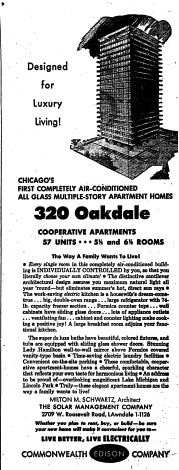
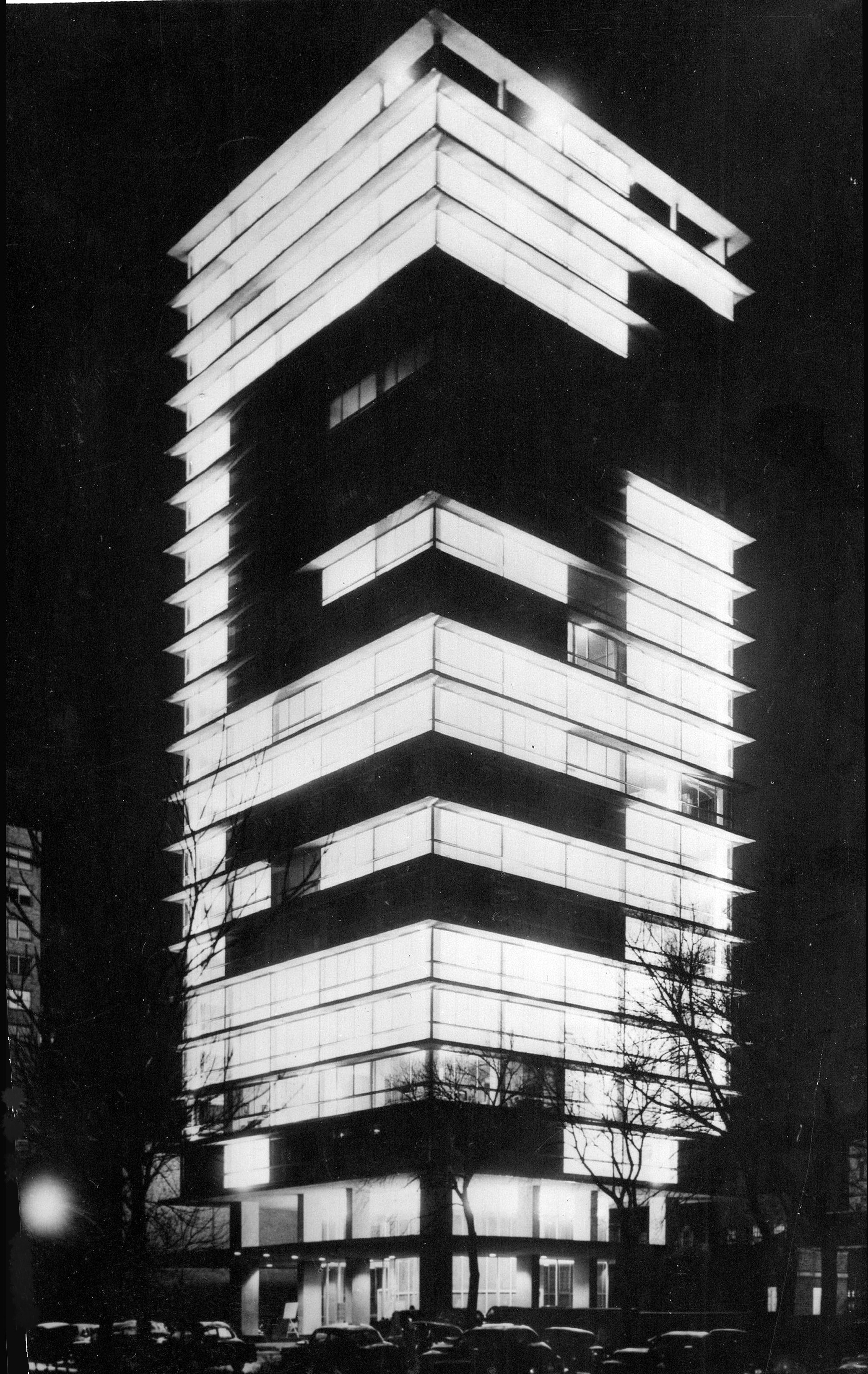
“Chicago’s First Completely Air-Conditioned All Glass Multiple Story Apartment Homes,” announced Schwartz’ advertising campaign in the spring of 1954. Co-sponsored by Commonwealth Edison, his ads pitched the units, available as cooperatives for between $32,000 and $38,000 ($315,000 and $374,000), to a more child-friendly clientele than Greenwald or Perlman, offering competition for the suburbs’ convenience and open space. With Lincoln Park and the lakefront so close, Schwartz’ advertising enthused, “these elegant apartment homes are the way a family wants to live!”[vi] The building’s air conditioning system was a major selling point— “Every single room in this completely air-conditioned building is Individually Controlled by you, so that you literally choose your own climate!”—as were appliances and amenities that were standard features of new suburban homes. “The work-saving electric kitchen,” his ads promised, would be “a housewife’s dream-come-true.”[vii] These amenities were matched by reasonable co-op fees. Schwartz required a 60% down payment but offered low monthly assessments of $200 ($2000), dropping to $30 ($300) after the five-year construction mortgage had been paid down. 320 Oakdale attracted the families he had targeted; demand for the project’s three-bedroom units outpaced that for one- and two-bedroom units. Schwartz was reduced to showmanship to sell the smaller apartments, installing high-intensity lights in every room of the vacant units that turned the tower into a beacon to evening commuters on Lake Shore Drive in late 1954.[viii]
That stunt “managed to sell one or two apartments, but it left more conservative architectural critics nonplussed.[ix]Forum’s panel regarded the project grudgingly, calling the long horizontals “awkward” and pointing out that the 360° sunshades “make no sense…except on the south face.” Much of 320 Oakdale’s design was prescient, though. Its cantilevered sunshades, reinterpreted as occupied balconies, would emerge in Marina City (see below), a project that realized Schwarz’ abandoned dream of a cylindrical tower. Its large units’ success showed how high-rises could compete with suburban ranch homes, and Miller’s structural accommodation of automotive traffic recognized the car’s increasing presence. Most importantly, 320 Oakdale proved the viability of glass curtain walls and air conditioning in residential high rises. Schwarz had the technical ability close enough to hand that he understood how cladding, air conditioning, and solar shading could be integrated in ways that Greenwald and Perlman had not. Forum may have considered the tower “outlandish,” but Schwartz’ ‘dream’ set new comfort standards for Chicago apartments.
Apartment building at 320 W. Oakdale Avenue, designed by architect Milton Schwartz & Associates, Chicago, Illinois, February 12, 1959. [Chicago History Museum].
320 Oakdale was one of several important turning points in curtain wall and air conditioning nationwide. Window air conditioners saw sales spike during the hot summer of 1952 and “are you air-conditioned?” challenged “politics, baseball, and Russia as something to talk about,” according to the New York Times.[x] Chicago hosted the American Society of Heating and Ventilating Engineers’ annual conference in January, 1953, which the organization billed as “air conditioning’s biggest year.”[xi] Used to mechanical comfort in offices, stores, and theaters, Chicagoans also began to demand it in their homes.
[i] Al Chase, “Building Using Big Glass Area Under Study.” Chicago Daily Tribune, Dec. 21, 1952. A7.
[ii] “Eight Chicago Apartments: Nineteen Glass Tiers Sitting on a Cantilever.” Architectural Forum, vol. 103, no. 5. November, 1955. 149.
[iii] “Real Estate Notes,” Chicago Daily Tribune, Feb. 27, 1954. A5; Al Chase, “21-Story Co-op with Walls of Glass Rising.” Chicago Daily Tribune, May 31, 1953. A9.
[iv] See floor plan published in “Eight Chicago Apartments: Nineteen Glass Tiers Sitting on a Cantilever.” Architectural Forum, vol. 103, no. 5. November, 1955. 149.
[vi] Display Ad: “Designed for Luxury Living! [320 Oakdale]” Chicago Daily Tribune, May 23, 1954. E8.
[vii] Display Ad: “Designed for Luxury Living! [320 Oakdale]” Chicago Daily Tribune, May 23, 1954. E8.
[viii] “Eight Chicago Apartments: Nineteen Glass Tiers Sitting on a Cantilever.” Architectural Forum, vol. 103, no. 5. November, 1955. 149.
[ix] “Glass Tower Doesn’t Hide its Light.” Chicago Daily Tribune, Nov. 25, 1954. G6.
[x] C. B. Palmer, “The A B C and the X of Air Conditioning: The Elements and Benefits are Simple; the Unknown Quantity is the Future. the ABC and the X of Air Conditioning.” New York Times, July 27, 1952. 2.
[xi] Russell Freeburg, “Homes Are Air Conditioning’s New ‘Frontier’: Fair of ’33 Gave Big Boost To Industry.” Chicago Daily Tribune, Jan. 23, 1953. 1-b5.
[Chicago Skyscrapers, 1934-1986, published by University of Illinois Press, is out now–available on Bookshop.org and Amazon.com, among other outlets.This week’s entry follows up on last week’s Skyscraper Museum webinar conversation with SOM Principal Emeritus Bill Baker about that firm’s history of concrete high rises and tube structures].
“The right means to the right ends must be found; i.e., the means must be in scale with the ends, and a philosophic base must be used to judge the relationship of structure, scale, end architecture.”
–Myron Goldsmith, “The Effects of Scale,” 1953-1987.[i]
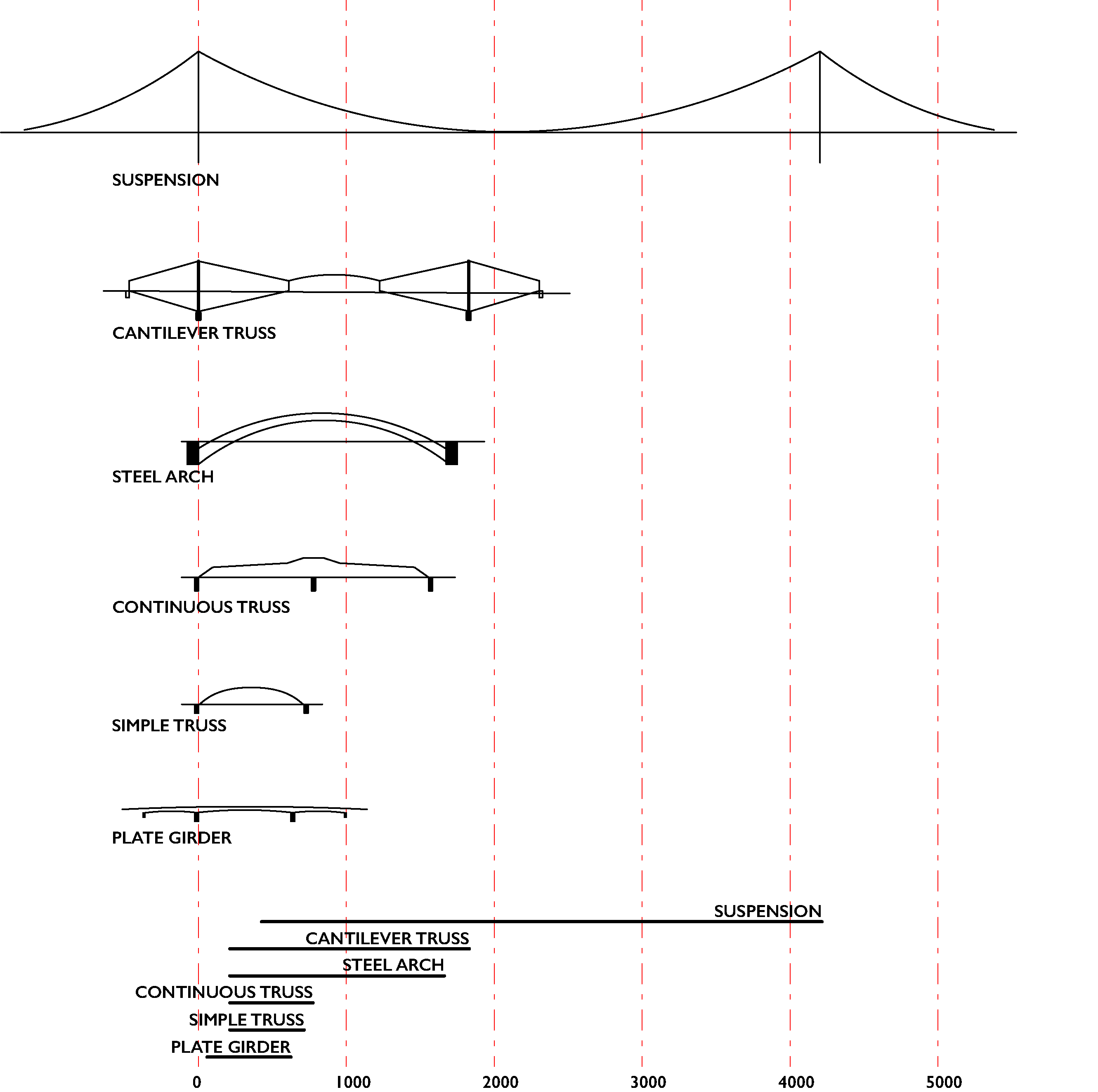
Myron Goldsmith’s 1953 IIT Master’s thesis on tall building structures argued that scale was critical to structural systems. He began with Galileo’s physiological example: if a bone is enlarged proportionally, its cross-sectional area—and thus bearing capacity—increases exponentially by a factor of two but its volume—determinant of the bone’s self-weight and thus of the loads it carries—increases by a factor of three. A structure can only be scaled up so far, Galileo realized, before it fails under its own weight—or, as Goldsmith quoted biologist D’Arcy Wentworth Thompson: “Elephant and hippopotamus have grown clumsy as well as big.”
Goldsmith recognized this principle in building structures, particularly masonry ones, where bearing walls’ self-weight produced structurally clumsy equivalents—the massive walls of the Monadnock’s lower stories, for example. Similar limits exist for all systems and materials. In high rises, lateral resistance to wind limits simple frames to around 25 stories—lower-story columns become ungainly in buildings taller than this as shear forces build up, and shear walls or trusses are needed to maintain reasonable column sizes. Taller buildings, Goldsmith argued, require structural changes that are not simply quantitative—more cross-section or stronger materials. Instead, they require qualitative changes in the configuration of the structure itself. New systems came with architectural potential in addition to optimization. “A new structural system,” he wrote, “gives the possibility of a new aesthetic expression.”
Myron Goldsmith, “The Effects of Scale.” Master’s Thesis, IIT, 1952 and Fazlur Khan, diagram of comparative structural types for high-rises, ca. 1968. (Author, new graphic after original in SOM Archives).
“Engineering for efficiency is not the last and only determinant; it is possible to make a choice from several efficient schemes because of architectural, aesthetic, and environmental reasons. The human needs must give the directions.”[ii]
Goldsmith expanded “The Effects of Scale” in his 1987 monograph, Buildings and Concepts, to include urban and environmental impacts. The efficient scaling up of oil tankers in the 1970s, for instance, made more optimal vessels but brought greater risk of catastrophe, and denser and larger cities required more complex systems—circulatory, infrastructural, and economic, among others. Goldsmith’s thesis, done with Mies as advisor, formed the prototype for IIT’s M.S. program during the 1960s, much of which he and Fazlur Khan supervised along with David Sharpe, a graduate of Tuskegee’s undergraduate program who joined SOM and the IIT faculty. IIT’s Master’s program became a fertile think-tank for SOM, producing case studies of structural and architectural integration that often found their way to drawing boards downtown and vice versa.[iii]
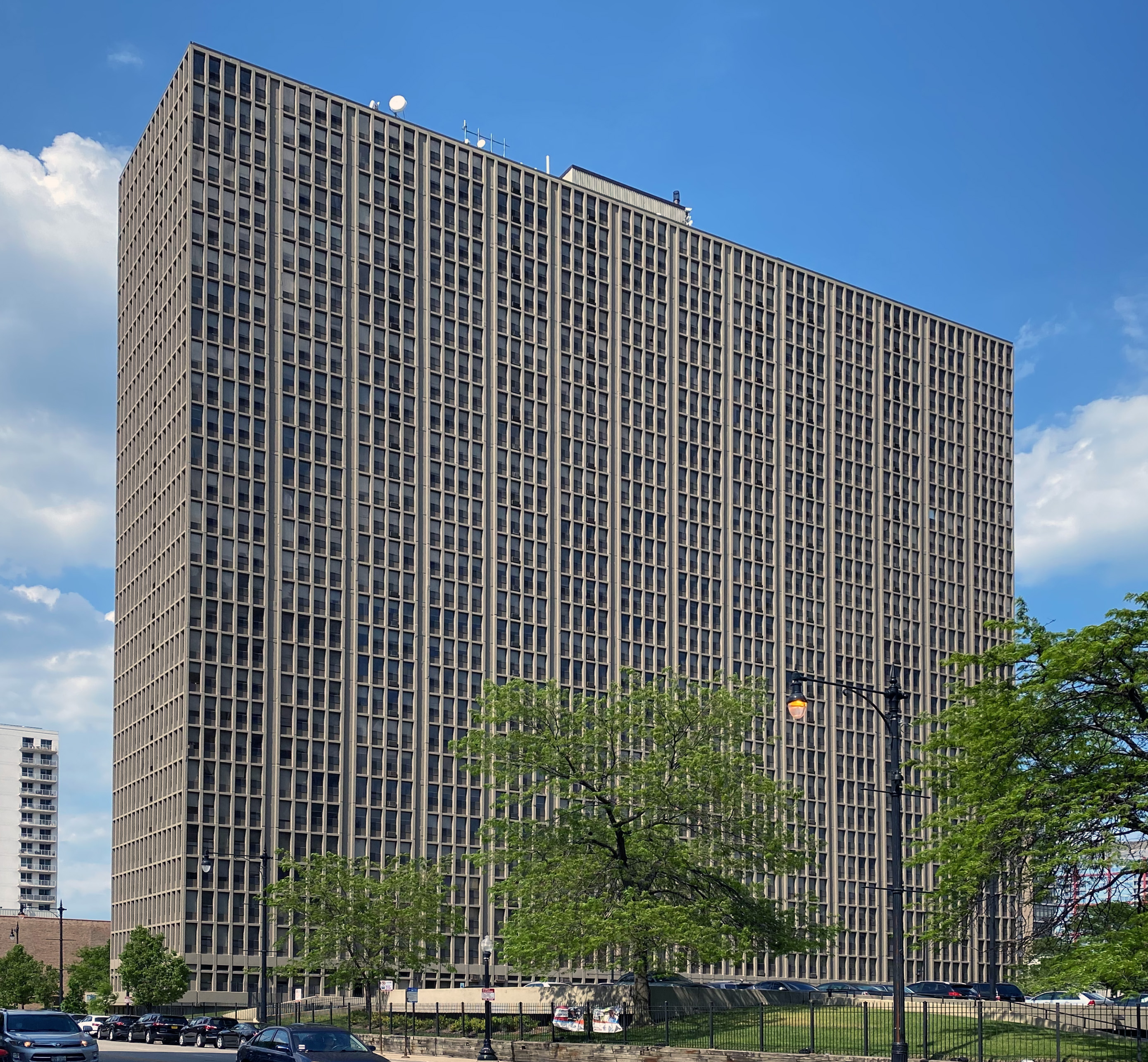
Chestnut-DeWitt (SOM, 1962-65)
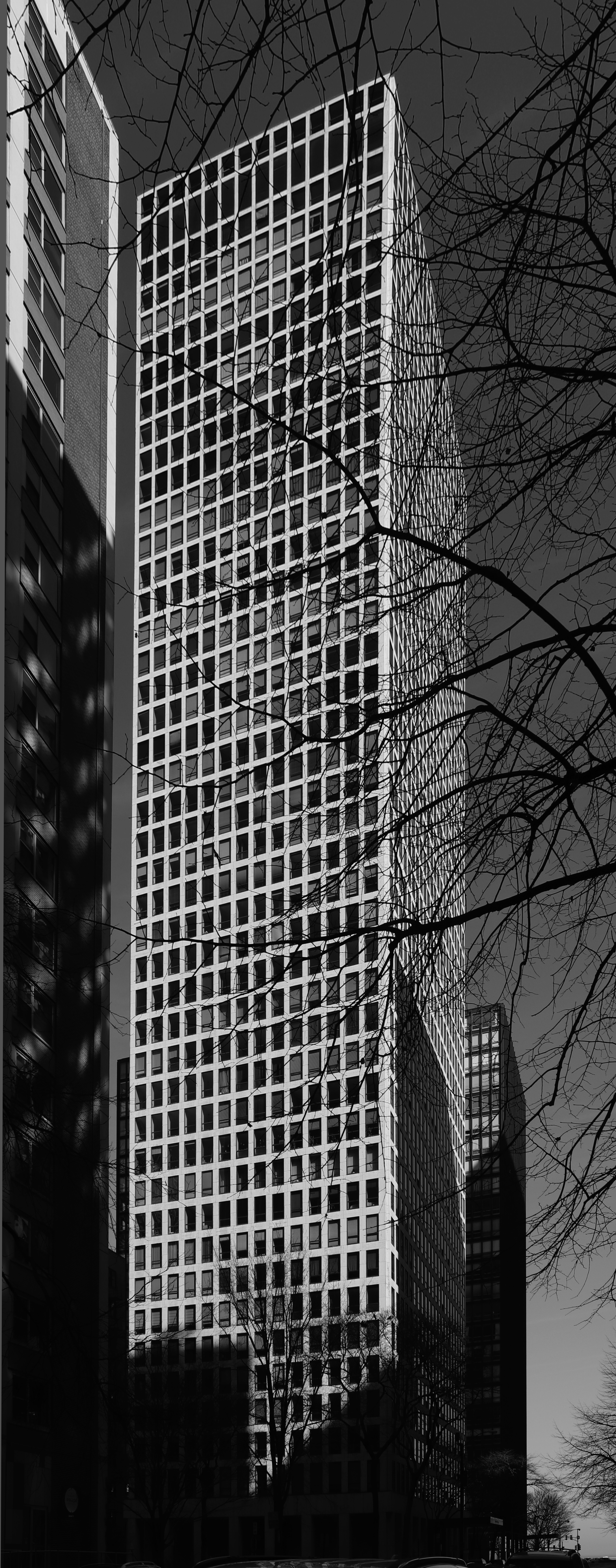
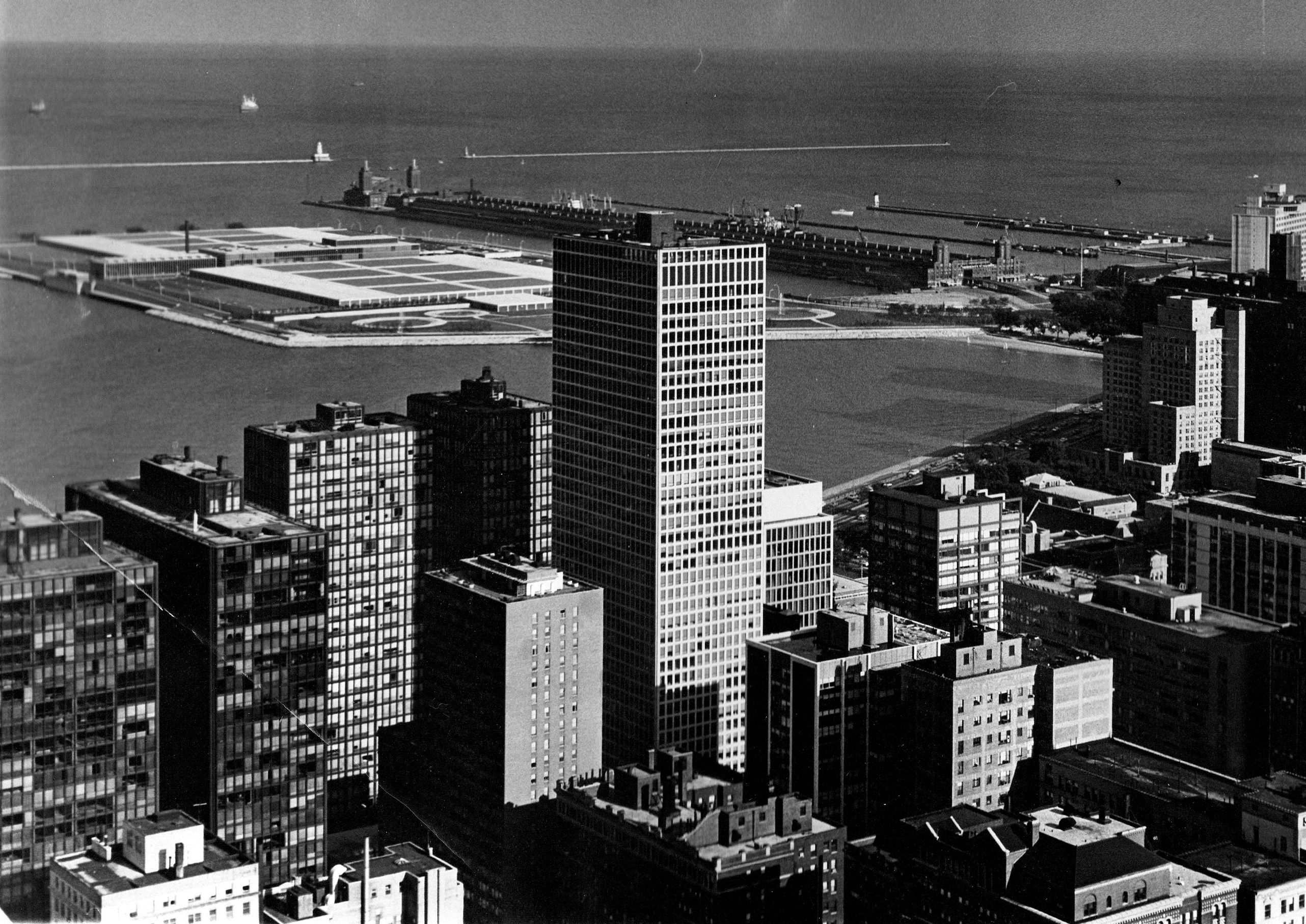
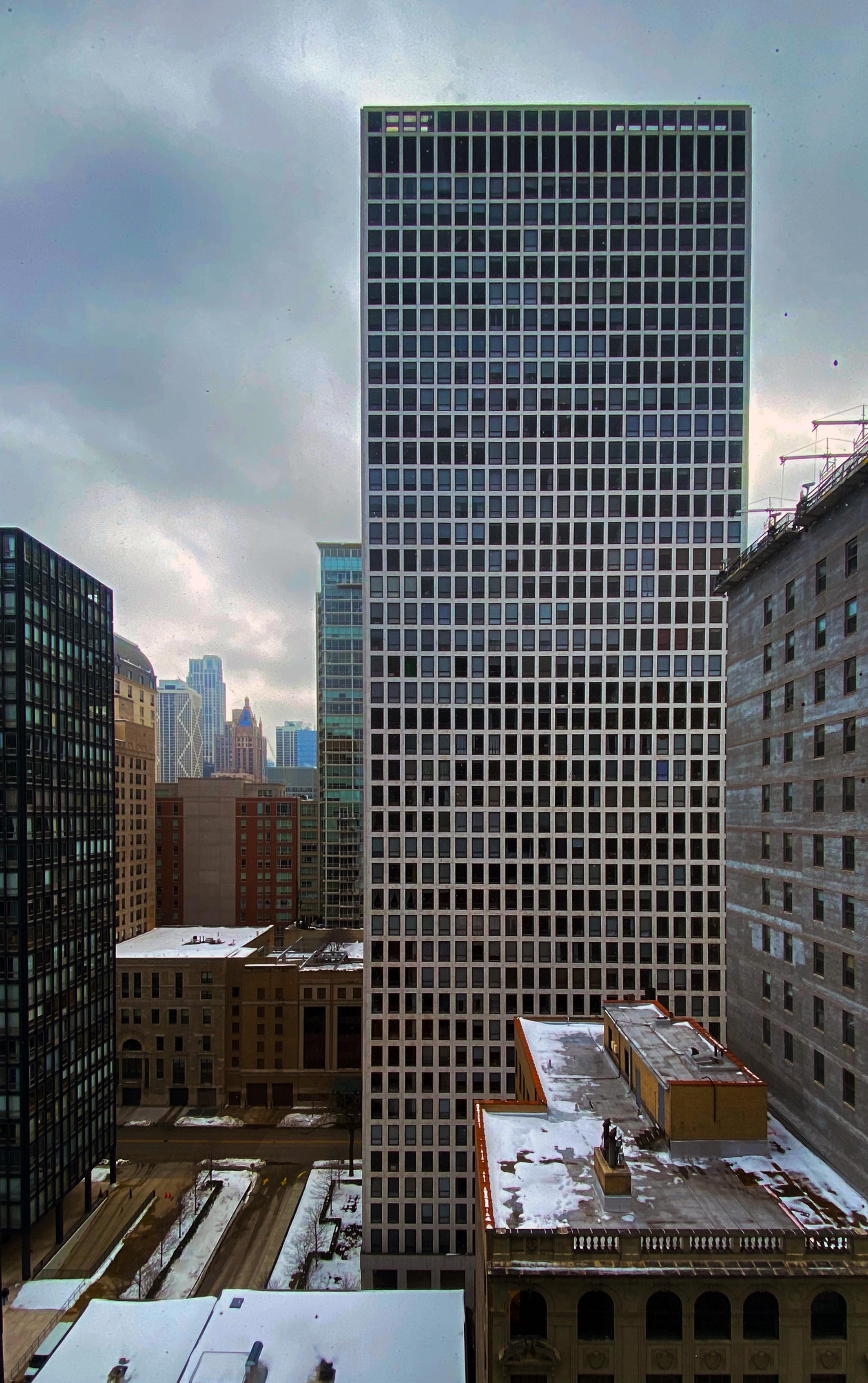
Goldsmith’s thesis saw striking application in the 43-story Chestnut-DeWitt Apartments, designed in parallel with the 37-story Brunswick. Brunswick’s wind-resisting synthesis of closely spaced perimeter columns, stiff spandrel beams, core shear walls, and linking floor slabs spurred Graham, Goldsmith and Khan’s growing interest in the ‘rebirth of the bearing wall.’ But Chestnut-DeWitt’s unique site circumstances, coupled with differences between commercial and residential programs, made for a subtle reconsideration of the Brunswick’s principle into a new structural type—the tube.
Chestnut-DeWitt’s site was an L-shaped Streeterville lot adjacent to Mies’ 860-880 Lake Shore Drive. Metropolitan Structures, re-organized after Herbert Greenwald’s death in 1959, owned the site and asked SOM to design a third pair of towers in their Lake Shore Drive cluster. Graham recalled being concerned about views to and from the iconic 860-880 and realizing that another pair of towers would crowd them.[iv] He suggested stacking Metropolitan’s program into one taller tower, leaving half the site for a low garage pavilion. This would leave breathing space around Mies’ towers, but Graham’s massing brought structural issues. Commercial floor plates like the Brunswick’s could accommodate deep shear walls or trusses in their large cores to resist wind. Alternatively, they could rely on stiff joints throughout deep, repetitive rigid frames. In apartments, however, the desire—and, in Chicago, code requirement—for natural light and ventilation in living areas produced longer, shallower building masses that were weak across their short axes. Shear walls deployed between units or at building ends could contribute lateral resistance, but apartment buildings lacked the multiple elevator shafts and condensed plumbing cores convenient for effective shear walls or wind trusses in commercial towers. Worse, residential buildings did not have the interstitial mechanical requirements that made deep, moment-resisting girders viable. Instead, concrete slab construction, thinned by the economic advantages of reducing floor-to-floor height, left little sectional area for the deep moment connections that could brace commercial towers.
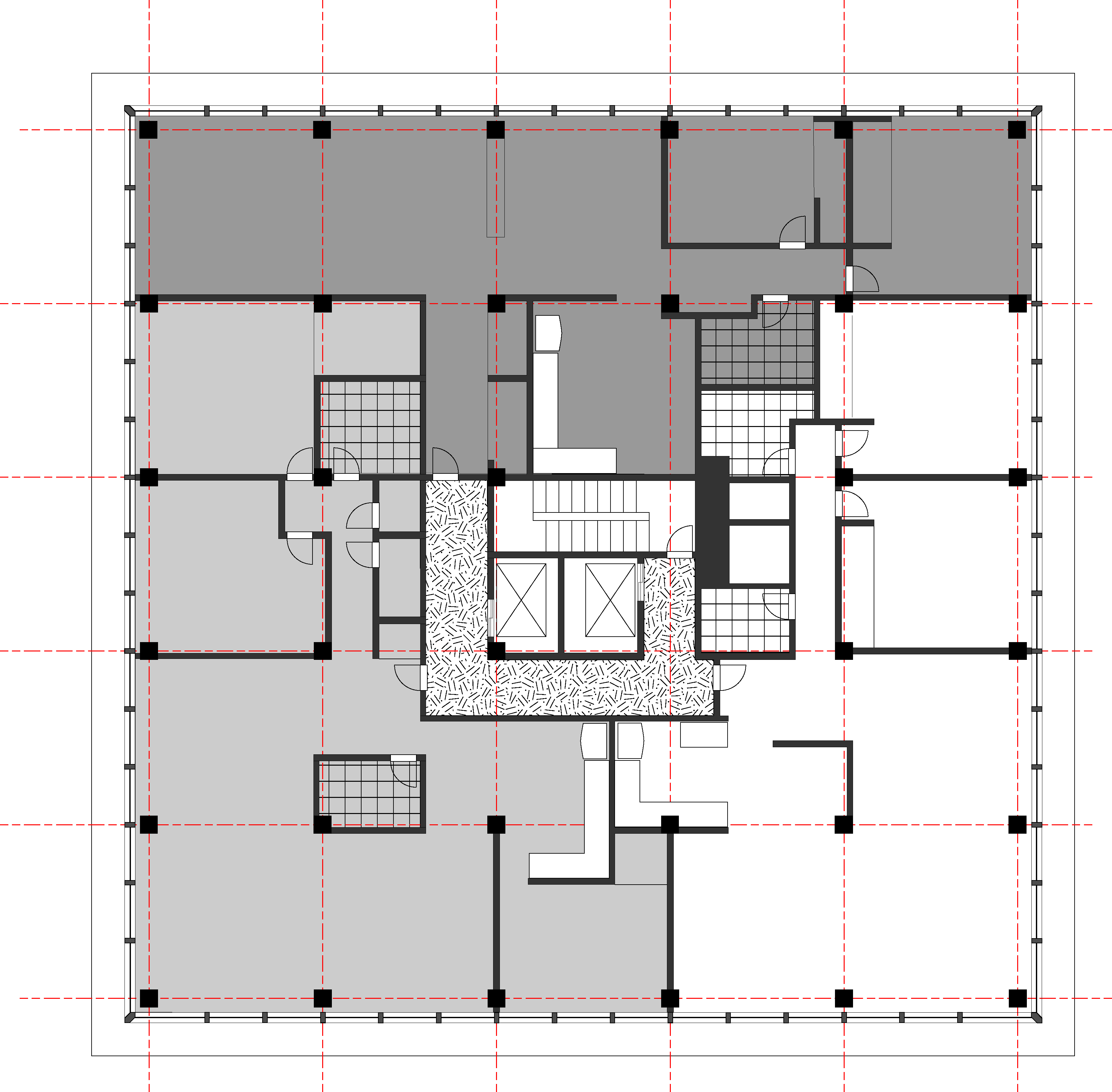
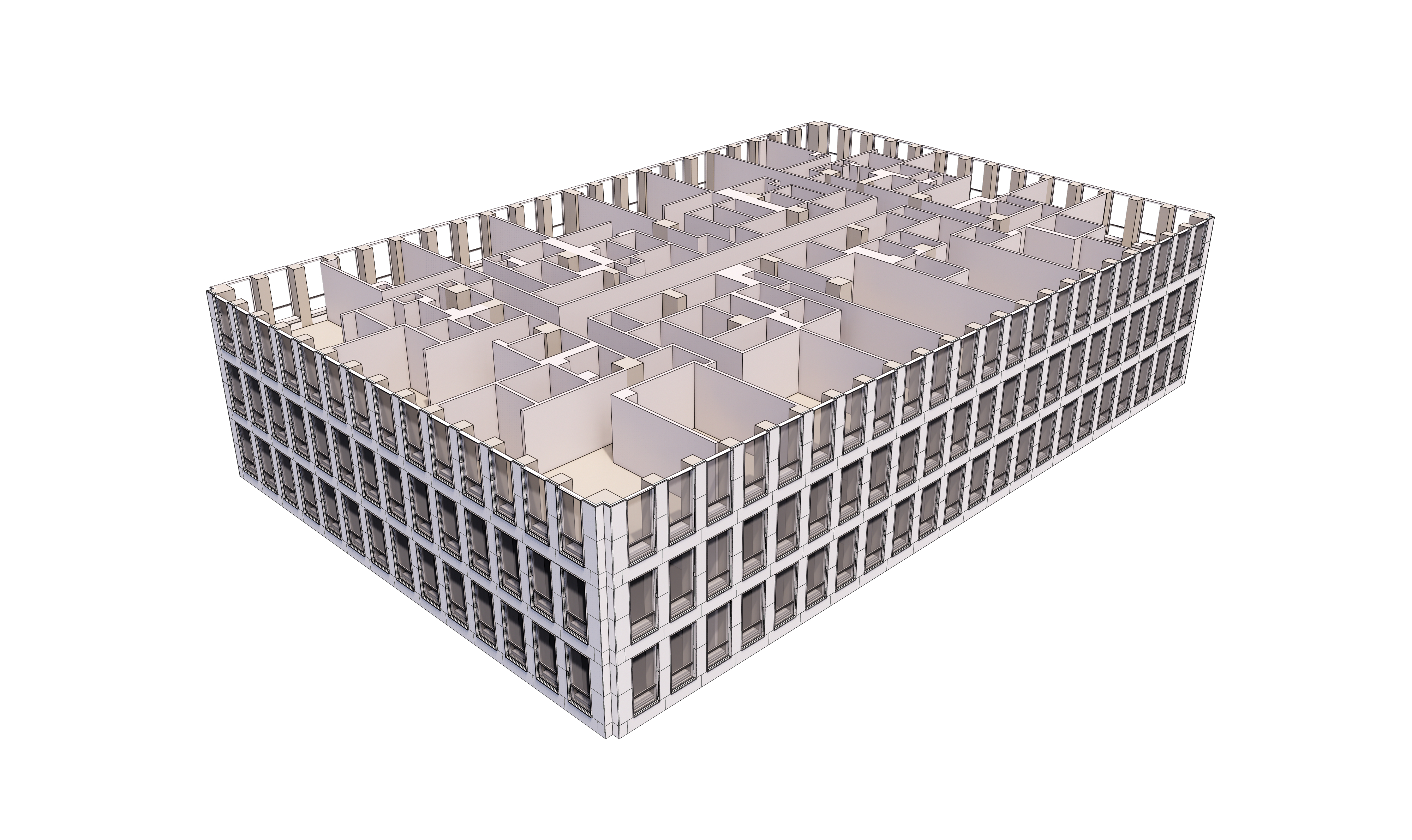
Graham planned apartment layouts around short, hammer-headed corridors, wrapping bedrooms and living rooms around tightly planned bathrooms, closets, and entries into floor plates of 122’ x 78’. Multiplying this to fill Metropolitan’s program required a tower more than 40 stories tall, slender enough to require significant bracing in both directions. Exterior shear walls were out of the question given the lake and city views in all directions. Hal Iyengar and Khan instead tried to develop a central core out of fire stairs and elevator shafts, at one point suggesting twin shear walls containing these elements parallel to the building’s longer axis. Stair and elevator openings, however, frustrated these attempts.
Chestnut-Dewitt Apartments (SOM, 1962-1965). Digital model of typical floors by Jack Strait
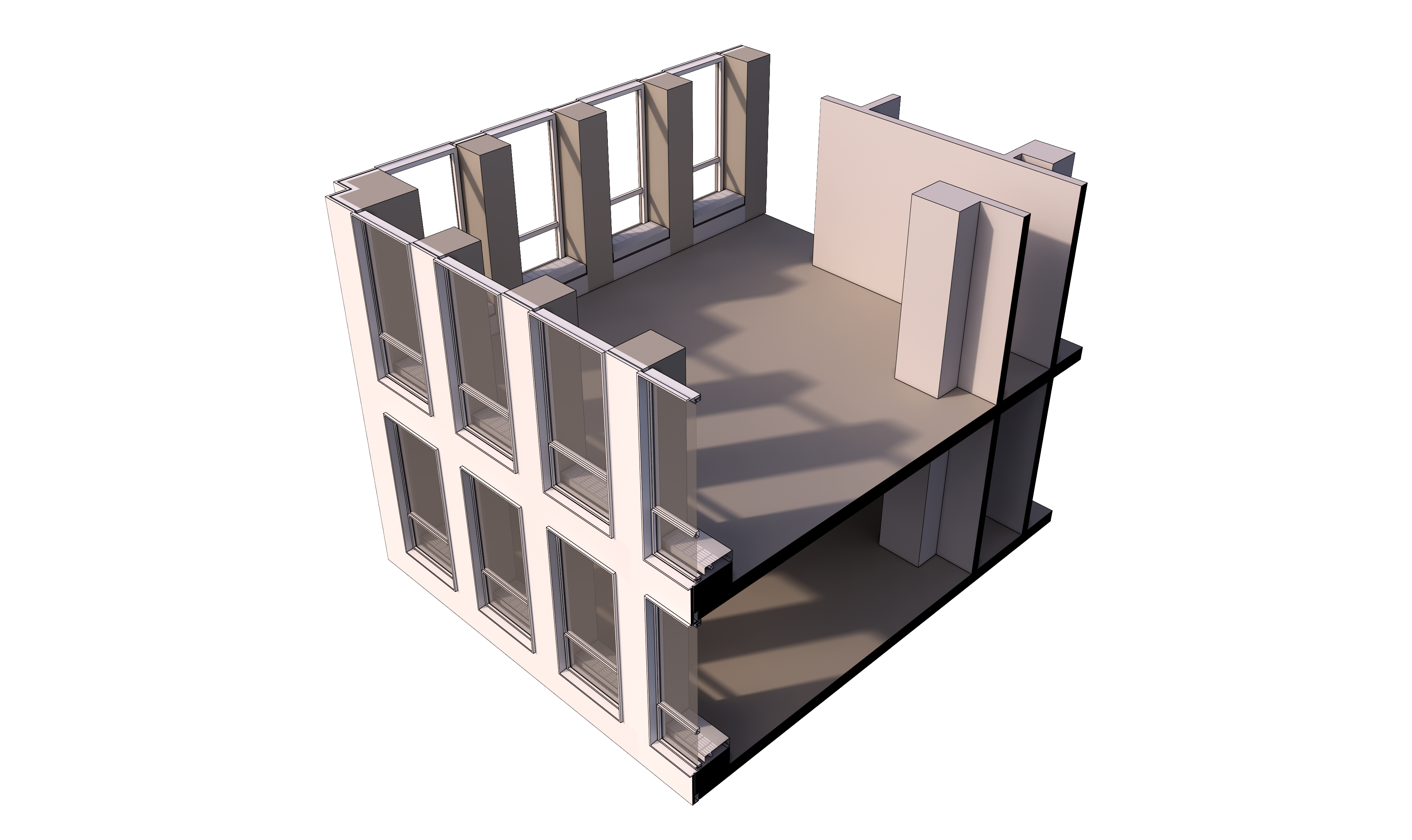
The structural design for Brunswick, meanwhile, was developing a few months ahead of Dewitt-Chestnut’s. Its rigid but porous external bearing walls showed that a shear wall’s rigidity could be distilled into a network of moment joints around large window apertures. Brunswick’s large central core made it only partly reliant on this external frame–the tall, open lobby and large transfer girder made its core shear walls critical to the building’s stability. Khan wondered whether, with more robust connections, skyscrapers’ exterior walls themselves could provide such a slender structure’s lateral stability. Doing so required a compromise between exterior member sizes and desirable views. But the Brunswick’s upturned perimeter beams held a clue. The one place in an apartment where structural elements could intrude into the expected 8’ floor-to-ceiling height was at the exterior, where sills and air conditioner cabinets reduced window apertures anyway. Upstand beams here could provide the deep column connections necessary to create stiff moment joints in the exterior wall. Khan also realized that exterior columns could be spaced more closely together in a residential program, performing double duty as structural mullions, and forming more, narrower windows. Doubling or tripling perimeter columns meant more connections and, thus, greater overall stiffness. At some point, the distinction between a skeleton of columns and beams blurred into structurally solid walls pierced with window openings that could work as a giant, tubular cantilever beam sticking out of the ground. The resulting shape was an imperfect beam (with two webs instead of the I-beam’s one), an imperfect shear wall (perforated with dozens of window openings), and an imperfect architectural solution (window walls interrupted by columns larger than mullions)—but taken together these individual elements formed an efficient overall structure.
Chestnut-Dewitt Apartments (SOM, 1962-1965). Digital model of exterior wall by Jack Strait
Thinking about the entire building as a cantilever was a paradigm shift. Hand calculations were limited to tracing loads through a structure, looking at individual elements’ capacities to resist loads and deflection. Such an elemental approach, engineers knew, provided conservative results—studies on the 55-story 1000 Lake Shore Plaza showed that its shear wall and column structure deflected only 37% as far its designers had calculated due to wind.[v] This may have been reassuring, but it was a waste of materials. Khan’s sense of the building structure as a holistic—almost organic—system marked a new approach. Understanding the flow of forces through a monolithic network required more computing power than hand calculation could provide. But the redundancies that made such structures difficult to calculate also made them efficient— ‘hyperstatic,’ dispersing forces throughout building frames in multiple, simultaneous load paths, in this case through a “shear shell” or “tube.”[vi]
Concentrating the tower’s structure on its exterior allowed more efficient unit layouts, too. Seventeen interior columns, taking gravity loads only and located based on apartment layouts rather than a structural grid, reduced spans, taking advantage of flat plate systems’ adaptability to irregular column placement. One important problem developed as Khan and Iyengar began using SOM’s new mainframe computer to analyze the structure. As the tube walls collected wind loads on their faces they would flex, lacking the backup of the Brunswick’s shear walls. As they did so, they would transfer loads to the side walls—the ‘webs’ of the cantilevered beam—only gradually, meaning that the wind-facing wall’s center would deflect farther than its ends, a phenomenon Khan called “shear lag.” The end walls would, essentially, be dragged along, causing unanticipated stresses in the corner columns. In conventional frame construction, corner columns were the least loaded since they carried only ¼ of the floor area of an interior column. But for tube structures, the team now recognized, corner columns became highly stressed elements, demanding larger sections—validating, at least in this case, the classical rules championed by Mies that doubled columns up when turning a corner.
DeWitt-Chestnut Apartments (SOM, 1962-1965). Street level arcade showing transfer girder. Architectural Record, January, 1966.
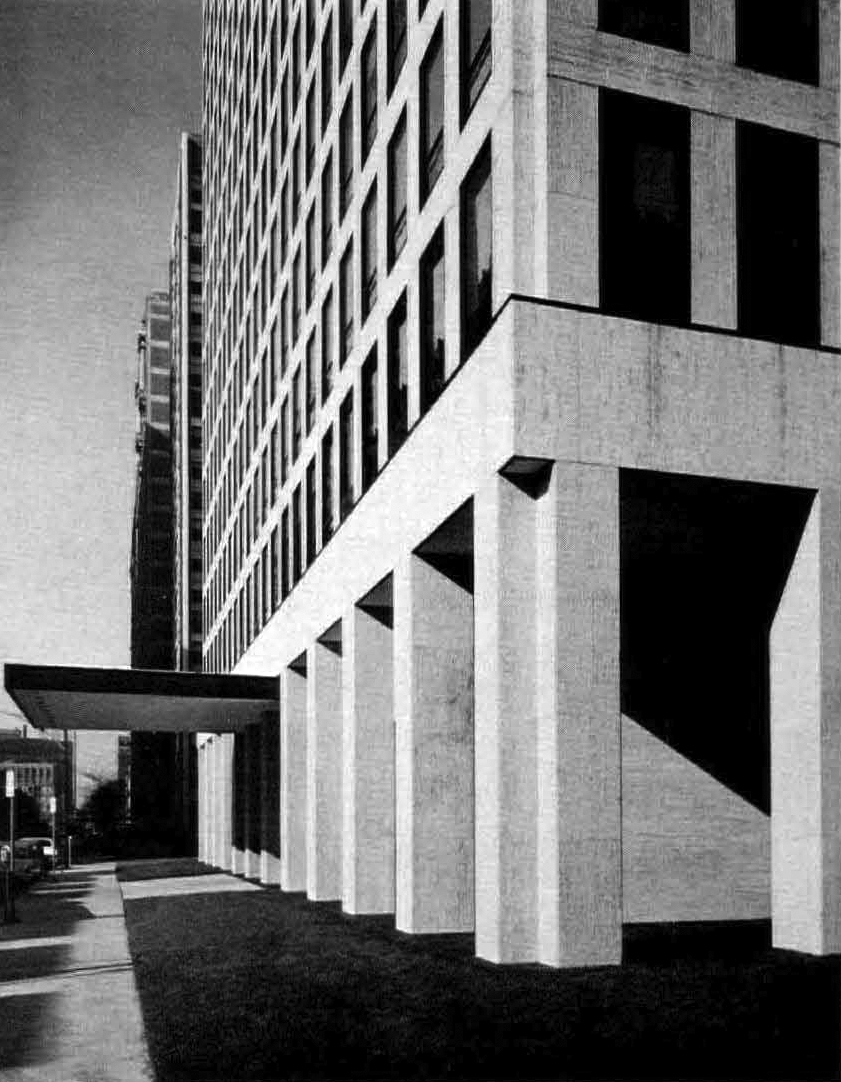
Graham adapted DeWitt-Chestnut’s exteriors to Khan’s structural scheme. Its perimeter columns are collected by a transfer girder at the second floor, as at Brunswick, but here only at every other column, leaving 11’-0” openings at ground level for a colonnade. Like Brunswick, Graham selected travertine to clad the raw structural frame, although here it was actually installed along with a layer of rigid foam, to forestall thermal expansion and contraction. At the corners, a re-entrant detail allowed greater column depth in both directions, accommodating the shear lag stresses while providing visual emphasis. In a subtle expression of its wind bracing theory, the tower’s structural elements all become thinner as the building rises; lateral shear and bending increase toward the base, allowing the structure to be far more flexible toward the top. As the columns and edge beams thin, from 1’-11” at the base to 1’-2” at the roof, DeWitt Chestnut’s windows grow, from 3’-7” to 4’-4”.
Metropolitan Structures secured an $8 million mortgage for this innovative structure from Aetna Life through Draper and Kramer. The project received FHA support even though it was aimed at the upper middle-class market. Federal funding meant that DeWitt-Chestnut was, along with Marina City, Sandburg Village, and Outer Drive East, open to any qualified applicant regardless of race,—still unusual enough that these projects were lauded by the Chicago Commission on Human Relations.[vii] Metropolitan’s construction subsidiary began work on site in August, 1963 and the building opened to tenants in February, 1965, with rents ranging from $140 for studios up to $410 for three-bedroom units ($1200 to $3475), 30% higher than Marina City but comparable to Outer Drive East, in keeping with Metropolitan’s professional, rather than executive, market.[viii]
DeWitt-Chestnut proved a deferential contrasting backdrop to the Mies buildings, but for engineers and critics who understood this elegant, quiet block’s structural innovation and nuanced expression, it was a qualitative leap in performance, based on principles first explored by Komendant and Pei and furthered by SOM at Brunswick, but honed into a distinct, new species of skyscraper structure. Komendant, Khan and New York’s Leslie Robertson all made steps toward the pure tube structure, but credit for SOM’s team in developing the first pure tube skyscraper here—one that relied entirely on its exterior for its lateral stability—was justified. Khan’s systemic approach turned engineers from calculators to designers. His work with Graham over the next decade fused static, programmatic, and architectural form, setting height records along with high standards for integrated engineering and structural aesthetics. DeWitt-Chestnut, on that point, was more than a technical success. Architectural Record called it “one of the most sophisticated and disciplined of SOM’s sophisticated and disciplined designs.”[ix] And, if it was a deliberate visual contrast to Mies’ incomparable towers to the east it was also, according to Iyengar, a link between Khan’s structural philosophy and 860-880’s principles:
“Mies’ buildings were still framed buildings. He was still mostly concerned with expressing the frame. He didn’t get beyond that. But, his principle though, his notion of the structure having a prominence in architecture could be seen all the way through…. As long as the structures play a dominant role, creates the essence of architecture, then it becomes Miesian.”[x]
[i] Myron Goldsmith, “The Effects of Scale” in Myron Goldsmith-Buildings and Concepts. (New York: Rizzoli, 1987). 8-23.
[ii] Goldsmith, “The Effects of Scale,” op. cit. 22.
[iii] On David Sharpe’s career, see Dahna M Chandler, “Scaling the Heights of Architectural Academe.” Black Issues in Higher Education, vol. 16, no. 23, Jan. 6, 2000. 24 and Robert Lau, “The Legacy of David C. Sharpe.” CTBUH Journal, 3. 2010. 40-43. See, too, Lizondo-Sevilla, L., S.-F. José, G.-R. Zaida. “Mies and His Teaching Venues: The Triumph of Architecture over Function”. ACE: Architecture, City and Environment, Vol. 15, no. 45, Feb., 2021.
[iv] The following relies heavily on the excellent descriptions of the building’s design process in Yasmin Sabina Khan, Engineering Architecture: The Vision of Fazlur R. Khan (New York: Norton, 2004). 84-103 and Mir M. Ali, Art of the Skyscraper: The Genius of Fazlur Khan. (New York: Rizzoli, 2001). 43-44, 86.
[v] “Winds Post Challenge for Skyscraper Builders.” Chicago Tribune, June 23, 1968. D1.
[vi] An authoritative overview of tube principles is Fazlur R. Khan, Ph.D., “Tubular Structures for Tall Buildings” in Mark Fintel, ed., Handbook of Concrete Engineering (New York; Van Nostrand Reinhold, 1974). 345-354. See, too, the excellent overview of the tube concept in Robert E. Fischer, “Optimizing the Structure of the Skyscraper.” Architectural Record, Vol. 152, no. 4. October 1972. 97-104.
[vii] “Open Housing Increasing on Near North Side.” Chicago Tribune, Dec. 29, 1963. N2.
[viii] Display Ad, The Dewitt Apartments. Chicago Tribune, Feb. 14, 1965. C9.
In Situ is an ongoing project with Carol Willis of New York’s outstanding Skyscraper Museum and Bill Baker, Emeritus Partner at SOM Chicago, to look at the history of the concrete skyscraper. Most historians have focused on steel as the key material development in tall building construction, and while that was the case at the end of the nineteenth century, Carol makes the argument that concrete has been the more important, even the defining innovation that has allowed many of the 20th and (especially) 21st century’s greatest achievements.
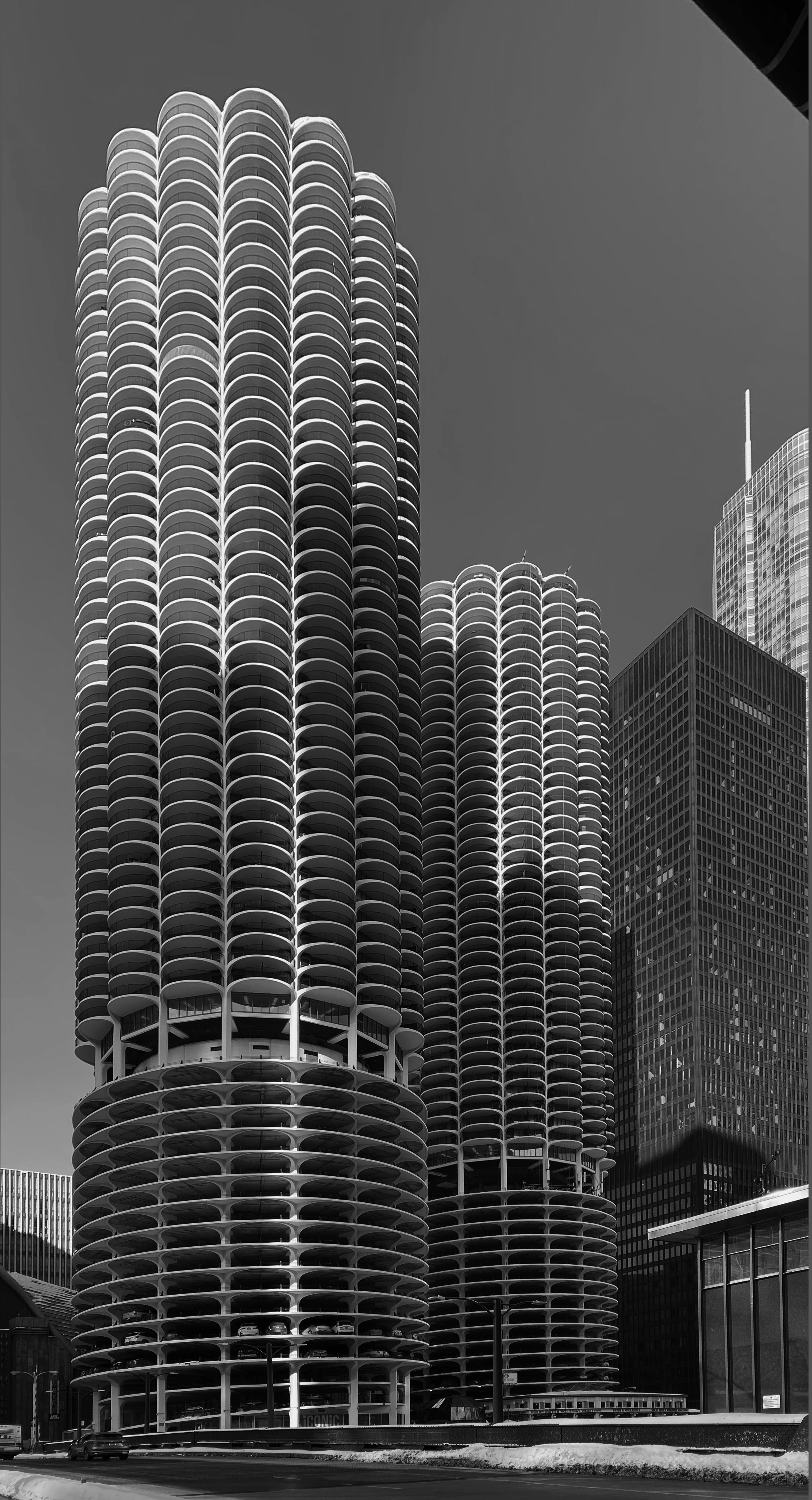
We’re working toward an exhibition sometime in the late Fall, but as part of the conversation, Carol has commissioned a series of conversations with historians, architects, and engineers that will look at some key moments in concrete skyscraper development. We’ve just had the first two of these. Earlier this month, Chicago architect Geoffry Goldberg talked about Marina City, designed by (and, in large part, inspired by) his father, architect Bertrand Goldberg:
Earlier this week, Bill Baker and I talked about two other Chicago skyscrapers–almost exactly contemporary with Marina City–that have been largely left out of the standard histories. Chestnut-DeWitt Apartments and the Brunswick Building in Chicago were important moments in the development of the tube structure. Architects Myron Goldsmith and Bruce Graham worked with engineers Hal Iyengar and Fazlur Khan to distill these buildings’ structures onto their exterior skins–clearing space for programmatic flexibility while discovering new synergies that came with thinking of the towers’ structures as structural ‘organisms’ instead of collected structural elements:
We have more of these planned–the next two will take place at the end of July and August, respectively, and will cover high rises farther afield–watch this space (and the Skyscraper Museum’s page) for further details…


 architecturefarm