Every four or eight years, the age-old question “in what style should we build” seems to enter political discourse; modernism (or in the current iteration, a straw-man “brutalism”) and classicism come to stand in for left vs. right in a way that seems to encapsulate arguments about individualism, tradition, beauty, and whatever else is the argument du jour.
To be clear: there is good classicism and good modernism. There is bad classicism and bad modernism. But looking under the hood at the moral argument–that, somehow, one of these two is genuinely bad for the national soul–leads to an interesting and, IMHO, vastly underrated moment in architectural theory.
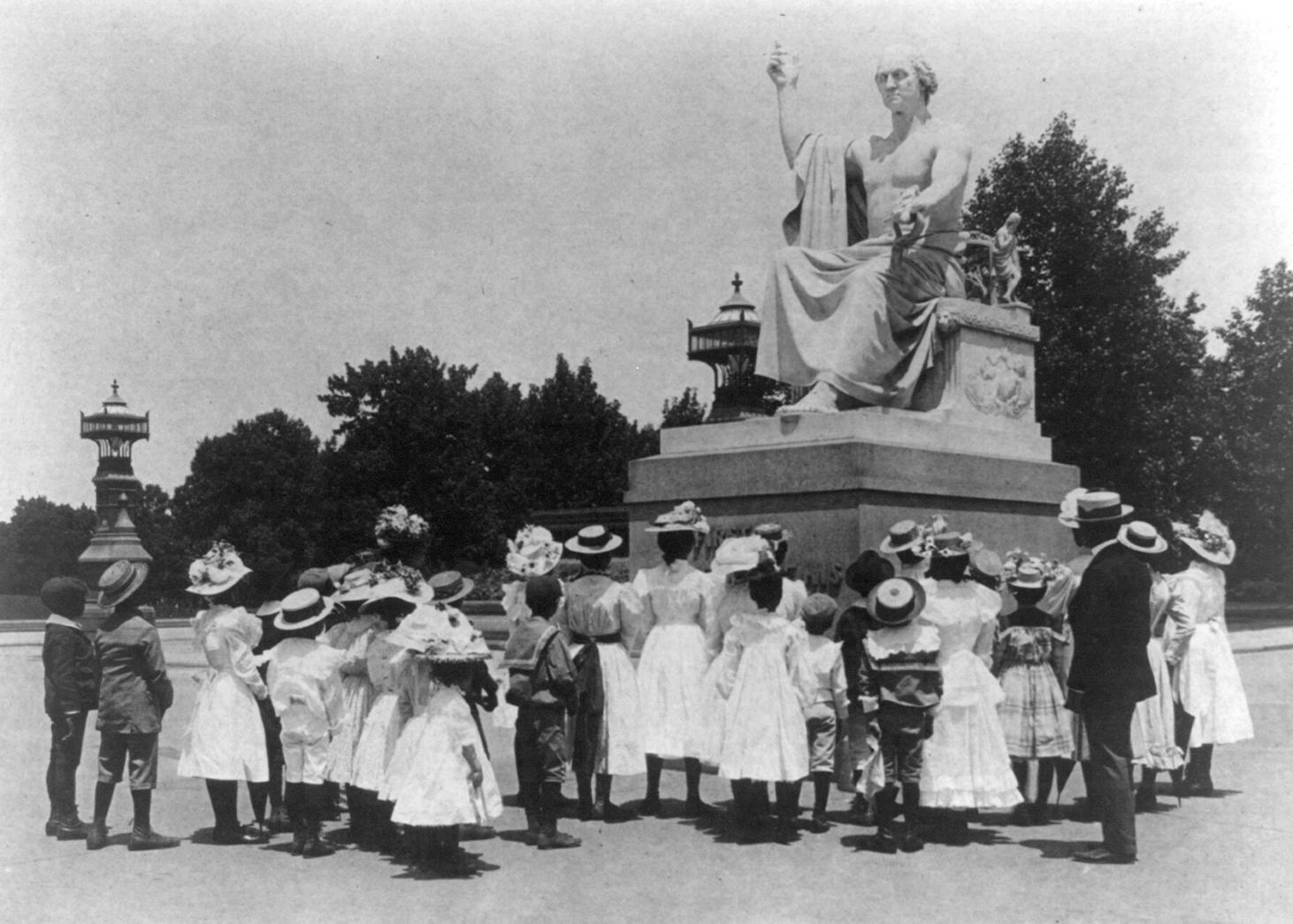
Horatio Greenough was one of America’s most skilled and prolific classical sculptors in the 1830s and 1840s. Trained at Harvard and through extended study trips in Rome and Florence, his style was that of a sculptural philologist, looking to translate ancient precedents into modern subjects. His sculptors of Revolutionary War-era heroes, including Washington and Lafayette, stood in or around the United States Capitol for generations.
Horatio Greenough, George Washington, 1843. Image ca. 1899, Frances Benjamin Johnson. Library of Congress.
But when it came to architecture, Greenough was anything but a traditionalist. In his 1843 essay, “American Architecture,” he critiqued the nation’s architectural development to that point as a betrayal of the independent, enlightenment-based roots of the still-young country:
“The mind of this country has never been seriously applied to the subject of building. Intently engaged in matters of more pressing importance, we have been con tent to receive our notions of architecture as we have received the fashion of our garments, and the form of our entertainments, from Europe.”
For sculpture, looking to Europe was fine–making the case that our political roots lay in Greek and (Republican) Roman principles could be illustrated by, say, a sculpture of Washington in sandals and a toga. But architecture, Greenough thought, was fundamentally different. The purity of Greek temples lay in their essentially sculptural quality–they were primarily monuments, designed primarily to evoke spiritual and emotional reactions, not so much to house any sort of complex function. Attempting to adapt their simple, if articulate, forms to increasingly complex functions was, for Greenough, a mistake that had roots in the Roman world’s adoption of Greek styles to mismatched uses:
“If we trace architecture from its perfection, in the days of Pericles, to its manifest decay in the reign of Constantine, we shall find that one of the surest symptoms of decline was the adoption of admired forms and models for purposes not contemplated in their invention. The forum became a temple, the tribunal became a temple, the theatre was turned into a church; nay, the column, that organized member, that subordinate part, set up for itself, usurped unity, and was a monument!”
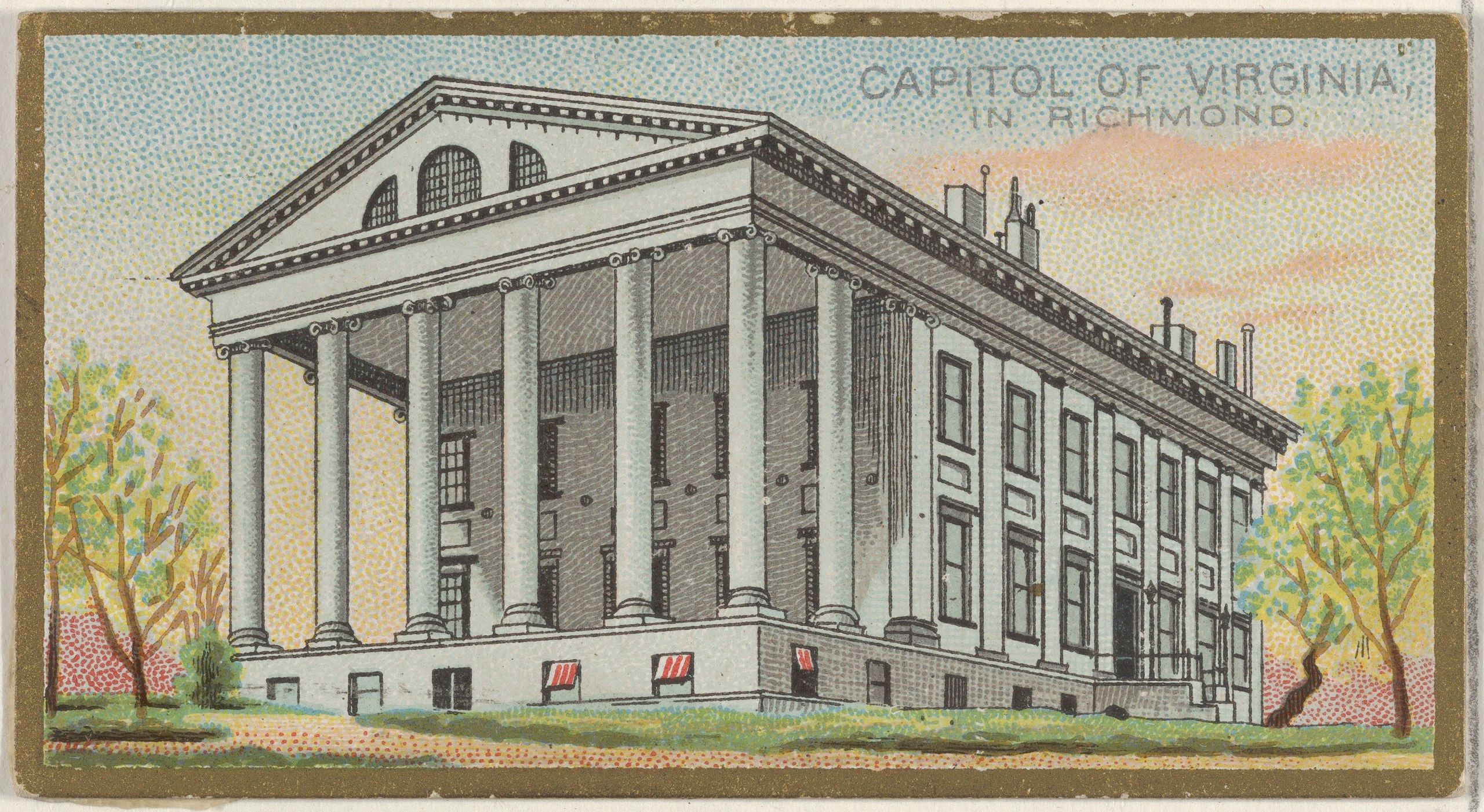
Virginia State Capitol, Richmond, VA. Thomas Jefferson and Charles-Louis Clérisseau, 1785-88. General Government and State Capitol Buildings series (N14) for Allen & Ginter Cigarettes Brands. Metropolitan Museum of Art/Wikimedia.
Greenough had in mind buildings like Jefferson’s Virginia State Capitol, based on the Roman temple at Nimes, France, which was, of course, already based on Greek precedents. The problem? Greek temples did not have the formal agility to reflect the more complicated functions of, say, a State Capitol (or, for that matter, a town bank). In trying to adopt forms to function, he wrote,
“…we have shorn them [Greek precedents] of their lateral colonnades, let them down from their dignified platform, pierced their walls for light, and, instead of the storied relief and the eloquent statue which enriched the frieze, and graced the pediment, we have made our chimney tops to peer over the broken profile, and tell by their rising smoke of the traffic and desecration of the interior.”
Greenough then extrapolated a broader program for American architecture from this complaint. Uniquely freed from what he saw as cultural constraints, he thought Greek temples and Gothic cathedrals would always be “strangers.” Worse, the speed with which America had to build and the lack of time and labor available to invest in the ornament and sculpture that articulated those monuments would always mean that our imitations would “depart from its original beauty and propriety as widely as the crippled gelding of a hackney coach differs from the bounding and neighing wild horse of the desert.”
First Congregational Church Old Saybrook, built 1840. MMDA Photos.
Instead, Greenough proposed, American architects should look to more universal examples:
Let us consult nature, and in the assurance that she will disclose a mine, richer than was ever dreamed of by the Greeks, in art as well as in philosophy…. If, as the first step in our search after the great principles of construction, we but observe the skeletons and skins of animals, through all the varieties of beast and bird, of fish and insect, are we not as forcibly struck by their variety as by their beauty? There is no arbitrary law of proportion, no unbending model of form….
Greenough also suggested another analogy, that of the machine–particularly the most advanced machines being built at the time, symbols of American engineering and technology:
Observe a ship at sea! Mark the majestic form of her hull as she rushes through the water, observe the graceful bend of her body, the gentle transition from round to flat, the grasp of her. keel, the leap of her bows, the symmetry and rich tracery of her spars and rigging, and those grand wind muscles, her sails! Behold an organization second only to that of an animal, obedient as the horse, swift as the stag, and bearing the burden of a thousand camels from pole to pole! What Academy of Design, what research of connoisseurship, what imitation of the Greeks produced this marvel of construction?
These two models–nature and the machine–were also touted by the great French theorist Viollet-le-Duc as ideal sources for the new principles necessary to develop authentic architecture in the face of industrial construction and materials.
Greenough anticipated so much in this essay–there are echoes of Darwin in his description of natural adaptation–sixteen years before Origin of Species–and he uses the phrase “organic” to describe not a metaphorical inspiration from nature (buildings that ‘look like’ plants or animals) but an analogical one: “formed to meet the wants of their occupants.” Most remarked upon has been Greenough’s anticipation of Louis Sullivan’s “form follows function.” There’s no doubt that Sullivan knew of Greenough’s writings, but the 1896 “Tall Building Artistically Considered” was primarily a visual argument–“proud and soaring things.” Greenough goes slightly further, agreeing with Viollet-le-Duc that all aspects of the design, from massing and arrangement to proportion and detail, should rigorously adhere to functional precepts. Sullivan, remember, was Beaux-Arts trained, and buildings like the Wainwright in St. Louis retain some of his preference for symmetry, rhythm, and classical proportion. Greenough thought more radical aesthetic potential lay in throwing out all of these compositional niceties and finding, instead, architectural meaning and beauty within the principles underlying building:
“…let us begin from. the heart as a nucleus and work outward.; The most convenient size and arrangement of the rooms that are to constitute the building being fixed, the access of the light that may, of the air that must, be wanted; being provided for, we have the skeleton of our building. Nay, we have all excepting the dress. The connexion and order of parts, juxtaposed for convenience, cannot fail to speak of their relation and uses. As a group of idlers on the quay, if they grasp a rope to haul a vessel to the pier, are: united in harmonious action by the cord they seize, as the slowly yielding mass: forms a thorough bass to their livelier movement, so the unflinching adaptation of a building to its position and use gives, as a sure product of that adaptation, character, and expression.”
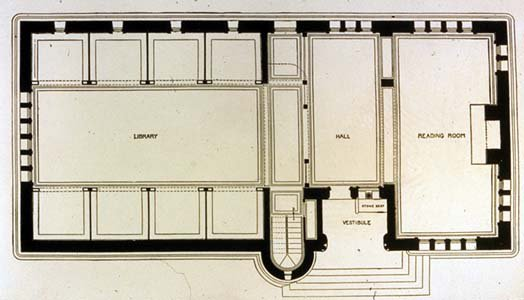
What would that look like? The closest example I can find that’s remotely contemporary is the work of H.H. Richardson, whose “romanesque” style certainly recalls ancient precedent, but in spirit more than detail. The semi-circular arches and peaked roofs that characterize his designs don’t have the academic adherence to Roman forms that, say, Jefferson’s did; instead, Richardson developed compositions out of functional arrangements, and ornamental styles out of the techniques used to shape the sandstone and granite that were native to the New England region in which he practiced. The Crane Library in Quincy, MA., is a great example of this; the functional division of the building–entry, stacks, reading room, staircase–is clearly the basis of the building’s asymmetrical, very not-Roman composition:
H.H. Richardson, Thomas Crane LIbrary, Quincy, MA. 1882. Photo by emw
Greenough concluded by arguing that a truly American architecture, a democratic one, would spring from this sort of plain-spokenness, a confidence that such honesty in massing, proportion, and detail would appeal to the particularly American common sense and that we, as a nation, would come to find beauty in functionality:
If this anatomic connexion and proportion has been attained in ships, in machines, and, in spite of false principles, in such buildings, as make a departure from it fatal, as in bridges and in scaffolding, why should we fear its immediate use in all construction? As its first result, the bank would have the physiognomy of a bank, the church would be recognized as such, nor would the billiard room and the chapel wear the same uniform of columns and pediment.
There was also a moral dimension to this argument. Dressing buildings up in styles and ornament that weren’t native or that were borrowed from another culture had the whiff of dishonesty to it, betraying (or, perhaps, instilling) a lack of character:
The monuments of Egypt and of Greece are sublime as expressions of their power and their feeling. The modern nation that appropriates them displays only wealth in so doing. The possession of means, not accompanied by the sense of propriety or feeling for the true, can do no more for a nation than it can do for an individual. The want of an illustrious ancestry may be compensated, fully compensated; but the purloining of the coat of arms of a defunct family, is intolerable.
That sense of unearned wealth hews nicely to the Protestant work ethic permeating much of early America–adopting the fancy ‘clothing’ of ancient models is an inheritance, not an achievement. Greenough closed with an appeal to another fundamentally American tenet, the right to express his opinion, and in so doing, he hinted that the Greek Revival architecture he was arguing against was unlikely to survive a rigorous, generational inquiry into what a truly “American Architecture” should be.
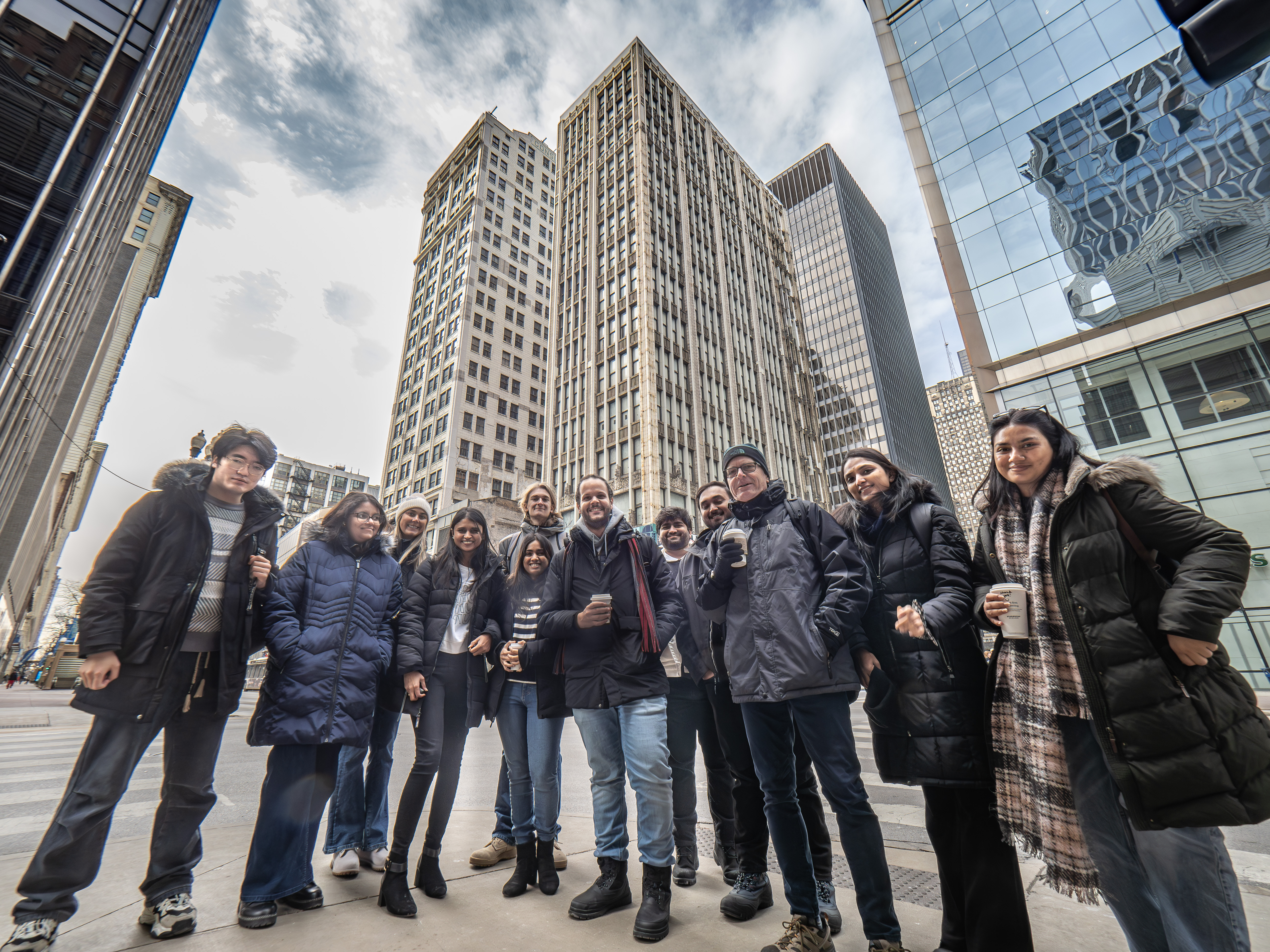
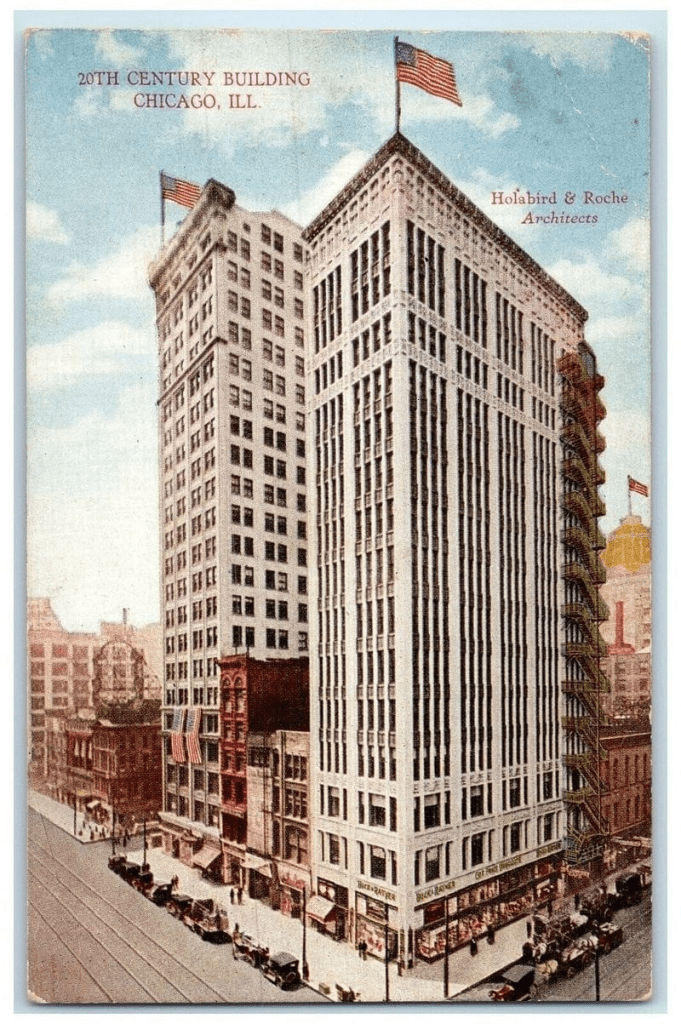
Preservation folks will recognize the buildings in the back there as the cause du jour. The Century Building (front, Holabird and Roche, 1915) and its taller sibling, the Consumers (behind, Mundie & Jensen, 1913), were typical of the commercial buildings constructed along State Street as it enjoyed renewed status as the city’s main retail thoroughfare. The two aren’t particularly distinguished, but they’re almost perfect representatives of the type, with tall retail storefronts, convenience offices on the second and third floors, and repetitive lease space from there to the attics. The Century is almost unique in its neo-Gothic styling for its time–relentlessly vertical, as opposed to the more stolid Consumers, which is strictly Burnham-esque mercantile classicism.
Unfortunately for the two buildings, they’re immediately adjacent to the Dirksen Federal Building and Courthouse. The GSA purchased them in other early 2000s and vacated them, seeing their proximity as a security risk. The two have sat, empty, ever since, with all the deterioration from a lack of occupancy that you’d expect. Preservation Chicago named the two to their 2023 “Most Endangered” list despite plenty of interest in converting their relatively small lease spans and floor plates into apartments.
The federal government made no secret of its plan to demolish the two, which would actually open up a more significant security issue. The City of Chicago, in response last year, landmarked the two back in April, 2024, essentially forcing the GSA’s hand. They responded with a Request for Proposals that comes with a handful of onerous restrictions, including a ban on residential programs, which they see as potentially providing bad actors with open views of the courthouse offices and loading operations on Quincy Street.
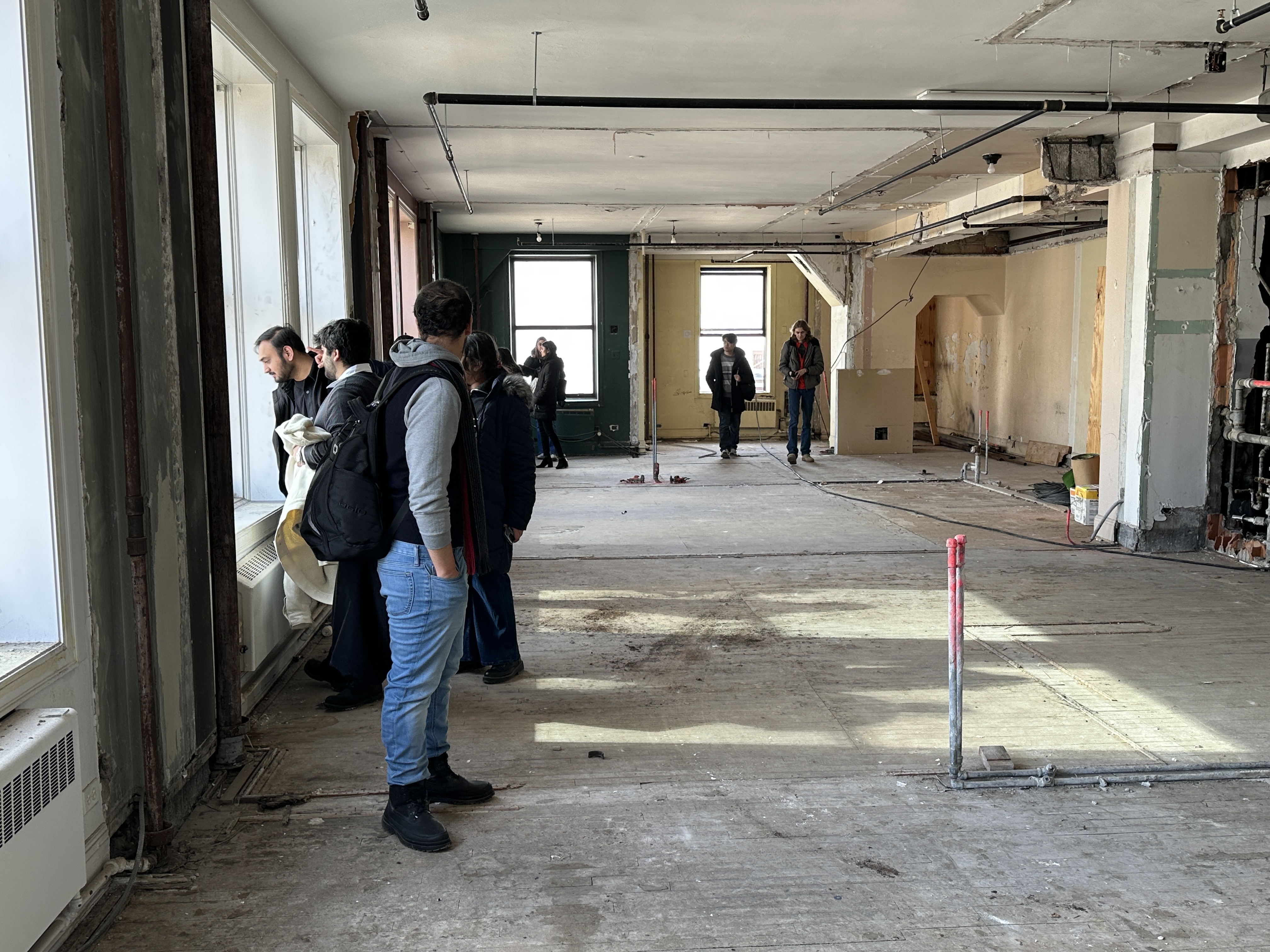
OK, fair enough, but what if…you could convince the GSA to design its way around those issues? That’s the premise of our spring studio–provide hotel and short-term apartment accommodation in the two buildings while taking the security concerns seriously. Last week, we met on site with Ken DeMuth of Pappageorge Haymes, one of the city’s leading designers in converting this era of skyscrapers into residential uses, as well as Mark Kuberski of Central Building and Preservation and Rachel Will of Wiss, Janney, Elstner–two of Chicago’s most knowledgeable preservation engineers, especially when it comes to the terra cotta cladding that (barely) covers the two towers.
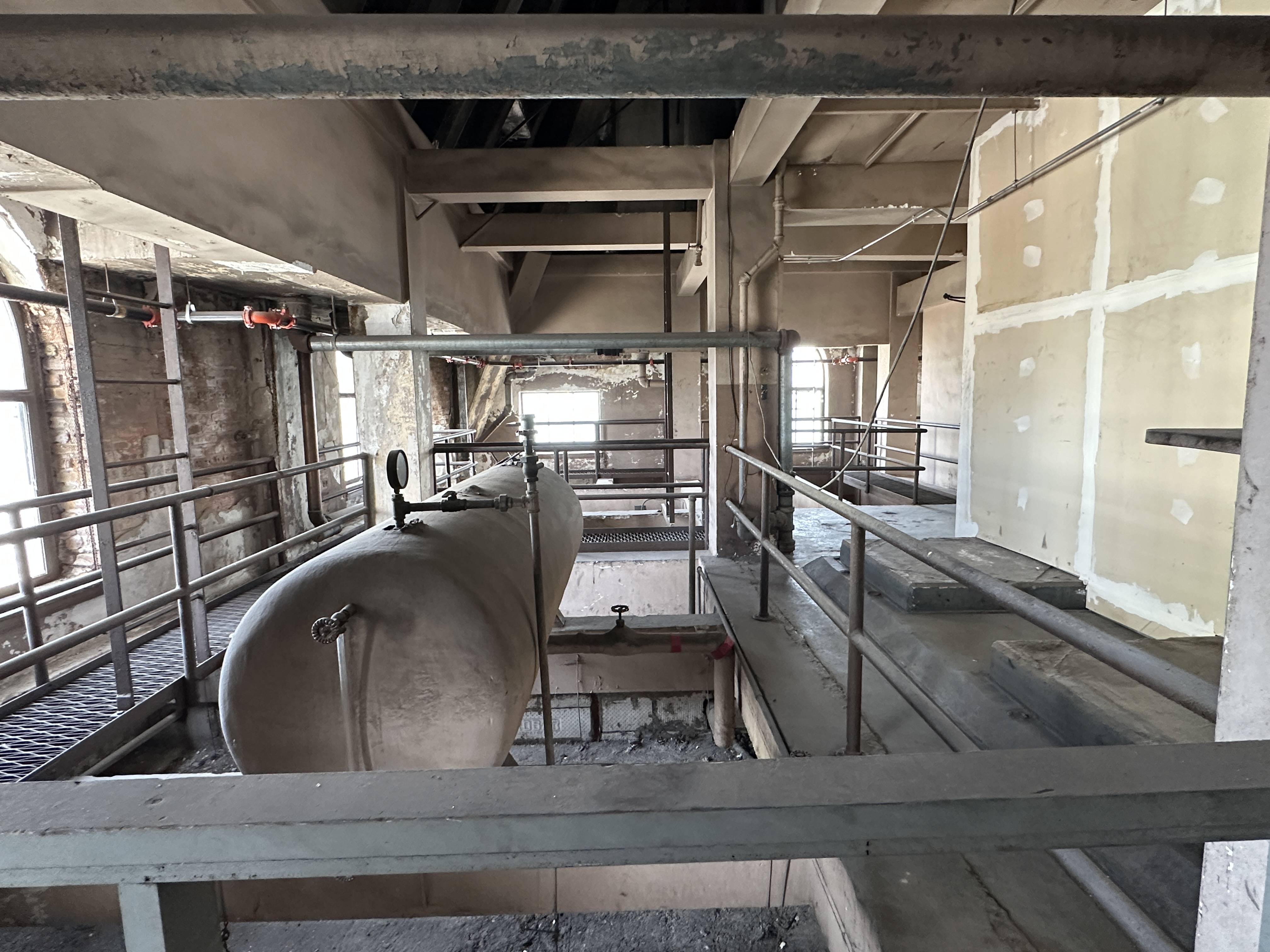
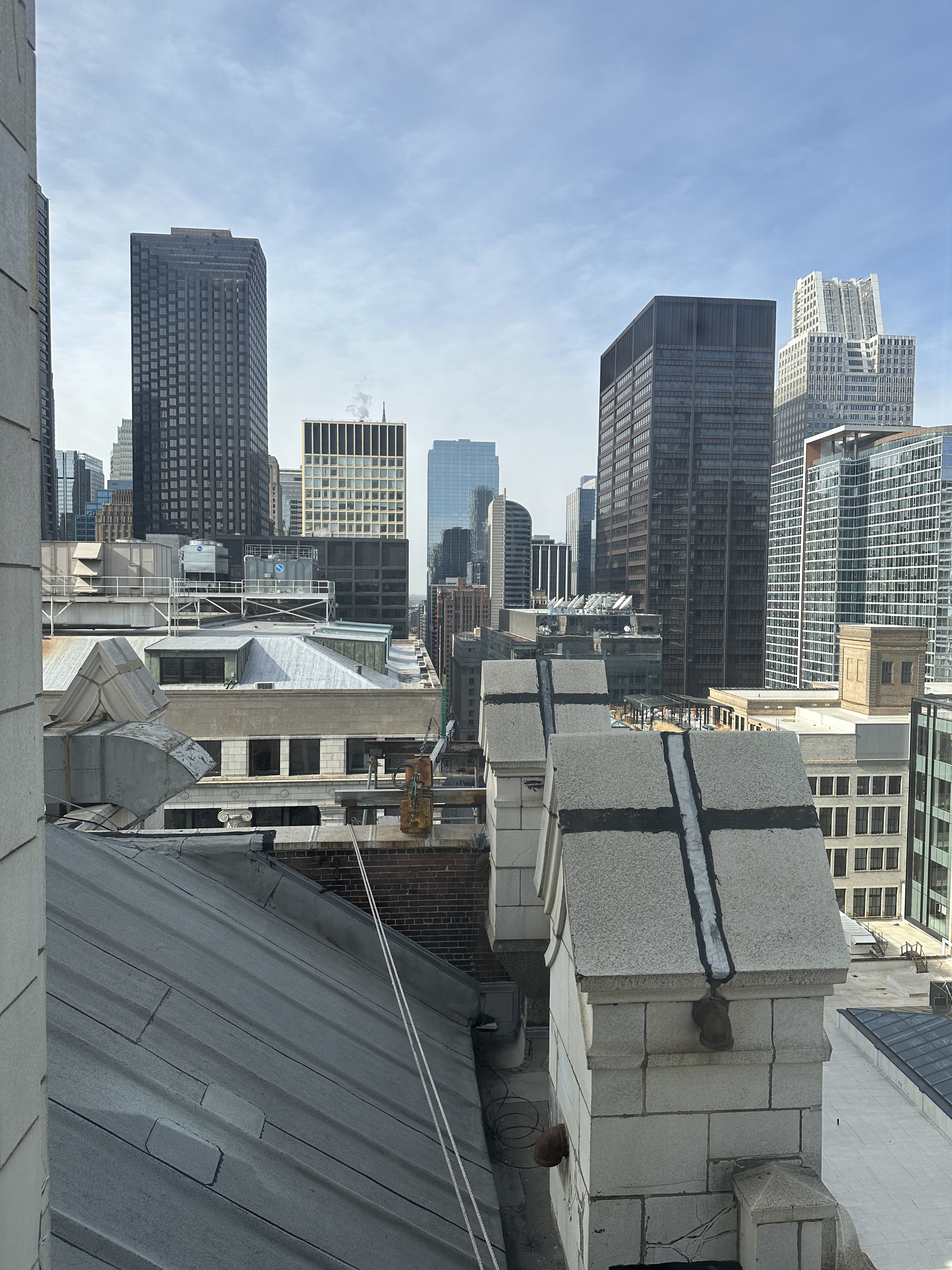
Not surprisingly, the GSA was not enthusiastic about students touring the buildings, but Ken got us into the Pittsfield Building, where residential conversion plans have been ongoing, so we got to see first hand what a vacated office building of (about) the same era presents in terms of spaces and details–including a bucket-list level visit to the mechanical penthouse in the peak of the tower, which would provide any rooftop apartment with a ready-made conversation pit:
We’ll see what this group comes up with, but we’re hoping to show that there’s room for cleverness in addressing the real security issues here, and to be part of the conversation about how important saving even these, ‘vernacular commercial’ structures will be to maintaining the Loop’s sense of history.
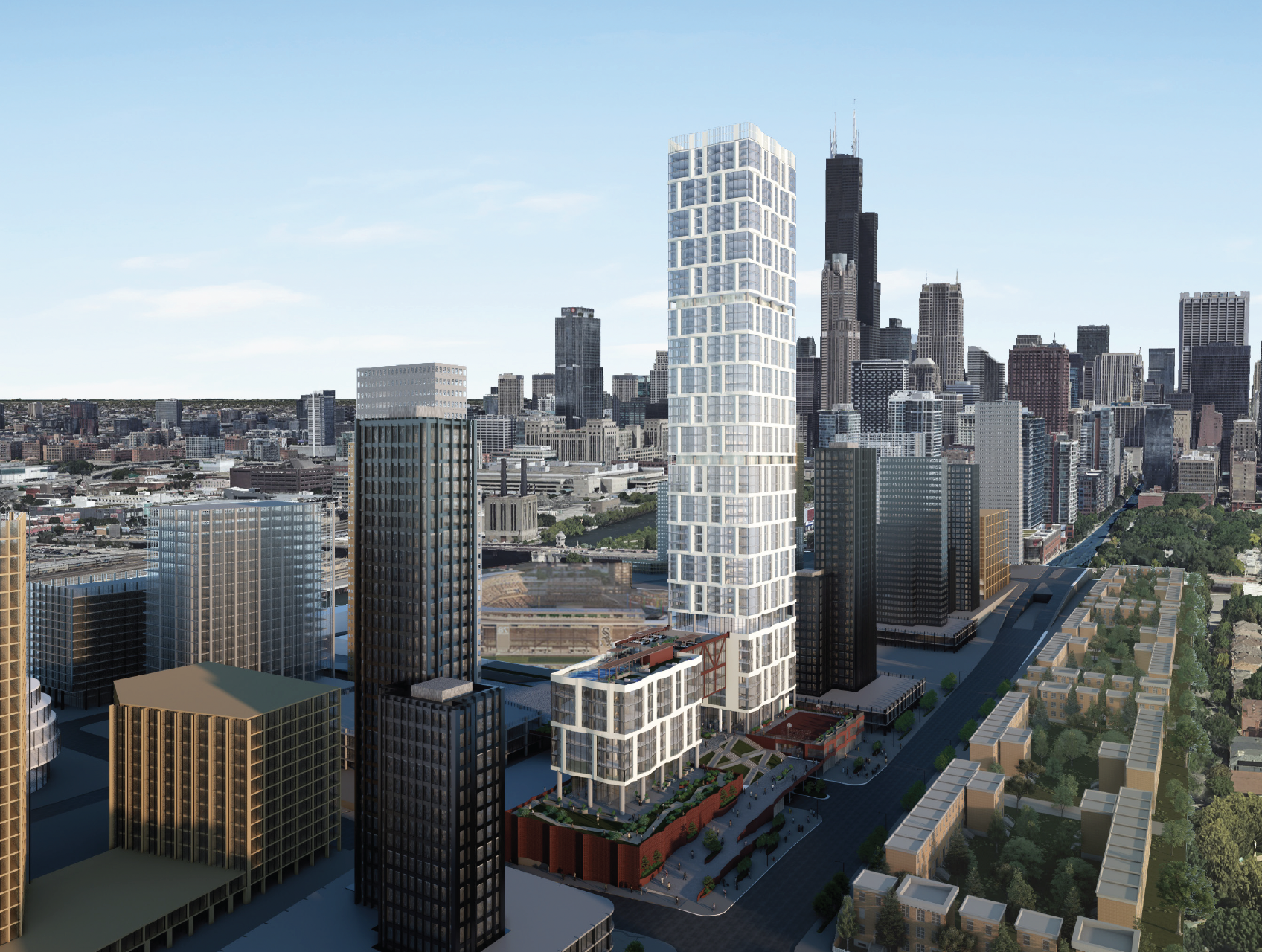
My Integrated Design Studio this semester was a collaboration with Related Midwest that looked at the evolving plans for The 78, a 62-acre brownfield site that is just a half-mile south of the Loop along the Chicago River. Ann Thompson, Executive Vice President of Architecture and Design at Related Midwest, put together a proposed site and program and then hosted the studio for an introduction to their process at the start of the semester. Student teams thus had a real-world problem to solve and the fine-grain program information that gave them a high bar to reach in terms of efficiency–but also design quality.
Lufan Xu and Giovanni Almanza
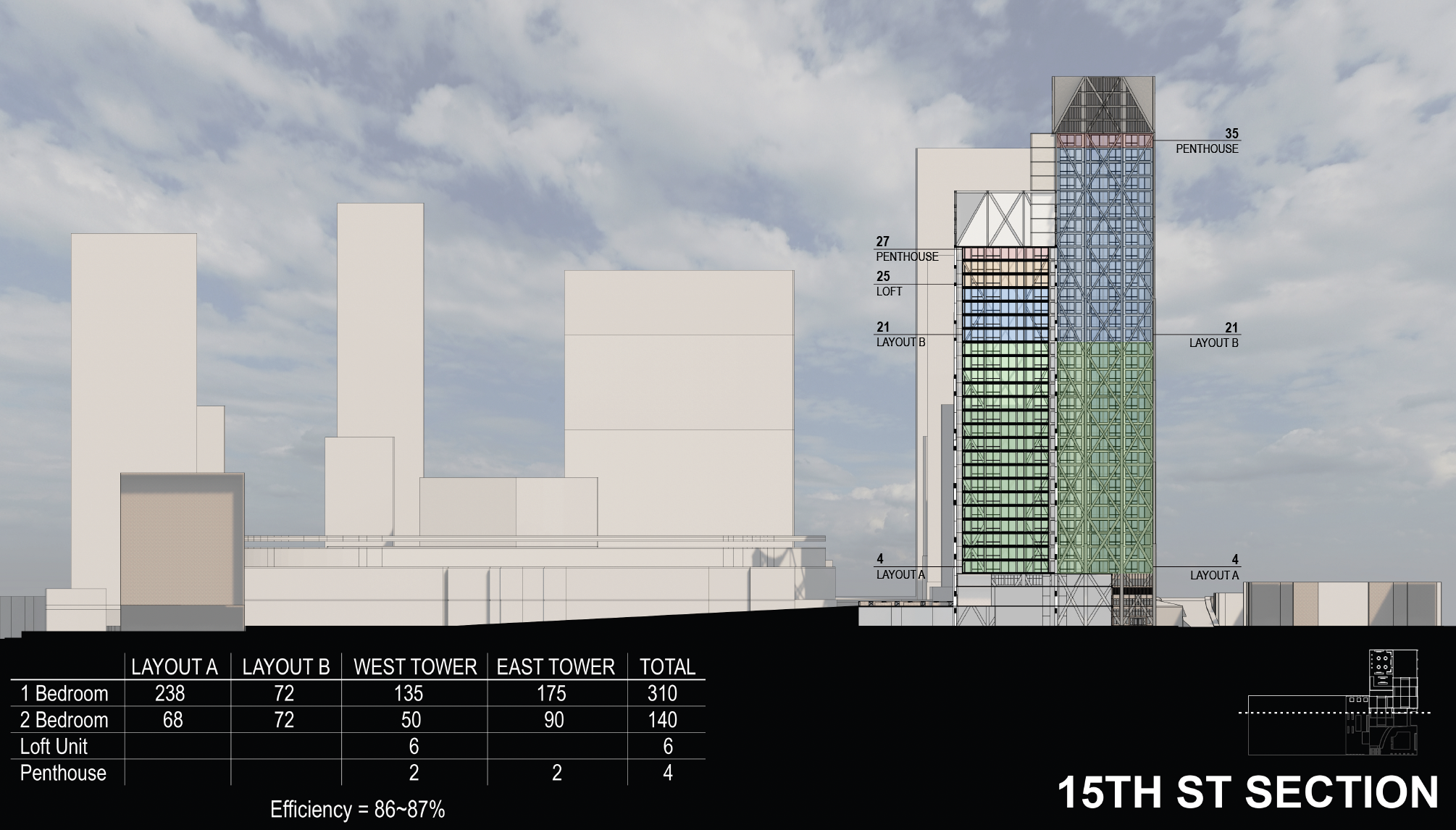
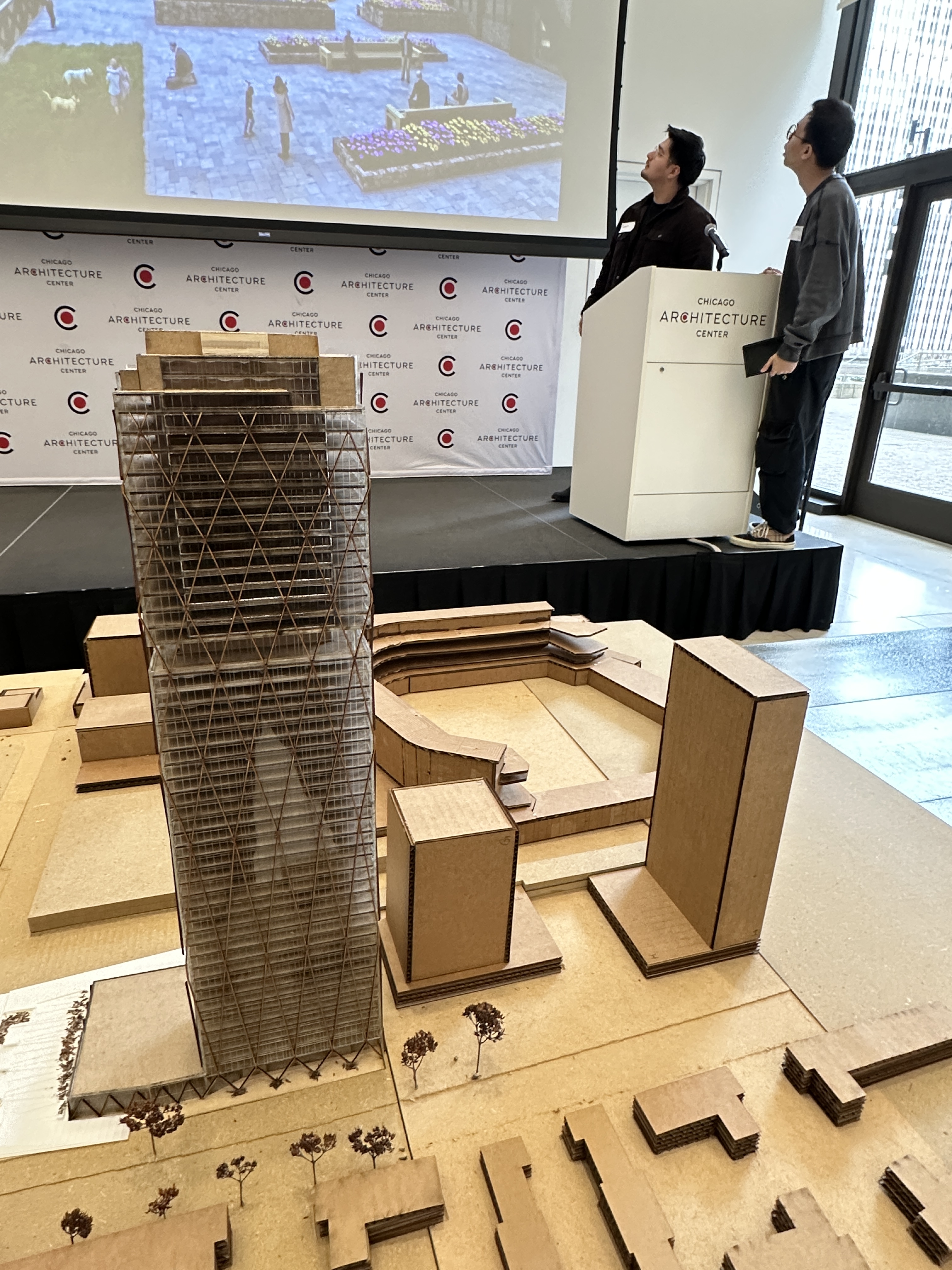
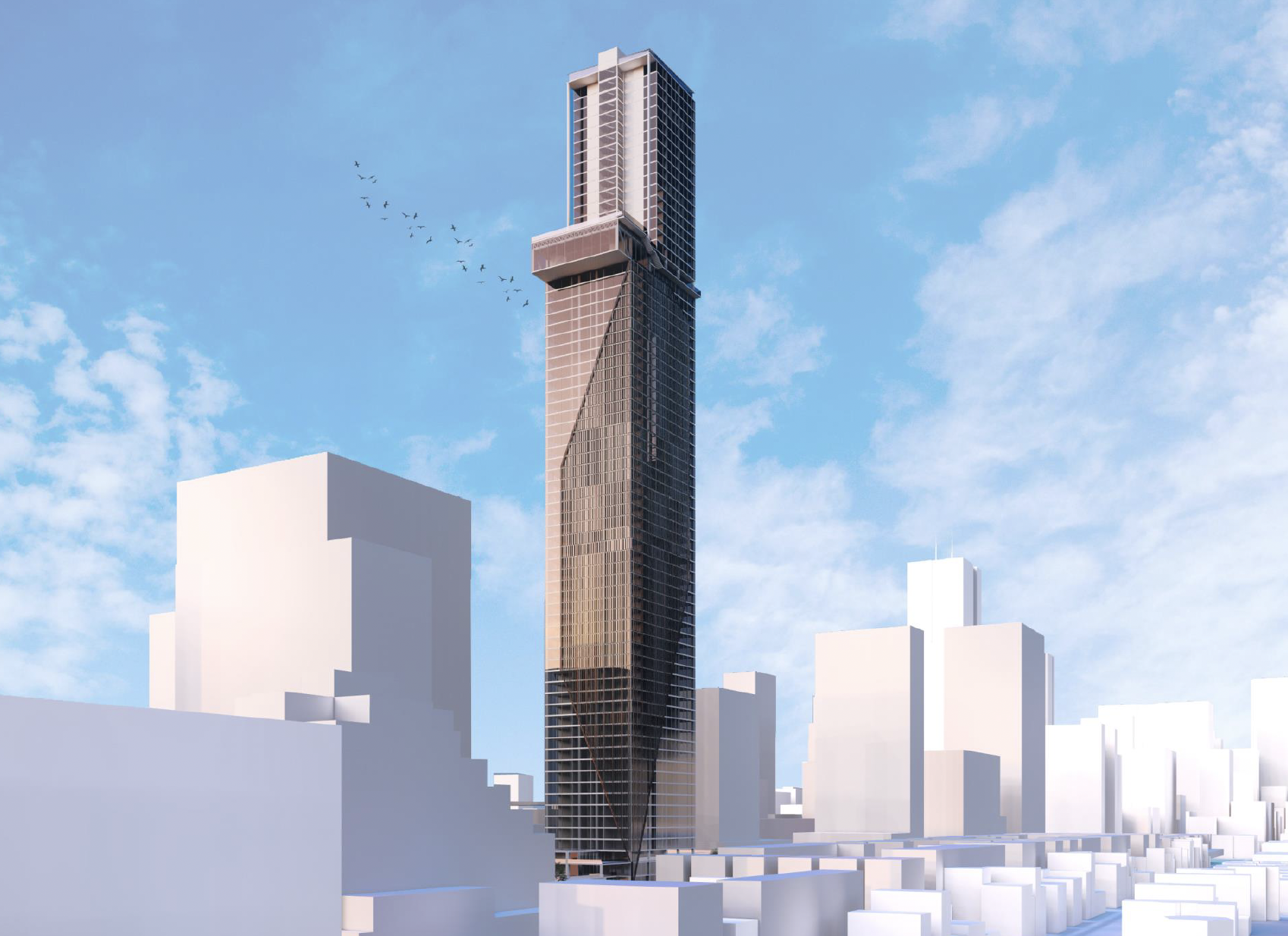
Related’s brief to them was to design a 450-unit residential tower that was amenity-rich in terms of tenant and pedestrian experience. The site, at the corner of Clark and 15th Streets, isn’t much to look at now, but when we started the project,t it promised to become one of the most active intersections in the South Loop. A University-led research initiative, the Discovery Partners Institute, had announced plans for its research center, designed by OMA, for a block of the 78 development just southwest of our site, and last summer, the Chicago White Sox stated their interest in building a new stadium just northwest of our site. So, the issue is, how do you design for tech workers and 40,000 baseball fans? To add pressure to the project, there are plans for a new CTA Red Line stop right at Clark and 15th–so our site will likely become a heavily trafficked, vital circulation node in the neighborhood. Adding to the difficulty, a relocated pair of suburban rail lines will separate our site from the development along the river.
Sanchita Damle & Nidhi Naik
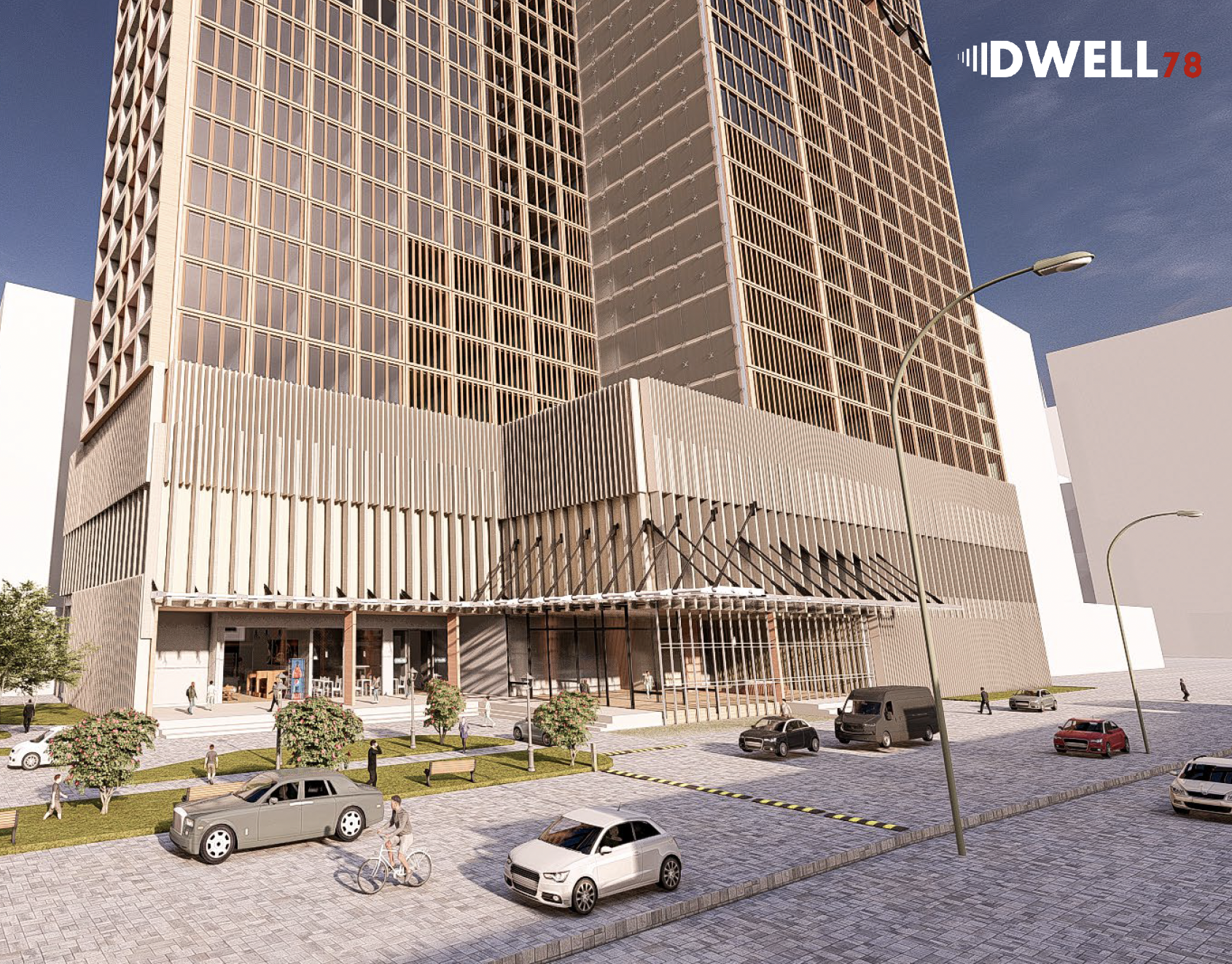
Design teams tackled the big program and the complex site with innovative ideas. Some began with the intersection itself, shaping their ground-level plans to house open plazas that could serve as ‘lobbies’ for the ballpark. Others addressed the problem of crossing the rail lines with ramping podiums that would add semi-public spaces for vendors or gameday retail.
Chang Chen & Ryan Chip
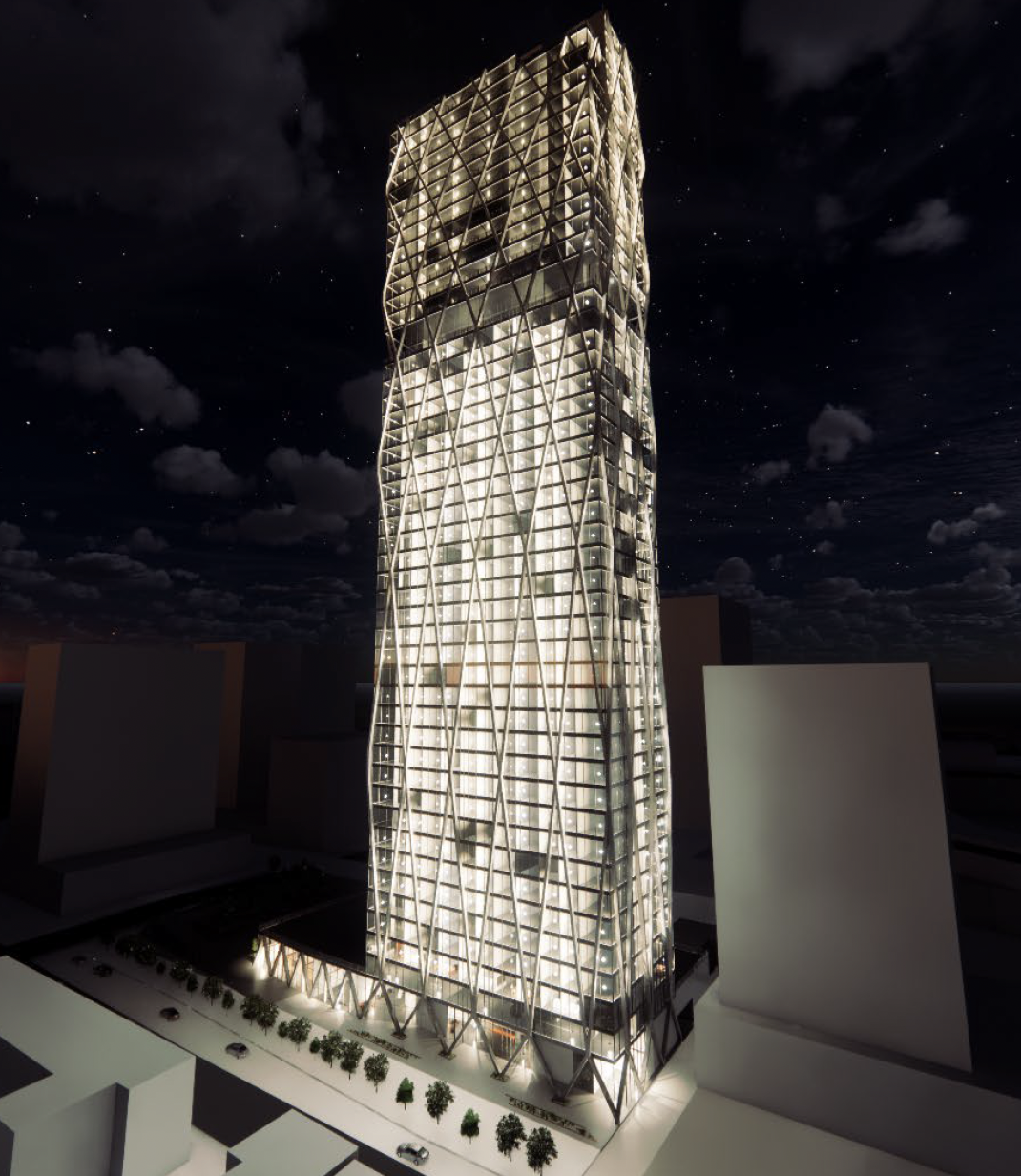
The towers took various forms, shaped by view corridors, daylighting strategies, and the desire to put an identifiable mark on the skyline that would be the 78’s signature. Midterm reviews and desk crits looked at structural schemes and facade palettes that called back to Chicago traditions like trussed tubes and terra cotta cladding, but all deployed in ways that would make sense for a 21st-century tower. We’re lucky at UIUC to have access to great engineering and construction expertise; students learn to take advantage of this early in their design process with clear results.
Atousa Esmaeili & Prajwal Sagari Mahaveer
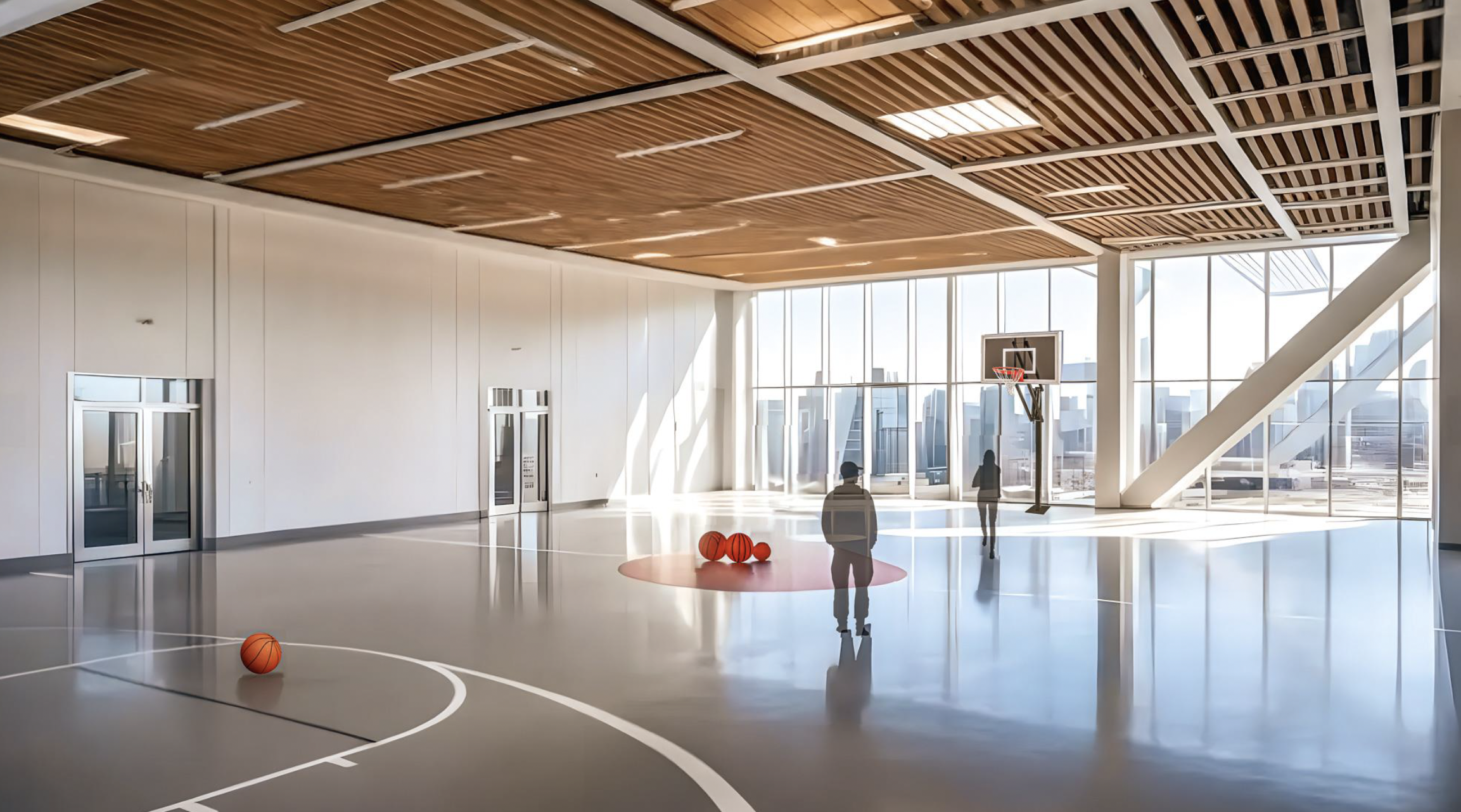
Ann and her team included a basketball court in their tenant amenities list, which became a signature in several projects–an opportunity to show off some structure, but also to think about how this very Chicago element could relate to the city. Grabbing a rebound 300′ in the air? Serious Air Jordan material.
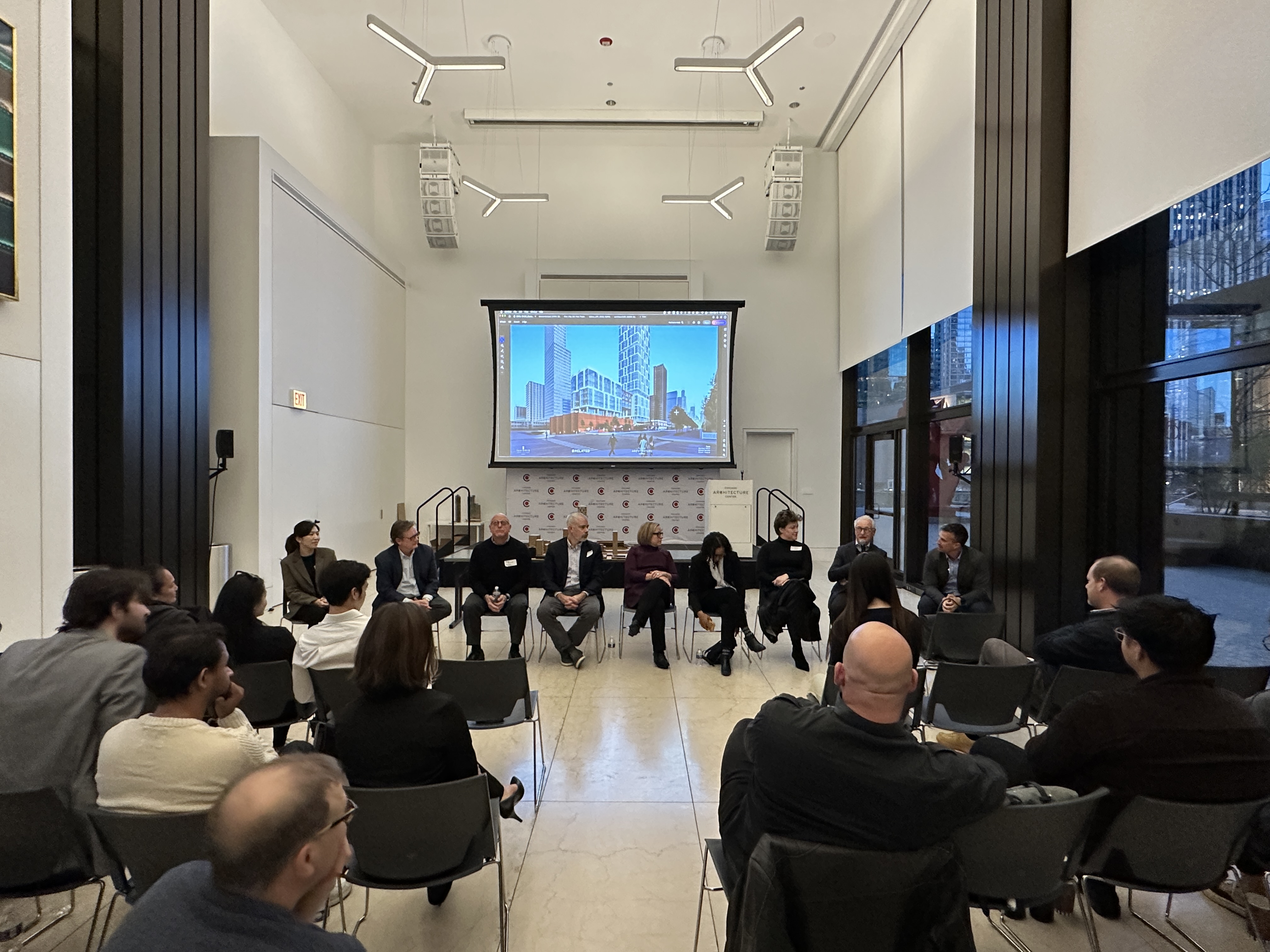
We celebrated the end of the semester with a presentation to Related and other members of the profession and the public at the Chicago Architecture Center last week. It was a great chance for teams to get feedback and show off their work. CAC leadership and staff have been great about letting us bring the work done in Urbana-Champaign up to Chicago, and it’s always a good experience for students to present in esteemed surroundings. Thanks to everyone who made this happen and to a stellar bunch of designers who eagerly dove into a genuinely challenging project.
A 400-foot version of the Chicago Temple, as published in the Tribune, March 26, 1922
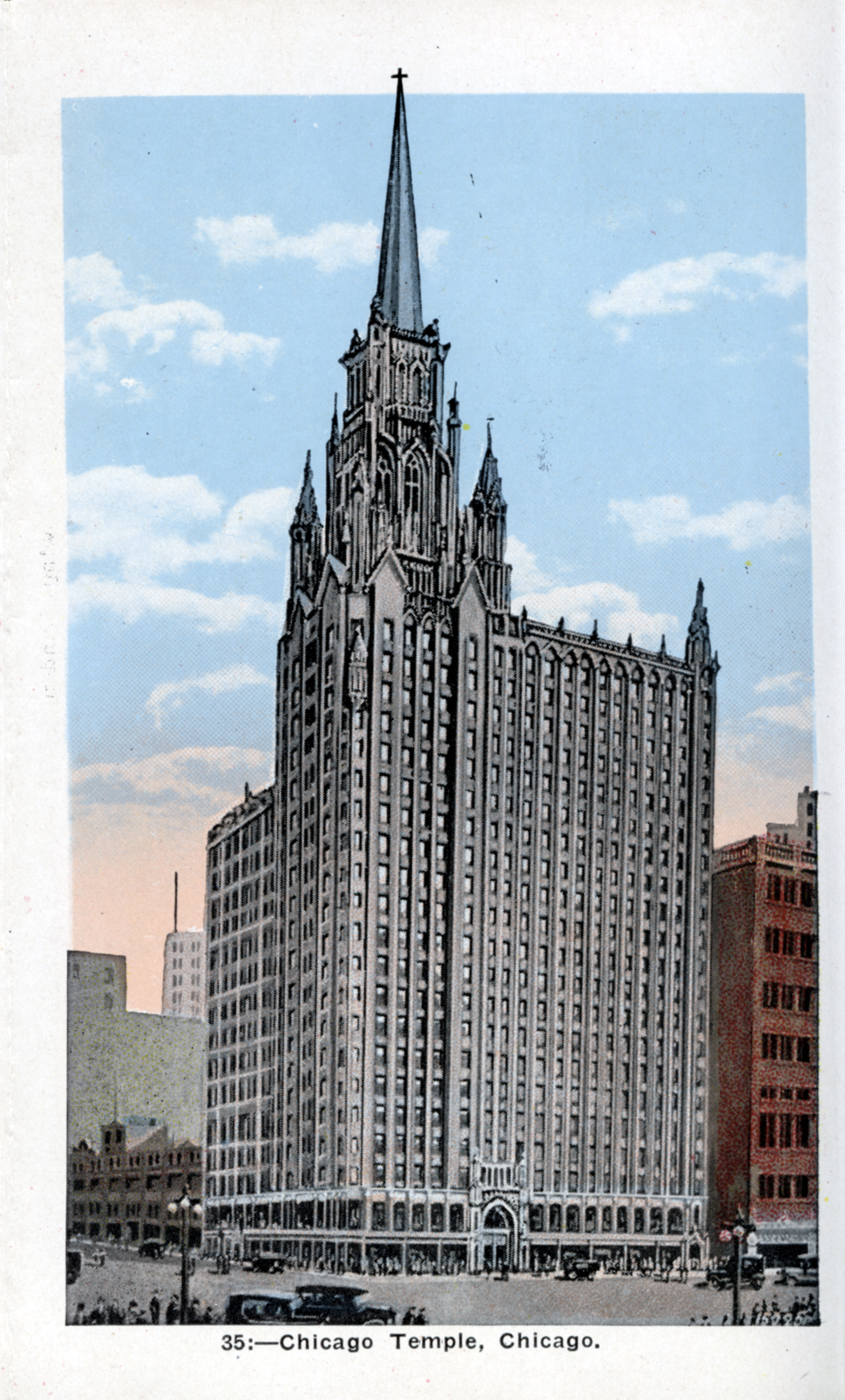
I was honored to be part of the Chicago Temple’s 100th birthday celebrations earlier this month. UIC’s Robert Bruegmann, Lee Bey from the Sun-Times, and the Chicago History Museum’s Rebekah Coffman, and I all offered context to the 556-foot skyscraper church (or is that skyscraper/church?). I’ve written about the Temple in Chicago Skyscrapers, 1871-1934 and on ArchitectureFarm here; this was a chance to dive more deeply into the politics—and scandal!—surrounding the tower’s permitting and its ultimate effect on the city’s skyline.
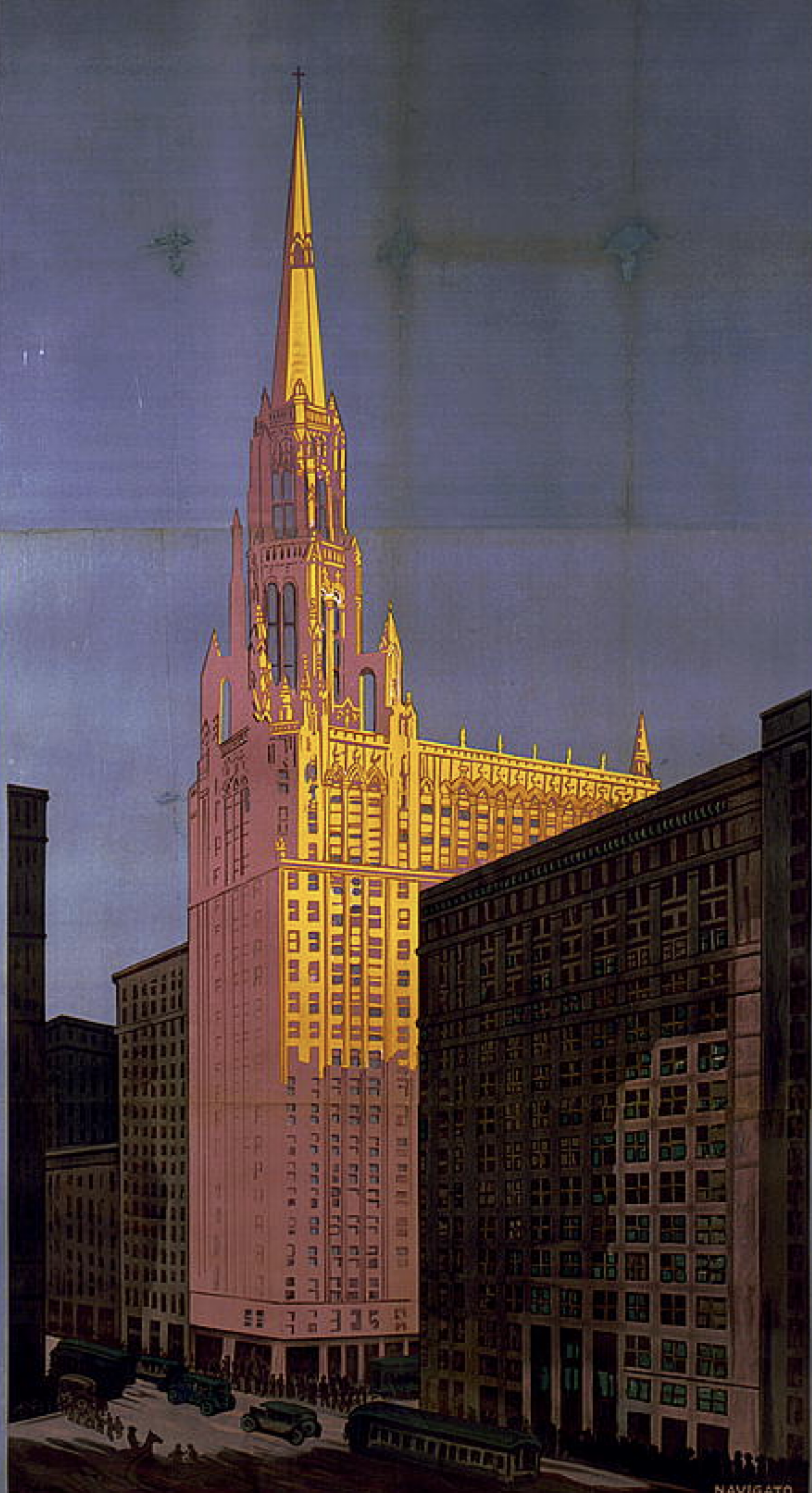
“METHODISTS SEE DREAM REALIZED IN LOOP TEMPLE,” announced headlines in the Chicago Tribune in March 1922, alongside a rendering showing a skyscraper church—260 feet of commercial office space sandwiched between a new sanctuary for the First Methodist Episcopal Church on the ground floor, and a 140-foot spire atop the commercial block.[1]
The early 1920s were banner years for skyscraper construction, but Chicago’s efforts were hindered by a building code that had resolutely capped building height. While the limit was raised and lowered several times, it hovered between 200 and 265 feet during the 1910s, frustrating downtown developers with the technology to build higher. Led by landowners in surrounding wards who sought to “press out” the Loop’s land value, the building height limit left Chicago a city of flat tops, far lower than the 792-foot tall Woolworth Building that New York boasted. Completed in 1913, it wrested the title of “world’s tallest” from Chicago—seemingly for good.
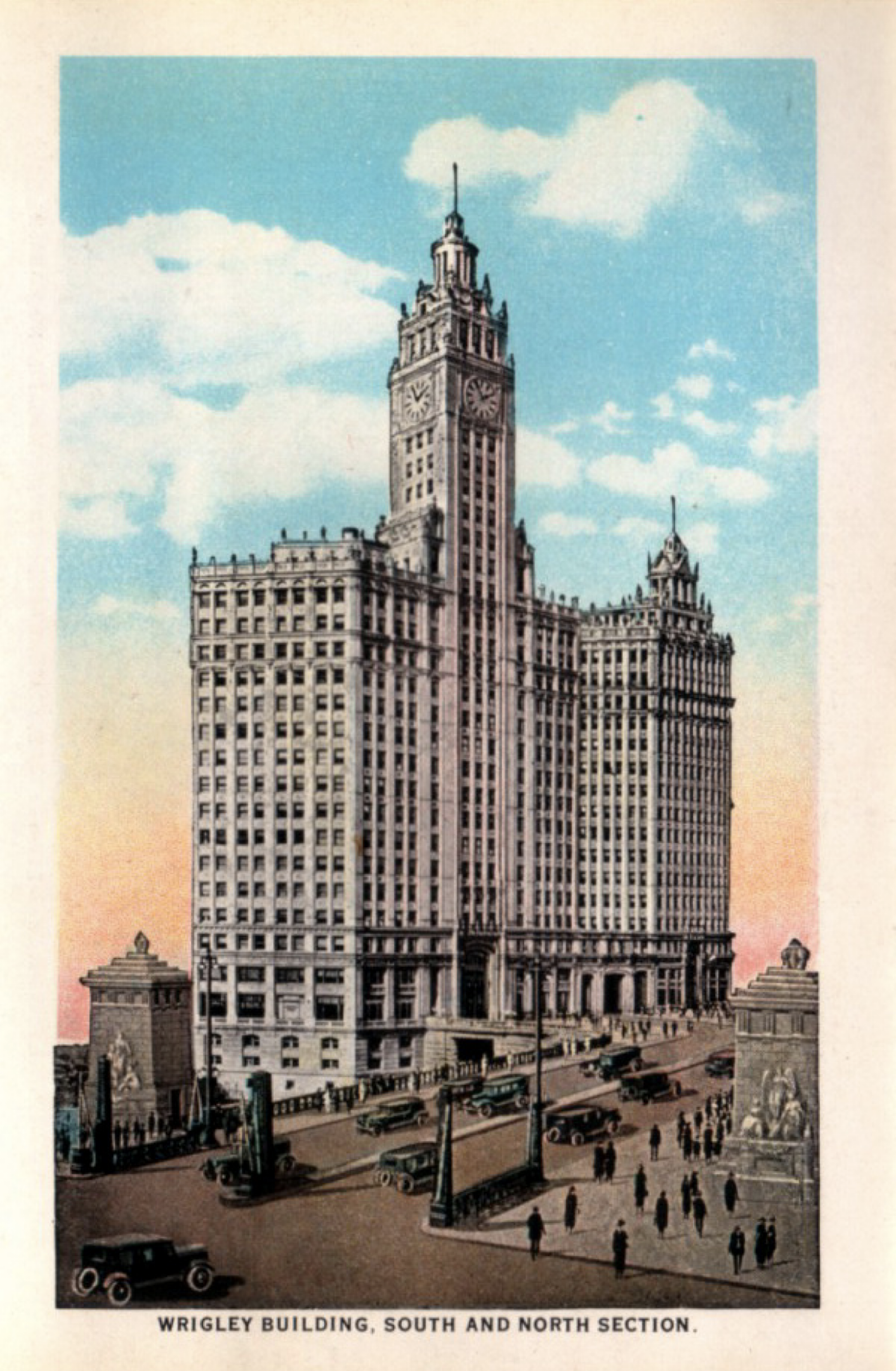
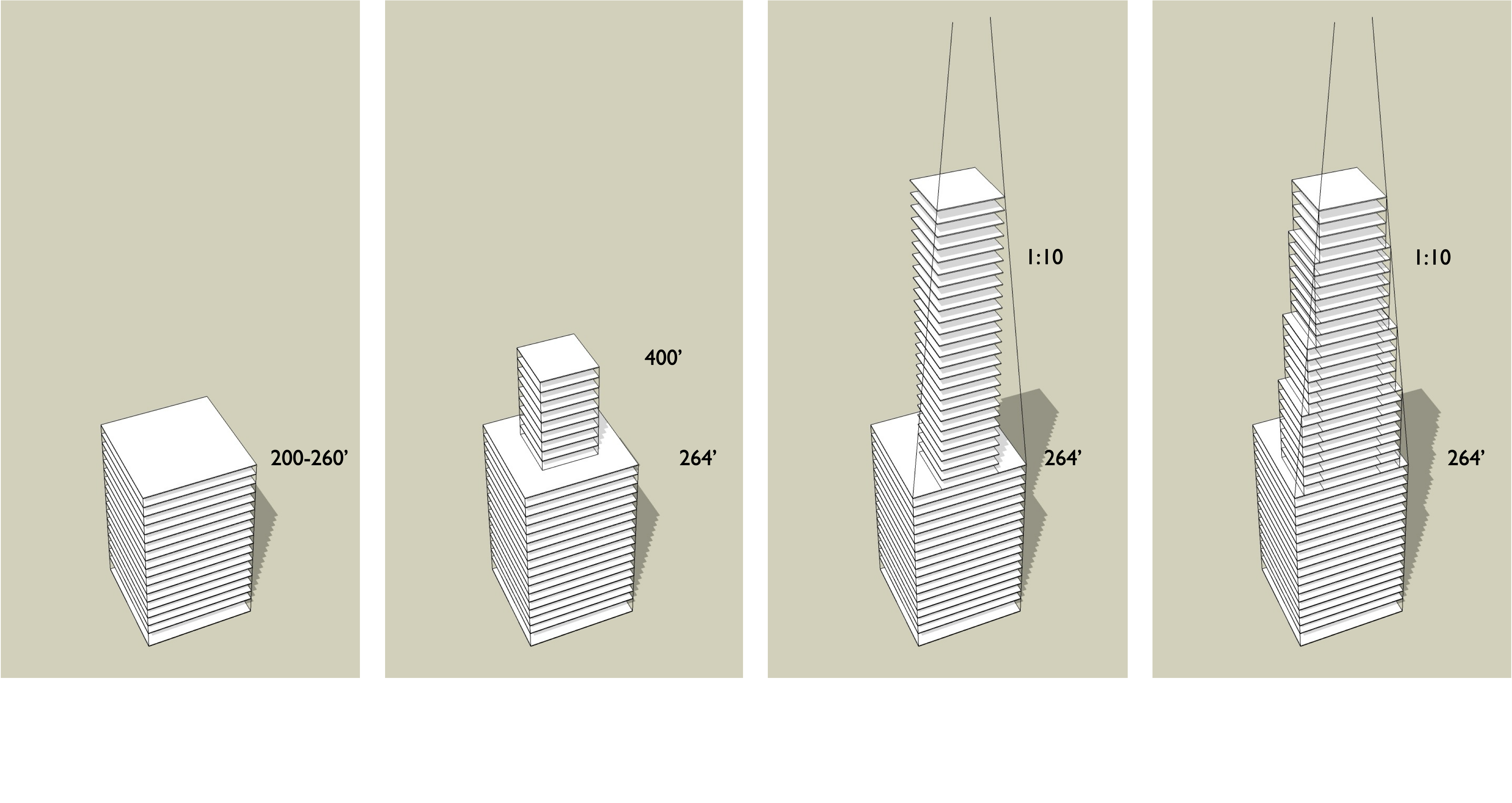
The city grudgingly allowed an exception in 1920, permitting “spires” to rise above the absolute limit (then set at 260 feet) to 400 feet, provided they did not occupy more than 25% of the “building frontage.” The Wrigley Building, designed by Graham, Anderson, Probst, and White and completed in 1921, was the first and most visible tower to exploit this loophole. Holabird and Roche, the architects for the Chicago Temple, proposed this strategy for the new building; the commercial block would touch the cornice height restriction, while the spire would exactly hit the ultimate 400’ limit.
The 400-foot tall spire atop Graham, Anderson, Probst, and White’s Wrigley Building.
Within a month, however, Chicago’s Building Commissioner, C.A. Bostrom, announced that the Methodists’ permit would be denied. The tower’s width was based on 25% of the total frontage of the lot along Washington and Clark Streets. The code, Bostrom argued, required the spire’s width to be based only on the main frontage. Given the skinny lot’s frontage on Washington, the spire could, effectively, be nothing more than a flagpole. Just one day later, however, Bostrom seemed to relent and then, after eight months, announced that the Church had been granted a permit for a 556-foot spire—a foot taller than the Washington Monument and far taller than any building in Chicago, religious or commercial.
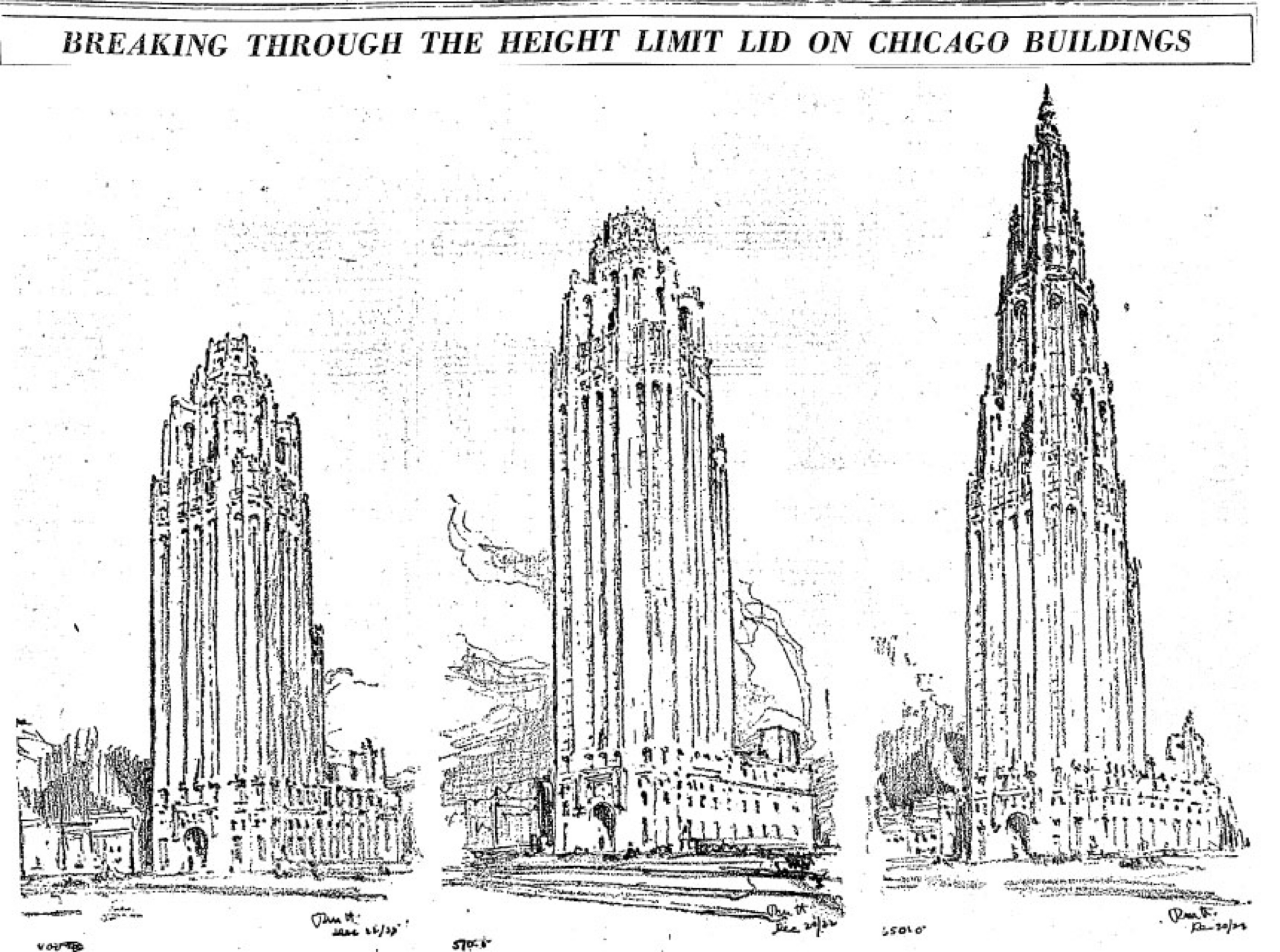
Other building owners were apoplectic at this exception—far beyond anything permitted up to that point in the city. The Tribune, which had just announced its code-compliant tower and spire, designed by Hood and Howells to reach precisely 400 feet with its gothic tower centered in the plan and exactly 25% as wide as its main front, was particularly vexed. “The Methodists,” the paper wrote, “have found the way to break through the 400-foot crust which truncates Chicago architecture.”
Alternate versions of the Tribune Tower prepared by Hood and Howells after the Chicago Temple exception was announced, James O’Donnell, Bennett. “M. E. Building Opens New Era Of Sky Scrapers.” Chicago Daily Tribune, Dec 27, 1922. 1.
“In obtaining the grant of this spectacular exception to the provisions of the existing building ordinance the Methodists have done a big thing for art and inspiration in Chicago. Its value as a precedent is obvious and will prove a source of encouragement to architects…
“Meanwhile the ordinance stands just as it did. Every exception to it that is made in behalf of builders and of art must be a special order of council. That many such exceptions can be made without causing tedious and costly litigation seems improbable. In short, the projectors of the great temple in the loop have brought to a head a situation that long has been commercially irksome and artistically deadening. Thorough revision of an ordinance which creates conditions so benighted now appears inevitable.”[2]
The paper commissioned Hood and Howells to draw up versions of the Tribune Tower at 570 and 650 feet high. “The churchmen will find that there are others who have as much at heart as they have in the cause of beauty in city buildings,” they wrote, threatening to beat the Methodists to the title of the tallest building in Chicago.
The revised Temple with its 556-foot tall spire.
What happened? Why would the Temple receive permission not just to build their planned design but also to exceed the limitations of every other city tower? The answer may lie in news reports of the original denial. Just after Bostrom’s initial decision, reporters queried whether “the difficulties over the permit have any connection with the refusal of the Methodist ministers to indorse the Rev. John H. Williamson, city hall law enforcer, whose please for law enforcement have been mingled with speeches lauding Mayor Thompson.”[3]
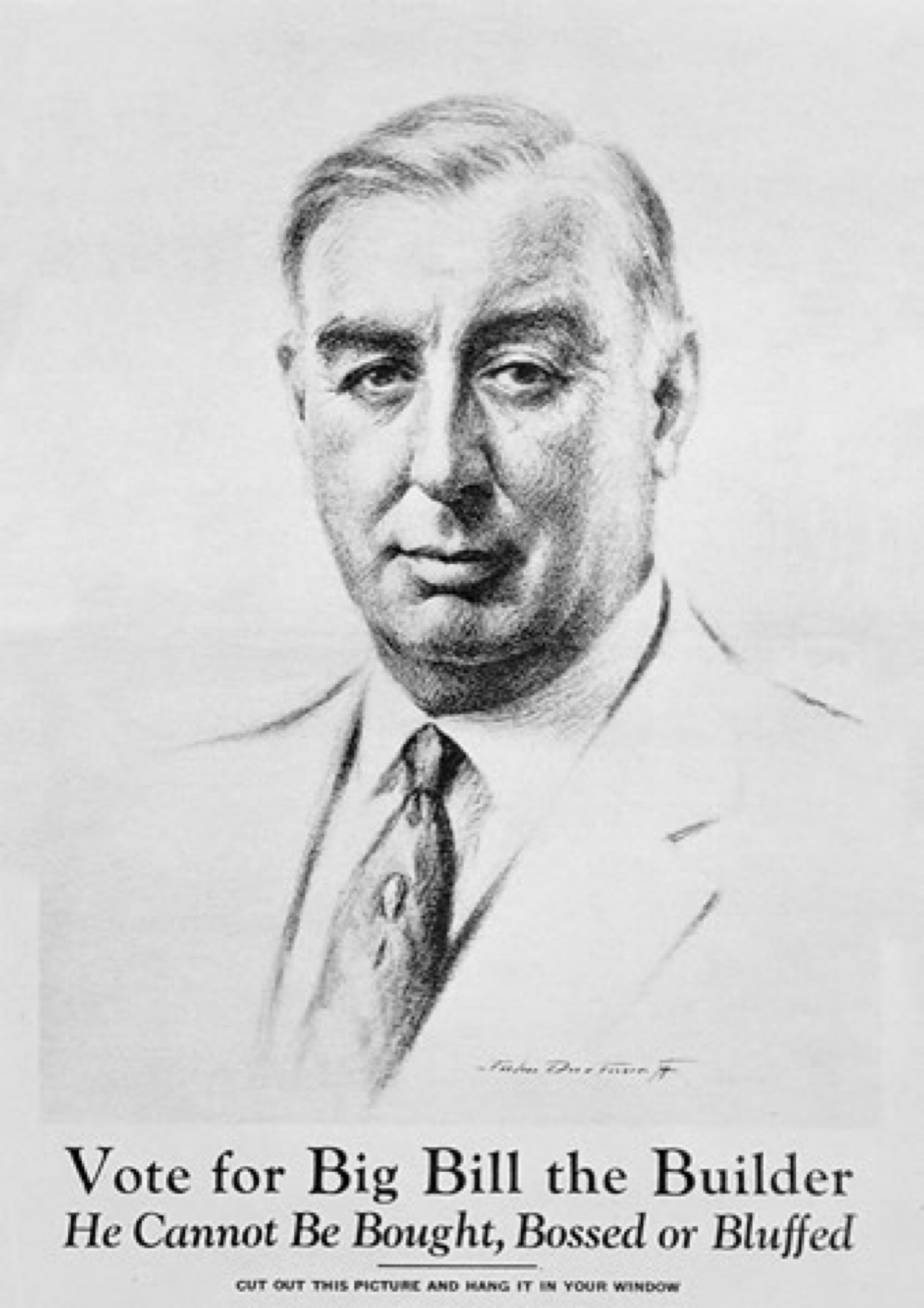
William Hale “Big Bill” Thompson, Mayor of Chicago 1915-1923 and 1927-1931. (Wikimedia)
Therein lies a tale, one that could only happen in Chicago. Mayor Thompson was William Hale Thompson, by later accounts, “not only the most corrupt politician in America but the most corrupt politician in Chicago.” Thompson, a “non-practicing Methodist” by his admission, had risen to power in 1915 partly by courting the “temperance vote,” a bloc of largely Methodist voters who pushed for prohibition. His campaign had promised to enforce Sunday blue laws that were already on the books but widely ignored, and the early years of his mayoralty were marked by a prominent campaign to do so. Keen to hang on to this vital demographic, Thompson campaigned for re-election in 1919 by appealing directly to the Methodists in campaign rallies, some of them held within the First Church itself. Clergy grew increasingly skeptical as they saw saloons remaining suspiciously open on Sundays, drawing connections between those and a notoriously corrupt police force led by Commissioner F.W. Fitzmorris.
As the next election drew near, Thompson responded by installing a Methodist minister, Rev. Williamson, as a “super law enforcer.” Williamson drew a $10,000 salary with no clear portfolio of responsibilities, but he was brought out to stand with the Mayor and denounce alcohol and other vices regularly. First Methodist minister, John Thompson, finally had enough, declaring in March 1922 that Williamson’s hire had been mere window dressing—“a political trick and not on the square,” in his words.[4] Williamson, for his part, seems not to have understood his assignment. Throughout the summer, he announced investigations into bribes paid by saloon owners and a gambling ring run by higher-ups in the police force. Thompson summarily fired Williamson, and in early December, he implicated the Mayor and Police Commissioner in a prostitution ring being run in the Levee, the city’s vice district.[5] Fitzmorris resigned. Thompson announced in January 1923 that he would not run for Mayor again.[6] All of this took place while the controversy over the Methodist’s tower simmered behind the closed doors of the Building Department. There is no direct evidence that the Methodists were “squeezed” in April when Bostrom denied their permit or that the 556-foot exception was granted to buy their goodwill amid a lurid Mayoral scandal, even by Chicago standards. However, it is hard not to see those decisions in this context.
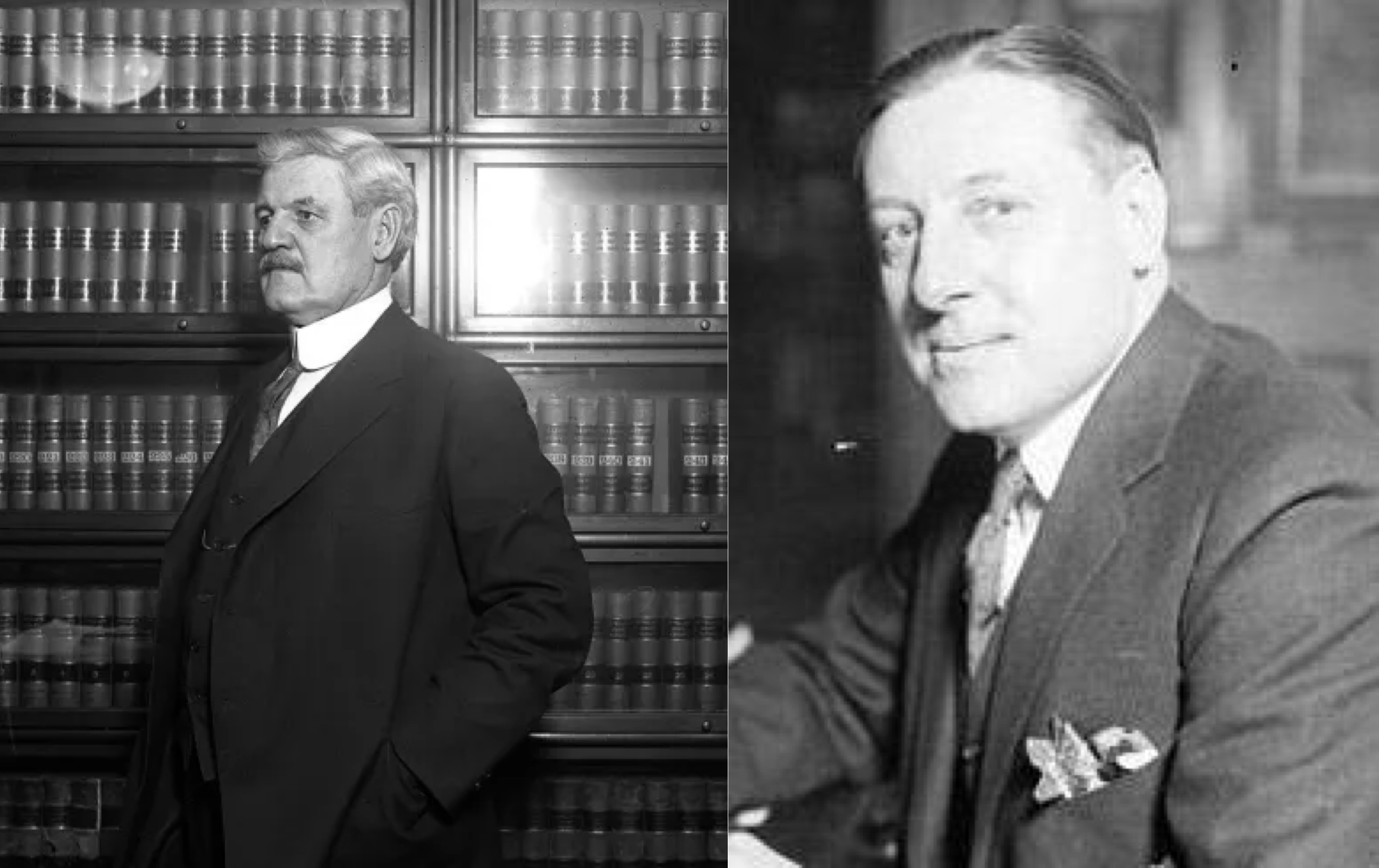
William E. Dever (D) and Arthur Lueder (R), two reform candidates seeking to sweep out the corruption that plagued the first Thompson administration.
The April 1923 election was a race between two candidates promising to clean up city government and to put the brakes on the development that threatened, to many, to change the Loop and its surroundings into “Skyscraperville.” William E. Dever, a former judge, ran as a Democrat against Thompson’s replacement, a city tax assessor named Arthur Lueder. While the Tribune campaigned for “a realtor for Mayor,” hoping that Lueder would continue Thompson’s laissez-faire approach to development, Dever, however, won handily.
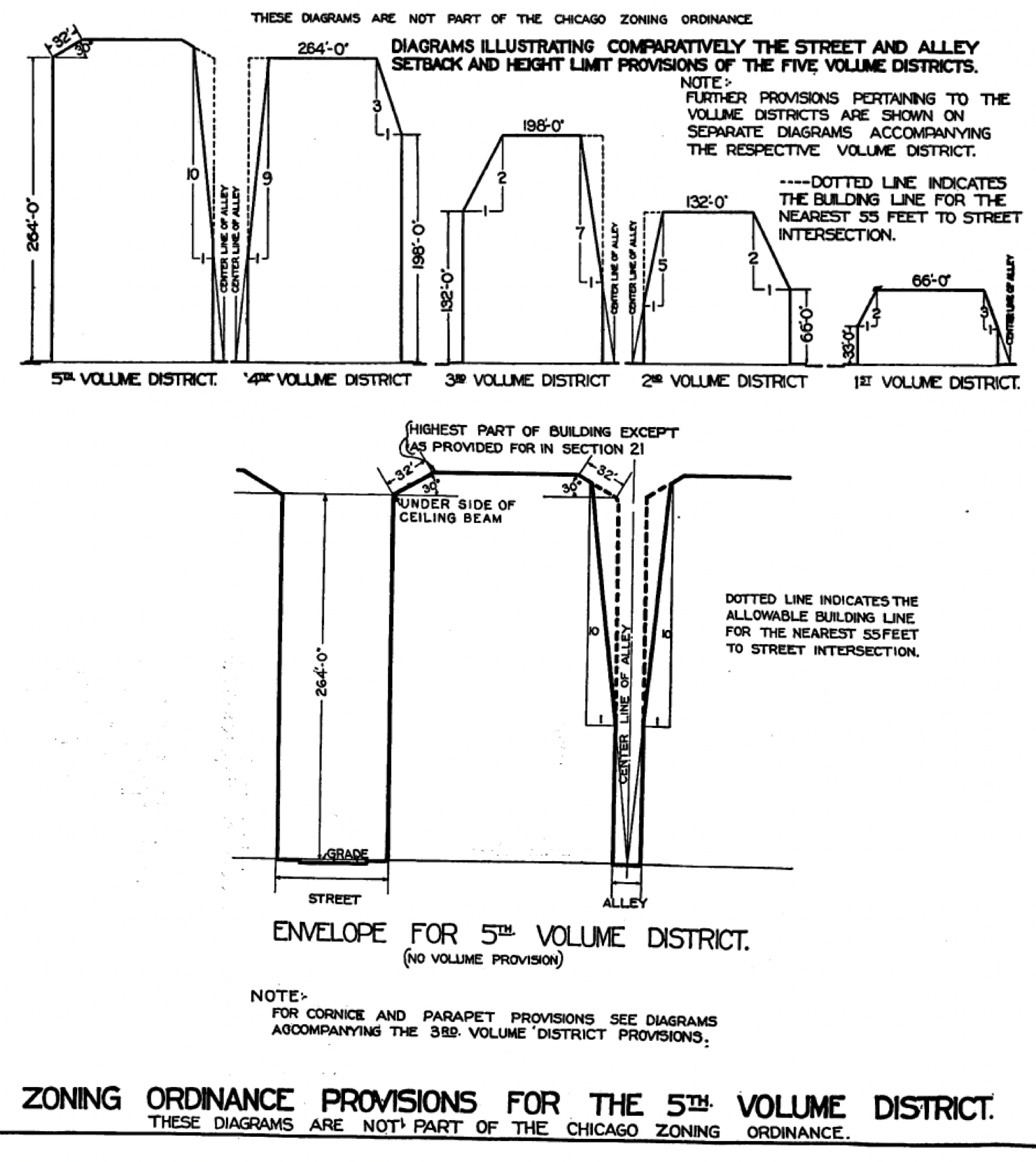
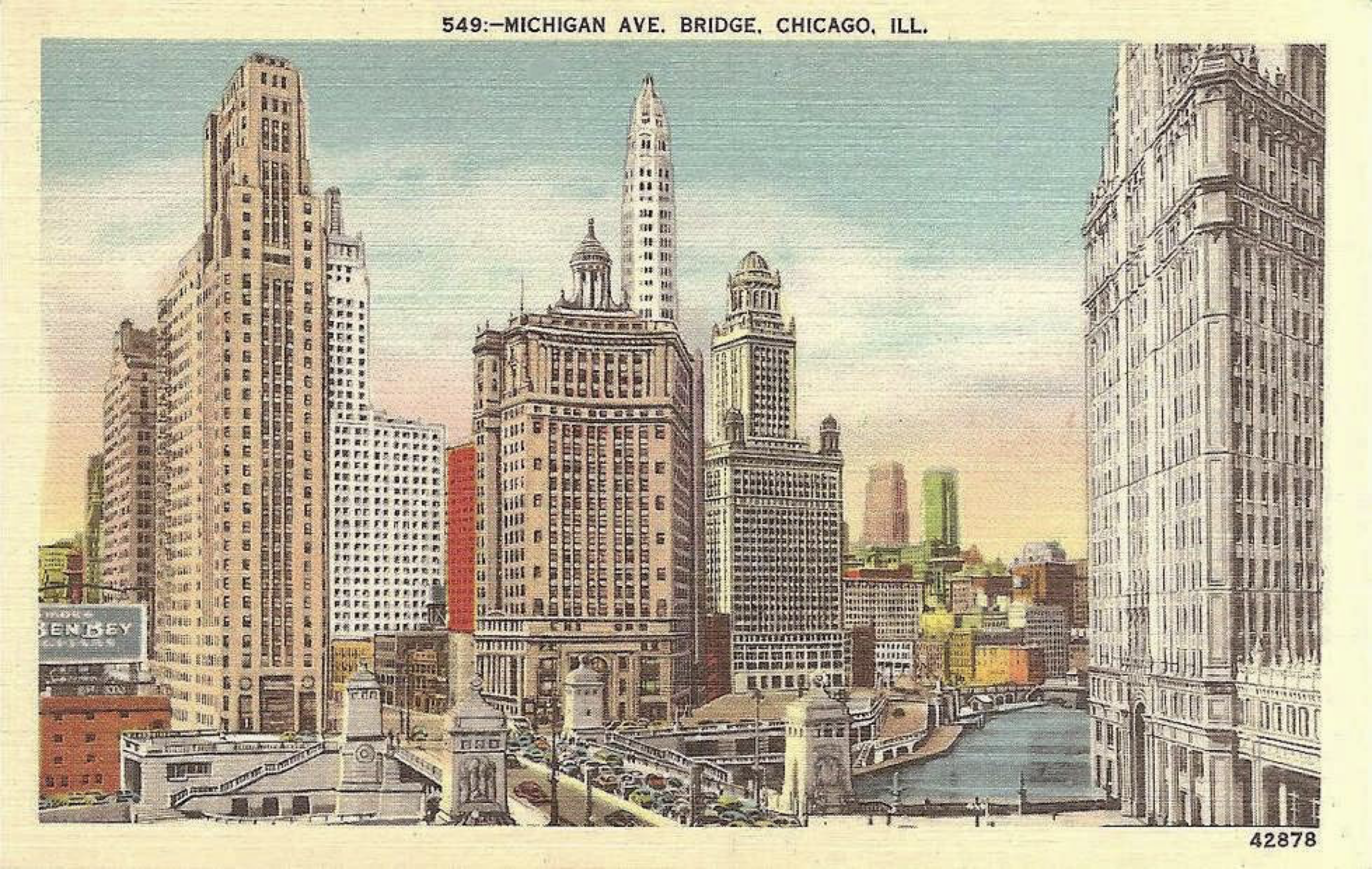
Chicago’s city council was also radically reshaped in that election as the aldermanic structure changed from 35 wards with two representatives each to 50 wards with just one alderman apiece. About to be swept out wholesale, the departing council rushed through the city’s new Zoning Ordinance, which the city’s Real Estate Board had primarily assembled. Initially recommending a strict 265-foot limit, the Board had made a last-minute suggestion, authored by architect George Nimmons, that would allow “setbacks” above this cornice as long as they met certain area limitations and were contained within a 4:1 slope measured vertically from the cornice limit. Two days after the election, the lame-duck city council enacted the new Ordinance with this exception, but—in what was perhaps a spirit of generosity or an effort to please developers and owners who might be convinced to fund departing aldermen’s future campaign coffers—they increased Nimmons’ recommended slope to 10:1. The resulting “block and towers,” “setback skyscrapers,” or “streamlined pylons” quickly became a signature of Chicago during the roaring 20s, marking, in particular, the panorama surrounding the newly finished Michigan Avenue Bridge; The London Guarantee Building, 333 N. Michigan, Mather Tower, and the Jeweler’s Building all feature cornices at 265 feet, with towers above that—often precisely—meet the setback lines of the expanded “Nimmons Loophole.”
The original Zoning Ordinance envelope for the “5th Volume District,” or downtown, featured a strict cutoff at 264′-0″ with only small exceptions for roof cornices.The “Nimmons Loophole,” extended from a 4:1 slope to a 10:1 slope, permitted the “block and tower” and “pylon” arrangements that are now signatures of 1920s Chicago.The ultimate legacy of the Temple’s height exemption may be the panorama around the Michigan Avenue Bridge, which opened in 1923 and spurred the development of former warehouse sites after the new zoning code passed. In addition to legacy buildings such as the Wrigley (right) and the London Guarantee Building (center), 333 N. Michigan (far left), Mather Tower (behind London Guarantee), and the Jeweler’s Building (right of center) all interpreted the 10:1 setback lines differently.
POSTSCRIPT: Prohibition passed nationally in 1920. After publicly re-confirming his Methodist faith, William Hale Thompson survived the vice scandal and was re-elected as Chicago’s Mayor, defeating William Dever in 1927. Thompson’s campaign was partly bankrolled by proceeds from bootlegging operations in Chicago. The Chicago Temple remained the tallest building in Chicago until 1930 when the 605’ Board of Trade opened.
[1] Norton, W. B. “Loop’s Spiritual Fortress: Methodists See Dream Realized in Loop Temple.” Chicago Daily Tribune, Mar 26, 1922. 6.
[2] James O’Donnell, Bennett. “M. E. Building Opens New Era Of Sky Scrapers.” Chicago Daily Tribune, Dec 27, 1922. 1.
[3] “New First M. E. Church Permit Tangle Bared.” Chicago Daily Tribune, Apr 28, 1922. 7.
[4] Norton, W. B. “Seeks Probe Of Appointment of Rev. Williamson: M. E. Pastor Sees Joker in Enforcer Job.” Chicago Daily Tribune, Mar 20, 1922. 10.
[5] “Rev. Williamson Hears ‘High Cops’ Take Vice Graft: So Enforcer Aims To Start Something.” Chicago Daily Tribune, Sep 07, 1922. 17.
[6] “Thompson Won’t Run Again: Mayor Quits Race.” Chicago Daily Tribune, Jan 26, 1923. 1.
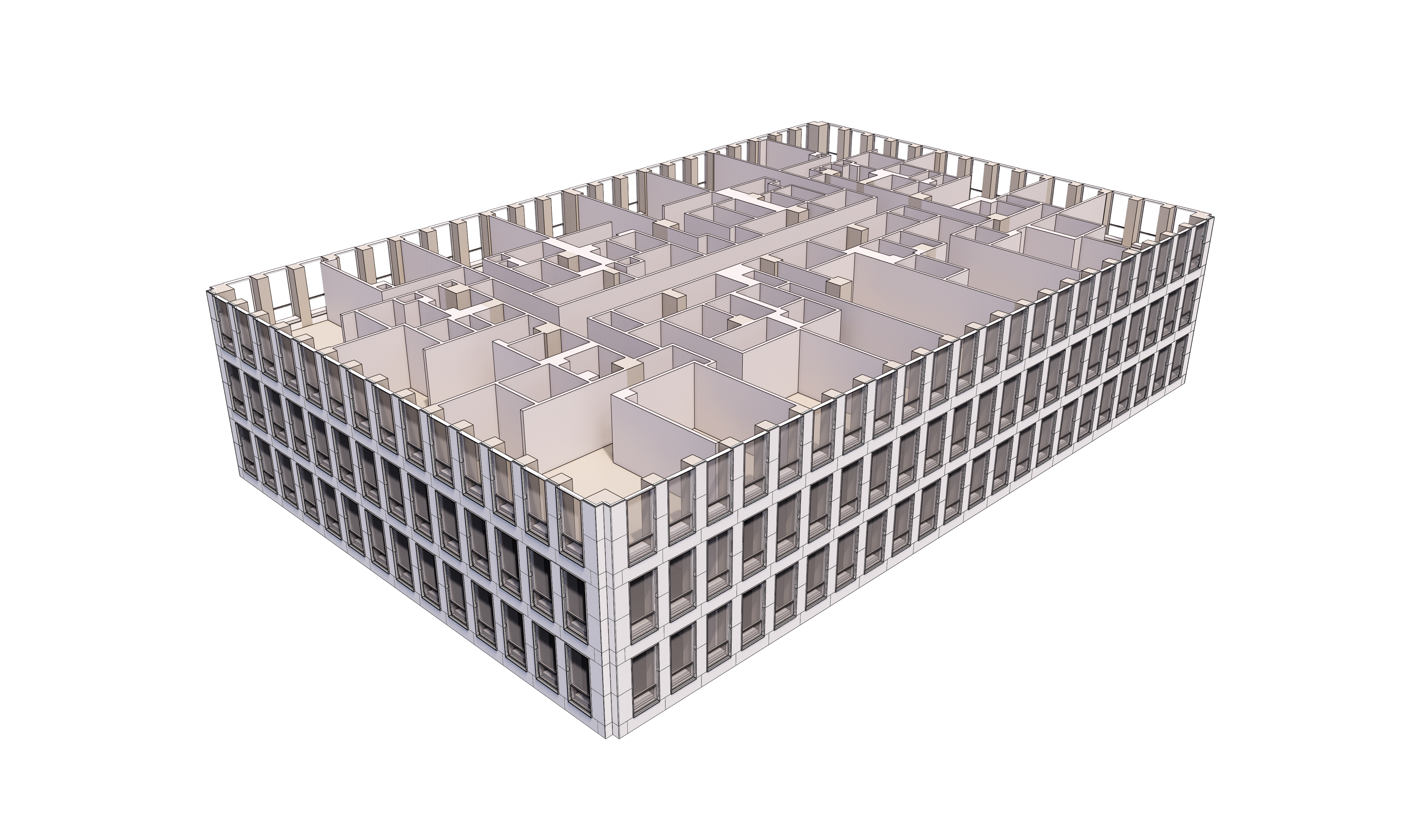
Dewitt-Chestnut Apartments (SOM, 1966). Model by Jack Strait
Skyscrapers! Nervi! Nervi Skyscrapers! Several upcoming appearances to shout out…
First, on Saturday, Sept. 14,Chicago Skyscrapers, 1934-1986, will receive the Pattis Family Foundation Chicago Book Award at the Newberry Library. The award will be part of an afternoon event celebrating storytelling in Chicago, with four storytellers and a performance by the amazing Joel Hall Dancers. I’ll discuss the book and how skyscrapers have good stories to tell with Chicago Tribune architecture columnist Ed Keegan and sign books afterward. The event is free and will be streamed online–more information and registration at the Newberry’s website.
Michelangelo Sabatino, the John Vinci Distinguished Research Fellow, and Director of the PhD program at the Illinois Institute of Technology’s College of Architecture, will be lecturing at the University of Illinois School of Architecture on Monday, Sept. 16. His new book, The Edith Farnsworth House: Architecture, Preservation, Culture,looks at this iconic house in new, overlapping realms of landscape, preservation, and social history. I’ll be part of a panel discussing the book, the house, and Michelangelo’s talk with UIUC faculty Kathryn Holliday and Pollyanna Rhee afterward.
On Thursday, Sept. 19, I’ll talk with SOM structural consulting partner Bill Baker about Pier Luigi Nervi’s high-rise designs for the Skyscraper Museum’s ongoing project about concrete skyscrapers. Bill and I have been working with Carol Willis, the Museum’s Director, on how concrete has emerged as, arguably, the key material in tall building design, and Nervi’s role in their engineering and aesthetics was critical. Also a free event and online-only–registration required through the Skyscrapers Museum’s website.
Sept. 28 marks the 100th anniversary of the Chicago Temple’s opening–the 555′ spire remains (depending on who you ask!) the tallest church in the world and certainly one of the most fascinating skyscrapers in Chicago. I’ll be discussing the Temple’s place in Chicago’s political, architectural, and zoning history along with historian Robert Bruegmann, the Chicago Architecture Center’s Adam Rubin, and Sun-Times architectural columnist Lee Bey in the sanctuary (Clark and Washington Streets) at 2:00 on the 28th. More information on the building and the event here.
I’ve been down a rabbit hole on British glasshouses this summer, redoing some of my Construction History seminars and trying to dig deeper into the ways that glass and iron complemented and provoked one another in buildings like Kew’s Palm House and the Crystal Palace (I may not think of the Roman Empire every day, as the meme goes, but I definitely think of the Crystal Palace at least twice a week…)
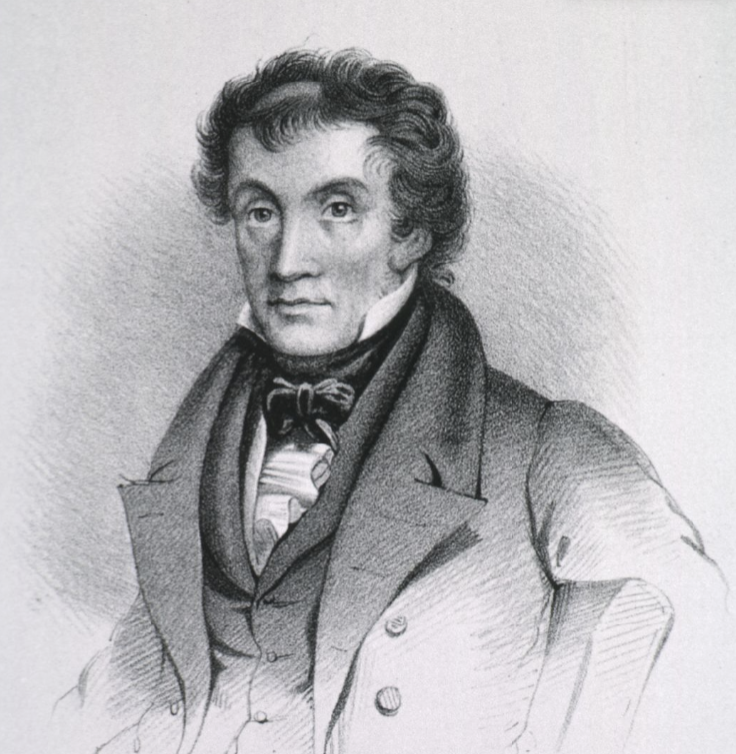
John Claudius Loudon (1783-1843)
One of the great heroes of the movement was John Claudius Loudon (1783-1843). Born to a farming family, he studied agriculture and horticulture at Edinburgh. Employed originally as a gardener, he expanded his efforts into architecture, city planning after a tour of Europe in his early 30s. Hampered by rheumatism and the loss of an arm after a botched surgery, his marriage to author Jane Webb made a productive collaboration. The two founded and published some of the first architectural and gardening magazines, as well as encyclopedias that remained primary reference sources in the two fields for decades.
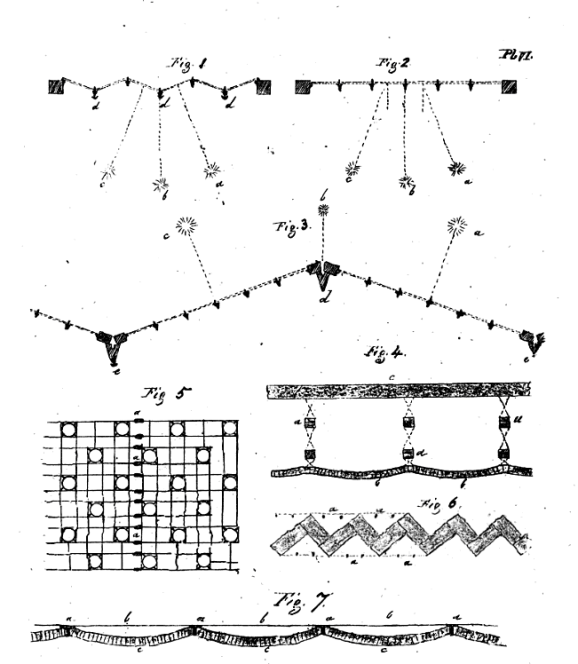
A page from Loudon’s Remarks on the Construction of Hothouses, 1817.
But among all of these varied interests, Loudon returned, continually, to hothouse design, publishing treatises on the subject in 1805, 1817, and 1824, along with extensive articles in the various encyclopedias published in the 1820s. In these, beginning with his remarks after building a functional but flawed structure for gardening clients, Loudon’s approach evolved from versions of the angled glass walls that enclosed forcing frames in the previous century to something entirely new—structures of glass and iron that married functional requirements of light with developing techniques of glass and iron production. The results were not only effective greenhouses, they were also harbingers of new architectural forms and a challenge to aesthetic traditions that had, he felt, held back the development of truly effective horticultural building.
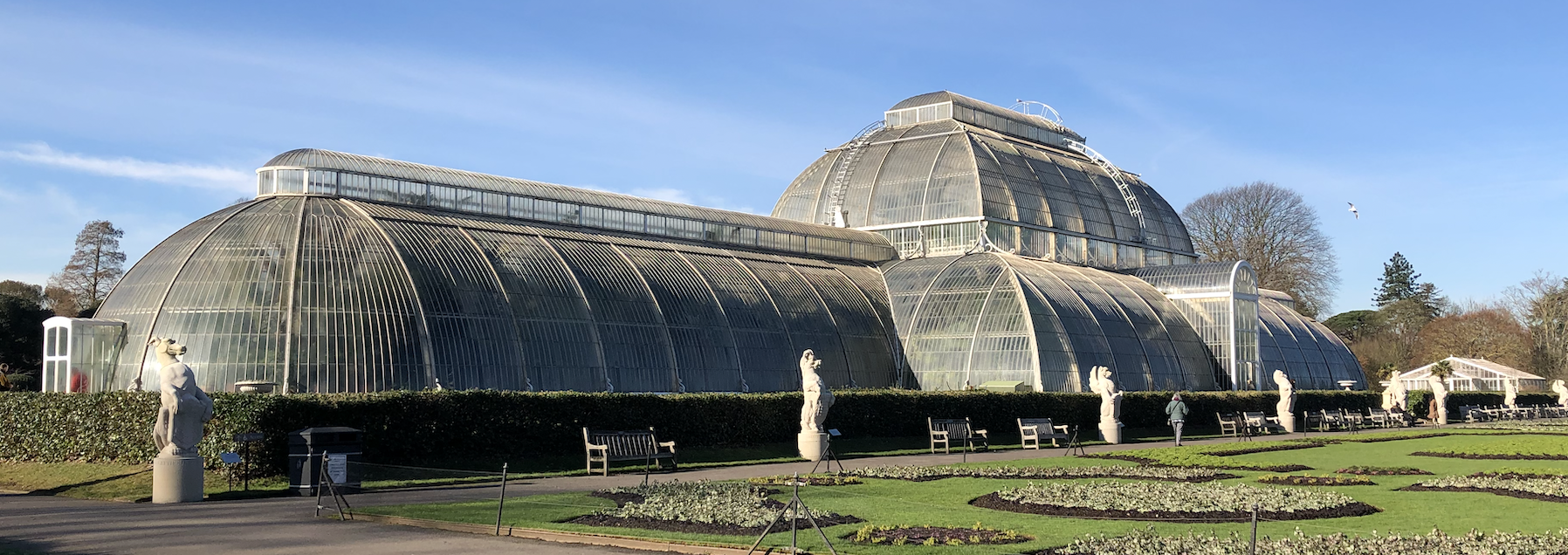
Palm House, Kew Gardens. Decimus Burton and Richard Turner, 1848. A “mansion architect’ and an iron fabricator join forces.
In 1835, remarking on hot-house construction in their Encyclopedia of Gardening,Loudon and Webb compared the emerging aesthetics of iron and glass to the dysfunctional efforts made by traditional architect to design greenhouses integrated with solid masonry houses. Their language is a bit florid, but their point, that style emerges from a logical application of available materials to desired functions, foretold Horatio Greenough’s essays on “Function and Form” in the 1850s, Louis Sullivan’s “Form follows Function” in the 1890s, and much of Corbusier’s rhetoric in the 1920s:
“The grand cause of the improvements which have been made in hot-houses may be traced to their being no longer, as formerly, under the control of mansion architects. To civil architecture, as far as respects mechanical and chemical principles, or the laws of the strength and durability of materials, they are certainly subject, in common with every description of edifice; but, in respect to the principles of design or beauty, the foundation of which we consider, in works of utility at least, to be ” fitness for the end in view,” they are no more subject to the rules of civil architecture than is a ship or a fortress; for those forms and combinations of forms, and that composition of solids and openings which are very fitting and beautiful in a habitation for man or domestic animals, are by no means fitting, and consequently not beautiful, in a habitation for plants….Fitness for the end in view, we repeat, is the basis of all beauty in works of use…”[i]
[J. C. Loudon [and Jane Webb], An Encyclopedia of Gardening. (London: Longman, 1835). 2449.
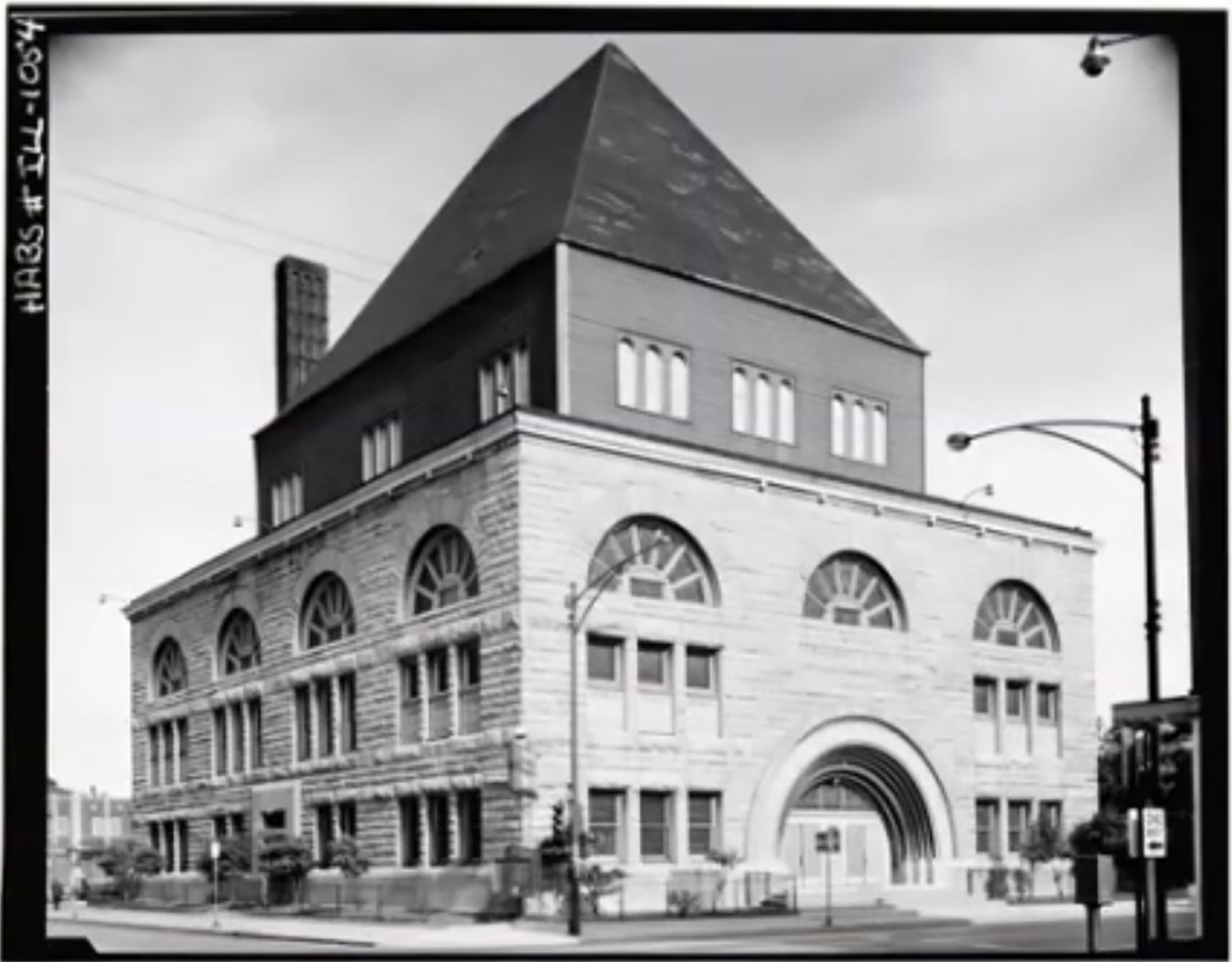
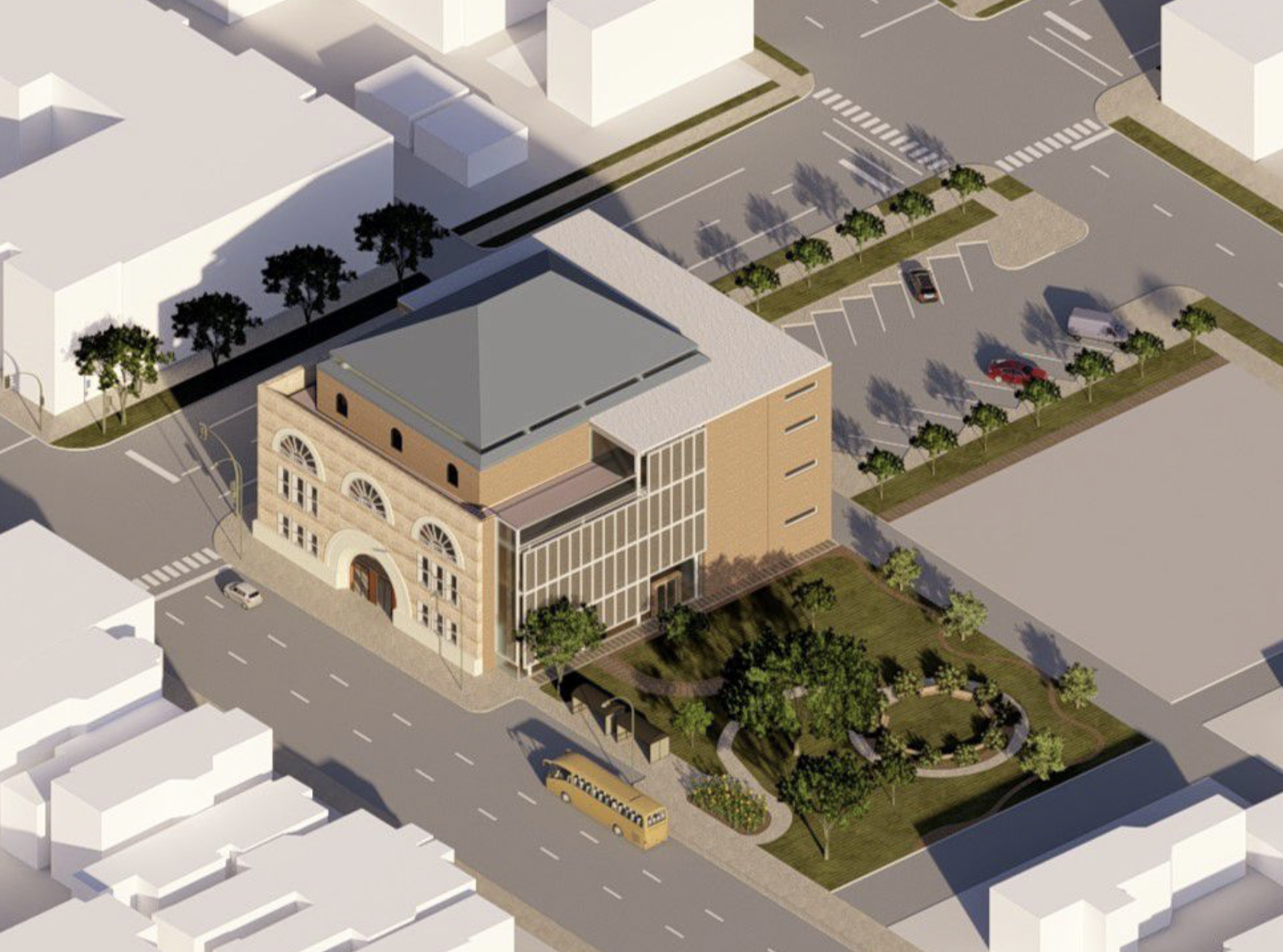
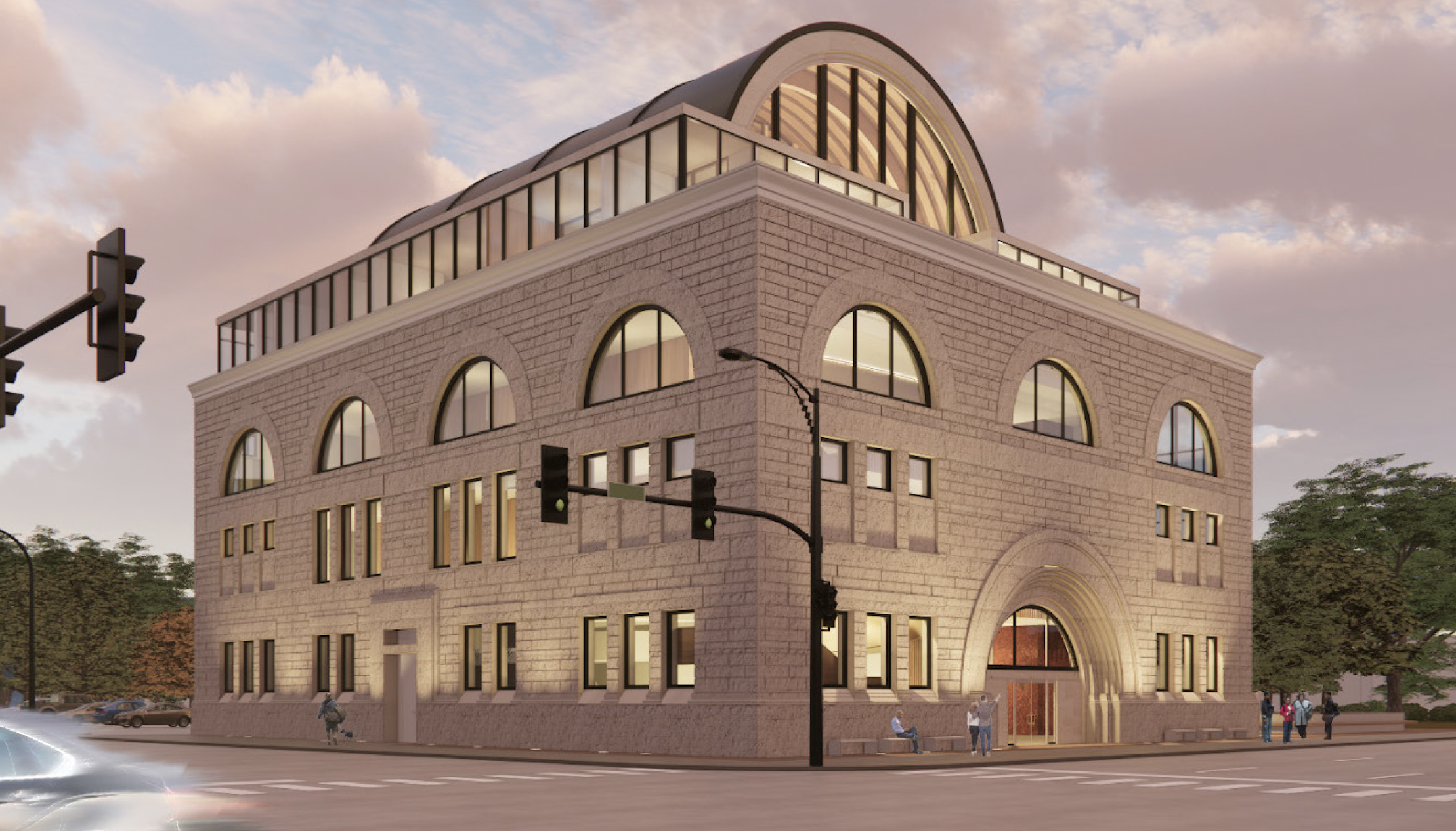
Dankmar Adler and Louis Sullivan designed the Kehilath Anshe Ma’arav Synagogue in 1890 as a worship and community center for the German-Jewish community in Douglas. As the Black community grew with the first wave of the Great Migration in the 1910s, KAM sold the Synagogue to the Pilgrim Baptist Church in 1922. The Church’s Music Director, Thomas A. Dorsey, was a visionary composer and performer who blended spiritual and blues traditions into the style first called Gospel Blues and, by the 1930s, simply Gospel. Pilgrim Baptist was a landmark in the Gospel world for seven decades, its 3000 seats filling for artists from Chicago, particularly Mahalia Jackson. Aretha Franklin, James Cleveland, and the Staples Singers performed regularly, and Martin Luther King, Jr. preached there during the Civil Rights movement.
Brenda Varghese & Hrushikesh Chavan
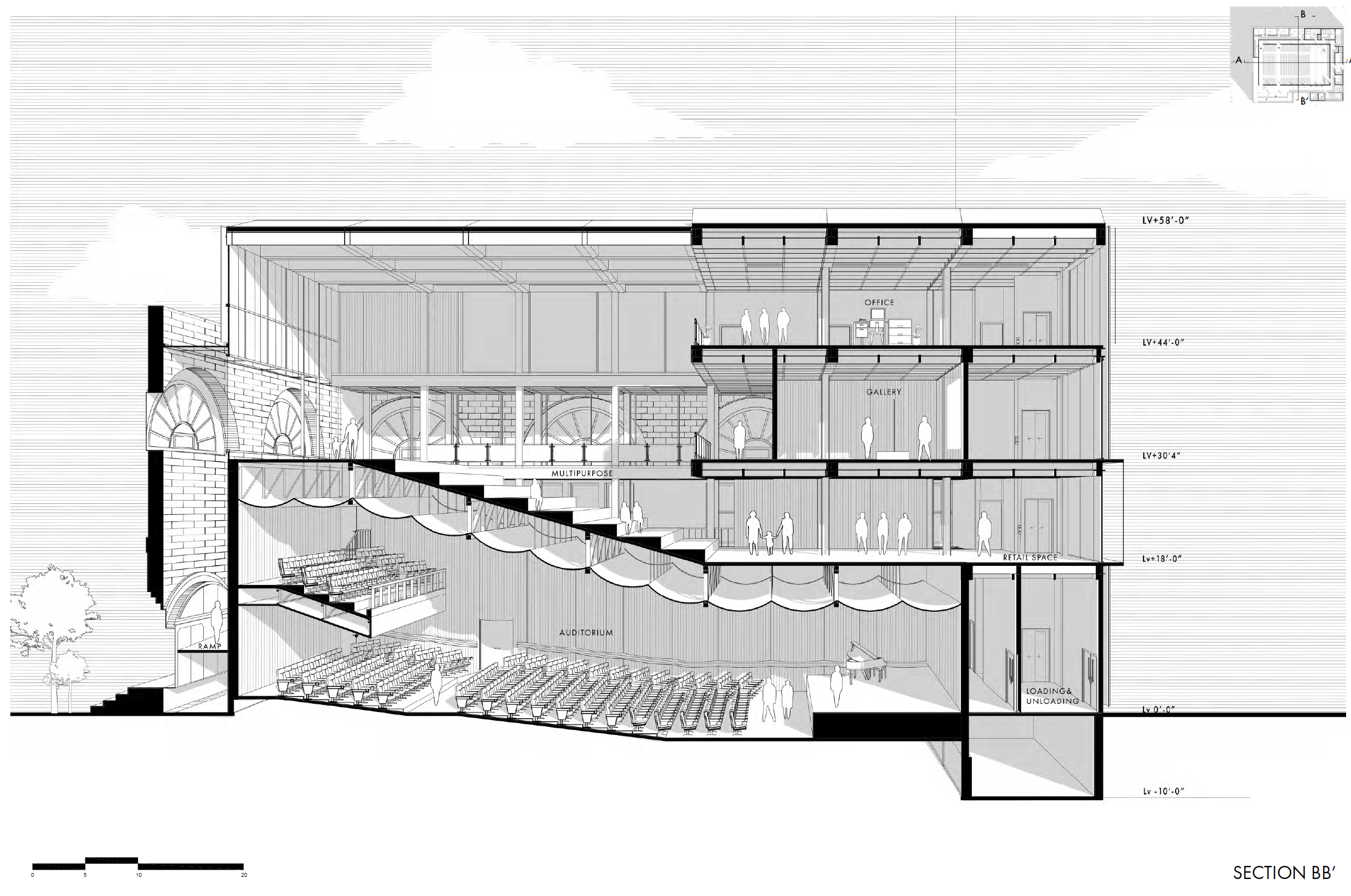
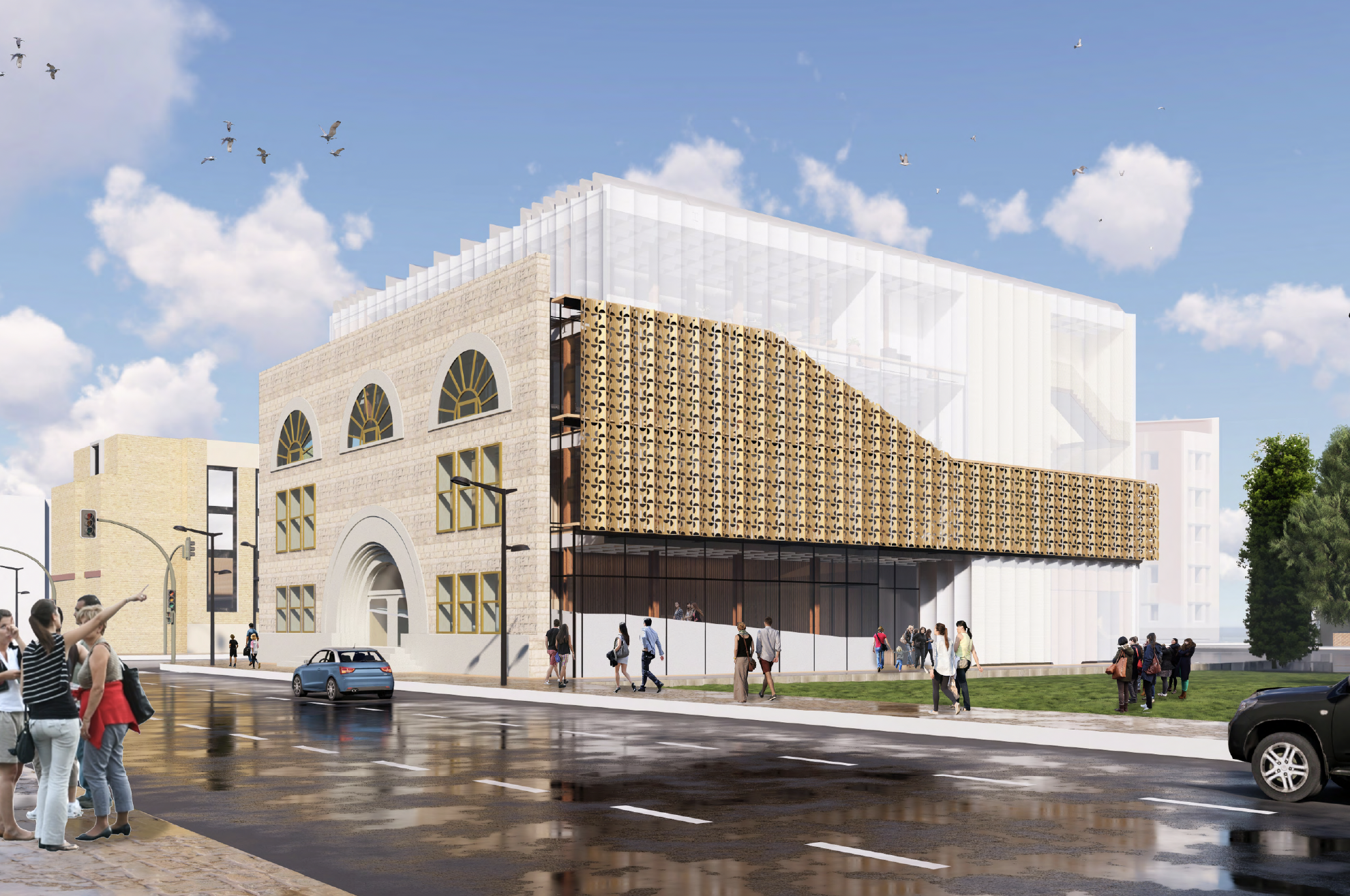
The Church burned in a 2006 fire while undergoing repairs to its roof. The entire Sullivan-designed interior was destroyed, leaving only the perimeter walls standing. Thanks to a preservation plan by WJE and Central Building and Preservation, those walls were stabilized and maintained. Meanwhile, community and church members formed the National Museum of Gospel Music and have been working to transform the site into an exhibition and performance center that would both acknowledge the structure’s deep history while introducing new generations to Gospel’s traditions and its contemporary styles.
Basmah Kishta and Raissa Gonzalez
Last summer, we organized a visit to the site for the Construction History Society of America’s annual meeting. Out of that visit and with the help of Rachel Will from WJE and Mark Kuberski from Central Buiding and Preservation, I met with Antoinette Wright, President and Executive Director of the Museum, and Cynthia Jones, Chair of the Church’s Board of Trustees, about basing our Fall Integrated Design Studio on the project. They were enthusiastic about having students generate ideas from their program, and Christopher Lee, from the Chicago design firm Johnson & Lee, generously shared the space plan they had developed.
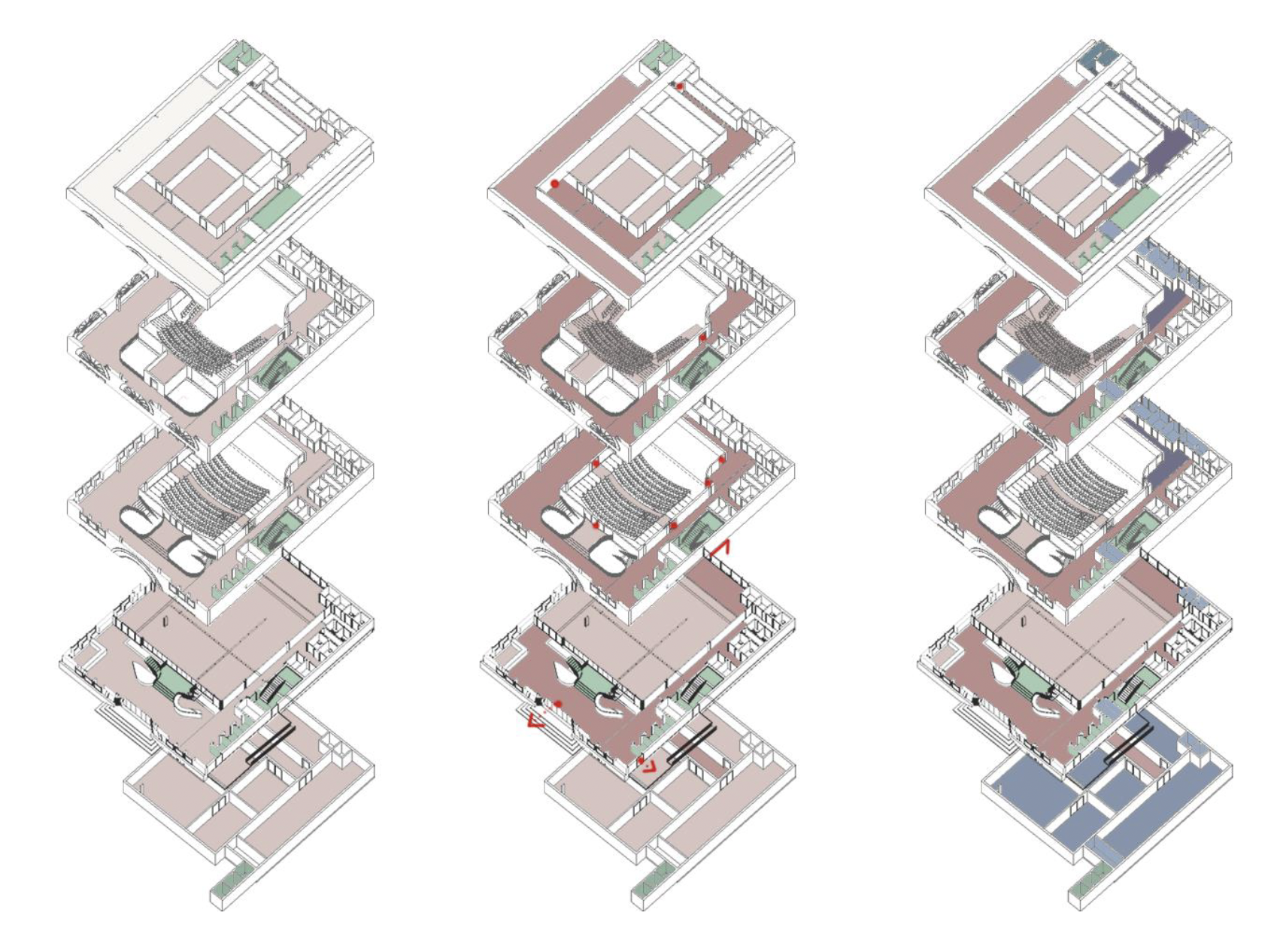
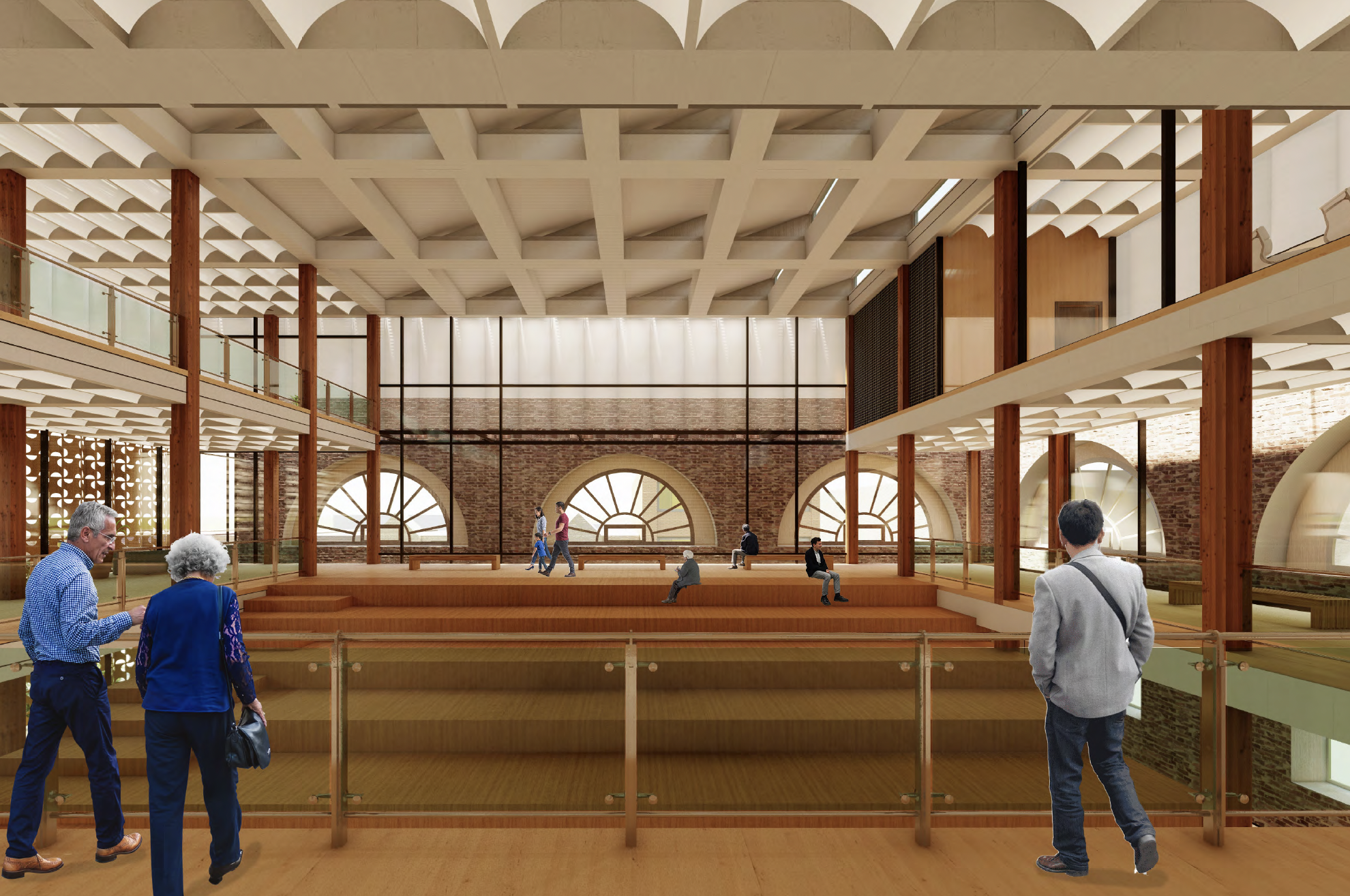
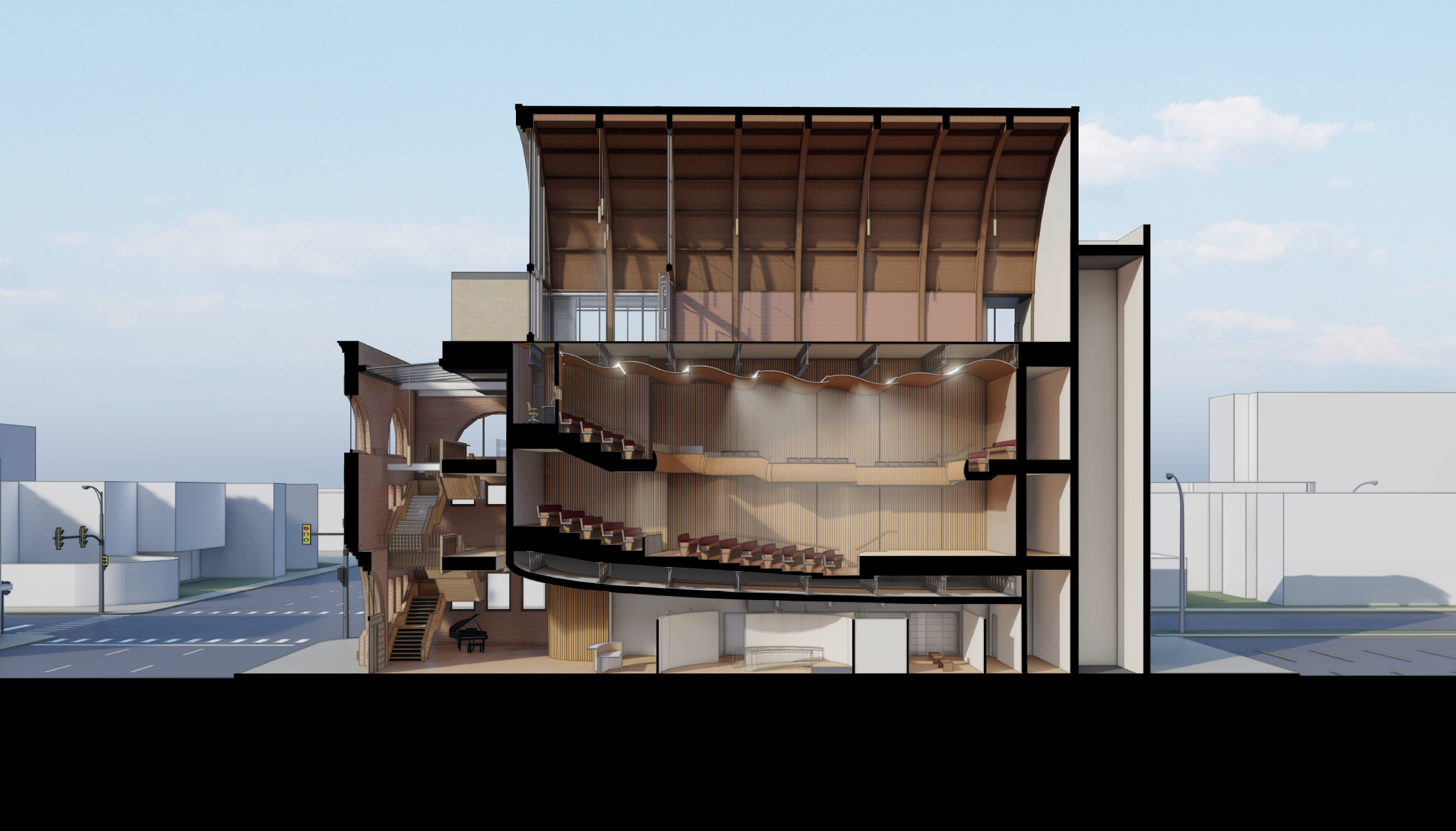
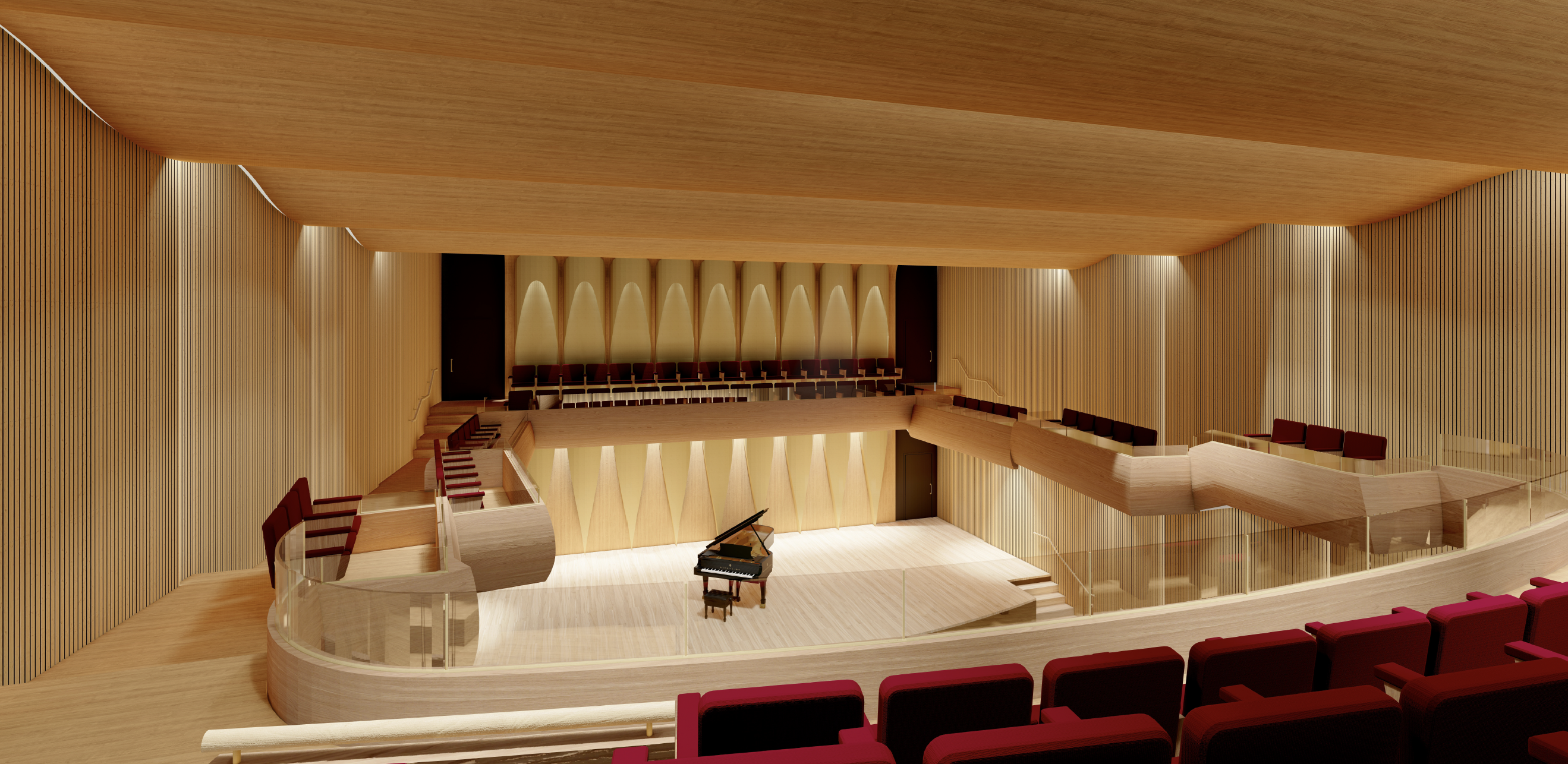
That proved to be a challenging but inspiring brief. Students tackled the problems of wedging a 450-seat auditorium, along with exhibition spaces, offices, public facilities, and extensive back-of-house requirements into the confined footprint of the original Church—while paying homage to the relics of the Sullivan walls. Gospel, we learned from UIUC music postdoc Alonza Lawrence, has both a deep tradition and an energetic range of current practitioners. How to build for a genre that incorporates influences from classical to hip-hop layered additional questions onto the spatial and civic charges the site and program already offered.
Samantha Hendrickson, Lukas Elisha, and Michelle Mo
We took an admittedly liberal view of preservation standards, trying to see the Sullivan elements more as catalysts than museum pieces. But each project found inspiration from the existing compositions—either in massing, detail, materiality, or proportion. Some were inspired by seeing the raw, scarred interiors of the walls, composed of seven layers of structural brick and bearing the marks of the collapsed iron structure within. Those surfaces seemed to tell a more complete history of the original structure and the fire. Others saw opportunities to look forward, with glass skins, metal screens, or timber vaults that extended new interior volumes above or next to the originals, again trying to find a dialogue between the structure’s past, present, and future lives.
Kabir Dole & Harshini Varanasi
Last week, students had the opportunity to present their work in Chicago to Museum and Church board members, as well as a large group of neighborhood residents, city officials, and local church figures. The discussion was lively, and the projects generated a deep discussion about the contexts in which the walls find themselves. While some want a modern museum that reflects the ongoing relevance and vitality of Gospel in its contemporary forms, others hope for a more faithful restoration of the original Church’s massing and interiors. We hope that discussion will continue, at all levels.
Samantha Hendrickson, Lukas Elisha, and Michelle Mo
Many thanks to Cynthia Jones and Antoinette Wright of Pilgrim Baptist and the National Museum of Gospel Music; Rachel Will of WJE and Mark Kuberski of Central Building and Preservation; Christopher Lee from Johnson and Lee; Dr. Alonza Lawrence of the UIUC School of Music, who sat on reviews all semester after talking to us about the history and future of Gospel; and the Illinois School of Architecture, which arranged student travel. An exceptionally enjoyable semester.
Kabir Dole & Harshini VaranasiKabir Dole & Harshini VaranasiSamantha Hendrickson, Lukas Elisha, and Michelle Mo
One of the best parts about getting a book out into the world is hearing how it provokes further thought by others. Chicago Sun-Times architecture critic Lee Bey and I spoke last month at the Newberry Library and had a great conversation about Chicago Skyscrapers, 1934-1986 and the role that high rises have played in the city’s growth over the last century. A real privilege to have the time with Lee (whose own new book project is in the works…) and to push some ideas about skyscrapers’ origins and afterlives.
[Chicago Skyscrapers, 1934-1986, published by University of Illinois Press, is available now on Bookshop.org and Amazon.com, among other outlets. I’m reviving the weekly excerpt in honor of this week’s news about the State of Illinois Center, a building with a far more complicated history than is generally acknowledged. I’ve written before about the dilemma buildings like this pose for preservation. A fuller accounting of its conception, design, and construction should be part of the current discussion regarding its fate.
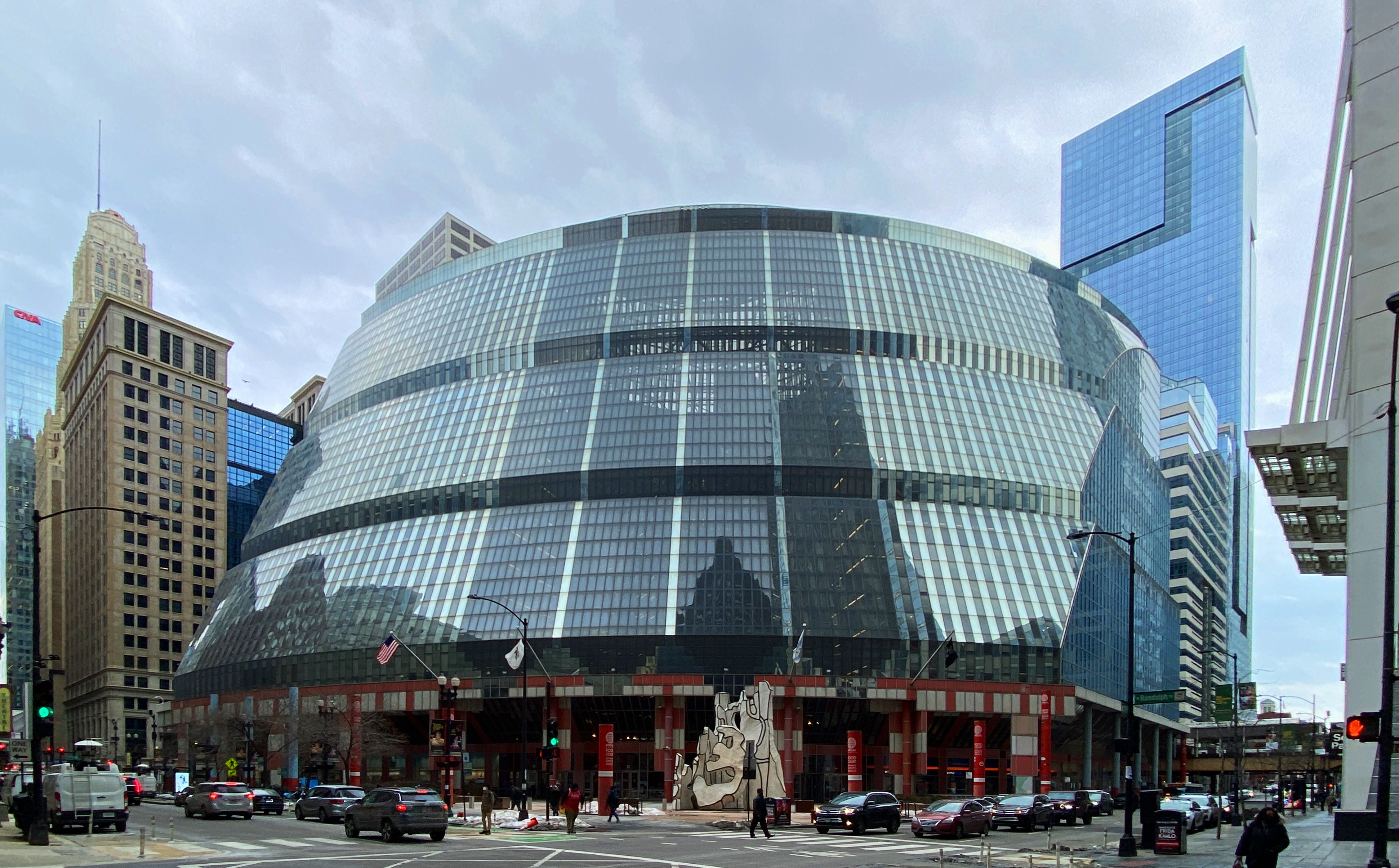
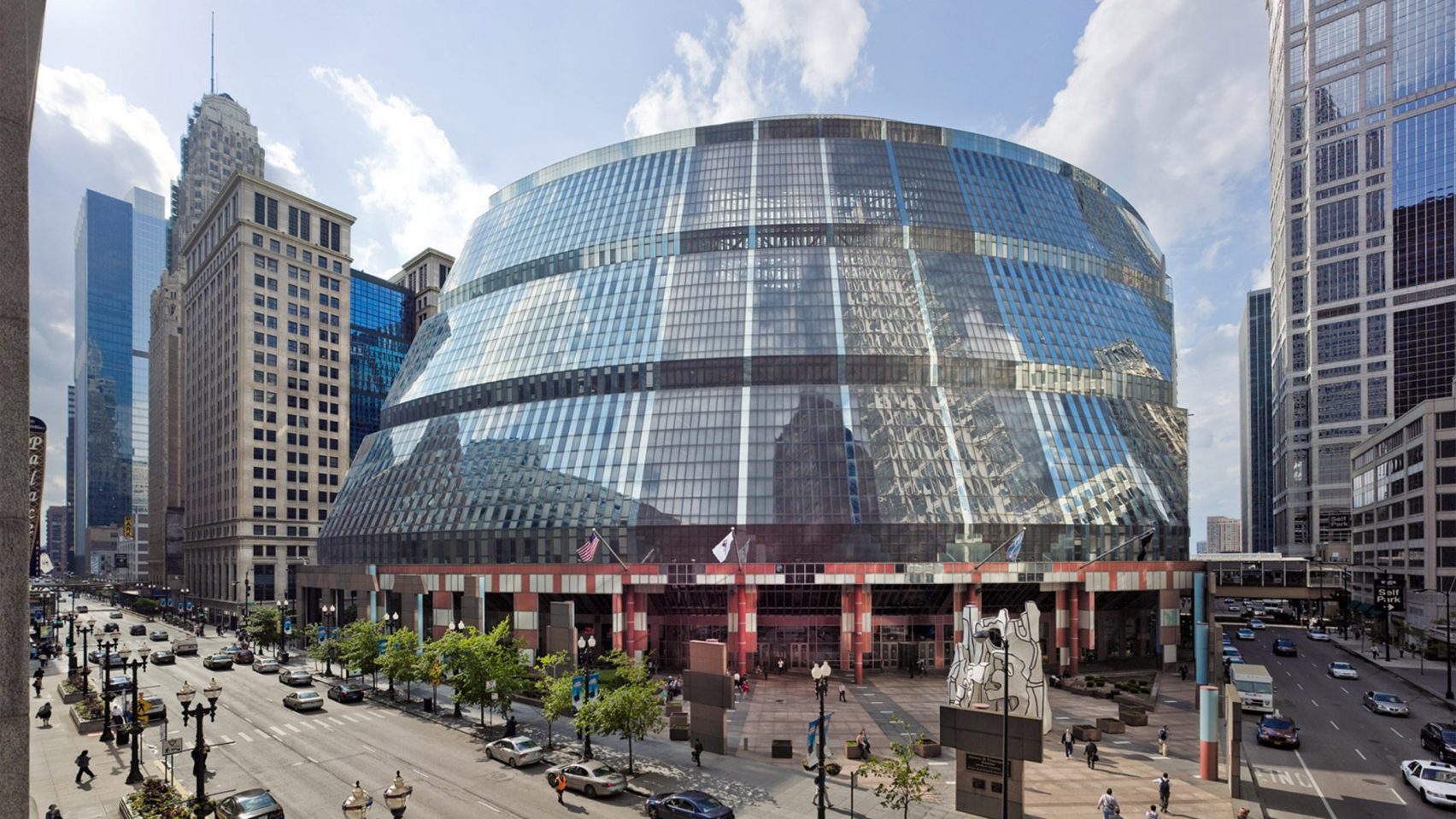
State of Illinois Center (Murphy/Jahn and Lester B. Knight Associates, 1979-1985).
Jahn’s most noted and notorious addition to Chicago’s downtown arose from the decades-long effort to address the “blighted” North Loop. Adjacent to City Hall and at the north end of the faltering but tenacious State Street retail district, the blocks between State, LaSalle, Randolph, and the River had been a constant irritant to Daley.[i] Greyhound’s 1953 terminal at Randolph and Clark was symbolic of—and a major contributor to—the problem, drawing a constant transient population. Blue Cross-Blue Shield had attempted to anchor the area with C.F. Murphy’s textured concrete exercise in 1968, but it outgrew this undersized building and moved to Illinois Center, leaving the quirky structure empty. The historic 500-room Sherman House Hotel, occupying the full block along Randolph between Clark and LaSalle, closed in January 1973 after losing business to better-located, newer hotels. Renovation efforts floundered in the mid-1970s, and the former stronghold of the city’s Democratic party sat vacant, taken over by the local Teamsters Union after its owners defaulted on a construction loan.[ii]
That year, Arthur Rubloff approached Daley with an outlandish urban renewal scheme, hoping to focus the Mayor’s waning enthusiasm for urban renewal onto the central city. Rubloff proposed using eminent domain to demolish seven “distressed” blocks, including the “bleak, grimy lineup of buildings on Dearborn” that formed the eastern edge of the Civic Center’s plaza.[iii] The Sandburg Village controversy left Daley wary of gifting Rubloff city land without maintaining control over its development.[iv] The project languished, and Daley’s death in 1976 complicated it further. In 1977, Illinois passed legislation that eased bonding restrictions on urban renewal, allowing the prospect of higher property tax receipts to offset purchase prices. This made the city’s involvement more likely, but it negated Rubloff’s agreements with investors, who had been promised enormous tax breaks.
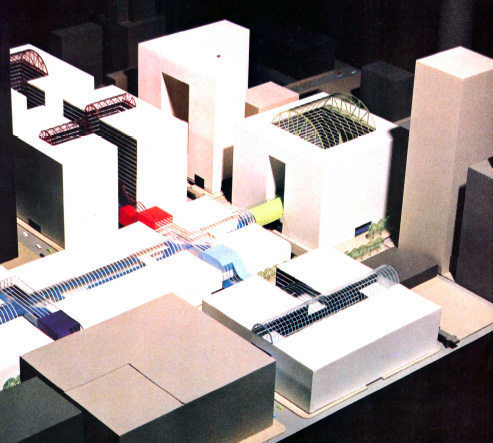
The City of Chicago applied for a $25 million HUD grant in April 1978 to purchase and clear land for the North Loop redevelopment. Rubloff hired C.F. Murphy, with Jahn in charge, to prepare a masterplan.[v] Jahn’s response was a mid- and low-rise megastructure replacing all seven blocks with 2400 apartments, a 60-story office tower, a multi-block indoor shopping center, an 1830-room hotel, and a new public library. All of these were rendered in fortress-like masses, filling blocks to their lot lines and carved out to create inward-looking atria that responded to Rubloff’s preoccupation with suburban white shoppers’ fear of an integrated Loop—Water Tower Place expanded to an even larger scale. Rubloff’s rationale was openly segregationist: “We have two factions downtown, and maybe we’ll have one cluster of multiple movie theaters for each,” he explained by way of example. Fortress-like blocks, skywalks, and closed-off atria would create an interior urbanism insulated from the “urban” population outside.[vi] The masterplan left dozens of buildings to the wreckers; a new library, for instance, was to replace Rapp and Rapp’s effusive Chicago Theater (1921).[vii] Tribune columnist Jeff Lyon led agitation to save the Theater, and the plan drew fire from activists determined to save the Loop from the ‘gigantism’ that had changed North Michigan.
The protesters’ cause was helped by Rubloff’s increasing demands. Lyon speculated that Mayor Bilandic, facing uncertain prospects in the 1979 election, was stringing Rubloff along. Rubloff, misjudging his influence and the new Mayor’s commitment, demanded that all seven blocks be sold to him without a bidding process, that the state agree to a new office building to anchor the development, and that the city commit to financing his scheme if federal funding fell through.[viii] Lyon’s prediction proved prescient, though. The city’s commitment vaporized when Jane Byrne’s anti-machine campaign beat Bilandic in the 1979 Mayoral primary. Just two weeks after the primary, the Metropolitan Housing and Planning Council issued guidelines requiring “several different developers” to be engaged in any Loop revitalization project, preserving the Chicago Theater, and leaving State Street as a pedestrian retail boulevard.[ix] Rubloff was replaced by other developers as the plan devolved. His North Loop plans ended, ignominiously, where he had first gained recognition; the three-story taxpayer he had erected in place of the demolished Masonic Temple in 1938 stood just south of the now-rescued Chicago Theater.
Murphy/Jahn, North Loop Redevelopment. Architectural Record, July, 1979.
While the North Loop plan collapsed, Rubloff had convinced the State of Illinois to implement its corner of the North Loop proposal. It was the last governmental entity foreseen by the Civic Center masterplans to build in the Loop. Daley antagonist James Thompson had parlayed his prosecutions of Thomas Keane and other machine allies into a successful campaign for Governor in 1976. Re-elected in 1978, he sought a greater state presence in Chicago beyond its crowded offices in the 1924 Burnham Building on LaSalle and Washington, and Rubloff convinced Thompson to choose the Sherman House site over a proposal to occupy several historic buildings on South Dearborn.[x] The state put out a request for interest in June 1978, anticipating a one-million-square-foot block to replace the dilapidated hotel. In April, 1979, Thompson’s administration announced that C.F. Murphy would team with mechanical engineers from Lester B. Knight Associates and interior planners from Vickrey-Oversat-Aswum to work with Morse-Diesel, who would serve as construction managers.[xi] The state would allocate $27 million to planning and site development that August—in the midst of a fiscal crisis that saw drastic cuts to other state projects. The city exercised eminent domain to buy the Sherman House from the Teamsters Local Union, transferring it to the State in October.
Murphy’s reputation for intertwining with the city’s governing agencies and its financial community was unscathed by the North Loop debacle. Already attracting attention for his sensational designs and outsized personality, Jahn represented the Murphy office’s transformation into a media-savvy producer of lighting-rod designs. Along with his longtime project architect, James Goettsch, Jahn’s designs for the Xerox Centre, the Board of Trade, and One South Wacker were joined by other provocative projects worldwide. In a manifesto on “New Directions and New Designs at C.F. Murphy Associates” published in Architectural Record in July 1979, he declared that the firm’s recent “eclectic attitude” reflected a synthesis of parallel themes—some of them inherited from Murphy’s Miesian lineage through Brownson and Summers, but others more in keeping with the office’s growing international reputation:
“The functionalist principles of plan, circulation, structure, servicing, and energy are intact, and their communicative quality, their formal character, represent a dovetailing of those basic elements with these: context, as it relates to place and history; space, light, transparency, and reflections, as they establish an enriched visual and physical perception; technical systems, as they make symbolic statements on technology, energy consciousness, and cost effectiveness; with geometry, as it represents a reaching out beyond the reductionist forms of the International Style; with metaphorical associations, using familiar forms, styles, colors, and products to generate form; with communication, as it relates to people’s use and perception of buildings; and with change, which entails both the metaphorical notion and the practical reality that our buildings are never quite finished, that they must accommodate growth physically and can successfully express this impermanence by way of a lighter, more lyrical esthetic.”[xii]
Architectural Record, July, 1979
While this list reflected the postmodern canon of varied interests, many saw it as disingenuously fungible. Lyon, a growing skeptic, described Jahn as “the paradigm of the contemporary architect: slick, facile, market-conscious and media-wise, possessor of a bold, sometimes outrageous architectural vision wedded to a canny gift for showmanship and the irresistible sales pitch.” In other words, in the first media use of the term, a “Starchitect.”[xiii]
Progressive Architecture, February, 1981.
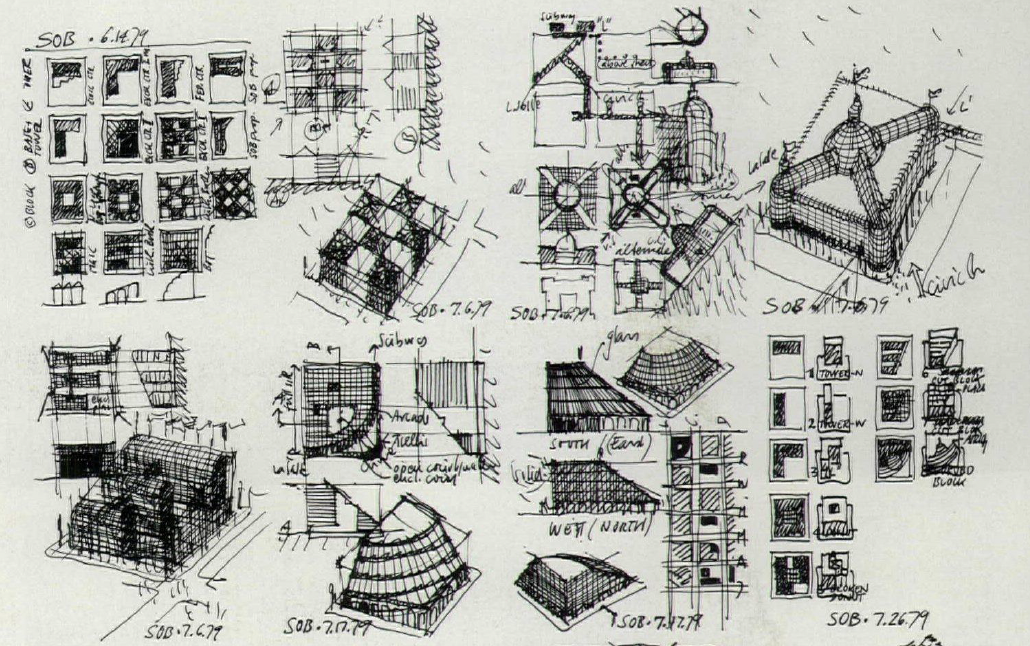
Jahn’s early sketches, published in Progressive Architecture’s preview of the State’s project in February 1981, show this restless eclecticism. His ideas jumped from a central glass dome with diagonal, skylit arcades reminiscent of Milan’s Galleria Vittorio Emanuele to a checkerboard of blocks and equally-sized open spaces to larger, stacked masses with plazas along the south or east half of the block.[xiv] As Joanna Merwood-Salisbury has noted, Jahn’s drawings were within the Beaux-Arts traditions of trying to “show the totality of the building on a single sheet of paper…intended for an audience of architects rather than a client.” Jahn’s axonometric drawings left street-level experience to chance, showing an energetic but noncommittal search instead, bouncing between, in Merwood-Salisbury’s words, “sleek containers given a clear identity through their sculptural form” and “some kind of abstracted historical imagery.”[xv]
Jahn presented Thompson with three of these schemes: a “conventional” 40-story tower on a triangular footprint with a large, landscaped plaza; a full-block low-rise with a long, diagonal slice defining a sloped glass atrium, and a full-block mass, eroded along shallow, concentric convex arcs, with a giant circular atrium punched through it that alluded to the classical tradition of domed public spaces.[xvi] Marvin Romanek, Xerox Centre’s developer, told Lyon in 1987 that Jahn, like any “outstanding architect,” needed a “disciplined client,” but Thompson was nothing of the sort, in Lyon’s view. Instead, he was “an amateur more accustomed to line vetoes than line drawings, and…that dangerous breed, an amateur with esthetic pretensions.”[xvii] The first two schemes’ bland appearance suggests that Jahn was maneuvering his client toward design that would serve its architects’ interests and client’s. If so, Thompson played into his hands. After he selected the atrium scheme, Thompson claimed later, Jahn was “a little surprised…. he was expecting a safe, bureaucratic response, but he didn’t know me.” Lyon, however, suggested that Jahn knew the media-hungry Thompson all too well.[xviii]
JAHN
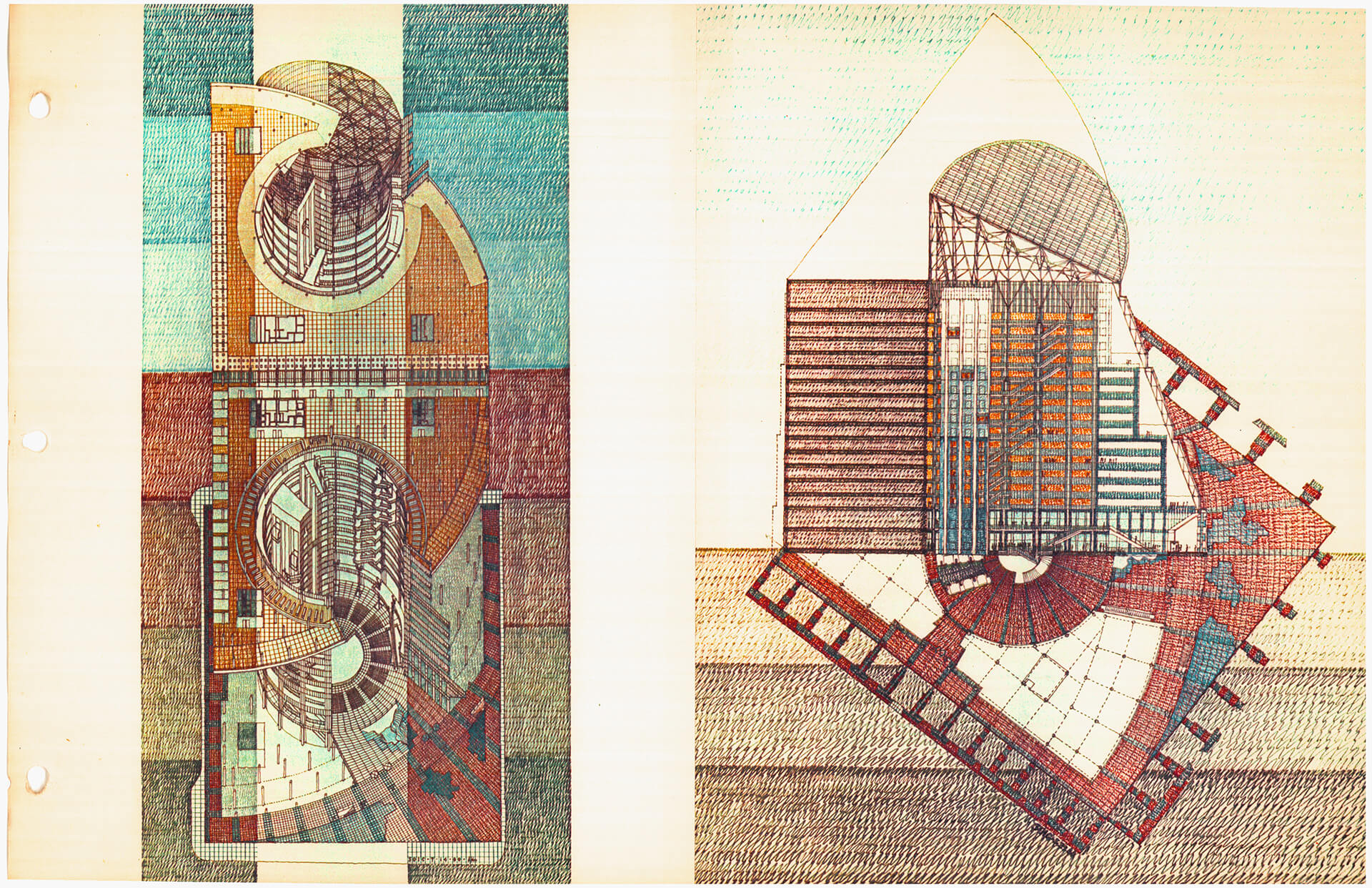
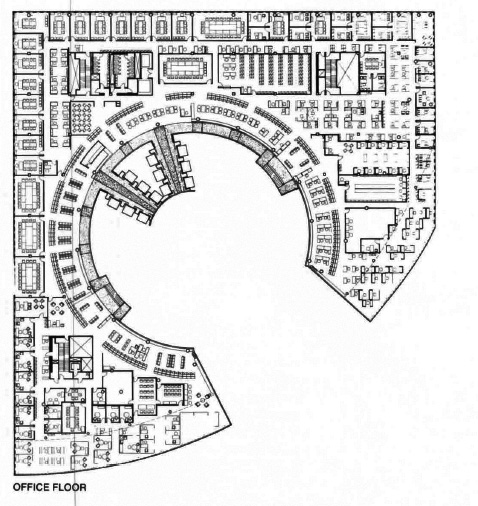
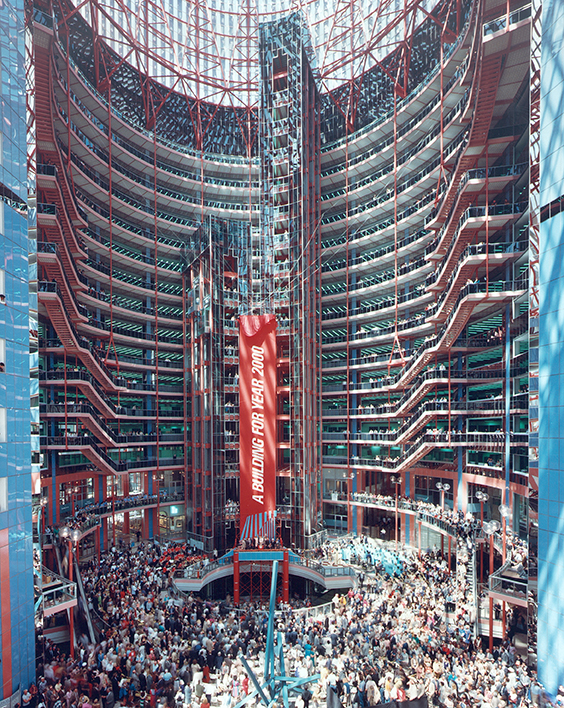
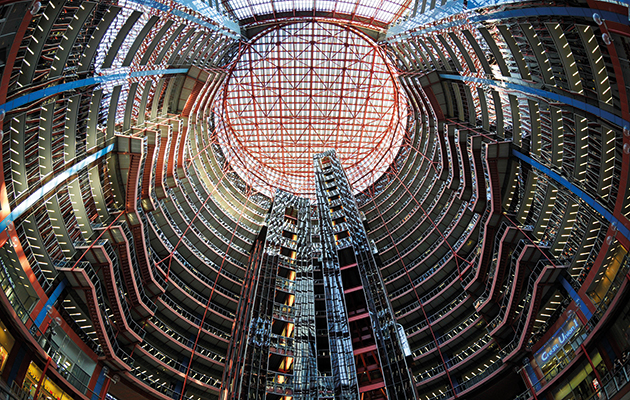
The atrium scheme, published in elaborate exploded axonometric drawings, centered on the rotunda. A broad, wedge-shaped entry led into the 16-story hollow cylinder, with twin banks of elevators jutting into the space and ranks of staircases bracketing it on either side. Escalators descended to a double-level retail and dining plaza, connected to the atrium space through a circular oculus. The office floors’ irregular shapes, stuffed between two curving geometries, presented planning challenges. Three service cores near the block’s corners provided toilets, fire stairs, and mechanical ducts, while the north and west elevations, pressed to the site’s lot lines, were divided into long ranks of single offices. Outside, the curving, sloping southeast façade was rendered in 18 shades and transparencies of vertically oriented curtain wall. Jahn specified insulated structural glazing, capped at the top of the atrium by a finely honed tubular steel network to support the rotunda’s truncated, cylindrical roof. Outside, the block-wide slice of a plaza was punctuated by regular follies that decomposed elements of the building’s block in stages, as if the glass form had been excavated from a now-demolished solid box. Jahn described the overall effect as “synthesizing Modern, Late Modern, and Post-Modern concepts…[an] appropriate and innovative recomposition of Classic and Modern principles of building.”[xix] He compared the glass atrium and rotunda to Henry Ives Cobb’s 1905 Federal Courthouse, which had been demolished to make way for Mies’ Federal Center—making no mention of that structure’s disastrous performance.[xx]
Thompson presented Jahn’s scheme in February, 1980, saying that its rotunda symbolized a “futuristic” center of state government and describing it as “probably the nation’s most energy-efficient” building.[xxi] An analysis by Dr. Vladimir Bazjanac of UC-Berkeley, however, suggested that its environmental performance would rely on a carefully tuned mechanical system and its double-glazed skin, warning that the temperature in the atrium could stray beyond 68° to 78°F three-quarters of the year.[xxii] Bazjanac’s environmental concerns were matched by opposing reactions from the public and Chicago’s architectural community. The Tribune was effusive, praising the “soaring glass skylight and the magnificent open area” and anticipating the “unusually energy efficient” design.[xxiii] Others were less keen, comparing Jahn’s design to a “circus tent” and an “elevated racetrack.” Carl Condit thought it illustrated the profession’s turn toward celebrity and sensation, calling it a “capricious anarchy of forms that is the chief symptom of the disease of neophilia.”[xxiv] Paul Gapp was again enthusiastic—but now cautious, taking note of the “nervous complexity” of the published model photos and drawings. “Jahn is walking a tightrope,” he warned. “There will be no room for false moves as he refines the final details. The craftsmanship of putting the intricate structure together will have to be of the highest order.”[xxv]
Gapp’s review praised the “highly functional” offices proposed, but planning difficulties emerged, and the building’s costs began rising. Its clashing geometries and irregular structural grid led to office plans of baroque complexity. VOAA’s fees for space planning climbed to $1.3 million.[xxvi] Controversy grew over the building’s cost. Thompson presented a figure of $89.8 million, but this was only the construction cost; he and his staff hadn’t included furnishings, which added $25 million. While this sleight-of-hand made the project more palatable to the press and public, Thompson’s elision haunted the project as it attracted greater scrutiny. Bidding problems emerged early. The insulated structural glass curtain wall, estimated at $17 million, was an untested hybrid. Illinois’ Capital Development Board, the State’s managing entity for the project, admitted in March 1981 that no American manufacturers had bid, forcing them to put the project out to international firms. Those bids came in astronomically high, between $49 and $70 million, forcing Jahn to redesign the cladding system. Cupples ultimately won the job after the system was downgraded to single glazing instead of insulated and aluminum-framed instead of structurally glazed. Knight’s office promised that the environmental impact of the change would be minimal. They adjusted the mechanical system, which now included a giant ice-making facility in the basement, to take advantage of lower off-peak rates.[xxvii] Meanwhile, crews began wrecking Sherman House in April,1980.
Construction, undertaken by Gust Newberg and Paschen under construction managers Morse Diesel, ran into problems immediately. A city-wide strike by operating engineers halted work for two weeks in summer, 1981, just as excavation was completed. The empty site filled with water, causing further delays. That December, a gondola carrying ironworkers fell more than 100 feet, killing five in front of horrified midday crowds.[xxviii] This came amidst a worsening state budget crisis. In February 1982, Thompson announced that all state construction—except the Center—would be frozen for six months. Reporters now began comparing Thompson’s $89 million figure with the full project costs; estimated at $120 million, including furnishings, the total figure was now more than $150 million. Thompson and other State officials obfuscated by reiterating the distinction between construction and project costs, even claiming that the project’s construction was, at one point, $9 million “less than estimated.” That estimate, though, soon rose to $171 million.[xxix] “The final cost of the new building,” the Tribune’s Mitchell Locin complained, “will be much more than Thompson led the public to believe. It also will be the most expensive public building ever built by the state.” Changes to the building’s glazing, Locin argued, would mean that “what had been planned as a very fuel-efficient building may become one of the least fuel-efficient structures.” As the project neared completion, it emerged that the Capital Development Board had eliminated new furniture to save money, electing to move old furniture from their existing offices.[xxx] Desperate, the Board also eliminated hundreds of office doors, saving $7.5 million even as the budget finally peaked at over $176 million. State workers were apoplectic. “We have a wide-open government in Illinois,” the Tribune quipped, “though maybe not on purpose.”[xxxi]
The State of Illinois Center opened formally in May 1985, though it was occupied by state workers and Jean Dubuffet’s “Monument with Standing Beast” beginning in late 1984. Thompson dubbed it “A Building for the Year 2000,” and Ira Bach praised it—without irony—as “our local Taj Mahal.” Critics disagreed, piling on in the wake of the budget controversy. “Starship Chicago,” snorted one headline, while others pointed out the incongruity of its salmon and robin’s egg-blue cladding in a district full of granite, limestone, Cor-Ten, and concrete. The flashy colors and “Buck Rogers” quality seemed, to many, better suited to cities like Miami, Phoenix—or worse. “It’s the ugliest building I’ve ever seen,” the Los Angeles Times quoted one Chicagoan. “It looks like it belongs in Springfield.”[xxxii]
More nuanced assessment came from Gapp, who appreciated the rotunda’s monumental character—a sublime experience, rare in a city of stacked floors, that he described as “tall, broad, soaring, full of interactive light and color.” Gapp admitted, though, that his initial enthusiasm for Jahn’s scheme had, like his reassessment of One South Wacker, been misplaced. “It doesn’t work,” he confessed just before its opening, “not by half.” Its massing had been seductive in model form but from the street it was “a chunky wedge of little grace or elegance.” Worse, as he had feared, “pinchpenny policies” sapped the building’s architectural vitality. “To the building’s chunkiness is added the seeming quality of cheapness…not simply out of context, but tawdry and vulgar.” The detailing that Gapp predicted would determine the building’s quality had fallen short. He pointed to the substitution of flanged steel for tubular in the atrium, adding visual clutter to the space and to the atrium glass’ dusty appearance despite three separate window-washing systems. Gapp tracked this issue down to the substitution, late in the process, of tempered glass for laminated. Laminated glass maintains its integrity even after breaking, as shards adhere to the adhesive interlayer. Switching to tempered glass threatened to rain lethal shards onto the atrium’s occupants—the solution, fine mesh screens, filtered incoming light, making the glass appear dirty. Jahn’s “worst design shortcomings,” Gapp explained, “spring from an incomplete understanding of building materials and a disdain for the details of good workmanship.”[xxxiii] The building split the architectural community, though; it won an honor award from the Chicago chapter of the AIA in 1986, which praised it as a “strong, powerful and important statement,” and “the ‘Pantheon of Chicago.’”[xxxiv]
During its first summer, the Center’s air conditioning failed to keep up with the southeast-facing atrium’s solar exposure and the single glazing that wrapped the remaining facades. Glare led workers to open umbrellas to shade computer screens. Interior temperatures soared to over 90°F that July and chillers, stressed beyond capacity, began burning out.[xxxv] Fixed venetian blinds were installed on the sloped, southeast-facing glazing in 1986 to cut sunlight, and the state commissioned a $2 million upgrade to the ice chilling system. The atrium proved to be problematic in winter, too; employees brought space heaters and blankets to work during colder months. Electricity costs for the structure ran more than a third over estimates, and the building’s murky cost history and perceived environmental failure became a statewide political issue.[xxxvi] In Fall, 1986, the State sued Lester B. Knight—but not Murphy/Jahn. The cost to upgrade the mechanical system ran to over $10 million. Jahn countersued the State to clear his firm of any perceived negligence, charging that Knight had failed to redesign the system after the switch to single glazing. That glazing, too, proved problematic as the building aged; perpetually leaky, by 1998, the “obstacle course” of buckets and tarps required a $950,000 renovation in 1998 that paralleled a $2.5 million replacement of the building’s elevators.
Despite these problems, the State of Illinois Center—and its atrium—proved popular with tourists, Loop workers, and the public. In 1993 it was named for Thompson, who had declined to run for a fifth term and left office in 1991. That the renamed James R. Thompson Center appears, formally, to nip at the heels of the Richard J. Daley Civic Center is a testament to the fraught politics of the city and state, rendered in competing architectural forms and styles that reflect the technocratic image that Daley sought as well as Thompson’s hunger for publicity. Jahn’s reputation never suffered from the building’s troubles. He drew greater recognition for its press and won further city work for the justly-praised United Terminal at O’Hare Airport and its accompanying Piranesian CTA station (1986). He continued to dot Chicago’s skyline—and other cities’—with amalgamations of historicist forms and modern materials, including the jukebox-like replacement for Frost and Granger’s Northwestern Station (1987) and the spired Oakbrook Terrace Tower (1987).
[i] Among other sources, Cohen and Taylor recount this in American Pharoah, 178.
[ii] Alvin Nagelberg, “Sherman House Closing to Mark End of Hotel Era.” Chicago Tribune, Jan 15, 1973. 1-c9.
[iii] Paul Gapp, “North Loop Pins Hopes on Drastic Surgery.” Chicago Tribune, Oct. 7, 1973. 49.
[iv] Ross Miller, Here’s the Deal: The Buying and Selling of a Great American City. (New York: Knopf, 1996). 70-86.
[v] Paul Gapp and Stanley Ziemba, “Rubloff’s North Loop Terms: No Competition.” Chicago Tribune, Aug. 6, 1978. 1.
[vi] Paul Gapp and Stanley Ziemba, “Rubloff’s North Loop Terms: No Competition.” Chicago Tribune, Aug. 6, 1978. 1.
[vii] Jeff Lyon, “A Look at Developer Rubloff and His Designs on the Loop: Close-Up with Jeff Lyon.” Chicago Tribune, Aug. 17, 1978. 1.
[viii] Paul Gapp and Stanley Ziemba, “Rubloff’s North Loop Terms: No Competition.” Chicago Tribune, Aug. 6, 1978. 1.
[ix] Ed McManus, “Group Tells North Loop Plan Guidelines.” Chicago Tribune, March 15, 1979. B8.
[x] “A Sparkplug for the Loop.” Chicago Tribune, Feb. 1, 1978. B2.
[xi] “4 Get State Center Pacts.” Chicago Tribune, Apr. 20, 1979. D5.
[xii] Helmut Jahn, “New Directions and New Designs at C.F. Murphy Associates.” Architectural Record, July, 1979. 98.
[xiii] Jeff Lyon, “Ego Building: Name-Brand Architects May Draw Tenants…” Chicago Tribune, Jan. 18, 1987. H8
[xiv] Jim Murphy, “State of Illinois Center, Chicago: Panoply of Images.” Progressive Architecture, February, 1981. 94-102.
[xv] Joanna Merwood-Salisbury, “This is Not a Skyscraper.” AA Files, No. 75. 2017. 132-149.
[xvi] Ron Grossman, “Starship Chicago.” Chicago Tribune, Feb. 19, 1984. H10.
[xvii] Jeff Lyon, “Ego Building: Name-Brand Architects May Draw Tenants…” Chicago Tribune, Jan. 18, 1987. H8
[xviii] Jeff Lyon, “Ego Building: Name-Brand Architects May Draw Tenants…” Chicago Tribune, Jan. 18, 1987. H8
[xix] Jim Murphy, “State of Illinois Center, Chicago: Panoply of Images.” Progressive Architecture, February, 1981. 98.
[xx] Paul Gapp, “Architecture: State of Illinois Center: Can a Flashy Showplace Turn the Loop Around?” Chicago Tribune, Apr. 13, 1980. D3.
[xxi] Robert Enstad, “New Fuel-Saving Building for State.” Chicago Tribune, Feb. 20, 1980. 1.
[xxii] Vladimir Bazjanac, Ph.D. “Energy Analysis [State of Illinois Center, Chicago].” Progressive Architecture, February, 1981. 99.
[xxiii] “Birth of a Landmark.” Chicago Tribune, Feb. 25, 1980. C2.
[xxiv] “Voice of the People.” Chicago Tribune, Mar. 9, 1980. A4.
[xxv] Paul Gapp, “Architecture: State of Illinois Center: Can a Flashy Showplace Turn the Loop Around?” Chicago Tribune, Apr. 13, 1980. D3.
[xxvi] Robert Enstad, “State Paid 1.3 Million for Illinois Center Plan.” Chicago Tribune, Mar. 27, 1980. N_A2.
[xxvii] Paul Gapp, “Illinois Center Works on Walls.” Chicago Tribune, Mar. 8, 1981. N5.
[xxviii] Douglas Frantz, and Rudolph Unger. “State Starts Probe in Fall Fatal to 5: State Begins Probe of Crane Accident that Killed 5.” Chicago Tribune (1963-1996), Dec 12, 1981. 2-a1.
[xxix] Alvin Nagelberg, “Costs Go Down as State Center Goes Up Here.” Chicago Tribune, Jan. 2, 1983. A7 and “Planned Cost of State Center Here Rises.” Chicago Tribune, Sept. 2, 1982. B1.
[xxx] Mitchell Locin, “State Building Blooming Early.” Chicago Tribune, Apr. 28, 1982. A17.
[xxxi] Maurice Possley and Douglas Frantz, “State Doors Hinge on Cost Cuts.” Chicago Tribune, Mar. 12, 1984. 1 and “Illinois’ Hollow Center.” Chicago Tribune, Mar. 19, 1984. 14.
[xxxii] Larry Green, “New 17-Story State Office Building Stirs Architectural Furor in Chicago.” Los Angeles Times. Oct. 28, 1984. A23.
[xxxiii] Paul Gapp, “Architecture: Helmut Jahn’s State of Illinois Center Is….” Chicago Tribune, Feb. 17, 1985. K16.
[xxxiv] Paul Gapp, “New State Building Honored.” Chicago Tribune, Sept. 18, 1986. E3.
[xxxv] Bill Barnhart and Saville Hodge, “Hottest Topic at New State Building: Can ‘It’ Be Fixed?” Chicago Tribune, July 17, 1985. B1.
[xxxvi] John McCarron, “Heat’s On Governor for High Energy Bill.” Chicago Tribune, June 27, 1986. 15.


 architecturefarm