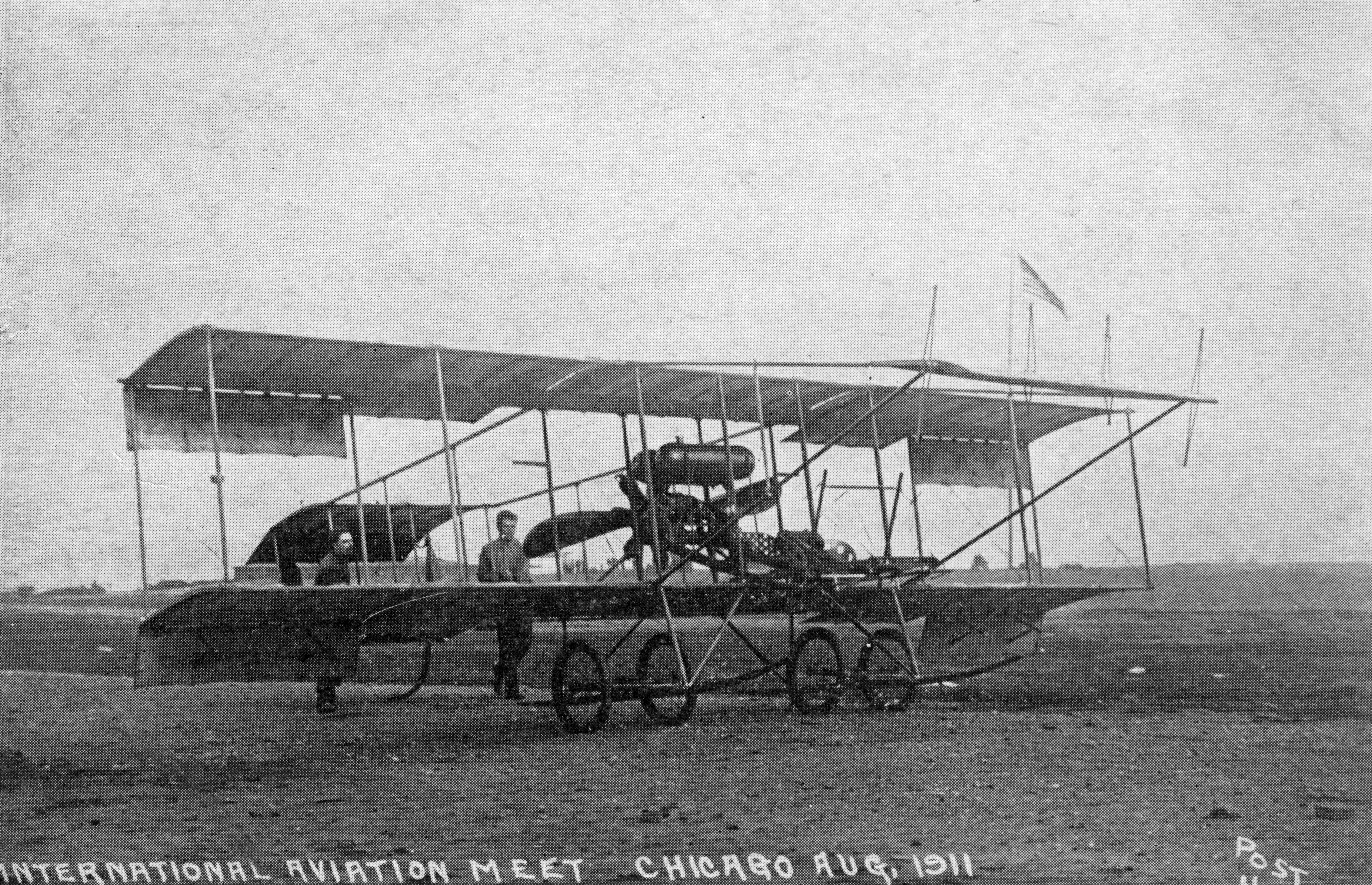
A contestant in Chicago’s first official International Aviation Meet, August, 1911.
With NASCAR racing in Grant Park earlier this summer and Chicago’s annual Air + Water Show warming up over the lake, this seems an appropriate time to point out that Chicago has a long history of racing and aviation in its otherwise pastoral ‘front yard.’
My current research project is a history of Chicago’s airports. Many of the same factors that shaped the city’s skyscrapers–rapidly advancing technology, new commercial imperatives, political friction within and outside the city limits, etc.–were also manifest in the city’s efforts to take advantage of its geographical position. First, as the country’s center of population migrated westward, Chicago was a natural hub for the developing network of air mail routes in the 1920s and for passenger travel in the ensuing decades. As jet aircraft made international travel commonplace in the 1950s and 60s, the city found itself at a natural position on great circle routes to Europe and Asia, spurring the development of O’Hare Airport.
That story’s beginnings take place at the most unlikely of “airports.” In 1910, a failed effort to stage a cross-country aviation race from Chicago to New York made Cicero Field, a half-mile square of turf at Cicero Ave. and 22nd Street, the epicenter of aviation for a summer. Would-be contestants gathered there to assemble their fragile planes and to fly them for paying spectators at nearby Hawthorne Race Track. Cicero Field was owned by Harold McCormick, a scion of the family that had earned its fortune with the original McCormick Reaper and would go on to own the Chicago Tribune. Harold’s fascination with Aviation led to his founding and funding the Aero Club of Illinois, which ran Cicero Field and sponsored local competitions and exhibitions designed to increase public awareness while advancing aviation technology.1
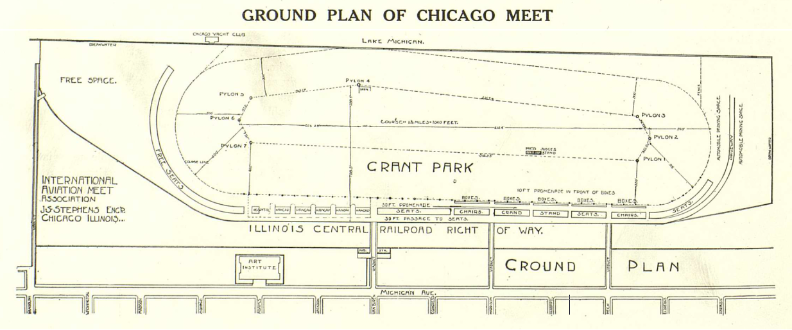
Most of the flying done at Cicero Field was of the “grass mowing” type–short, low-altitude hops in amateur craft, but the influx of national and international aircraft in 1910 led McCormick to propose a larger, more formal exhibition in 1911. That took place in August, turning the newly-completed Grant Park into a hive of flying activity for nine days. McCormick cleverly based prize money on both accomplishments–altitude, speed, and duration, among them–and on total flying time, encouraging participants to keep their machines in the air as much as possible. The 1.3-mile course, laid out from Randolph Street to 12th Street, was a narrow oval lined with seating for 70,000 that allowed spectators to view a constant parade of machinery with the lake as a backdrop in the afternoon sun.2
Geo F. Campbell Wood, “The Chicago Meet.” Aircraft, Aug. 1, 1911. 190.
The meet was an extraordinary success, spurring plans for a second event, held in 1912. But even as it highlighted the rapid progress that had been made in American aviation, it also revealed the problems confronting aircraft builders and pilots; one contestant was killed when the wings of his aircraft collapsed during a high-speed turn in front of the grandstand, and another drowned when his plane crashed a mile offshore.3 After 1912, exhibitions like the Grant Park event faded in favor of more ambitious cross-country races as aircraft became more reliable and their appearance less remarkable.
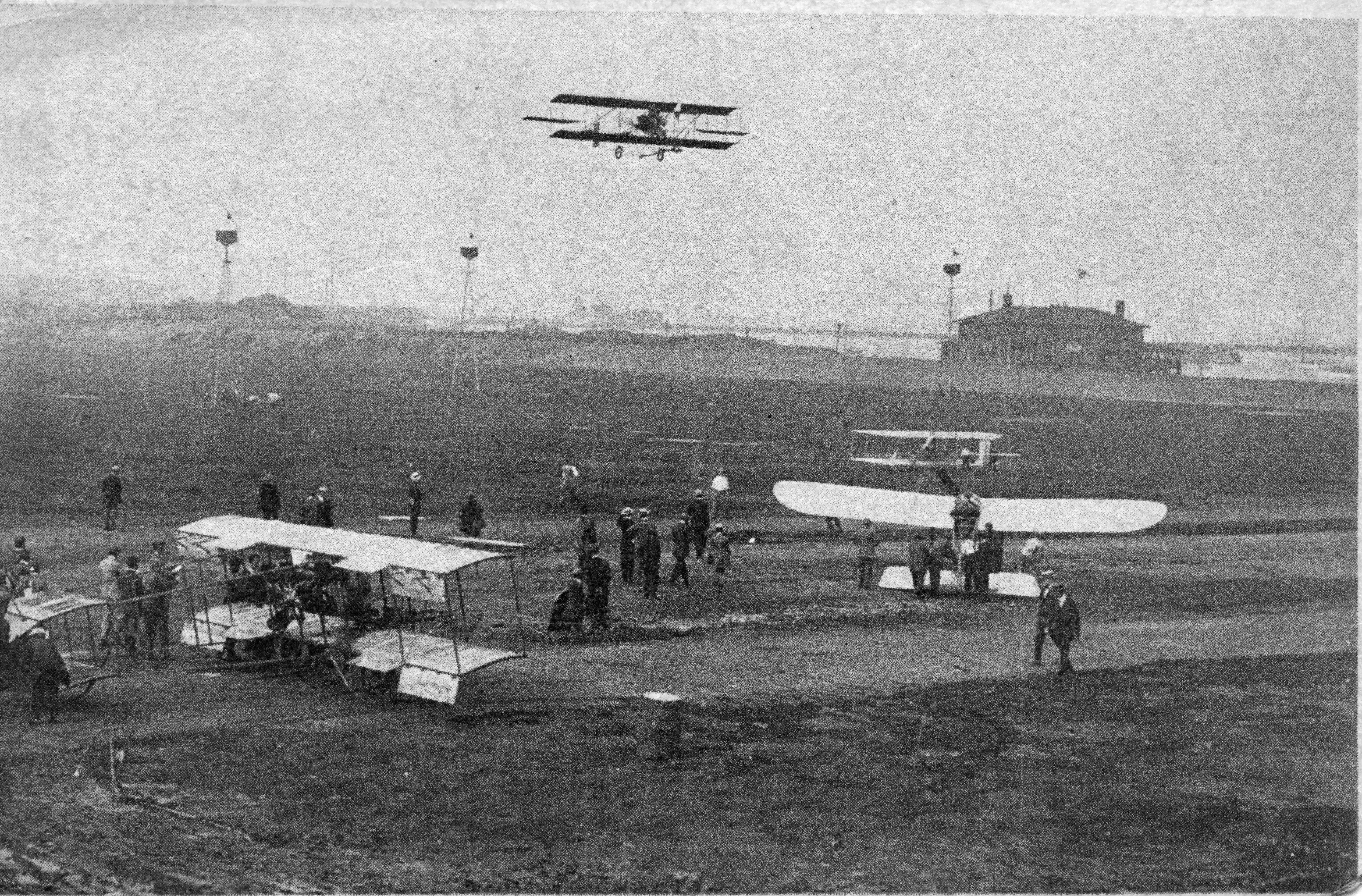
Aircraft aloft and awaiting flight at the International Aviation Meet in Grant Park, 1911. Chicago Yacht Club in the background (Contemporary Postcard, Author’s Collection).
With five international aircraft and their pilots competing, Grant Park can make a claim as Chicago’s first international airport. It would continue to serve as a landing strip for recreational craft and, for a short time, for air mail when that service began in 1918.
A final note. The 1911 and 1912 events took place after a boom in skyscraper construction in the city, and a couple of press accounts that related the aviation meets to the city’s high rises stand out. The first is the entertainment trade journal The Billboard, which reported on aviation mostly in terms of the crowds these exhibitions drew. Chicago, it reported in 1911, was a ready-made arena for such displays:
“There is not another city in America, if indeed in the world, that possesses such a remarkable aviation field right at its doors, as does Chicago in Grant Park, the 160-acre park on the downtown lakefront. where the meet takes place….with the sightseeing space afforded by the skyscraping hotels and commercial buildings along Michigan Avenue, as well as the standing space for the multitude outside the pylons and west of the Illinois Central tracks, over a million people will be able to witness the event.”4
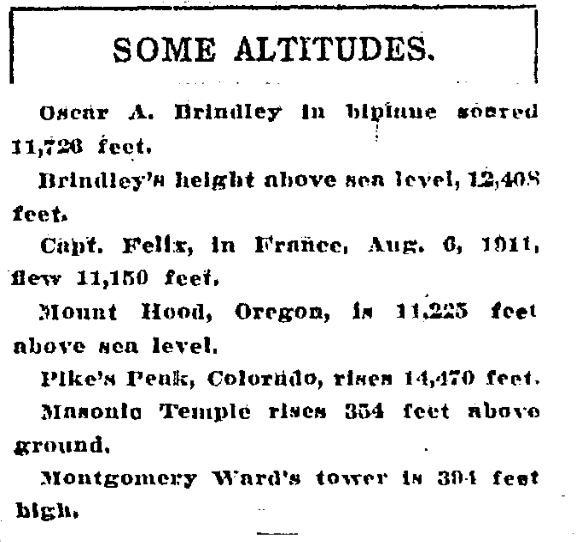
And, marking the turn in public fascination from buildings that appeared to climb skyward to machines that actually did, the Tribune offered some intriguing comparisons5 in reporting on the record altitude achieved by aviator Oscar Brindley during the meet:
Howard Lee Scamehorn, “Balloons to Jets: A Century of Aeronautics in Illinois, 1855-1955.” (Chicago: Regnery, 1957). 53, 81. ↩︎
“Advertisement: International Aviation Meet.” Town & Country, suppl.The Air-Scout, vol. 66, no. 22, Aug. 12, 1911, pp. 2.↩︎
“AVIATORS BADGER AND JOHNSTONE DROP TO DEATH: 50,000 LOOK ON.” Chicago Daily Tribune, Aug. 16, 1911, pp. 1.↩︎
“INTERNATIONAL AVIATION MEET IN CHICAGO.” The Billboard, vol. 23, no. 33, Aug. 19, 1911, pp. 4-4, 55.↩︎
“WORLD RECORD BROKEN; FLIES UP 11,726 FEET: B.” Chicago Daily Tribune, Aug. 19, 1911, pp. 1.↩︎
Parth Solanki and Siddharth Shah (UIUC), with Alice Wimbe (SAIC)
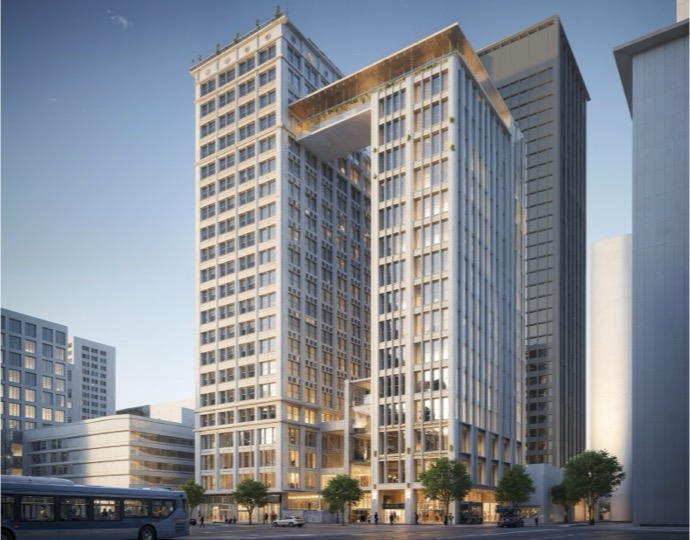
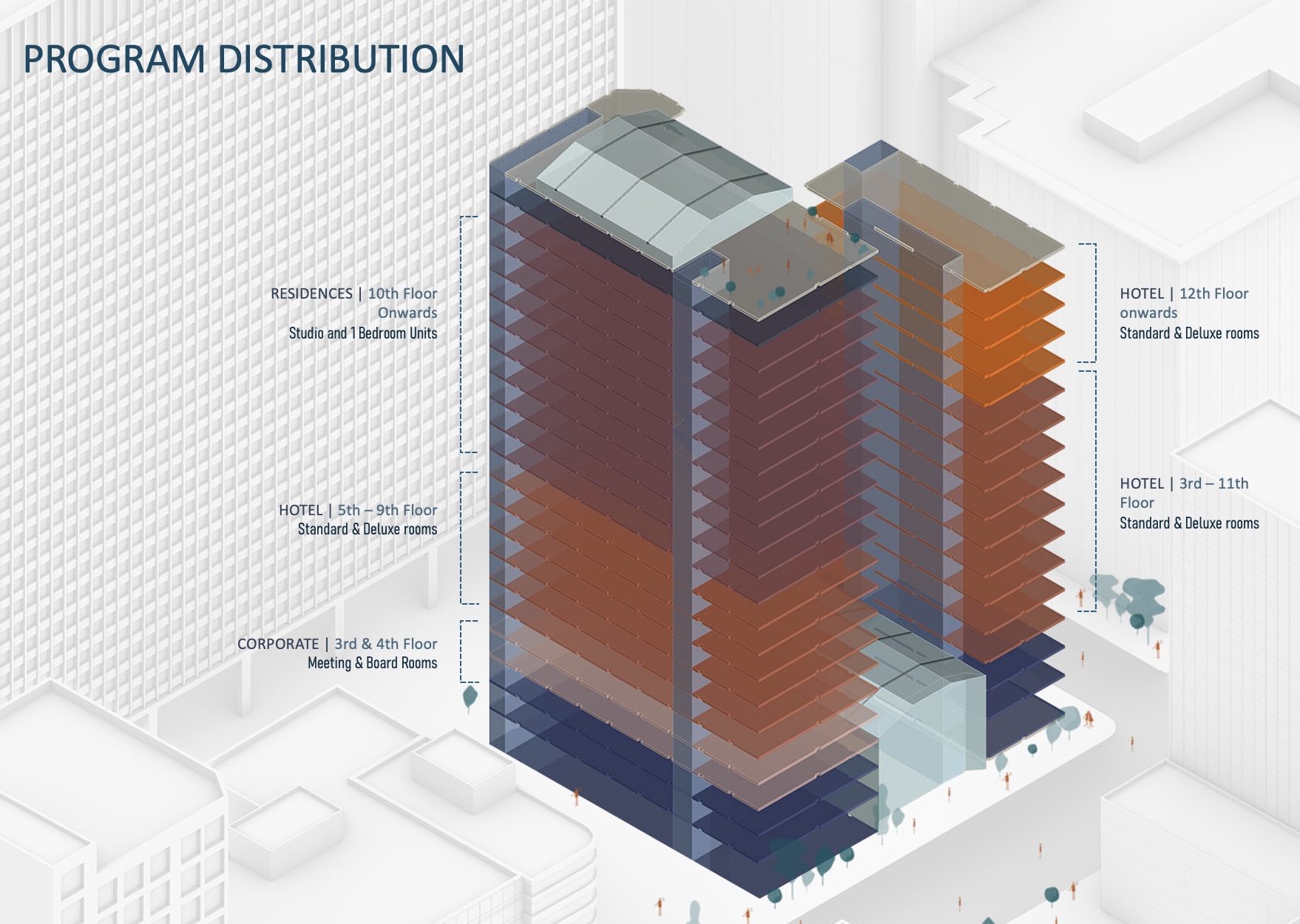
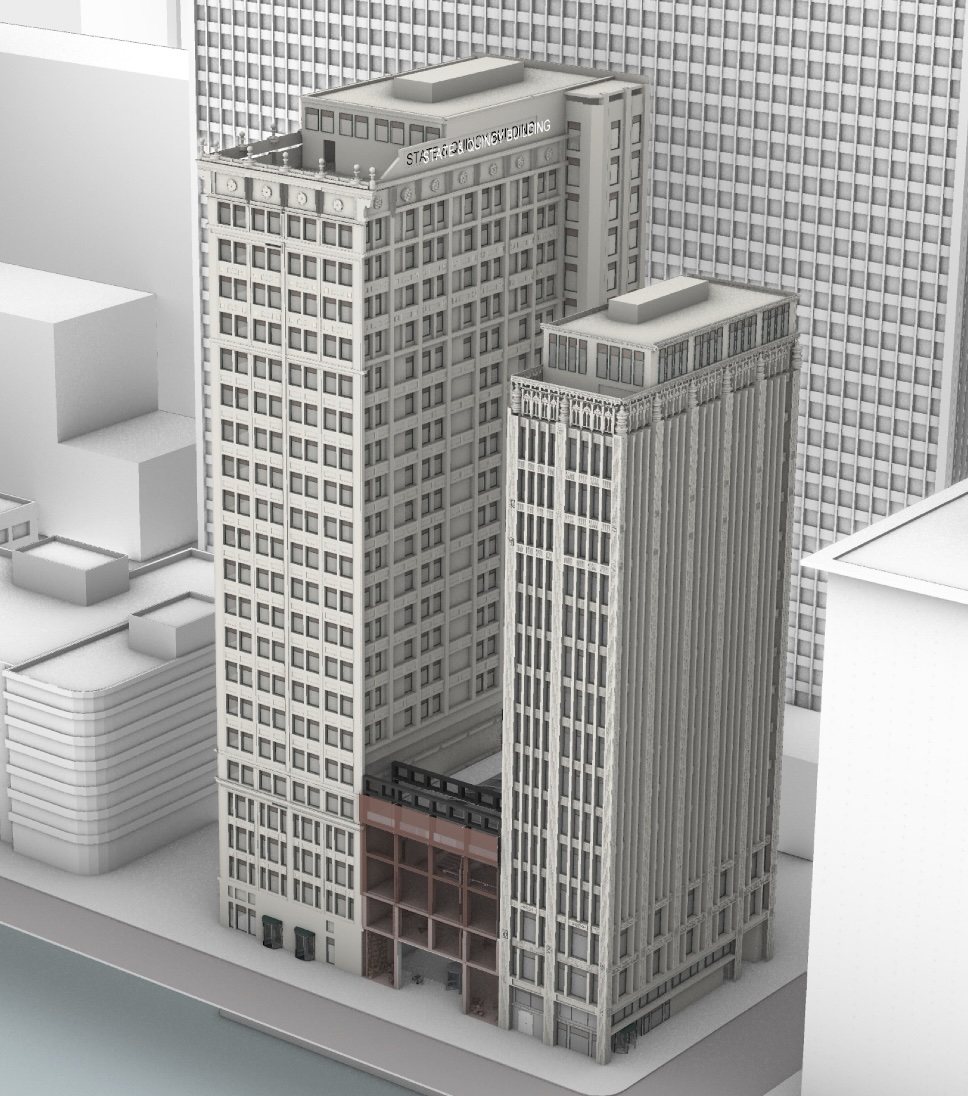
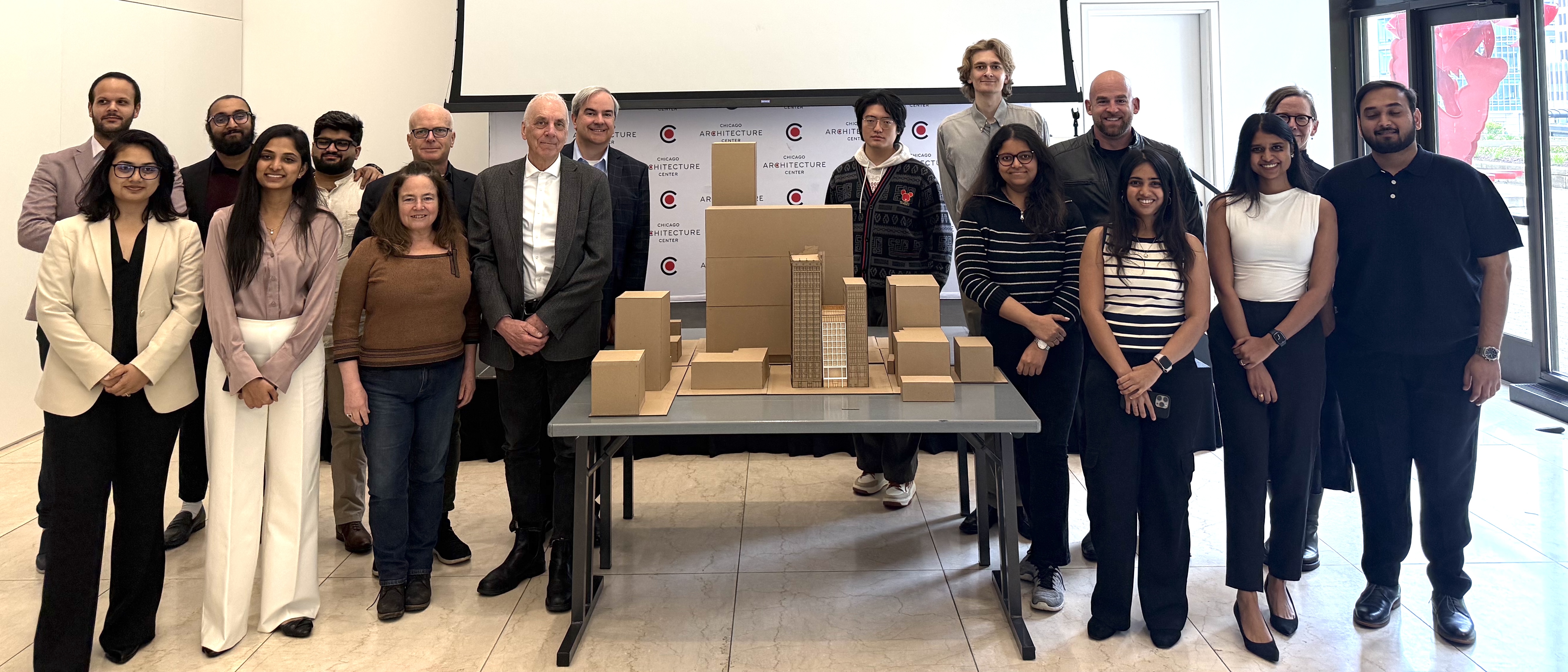
We finished up a challenging but exciting studio project this week with final reviews at the Chicago Architecture Center–many thanks to CAC for hosting. The project has been a visionary adaptive reuse of the Consumers and Century Buildings, at State and Adams Streets in the Loop. As previously noted, these buildings are threatened as the Federal Government seeks to address security issues with the Dirksen Federal Courthouse next door. Landmarking by the City of Chicago has forced the government to solicit proposals for developing the two structures, but their RFP puts onerous restrictions on their use. Our studio sought ways to develop the buildings as residential and hotel structures while addressing issues of sightlines and proximity that, understandably, have the GSA worried.
Sharanya Mathrudev and Elizabeth Tabisz (UIUC) with Rich McKee (SAIC)
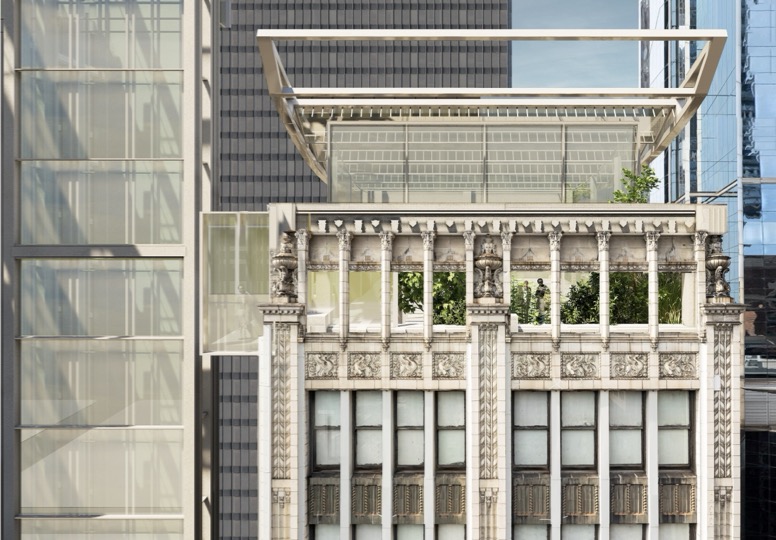
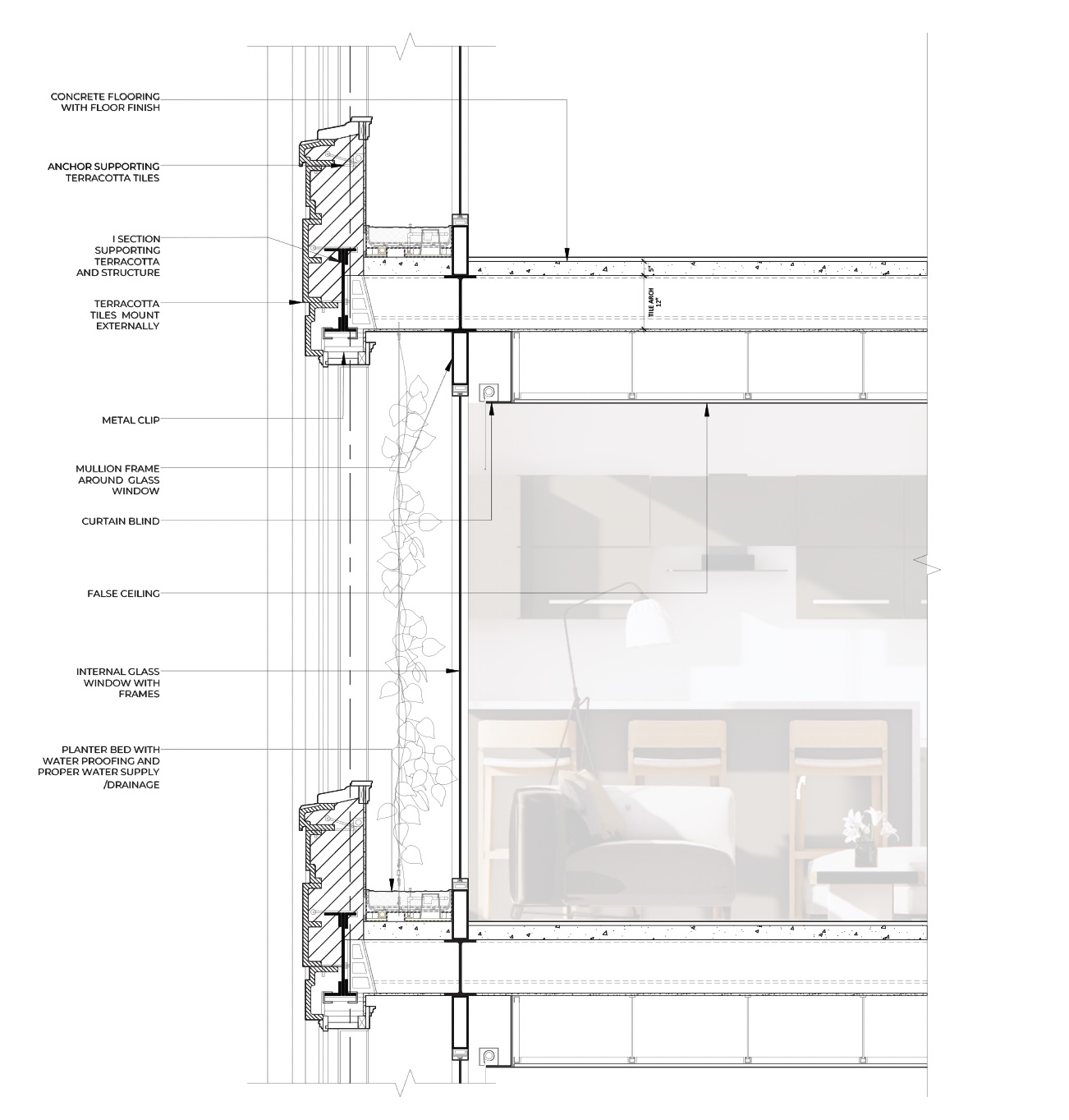
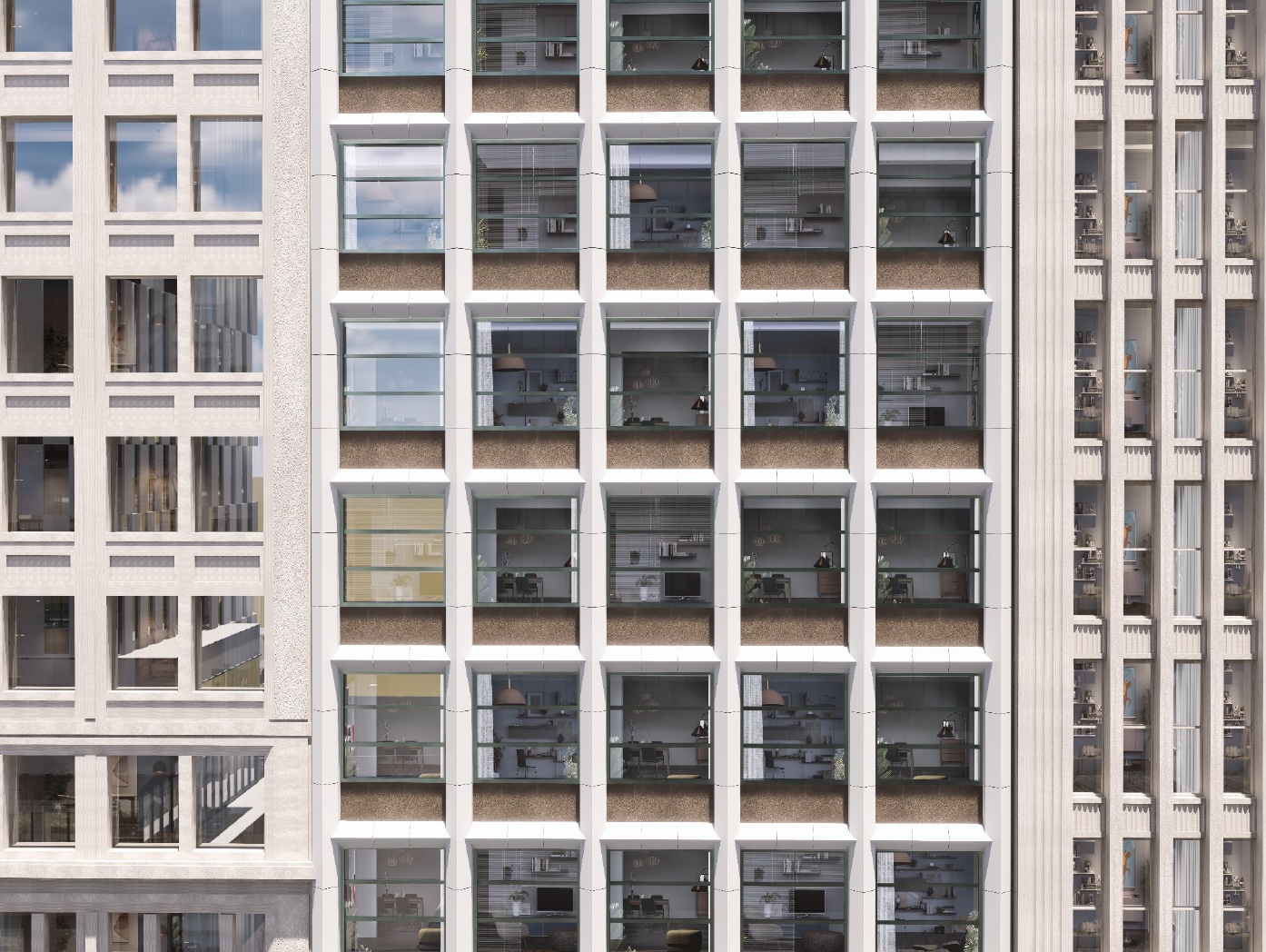
Student teams from our M.Arch. Program, working with historic preservation students from the School of the Art Institute, tackled this by looking at programming and detail strategies that carved apartments and hotel rooms out of the exiting building fabric while creating new semi-public spaces in the gap between the two buildings, all while focusing views and circulation toward the street and away from the courthouse and its associated exterior driveways, loading, and prisoner handling areas. We worked with Rachel Will and Kim Clawson, of Wiss, Janney, Elstner, Ken DeMuth of Pappageorge Haymes, and Mark Kuberscki of Central Building and Preservation to understand the conservation and restoration issues, but student teams had a long leash in considering how best to transform the two structures. The fact that both are “vernacular” skyscrapers–good examples but not, say, Sullivan masterpieces–allowed some creative extensions and additions that wouldn’t meet Secretary of the Interior standards, but that allowed some visionary thinking and innovative approaches, especially to the central space and the buildings’ rooftops.
Omar Abunnaja and Jasbir Bhamra (UIUC) with Katrina Lewis (SAIC)
Our jury included practitioners, preservationists, and engineers from firms in the city, who lived up to the challenge of critiquing a wide range of approaches. Many thanks to those who took part, and to a particularly energetic, dedicated group of students–hire these folks!
Noushin Anjum & Nupur Agarwal (UIUC), with Leah Zuberer (SAIC)Anusha Ronda and Shravani Keesara (UIUC), with Tucker Jaroll (SAIC)Odin Babcock and Deyang Hu (UIUC), with Zach Waters (SAIC)
As part of our research for the Skyscraper Museum’s Modern Concrete Skyscraper exhibition, Carol Willis and I worked to understand how and why Chicago became the acknowledged center of high-strength and high-rise concrete design for much of the last half of the 20th century. What follows has relied on perspectives and input from conversations and virtual lectures held with, among others, Bill Baker, Paul James, Kim Clawson, Ken DeMuth, Geoffrey Goldberg, Matthys Levy, Joseph Colaco, and, especially, the late Charlie Thornton.Many of those conversationsare available in video form on the Skyscraper Museum’s website.
Early Concrete in Chicago
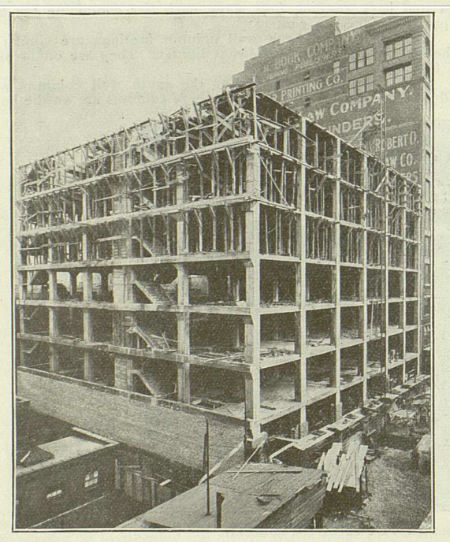
Even as the city’s earliest iron frames emerged in structures like the Home Insurance and Rookery, Chicago’s builders experimented with 19th-century versions of concrete—mainly as a replacement for natural stone. Like the history of terra cotta fireproofing businesses in Chicago, the 1871 fire inspired entrepreneurs and inventors to join the massive rebuilding effort. Portland cement, a mixture of crushed limestone and calcium silicates, was first patented in England in 1824 and gradually improved over the following decades, forming a crucial ingredient in producing strong “artificial stone” that won favor for its resistance to fire and manufacturing processes that limited labor costs. By 1876, there were more than 100 buildings with artificial stone fronts or structural elements in Chicago and five manufacturers, among them Ransome and Smith, an enterprise of concrete pioneer Ernest Ransome.[i] Ransome himself relocated to the city from 1890 to 1895 before settling in New York City in 1896. Ransome and others patented systems for fireproof concrete floors, reinforced with twisted or shaped steel bars, in the late 1890s that became the basis for more comprehensive building systems.[ii] Ransome’s patented system was used for the first reinforced concrete skyscraper, the Ingalls Building in Cincinnati, in 1903-5. Builders in Chicago and elsewhere quickly saw the advantages of the hybrid material’s durability and strength. Montgomery Ward’s 2,000,000 square foot Catalogue House, designed by Schmidt, Garden, and Martin, deployed a concrete frame over a winding, six-acre site along the Chicago River in 1908, and Studebaker built a seven-story building at Michigan and 21st Street in 1909 that used paneled slabs to span 24’ x 24’ column bays.[iii] Henry Ericsson, the city’s Commissioner of Buildings, was fascinated by the new material’s fire resistance but concerned about its structural performance and durability. After commissioning laboratory experiments from Arthur Talbot at the University of Illinois and W.K. Hatt at Purdue University in 1911, he drafted one of the first building codes in the United States to address flat-slab construction, which had vexed engineers because of its hyperstatic performance. “Owing to the complication of methods used in designing reinforced concrete flat slab or girderless floor systems,” Cement Age noted,
“…there is little agreement among designers of this type of construction in determining the thickness and reinforcement of flat lab floors. Therefore, the ruling drawn up by the Chicago Building Department should prove both rational and simple, since it is the result of nearly four years’ study and testing.”[iv]
Typical early-20th-century concrete construction in Chicago: the Moser Paper Co. Bldg., Plymouth Ct. The Construction News, Nov. 27, 1909.
While reliant on rules of thumb instead of mathematical analysis, the code gave builders and engineers confidence in the material; 1911-12 saw half a dozen major warehouse, manufacturing, and office structures built concrete in Chicago. “Never before in the city’s history,” reported the journal Concrete, “have cement and crushed stone played so prominent a part in building construction.” Among these were the Sharples Cream Separator Building, designed for 225 psf loads, the Rand-McNally Building, which reached a height of ten stories, and the Dwight Paper Co., another ten-story structure that rose at a record rate of one floor per week.[v] Laboratory research at Purdue and Illinois was supplemented by extraordinary static and dynamic testing supervised by Talbot and others on the Western Newspaper Union Building. This 1910 nine-story concrete structure was demolished in 1917 as part of the city’s Union Station project, and it served as a test bed for developing theories and rules of thumb for concrete engineering. The structure’s floor slabs withstood over 900 psf loads, suggesting that the city’s codes and engineering practices were overly conservative.[vi]
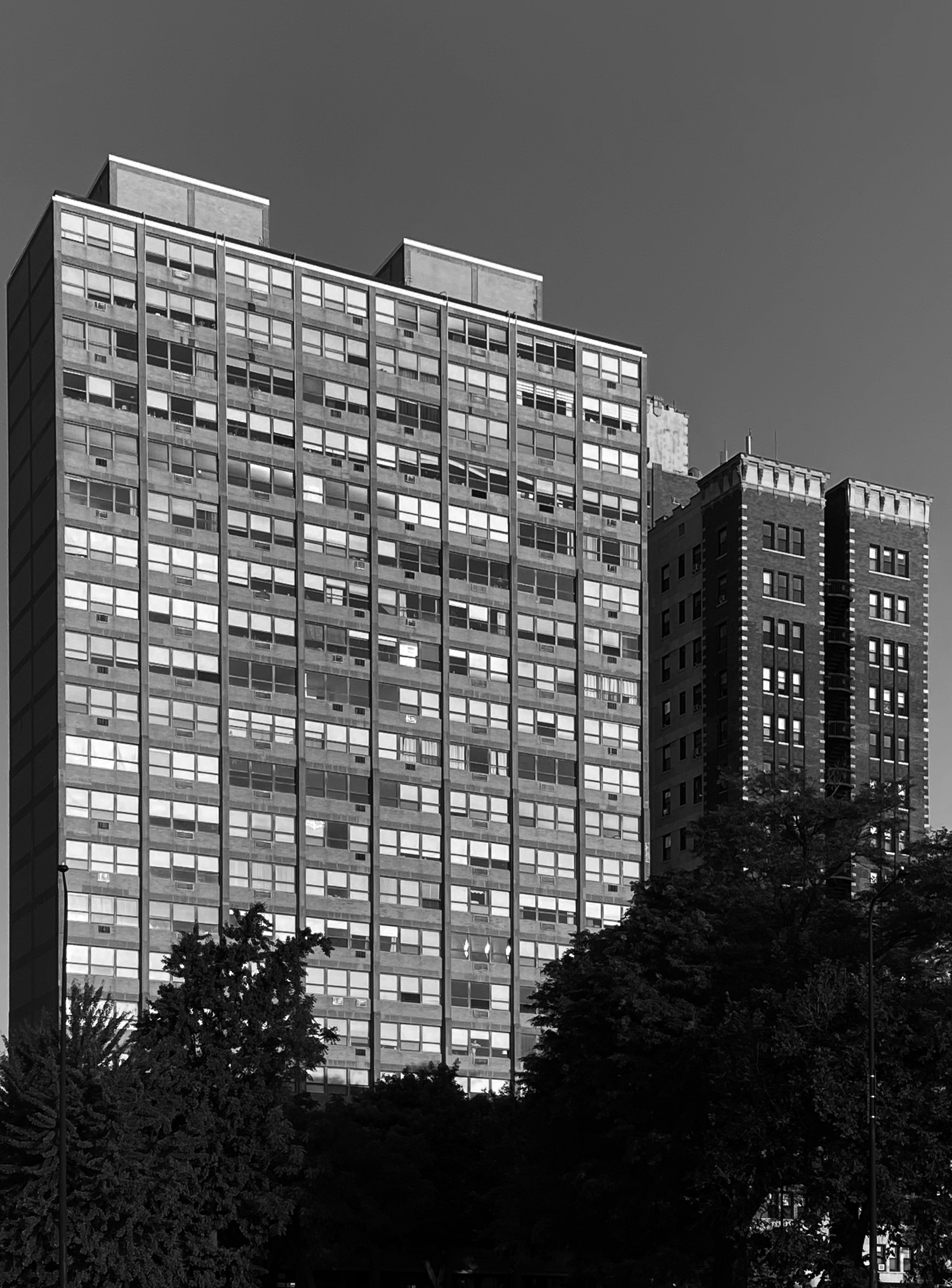
Flat slab construction saw a natural market in residential high rises in the 1910s and 1920s as advances in reinforcement allowed thinner structural depths than steel construction, maximizing the number of floors possible within a given height. The original Edgewater Beach Hotel, built to designs by Marshall and Fox in 1917, used dense reinforcement mats to resist punching shear, eliminating the mushroom capitals and drop panels of typical industrial construction.[vii] Similar reinforcing was used in the all-concrete Bournique Apartments on Goethe St. in 1916.[viii] Concrete became standard for Chicago’s high-rise residential construction, such as the 22-story Powhatan and Narragansett Apartments (both 1929) as its malleability allowed designers to take advantage of the city’s post-1922 setback code while providing reliable fire separation between floors. Its durable, inexpensive construction made it ideal for the city’s public housing projects, beginning with the low-rise Ida B. Wells Homes in 1939 and extending upward into the Chicago Housing Authority’s early high-rise projects, in particular, the Dearborn Homes (1949-50) and Loomis and Ogden Courts (1951, 1953). Mies van der Rohe’s Promontory Apartments (with PACE and Holsman, Holsman, Kleklamp, and Taylor, 1949) featured exposed concrete columns and slabs, suggesting that the material had aesthetic possibilities alongside its affordability and fire resistance.
Promontory Apartments, Hyde Park. Mies van der Rohe; Holsman, Holsman, Klekamp, and Taylor, and PACE Associates, 1949.
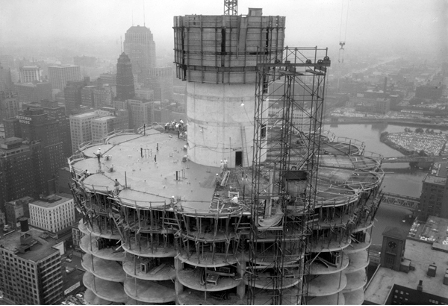
Marina City
Engineer Henry Miller and architect Milton Schwartz set a record for tall concrete construction with the 40-story Executive House Hotel on Wacker Drive in 1958. Executive House relied on two-foot-thick shear walls of heavily reinforced concrete around its elevator core for stability, but these were hidden behind a slick, stainless steel and glass exterior. More dramatic structural performance and architectural expression came with the 60-story, 588’ tall twin towers of Marina City, built across the River from the Executive House beginning in 1959. Designed by visionary Chicago architect Bertrand Goldberg, Marina City catalyzed advanced concrete construction in Chicago even as it set new urban development and architectural design standards. Goldberg’s design called for cylindrical shafts of apartments that would open outward toward views of the city and the Chicago River with curving, cantilevered balconies. The structure, based on stiff central cores surrounded by rings of columns, all connected with moment-framed girders, was engineered by a team including Frank Kornacker, Bertold Weinberg, and Fred Severud from New York City. Goldberg’s relentlessly circular geometry expanded into three dimensions and produced doubly-curved forms that would have required extensive skilled carpentry. Further issues arose with scheduling; traditional concrete construction would have pushed the schedule out to three or more years, while financing requirements made it necessary to begin renting in 1962.
Marina City under construction, showing fiberglass formwork and slip-form core construction. (Chicago History Museum).
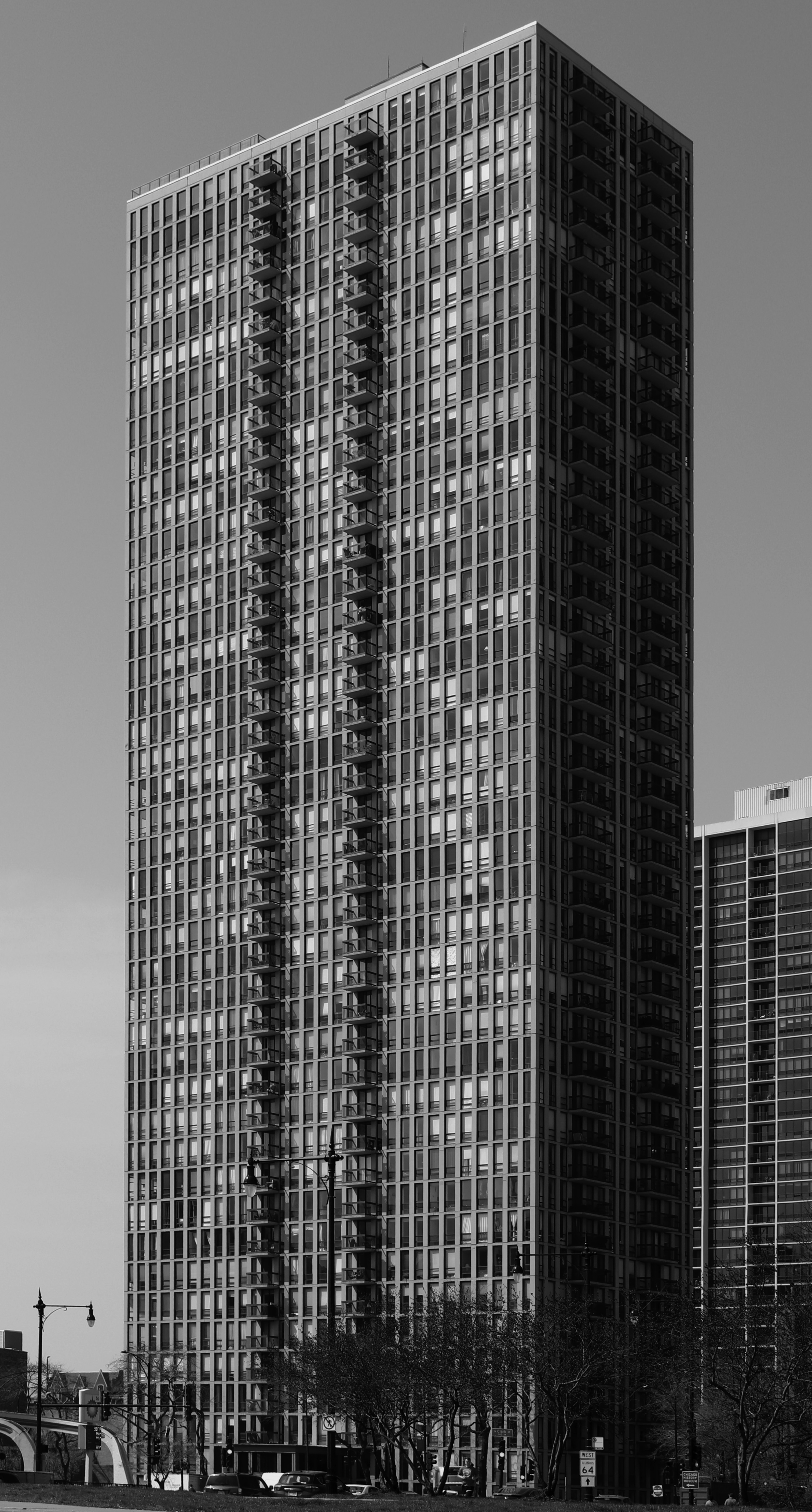
McHugh Construction, a local firm founded by bricklayer James McHugh at the turn of the century, had developed concrete expertise through winning bids on Chicago Housing Authority projects throughout the 1950s. By 1960, they had established a reputation for reliable concrete work that supported their successful bid on Marina City. McHugh developed innovative solutions to form Goldberg’s complex, curving shapes and meet the aggressive construction schedule, developing fiberglass formwork that could be mass-produced and used up to 60 times apiece.[ix] They also proposed using the cores as the bases for self-climbing Linden cranes, which could rotate 360° and hoist up to 8,000 pounds—about two cubic yards of concrete—from ground locations up to 90’ distant. McHugh matched the speed of the Linden equipment with an extraordinary coordination of concrete delivery and placement. Ironworkers assembled reinforcement panels on the ground, relying on the Linden’s capacity to lift them, fully assembled, into place. The fiberglass forms were staged to allow them to ‘jump’ three stories above as concrete came to strength. With these advances, McHugh averaged a new floor every two days.[x] Concrete surfaces were left as-struck and painted; the smooth finish imparted by the fiberglass required no additional work, and exposed concrete became a signature element in the building’s space-age aesthetic.[xi] McHugh would go on to use fiberglass formwork in sculpturally rich concrete apartment towers such as 2020 Lincoln Park West (1971) and in “rib-cage” high-rises including Eugenie Square in Lincoln Park (1972); rigid concrete tubes of closely-spaced concrete mullion-columns formed by steel jump forms that matched Marina City’s record for floor construction.
Eugenie Square, Lincoln Park. Dubin, Dubin, Black, and Moutoussamy, 1972.
[i] “Building: Concrete and Artificial Stone in Chicago.” Chicago Daily Tribune, Aug. 6, 1876. 10 and “Chicago Manufactures.” The Lumberman’s Gazette, vol. 3, no. 5, 1873, pp. 145.
[ii] Ernest L. Ransome and Alexis Saurbrey. Reinforced Concrete Buildings. (New York [etc.]: McGraw-Hill Book Company, 1912). Chapter 1, “Personal Reminiscences,” 1-18.
[iii] “Two Model Business Structures Now Being Erected in Chicago.” Chicago Daily Tribune, July 18, 1909. I18.
[v] “Many New Chicago Buildings of Concrete.” Concrete; Feb 1, 1912; vol. 12, no. 2. 27..
[vi] “Unusual Test of Flat-Slab Floor.” The American Architect, Nov. 28, 1917. Vol. 112, no. 2188. 393.
[vii] “The Edgewater Beach Hotel, Chicago, Il.” The American Architect, Sept. 26, 1917. Vol. 112, no. 2179.. 233.
[viii] “New Wrinkle in Building: Radical Departure From Usual Construction Methods Contemplated in Bournique Apartments.” Chicago Daily Tribune, Nov. 19, 1916. 19.
[ix] Richard J. Kirby, “Fiberglas Forms—A Progress Report.” Concrete Construction, July 1, 1962.
[x] “Huge Project Overlooks Chicago River: Compared to Sunflower Climbing Cranes Used.” The Christian Science Monitor, Feb. 2, 1962. 10.
[xi] James M. Liston, “Amazing Marina City.” Popular Science Monthly, Vol. 182, no. 4. April, 1963. 82-85, 194.
(A version of this appears in Chicago Skyscrapers, 1934-1986. Dusting thisoff as Kluczynski Building has–supposedly–been on the list of federal properties the current administration is looking to sell). (Update—Or not).
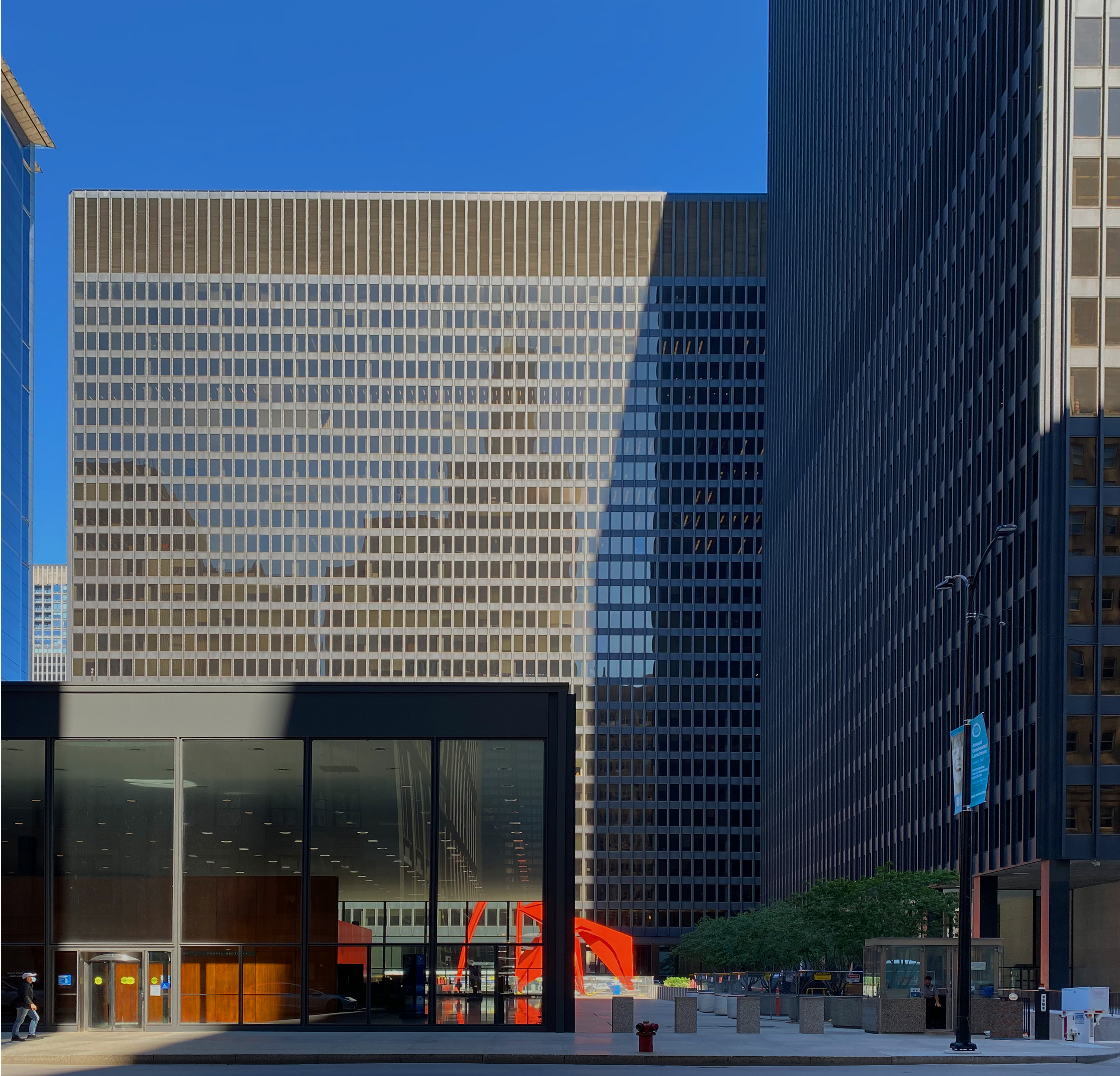
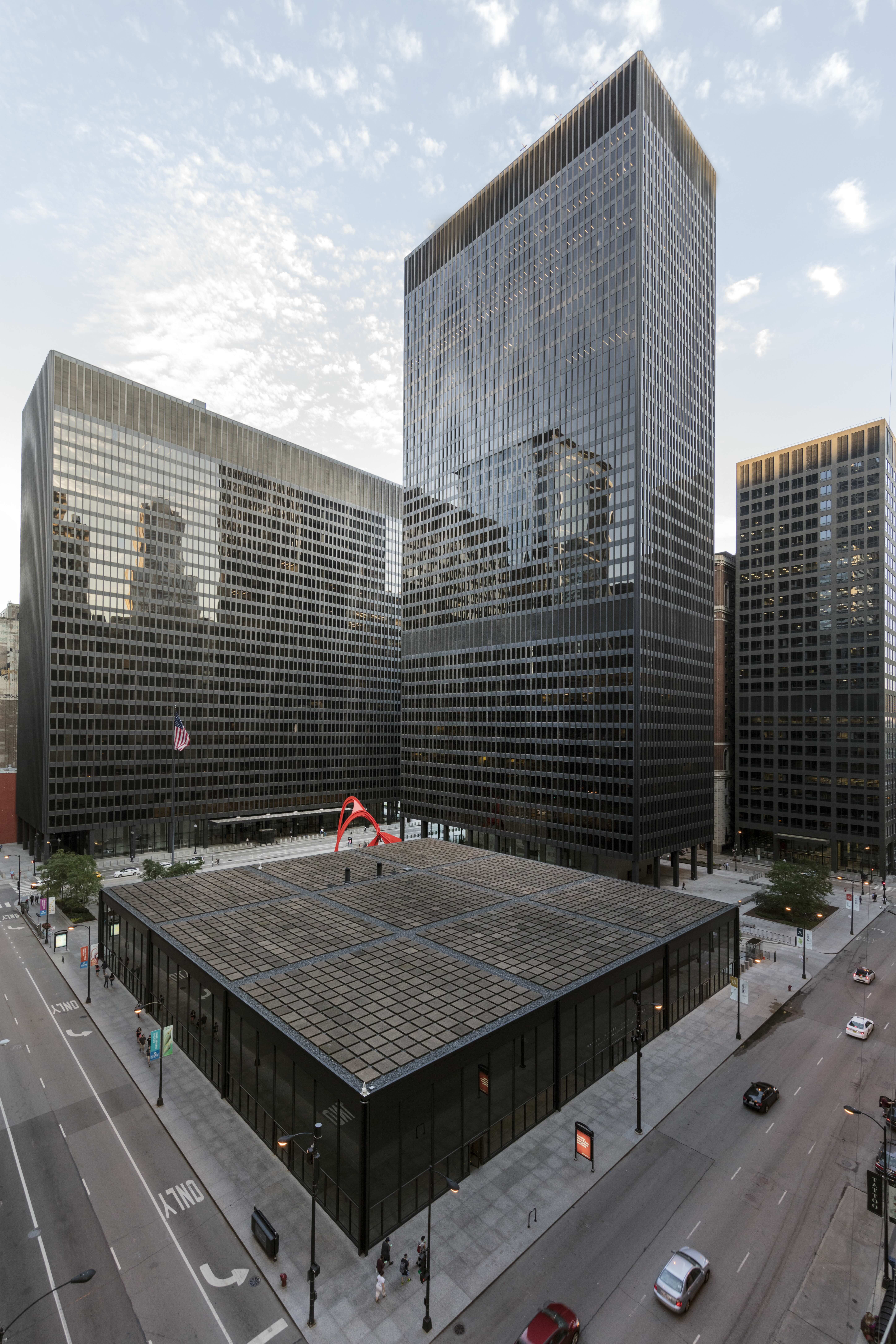
Everett McKinley Dirksen Building, John C. Kluczynski Building, and United States Post Office (Chicago Federal Center Architects, a joint venture of Schmidt Garden & Erickson, Ludwig Mies van der Rohe, C.F. Murphy Associates and A. Epstein & Son, 1958-1974).
The first of the city’s postwar civic monuments to be announced would take the longest to realize, outliving its key architect and leaving a block-wide hole in the Loop for much of the decade. The need for new federal offices in Chicago was acute. Plagued by cost and schedule overruns, Henry Ives Cobb’s 1905 Federal Building and Post Office was obsolete when it opened. Burnham and Bennett suggested its replacement just four years later, calling it “already inadequate” and proposing “a building exclusively for that one purpose…the dignity and the business of the United States courts.”[i] The Post Office moved to its Graham, Anderson, Probst, and White building west of the River in 1932, but the Cobb building’s clumsy, cross-axial plan remained crowded and inefficient even as just a courthouse. Illinois Senator Everett Dirksen and Representative Sidney Yates sponsored legislation to build new government buildings nationwide in 1957, and in December 195,8 the General Services Administration announced a $98 million Federal complex for Chicago.[ii]
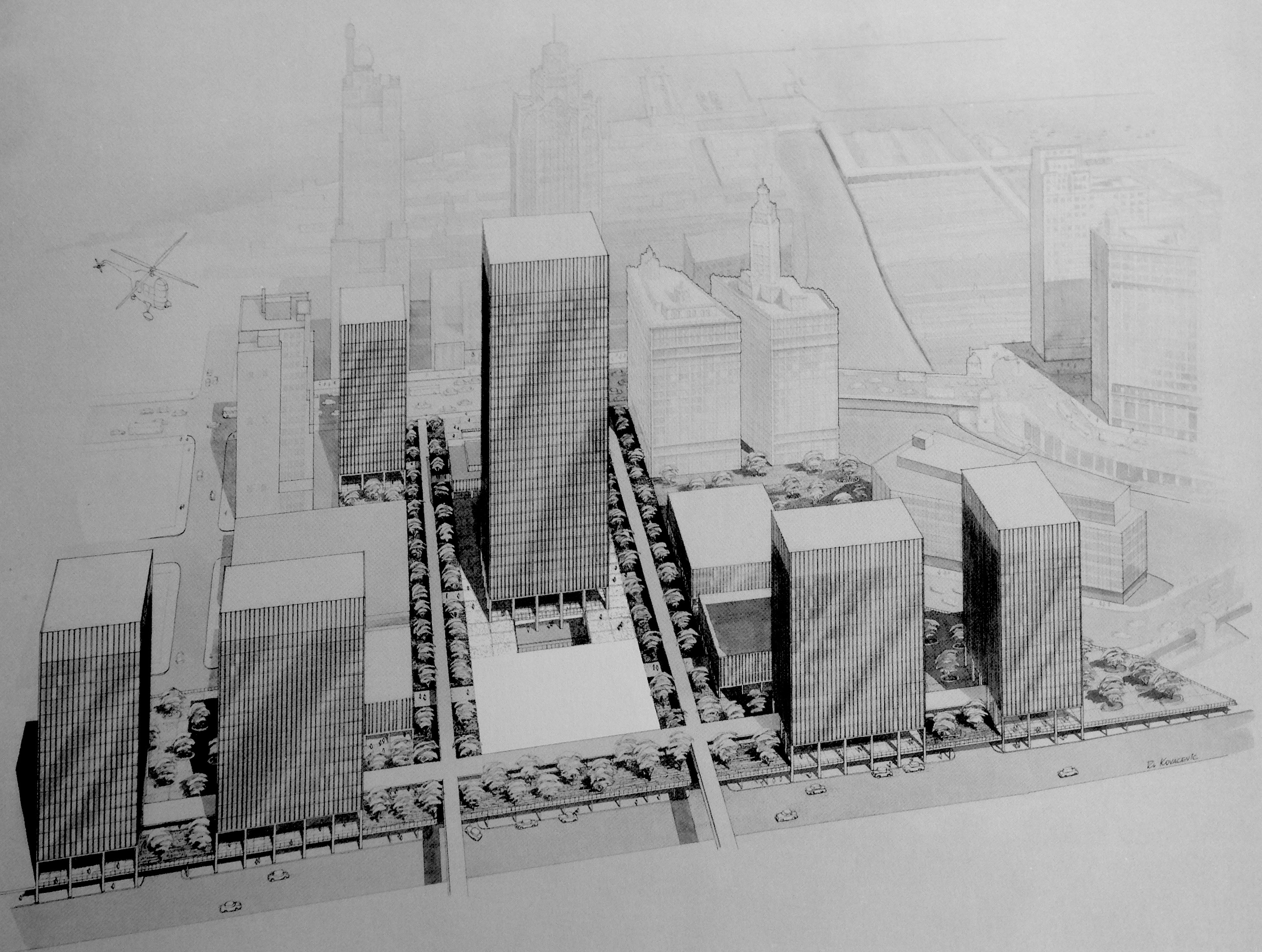
“Government Center,” Fort Dearborn Project, 1958. View looking east from State Street. (Chicago Public Library, Municipal Collection).
Where such a massive investment would go was controversial. The Central Area Plan, released just four months earlier, suggested a new Federal Center along the River, between Dearborn and LaSalle—a gentle nod toward Rubloff’s Fort Dearborn vision. Daley and Ira Bach hoped to anchor the North Loop as a political center, rejuvenating this run-down part of downtown. The Central Area Committee, however, sought to anchor the South Loop with this captive population, seeing it as a buffer to South Side ‘blight’ and predicting that several thousand government employees would support retail development south on State Street. Holman Pettibone made the case that a federal presence there would also spur development along Congress, supporting two other Plan elements—a new University of Illinois Campus, planned for a large tract of railroad land just southwest of the South Loop site, and the consolidated railway terminal being planned a few blocks west on Jackson.
The GSA disappointed both sides in January 1959 by selecting the southern site, but only for one phase of the overall project: a 1,300,000 square foot building containing new courtrooms and half its required office space, to be combined on the half-block east of the existing courthouse. According to administrator Franklin Floete, this would allow the existing courthouse to remain open while the new structure was completed, but where the remaining office space would be built was still uncertain. Floete suggested that it could be built in a second phase on the site of the Cobb building or elsewhere in the Loop if the GSA could get a good price for that building’s site.[iii] For the moment, however, plans for the combined courthouse and office building would be a “five story base, with…twin towers rising above that level.” The GSA solicited bids from architects to develop the idea further in April 1959.[iv]
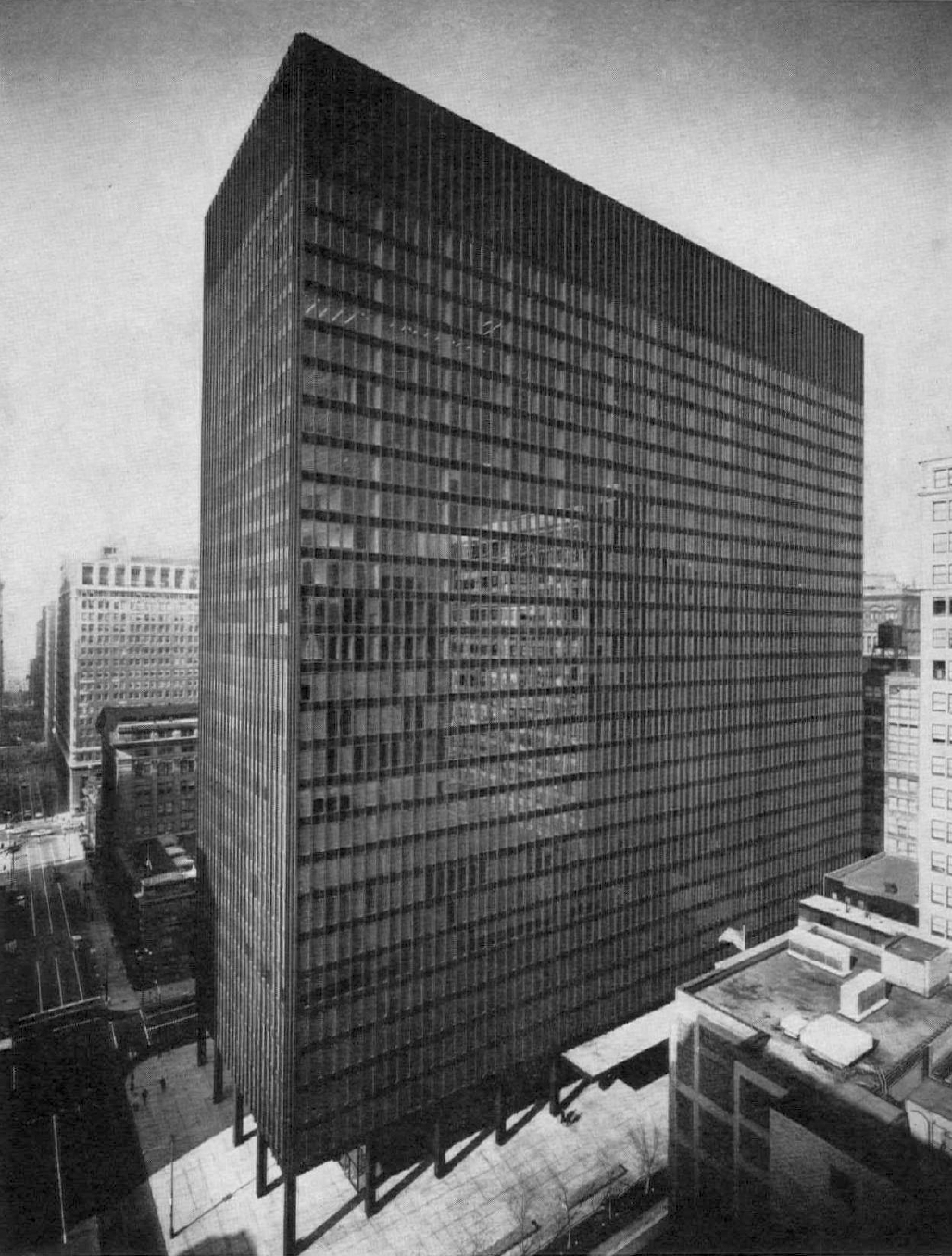
Everett McKinley Dirksen Building (Chicago Federal Center Architects, 1959-64). Architectural Record, March 1965.
Charles Genther of PACE convinced Mies to present their joint qualifications. Mies had rarely entered competitions, but 1959 was a turning point. He had retired as Director of the Department of Architecture at IIT in September 1958, forced out after 21 years by internal politics. Herbert Greenwald had died in February, leaving the office without its primary client, and his daughter, Waltraut, who had moved to Chicago to be with him, was ill with cancer and would die that November.[v] With neither the IIT’s Director’s salary to bolster it nor the steady income from Greenwald’s projects, his office shrank. Yet he enjoyed global acclaim after the Seagram’s opening, traveling to Europe in Spring 1959 to receive honors and awards in England and Germany. At 72, he could well have closed his office and enjoyed a comfortable retirement, but word came on this trip that the GSA had selected him as part of a carefully picked architectural team. PACE, however, wasn’t included. Instead, the GSA asked Mies to collaborate with Schmidt, Garden, Erickson, C.F. Murphy, and A. Epstein & Sons. PACE had hedged its bets, secretly submitting an independent bid, an ethical lapse that Mies felt left him free to take the project without them; the two firms would not work together again. The GSA announced the team in May 1959, along with word that the second phase would, in fact, be built on the site of the old courthouse.[vi]
Mies’ office team for the project included Gene Summers, Bruno Conterato, and Joseph Fujikawa. They presented three schemes to the GSA: one combining the two phases into a single, 56-story tower containing offices and courtrooms, a second for a 30-story courthouse and office tower on the eastern site and a taller block to be built later on the full block opposite, and a third, variant of the two-building scheme that split the remaining office program into two blocks, symmetrically disposed and framing the first structure. Mies and his team preferred the first scheme for the full-block plaza it allowed, but realized it presented intractable problems. Not only could it not be phased as the GSA planned, it would have been among the tallest buildings in the Loop—monumental, for sure, but overbearing for government agencies wanting to seem approachable. GSA’s advisers picked the second scheme of two tall buildings fronting an asymmetrical plaza instead.
With the new courthouse forming a wall along Dearborn, Mies concluded that the second phase should be taller, terminating the plaza to the south and concealing the eclectic row of buildings opposite Jackson Street, which included the Monadnock and Mundie and Jensen’s beaux-arts 1926 Union League Club. On the other hand, the plaza’s north side would open toward Holabird and Roche’s 1895 Marquette building. The final structure, a low, clear-span post office, would take up the western 2/3 of the full block, adding a final edge to the plaza and forming a horizontal foil to the two vertical structures. Mies paid particular attention to the three elements’ proportions: the post office was square in plan, the courthouse almost square in elevation—383 feet tall (357 feet from the top of its colonnade) by 368 feet wide—and the second phase’s elevation just taller than a double square—547 feet by 228 feet.[vii]
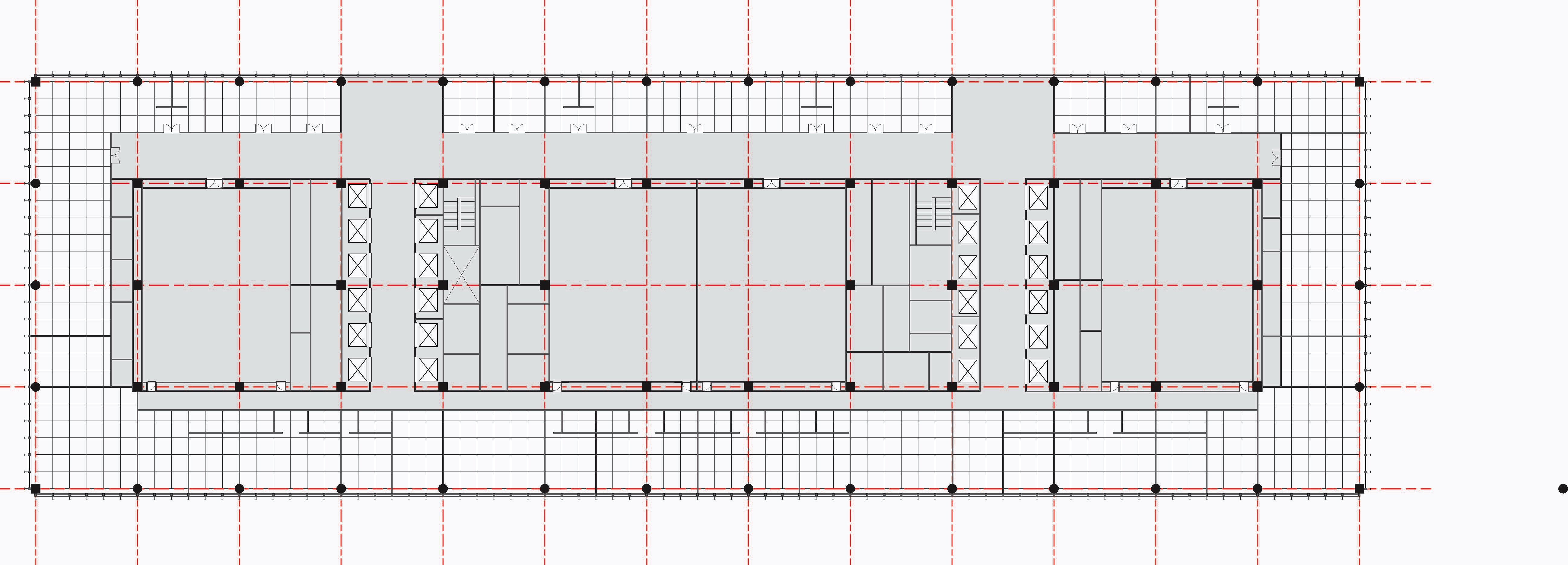
EEverett McKinley Dirksen Building (Chicago Federal Center Architects, 1959-64). Typical floor plan (drawing based on plans printed in Architectural Record, March, 1965).
Mies’s team developed the courthouse block through 1960 in a split-core arrangement, with double-height courtrooms on the building’s upper levels filling in as low-rise elevators dropped off at the 16th floor. The building was planned around 28-foot structural bays of steel columns and girders, each divided into a 6 x 6 grid of 4’-8” modules. Courtrooms and cores were concentrated toward the floor plates’ centers, with private corridors for judges and jurors along the east façade and public corridors overlooking Dearborn. Prisoner circulation and holding cells were contained in the cores, with elevators connecting to a secure garage in the basement. The split cores framed the axis of Quincy Street through the glass lobby at street level, a grand space rendered in flame-finished granite, stainless steel, and a white plaster ceiling—the 860-880 lobby scheme expanded to city scale.[viii]
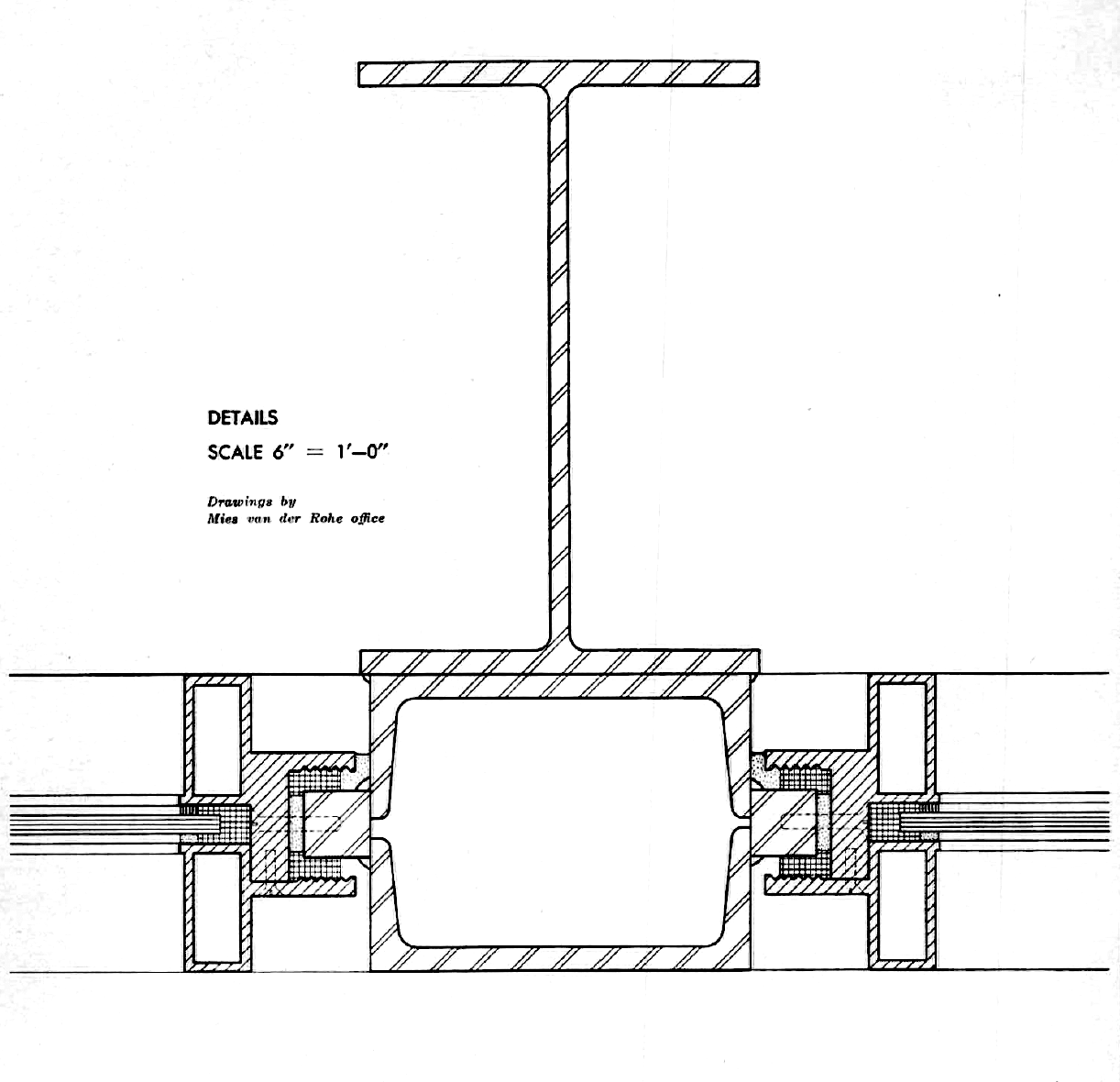
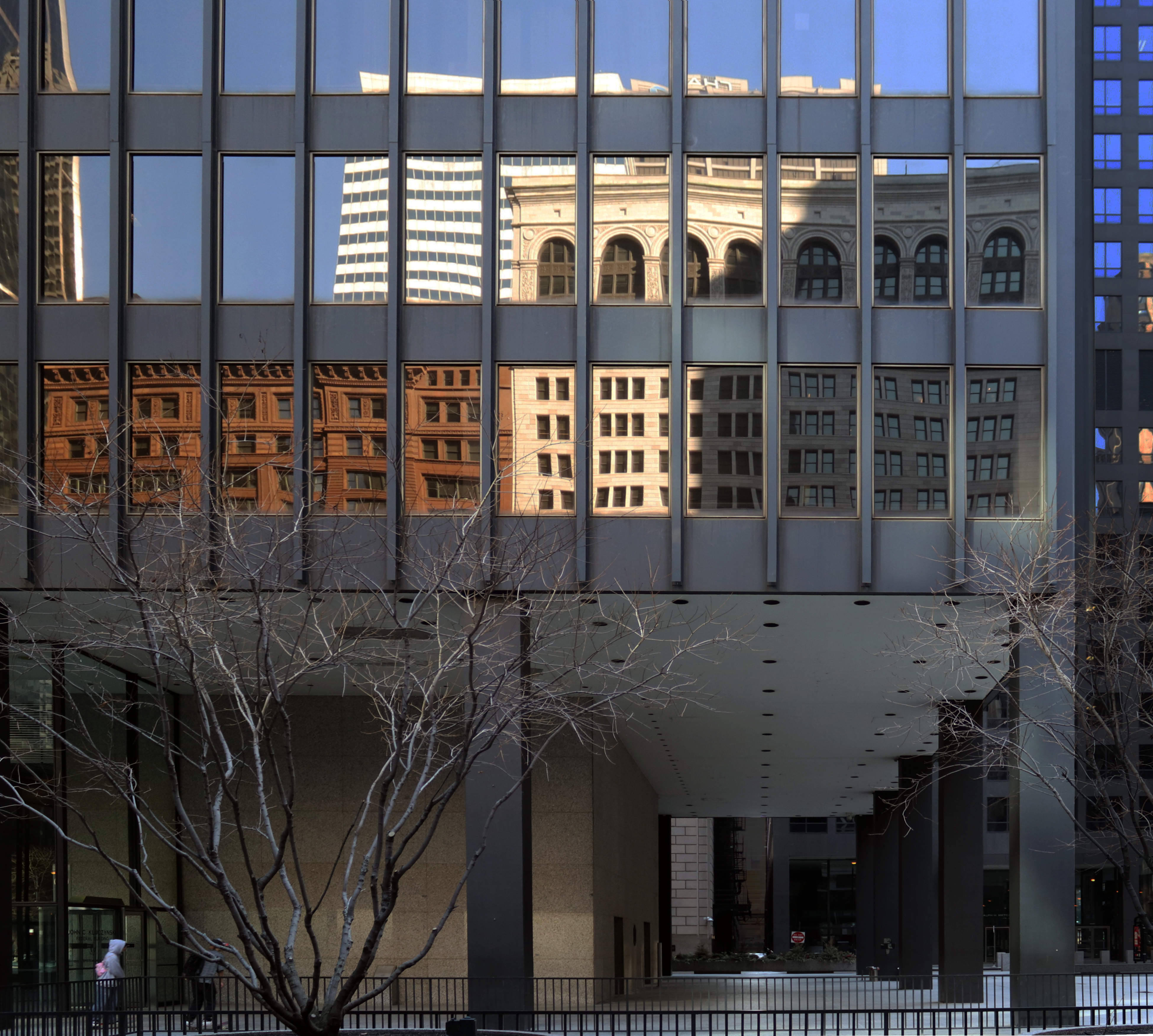
Summers sketched cladding options that telegraphed these double-height courtrooms onto the broad Dearborn Street elevation, but Mies overruled this expressive approach. Instead, the curtain walls continued the evolution of the 860-880 system, with floor-to-ceiling glass framed in aluminum and stiffened by exterior I-beam shapes. By 1960, steel curtain walls had been superseded by aluminum; Mies, however, insisted that steel frames should be rendered in like material.
Everett McKinley Dirksen Building (Chicago Federal Center Architects, 1959-64). Curtain wall detail.
Two steel channels form each mullion’s chassis, with square bars welded to either side framing aluminum stops that hold single sheets of plate glass. A standard W8 shape welded to the main chassis provides vertical articulation, while floor and ceiling finishes were detailed to align with window tops and bottoms. The system is punctuated by narrow shadowgaps surrounding each window frame, highlighting their infill nature and the change between aluminum mullion and steel support. The resulting façade shows Mies’ preference for steel’s continuity and texture over the gap-detailed aluminum cladding on Esplanade and Commonwealth, clarified with shadowgaps that would see further evolution at the Home Federal building in Des Moines (1960-63) and the Toronto Dominion Center (1965). Construction, by Paschen Contractors, began in 1962 and proceeded quickly, enabled by the design’s standardized details. The enclosure was finished a month ahead of schedule, and the building was dedicated in October 1964.
Everett McKinley Dirksen Building (Chicago Federal Center Architects, 1959-64). Photograph in the Carol M. Highsmith Archive, Library of Congress, Prints and Photographs Division. LC-DIG-highsm-45043
The same architectural and engineering team was awarded contracts for the second tower and post office in August 1963. Paschen began demolishing Cobb’s courthouse in January 1965, and the GSA accepted the team’s detailed designs for the post office and office building the next month.[ix] Paschen, now in a joint venture with Gust Newberg, finished the substructure in late 1966, at which point Congress, facing rising labor costs and funding an increasingly dire war in Vietnam, slashed the federal building budget, halting work. For three and a half years, the site sat vacant, the roof of the substructure serving as a parking lot.[x] U.S. Representative John Kluczynski, a Chicago Democrat, led a charge in 1969 to resume work on the building, but the Nixon administration held contracts until 1971.[xi] Detailed with the same steel and aluminum cladding system as the courthouse, the office building and post office were completed in October 1975, graced by the red steel “Flamingo,” by Alexander Calder.[xii]
The Federal Center’s construction outlasted its primary architect and two political champions. Everett Dirksen died weeks after Mies, in September 1969. Senate Republicans voted to name the entire complex for him, but Democrats objected, suggesting that the two tall buildings should be bipartisan. The Everett McKinley Courthouse was dedicated in May 1970, and the office building was nearly named for Illinois’ “fighting liberal,” Senator Paul Douglas, who had lost to Republican Charles Percy in 1967. Illinois’ House delegation argued that they should be represented as well as Senators, though, and after Kluczynski died in March 1974, Congress agreed that the newer building should bear his name.
[i] Daniel H. Burnham and Edward H. Bennett, Plan of Chicago. (rep. New York: Princeton Architectural Press, 1993. 117.
[ii] “Site Selection for New U.S. Buildings Near.” Chicago Tribune, Dec. 10, 1958. B4.
[iii] “Federal Building Site Picked.” Chicago Daily Tribune, Jan. 7, 1959. 1.
[iv] “U. S. Acquires Loop Site For Courthouse.” Chicago Daily Tribune, Apr. 1, 1959. 1-c11.
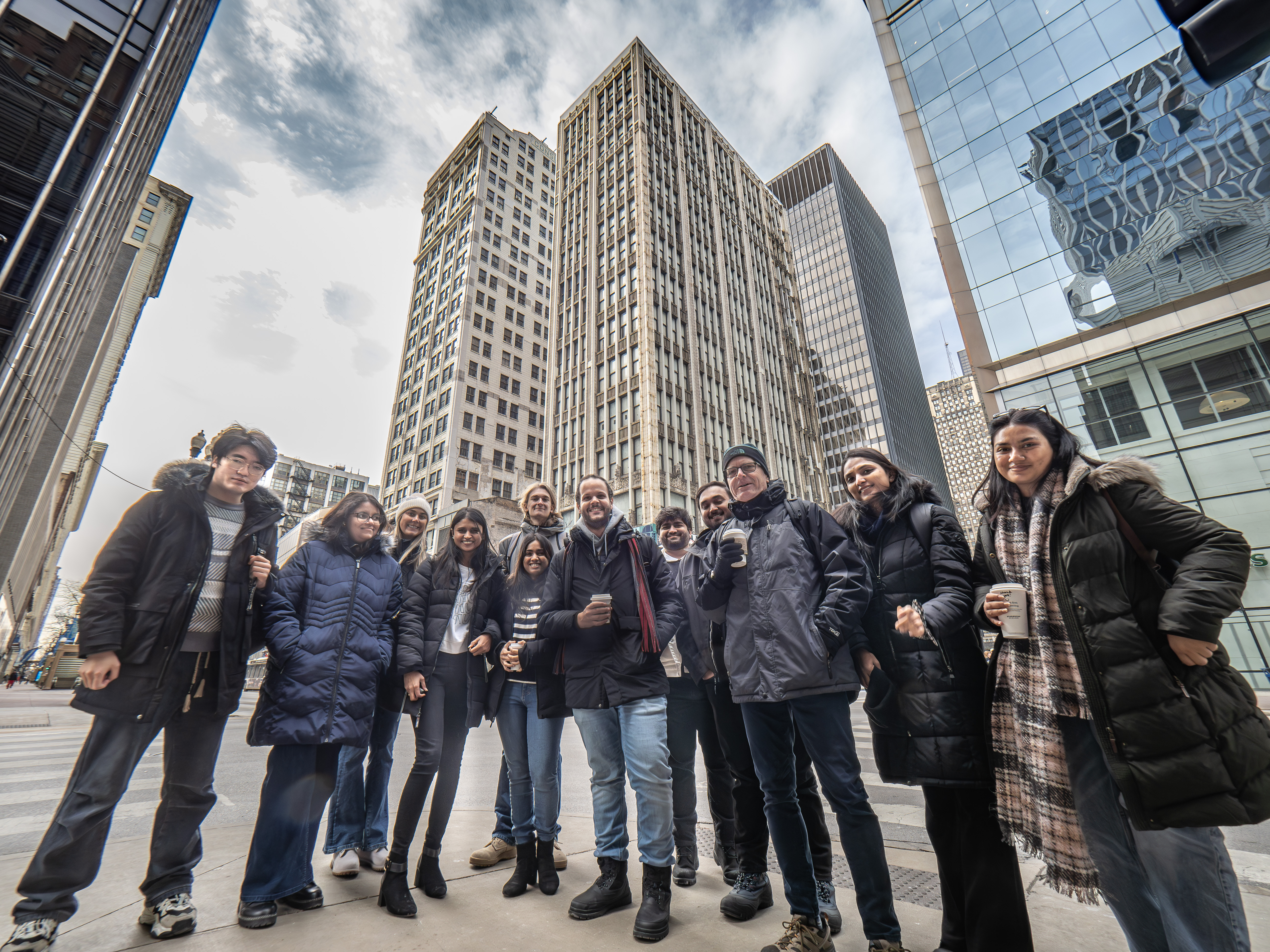
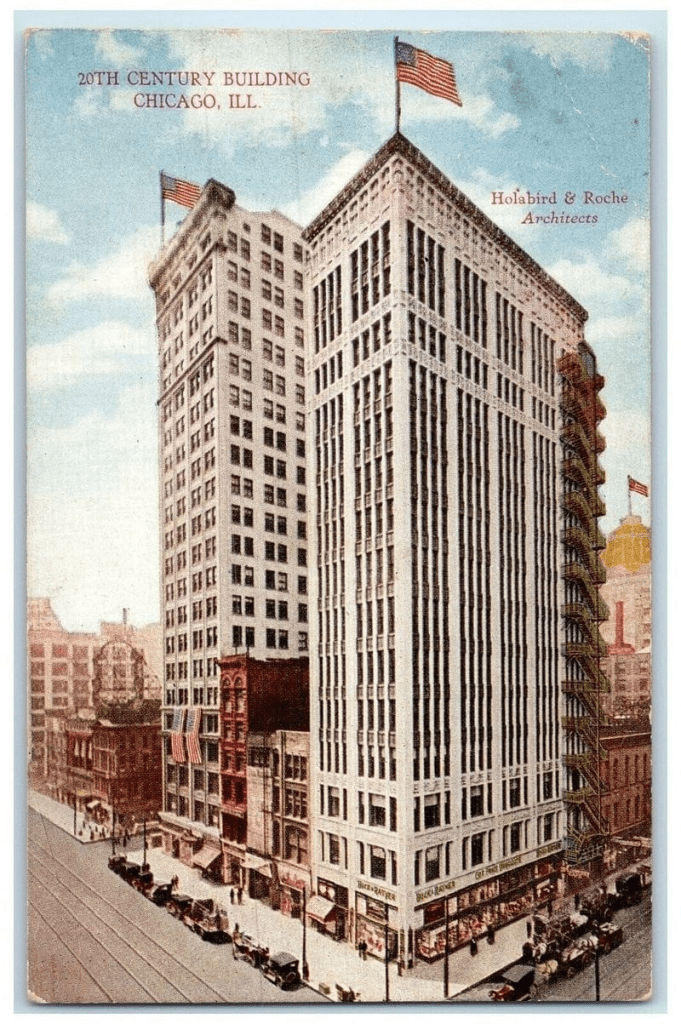
Preservation folks will recognize the buildings in the back there as the cause du jour. The Century Building (front, Holabird and Roche, 1915) and its taller sibling, the Consumers (behind, Mundie & Jensen, 1913), were typical of the commercial buildings constructed along State Street as it enjoyed renewed status as the city’s main retail thoroughfare. The two aren’t particularly distinguished, but they’re almost perfect representatives of the type, with tall retail storefronts, convenience offices on the second and third floors, and repetitive lease space from there to the attics. The Century is almost unique in its neo-Gothic styling for its time–relentlessly vertical, as opposed to the more stolid Consumers, which is strictly Burnham-esque mercantile classicism.
Unfortunately for the two buildings, they’re immediately adjacent to the Dirksen Federal Building and Courthouse. The GSA purchased them in other early 2000s and vacated them, seeing their proximity as a security risk. The two have sat, empty, ever since, with all the deterioration from a lack of occupancy that you’d expect. Preservation Chicago named the two to their 2023 “Most Endangered” list despite plenty of interest in converting their relatively small lease spans and floor plates into apartments.
The federal government made no secret of its plan to demolish the two, which would actually open up a more significant security issue. The City of Chicago, in response last year, landmarked the two back in April, 2024, essentially forcing the GSA’s hand. They responded with a Request for Proposals that comes with a handful of onerous restrictions, including a ban on residential programs, which they see as potentially providing bad actors with open views of the courthouse offices and loading operations on Quincy Street.
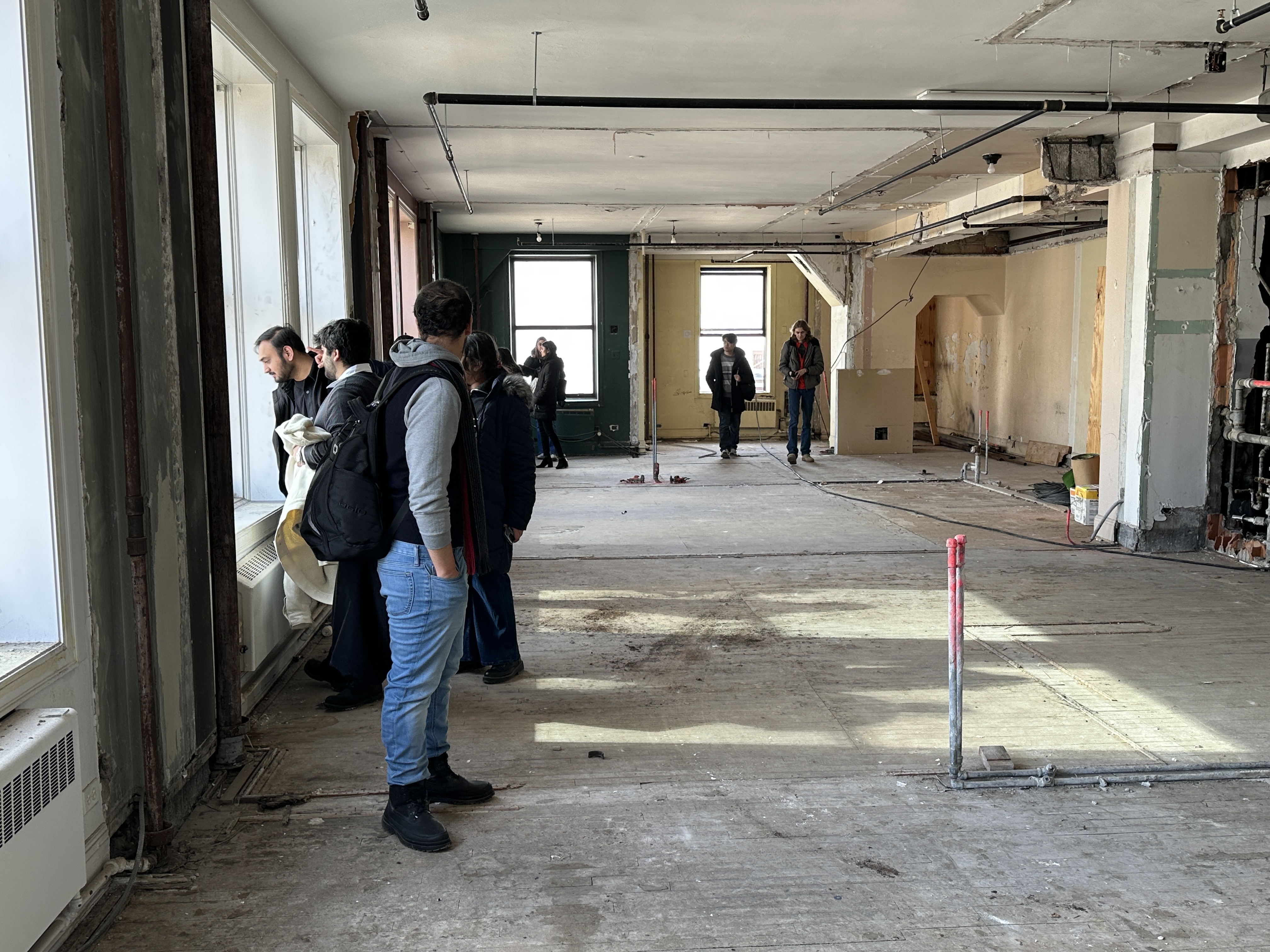
OK, fair enough, but what if…you could convince the GSA to design its way around those issues? That’s the premise of our spring studio–provide hotel and short-term apartment accommodation in the two buildings while taking the security concerns seriously. Last week, we met on site with Ken DeMuth of Pappageorge Haymes, one of the city’s leading designers in converting this era of skyscrapers into residential uses, as well as Mark Kuberski of Central Building and Preservation and Rachel Will of Wiss, Janney, Elstner–two of Chicago’s most knowledgeable preservation engineers, especially when it comes to the terra cotta cladding that (barely) covers the two towers.
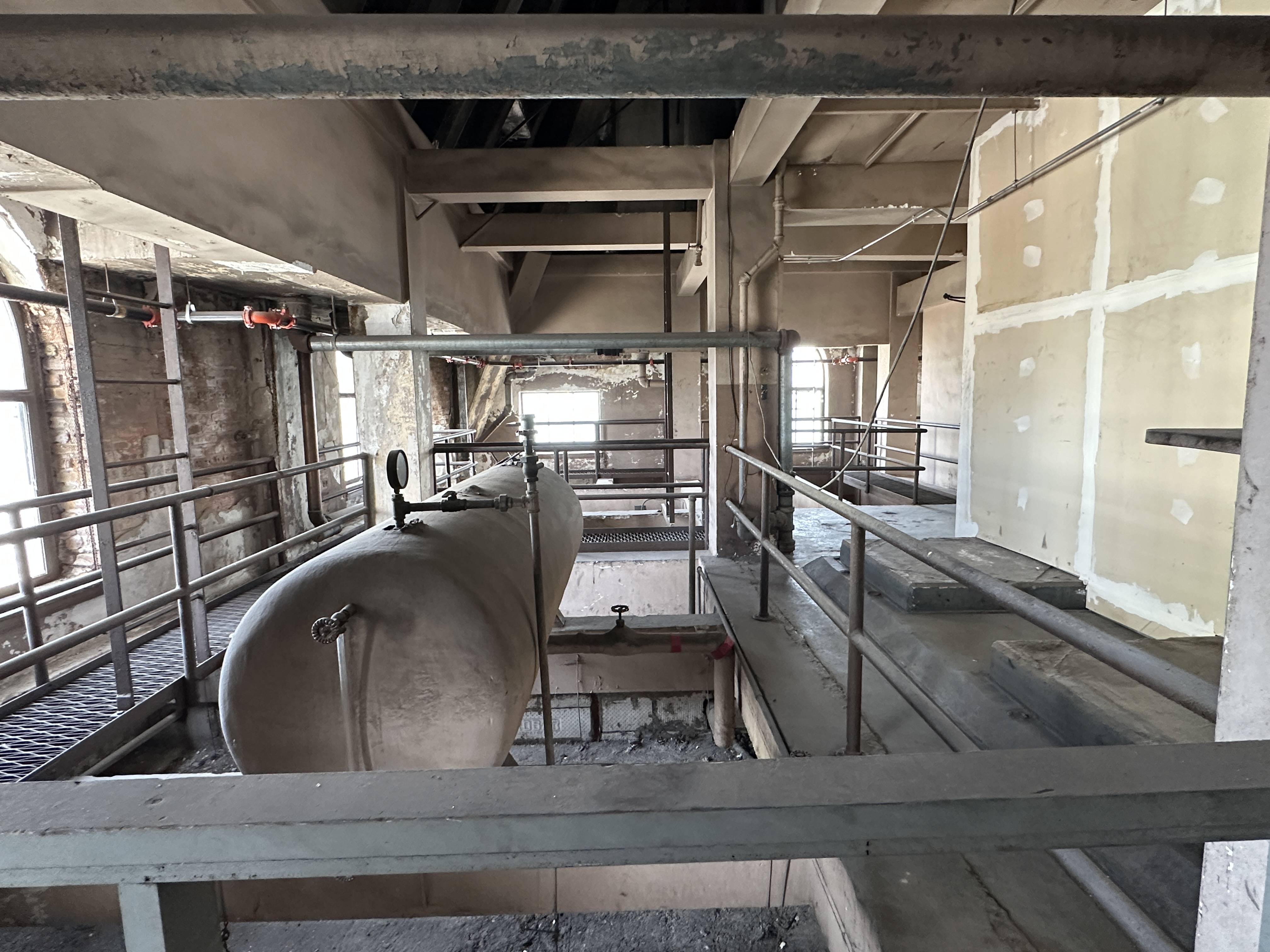
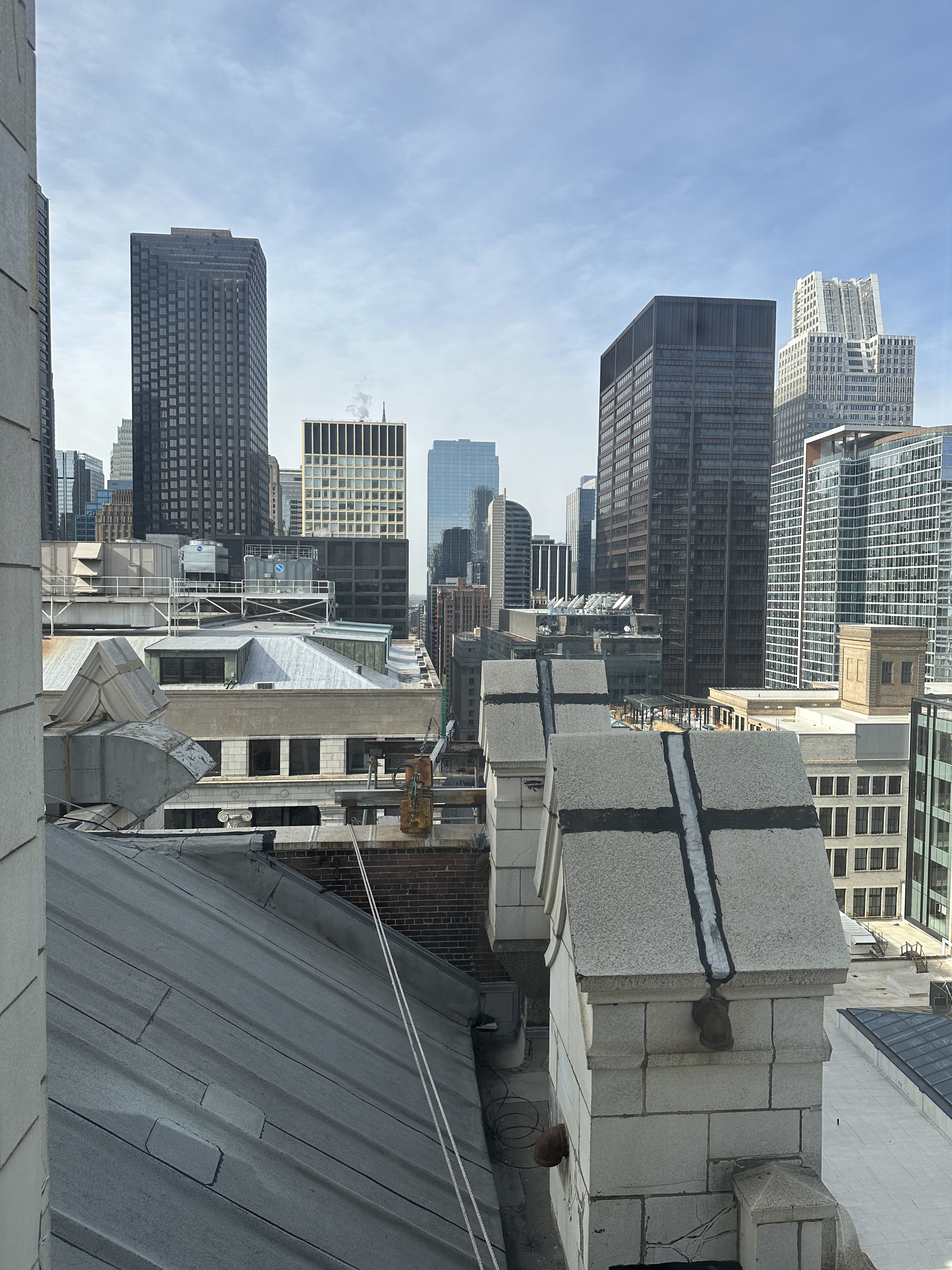
Not surprisingly, the GSA was not enthusiastic about students touring the buildings, but Ken got us into the Pittsfield Building, where residential conversion plans have been ongoing, so we got to see first hand what a vacated office building of (about) the same era presents in terms of spaces and details–including a bucket-list level visit to the mechanical penthouse in the peak of the tower, which would provide any rooftop apartment with a ready-made conversation pit:
We’ll see what this group comes up with, but we’re hoping to show that there’s room for cleverness in addressing the real security issues here, and to be part of the conversation about how important saving even these, ‘vernacular commercial’ structures will be to maintaining the Loop’s sense of history.
My Integrated Design Studio this semester was a collaboration with Related Midwest that looked at the evolving plans for The 78, a 62-acre brownfield site that is just a half-mile south of the Loop along the Chicago River. Ann Thompson, Executive Vice President of Architecture and Design at Related Midwest, put together a proposed site and program and then hosted the studio for an introduction to their process at the start of the semester. Student teams thus had a real-world problem to solve and the fine-grain program information that gave them a high bar to reach in terms of efficiency–but also design quality.
Lufan Xu and Giovanni Almanza
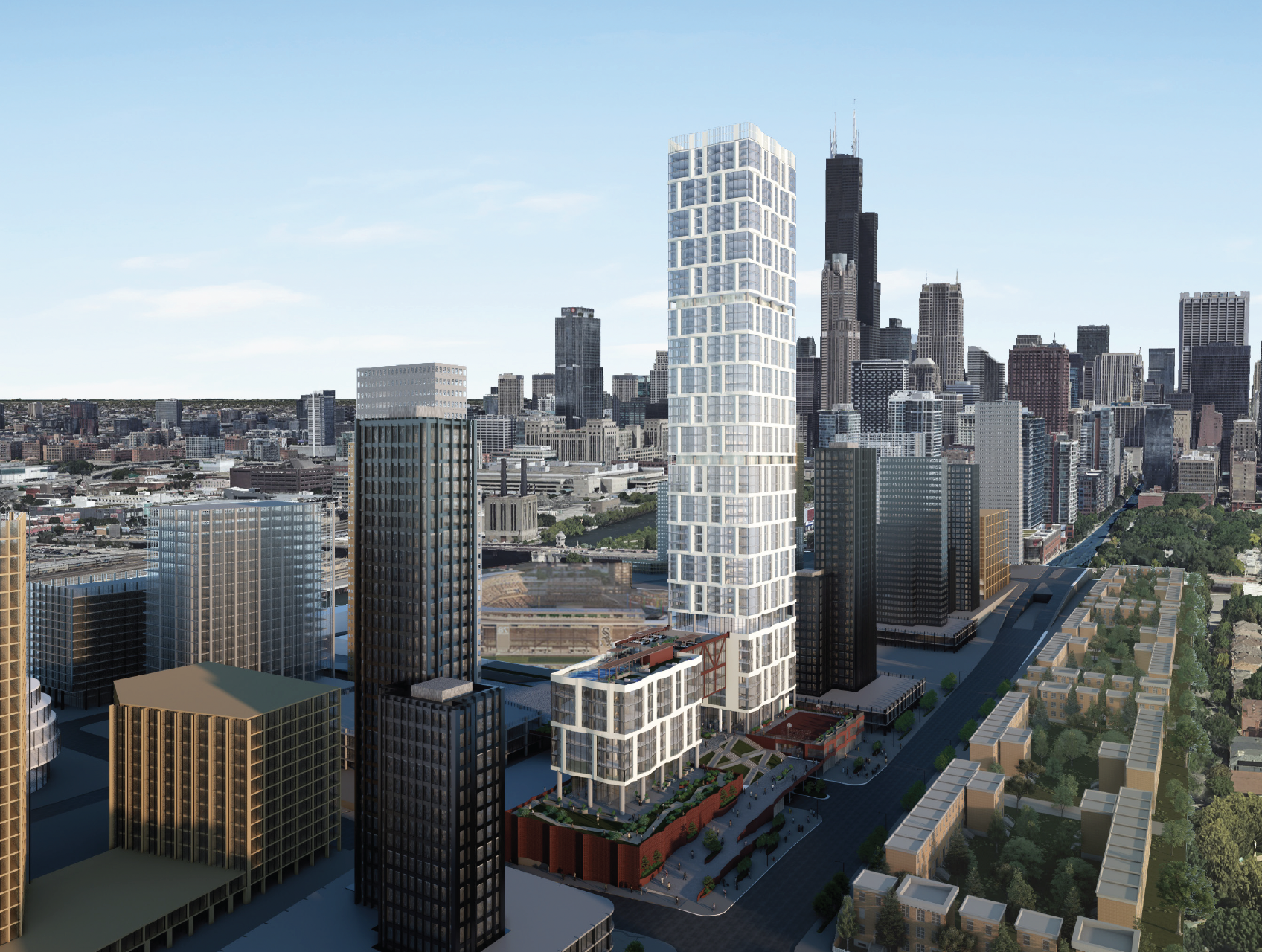
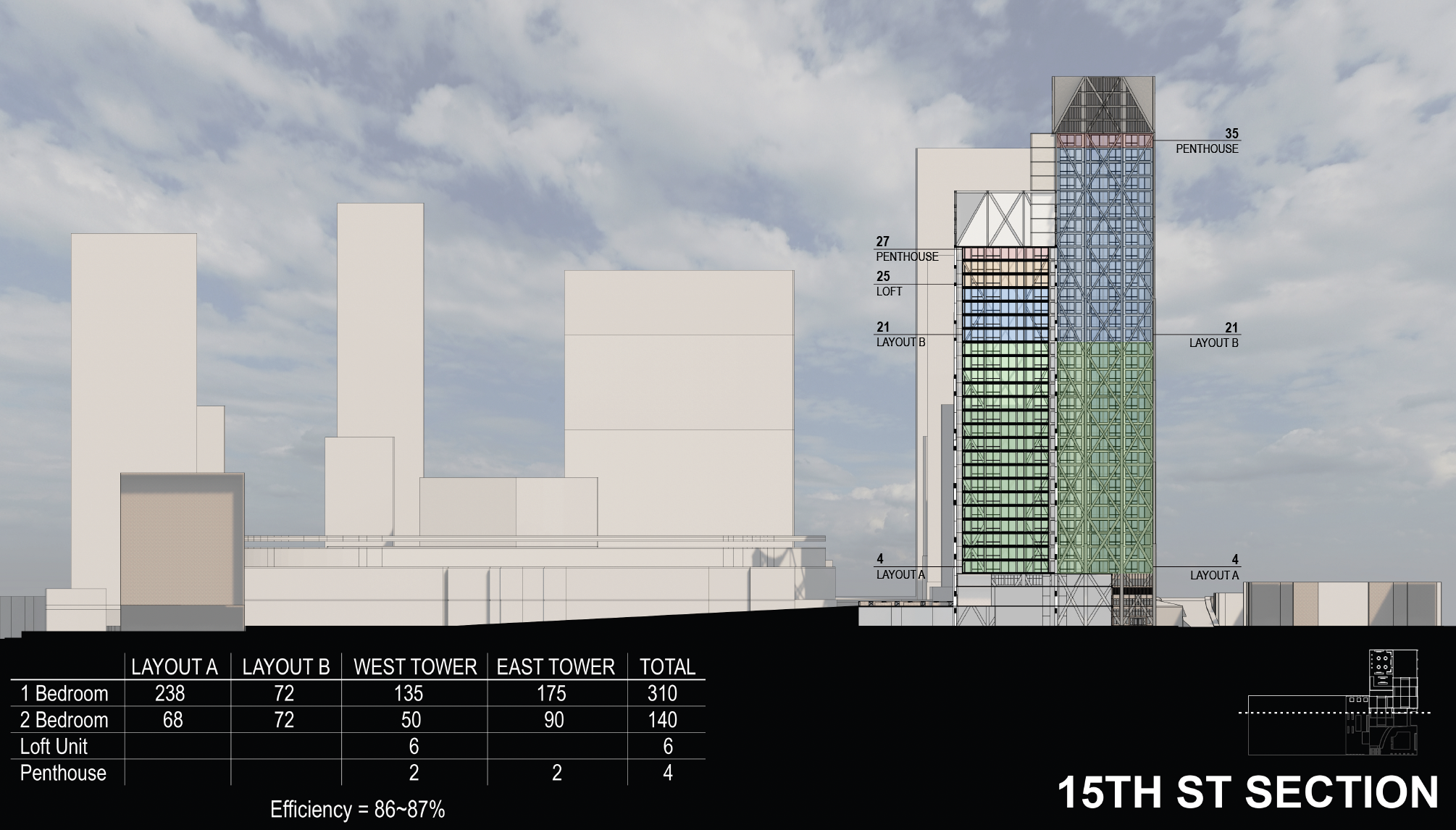
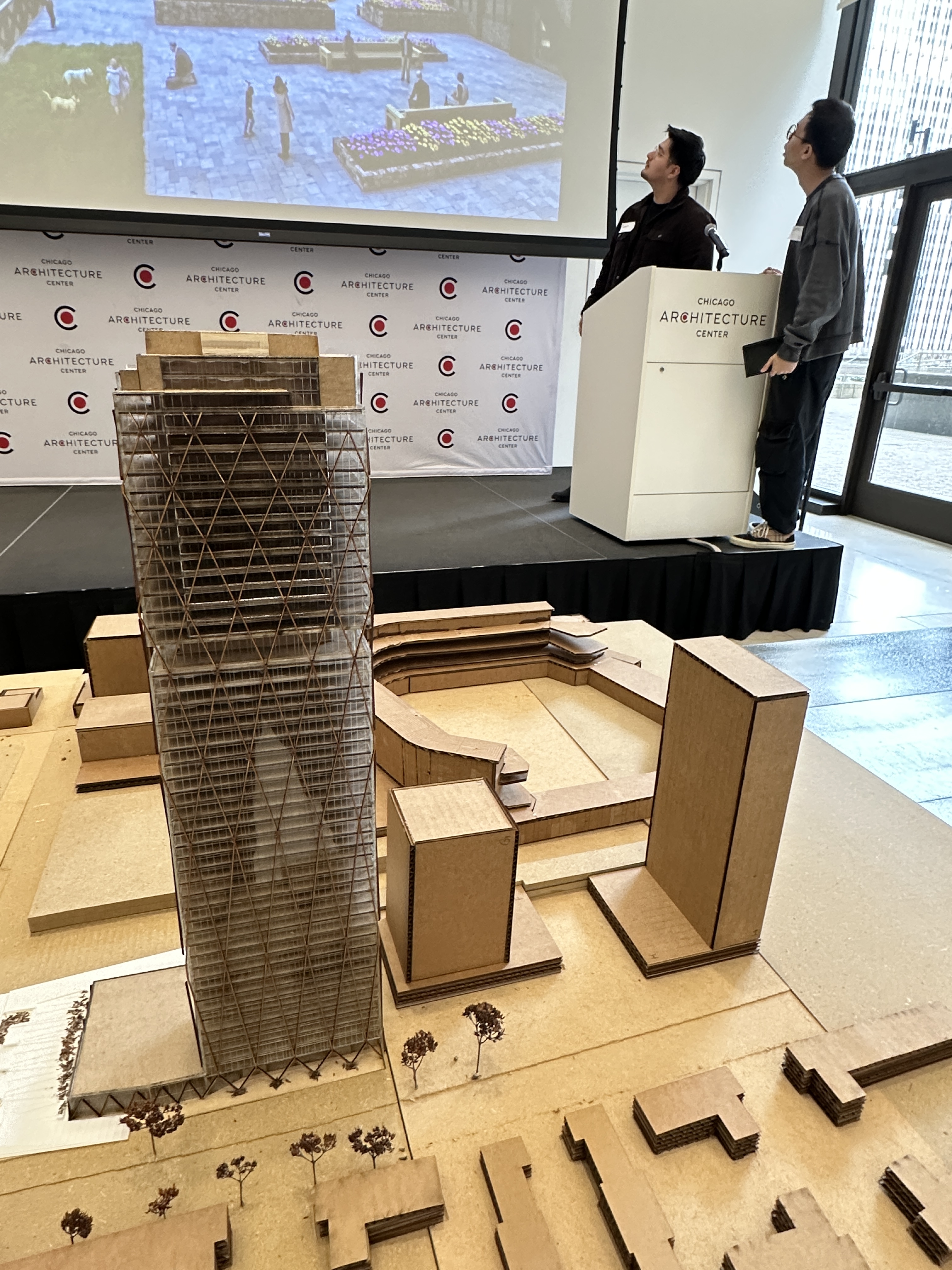
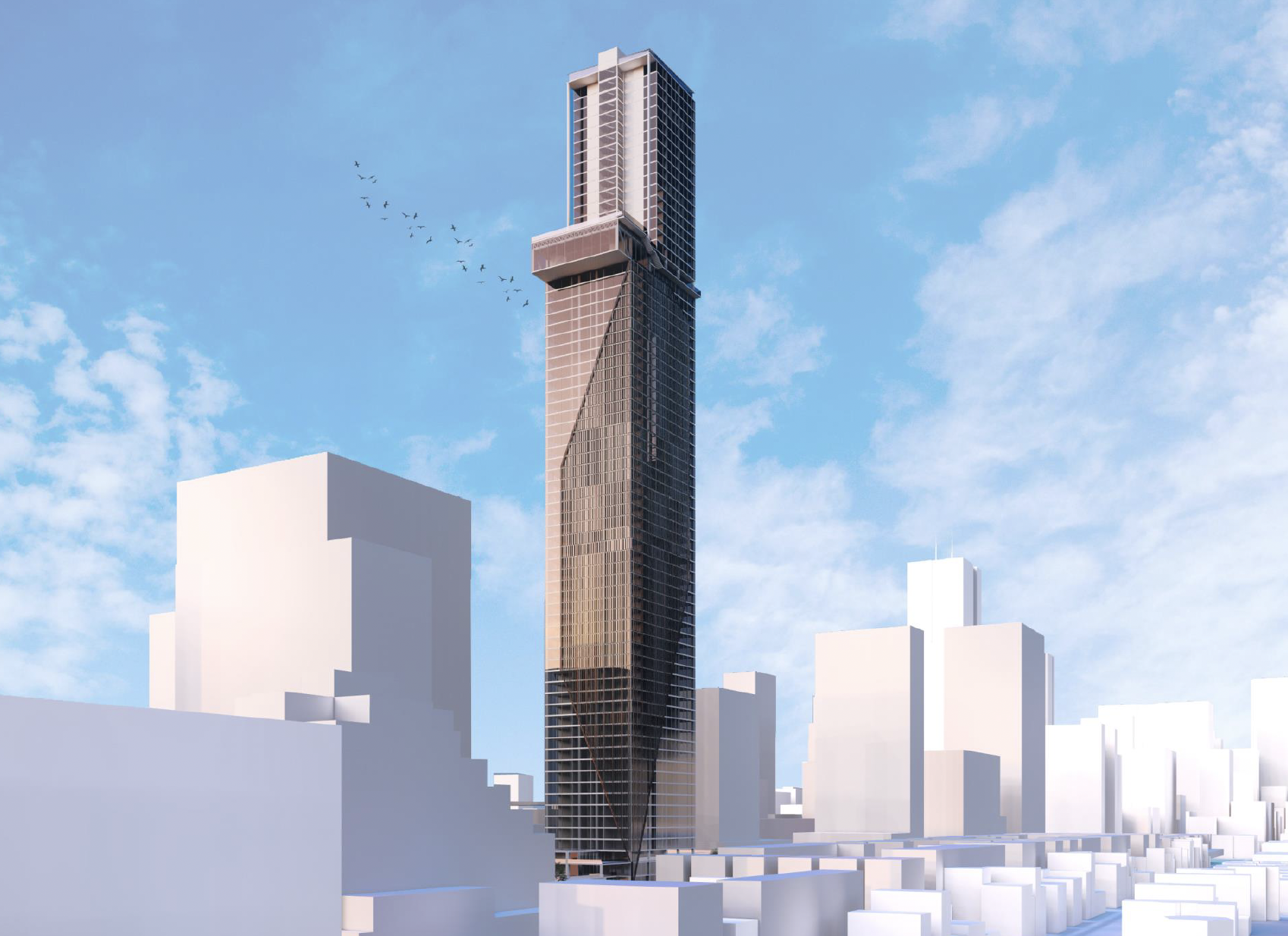
Related’s brief to them was to design a 450-unit residential tower that was amenity-rich in terms of tenant and pedestrian experience. The site, at the corner of Clark and 15th Streets, isn’t much to look at now, but when we started the project,t it promised to become one of the most active intersections in the South Loop. A University-led research initiative, the Discovery Partners Institute, had announced plans for its research center, designed by OMA, for a block of the 78 development just southwest of our site, and last summer, the Chicago White Sox stated their interest in building a new stadium just northwest of our site. So, the issue is, how do you design for tech workers and 40,000 baseball fans? To add pressure to the project, there are plans for a new CTA Red Line stop right at Clark and 15th–so our site will likely become a heavily trafficked, vital circulation node in the neighborhood. Adding to the difficulty, a relocated pair of suburban rail lines will separate our site from the development along the river.
Sanchita Damle & Nidhi Naik
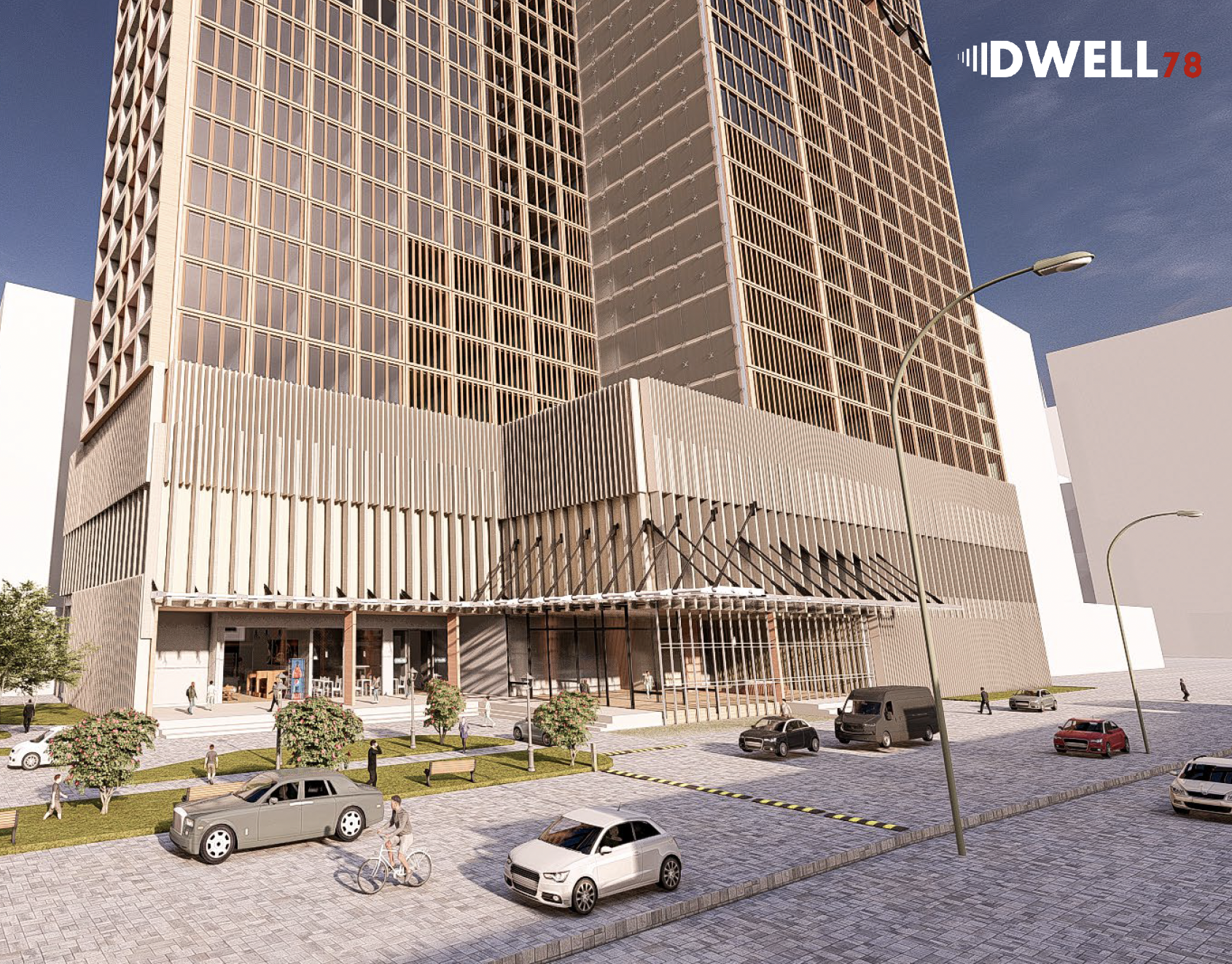
Design teams tackled the big program and the complex site with innovative ideas. Some began with the intersection itself, shaping their ground-level plans to house open plazas that could serve as ‘lobbies’ for the ballpark. Others addressed the problem of crossing the rail lines with ramping podiums that would add semi-public spaces for vendors or gameday retail.
Chang Chen & Ryan Chip
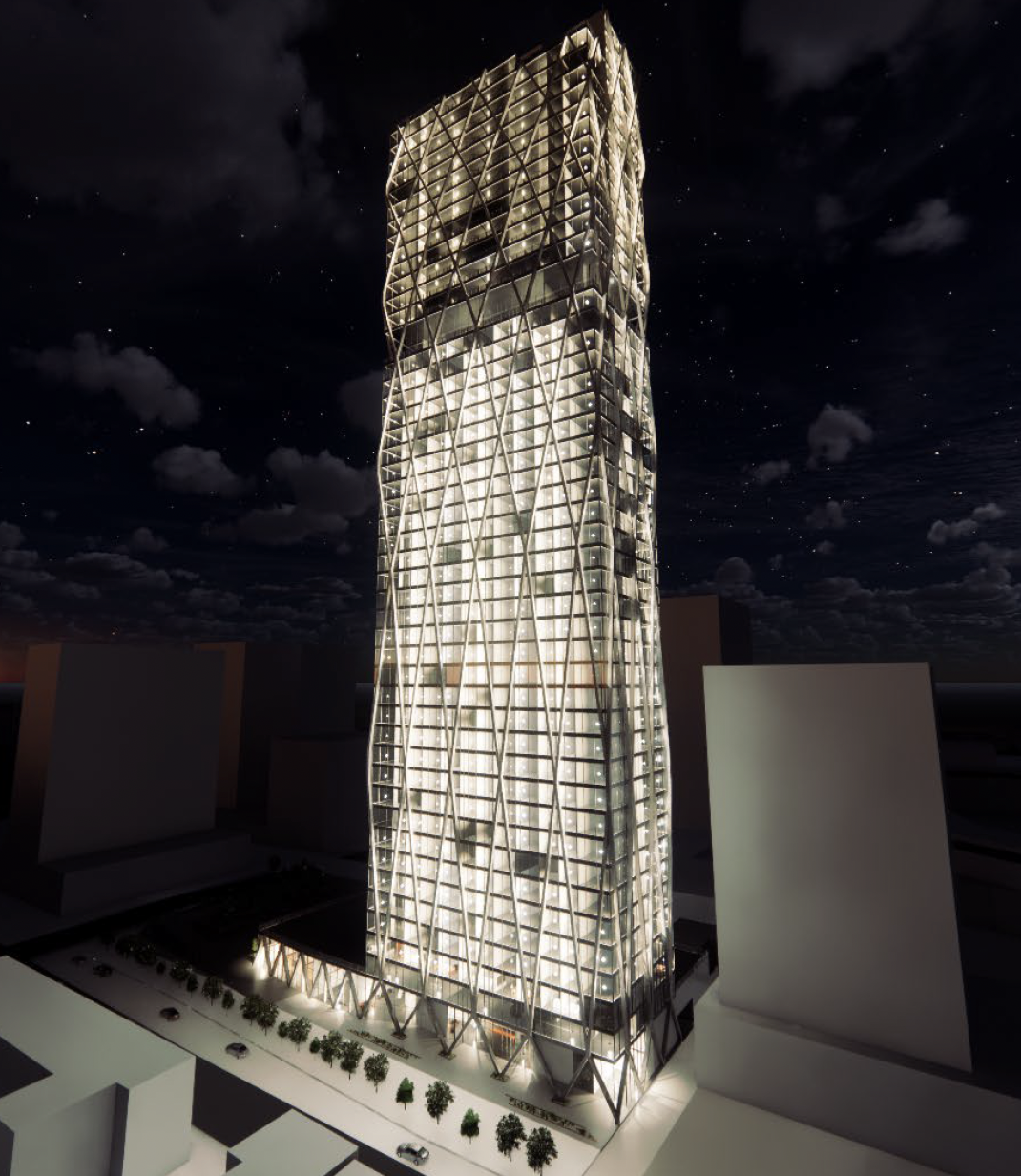
The towers took various forms, shaped by view corridors, daylighting strategies, and the desire to put an identifiable mark on the skyline that would be the 78’s signature. Midterm reviews and desk crits looked at structural schemes and facade palettes that called back to Chicago traditions like trussed tubes and terra cotta cladding, but all deployed in ways that would make sense for a 21st-century tower. We’re lucky at UIUC to have access to great engineering and construction expertise; students learn to take advantage of this early in their design process with clear results.
Atousa Esmaeili & Prajwal Sagari Mahaveer
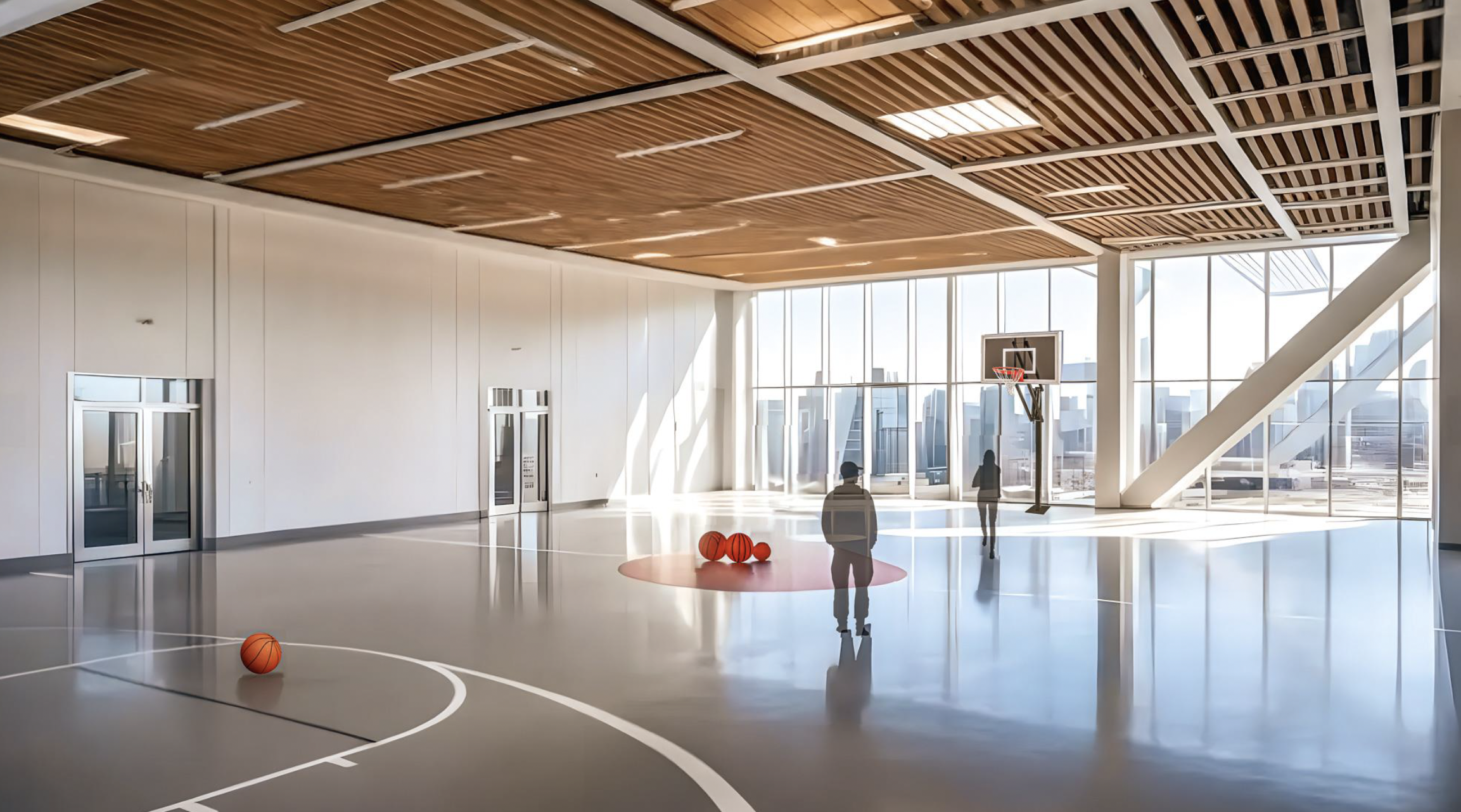
Ann and her team included a basketball court in their tenant amenities list, which became a signature in several projects–an opportunity to show off some structure, but also to think about how this very Chicago element could relate to the city. Grabbing a rebound 300′ in the air? Serious Air Jordan material.
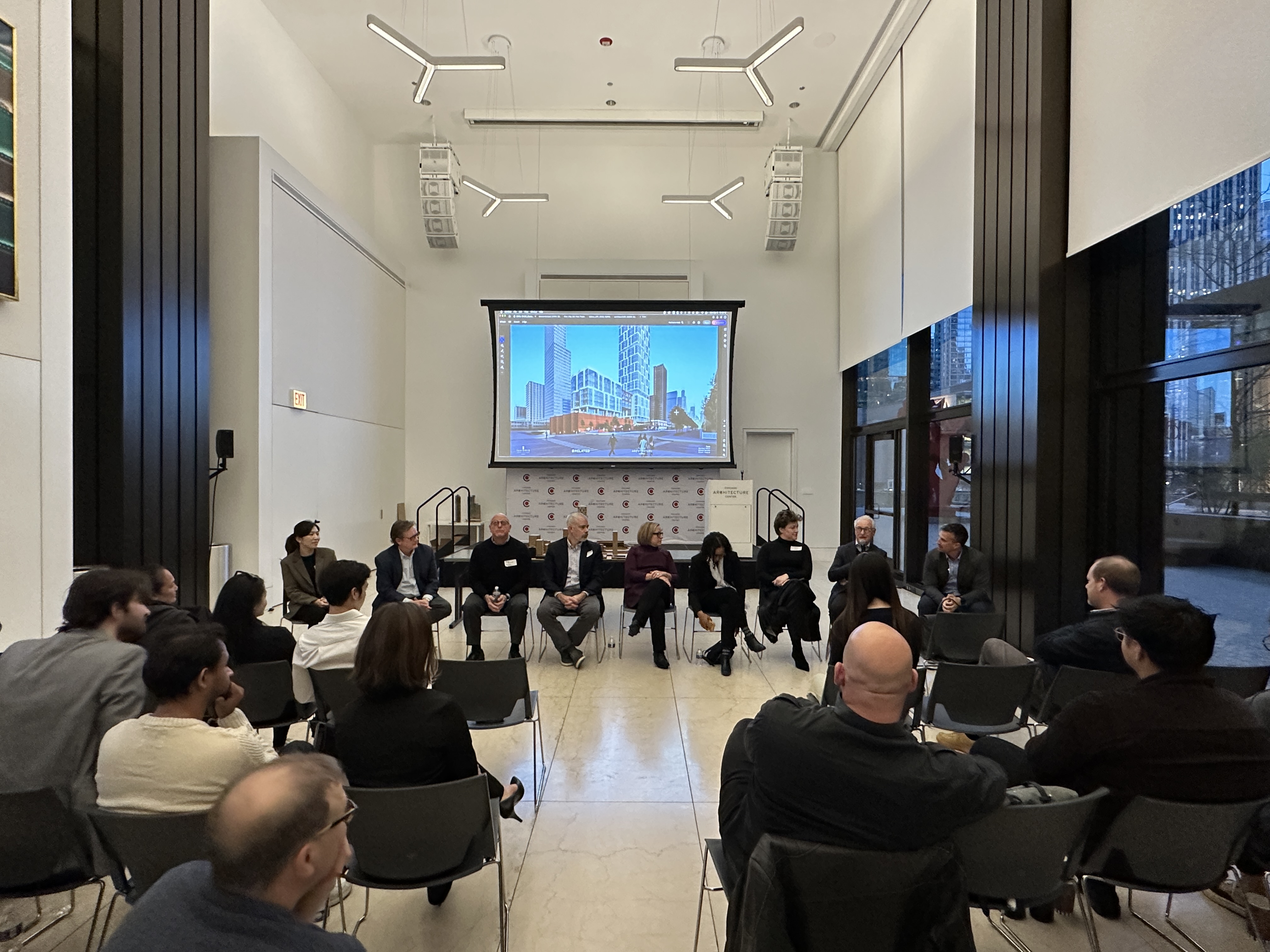
We celebrated the end of the semester with a presentation to Related and other members of the profession and the public at the Chicago Architecture Center last week. It was a great chance for teams to get feedback and show off their work. CAC leadership and staff have been great about letting us bring the work done in Urbana-Champaign up to Chicago, and it’s always a good experience for students to present in esteemed surroundings. Thanks to everyone who made this happen and to a stellar bunch of designers who eagerly dove into a genuinely challenging project.
 architecturefarm