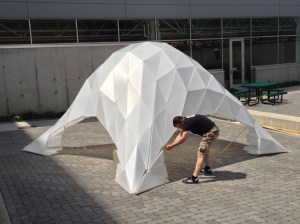
My colleague, Rob Whitehead, has been in and out of the grad studio all semester, brimming with even more enthusiasm than usual. Two grad students have been doing an independent study project with him that marries digital methods with Heinz Eisler’s intuitive form finding with fabric and shells.
The results, as you can see there, are pretty spectacular. One of Eisler’s methods was to basically take Gaudi’s trick (or, OK, Hooke’s) of hanging a tensile element like a chain, tracing its shape, and then inverting it and constructing it out of a compressive material. This gives you a pure compression structure, and it’s as simple a form-finding exercise as it gets.
Eisler, of course, used fabric and concrete instead of chains and stone. His shell structures were complicated to build, though, since they still required complex formwork to achieve the geometrically complicated curves that created such pure structure.
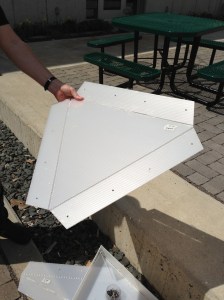
Which is where the digital stuff comes in. What these guys managed was a form-finding exercise that was then translated into a CNC-cutting exercise that produced several dozen of these light polycarbonate panels, complete with foldable ribs that, when attached to one another, created structural ribs. At just under 200 pounds, the resulting structure now occupies–temporarily–our building’s back yard, and its snuffleupagus-like massing and intuitively strong shape has drawn all sorts of approving stares.
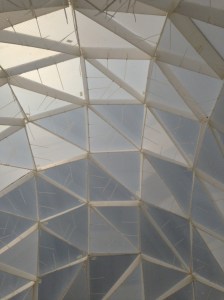
Polycarbonate was, of course, something that Eisler didn’t have for most of his career, but it’s the digital process that is most interesting here. For a while now, there’s been a tendency to see the new tools as a way to make any form the architect wants. But there’s a growing body of research like this, that looks at making efficient structural or acoustic forms. Both the shape-finding and the digital fabrication are important advances that let us figure out the lightest possible shape for a given loading configuration, and then let us build it fairly easily. This went up over a weekend, and while Bart and Nate are pretty skillful folks, there’s nothing to say this couldn’t have been built by far less competent builders.
Rob points out that this is the first large-scale iteration of several. They want to refine the process a bit to take care of more effective load paths at the base (if you squint, you can see that there are a couple of props down by the paws). And the detailing could stand some refinement–the zip ties are charming in a sort of first-try sort of way, but down the road this wants to be a bit slicker, no?
Eisler, famously, had exactly one computer in his office. It was used, exclusively, by the office secretary for word processing….
 After a strong start, the rest of the ACSA week was a mixed bag. Francois Roche gave the first keynote, and while his talk was wildly entertaining–hermaphrodite polar bears, grasshopper-based shelters for racist penguins, you get the drift–there was a palpable sense among the audience that we were being punk’d. Many of the sessions followed suit, with really broad speculation about new “constellations” of ecology and digital worlds, and precious little of this actually coming home to roost. By the time a colleague and I got through a paper on the “problematizing of scarcity,” we were ready to bail. (His comment: there are plenty of folks in Haiti willing to “problematize” that issue for us. Agreed).
 architecturefarm