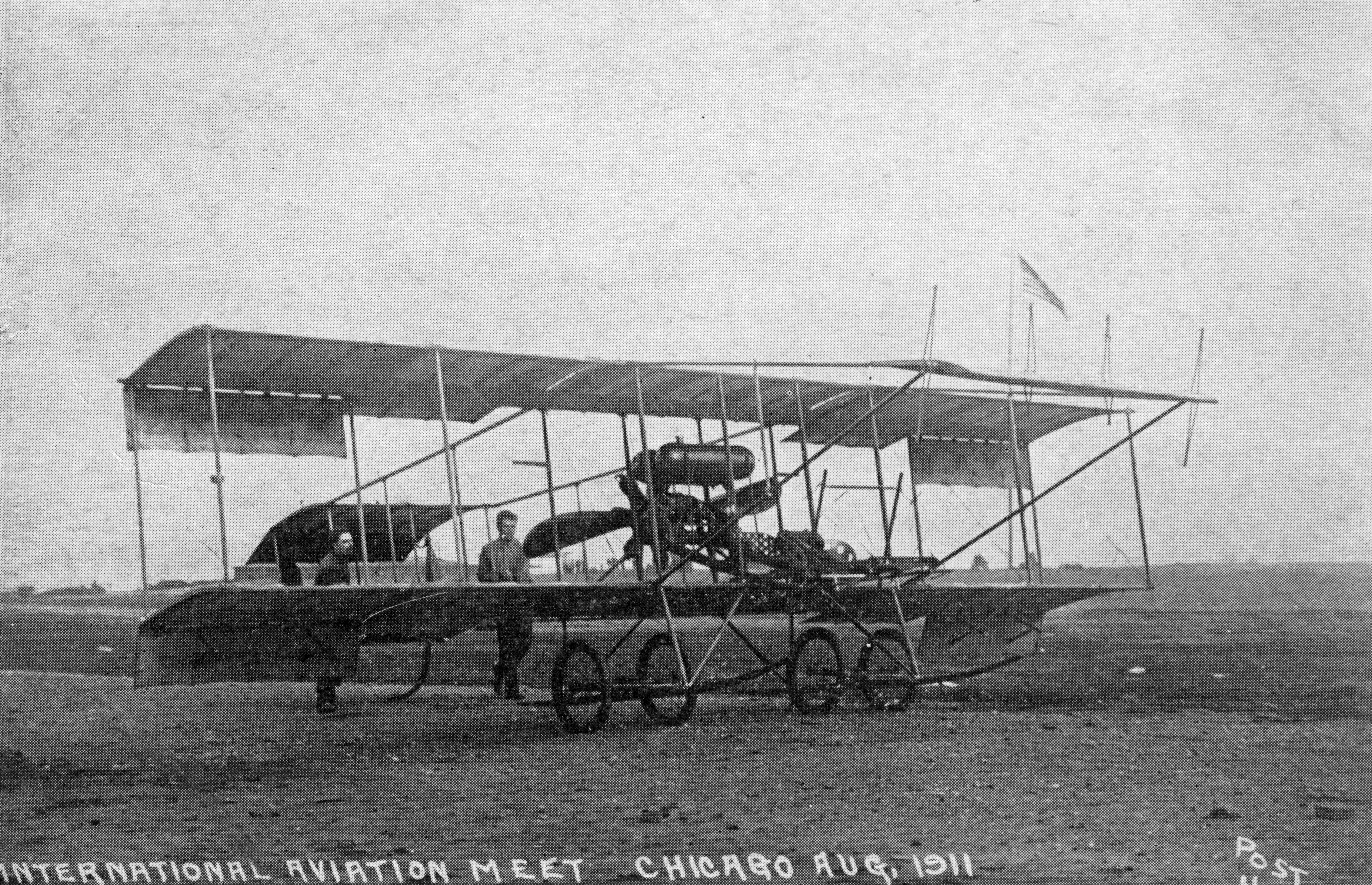
A contestant in Chicago’s first official International Aviation Meet, August, 1911.
With NASCAR racing in Grant Park earlier this summer and Chicago’s annual Air + Water Show warming up over the lake, this seems an appropriate time to point out that Chicago has a long history of racing and aviation in its otherwise pastoral ‘front yard.’
My current research project is a history of Chicago’s airports. Many of the same factors that shaped the city’s skyscrapers–rapidly advancing technology, new commercial imperatives, political friction within and outside the city limits, etc.–were also manifest in the city’s efforts to take advantage of its geographical position. First, as the country’s center of population migrated westward, Chicago was a natural hub for the developing network of air mail routes in the 1920s and for passenger travel in the ensuing decades. As jet aircraft made international travel commonplace in the 1950s and 60s, the city found itself at a natural position on great circle routes to Europe and Asia, spurring the development of O’Hare Airport.
That story’s beginnings take place at the most unlikely of “airports.” In 1910, a failed effort to stage a cross-country aviation race from Chicago to New York made Cicero Field, a half-mile square of turf at Cicero Ave. and 22nd Street, the epicenter of aviation for a summer. Would-be contestants gathered there to assemble their fragile planes and to fly them for paying spectators at nearby Hawthorne Race Track. Cicero Field was owned by Harold McCormick, a scion of the family that had earned its fortune with the original McCormick Reaper and would go on to own the Chicago Tribune. Harold’s fascination with Aviation led to his founding and funding the Aero Club of Illinois, which ran Cicero Field and sponsored local competitions and exhibitions designed to increase public awareness while advancing aviation technology.1
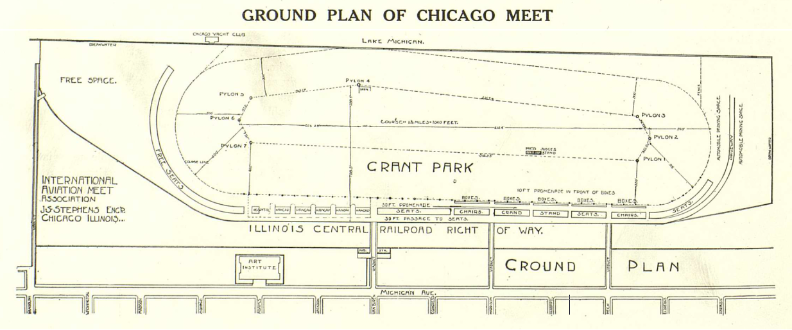
Most of the flying done at Cicero Field was of the “grass mowing” type–short, low-altitude hops in amateur craft, but the influx of national and international aircraft in 1910 led McCormick to propose a larger, more formal exhibition in 1911. That took place in August, turning the newly-completed Grant Park into a hive of flying activity for nine days. McCormick cleverly based prize money on both accomplishments–altitude, speed, and duration, among them–and on total flying time, encouraging participants to keep their machines in the air as much as possible. The 1.3-mile course, laid out from Randolph Street to 12th Street, was a narrow oval lined with seating for 70,000 that allowed spectators to view a constant parade of machinery with the lake as a backdrop in the afternoon sun.2
Geo F. Campbell Wood, “The Chicago Meet.” Aircraft, Aug. 1, 1911. 190.
The meet was an extraordinary success, spurring plans for a second event, held in 1912. But even as it highlighted the rapid progress that had been made in American aviation, it also revealed the problems confronting aircraft builders and pilots; one contestant was killed when the wings of his aircraft collapsed during a high-speed turn in front of the grandstand, and another drowned when his plane crashed a mile offshore.3 After 1912, exhibitions like the Grant Park event faded in favor of more ambitious cross-country races as aircraft became more reliable and their appearance less remarkable.
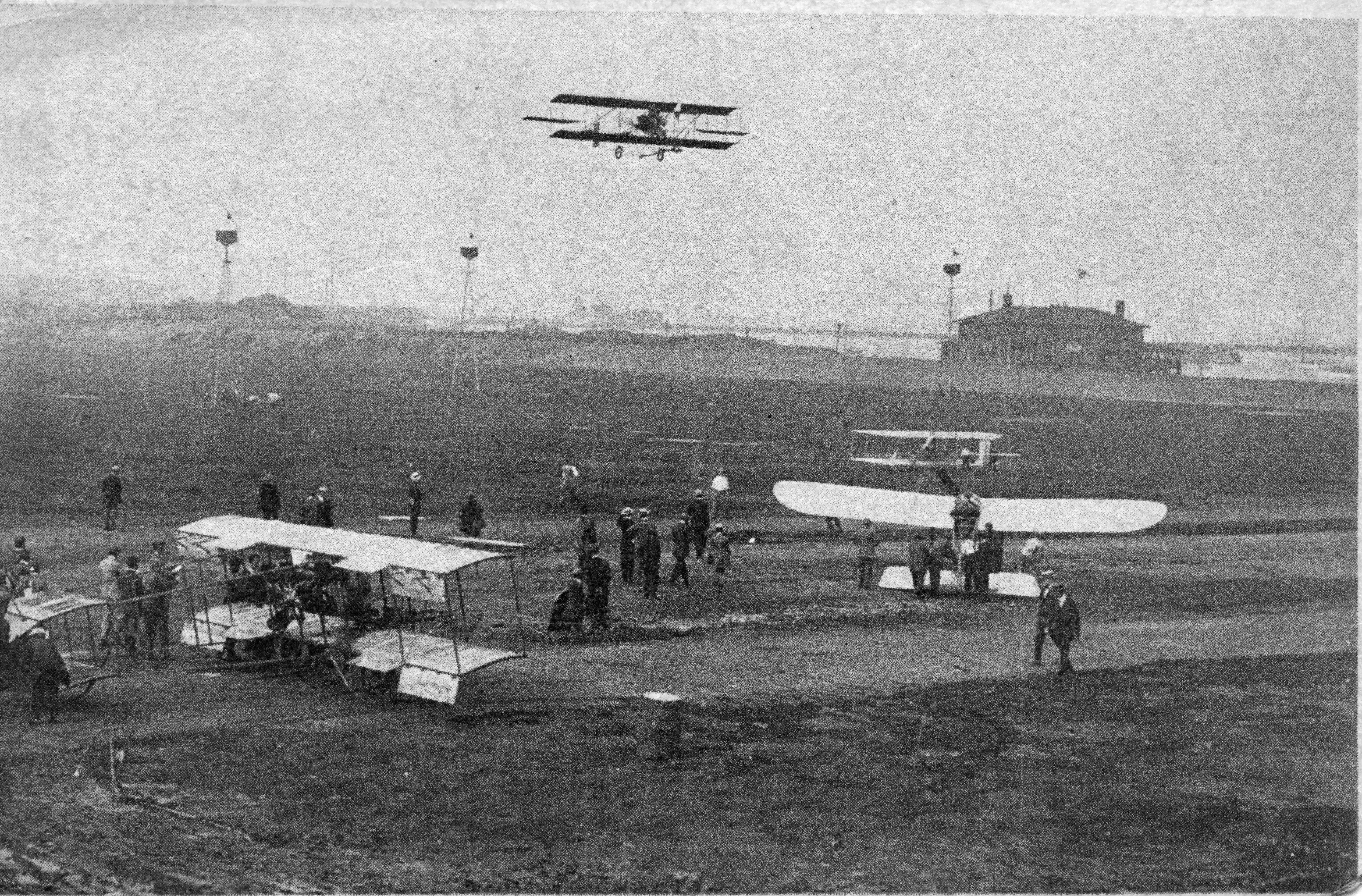
Aircraft aloft and awaiting flight at the International Aviation Meet in Grant Park, 1911. Chicago Yacht Club in the background (Contemporary Postcard, Author’s Collection).
With five international aircraft and their pilots competing, Grant Park can make a claim as Chicago’s first international airport. It would continue to serve as a landing strip for recreational craft and, for a short time, for air mail when that service began in 1918.
A final note. The 1911 and 1912 events took place after a boom in skyscraper construction in the city, and a couple of press accounts that related the aviation meets to the city’s high rises stand out. The first is the entertainment trade journal The Billboard, which reported on aviation mostly in terms of the crowds these exhibitions drew. Chicago, it reported in 1911, was a ready-made arena for such displays:
“There is not another city in America, if indeed in the world, that possesses such a remarkable aviation field right at its doors, as does Chicago in Grant Park, the 160-acre park on the downtown lakefront. where the meet takes place….with the sightseeing space afforded by the skyscraping hotels and commercial buildings along Michigan Avenue, as well as the standing space for the multitude outside the pylons and west of the Illinois Central tracks, over a million people will be able to witness the event.”4
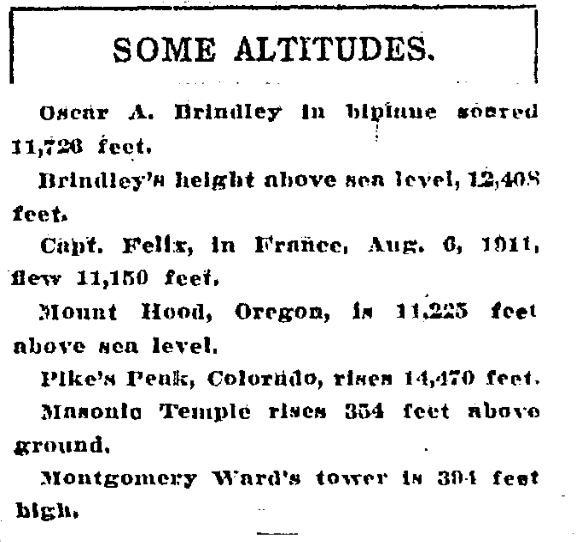
And, marking the turn in public fascination from buildings that appeared to climb skyward to machines that actually did, the Tribune offered some intriguing comparisons5 in reporting on the record altitude achieved by aviator Oscar Brindley during the meet:
Howard Lee Scamehorn, “Balloons to Jets: A Century of Aeronautics in Illinois, 1855-1955.” (Chicago: Regnery, 1957). 53, 81. ↩︎
“Advertisement: International Aviation Meet.” Town & Country, suppl.The Air-Scout, vol. 66, no. 22, Aug. 12, 1911, pp. 2.↩︎
“AVIATORS BADGER AND JOHNSTONE DROP TO DEATH: 50,000 LOOK ON.” Chicago Daily Tribune, Aug. 16, 1911, pp. 1.↩︎
“INTERNATIONAL AVIATION MEET IN CHICAGO.” The Billboard, vol. 23, no. 33, Aug. 19, 1911, pp. 4-4, 55.↩︎
“WORLD RECORD BROKEN; FLIES UP 11,726 FEET: B.” Chicago Daily Tribune, Aug. 19, 1911, pp. 1.↩︎
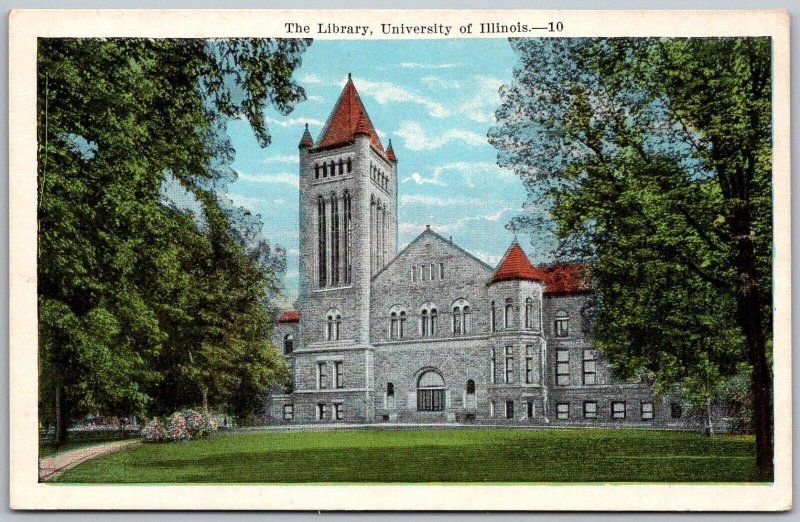
Any University of Illinois School of Architecture graduate will recognize the name Nathan Clifford Ricker. Our library and two school publications are named for him. We’ll waste no opportunity to point out that he was the first American to receive a home-grown architectural degree—in 1873. He designed several key buildings on the Urbana-Champaign campus, in addition to his own home nearby, and he stayed on as a faculty member (1916), director of the nascent architecture program (1910), and general guiding spirit until 1922. The School’s reputation for turning out technically-fluent graduates was primarily due to his vision of a program emphasizing building construction, bucking the national trend toward education inspired by the compositional theories and tropes of the French Beaux-Arts. “Shop Practice,” a hands-on introductory course requiring students to draft and fabricate elements in wood and metal shops, set the early School’s high bar for practical, real-world knowledge and know-how.
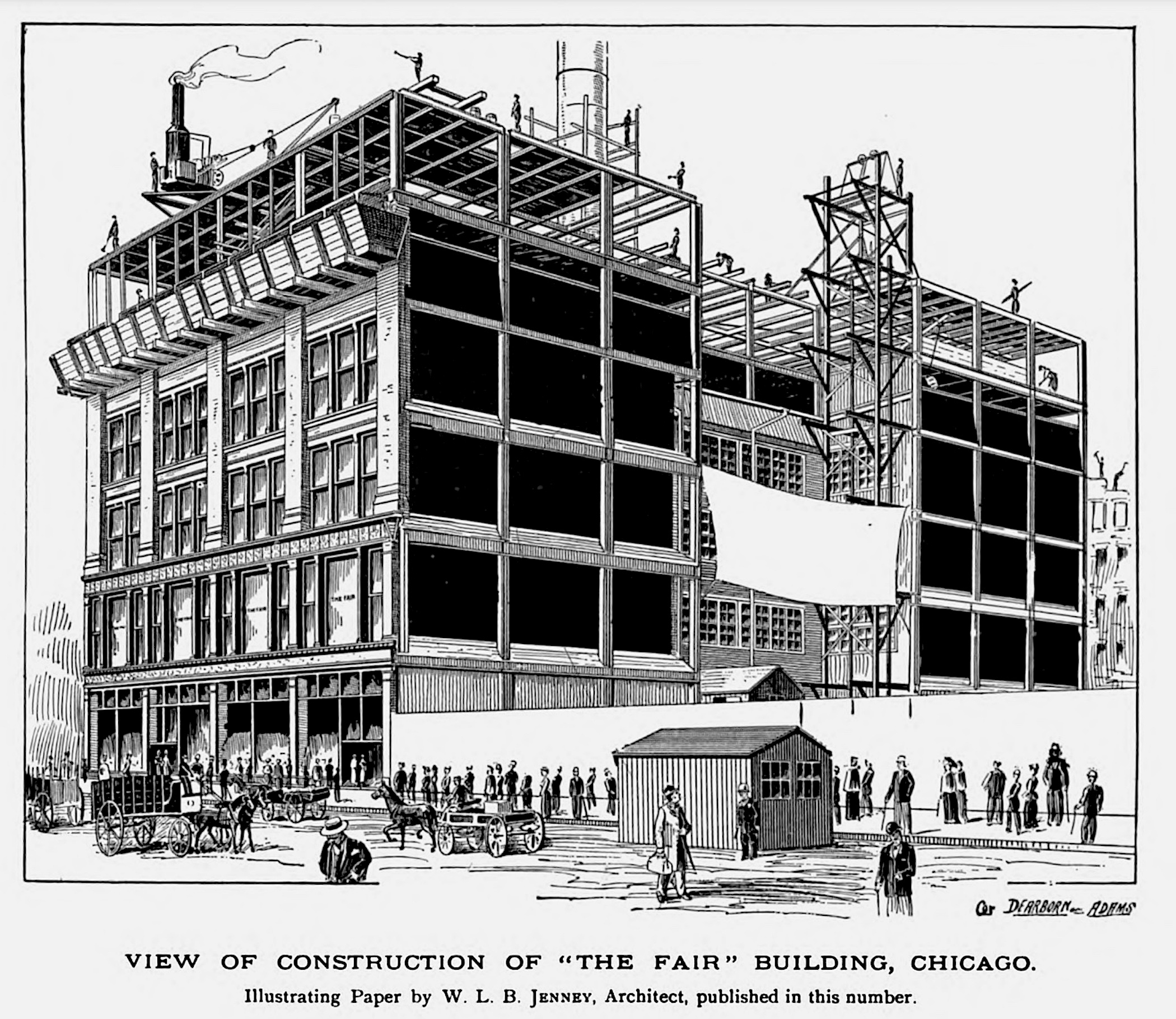
Image of the Fair Building under construction, one of many contemporary journal illustrations reprinted by Ricker in The Elements of Construction.
Ricker also compiled a comprehensive textbook on building technology of all sorts for use in his classes here, based on his practice and his diligent reading of seemingly every journal or book that came out on the subject (among other things, Ricker translated and published excerpts from Viollet-le-Duc during his career). The two volumes of his Elements of Construction were constantly updated; master copies were typed onto vellum. New students ‘printed’ their copies using sunlight and blueprint paper, an agile process that allowed Ricker to slip in new pages as new technologies came online.
The Elements of Construction must have been profoundly influential—Illinois’ students would have taken their copies with them to offices in Chicago and throughout the Midwest. However, the fragile nature of blueprint paper also meant that the copies would have disintegrated, making it an ephemeral book at best.
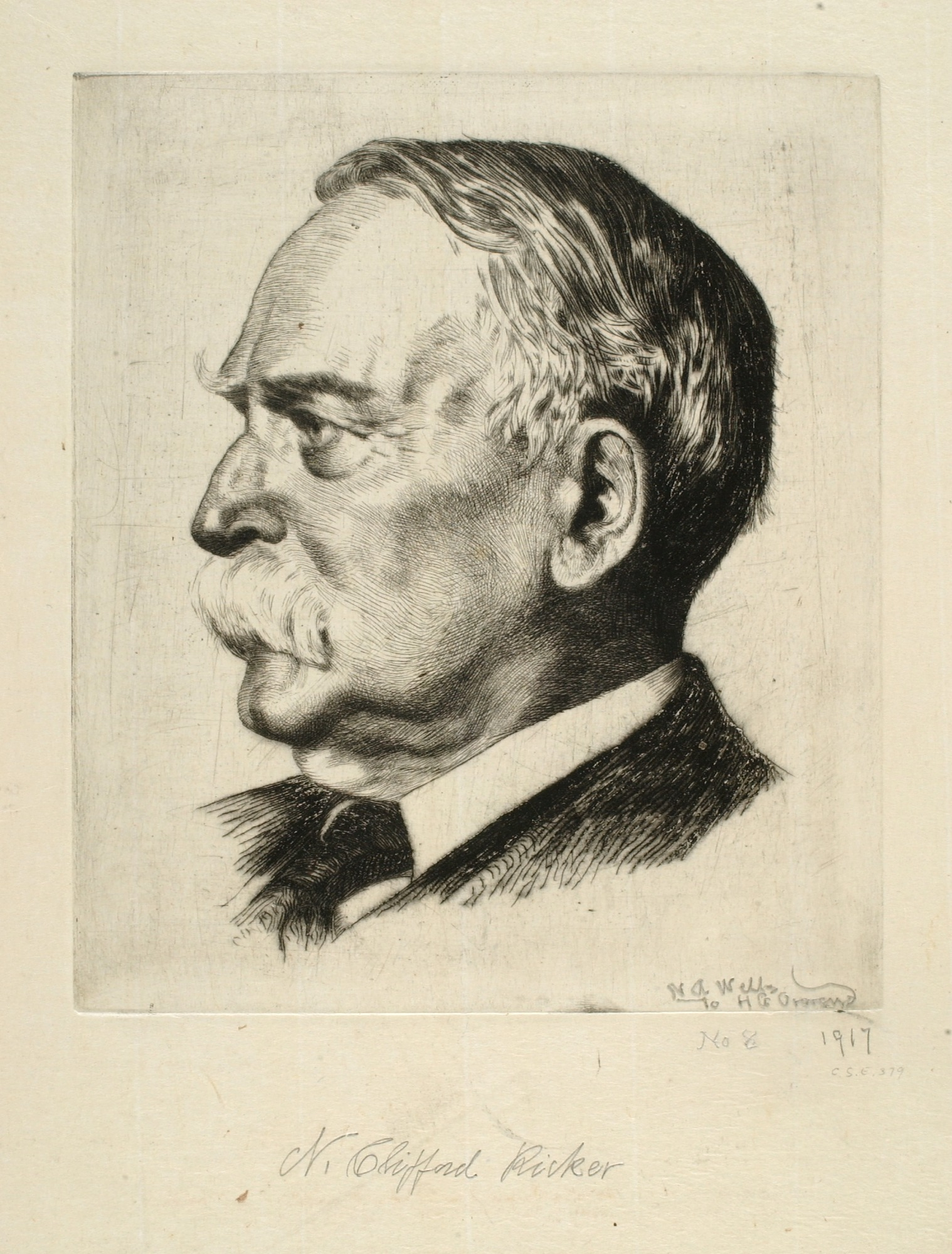
Newton A. Wells, Portrait of N. Clifford Ricker, 1917, etching, 7 x 6 in. (17.8 x 15.2 cm), Smithsonian American Art Museum, Gift of Chicago Society of Etchers, 1935.13.379
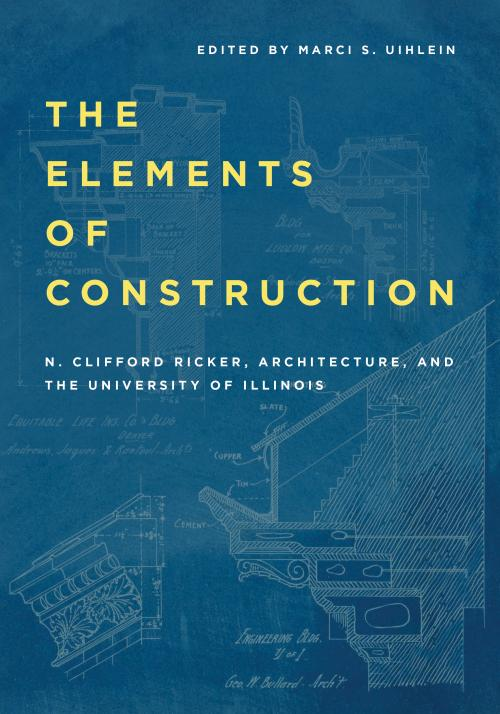
Until now. My colleague here at Illinois, Marci S. Uihlein, has just published the result of her painstaking research into and reconstruction of Ricker’s book from original blueprints in the School’s archives. The Elements of Construction: N. Clifford Ricker, Architecture, and the University of Illinois makes the convincing case that Ricker and his textbook deserve to be seen alongside the most important authors on building technology of the era—J.K. Freitag and William Birkmire. Freitag and Birkmire published vital books on skyscraper design that Elements echoes and enhances. Since Ricker was writing for students who would go on to design many different building types, his book is broader in scope, covering stonework and masonry in addition to iron and steel. It’s a holistic work that addresses skyscraper technology in the wider context of architectural engineering in general.
This new book reproduces four complete chapters of Ricker’s Elements of Construction: Foundations; Stone Masonry; Bricks, Tiles, and Terra Cotta; and Iron and Steel Construction. It includes original and reconstructed illustrations from Ricker’s vellums and framing essays by Construction History scholars, including Don Friedman, Tom Peters, Rachel Will, and myself, that put Ricker’s text and pedagogy in context. The result is a richly detailed overview of architectural technologies and construction in the late 19th and early 20th century—but also of the unique pedagogy that went hand-in-hand with the innovation happening in Chicago, especially, at the time. It’s also a good read for alumni of the School and anyone interested in the era’s building culture.
 architecturefarm