“Concrete City” Part 1 (of 3)

As part of our research for the Skyscraper Museum’s Modern Concrete Skyscraper exhibition, Carol Willis and I worked to understand how and why Chicago became the acknowledged center of high-strength and high-rise concrete design for much of the last half of the 20th century. What follows has relied on perspectives and input from conversations and virtual lectures held with, among others, Bill Baker, Paul James, Kim Clawson, Ken DeMuth, Geoffrey Goldberg, Matthys Levy, Joseph Colaco, and, especially, the late Charlie Thornton. Many of those conversations are available in video form on the Skyscraper Museum’s website.

Early Concrete in Chicago

Even as the city’s earliest iron frames emerged in structures like the Home Insurance and Rookery, Chicago’s builders experimented with 19th-century versions of concrete—mainly as a replacement for natural stone.  Like the history of terra cotta fireproofing businesses in Chicago, the 1871 fire inspired entrepreneurs and inventors to join the massive rebuilding effort.  Portland cement, a mixture of crushed limestone and calcium silicates, was first patented in England in 1824 and gradually improved over the following decades, forming a crucial ingredient in producing strong “artificial stone” that won favor for its resistance to fire and manufacturing processes that limited labor costs.  By 1876, there were more than 100 buildings with artificial stone fronts or structural elements in Chicago and five manufacturers, among them Ransome and Smith, an enterprise of concrete pioneer Ernest Ransome.[i]  Ransome himself relocated to the city from 1890 to 1895 before settling in New York City in 1896.  Ransome and others patented systems for fireproof concrete floors, reinforced with twisted or shaped steel bars, in the late 1890s that became the basis for more comprehensive building systems.[ii]  Ransome’s patented system was used for the first reinforced concrete skyscraper, the Ingalls Building in Cincinnati, in 1903-5. Builders in Chicago and elsewhere quickly saw the advantages of the hybrid material’s durability and strength.  Montgomery Ward’s 2,000,000 square foot Catalogue House, designed by Schmidt, Garden, and Martin, deployed a concrete frame over a winding, six-acre site along the Chicago River in 1908, and Studebaker built a seven-story building at Michigan and 21st Street in 1909 that used paneled slabs to span 24’ x 24’ column bays.[iii]  Henry Ericsson, the city’s Commissioner of Buildings, was fascinated by the new material’s fire resistance but concerned about its structural performance and durability.  After commissioning laboratory experiments from Arthur Talbot at the University of Illinois and W.K. Hatt at Purdue University in 1911, he drafted one of the first building codes in the United States to address flat-slab construction, which had vexed engineers because of its hyperstatic performance.  “Owing to the complication of methods used in designing reinforced concrete flat slab or girderless floor systems,” Cement Age noted,

“…there is little agreement among designers of this type of construction in determining the thickness and reinforcement of flat lab floors.  Therefore, the ruling drawn up by the Chicago Building Department should prove both rational and simple, since it is the result of nearly four years’ study and testing.”[iv]  
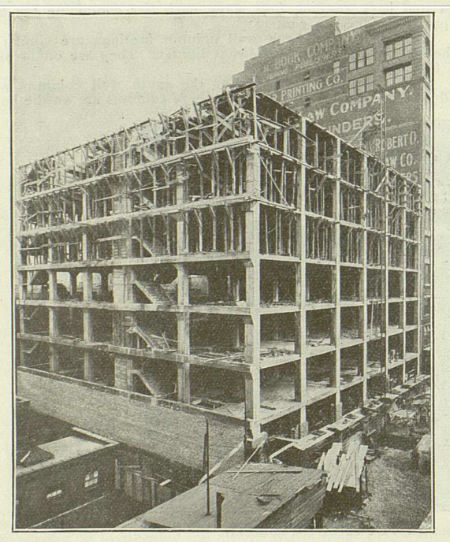
Typical early-20th-century concrete construction in Chicago: the Moser Paper Co. Bldg., Plymouth Ct.  The Construction News, Nov. 27, 1909.

While reliant on rules of thumb instead of mathematical analysis, the code gave builders and engineers confidence in the material; 1911-12 saw half a dozen major warehouse, manufacturing, and office structures built concrete in Chicago.  “Never before in the city’s history,” reported the journal Concrete, “have cement and crushed stone played so prominent a part in building construction.”  Among these were the Sharples Cream Separator Building, designed for 225 psf loads, the Rand-McNally Building, which reached a height of ten stories, and the Dwight Paper Co., another ten-story structure that rose at a record rate of one floor per week.[v]  Laboratory research at Purdue and Illinois was supplemented by extraordinary static and dynamic testing supervised by Talbot and others on the Western Newspaper Union Building. This 1910 nine-story concrete structure was demolished in 1917 as part of the city’s Union Station project, and it served as a test bed for developing theories and rules of thumb for concrete engineering.  The structure’s floor slabs withstood over 900 psf loads, suggesting that the city’s codes and engineering practices were overly conservative.[vi]
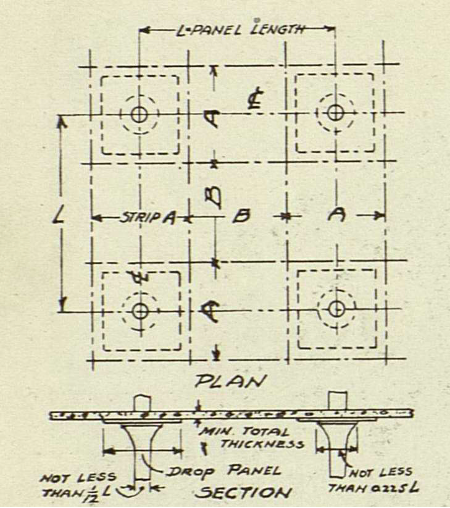
Chicago’s 1911 Code illustrated.  Concrete-Cement Age, Nov. 1, 1914.

Flat slab construction saw a natural market in residential high rises in the 1910s and 1920s as advances in reinforcement allowed thinner structural depths than steel construction, maximizing the number of floors possible within a given height.  The original Edgewater Beach Hotel, built to designs by Marshall and Fox in 1917, used dense reinforcement mats to resist punching shear, eliminating the mushroom capitals and drop panels of typical industrial construction.[vii]  Similar reinforcing was used in the all-concrete Bournique Apartments on Goethe St. in 1916.[viii]  Concrete became standard for Chicago’s high-rise residential construction, such as the 22-story Powhatan and Narragansett Apartments (both 1929) as its malleability allowed designers to take advantage of the city’s post-1922 setback code while providing reliable fire separation between floors.  Its durable, inexpensive construction made it ideal for the city’s public housing projects, beginning with the low-rise Ida B. Wells Homes in 1939 and extending upward into the Chicago Housing Authority’s early high-rise projects, in particular, the Dearborn Homes (1949-50) and Loomis and Ogden Courts (1951, 1953).  Mies van der Rohe’s Promontory Apartments (with PACE and Holsman, Holsman, Kleklamp, and Taylor, 1949) featured exposed concrete columns and slabs, suggesting that the material had aesthetic possibilities alongside its affordability and fire resistance.
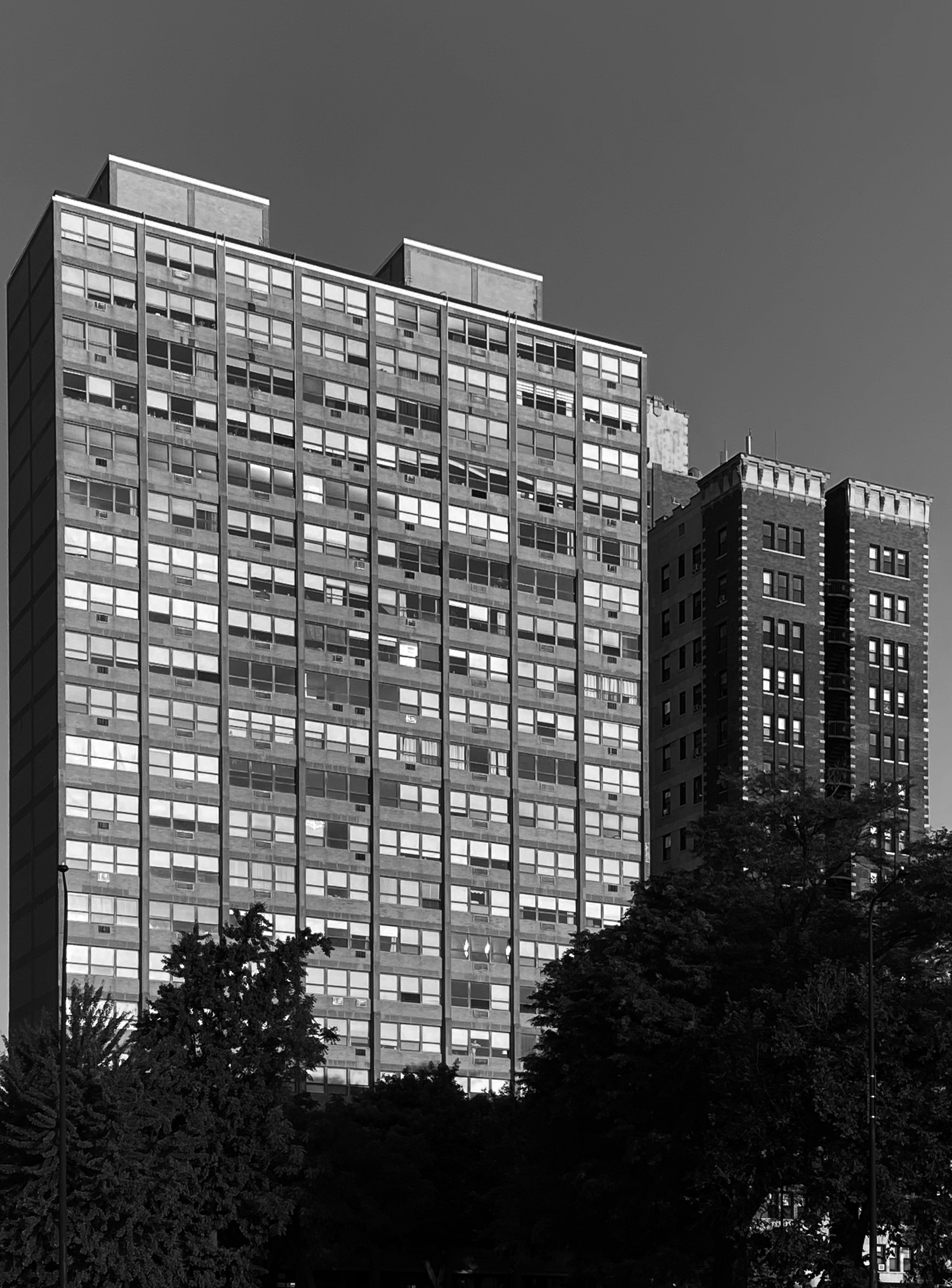
Promontory Apartments, Hyde Park. Mies van der Rohe; Holsman, Holsman, Klekamp, and Taylor, and PACE Associates, 1949.

Marina City

Engineer Henry Miller and architect Milton Schwartz set a record for tall concrete construction with the 40-story Executive House Hotel on Wacker Drive in 1958.  Executive House relied on two-foot-thick shear walls of heavily reinforced concrete around its elevator core for stability, but these were hidden behind a slick, stainless steel and glass exterior.  More dramatic structural performance and architectural expression came with the 60-story, 588’ tall twin towers of Marina City, built across the River from the Executive House beginning in 1959.  Designed by visionary Chicago architect Bertrand Goldberg, Marina City catalyzed advanced concrete construction in Chicago even as it set new urban development and architectural design standards.  Goldberg’s design called for cylindrical shafts of apartments that would open outward toward views of the city and the Chicago River with curving, cantilevered balconies.  The structure, based on stiff central cores surrounded by rings of columns, all connected with moment-framed girders, was engineered by a team including Frank Kornacker, Bertold Weinberg, and Fred Severud from New York City.   Goldberg’s relentlessly circular geometry expanded into three dimensions and produced doubly-curved forms that would have required extensive skilled carpentry.  Further issues arose with scheduling; traditional concrete construction would have pushed the schedule out to three or more years, while financing requirements made it necessary to begin renting in 1962. 
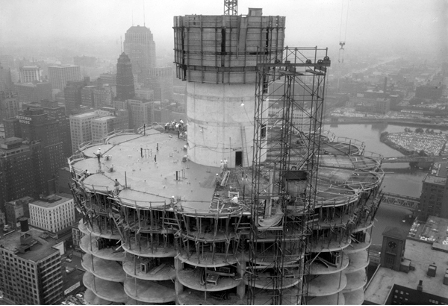
Marina City under construction, showing fiberglass formwork and slip-form core construction. (Chicago History Museum).

McHugh Construction, a local firm founded by bricklayer James McHugh at the turn of the century, had developed concrete expertise through winning bids on Chicago Housing Authority projects throughout the 1950s.  By 1960, they had established a reputation for reliable concrete work that supported their successful bid on Marina City.  McHugh developed innovative solutions to form Goldberg’s complex, curving shapes and meet the aggressive construction schedule, developing fiberglass formwork that could be mass-produced and used up to 60 times apiece.[ix]  They also proposed using the cores as the bases for self-climbing Linden cranes, which could rotate 360° and hoist up to 8,000 pounds—about two cubic yards of concrete—from ground locations up to 90’ distant.  McHugh matched the speed of the Linden equipment with an extraordinary coordination of concrete delivery and placement.  Ironworkers assembled reinforcement panels on the ground, relying on the Linden’s capacity to lift them, fully assembled, into place.  The fiberglass forms were staged to allow them to ‘jump’ three stories above as concrete came to strength.  With these advances, McHugh averaged a new floor every two days.[x]  Concrete surfaces were left as-struck and painted; the smooth finish imparted by the fiberglass required no additional work, and exposed concrete became a signature element in the building’s space-age aesthetic.[xi]  McHugh would go on to use fiberglass formwork in sculpturally rich concrete apartment towers such as 2020 Lincoln Park West (1971) and in “rib-cage” high-rises including Eugenie Square in Lincoln Park (1972); rigid concrete tubes of closely-spaced concrete mullion-columns formed by steel jump forms that matched Marina City’s record for floor construction.
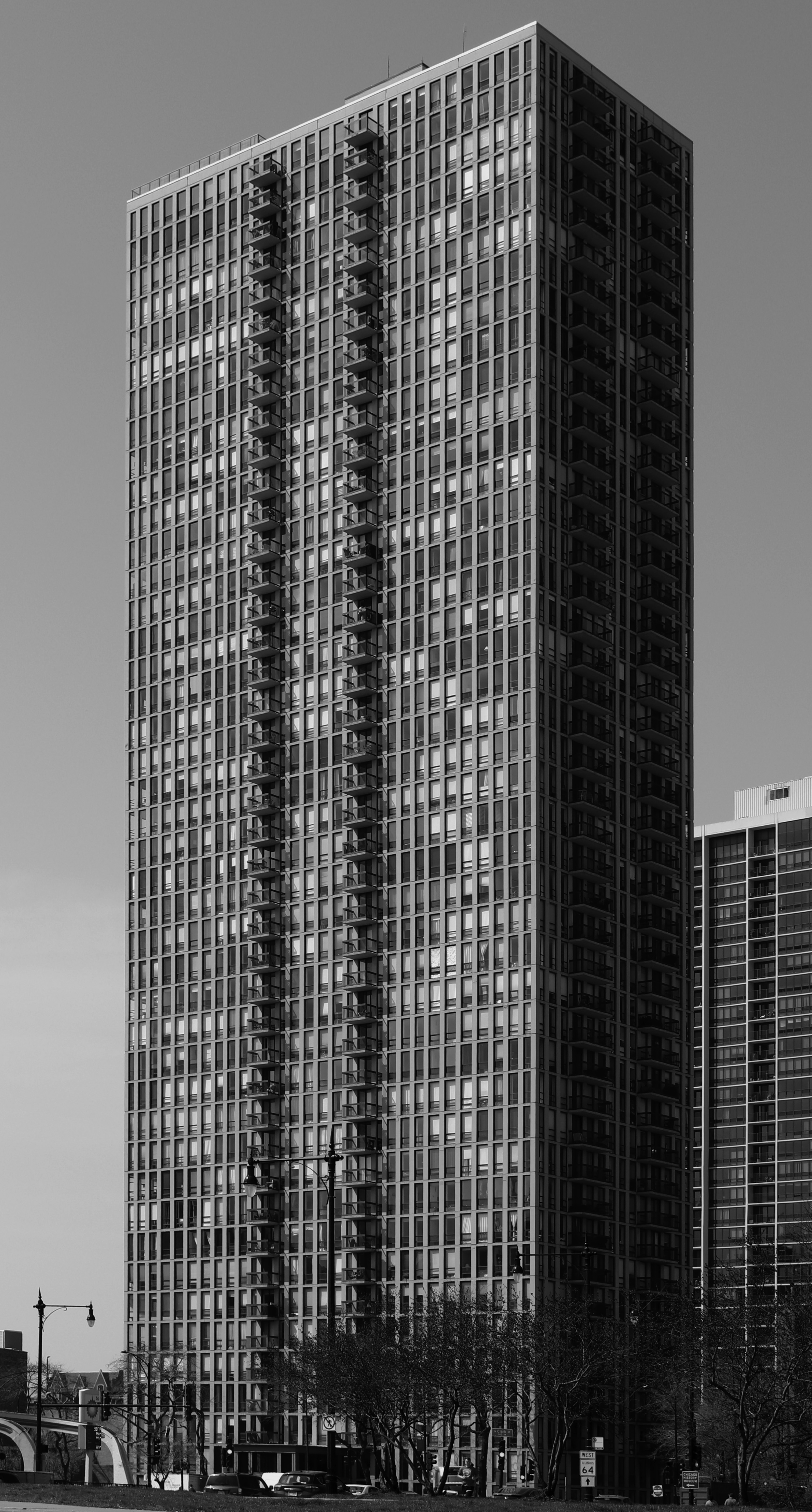
Eugenie Square, Lincoln Park. Dubin, Dubin, Black, and Moutoussamy, 1972.

[i] “Building: Concrete and Artificial Stone in Chicago.” Chicago Daily Tribune, Aug. 6, 1876. 10 and “Chicago Manufactures.” The Lumberman’s Gazette, vol. 3, no. 5, 1873, pp. 145.

[ii] Ernest L. Ransome and Alexis Saurbrey. Reinforced Concrete Buildings.  (New York [etc.]: McGraw-Hill Book Company, 1912).  Chapter 1, “Personal Reminiscences,” 1-18.

[iii] “Two Model Business Structures Now Being Erected in Chicago.”  Chicago Daily Tribune, July 18, 1909.  I18.

[iv]Concrete – Cement Age, Vol. 5, no. 5.  Nov. 1, 1914. 185, 194.

[v] “Many New Chicago Buildings of Concrete.” Concrete; Feb 1, 1912; vol. 12, no. 2. 27..

[vi] “Unusual Test of Flat-Slab Floor.” The American Architect, Nov. 28, 1917.  Vol. 112, no. 2188. 393.

[vii] “The Edgewater Beach Hotel, Chicago, Il.”  The American Architect, Sept. 26, 1917.  Vol. 112, no. 2179.. 233.

[viii] “New Wrinkle in Building: Radical Departure From Usual Construction Methods Contemplated in Bournique Apartments.” Chicago Daily Tribune, Nov. 19, 1916. 19.

[ix] Richard J. Kirby, “Fiberglas Forms—A Progress Report.” Concrete Construction, July 1, 1962.

[x] “Huge Project Overlooks Chicago River: Compared to Sunflower Climbing Cranes Used.” The Christian Science Monitor, Feb. 2, 1962. 10.

[xi] James M. Liston, “Amazing Marina City.”  Popular Science Monthly, Vol. 182, no. 4.  April, 1963.  82-85, 194.
“the modern concrete skyscraper” at the skyscraper museum

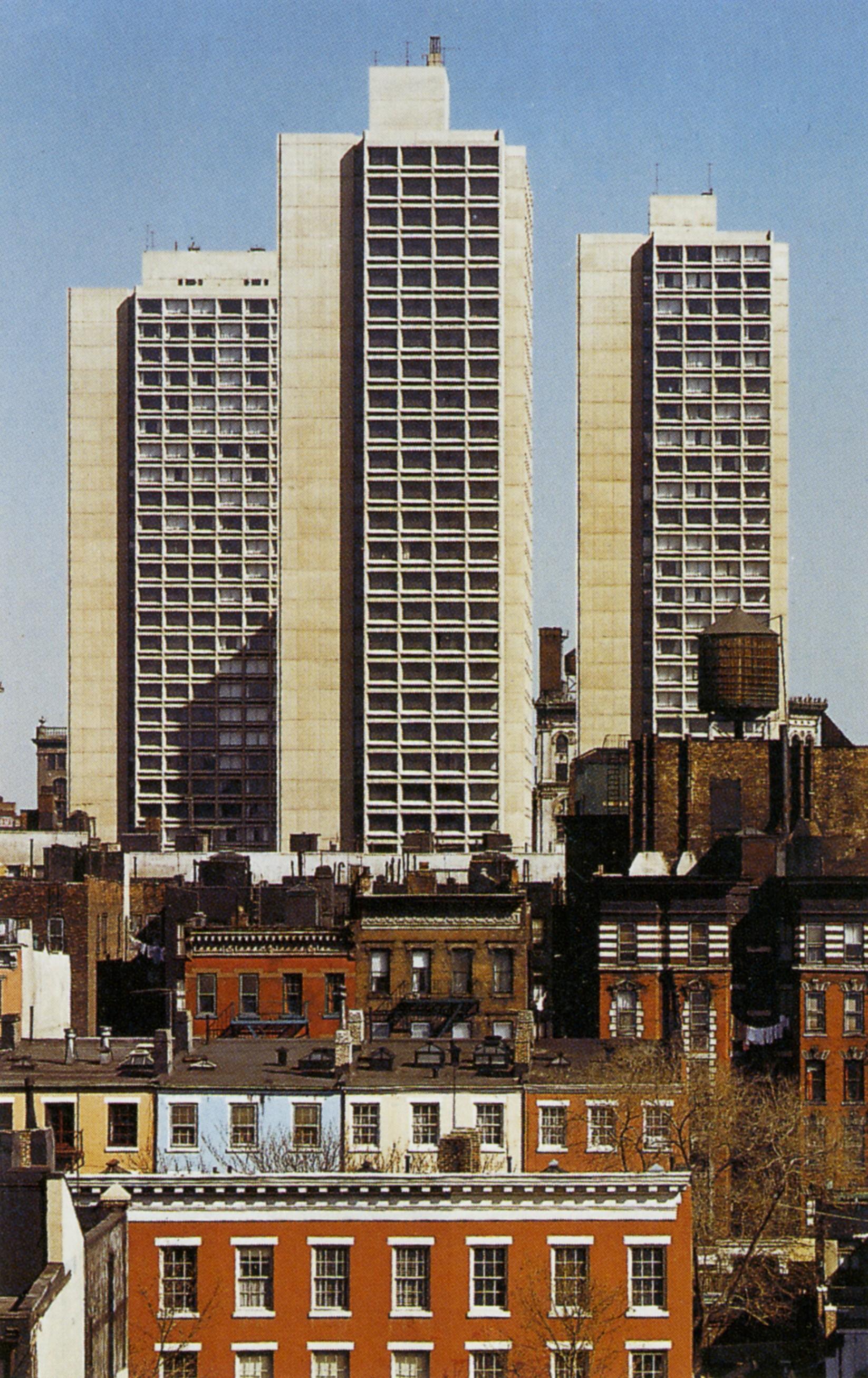
University Towers, NYC. I.M. Pei. 1966-1967. JSTOR

Happy to announce that after a couple of years of great conversations, deep dives into obscure 1920s issues of Cement Age, and ace model-making by a student team here, The Modern Concrete Skyscraper is opening this week at the Skyscraper Museum in New York. Carol Willis, the Museum’s Director and Founder, approached me about helping to curate an exhibition that would be a ‘gentle corrective’ to the idea that the skyscraper’s evolution was primarily a steel story. “”Steel is a chapter, but it’s not the whole story” is the consistent theme throughout. What we’ve heard from engineers, architects, historians, and what we’ve seen in the historical record presents a much more nuanced and interesting story, where the two materials often worked in concert, often in competition, as skyscraper heights rose throughout the 20th and 21st centuries.

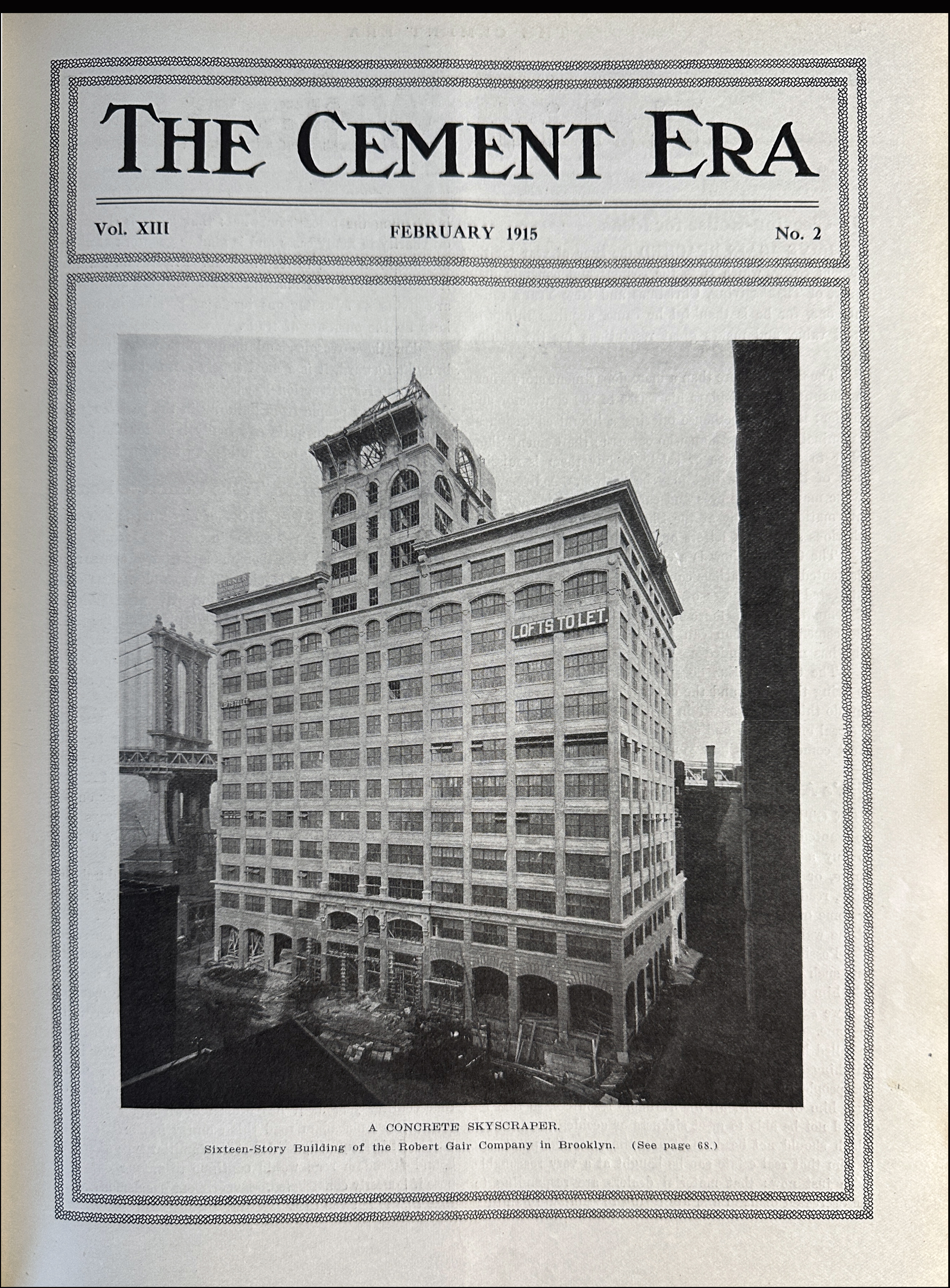
Gair Factory #7, Brooklyn, NYC. Wiliam Higginson/Turner Construction, 1914. Cement Era.

The exhibition looks at the history of concrete–one could argue that the first concrete ‘skyscrapers’ were the Roman insulae, apartment blocks that rose at least five and possibly as high as seven stories–and how the drive for greater height, safety, and efficiency led builders and designers to experiment with concrete as a more fireproof replacement for steel. Over time, research and development also made it competitive in terms of spatial efficiency and speed of construction. Today, the world’s tallest towers and construction sites are concrete, not steel, and the material’s emergence as the system of choice for supertalls is the result of a century of painstaking chemical, structural, and fabricational developments. “The rise of reinforced concrete skyscrapers evolved in several stages and from many influences,” Carol’s summary notes,

“…including architectural aspirations, engineering innovations, advances in the strength of materials and efficiencies in building construction, wind engineering, and computer-assisted design. While most of those changes were hidden from view behind sleek curtain walls or Postmodern ornament, the exhibition exposes the material concept and process in multiple structural models, construction views, and videos.”

However, this history hasn’t been adequately documented or presented previously. Carol asked questions throughout the project that seemed simple–how did flat plate construction become the global standard for residential construction as early as the 1920s, for instance, or why did composite construction–concrete cores with steel framing–become the norm for mid-sized office towers beginning in the late 1980s? The answers to these proved to be complicated but enlightening. Subsequent research uncovered some new stories, found some new heroes, and suggested a handful of buildings that should be in the skyscraper ‘canon’ but have so far been underappreciated by historians of construction and architecture alike.

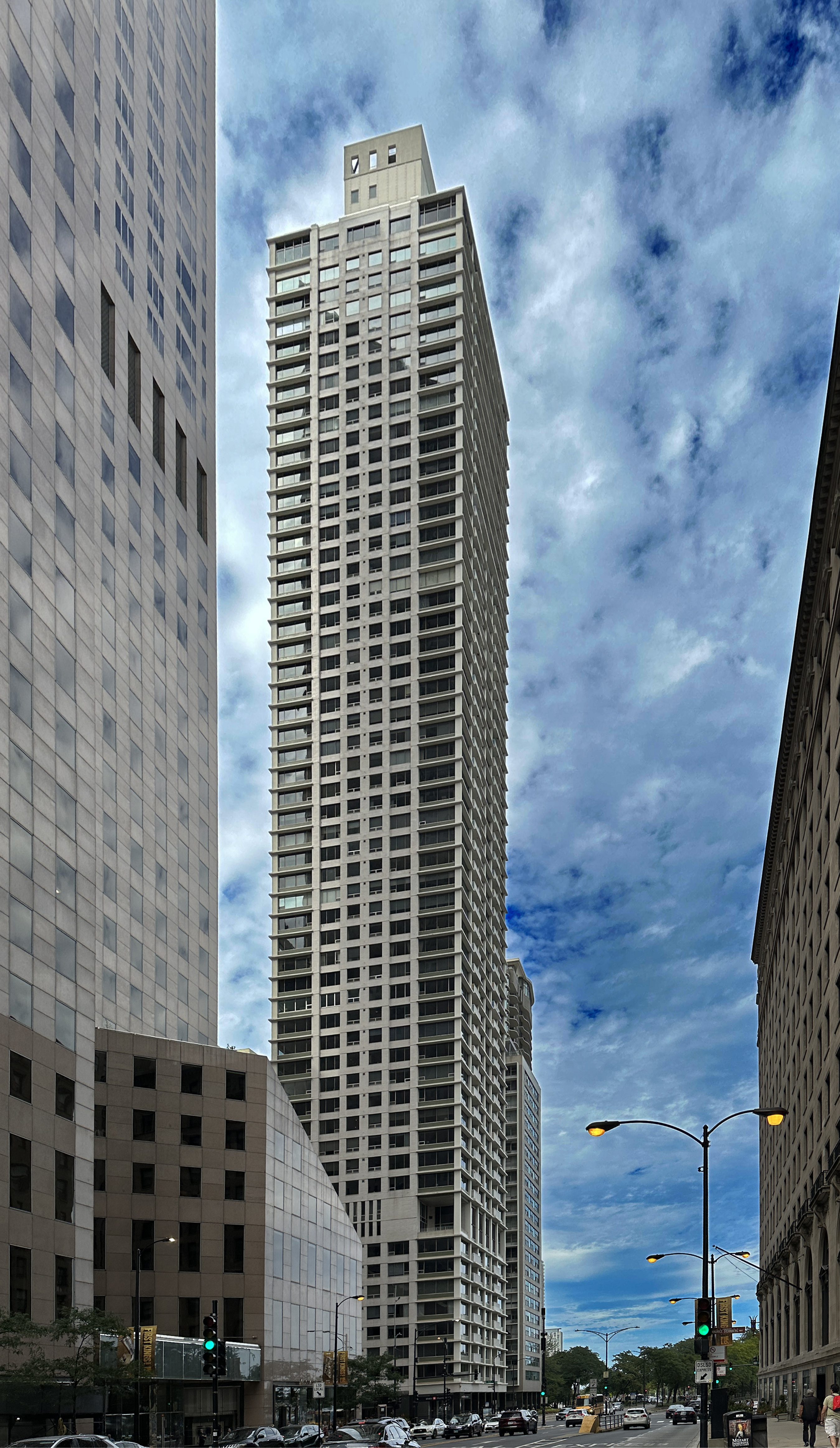
1000 Lake Shore Plaza, Chicago, IL. Sidney Morris/William Schmidt, 1963-1965).

The exhibition includes models of key buildings–some from the firms that designed them, others newly built by UIUC architecture students–as well as photographs, both new and historical, and diagrams that show the progression of height and technology from the 1905 Ingalls Building in Cincinnati at 16 stories and 210′–what I now think of as a steel framed tower re-imagined in concrete–to the 163-story, 2722′ tall Burj Khalifa, which SOM structural engineer emeritus Bill Baker, has described as a tower “cantilevered out from the crust of the earth.” “The strength and moldability of “liquid stone” into any form,” as the press release for the exhibit notes, “

“…has enabled bold experiments in forms, inside and out, as can be seen in the dramatic voids of the atriums of the architecture of John Portman, the open core of SOM’s Jin Mao tower in Shanghai, or Zaha Hadid’s 1000 Museum in Miami. Another advantage of high-strength concrete is the stiffness it affords for extremely slender buildings such as the “pencil towers” of Manhattan’s Billionaires’ Row, including 432 Park Avenue, a model of which is featured in the show.”

All of this is supplemented by eleven online lectures that have taken place throughout the exhibition’s conception and creation with engineers, architects, critics, and historians who have helped shape the narrative–these are all available online here. They form an outstanding companion to the show now open at the Skyscraper Museum in Battery Park City.

The Skyscraper Museum General Information

Location: 39 Battery Place, Battery Park City, New York, 10280

Hours: Wednesday – Saturday, 12 – 6pm

Admission is FREE, but timed tickets are recommended

Guided gallery tours are available for groups by appointment booking on Tuesday from 10:15am-5pm and on Wednesday-Friday from 10:15am-12pm.

For directions and more information, visit skyscraper.org. For questions, email info@skyscraper.org or call 212-945-6324.

For image inquiries, please contact Daniel J Borrero at Borrero@skyscraper.org or call 212-945-6324. For exhibition & press inquiries, please contact Carol Willis at Caw3@columbia.edu.

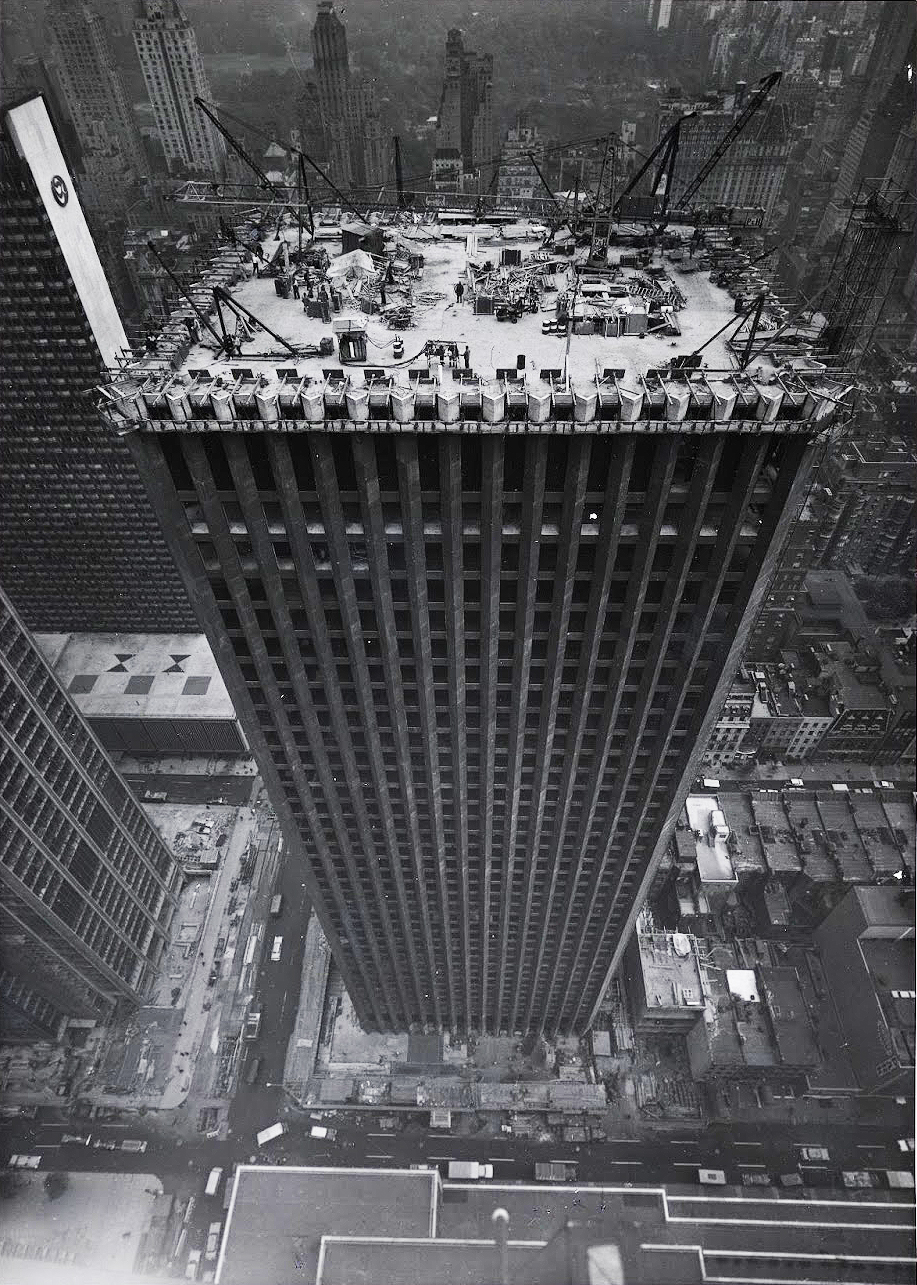
CBS Tower, NYC. Eero Saarinen/Paul Weidlinger, 1965. (Image courtesy Eero Saarinen Collection (MS 593). Manuscripts and Archives, Yale University Library).

old chicago skyscraper of the week–federal center

(A version of this appears in Chicago Skyscrapers, 1934-1986. Dusting this off as Kluczynski Building has–supposedly–been on the list of federal properties the current administration is looking to sell). (UpdateOr not).

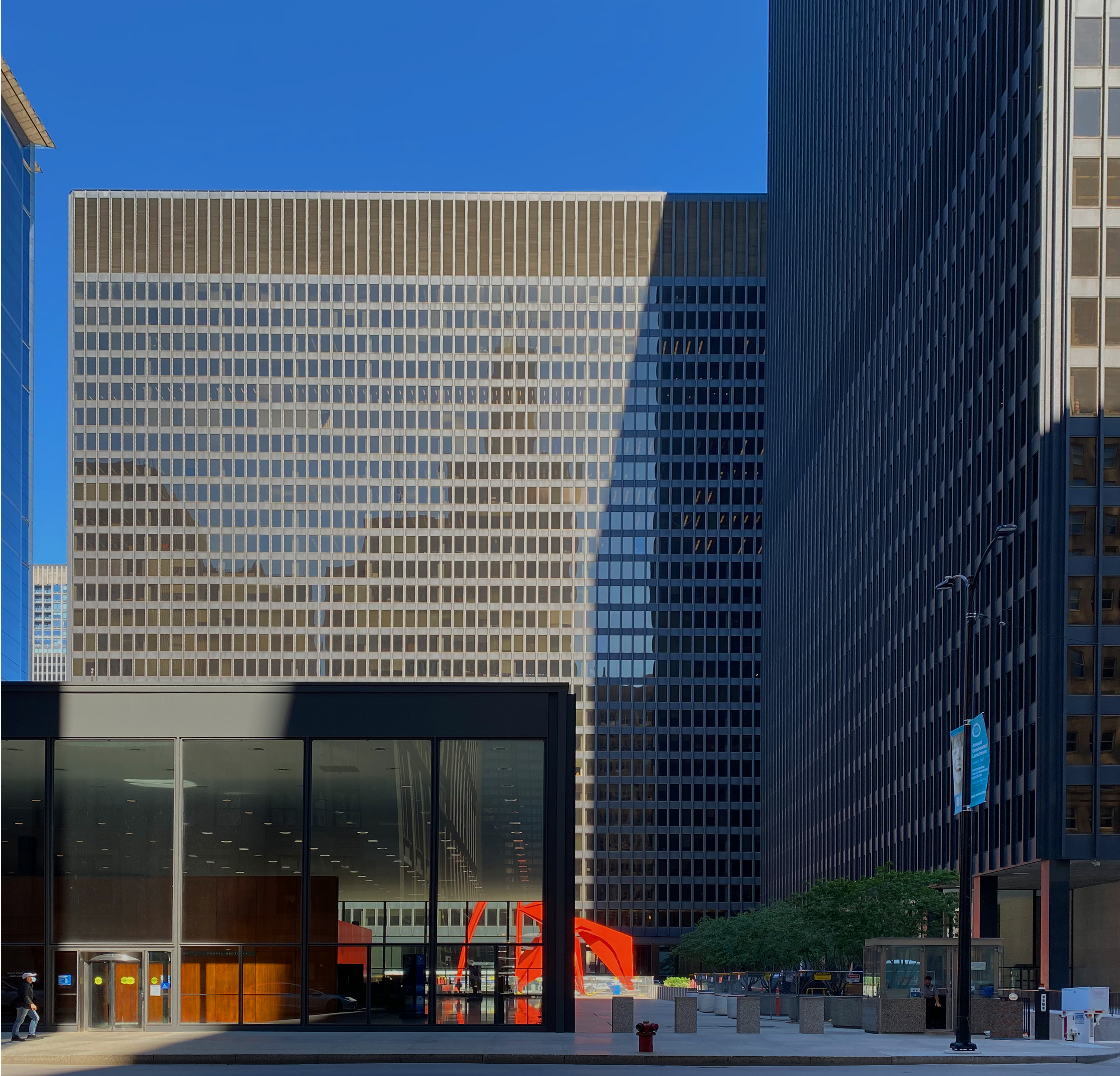
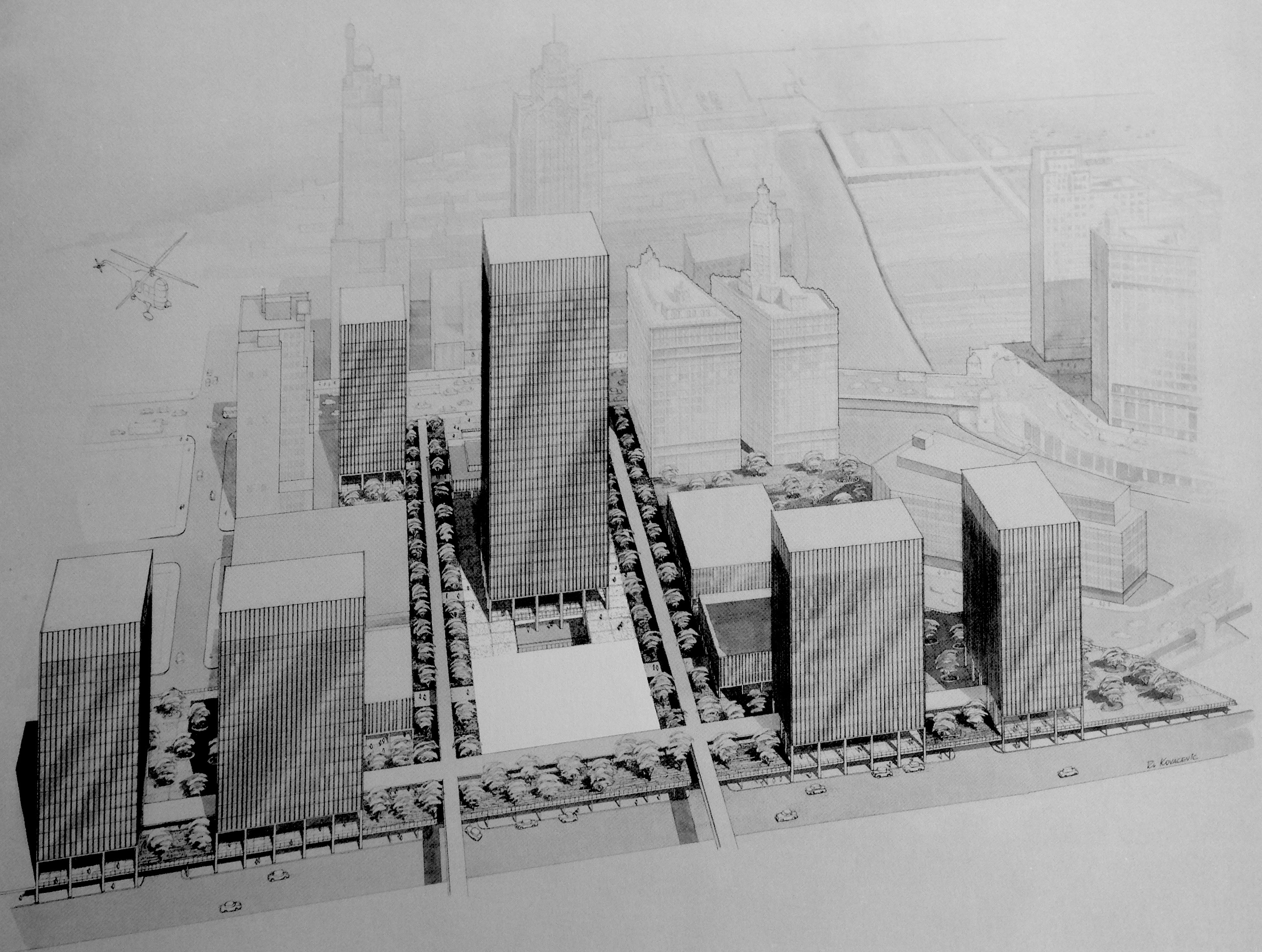
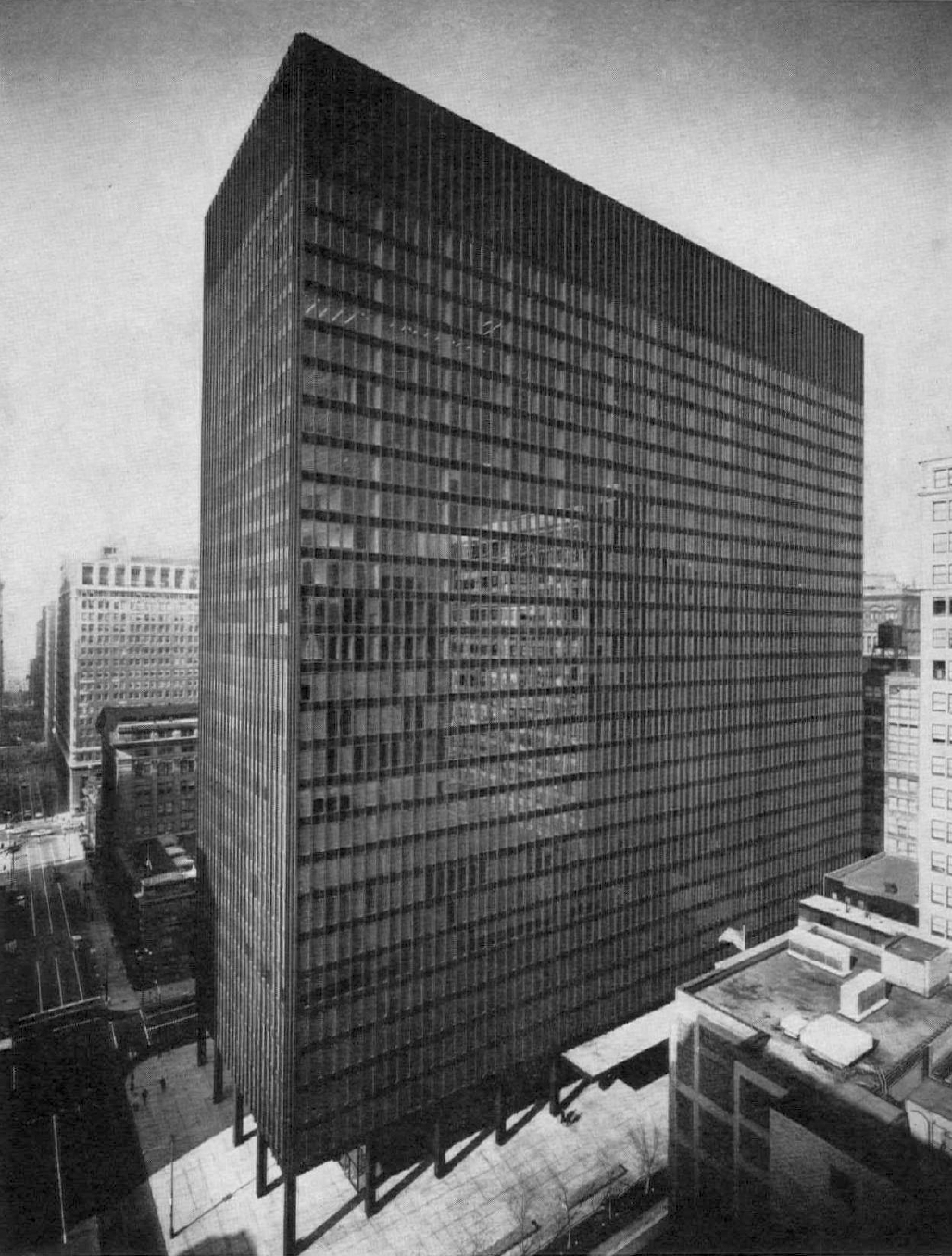
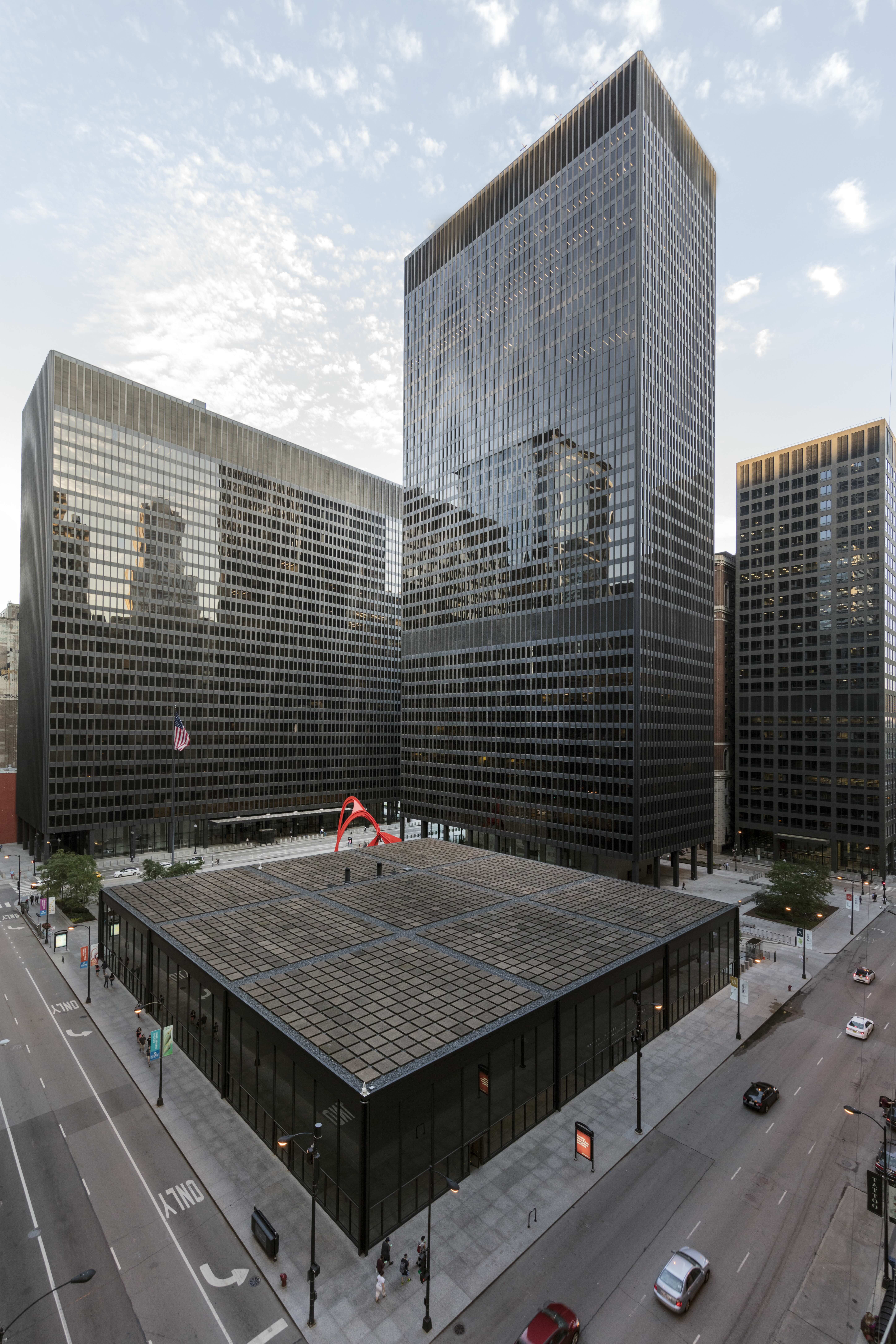
Everett McKinley Dirksen Building, John C. Kluczynski Building, and United States Post Office (Chicago Federal Center Architects, a joint venture of Schmidt Garden & Erickson, Ludwig Mies van der Rohe, C.F. Murphy Associates and A. Epstein & Son, 1958-1974).

The first of the city’s postwar civic monuments to be announced would take the longest to realize, outliving its key architect and leaving a block-wide hole in the Loop for much of the decade.  The need for new federal offices in Chicago was acute.  Plagued by cost and schedule overruns, Henry Ives Cobb’s 1905 Federal Building and Post Office was obsolete when it opened.  Burnham and Bennett suggested its replacement just four years later, calling it “already inadequate” and proposing “a building exclusively for that one purpose…the dignity and the business of the United States courts.”[i]  The Post Office moved to its Graham, Anderson, Probst, and White building west of the River in 1932, but the Cobb building’s clumsy, cross-axial plan remained crowded and inefficient even as just a courthouse.  Illinois Senator Everett Dirksen and Representative Sidney Yates sponsored legislation to build new government buildings nationwide in 1957, and in December 195,8 the General Services Administration announced a $98 million Federal complex for Chicago.[ii]

“Government Center,” Fort Dearborn Project, 1958. View looking east from State Street. (Chicago Public Library, Municipal Collection).

Where such a massive investment would go was controversial.  The Central Area Plan, released just four months earlier, suggested a new Federal Center along the River, between Dearborn and LaSalle—a gentle nod toward Rubloff’s Fort Dearborn vision.  Daley and Ira Bach hoped to anchor the North Loop as a political center, rejuvenating this run-down part of downtown.  The Central Area Committee, however, sought to anchor the South Loop with this captive population, seeing it as a buffer to South Side ‘blight’ and predicting that several thousand government employees would support retail development south on State Street.  Holman Pettibone made the case that a federal presence there would also spur development along Congress, supporting two other Plan elements—a new University of Illinois Campus, planned for a large tract of railroad land just southwest of the South Loop site, and the consolidated railway terminal being planned a few blocks west on Jackson.

The GSA disappointed both sides in January 1959 by selecting the southern site, but only for one phase of the overall project: a 1,300,000 square foot building containing new courtrooms and half its required office space, to be combined on the half-block east of the existing courthouse.  According to administrator Franklin Floete, this would allow the existing courthouse to remain open while the new structure was completed, but where the remaining office space would be built was still uncertain.  Floete suggested that it could be built in a second phase on the site of the Cobb building or elsewhere in the Loop if the GSA could get a good price for that building’s site.[iii]  For the moment, however, plans for the combined courthouse and office building would be a “five story base, with…twin towers rising above that level.”  The GSA solicited bids from architects to develop the idea further in April 1959.[iv]

Everett McKinley Dirksen Building (Chicago Federal Center Architects, 1959-64).  Architectural Record, March 1965.

Charles Genther of PACE convinced Mies to present their joint qualifications.  Mies had rarely entered competitions, but 1959 was a turning point.  He had retired as Director of the Department of Architecture at IIT in September 1958, forced out after 21 years by internal politics.  Herbert Greenwald had died in February, leaving the office without its primary client, and his daughter, Waltraut, who had moved to Chicago to be with him, was ill with cancer and would die that November.[v]  With neither the IIT’s Director’s salary to bolster it nor the steady income from Greenwald’s projects, his office shrank.  Yet he enjoyed global acclaim after the Seagram’s opening, traveling to Europe in Spring 1959 to receive honors and awards in England and Germany.  At 72, he could well have closed his office and enjoyed a comfortable retirement, but word came on this trip that the GSA had selected him as part of a carefully picked architectural team.  PACE, however, wasn’t included.  Instead, the GSA asked Mies to collaborate with Schmidt, Garden, Erickson, C.F. Murphy, and A. Epstein & Sons.  PACE had hedged its bets, secretly submitting an independent bid, an ethical lapse that Mies felt left him free to take the project without them; the two firms would not work together again.  The GSA announced the team in May 1959, along with word that the second phase would, in fact, be built on the site of the old courthouse.[vi]

Mies’ office team for the project included Gene Summers, Bruno Conterato, and Joseph Fujikawa.  They presented three schemes to the GSA: one combining the two phases into a single, 56-story tower containing offices and courtrooms, a second for a 30-story courthouse and office tower on the eastern site and a taller block to be built later on the full block opposite, and a third, variant of the two-building scheme that split the remaining office program into two blocks, symmetrically disposed and framing the first structure.  Mies and his team preferred the first scheme for the full-block plaza it allowed, but realized it presented intractable problems.  Not only could it not be phased as the GSA planned, it would have been among the tallest buildings in the Loop—monumental, for sure, but overbearing for government agencies wanting to seem approachable.  GSA’s advisers picked the second scheme of two tall buildings fronting an asymmetrical plaza instead. 

With the new courthouse forming a wall along Dearborn, Mies concluded that the second phase should be taller, terminating the plaza to the south and concealing the eclectic row of buildings opposite Jackson Street, which included the Monadnock and Mundie and Jensen’s beaux-arts 1926 Union League Club.  On the other hand, the plaza’s north side would open toward Holabird and Roche’s 1895 Marquette building.  The final structure, a low, clear-span post office, would take up the western 2/3 of the full block, adding a final edge to the plaza and forming a horizontal foil to the two vertical structures.  Mies paid particular attention to the three elements’ proportions: the post office was square in plan, the courthouse almost square in elevation—383 feet tall (357 feet from the top of its colonnade) by 368 feet wide—and the second phase’s elevation just taller than a double square—547 feet by 228 feet.[vii]

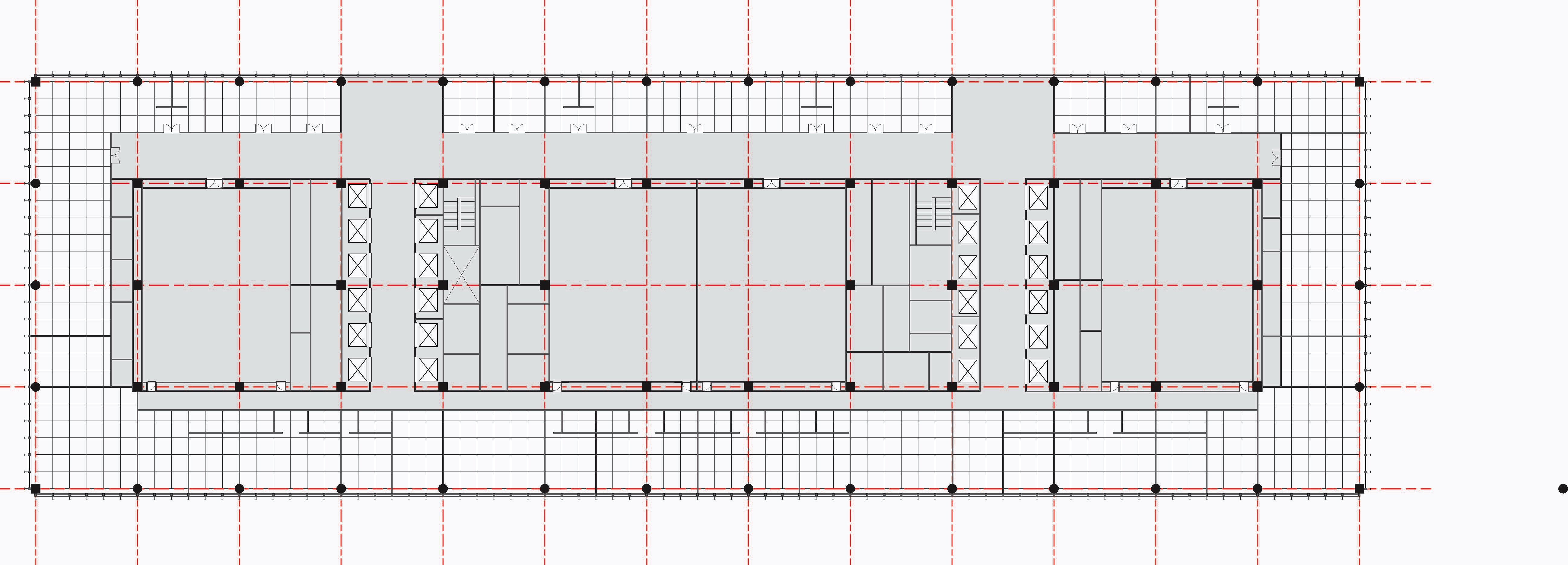
EEverett McKinley Dirksen Building (Chicago Federal Center Architects, 1959-64).  Typical floor plan (drawing based on plans printed in Architectural Record, March, 1965).

Mies’s team developed the courthouse block through 1960 in a split-core arrangement, with double-height courtrooms on the building’s upper levels filling in as low-rise elevators dropped off at the 16th floor.  The building was planned around 28-foot structural bays of steel columns and girders, each divided into a 6 x 6 grid of 4’-8” modules.  Courtrooms and cores were concentrated toward the floor plates’ centers, with private corridors for judges and jurors along the east façade and public corridors overlooking Dearborn.  Prisoner circulation and holding cells were contained in the cores, with elevators connecting to a secure garage in the basement.  The split cores framed the axis of Quincy Street through the glass lobby at street level, a grand space rendered in flame-finished granite, stainless steel, and a white plaster ceiling—the 860-880 lobby scheme expanded to city scale.[viii]  

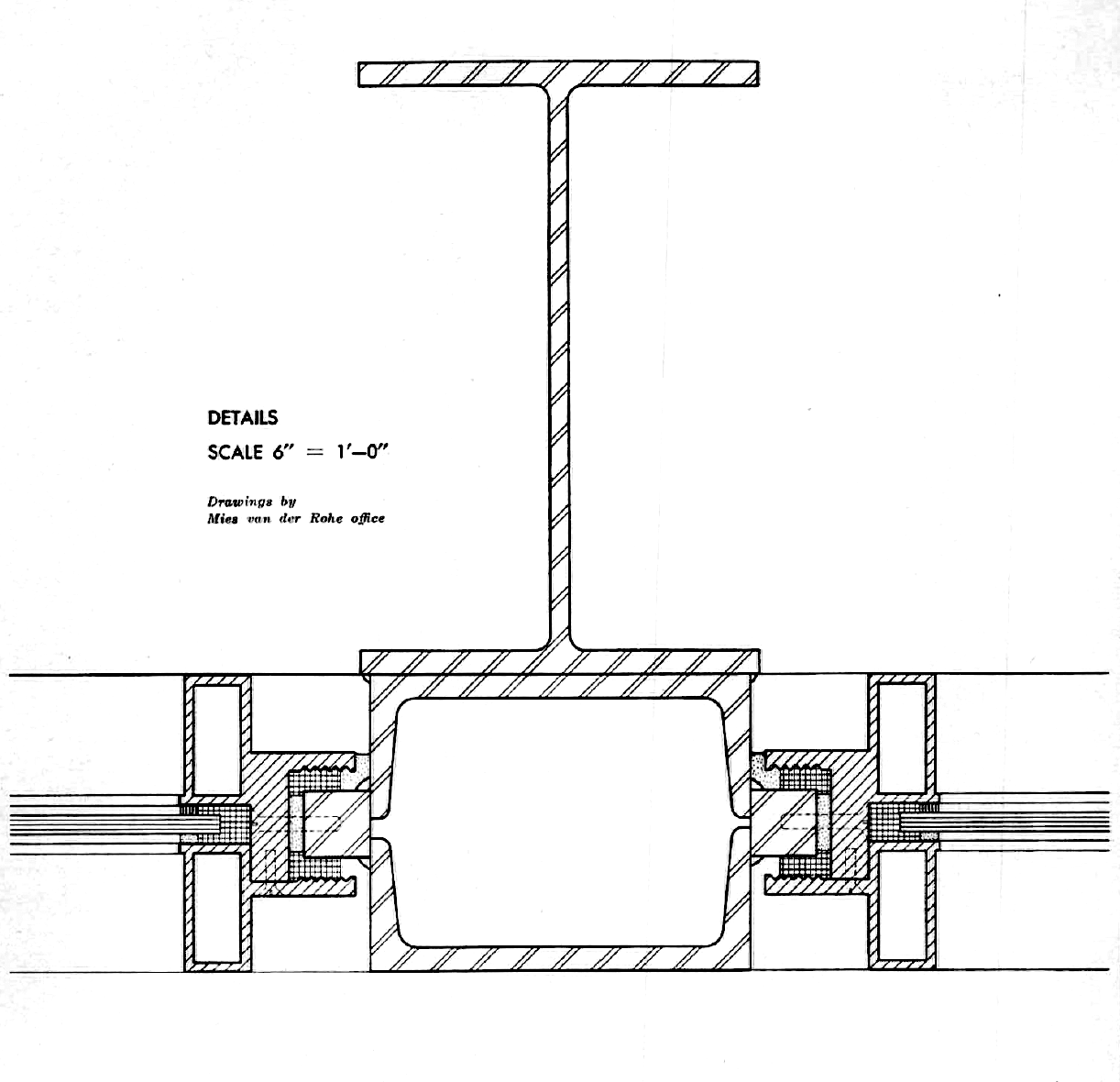
Summers sketched cladding options that telegraphed these double-height courtrooms onto the broad Dearborn Street elevation, but Mies overruled this expressive approach.  Instead, the curtain walls continued the evolution of the 860-880 system, with floor-to-ceiling glass framed in aluminum and stiffened by exterior I-beam shapes.  By 1960, steel curtain walls had been superseded by aluminum; Mies, however, insisted that steel frames should be rendered in like material. 

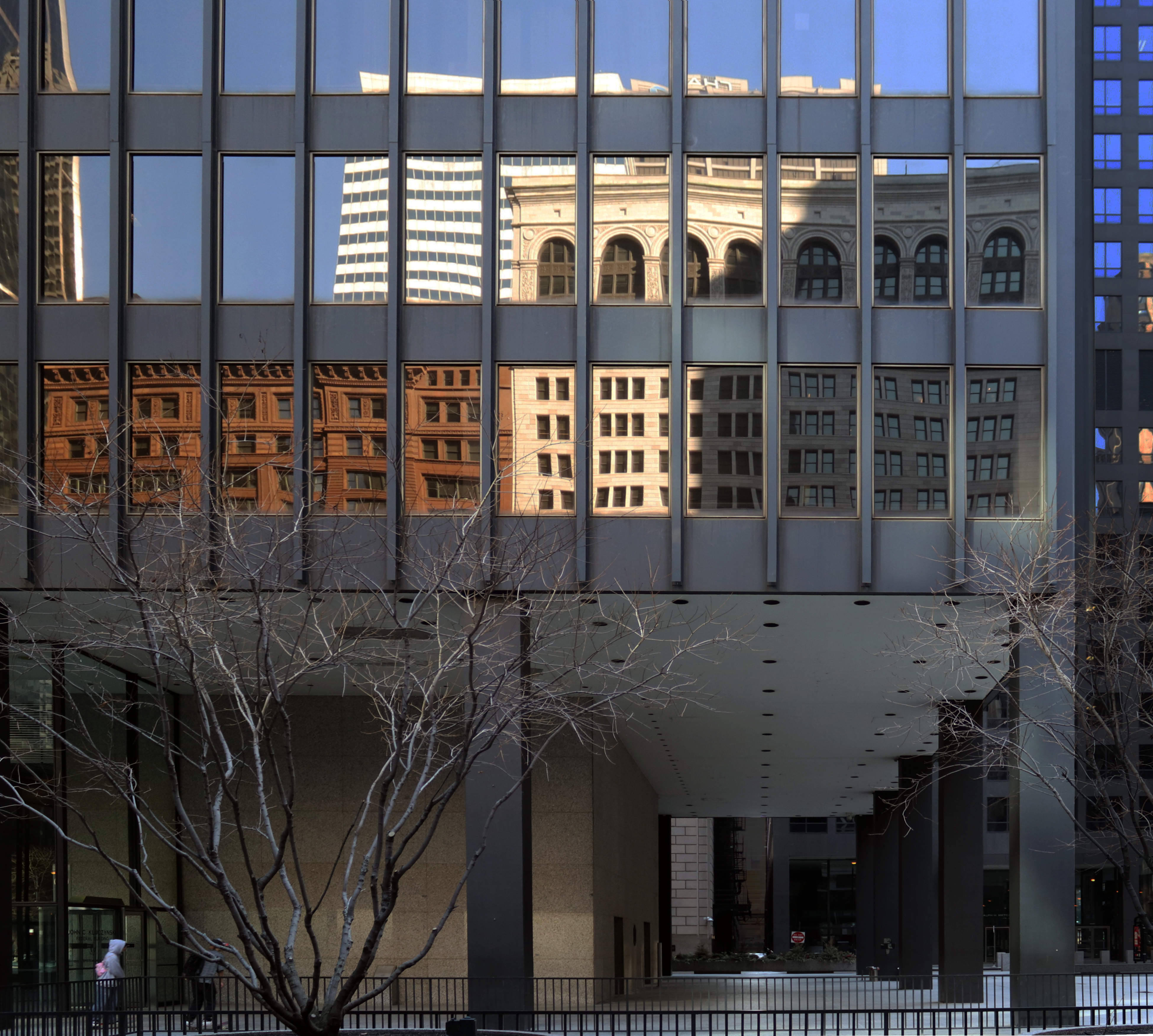
Everett McKinley Dirksen Building (Chicago Federal Center Architects, 1959-64). Curtain wall detail.

Two steel channels form each mullion’s chassis, with square bars welded to either side framing aluminum stops that hold single sheets of plate glass.  A standard W8 shape welded to the main chassis provides vertical articulation, while floor and ceiling finishes were detailed to align with window tops and bottoms.  The system is punctuated by narrow shadowgaps surrounding each window frame, highlighting their infill nature and the change between aluminum mullion and steel support.  The resulting façade shows Mies’ preference for steel’s continuity and texture over the gap-detailed aluminum cladding on Esplanade and Commonwealth, clarified with shadowgaps that would see further evolution at the Home Federal building in Des Moines (1960-63) and the Toronto Dominion Center (1965).  Construction, by Paschen Contractors, began in 1962 and proceeded quickly, enabled by the design’s standardized details.  The enclosure was finished a month ahead of schedule, and the building was dedicated in October 1964. 

Everett McKinley Dirksen Building (Chicago Federal Center Architects, 1959-64). Photograph in the Carol M. Highsmith Archive, Library of Congress, Prints and Photographs Division. LC-DIG-highsm-45043 

The same architectural and engineering team was awarded contracts for the second tower and post office in August 1963.  Paschen began demolishing Cobb’s courthouse in January 1965, and the GSA accepted the team’s detailed designs for the post office and office building the next month.[ix]  Paschen, now in a joint venture with Gust Newberg, finished the substructure in late 1966, at which point Congress, facing rising labor costs and funding an increasingly dire war in Vietnam, slashed the federal building budget, halting work.  For three and a half years, the site sat vacant, the roof of the substructure serving as a parking lot.[x]  U.S. Representative John Kluczynski, a Chicago Democrat, led a charge in 1969 to resume work on the building, but the Nixon administration held contracts until 1971.[xi]  Detailed with the same steel and aluminum cladding system as the courthouse, the office building and post office were completed in October 1975, graced by the red steel “Flamingo,” by Alexander Calder.[xii]

The Federal Center’s construction outlasted its primary architect and two political champions.  Everett Dirksen died weeks after Mies, in September 1969.  Senate Republicans voted to name the entire complex for him, but Democrats objected, suggesting that the two tall buildings should be bipartisan.  The Everett McKinley Courthouse was dedicated in May 1970, and the office building was nearly named for Illinois’ “fighting liberal,” Senator Paul Douglas, who had lost to Republican Charles Percy in 1967.  Illinois’ House delegation argued that they should be represented as well as Senators, though, and after Kluczynski died in March 1974, Congress agreed that the newer building should bear his name. 


[i] Daniel H. Burnham and Edward H. Bennett, Plan of Chicago.  (rep. New York: Princeton Architectural Press, 1993.  117.

[ii] “Site Selection for New U.S. Buildings Near.”  Chicago Tribune, Dec. 10, 1958.  B4.

[iii] “Federal Building Site Picked.”  Chicago Daily Tribune, Jan. 7, 1959.  1.

[iv] “U. S. Acquires Loop Site For Courthouse.” Chicago Daily Tribune, Apr. 1, 1959. 1-c11.

[v] Schulze and Windhorst, 342.

[vi] “2d Federal Building for Loop is Ok’d.”  Chicago Daily Tribune, May 29, 1959.  1.

[vii] Figures from Peter Carter Mies van der Rohe at Work.  (London: Phaidon, 1999).  69, 134.

[viii] “Mies Designs Federal Center.”  Architectural Record, March, 1965.  128, 132.

[ix] “U.S. Accepts Design for Chicago Center.”  Chicago Tribune, Feb. 12, 1965.  44.

[x] Philip Warden, “O.K. Funds for U.S. Building.”  Chicago Tribune, May 7, 1969.  8.

[xi] “Sign U.S. Building Pacts Today.”  Chicago Tribune, Aug. 5, 1971.  3.

[xii] Pauline A. Saliga, Oral History of Gene Summers (Chicago: Art Institute of Chicago, 1993). 

APTWGLC/CHSA Skyscraper Symposium 22 June, 1:00-7:00

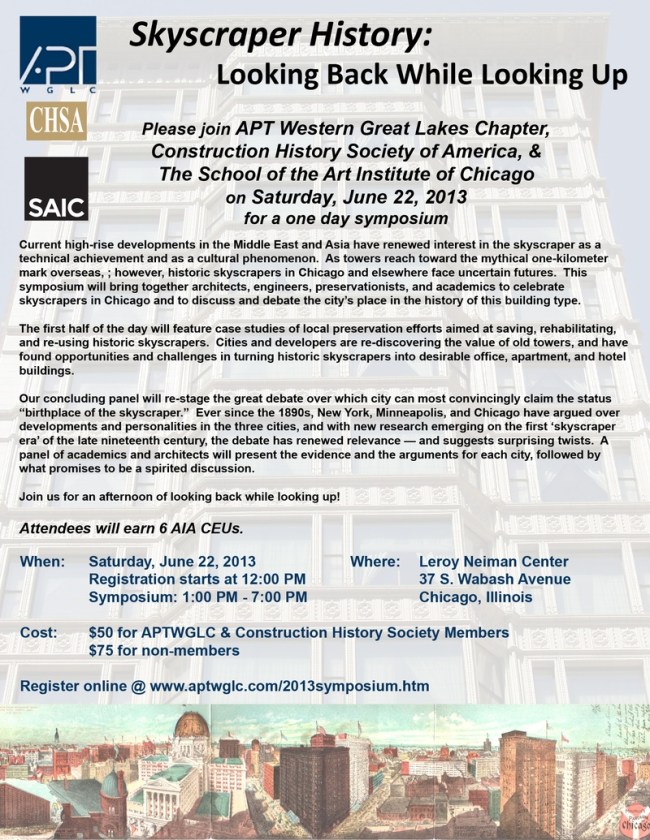
ImageDetails have firmed up for next weekend’s symposium on historic skyscrapers–it promises to be a solid afternoon with an all-star cast of preservationists.  And the debate that I’m taking part in should be both enlightening and enjoyable.  The New York/Chicago fight has a 120-year track record, and Don Friedman and I have been happy to carry our respective flags for the last few years.  Adding Minneapolis, and one of their leading preservation engineers in Meghan Elliott, should provide an even wider discussion.

Anyway.  Thanks to Rachel Will at WJE for organizing, the schedule (always subject to change) looks like this:

Historic Skyscrapers

A Joint Symposium sponsored by APTWGLC and CHSA

22 June 2013

Nieman Center, SAIC, 37 South Wabash Avenue, 1st Floor Event Space

12:15            Registration and refreshments

12:50            Welcome, Introduction Rachel Will, APTWGLC President, WJE Chicago, IL

1:00            The Evolution of the Skyscraper, Dr. Shankar Nair, EXP, Chicago, IL

2:00            Evaluation and Repair of Historic Skyscrapers, Ed Gerns, WJE, Chicago, IL

3:00            Break

3:15            Preserving the Mies Skyscraper, Mark Sexton, Kreuck and Sexton, Chicago, IL

3:45            The Skyscraper Today, Aaron Mazeika, SOM, Chicago, IL


4:45            Break and Brief presentations by representatives of: APTWGLC, CHSA, AIA Historic Resources, Landmarks Illinois, SEAOI

5:00            The Great Debate:  What city can claim to be the home of the skyscraper?


5:00-5:30  New York and the Birth of the Skyscraper:  Don Friedman, Old Structures, Inc., NYC, NY


5:30-6:00  Chicago: Thomas Leslie, Iowa State University, Ames, IA


6:00-6:30  Minneapolis:  Meghan Elliott, Preservation Design Works, LLC, Minneapolis, MN


6:30            Q&A, Town Hall Debate Style Discussion

We plan to continue the Town Hall Debate at one of Chicago’s fine watering holes afterwards, of course.

Registration is required, and the fee is discounted if you’re an APT member.