[Chicago Skyscrapers, 1934-1986, published by University of Illinois Press, is out now–available on Bookshop.org and Amazon.com, among other outlets.
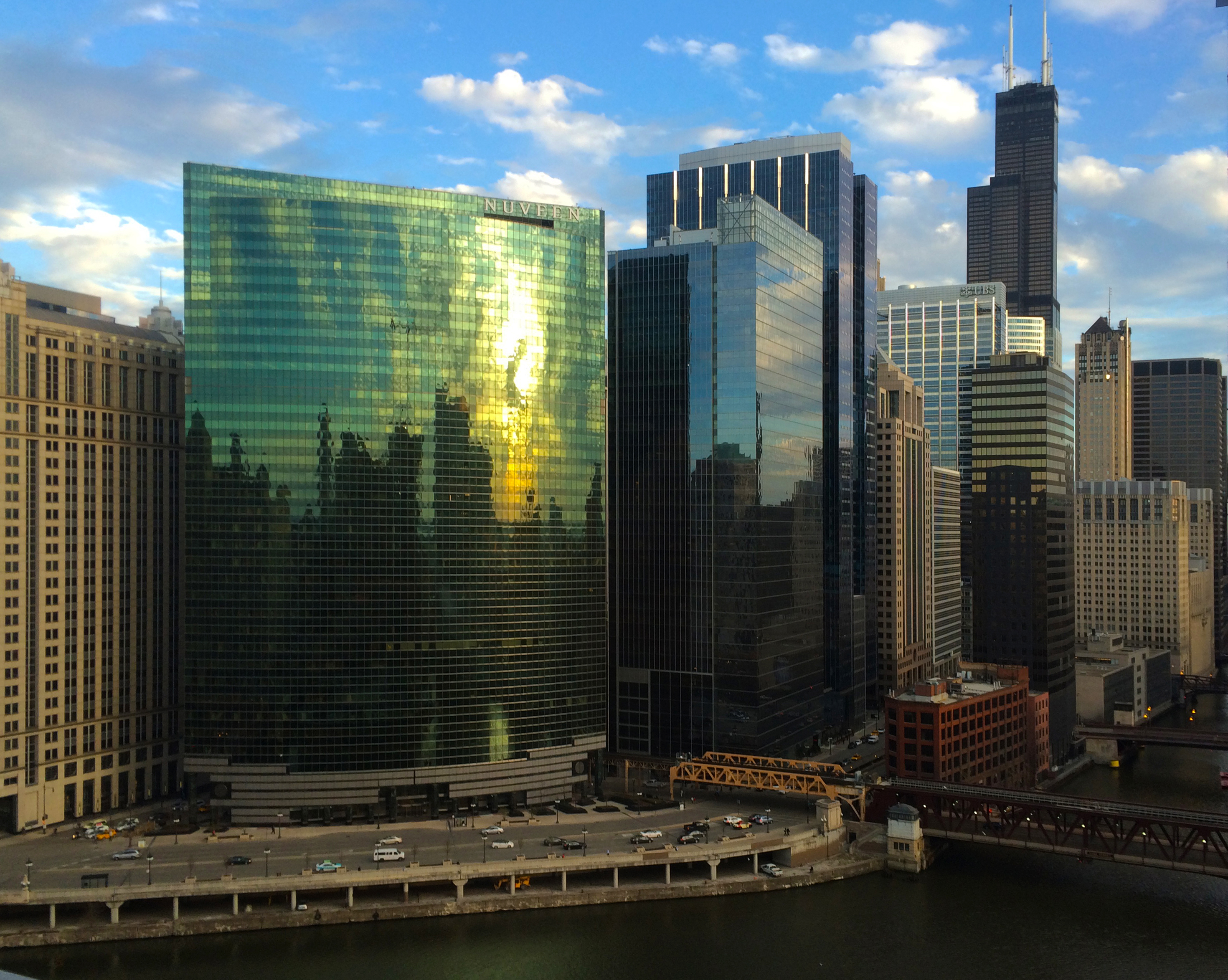
333 W. Wacker Dr. (KPF/Perkins & Will, 1979-83)
An early postmodern marriage of glass technology to “romantic” skyscraper form was the sweeping glass arc developed by Urban Investment and Development for the triangular lot between Wacker Drive, Franklin, and Lake Streets. After the success of Water Tower Place, Philip Klutznick and his son, Thomas, pursued an aggressive downtown development program to match their long suburban track record. Even with the late-1970s market lull, the younger Klutznick saw continued potential in the Loop, “the development area” in Chicago, he thought, “for maybe the next decade.”[i] The Wacker Drive site was laden with local history and held great promise for its river views and city-wide visibility. Still, its awkward, triangular geometry had left it occupied only by small warehouses and parking lots.
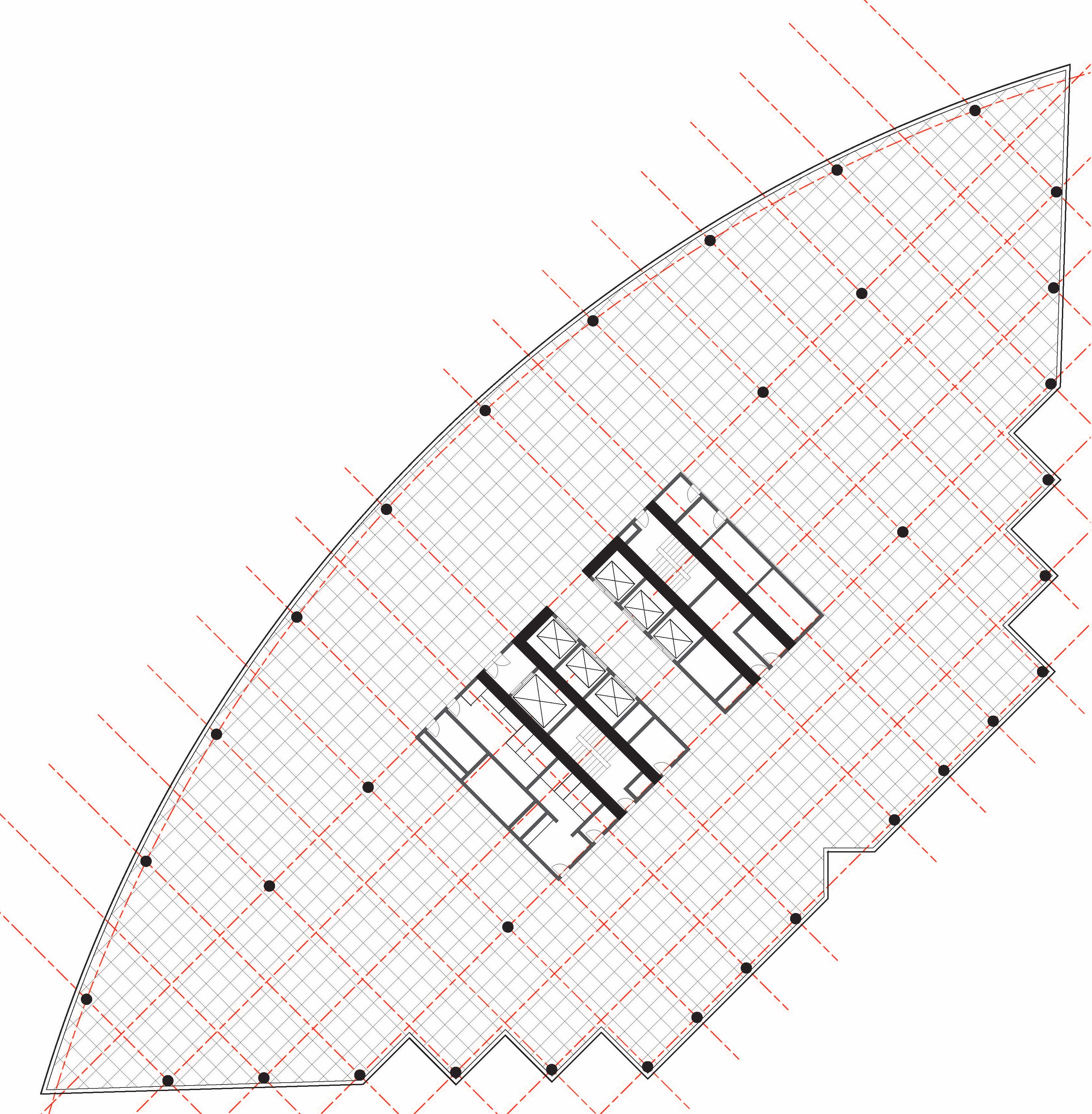
In June 1980, UIDC purchased the block and hired an upstart New York firm to design a 36-story “high-rise similar in shape to New York’s Pan Am Building,” wedging 900,000 square feet of lettable space into its confines. The design and management core of John Carl Warnecke’s New York office—Eugene Kohn, William Pedersen, and Sheldon Fox—had started their own firm in the 1976 economic downturn. By 1980 their portfolio contained just two high-rises: a 15-story building in Upper Manhattan for ABC and a 23-story office tower in Lexington, KY. Their pedigree with Warnecke was convincing, however, and UIDC asked them to team with Perkins & Will. UIDC senior vice president George Goldman previewed the project in 1980, hinting at a green glass tower that would be “an extremely interesting, dramatic building, very slick, wrapping around the site.”[ii] Cupples won the contract for the six acres of curtain wall, including insulated glass panes of Sunglas, a Ford automotive product that used a reflective metallic oxide film to reduce solar gain by 2/3.[iii] KPF specified a deep emerald green in two different shades for spandrel and vision panels, emphasizing the horizontal sweep of the riverfront facade rather than its vertical proportions—or its division into structural or cladding bays. The building’s form, published for the first time in November 1981, was “slick” but compelling. Ford’s glass would wrap around an arcing elevation along Wacker, framed by slender, flat returns at its corners and an angular, sawtooth volume on the southwest. At its base, KPF further emphasized this combination of rich materiality with sculptural form, with generous stairs at the Lake/Franklin corner and two stories of granite and round, stainless steel louvers, far from the minimal entries that marked modern Loop skyscrapers. This was the “romantic” approach championed by critic Paul Gapp—an abstract, technically-fluent vocabulary responding to its site in a singular, legible form.[iv] “Exhilarating and rational,” in the words of New York Times’ critic Paul Goldberger, 333 became an iconic presence on the skyline.[v] While its floor plans made it “one of the most challenging configurations of any of the new downtown office buildings,” according to one space planner, 333 W. Wacker gained prestige clients, including American Bell. UIDC moved its offices into the building when it was completed in 1983, and the next year it was recognized with a national AIA Honor Award .[vi]
[i] Gary Washburn, “Firm Planning Projects Here, in 5 Other Cities.” Chicago Tribune, July 15, 1979. E1.
[ii] Gary Washburn, “Developer May Build Wacker Dr. High-Rise.” Chicago Tribune, June 20, 1980. C7.
[iii] “6 Acres of Glass by Ford to Cover High-Rise Here.” Chicago Tribune, Nov. 1, 1981. S_B2.
[iv] “6 Acres of Glass by Ford to Cover High-Rise Here.” Chicago Tribune, Nov. 1, 1981. S_B2 and “Glass Curtain Wall Rigorously Tested.” Chicago Trinune, Aug. 23, 1981. N_B2C.
[v] Paul Goldberger, “A New York Firm Sets the Style in Chicago: Architecture View Given the Plethora of Kohn Pedersen Fox Buildings, it is Hard Not to Feel that a Different Sensibility has Taken Over the Town.” New York Times, Sep 30, 1990. 1 and Paul Gapp, “Architecture: A Gusty New Yorker and his Taut Green Giant on the River.” Chicago Tribune, Oct. 23, 1983. See, too, Jim Murphy, “Cornering the Loop: 333 Wacker Drive, Chicago.” Progressive Architecture, no. 10, Oct. 1983, p. 78.
[vi] “Tower Brings Out the Best in Space Planners, Designers.” Chicago Tribune, July 8, 1984. W_B1B; “Realty Briefs: Bell Finds a Home.” Chicago Tribune, Aug. 14, 1983. W_B2 and Paul Gapp, “3 Chicago Buildings Win Design Excellence Award.” Chicago Tribune, May 3, 1984. D_A11.
 architecturefarm
Thanks Tom,
The building remains beautiful and fresh in spite of being 40 years old. The monolithic sweep of glass belies the stick built, cross braced metal frame beneath with seems to have inspired the granite panel layout at the base along Wacker. One of the other innovations I recall being implemented during that post recession period was “fast tracking” where detailers were frantically working with fabricators for a ‘just in time’ delivery of components.
LikeLiked by 1 person
This building feels a bit like a reworking of the Phoenix Mutual Life Insurance Building (1961-1963) by Max Abramovits in Hartford, Conn.
Congratulations on the publication! I’m really looking forward to reading it. Any plans on doing a book talk in New York?
LikeLiked by 1 person
Ah, yes, the lenticular plan. Beautiful in concept, but with only two corner offices per floor–which, I suspect, is why we don’t see more of them! (Abramowitz was a proud UIUC grad, fwiw). Definitely planning on a book talk in NYC, likely at the Skyscraper Museum in the Fall. “Watch this space…”
LikeLiked by 1 person