[Chicago Skyscrapers, 1934-1986, published by University of Illinois Press, is out now–available on Bookshop.org and Amazon.com, among other outlets.
Time-Life, Harry Weese Associates (1968-70)
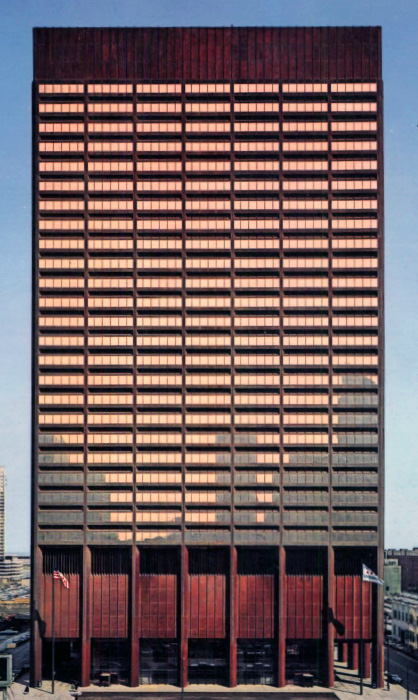
Weese’s most remarkable commercial skyscraper balanced Chicago traditions of ordered planning, plain-spoken façade grids, and robust materiality with sumptuous public spaces and articulated façades. Time-Life’s subscription services and Chicago bureau had outgrown space it had occupied for two decades, at 540 N. Michigan. Arthur Rubloff encouraged the company to pioneer development of the decaying industrial district between Michigan Avenue and the lake. Lake Point Tower, rising to the east, was encouraging. Rubloff recognized the potential gains in traffic for his interests on North Michigan if Streeterville saw parallel commercial investment.[i] Time-Life settled on a 40,000 square foot site on Fairbanks Court between Ohio and Grand. They estimated the company would need a half million square feet, much of it for a subscription department that had to be available at their desks precisely at 9:00 when telephone lines opened and was finished at exactly 5:00. This precision exacerbated rush-hour elevator congestion, requiring many more cabs than would be in use throughout the day.
Time-Life’s Books editor (and Architectural Forum’s publisher) Joseph Hazen argued that the new building had to be of exceptional architectural quality: “because our site is in the midst of an industrial slum, our building must set the right tone for the future redevelopment of the entire area.” Rather than a “steel and glass stereotype,” he suggested that the new building should have a “richer, more textured façade, rendered in warmer materials.” The company contacted nine local firms, interviewing four and selecting Weese for his “imaginative, resourceful, creative” approach to architectural problems—a decision, Hazen recalled, “of the heart as well as the mind.”[ii] Weese prepared seven schemes ranging from low, 14-story blocks that required fewer elevators but stranded operators far from windows to 27 story designs that faced efficiency problems, requiring 18 elevators to handle rush hour peaks.[iii] Time-Life wanted column-free space and windows for its employees, eliminating the lower schemes. Instead, working with mechanical engineers Cosentini and Otis Elevators, Weese revived a tandem-cab solution that had been tried in a New York tower in 1932 to make the taller scheme feasible. By stacking two cabs on top of one another in the same shaft—one serving even floors and one odd—this system did more than double capacity. Because elevator speed depends on the time spent discharging passengers, double-deck cabs cut ‘on-station’ time in half, speeding overall travel times. This arrangement required a double-floor lobby so that arriving employees could sort themselves into even and odd floors, but it provided off-peak flexibility, when the system could be switched to more typical operation with one cab per shaft serving all floors. While the system required more expensive, larger motors to hoist dual cabs, it reduced core sizes by a third, in Weese’s estimate.[iv]
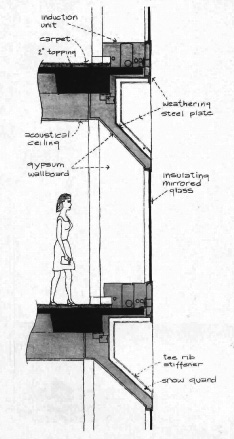
Time-Life’s exterior, meanwhile, developed from the company’s desire for richer materials. Ben Weese and project manager Jack Hartray took advantage of concrete’s malleability to combine structure and skin into a unique, expressive curtain wall. Weese had admired the Civic Center’s Cor-Ten exterior as it rose in the Loop, experimenting with the alloy on a cantilevered house near Green Bay while Time-Life was being designed. The office developed prefabricated, bay-width panels that could be quickly erected, allowing crews to insulate and glaze the facades from inside. While more expensive than aluminum, Time-Life’s managers appreciated its warm tones and sturdy appearance. The project’s contractor, Turner Construction, thought the additional material expense would be offset by the panels’ rapid on-site assembly. To stiffen each element during transportation and lifting, Weese’s office designed folded spandrel panels that, once in place, gave the façade a rhythmic pattern of shadowed recesses, complemented by gold-filmed insulated glass produced by PPG and New Jersey-based Kinney Vacuum Coatings that complemented the ruddy hue of the Cor-Ten cladding. Weese and Hartray further addressed glare issues on these elevations by limiting window sizes with upstand induction units at sill level and sloping ceilings that followed the folded spandrels above. The columns, on the other hand, taper toward the façade, so that the windows expand horizontally while contracting vertically.[v]
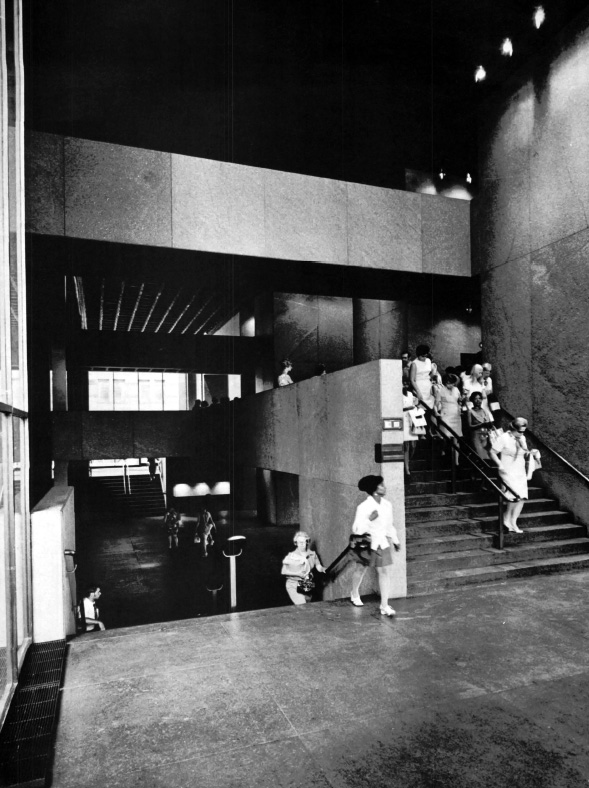
The building’s entrance lobby expanded the delicate jewel-boxes of Mies’ towers to “massive, Piranesian” scale. Its double-height space drops away from the street into a split-level arrangement that provides stair and escalator access to the elevator boarding levels, its subterranean floor and shaft walls rendered in beige granite that also forms the exterior pavement. Giant, Cor-Ten clad columns rise past this glass lobby and three floors of mechanical and warehouse space before engaging the façade panels of the main tower block. The resulting mass recalls Mies—but by way of Brownson’s Civic Center and the layered structural façades of Saarinen’s Deere Headquarters in Moline (1964). The lobby space was—at Weese’s urging—the site of the ‘Chicago Seven’ counter-exhibition to 100 Years of Chicago Architecture in 1976, highlighting his role between mainstream modernism and the ‘mavericks’ whose work was on display—including his own.[vi] Time-Life won a 1973 national AIA honor award, recognized for its ‘pleasing proportions’ and ‘great sophistication in the use of materials.”[vii]
Images from Architectural Forum, Sept., 1970.
[i] Alvin Nagelberg, “Time & Life to Build on Near North Side.” Chicago Tribune, Mar. 7, 1967. E5.
[ii] Kathleen Murphy Skolnik in Robert Bruegmann, ed., The Architecture of Harry Weese. (New York: Norton, 2010). 150-151.
[iii] “News of Realty: Building Planned.” New York Times, Mar. 8, 1967. 71.
[iv] “Time-Life Building Elevators to Serve Two Floors at Once During Rush Hours.” Chicago Tribune, Dec. 22, 1968. D1 and John Morris Dixon, “Thirty-Story Slab of Ingenuity.” Architectural Forum, Vol. 133, no. 2. Sept., 1970. 20-27.
[v] John Morris Dixon, “Thirty-Story Slab of Ingenuity.” Architectural Forum, Vol. 133, no. 2. Sept., 1970. 22 and “Time-Life Buildng is Special.” Chicago Tribune, June 8, 1969. D1. See, too, Process Architecture, no. 11 [“Harry Weese: Humanism and Tradition.”] 1979. 68-75.
[vi] “Show 1: ‘Mavericks’ on View at Time-Life Building.” Chicago Tribune, May 3, 1976. 1-e16.
[vii] “Architects Honor Time-Life Building, St. Procopius Abbey.” Chicago Tribune, Apr. 30, 1973. 16.
[viii] Elizabeth Brenner, “200 S. Wacker is Planned for Eye Appeal.” Chicago Tribune, Apr. 15, 1979. 1-s_b1 and Gary Washburn, “Big Office Building to Rise: His Determination Towers Over Chicago.” Chicago Tribune, Aug. 13, 1978. 1-n_b1.
[ix] Kathleen Murphy Skolnik in Robert Bruegmann, ed., The Architecture of Harry Weese. (New York: Norton, 2010). 176-179.
[x] Paul Gapp, “City’s Magnificent Mile Gets a Touch of Crass.” Chicago Tribune, May 28, 1978. 1-e3.
[xi] Paul Gapp, “New High-Rise Towers Over Chicago River–and Sinks.” Chicago Tribune, Apr 2, 1978. 1-e2.
[xii] “Newberry Plaza a Supersized Project.” Chicago Tribune, Oct. 8, 1972. D1; “40-Story Condo to Rise on Lake Shore Dr.” Chicago Tribune, July 29, 1967. 1-n_a6 and “Plan 28-Story Apartments at Belmont and Sheridan.” Chicago Tribune, Feb 14, 1964. 1-c5.
 architecturefarm
Hmmm….. I wonder if there is any connection between the Time-Life Building and use of Cor-Ten steel on the Ruan Building. The location and timing seems more than coincidental….
LikeLike
Indeed, though I suspect Saarinen’s John Deere may have had some influence, too (on both buildings, probably).
LikeLike
I would love to hear your thoughts on the practicalities in using Cor-Ten steel for large projects, given its challenges with weathering and corrosion, especially in the joints. (Perhaps a question to be answered when you come to New York.)
LikeLike
There were plenty of issues–the Daley Center, for instance, had problems with glazing stops cracking glass as the corrosion layer formed and expanded. A tolerance issue at its base, but one that worked against the more precise detailing that, for instance, aluminum allowed. Definitely more to discuss, hoping for New York in the fall…
LikeLiked by 1 person