[Chicago Skyscrapers, 1934-1986, published by University of Illinois Press, is out now–available on Bookshop.org and Amazon.com, among other outlets.
Brunswick (SOM, 1961-1964)
Planning for Chicago’s new Civic Center (see Chapter 7) gained renewed attention when Arthur Rubloff announced a project to transform Washington Street into Chicago’s “answer to Rockefeller Center” in October 1961.[i] Rubloff’s client, Brunswick, had begun as a billiard table manufacturer in Cincinnati in 1845, moving to Chicago in the 1870s, expanding into factories on the River’s north bank in the 1880s, and opening corporate offices in the city in 1907. In 1913, Brunswick moved into the former Studebaker Building on South Wabash, diversifying into real estate, small marine craft, and recreation and becoming a Fortune 500 company in 1957.[ii] As part of its re-branding, Rubloff convinced Brunswick to become the principal tenant in his Washington Street project.
The project would replace the Chicago Title and Trust building, an 1892 building by Henry Cobb at the corner of Washington and Dearborn. The quarter-block site was at the “crossroads of Chicago’s business and financial centers,” overlooking the site of the planned Civic Center. Rubloff planned a huge development—800,000 square feet, with an estimated cost of 35 million dollars, pitching it as “the largest and tallest to be constructed in the heart of the Loop since the early 1930s,” carefully excluding the million-square-foot Prudential. Rubloff signed Brunswick to a fifth of the building’s planned space, with the remainder of the structure to be rented out.[iii]
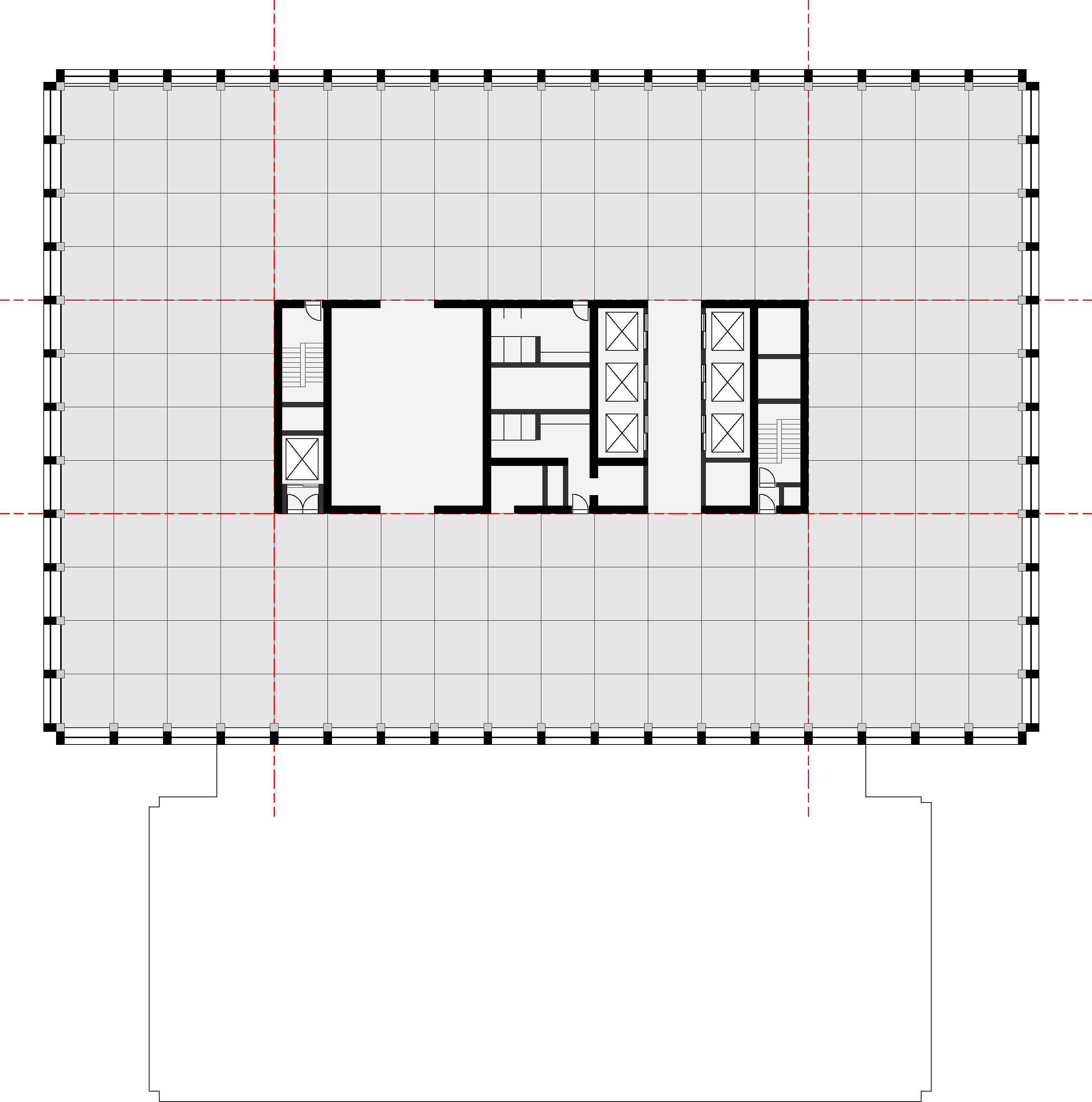
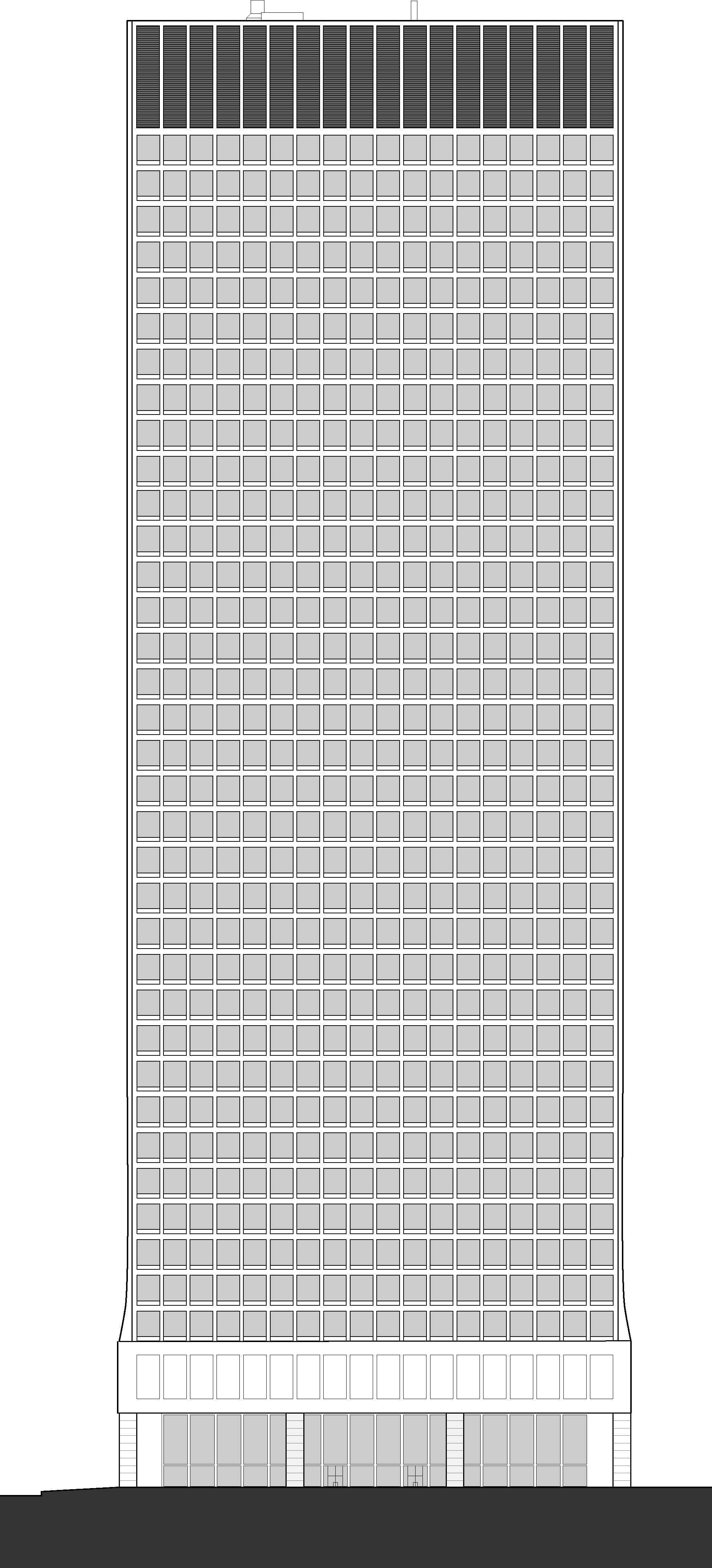
Rubloff hired SOM, whose design would be influential, providing open, unobstructed floor plates while advancing the office’s interest in new structural strategies for building taller. SOM’s team was led by Bill Hartmann, who paired Bruce Graham and Myron Goldsmith as design partners—one of the few times the two were credited on the same project—with Fazlur Khan leading the structural design.[iv] Rubloff asked for column-free floors and a modular approach to services allowing flexibility in office layouts. At the building’s base, Rubloff planned a subterranean retail mall connecting to the Civic Center’s concourse, linked by escalators to a ground-level lobby that would look out to its plaza. The office floors were arranged in a single rectangular shaft with a ‘bustle’ on the lower nine levels providing large floor plates of 27,000 square feet toward the base and 19,400 square feet in the main shaft.[v]
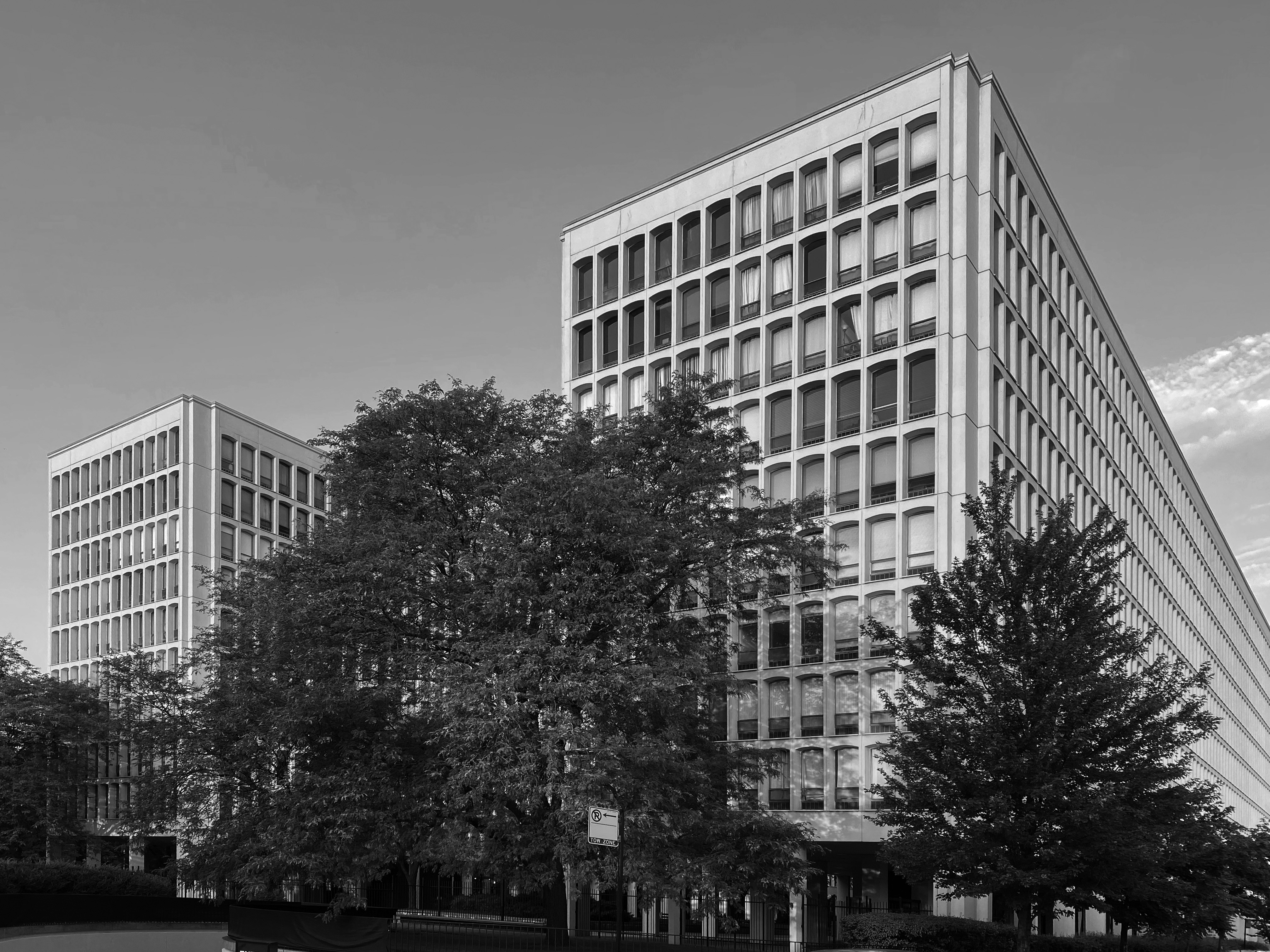
Supporting the building without interior columns led to its pivotal structural design. Hartmann had been intrigued by I.M. Pei’s Kips Bay Plaza in New York City, which carried its floor loads on an exposed concrete exoskeleton that also enclosed the building.[vi] Distilling the structure onto the exterior wall eliminated columns, making more efficient and flexible planning inside, but it also suggested re-considering the then-ascendant curtain wall. SOM had completed the Hartford Building’s exposed concrete frame in 1961, as Pei’s designs were being published and his University Apartments in Hyde Park, engineered by August Komendant, were being completed—Khan and his family took an apartment in them after they opened. The New York Times had noted that the exoskeletal approach revived the traditional idea of the exterior bearing wall—a seemingly reactionary structural development. Steel reinforcing now allowed engineers to avoid the thick, heavy masses plaguing traditional masonry wall buildings like the Monadnock. Kips Bay’s “honeycomb” structure, the Times reported, performed like a bearing wall structurally, but its stiffness and strength were so concentrated in its joints and structural mullions that it maintained the transparency of a glazed curtain wall.[vii]
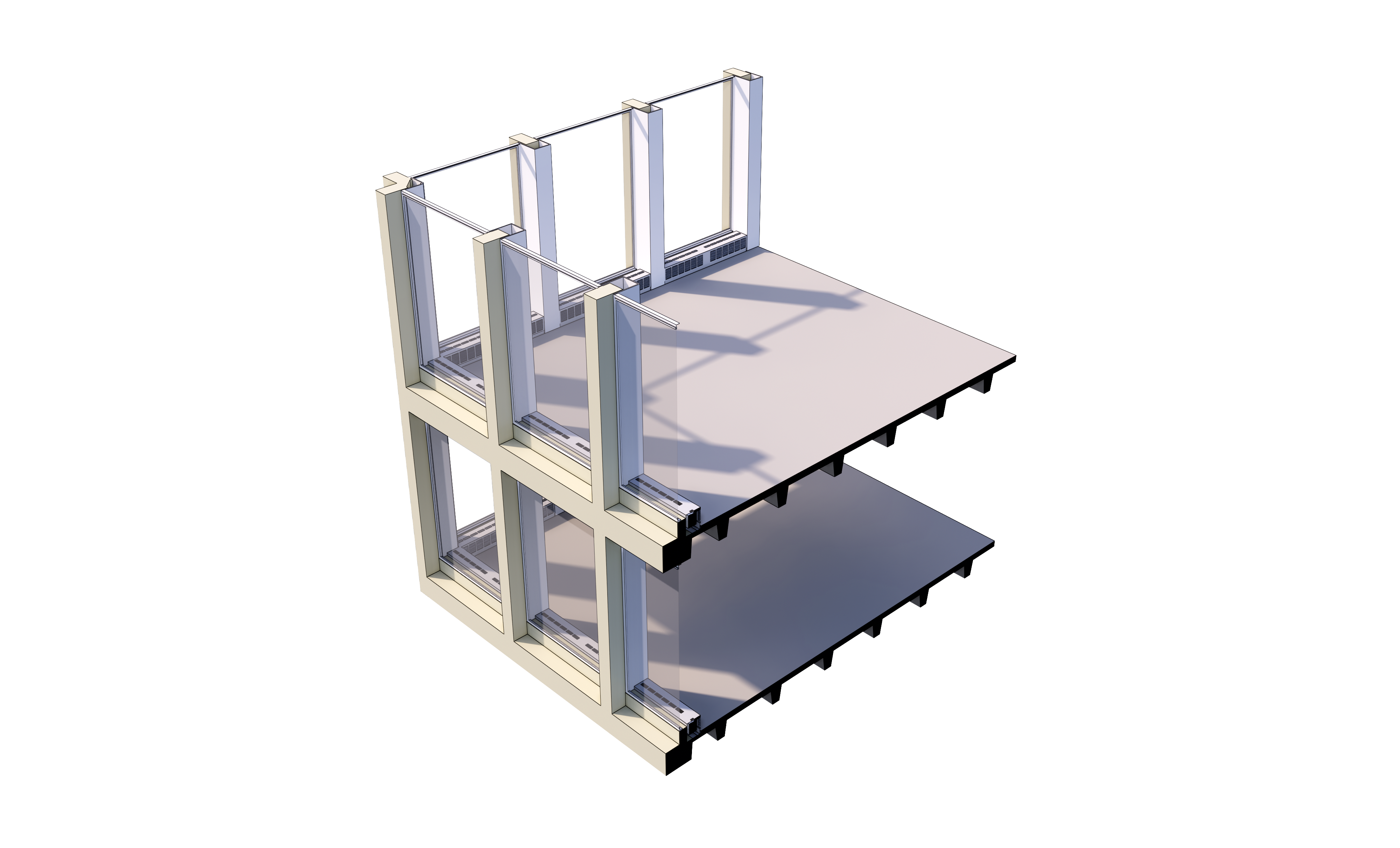
This integration provided more design freedom than what Pei called the “straitjacket of punching holes in a brick wall.” Still, SOM discovered structural potential beyond what Komendant and Pei had achieved.[viii] Recalling the Equitable design that had found efficiencies in its stiffer exterior connections, SOM engineer Hal Iyengar realized that Pei’s “honeycomb bearing wall” could be combined with Equitable’s concentration on the exterior structure to suggest a new structural species. Instead of designing the Brunswick as a “system of bays,” it would evolve as a “tubular building,” its structure condensed entirely onto the perimeter and core, creating two concentric tubes linked by stiff floor plates. Shear walls enclosing plumbing, elevators, and fire stairs formed the inner core tube, while the outer tube would be made of four giant perimeter shear walls, each perforated, or “honeycombed,” as Pei had termed it, by large glass windows. Replacing Equitable’s massive, widely spaced columns with a network of much smaller, closely spaced elements, Iyengar and Fazlur Khan balanced shear walls’ stiffness with a glass wall’s transparency.[ix] The resulting tube structure provided the column-free interior space desired by Rubloff, with clear spans of 38 feet between the core and exterior wall, while deploying structural material where it best resisted wind loads. Its exterior columns are located at 9’-4” centers, framing over 1,900 windows, each eight feet wide and nine feet tall. The concentric tubes created impressive spatial efficiencies in plan and section; its floor plates have an 81 percent net to gross floor area ratio, and its exterior ‘bearing wall’ is 70% glass.[x]
(to be continued)
[i] James M. Gavin, “How Brunswick Corp. was Sold on Building.” Chicago Tribune, Nov. 3, 1961. 4-C6.
[ii] Promotional Brochure, “69 West Washington, Chicago.” (Chicago: Brunswick Corporation, 1966).
[iii] “New Office Skyscraper Set for Loop.” Chicago Daily Tribune, Oct. 29, 1961. A9, and “Beauty, Success Blended in Tower.” Chicago Tribune, Dec. 5, 1965. 3A-H1.
[iv] “A Tale of Two Towers.” Architectural Forum, April, 1966. 31.
[v] Promotional Brochure, “69 West Washington, Chicago.” (Chicago: Brunswick Corporation, 1966) and Donald D. Hanson, “Structuring the Loop.” Progressive Architecture, vol. 47, no. 8. August, 1966. 104.
[vi] Betty Blum [????], “Oral History of Bruce J. Graham.” Art Institute of Chicago Architects’ Oral History Project. 89. Carl Condit also noted the connection to Pei’s work. See Carl W. Condit, “The New Architecture of Chicago.” Chicago Review, 17:2/3, special issue on New Chicago Writing and Art. 1964. 115.
[vii] Glenn Fowler, “Facade of Building Forms Structural Support for High-Rise Apartments.” The New York Times, Apr 23, 1961. 449.
[viii] Glenn Fowler, “Facade of Building Forms Structural Support for High-Rise Apartments.” The New York Times, Apr 23, 1961. 449.
[ix] Betty Blum [????], “Oral History of Hal Iyengar.” Art Institute of Chicago Architects’ Oral History Project. 36-37.
[x] Donald D. Hanson, “Structuring the Loop.” Progressive Architecture, vol. 47, no. 8. August, 1966. 104 and Promotional Brochure, “69 West Washington, Chicago.” (Chicago: Brunswick Corporation, 1966).
 architecturefarm
Totally tubular!
LikeLiked by 1 person
Thomas, I’d love to hear you discuss the history 0f “exoskeleton” and/or exterior bearing wall construction with the same approach you’ve given to the development of the curtain wall — especially since SOM was so instrumental in both technologies. (Its also nice that Des Moines had great examples of each by Mies and Bunshaft.)
LikeLiked by 1 person
There’s a bit of that in this post from 2020: https://architecturefarm.wordpress.com/2020/08/23/peis-proto-tube-structures/ And more in the new book. The “return of the bearing wall” is, to me, one of the most surprising aspects of postwar Chicago–after a century of curtain wall development, the fact that the poles reversed, so to speak, in tube structures is a great story. A bit more to come in the next Brunswick installment…
LikeLiked by 1 person
Thanks. I took a look at that post and thought the comments were quite good. This does remind me that some of the banking skyscrapers in New York may have continued to use load bearing walls into the 1920’s especially in lower Manhattan. This may also fit into your theory of isolated footings vs caisson foundations ….
LikeLike