Every four or eight years, the age-old question “in what style should we build” seems to enter political discourse; modernism (or in the current iteration, a straw-man “brutalism”) and classicism come to stand in for left vs. right in a way that seems to encapsulate arguments about individualism, tradition, beauty, and whatever else is the argument du jour.
To be clear: there is good classicism and good modernism. There is bad classicism and bad modernism. But looking under the hood at the moral argument–that, somehow, one of these two is genuinely bad for the national soul–leads to an interesting and, IMHO, vastly underrated moment in architectural theory.
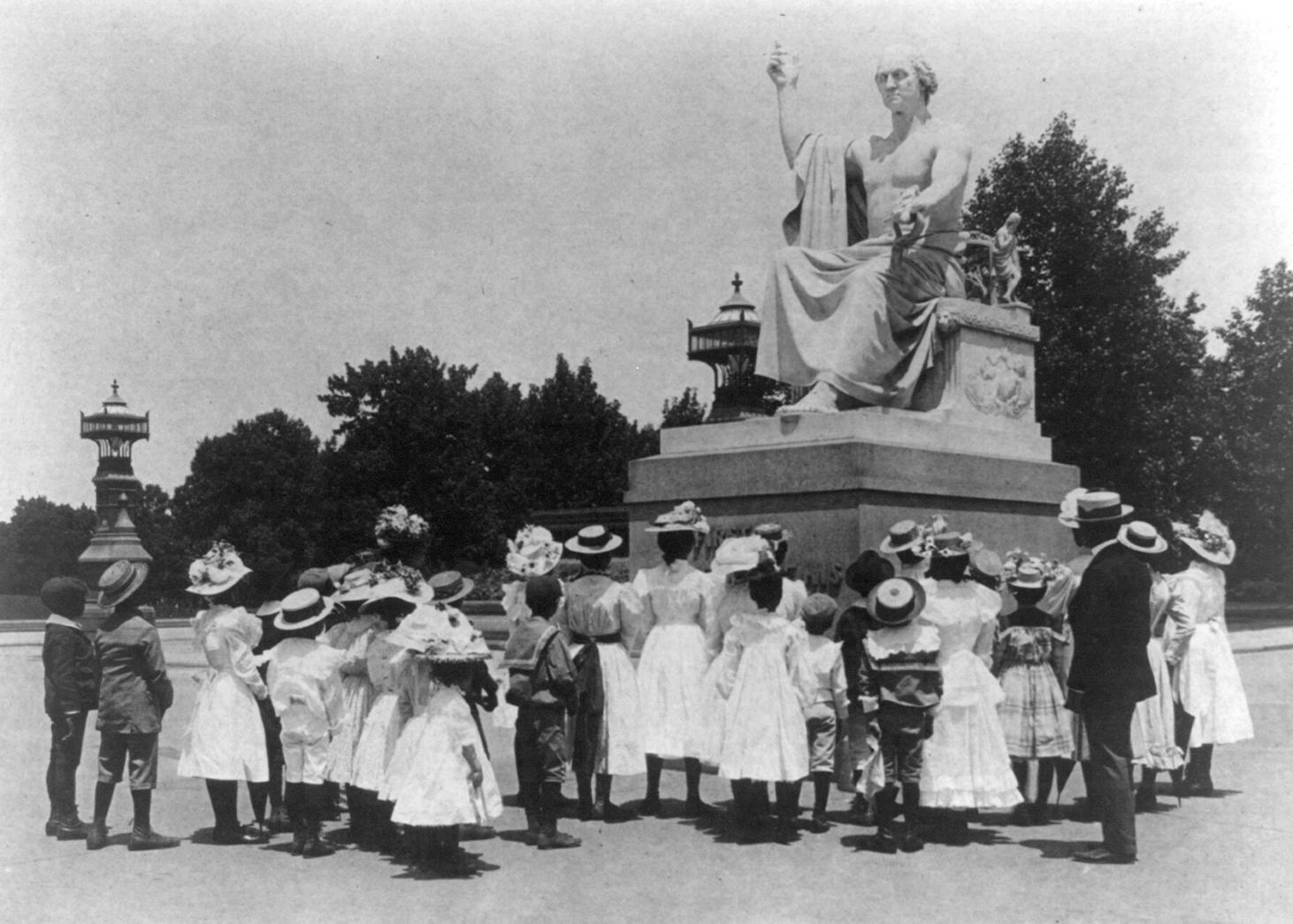
Horatio Greenough was one of America’s most skilled and prolific classical sculptors in the 1830s and 1840s. Trained at Harvard and through extended study trips in Rome and Florence, his style was that of a sculptural philologist, looking to translate ancient precedents into modern subjects. His sculptors of Revolutionary War-era heroes, including Washington and Lafayette, stood in or around the United States Capitol for generations.
Horatio Greenough, George Washington, 1843. Image ca. 1899, Frances Benjamin Johnson. Library of Congress.
But when it came to architecture, Greenough was anything but a traditionalist. In his 1843 essay, “American Architecture,” he critiqued the nation’s architectural development to that point as a betrayal of the independent, enlightenment-based roots of the still-young country:
“The mind of this country has never been seriously applied to the subject of building. Intently engaged in matters of more pressing importance, we have been con tent to receive our notions of architecture as we have received the fashion of our garments, and the form of our entertainments, from Europe.”
For sculpture, looking to Europe was fine–making the case that our political roots lay in Greek and (Republican) Roman principles could be illustrated by, say, a sculpture of Washington in sandals and a toga. But architecture, Greenough thought, was fundamentally different. The purity of Greek temples lay in their essentially sculptural quality–they were primarily monuments, designed primarily to evoke spiritual and emotional reactions, not so much to house any sort of complex function. Attempting to adapt their simple, if articulate, forms to increasingly complex functions was, for Greenough, a mistake that had roots in the Roman world’s adoption of Greek styles to mismatched uses:
“If we trace architecture from its perfection, in the days of Pericles, to its manifest decay in the reign of Constantine, we shall find that one of the surest symptoms of decline was the adoption of admired forms and models for purposes not contemplated in their invention. The forum became a temple, the tribunal became a temple, the theatre was turned into a church; nay, the column, that organized member, that subordinate part, set up for itself, usurped unity, and was a monument!”
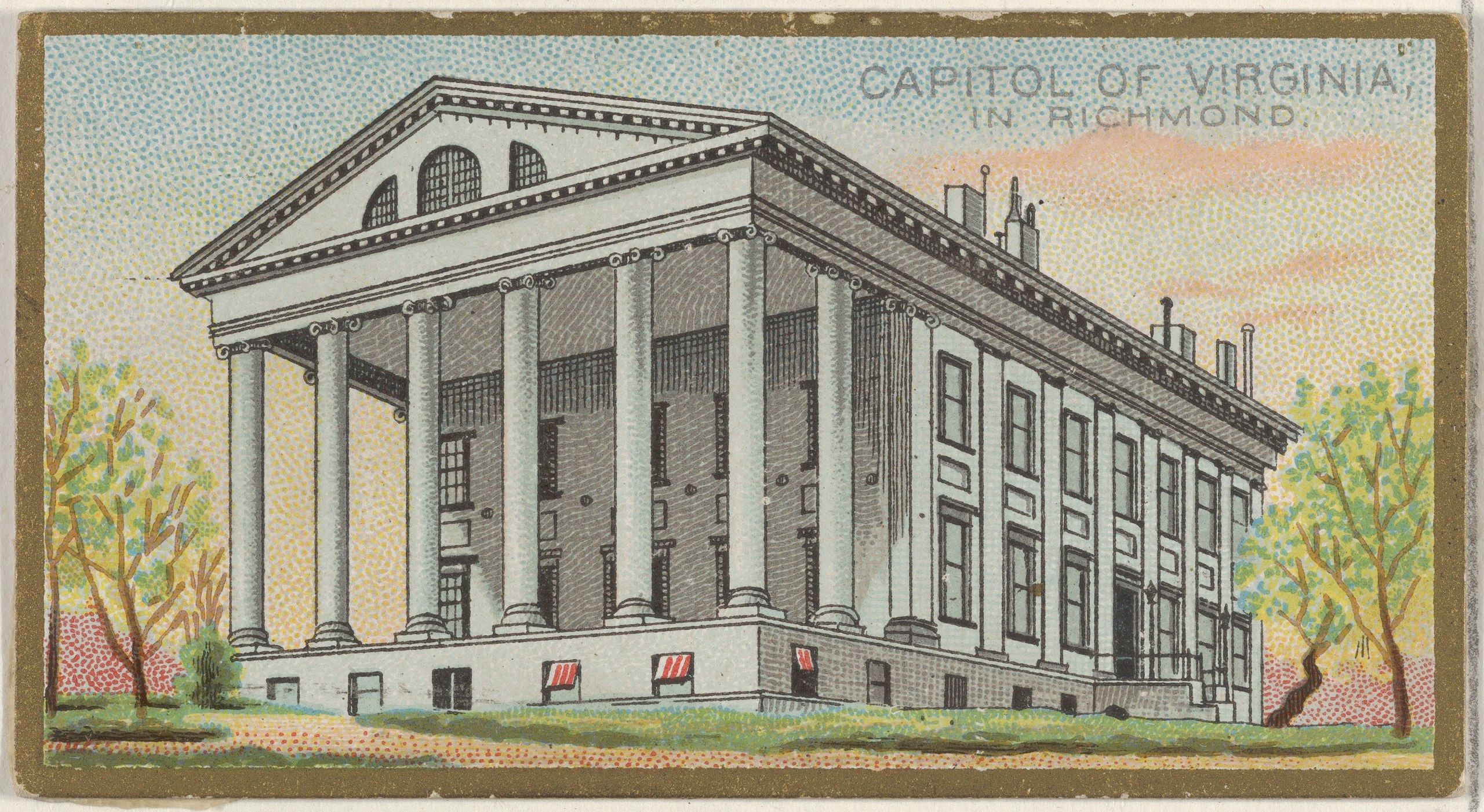
Virginia State Capitol, Richmond, VA. Thomas Jefferson and Charles-Louis Clérisseau, 1785-88. General Government and State Capitol Buildings series (N14) for Allen & Ginter Cigarettes Brands. Metropolitan Museum of Art/Wikimedia.
Greenough had in mind buildings like Jefferson’s Virginia State Capitol, based on the Roman temple at Nimes, France, which was, of course, already based on Greek precedents. The problem? Greek temples did not have the formal agility to reflect the more complicated functions of, say, a State Capitol (or, for that matter, a town bank). In trying to adopt forms to function, he wrote,
“…we have shorn them [Greek precedents] of their lateral colonnades, let them down from their dignified platform, pierced their walls for light, and, instead of the storied relief and the eloquent statue which enriched the frieze, and graced the pediment, we have made our chimney tops to peer over the broken profile, and tell by their rising smoke of the traffic and desecration of the interior.”
Greenough then extrapolated a broader program for American architecture from this complaint. Uniquely freed from what he saw as cultural constraints, he thought Greek temples and Gothic cathedrals would always be “strangers.” Worse, the speed with which America had to build and the lack of time and labor available to invest in the ornament and sculpture that articulated those monuments would always mean that our imitations would “depart from its original beauty and propriety as widely as the crippled gelding of a hackney coach differs from the bounding and neighing wild horse of the desert.”
First Congregational Church Old Saybrook, built 1840. MMDA Photos.
Instead, Greenough proposed, American architects should look to more universal examples:
Let us consult nature, and in the assurance that she will disclose a mine, richer than was ever dreamed of by the Greeks, in art as well as in philosophy…. If, as the first step in our search after the great principles of construction, we but observe the skeletons and skins of animals, through all the varieties of beast and bird, of fish and insect, are we not as forcibly struck by their variety as by their beauty? There is no arbitrary law of proportion, no unbending model of form….
Greenough also suggested another analogy, that of the machine–particularly the most advanced machines being built at the time, symbols of American engineering and technology:
Observe a ship at sea! Mark the majestic form of her hull as she rushes through the water, observe the graceful bend of her body, the gentle transition from round to flat, the grasp of her. keel, the leap of her bows, the symmetry and rich tracery of her spars and rigging, and those grand wind muscles, her sails! Behold an organization second only to that of an animal, obedient as the horse, swift as the stag, and bearing the burden of a thousand camels from pole to pole! What Academy of Design, what research of connoisseurship, what imitation of the Greeks produced this marvel of construction?
These two models–nature and the machine–were also touted by the great French theorist Viollet-le-Duc as ideal sources for the new principles necessary to develop authentic architecture in the face of industrial construction and materials.
Greenough anticipated so much in this essay–there are echoes of Darwin in his description of natural adaptation–sixteen years before Origin of Species–and he uses the phrase “organic” to describe not a metaphorical inspiration from nature (buildings that ‘look like’ plants or animals) but an analogical one: “formed to meet the wants of their occupants.” Most remarked upon has been Greenough’s anticipation of Louis Sullivan’s “form follows function.” There’s no doubt that Sullivan knew of Greenough’s writings, but the 1896 “Tall Building Artistically Considered” was primarily a visual argument–“proud and soaring things.” Greenough goes slightly further, agreeing with Viollet-le-Duc that all aspects of the design, from massing and arrangement to proportion and detail, should rigorously adhere to functional precepts. Sullivan, remember, was Beaux-Arts trained, and buildings like the Wainwright in St. Louis retain some of his preference for symmetry, rhythm, and classical proportion. Greenough thought more radical aesthetic potential lay in throwing out all of these compositional niceties and finding, instead, architectural meaning and beauty within the principles underlying building:
“…let us begin from. the heart as a nucleus and work outward.; The most convenient size and arrangement of the rooms that are to constitute the building being fixed, the access of the light that may, of the air that must, be wanted; being provided for, we have the skeleton of our building. Nay, we have all excepting the dress. The connexion and order of parts, juxtaposed for convenience, cannot fail to speak of their relation and uses. As a group of idlers on the quay, if they grasp a rope to haul a vessel to the pier, are: united in harmonious action by the cord they seize, as the slowly yielding mass: forms a thorough bass to their livelier movement, so the unflinching adaptation of a building to its position and use gives, as a sure product of that adaptation, character, and expression.”
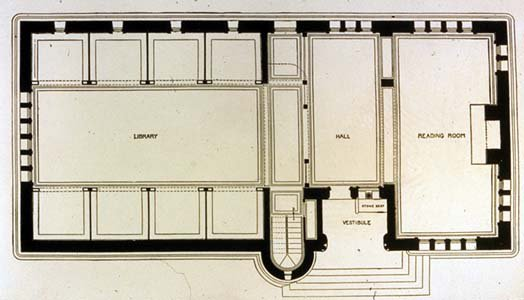
What would that look like? The closest example I can find that’s remotely contemporary is the work of H.H. Richardson, whose “romanesque” style certainly recalls ancient precedent, but in spirit more than detail. The semi-circular arches and peaked roofs that characterize his designs don’t have the academic adherence to Roman forms that, say, Jefferson’s did; instead, Richardson developed compositions out of functional arrangements, and ornamental styles out of the techniques used to shape the sandstone and granite that were native to the New England region in which he practiced. The Crane Library in Quincy, MA., is a great example of this; the functional division of the building–entry, stacks, reading room, staircase–is clearly the basis of the building’s asymmetrical, very not-Roman composition:
H.H. Richardson, Thomas Crane LIbrary, Quincy, MA. 1882. Photo by emw
Greenough concluded by arguing that a truly American architecture, a democratic one, would spring from this sort of plain-spokenness, a confidence that such honesty in massing, proportion, and detail would appeal to the particularly American common sense and that we, as a nation, would come to find beauty in functionality:
If this anatomic connexion and proportion has been attained in ships, in machines, and, in spite of false principles, in such buildings, as make a departure from it fatal, as in bridges and in scaffolding, why should we fear its immediate use in all construction? As its first result, the bank would have the physiognomy of a bank, the church would be recognized as such, nor would the billiard room and the chapel wear the same uniform of columns and pediment.
There was also a moral dimension to this argument. Dressing buildings up in styles and ornament that weren’t native or that were borrowed from another culture had the whiff of dishonesty to it, betraying (or, perhaps, instilling) a lack of character:
The monuments of Egypt and of Greece are sublime as expressions of their power and their feeling. The modern nation that appropriates them displays only wealth in so doing. The possession of means, not accompanied by the sense of propriety or feeling for the true, can do no more for a nation than it can do for an individual. The want of an illustrious ancestry may be compensated, fully compensated; but the purloining of the coat of arms of a defunct family, is intolerable.
That sense of unearned wealth hews nicely to the Protestant work ethic permeating much of early America–adopting the fancy ‘clothing’ of ancient models is an inheritance, not an achievement. Greenough closed with an appeal to another fundamentally American tenet, the right to express his opinion, and in so doing, he hinted that the Greek Revival architecture he was arguing against was unlikely to survive a rigorous, generational inquiry into what a truly “American Architecture” should be.
Very interesting, as usual. It does seem that each generation should have the opportunity to reflect and speak to its time. The result may not always be seen as beautiful or efficacious, but that is part of how cultural learning occurs over time. Imposing a fixed, historical style catalog on buildings seems a bit benighted, and particularly at odds with American tradition, where an openness and tolerance for change, innovation and novelty may be more welcome and accepted than in many societies. And apparently this has been recognized and articulated quite well for over 150 years!
Interesting that someone that would pose Washington in a deific role would also have this take on American architecture. Its a strange duality, given how he traces architecture and the rise and fall of empire. Also had some discussions recently that seem to dance around this issue, so glad to see you post this. Interested to see part 2.
Wonderful article as usual…. I would just like to note that there was a period when architecture in Washington, D.C. ( roughly the 1850’s through the 1880’s) relied less on Greco/ Roman styles and reflected wonderfully creative buildings that were rooted in Northern European traditions as well as Gothic, Moorish, Indo-Islamic, Moorish, etc… Your photo in the masthead shows this with the 1875 lanterns in the background of Greenough’s sculpture which were designed by Thomas Wisedell. The majority of classical buildings in D.C. were not erected until the early-mid 20th century.


 architecturefarm
Very interesting, as usual. It does seem that each generation should have the opportunity to reflect and speak to its time. The result may not always be seen as beautiful or efficacious, but that is part of how cultural learning occurs over time. Imposing a fixed, historical style catalog on buildings seems a bit benighted, and particularly at odds with American tradition, where an openness and tolerance for change, innovation and novelty may be more welcome and accepted than in many societies. And apparently this has been recognized and articulated quite well for over 150 years!
LikeLiked by 1 person
Interesting that someone that would pose Washington in a deific role would also have this take on American architecture. Its a strange duality, given how he traces architecture and the rise and fall of empire. Also had some discussions recently that seem to dance around this issue, so glad to see you post this. Interested to see part 2.
LikeLiked by 1 person
to be continued?? You just leave us all hanging like that?
LikeLiked by 1 person
Cliffhanger! Stay tuned!!
LikeLike
Thomas,
Wonderful article as usual…. I would just like to note that there was a period when architecture in Washington, D.C. ( roughly the 1850’s through the 1880’s) relied less on Greco/ Roman styles and reflected wonderfully creative buildings that were rooted in Northern European traditions as well as Gothic, Moorish, Indo-Islamic, Moorish, etc… Your photo in the masthead shows this with the 1875 lanterns in the background of Greenough’s sculpture which were designed by Thomas Wisedell. The majority of classical buildings in D.C. were not erected until the early-mid 20th century.
LikeLike