I spent this week at the annual conference of the International Association for Shell and Spatial Structures, presenting some spinoff Nervi work in sessions on shell history and archives. The conference was in Turin, Italy a longtime favorite city for many reasons, not least of which is that it contains some of Nervi’s most important work. As “Italy’s Detroit,” Turin not only built all sorts of industrial buildings, some of them by Nervi. It also regularly hosted auto shows, highlighting its local manufacturers–particularly Fiat.
In 1947, Turin decided to host that year’s International Automotive Exposition, despite the fact that its exposition buildng–like much of the city–had been bombed flat in the Second World War. Nervi, famously, was the sole bidder on a project to construct a new one. Italy’s other engineers and contractors were scared off by an eight-month construction schedule that seemed not just impossible, but superhuman. Nervi e Bartoli were able to design, fabricate, and build it on time, however, due to their prefabrication process and a construction sequence that eschewed large cranes in favor of smaller elements and human-powered winches.

I’ve blogged about that process and the results before here, along with a lament that the building had long been underused and ill-maintained. Several years ago, however, Turin decided to embark on an adaptive reuse project that sounded too good to be true–turning Nervi’s Salone B into a city library and hiring Rafael Moneo’s office to design it. Moneo, known for sensitively weaving new functions into historic–occasionally Roman–building fabric, seemed an inspired choice.

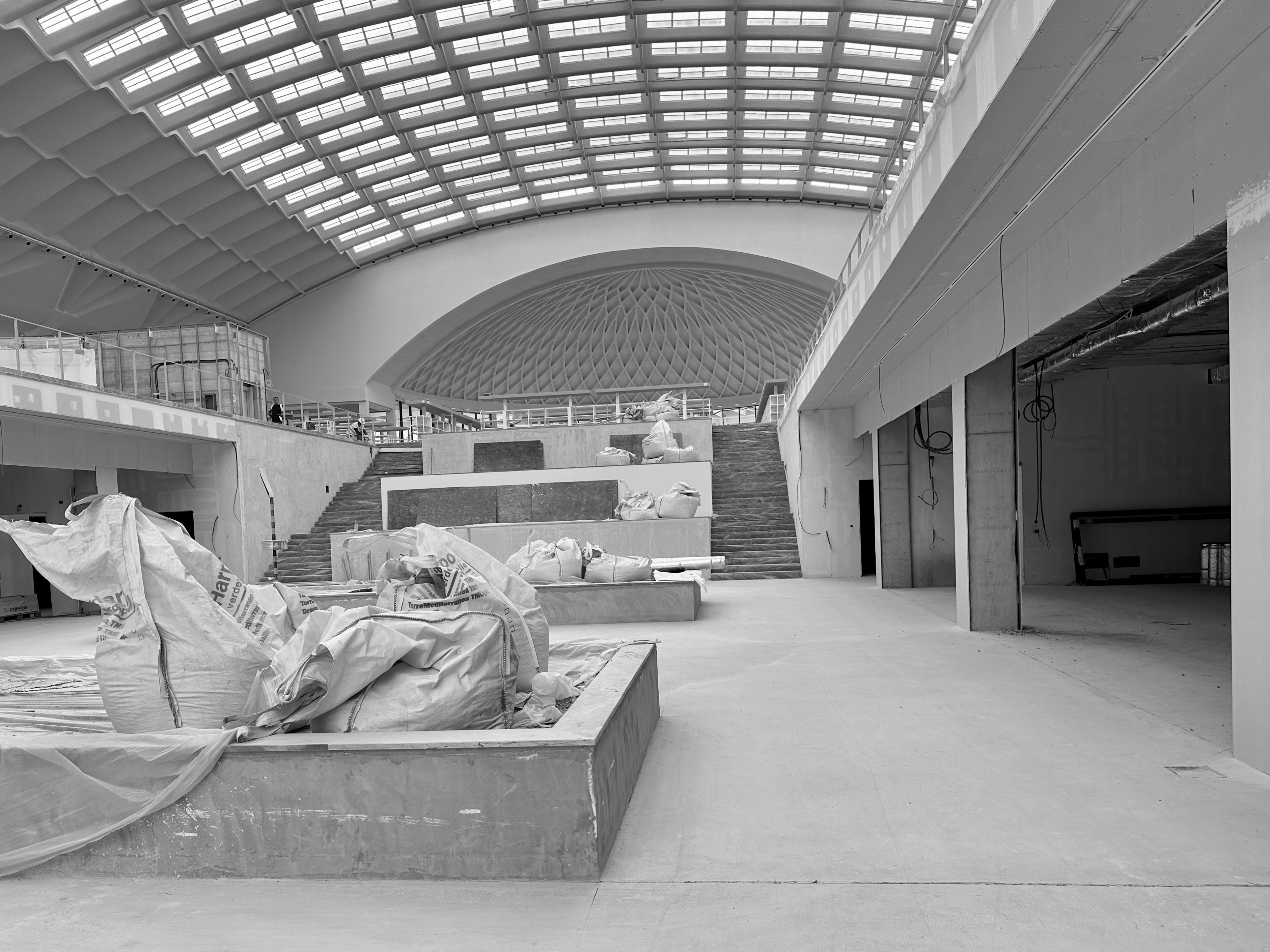
After a generous invitation to tour the nearly-completed project, I can report that the results exceed any Nervi fan’s wildest expectations. The structure and its ancillary spaces received a comprehensive analysis and restoration, thanks in part to a conservation plan funded by the Getty and a small army of dedicated Italian architects and engineers, and much of the work of redeveloping it as a library went to addressing issues–roofing and waterproofing, environmental control, and seismic upgrades–that could only be funded with a suitably massive civic project.

The main space looks spectacular; Moneo’s major intervention was to add mechanical and storage space in a new basement (most of the original was slab-on-grade to save construction time), and to open up a new, sunken reading room within the main space. While this changes the purity of the original space, it also offers new views of Nervi’s “wave ashlar” roof, a finely scaled, broad-spanning structure fabricated and hoisted into place piece by piece. Moneo’s office limited the height of new shelving on the main floor and in the ‘aisles’ to ensure none of the vast space feels too partitioned, and the entire structure has received a cleaning and a new palette of matte white paint that emphasizes the roof’s lightness and structural texture.

It’s a phenomenal achievement, and when it formally opens in December, it will be proof that the investment in transforming “obsolete” structures, especially early postwar ones, can pay off in civic monuments that dialogue with, rather than replace, the past. But this one also provided a template for how conservation science, creative architectural design, and sensitive engineering solutions can all work together to make that process both more robust and more cost-effective. Turin will have an inspiring library, and a structure that speaks clearly to a moment of recovery and rebirth in its own past.

Nervi’s other works–many of which are under serious threat from either neglect (the same city’s Palazzo Lavoro) or ill-considered additions (Florence’s Stadio Franchi and Rome’s Stadio Flaminio) have another model showing how conservation and re-imagining can co-exist. Salone B will add to the recent, successful renovation of Rome’s Palazzetto dello Sport. We can only hope for more good news–Turin has set a high but achievable bar for itself and for other cities that have such a success story waiting to happen in their midst.
Many thanks to Elisabetta Margiotta Nervi, Cristiana Chiorino, Irene Matteini, Erica Lenticchia, and Francesco Romeo.
